Disclosure: As an Amazon Associate, UMT Smart Tool earns from qualifying purchases. This guide is built from product listings and maker specifications, not from our own hands-on testing. Prices are approximate and can change, so check the current price before you buy. Last updated: November 10, 2026.
“Affordable” alarm clocks look interchangeable — a plastic box, red or white digits, a beep — but the differences that matter show up at 6 a.m., not on the product page. Some clocks set themselves and handle daylight saving time on their own. Some wake you with light or by shaking the bed instead of sound alone. Some make no noise at all until the alarm fires, and one pick here does not even need a wall outlet. This guide is organized by wake-up problem: sleeping through alarms, hating harsh beeps, sharing a room with a light sleeper, or losing power overnight. Every pick sits in the budget-friendly tier and none needs an app or a subscription.
In this guide
Quick Picks
The short version: six affordable alarm clocks, one per wake-up problem.
| Pick | Type | Best for |
|---|---|---|
| DreamSky Auto Set Alarm Clock (DS305) | Auto-set digital | Hands-off setup and automatic DST changes |
| Travelwey Home LED Alarm Clock | Simple LED digital | The simplest fuss-free bedside basics |
| JALL Wake Up Light Sunrise Alarm Clock (ACA-002) | Sunrise simulation | Gentle, light-first wake-ups |
| Sonic Alert Sonic Bomb (SBB500SS) | Extra-loud with bed shaker | Heavy sleepers and hearing loss |
| Peakeep Analog Alarm Clock (MHP-3129) | Silent analog | Light sleepers who hate ticking and glare |
| KWANWA LED Digital Alarm Clock (KW618) | Battery-only digital | Travel, RVs and power-cut insurance |
Our Picks
1. DreamSky Auto Set Alarm Clock (DS305) — Best Overall
The DS305 removes the two most irritating jobs in this price class: setting the time, and setting it again twice a year. The current US time is preset at the factory and protected by an installed button-cell battery, so you plug the clock in, choose one of seven US time zones (there is also a Newfoundland option), and it shows the correct time, the date and the room temperature. Turn Auto DST on and it springs forward and falls back by itself. Around that trick is a sensible everyday clock: a display dimmer for brightness, adjustable alarm volume with snooze, and a USB port on the back for charging a phone overnight.
The trade-offs are about scope, not quality. This is a clock only — no radio, no nature sounds, no sunrise lamp — and the auto-set feature makes it a US-market product, so it is the wrong buy for other regions. The button-cell backup preserves the time and your settings through a power cut rather than powering the lit display, which is normal for plug-in clocks at this price. Choose it for your own nightstand if you want to set an alarm once and forget the clock exists, or for a guest room where visitors should never have to decode a manual.
2. Travelwey Home LED Alarm Clock — Best Simple Budget Digital
Travelwey built its reputation on doing less, well. The digits are big red LEDs you can read from across the room, and instead of two or three fixed brightness steps there is a slider on the back that dims them across the full range, so the display can be bright at noon and barely-there at midnight. A proper night light is built into the oversized top button — press it in the dark and you get light without reaching for a lamp. The alarm itself runs for five minutes, offers a low or high volume, and snoozes in classic nine-minute repeats. There are very few buttons, and every one of them is labelled.
What you give up is everything beyond the basics: a single alarm, no date or temperature readout, no USB charging, and plain black plastic styling on a body about 6.5 inches wide. Battery backup takes two AAA batteries (not included) and holds the time and alarm settings during an outage instead of keeping the display lit. That restraint is exactly the point. This is the pick for kids’ rooms, for older relatives, and for anyone who has ever been defeated by a houseguest asking how to turn the alarm off — nobody needs instructions for this one.
3. JALL Wake Up Light Sunrise Alarm Clock (ACA-002) — Best Budget Sunrise
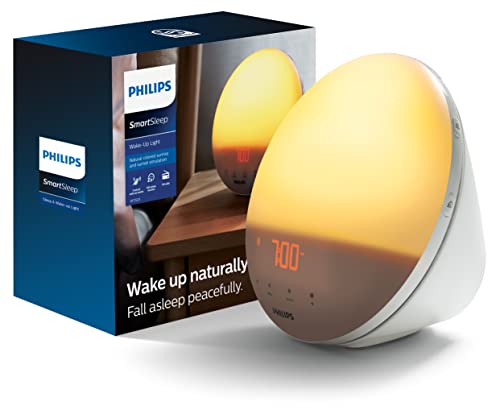
This is the cheapest credible way to try light-based waking. The lamp simulates a sunrise ahead of your alarm time, so light starts the waking process before any sound plays — the gentlest wake-up in this guide. You can run the light through seven colors, pair it with one of seven natural sounds or the FM radio, and set dual alarms, which covers couples on different schedules or a weekday/weekend split on one nightstand. A sleep-aid mode fades the light down at bedtime, the lamp doubles as a nightlight, and the time display dims so the clock face does not fight the darkness it is supposed to create.
Keep expectations in line with the tier. The body is lightweight plastic, the controls arranged around the rim take a few mornings to learn by touch, and the lamp’s maximum brightness is modest next to premium wake-up lights — very heavy sleepers should plan on the sound alarm doing the real work, with the light as a head start. There is no app and no subscription; everything is set on the device. Choose it if harsh beeping ruins your first hour, or if you want to test whether sunrise waking suits you before spending premium money.
4. Sonic Alert Sonic Bomb Dual Alarm Clock with Bed Shaker (SBB500SS) — Best for Heavy Sleepers
When ordinary alarms fail, this is the escalation. The Sonic Bomb combines an alarm adjustable up to 113 dB — with adjustable tone as well as volume, so you can pick a pitch that cuts through — with a wired bed shaker that slips under the mattress or pillow and physically shakes you awake, backed by flashing alert lights. You can run sound only, vibration only, or both together. It carries dual alarms, an adjustable snooze of 1 to 30 minutes, and an alarm duration you can set anywhere from 1 to 59 minutes, so it does not give up after a couple of minutes the way cheap clocks do. A five-level dimmer keeps the display under control at night.
It is the biggest and least subtle clock here, and the shaker’s cable limits where the clock can sit relative to the bed. Battery backup needs a 9V battery that is not included, and at full volume this will wake the whole household, not just you — it is a tool for solo rooms, deep sleepers, people with hearing loss, and shift workers who sleep through daytime noise. Within an affordable line-up it is the splurge, but it is also the only pick whose entire design brief is “failure is not an option.”
5. Peakeep Analog Alarm Clock (MHP-3129, Black) — Best Silent Non-Ticking
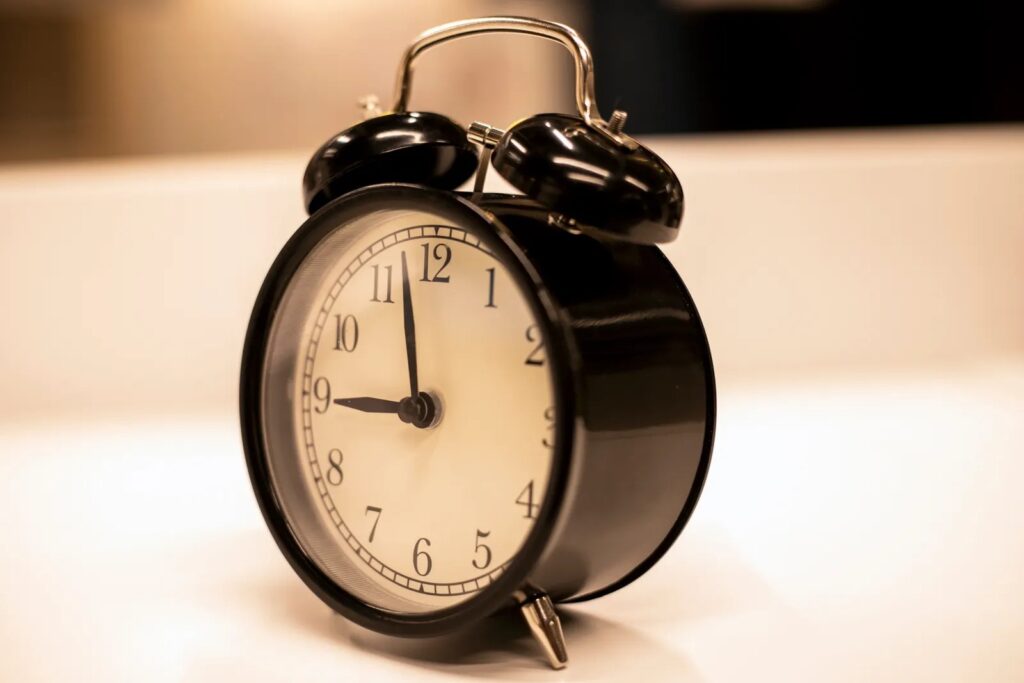
Some people are woken at 3 a.m. not by the alarm but by the clock itself. The MHP-3129 answers that with a silent sweep quartz movement — the second hand glides in a continuous motion instead of ticking — behind a simple 4.5-inch analog face with no glowing digits at all. The alarm, though, is electronic rather than a bell: you choose from seven built-in wake-up sounds, set the volume to suit, and use the snooze when you need it. A tap-on nightlight lets you check the time in the dark without lighting up the room, and the whole clock runs on three AA batteries, so placement is not dictated by the nearest outlet.
The compromises are the honest ones of analog life. The alarm is set with a dial, so precision is to the nearest few minutes rather than the exact minute a digital clock offers. There is no date display, no radio and no USB port, and the AA batteries are not included. In exchange you get the only pick here that adds zero light and zero noise to the bedroom while you sleep. Choose it if you are a light sleeper, if a partner is, or if you are deliberately pushing glowing screens out of the room — it is also a kind first alarm clock for kids, readable and unthreatening.
6. KWANWA LED Digital Alarm Clock (KW618) — Best Battery-Only
Every other pick in this guide plugs in. The KW618 does not even have a cord: it runs entirely on four AA alkaline batteries and keeps its 1.2-inch LED digits lit constantly, with the maker rating a set of batteries at more than a year of use. Brightness adjusts across three levels, an automatic night mode dims the display after dark, and you can switch between 12- and 24-hour formats. It wall-mounts or stands on a nightstand, and a snooze button covers the basics. Because nothing depends on an outlet, it works where the others cannot — RVs and cabins, a bathroom shelf, a kid’s room with no spare socket — and it stays lit and correct through a blackout that resets every plug-in clock in the house.
Battery-only design has its own costs. Brightness is deliberately conservative to protect battery life, there is no radio, USB charging or auto-set, and you set the time by hand and swap in fresh AAs roughly once a year. The alarm itself is a straightforward beeper rather than anything fancy. None of that matters for its job. Choose it as a travel clock with a display worth reading, as the backup that makes a power cut a non-event, or for any room where the outlet situation is the real problem.
Best Picks by Category
- Best overall: DreamSky Auto Set Alarm Clock (DS305) — sets itself, handles DST automatically, and adds a USB charging port.
- Simplest budget digital: Travelwey Home LED Alarm Clock — big dimmable digits, a real night light, and controls anyone can work out.
- Budget sunrise: JALL Wake Up Light (ACA-002) — sunrise simulation, seven sounds, FM radio and dual alarms at an entry-level tier.
- Heavy sleepers: Sonic Alert Sonic Bomb (SBB500SS) — up to 113 dB plus a bed shaker and flashing lights.
- Silent analog: Peakeep Analog Alarm Clock (MHP-3129) — a sweep movement with no ticking and no screen glare.
- Battery-only: KWANWA KW618 — a constantly lit LED display that runs over a year on AA batteries, no outlet needed.
Notice the pattern: at this price, “best” is not about the longest feature list. It is about which single wake-up problem the clock was designed to solve — and whether that problem is yours.
How to Choose
Decide how the clock will wake you: sound, light or vibration
Start with the wake-up method, not the display. Sound suits most people and costs the least. Light — a sunrise lamp like the JALL — wakes lighter sleepers more gently and helps dark winter mornings feel less abrupt. Vibration, from a bed shaker like the Sonic Bomb’s, is the fallback that works when sound fails, and the polite option when you must not wake a partner. Pick the method first and the shortlist writes itself.
Loudness, tone and snooze behaviour
Volume figures are rarely published for basic clocks, so treat adjustable volume as the feature to insist on — fixed-volume beepers are either too quiet or obnoxious. Tone matters too: a pitch you can change is a pitch you can tune to your hearing. Check the snooze as well. A standard nine-minute snooze suits most people; heavy sleepers should look for adjustable snooze length and a long alarm duration, so the clock keeps trying instead of timing out.
Display brightness — and whether it can go dark enough
The most common cheap-clock complaint is a display that lights up the room. A full-range dimmer (a slider, like Travelwey’s) beats two or three preset steps, and some displays can be turned off entirely overnight. Red digits are traditionally easier on night vision than blue or white. If any glow bothers you, skip LED altogether: the Peakeep analog pick shows how much calmer a bedroom feels with no lit screen in it.
Power source and what “battery backup” actually means
Read this part of any listing carefully, because the same words hide three different things. Most plug-in clocks use backup batteries only to remember the time and alarm settings during an outage — the display goes dark. Better backups keep the alarm itself working on battery. A battery-only clock like the KWANWA sidesteps the question entirely: an outage changes nothing. Decide which behaviour you need before a storm decides for you.
Setup effort: auto-set, DST and dual alarms
Cheap clocks used to mean squinting at a manual twice a year. Auto-set models like the DreamSky arrive showing the right time and adjust for daylight saving time on their own — worth real money if you hate fiddly buttons or are buying for someone else. Dual alarms matter for couples and for weekday/weekend schedules. Also check the basics: a 12/24-hour toggle if you prefer military time, and buttons large enough to operate half-asleep.
Analog vs digital at the affordable end
Digital wins on precision, extra readouts (date, temperature) and features per dollar. Analog wins on silence, on zero light pollution, and on being readable at a glance by kids learning to tell time. Neither is better in the abstract: the right question is whether your bedroom needs information or calm. Many households end up with one of each — a full-featured digital on the main nightstand and a silent analog where sleep is fragile.
Which affordable alarm clock should you buy?
Buy the DreamSky DS305 if you want a clock that sets itself and needs no attention, and choose another pick only if one specific wake-up problem describes you better. An affordable alarm clock works best when it solves one problem well.
- Set it once and forget it: the DreamSky Auto Set handles the time and daylight saving changes itself.
- The simplest bedside clock: the Travelwey has big digits, a wide dimming range and very few buttons.
- Harsh beeps ruin your mornings: the JALL sunrise clock starts with light before any sound.
- You sleep through ordinary alarms: the Sonic Bomb adds a loud alarm, a bed shaker and flashing lights.
- Light sleeper who hates glow and ticking: the Peakeep analog clock adds no light and no tick.
- No outlet or frequent power cuts: the KWANWA KW618 runs on batteries alone.
If two picks seem close, think about who else shares the room. A loud shaker suits a solo sleeper, while a silent analog clock suits a household with a light sleeper.
What to check before you buy, and who should skip it
Before you buy an alarm clock, check the power source, the batteries it needs and how the alarm behaves, because these details are easy to miss on a short listing.
- Confirm whether batteries are included and which type the clock uses.
- Read what the backup battery actually does during a power cut, since some only save settings.
- Check the dimming range and whether the display can be turned down enough for a dark room.
- Look for adjustable volume, snooze length and alarm duration if you are a heavy sleeper.
- Confirm the region, since auto-set time features are built for specific time zones.
Be honest about the trade-offs. Simple clocks skip extras like a radio, an app or smart features, so if you want voice control or sleep tracking, a basic model will disappoint you. The loudest model will wake a whole household, a sunrise lamp may not rouse the deepest sleepers by light alone, and an analog dial is less exact than a digital set. If your phone alarm already works for you and you are happy keeping it by the bed, you may not need a separate clock.
When you are ready, compare the picks above, check the current listing for size and what is included, then choose the one that fits how you will use it.
Frequently Asked Questions
What is the loudest affordable alarm clock?
The Sonic Alert Sonic Bomb (SBB500SS) in this guide: its alarm adjusts up to 113 dB with selectable tone, and it adds a bed shaker and flashing lights on top of the sound. For anyone who has slept through ordinary clocks, that combination — not volume alone — is what makes the difference.
Will a cheap sunrise clock really wake me up?
If you are a light or average sleeper, usually yes: the gradual brightening starts pulling you out of deep sleep before the sound alarm begins, and the JALL ACA-002 pairs the light with natural sounds or FM radio as a backstop. Very heavy sleepers should treat sunrise as a gentle first stage and choose the Sonic Bomb instead.
What happens to these clocks during a power cut?
It depends on the model. The DreamSky and Travelwey use backup power to preserve time and settings, so the clock recovers correctly when power returns. The KWANWA KW618 is battery-only and is not affected at all. Analog battery clocks like the Peakeep are likewise indifferent to outages — worth remembering if your area loses power often.
Are non-ticking analog clocks completely silent?
The timekeeping is: a sweep movement moves the second hand continuously, with no tick-tock. The Peakeep MHP-3129 goes a step further by making its alarm electronic — seven selectable sounds with volume control — so there is no bell either. The only noise it ever makes is the alarm you asked for.
Do any of these clocks need an app or a subscription?
None of them. All six picks are set entirely with on-device buttons and keep working without a phone, an account or a monthly fee. At the affordable end that simplicity is a feature: there is nothing to stop working when an app is discontinued.
How long should an affordable alarm clock last?
Simple clocks routinely run for years because there is little to fail — no apps, few moving parts, and LED displays that do not wear out quickly. The realistic wear points are buttons, battery contacts and, on plug-in models, the backup battery. Expect to replace backup and AA batteries periodically.
Is a loud alarm clock bad for your hearing?
A very loud alarm close to your ear is not ideal, so set the volume only as high as you need. If sound alone fails, pairing a moderate alarm with a bed shaker or light can be a gentler option.
Where should you place an alarm clock in the bedroom?
Place it within arm's reach but not so close that glare or sound is harsh. A spot across the nightstand works for most people. If you tend to switch it off half-asleep, putting it a little farther away helps.
Do alarm clocks with bed shakers work for deaf or hard-of-hearing users?
A bed shaker is designed for exactly that purpose, because the vibration wakes you without relying on sound. Check the listing for how the shaker connects and where it can sit relative to the bed.
Why does my digital alarm clock lose the time?
Plug-in clocks without a working backup battery reset after a power cut. Replace the backup battery if the clock keeps losing its settings, and check the manual for how the backup is meant to work.
Is red or blue better for an alarm clock display?
Red is usually easier on night vision than blue or white, so many people find it less disruptive in a dark room. A dimmer matters more than the color, so look for a wide adjustment range.
How do I stop hitting snooze every morning?
Placing the clock out of reach, using a gentler wake-up light and keeping a steady schedule all help. A snooze setting you can shorten, or a clock that keeps ringing, can also remove the temptation.
Bottom Line
For most people, the DreamSky Auto Set (DS305) is the affordable alarm clock to buy first: it sets itself, survives daylight-saving changes without help, and covers the everyday basics well. Buy the Travelwey if you want the simplest possible clock, the JALL ACA-002 if mornings need to feel gentler, and the Sonic Bomb if sleeping through alarms has real consequences. The Peakeep keeps a bedroom silent and dark, and the KWANWA KW618 removes the outlet from the equation entirely. Whichever you choose, confirm the exact model variant and the current price on the listing before you order — at this end of the market, small model differences change what you get.