Disclosure: As an Amazon Associate, UMT Smart Tool earns from qualifying purchases. This guide is built from product listings and maker specs, not our own direct testing, so confirm features on each product page. Listing details are approximate and change often; check the current listing before you buy. Sleep and health notes here are general information, not medical advice. Last updated: November 9, 2026.
The best alarm clock matches how you actually sleep. A light sleeper needs something very different from a heavy sleeper who sleeps through three phone alarms, and both differ from someone whose problem is a racing mind at bedtime. The six choices cover the main approaches: sunrise simulation, app-driven routines, a gentle two-phase alarm, a simple clock radio, a loud old-school bell, and a travel clock.
Quick Choices
| Product | Type | Best for |
|---|---|---|
| Philips SmartSleep Wake-Up Light | Sunrise wake-up light | Waking gradually with light |
| Hatch Restore | Smart sleep clock | Bedtime routines and sleep sounds |
| Loftie Clock | Two-phase alarm clock | A phone-free bedroom |
| Sony ICF-C1 | Digital clock radio | Simple, set-and-forget use |
| Peakeep Twin Bell Alarm Clock | Analog bell clock | Heavy sleepers |
| Braun BC08 | Digital travel clock | Travel and small spaces |
In this guide
Our Choices
Top pick
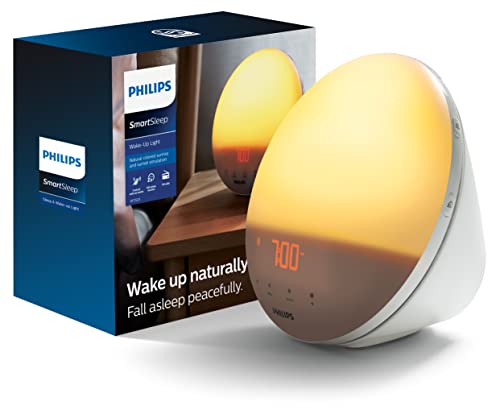
1. Philips SmartSleep Wake-Up Light – Best Sunrise Alarm
The Philips Wake-Up Light wakes you with light first and sound second. Its colored sunrise simulation moves from soft red through orange to bright yellow over an adjustable period, with 20 brightness settings and a maker-listed light intensity of up to 300 lux, so the room is already bright before any sound begins. At the set time you can wake to one of five natural sounds or FM radio, and a tap on top snoozes the sound. A dimming sunset simulation works in reverse in the evening, the light doubles as a reading lamp, and the display dims automatically as the room darkens. There is no app and no subscription: everything is set on the unit itself, which many buyers see as a strength. Trade-offs are a larger nightstand footprint, a premium listing detail tier, and gentle sounds rather than sheer volume, so very heavy sleepers may still want a louder backup. It suits light to average sleepers and dark winter mornings.
2. Hatch Restore – Best for Sleep Routines
The Hatch Restore is less a clock than a small sleep system. It combines a sunrise alarm that brightens before your wake time, a library of sleep sounds, dimmable clock digits that can be turned down or off, and guided Unwind routines pairing light and audio in the evening. Setup happens in the Hatch app over Wi-Fi, while large physical controls begin routines and adjust volume at the bedside, so the phone can stay out of the bedroom overnight. A core set of sounds, lights, and routines is included. The optional Hatch+ membership expands the library with more sounds, stories, and meditations, and typically begins with a trial, so read what continues for free afterward. Trade-offs: it is app-dependent, premium-tier, and current models are mains-powered without battery backup. It suits people whose problem is the whole sleep routine: trouble winding down, inconsistent bedtimes, or waking in a panic to a harsh phone tone.

3. Loftie Clock – Best for a Phone-Free Bedroom
Loftie’s signature feature is a two-phase alarm. A first, gentle wake-up sound plays briefly and fades on its own; a second get-up tone follows a few minutes later, with the gap adjustable in the settings. The idea is to pull you toward the surface slowly instead of demanding you sit up instantly. Around that alarm sits a sound machine with more than 100 built-in sleep sounds the maker says are included without a paywall, an adjustable nightlight, a bedtime reminder signal, a red display mode, and a blackout mode that turns the display fully dark while alarms stay active. It also works as a Bluetooth speaker, runs from USB-C power with a built-in battery for short outages, and can run in a no-Wi-Fi mode after setup. Trade-offs: no sunrise light, and setup needs the app and Wi-Fi first. It suits people who want a calmer, screen-free nightstand and a forgiving wake-up.

4. Sony ICF-C1 – Best Simple Clock Radio
The Sony ICF-C1 is the straightforward cube clock radio that has sat on nightstands for years. It offers a single alarm with a gradual wake feature that begins quietly and builds, a choice of waking to the FM/AM radio or a buzzer, a snooze button on top, and an amber LED display with adjustable brightness that stays easy to read without lighting up the room. A pre-installed backup battery keeps the clock and alarm settings on track if the power drops overnight, and versions in some regions add automatic time setting and daylight-saving adjustment, so check the listing for your market. Its limits are equally clear: no sunrise light, no app, no sound library, and only one alarm time. It is value-focused and takes up very little space. It suits anyone who wants a dependable, set-and-forget alarm, without menus, accounts, or updates.

5. Peakeep Twin Bell Alarm Clock – Best Loud Alarm for Heavy Sleepers
Peakeep’s twin bell clock is the analog answer to sleeping through everything. A small hammer strikes two metal bells, producing a sharp, ringing alarm that is hard to ignore and completely different in character from an electronic beep. Because it is battery-powered, it works anywhere, keeps going through power cuts, and never needs a cord or charger. The classic dial uses large numerals with luminous elements on the hands and face, so a glance gives you the time at night without a glowing screen. There is no radio, no app, and on most versions no real snooze: the alarm rings until you switch it off, which is precisely the point for snooze-button abusers. The bells are too much for light sleepers or partners on a different schedule, and you must set the alarm hand each night. It suits deep sleepers and students.
6. Braun BC08 – Best Travel Alarm Clock
Braun’s BC08 is a compact digital travel clock, roughly 5.8 cm square, in Braun’s minimalist design language. Its negative LCD display is crisp and can invert for preference, showing the time in 12- or 24-hour format. The crescendo beep alarm begins quietly and increases in frequency and volume the longer it runs, which is kinder than a full-volume blast in a hotel room. Tapping the top activates a short snooze of about five minutes and briefly lights the display for a time check in the dark. It runs on a single AAA battery, so there are no cables to pack, and radio-controlled versions set themselves from a time signal that depends on the region of sale. Trade-offs: small digits across a large bedroom, one alarm only, and a beep that is not the loudest here. It suits frequent travelers and small nightstands.
Best by Category
- Best for heavy sleepers: Peakeep Twin Bell – the hardest alarm here to sleep through, and it cannot be snoozed away.
- Best sunrise simulation: Philips SmartSleep Wake-Up Light – colored sunrise and sunset programs with the widest brightness range here.
- Best smart features: Hatch Restore – routines, sleep sounds, and app control, if you accept the optional membership.
- Best gentle wake-up: Loftie Clock – the two-phase alarm brings you up in stages, phone-free.
- Best simple and value-focused: Sony ICF-C1 – radio or buzzer, battery backup, nothing to learn.
- Best for travel: Braun BC08 – palm-sized, battery-powered, self-setting in radio-controlled versions.
How to Choose
Sunrise simulation vs sound alarms
Sunrise clocks wake you with gradually brightening light, sometimes adding sound at the end. They help most in dark bedrooms, in winter, or if sudden noise leaves you groggy. Sound alarms work anywhere, cost less, and suit people who sleep through light. Many do best with both: light to surface, sound to commit. Work out which problem you have – the shock of waking, or not waking at all.
Loudness and heavy sleepers
Makers describe loudness inconsistently, so treat volume claims cautiously. What matters is the character of the sound and what happens if you ignore it: mechanical bells and insistent, rising alarms cut through sleep better than a pleasant tone. Behavior matters too – a clock across the room beats a snooze button within arm’s reach. If you regularly sleep through alarms, raise it with a clinician.
Display brightness and red-night modes
A display you can read at noon may glare at 2 a.m. Look for multiple brightness levels or automatic dimming, and consider red or amber night modes, which are easier on dark-adjusted eyes. The darkest options are a blackout mode or an analog dial with luminous hands.
Battery backup and power cuts
Backup comes in different grades. Some clocks keep the time and alarm memory during an outage, so the alarm still sounds, while others go dark until power returns. Battery-powered clocks, like the analog and travel choices here, ignore outages entirely; app-connected models are often mains-only. Before an important morning, keep a phone alarm as a second line of defense either way.
Smart features, apps and subscriptions – read the fine print
Smart clocks can add real value: evolving sound libraries, guided routines, and easy schedule changes. The catch is ongoing cost and dependency. Check what works without paying, what the membership adds, whether a trial quietly converts to a paid plan, and whether core alarms still work if Wi-Fi goes down. A clock should never stop being a clock because a subscription lapsed.
Analog vs digital and travel use
Analog clocks are glow-free and dead simple, but setting an alarm hand is less precise and there is usually no snooze or radio. Digital clocks add multiple alarms, radio, and exact setting, at the cost of a display in the room. For travel, prioritize compact size, battery power, and a display you can darken; radio-controlled models may not sync abroad.
Power Sources and Placement
Where a clock sits and how it is powered shape how useful it will be. A nightstand near an outlet is easy, but a shelf across the room or a travel bag calls for different choices.
Plug-in clocks
Mains-powered clocks never need a battery swap and can run bright displays and speakers. The cord needs a reachable outlet, though, and a long cable may look untidy behind a bed.
Battery and USB clocks
Battery models are easy to place anywhere and suit travel, while USB-powered clocks can run from a phone charger or a power bank. Look at what the listing says about the type of batteries and how long the maker expects them to last, and keep spare cells where you can find them.
Placement tips
Put a sound alarm within arm’s reach only if you can resist the snooze button. Placing it across the room forces you to stand up, which many people find effective for getting out of bed.
Snooze, Scheduling and Alarm Behavior
Basic clocks have a single alarm and a snooze button, but the details differ more than you might expect. Reading how a clock handles repeat alarms tells you whether it matches your routine.
- Multiple alarms: useful if you and a partner wake at different times, or if you use a weekday and weekend schedule.
- Weekday-only mode: avoids having to turn the alarm off every Saturday.
- Snooze length: some clocks fix it at nine minutes, others let you change it.
- Gradual volume: raises the sound slowly instead of jumping to full strength.
- Alarm memory: shows whether settings survive a power cut.
If you share a room, check whether the clock can be set to ring only on your side, for example with a vibrating pad or a small clock with a quiet tone.
Sound Options: Tones, Radio and Bluetooth
The sound a clock makes matters as much as how loud it is. A harsh buzzer wakes some people fast but opens the day abruptly, while a soft chime may be too gentle for others.
| Sound type | Typical feel | Consider |
|---|---|---|
| Buzzer or beep | Sharp and direct | Can be unpleasant in small rooms |
| Bell | Classic and loud | Mechanical models can be noisy while ticking |
| Radio | Familiar voices and music | Needs a clear signal |
| Nature or melody tones | Gentle wake-up | May be too quiet alone |
| Bluetooth playback | Your own playlist | Depends on a paired device |
Look at whether tones can be chosen and whether volume is adjustable on the clock itself, rather than only through an app.
Clocks for Kids and Shared Bedrooms
Children and roommates have different needs from a solo adult. Children often benefit from a clock that shows when it is acceptable to get up, using colors or icons rather than numbers alone.
Some clocks use a light that changes color at a set time, which can help young children learn a routine. Check that the controls are simple and that settings are not easy to change by accident. Follow the manufacturer’s guidance about placement and power supplies near children.
In shared rooms, a dim display, a quiet tick or no tick, and a gentle alarm sound matter more than raw volume. If two people wake at different times, consider two small clocks so that one person’s schedule does not disturb the other.
One last practical point is the display. A clock that is easy to read from across the room, with a dimmer you can reach in the dark, saves fumbling at night. Check whether brightness is adjustable in several steps or only on and off, and whether the display can be switched off entirely for people who dislike any glow in the bedroom. Also read how the clock is set after a power cut, because some models need several button presses to restore the time while others keep it automatically.
More Alarm Clocks Worth a Look
Lumie Bodyclock Glow 150
Lumie makes wake-up lights that brighten gradually before the alarm time, and the Glow 150 is one of its simpler designs. It is aimed at people who prefer a light-based wake-up over a sudden sound. Check the listing for the sound options, brightness settings and what accessories come in the box before ordering.

Amazon Echo Spot
The Echo Spot combines a small round display with a smart speaker, so it can act as a bedside clock as well as a voice assistant. It suits households already using that ecosystem. Read the listing for microphone controls, display behavior and the features that need an internet connection, and decide whether you want a smart device in the bedroom.

Mirari OK To Wake Children’s Alarm Clock
This clock uses a colored light to signal when a child can get up, which gives young kids a visual cue without reading numbers. It is aimed at families building a morning routine. Check the listing for the power source, how the colors are set and what age range the maker recommends.
Travelwey Home LED Digital Alarm Clock
This is a plain, plug-in digital clock with a large LED display and adjustable brightness. It suits a bedside table where you want easy-to-read digits without extra features. Look at the listing for display dimming options, alarm settings and whether a backup battery is included for power cuts.
More Questions Buyers Ask
How do I stop hitting snooze every morning?
Move the clock out of reach so you have to get up to silence it. Some clocks also limit the number of snoozes or use a gradual alarm that does not feel as jarring. Consistent wake times matter too.
Can I use a clock radio without a good signal?
You can, but reception may be patchy, and a weak signal produces static at the worst moment. Pick a model with a backup buzzer, or use a clock with Bluetooth or tones so the alarm still sounds without a radio station.
Do I need an app for a smart alarm clock?
Many smart clocks need an app for setup and some features, though basic alarms often work on the clock itself. Read the listing to see what works offline and whether any features require a paid plan or account.
Is it safe to put a clock near my bed?
Ordinary bedside clocks are normal household items. Keep cords tidy, avoid covering vents or lamps with fabric, and follow the manufacturer’s instructions for placement and power supply.
Frequently Asked Questions
Will a sunrise alarm clock wake a heavy sleeper?
On its own, not always. Light wakes many people gently, but deep sleepers in bright rooms may sleep through it. Choose a sunrise model that adds sound at the end of the cycle, keep a louder backup for critical mornings, and treat persistent oversleeping as a sleep issue, not just a shopping problem.
Do I need a subscription for a Hatch or Loftie clock?
No. Both work as alarm clocks without paying. Hatch includes a core library and sells an optional membership for expanded content; Loftie markets its built-in sounds as included without a paywall. Check the current terms on the maker’s site either way, because what is included can change.
What happens to my alarm during a power cut?
It depends on the model. Battery-powered analog and travel clocks are unaffected. Mains-powered digital clocks with a backup battery usually keep time and sound the alarm; app-connected clocks without a backup may not. Check the manual to confirm which applies.
Is a red display really better at night?
Red light is easier on dark-adjusted eyes and less likely to make you feel fully awake during a brief glance at the time, which is why several makers offer red night modes. The bigger win is dimness: a display that can go very dim, or fully dark, helps more than color alone.
Should I stop using my phone as my alarm?
A separate clock removes the main reasons phones ruin sleep: late-night scrolling, notifications, and checking messages in bed. Keep the phone charging outside the bedroom if you can. For a one-off early flight, setting it as a backup alarm too is a sensible belt-and-braces move.
How long should an alarm clock last?
Simple digital and analog clocks commonly run for many years; what ages is batteries, buttons, and, on smart models, app and server support. Buying from a maker that publishes manuals and support pages gives a clock the best chance of a long life.
Bottom Line
Begin with your sleeper type. Heavy sleepers should go straight to the Peakeep twin bell. Anyone who dreads the morning jolt should try light first with the Philips Wake-Up Light, or Loftie’s staged alarm. Hatch Restore is the choice when bedtime itself needs fixing. And if you want a clock that works without accounts or updates, the Sony ICF-C1 at home and the Braun BC08 in your bag cover it. Choice the alarm you will still be happy to hear in six months – that is what gets you up.