Where to buy
Shopping for the best car organizer for car owners under $30? Check the latest price, availability and delivery on Amazon. Orders are placed on Amazon. We may earn a commission from qualifying purchases.
- Best overall: HOTOR Trunk Organizer, 2 Compartments (21.3 x 12.6 x 10.6 in) — Check on Amazon
- HOTOR Trunk Organizer, Large 2 Compartments (35.4 x 14.2 x 10.6 in) — Check on Amazon
- HOTOR Trunk Organizer with Cooler, 3 Compartments (30.9 x 12.6 x 10.6 in) — Check on Amazon
See more options in the full guide
- FORTEM Car Trunk Organizer, 45L with Cover — Check on Amazon
- Lusso Gear Backseat Organizer with 12 Pockets — Check on Amazon
- FORTEM Car Trunk Organizer, 50L with Cover — Check on Amazon
Read the full guide ↓
Disclosure: As an Amazon Associate, umtsmarttool.com earns from qualifying purchases. Links to Amazon on this page are affiliate links; they cost you nothing extra. Listing details such as price and availability change often, so check the current Amazon listing before you buy.
The search for the best car organizer for car owners under $30 is a household decision: not which box is cleverest, but which system every driver in the family can use without instruction, in every car, at midnight, in the rain. Owners therefore rank organizers by standardization, durability and the quality of being unremarkable — fixed places, known contents, a shape that survives being loaded by teenagers and borrowed by spouses. This guide’s picks were chosen to that ledger, from the standard size that can live identically in both cars to the covered structure that keeps the good car’s trunk presentable.
The tier honesty of this bundle applies as usual: the lowest band links the reference organizer and the gap organizer and reviews the larger systems in prose above it; the upper band links the field, including the rigid FORTEMs and the cooler and seatback specialists. What owners get at either band is a system view — zones, standardization, the audit habit — rather than a product list, because the household problem is never really the box. Owners completing the fleet’s systems will also use Best Trunk Organizer For Car Owners Under $15 and Best Car Vacuum For Car Owners Under $30.
One owner-specific principle frames the reviews: an organizer’s value is proven by other people. The system that only its buyer understands is a hobby; the system a visiting parent can load correctly without asking is infrastructure. The final recommendation names the household standard and the specialist for the car with the public-facing trunk.
In this guide
Quick Picks
Short on time, or comparing several options at once? Each row below names a buyer type and the product that suits it, with a link to the listing where one applies.
| Buyer type | Pick | Why it stands out | Link |
|---|---|---|---|
| Best overall | HOTOR Trunk Organizer, 2 Compartments (21.3 x 12.6 x 10.6 in) | 2 compartments, 6 mesh pockets, sturdy base panel, maker-rated over 60 lb, folds flat | Check on Amazon |
| Best for SUV seatback strip | HOTOR Trunk Organizer, Large 2 Compartments (35.4 x 14.2 x 10.6 in) | 2 compartments across 35.4 in, 5 pockets, sturdy base panel | Check on Amazon |
| Best with a cooler | HOTOR Trunk Organizer with Cooler, 3 Compartments (30.9 x 12.6 x 10.6 in) | 3 compartments including a leakproof cooler section, 30.9 x 12.6 x 10.6 in | Check on Amazon |
| Best structured step-up | FORTEM Car Trunk Organizer, 45L with Cover | 45L, 600D Oxford, rigid base plates, non-slip bottom, securing straps, removable cover | Check on Amazon |
| Best for rear passengers | Lusso Gear Backseat Organizer with 12 Pockets | 12 pockets including tablet and bottle holders, kick-mat seatback protection, reinforced top corners | Check on Amazon |
| Best large capacity | FORTEM Car Trunk Organizer, 50L with Cover | 50L, about 20 x 14.5 x 10 in, rigid base plates, non-slip bottom, straps, removable cover | Check on Amazon |
How These Picks Were Chosen
The budget was applied as a ceiling, and organizers reward the discipline, because this category’s pricing is unusually honest at the bottom and unusually inventive at the top. We read listings for the specs that decide an organizer’s life — dimensions, compartment geometry, base construction, whether it folds and how far — and we separated the picks into those genuinely purchasable at each tier and those whose street positions live above it. Above-tier picks are covered in prose, labeled as step-ups, and never linked as bargains. Check the current price on Amazon before you buy.
We did not load these organizers. We compared published dimensions against real trunk and seatback geometries, and we applied the category’s one brutal filter: an organizer that does not get kept is not an organizer. Fold-flat designs survive garage cleanouts; rigid designs survive loads; both virtues are real and they belong to different products, which is why this guide carries both rather than crowning one philosophy. Capacities in litres are maker figures and are treated as approximations of shape, not measurements of worth — a 45L box in the wrong geometry organizes less than a 30L box in the right one.
One structural note organizes the whole guide: a car has two geographies, the cargo’s and the passengers’, and they need different systems. Most picks here serve the trunk; the seatback and gap organizers serve the cabin, and they are complements, not competitors. The complete car runs one of each, and the how-to-choose section is written to help you sequence them rather than choose between them.
Finally, a word about what organization is for, because it decides sizing: the goal is not a tidy photograph but a findable car — every object with a place that a hand can reach in the dark, in the rain, at the fuel stop. Picks were ranked by that standard, which favors simple geometries, fixed places and lids where privacy matters, over cleverness that photographs well and files badly.
A last methodological note, because organizers attract a particular kind of review inflation: almost every listing photograph in this category shows the product empty, new and perfectly lit, in a trunk that contains nothing else. Real service looks different — half-loaded, dusty, one pocket given over to something unplanned — and the picks here were judged for that photograph instead: whether the base stays standing when one compartment is empty and the other full, whether the pockets remain usable when the box is not pristine, whether the fold still works with grit in the hinges of daily life. An organizer that only organizes in showroom condition is a prop, and this guide has tried, within the limits of published information, to exclude props.
The step up to a $30 ceiling completes the category’s map: at this band the long seatback-strip fixture, the cooler model, the seatback organizer and the rigid covered FORTEMs all become linked, purchasable picks, and the choice turns from ‘what can the tier afford’ into the genuine question of which geography and which structure your car needs. What the step up does not change is the sequencing logic — zones first, products second — nor the audit habit that keeps any of these systems the size of your actual life.
The 6 Best Car Organizers For car owners Under $30
HOTOR Trunk Organizer, 2 Compartments (21.3 x 12.6 x 10.6 in)
Who it suits: Most drivers, honestly: the standard car-kit inventory in a right-sized, foldable box that also works on the back seat and in the footwell.
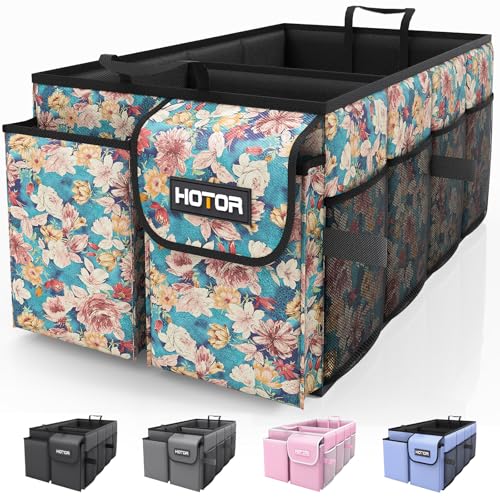
This is the organizer the category is measured by at the human scale: two compartments, about 21.3 x 12.6 x 10.6 inches, six mesh pockets around the outside, a sturdy base panel that keeps it standing open rather than slumping into a fabric puddle, and a rated carry capacity the maker puts at over 60 lb. The size is the insight — it is large enough to swallow the standard car-kit inventory (jumper cables or jump pack, inflator, first-aid kit, reusable bags, the umbrella that otherwise lives on the floor) and small enough to sit on a back seat, in a footwell, or across a sedan’s trunk without becoming the trunk’s landlord. It folds flat when empty, which is the feature that decides whether an organizer gets kept or quietly discarded in a garage cleanout.
Its street position is why it headlines both of this guide’s tiers: it is the rare organizer whose typical price genuinely lives at the lowest band (it is frequently documented at the tier on promotion) while remaining a complete, name-brand product at the upper one. The honest limitations are format ones: two compartments is a simple geometry that power users will outgrow, the mesh pockets fit small items rather than bottles upright, and it has no lid — what it holds, it shows. For the majority of cars, whose organization problem is a dozen loose objects rather than a logistics operation, those are the right limitations to have. Check the current price on Amazon before you buy.
Owners will appreciate that it standardizes: the same organizer in both household cars means every driver knows where the cables, bags and kit live, whichever car they take.
- Right-sized for real inventories — big enough for the kit, small enough for any car.
- Folds flat when empty, so it survives garage cleanouts and seat-down days.
- The one pick whose street position genuinely lives at this guide’s lowest tier.
Honest limitation: Two open compartments and no lid: it organizes visibly, and power users will outgrow its simple geometry.
Choose it if you want the category’s reference organizer at its most honest price. Skip it if you need concealed, rigid, furniture-grade storage — the FORTEM picks are that step-up.
HOTOR Trunk Organizer, Large 2 Compartments (35.4 x 14.2 x 10.6 in)
Who it suits: SUV and wagon owners whose trunk needs a fixed system along the seatbacks that leaves the open floor free for real loads.
The large HOTOR scales the same formula up: two compartments across a 35.4 x 14.2 x 10.6 inch footprint, five pockets, and a sturdy base panel, shaped to run along the back of an SUV’s rear seats or across a generous sedan trunk. The long, low profile is the design’s argument — it claims the strip of cargo floor against the seatbacks, the least useful geometry in most trunks, and leaves the open floor free for the big, awkward loads that organizers usually have to be removed to admit. If your trunk’s problem is that everything slides to the back and stays there, this is the pick that turns the back into the system.
Capacity honesty applies as everywhere in this guide: a long organizer invites overloading, and its two compartments will hold more weight than its handles enjoy carrying — treat it as a fixture that gets loaded in place rather than a tote that travels full. Its street position sits inside this guide’s upper tier and above the lowest, so in the under-$15 articles it is covered in prose as the closest full-size step-up, while the upper-tier articles link it as a core pick. Between this and its smaller sibling, the decision is purely spatial: measure the strip behind your rear seats, and let the tape decide. Check the current price on Amazon.
For the household SUV this is the fixture pick — the permanent back-of-seats system that ends the era of everything migrating to the tailgate — while the standard size serves the second car.
- Long, low profile claims the seatback strip — the trunk’s least useful space, made useful.
- Five pockets plus two full compartments in a load-in-place fixture.
- Same proven HOTOR formula at full width for larger cargo areas.
Honest limitation: Loaded in place by design: it will hold more than its handles enjoy carrying, and its position sits above the lowest tier.
Choose it if your cargo area is wide and its back strip is currently a sliding zone. Skip it if your car is a sedan with a compact trunk — the standard HOTOR is your geometry.
HOTOR Trunk Organizer with Cooler, 3 Compartments (30.9 x 12.6 x 10.6 in)
Who it suits: Drivers whose organizing problem includes cold drinks and groceries — trip-takers, sports parents, and anyone whose car doubles as a canteen.
The three-compartment HOTOR adds the feature long-distance drivers ask about first: a built-in cooler section, in a 30.9 x 12.6 x 10.6 inch body with three compartments. The cooler is leakproof-lined and sized for the realistic cold inventory — drinks, sandwiches, the grocery run’s frozen items on the way home — rather than for expedition provisioning, and its presence changes the organizer’s job description: this is the pick that serves the journey itself, not just the car’s storage. Beside the cooler, the standard compartments take the usual kit, so one box covers the trip’s two geographies, the things the car needs and the things the people do.
Two honest notes. A cooler section is insulation and lining, not refrigeration: pre-chilled contents and an ice pack are the system, and a hot trunk in August defeats any passive cooler by afternoon. And the three-compartment body is a trunk fixture’s size — sedan owners should measure before assuming. Its street position lives in this guide’s upper tier; at the lowest tier it is a prose step-up for drivers whose trips justify it. If your organizing problem and your snack problem are the same problem, this is the only pick in the guide that solves both in one purchase. Check the current price on Amazon.
For the family car, the cooler compartment is the grocery-run feature that earns its space weekly: frozen goods ride home in the organizer that already lives in the trunk.
- Built-in leakproof cooler section covers drinks and the grocery run’s cold items.
- Three compartments keep the car’s kit and the people’s provisions in one system.
- Trip-shaped: the organizer that serves the journey, not just the storage.
Honest limitation: A passive cooler is not a refrigerator — pre-chilled contents and an ice pack are the system, and a hot trunk wins by afternoon.
Choose it if your snacks and your storage are the same problem and you want one box for both. Skip it if you never carry cold anything — the standard HOTOR spends the same money on simplicity.
FORTEM Car Trunk Organizer, 45L with Cover
Who it suits: Drivers who need their trunk to look like furniture: rigid, covered, private — for tools, valuables or a professional standard.
FORTEM’s organizer is the structured end of the category: a collapsible multi-compartment body (the line’s documented capacity is 45L for this model) in 600D Oxford fabric, reinforced with rigid base plates so the box holds its geometry under load, with a non-slip bottom, securing straps, interlocking buckles that let two units connect, and a soft removable cover that hides the contents. Where fabric organizers slump, this one stands; where open organizers display, this one conceals. It is the pick for drivers whose trunk carries valuables, tools or a professional appearance standard — the cover alone justifies it for anyone who has watched a client or a carpool parent survey an open box of their life.
The structure costs what structure costs: this is the heaviest style of organizer in the guide, its street position sits at the upper end of the upper tier, and at the lowest tier it is firmly prose-only — a step-up documented here so the ladder is visible, not a bargain being pretended. Collapse is partial rather than flat: it folds down to a single compartment’s footprint for storage, not to a sheet. Judge it as furniture rather than fabric and its proposition clarifies — it is the organizer for a trunk that is a place, bought once, at the position its construction honestly occupies. Check the current price on Amazon before you buy.
Owners who keep a car presentable for work — clients, colleagues, occasions — will find the covered, rigid FORTEM the professional standard: the trunk opens, and what it shows is a box, not a biography.
- Rigid base plates hold its geometry under load where fabric organizers slump.
- Removable cover keeps contents private and dust-free.
- Interlocking buckles connect a second unit as the system grows.
Honest limitation: The heaviest style here, collapses only to one compartment rather than flat, and priced at the top of the upper tier — prose-only at the lowest tier.
Choose it if your trunk carries things that should be concealed and a structure that should stand. Skip it if you want the lightest, flattest-folding system — the standard HOTOR is that pick.
Lusso Gear Backseat Organizer with 12 Pockets
Who it suits: Families: it organizes the rear passengers’ ecosystem — tablets, bottles, snacks, wipes — and protects the seatback while doing it.
Lusso Gear’s backseat organizer attacks the other geography entirely: it hangs on the front seat’s headrest, protects the seatback as a kick mat, and presents twelve storage pockets — including a tablet holder and bottle holders — to the rear passengers. It is, in other words, the organizer for the people in the car rather than the cargo behind them, and for families it solves the problem the trunk organizers cannot: the rear seat’s own ecosystem of tablets, bottles, snacks, wipes, books and small toys, which otherwise lives on the seat, under the seat, and in the seat-back pocket that was designed for a map in 1997.
The honest limits are its audience: it organizes passengers, not cargo, and a car without rear passengers has no use for its talents. Its reinforced top corners — the brand’s noted design point — address the sag that defeats cheaper seatback organizers once the tablet and bottles load up. Its street position sits inside this guide’s upper tier and above the lowest, where it is covered in prose. For the family car it is not an alternative to a trunk organizer but the second half of the system: trunk for the car’s things, seatback for the people’s. Check the current price on Amazon before you buy.
Owners of the family car will recognize this as the peace treaty: every passenger’s things in their own pockets, the seatback protected, and the front-seat adults out of the distribution business.
- Twelve pockets at passenger height, including a tablet holder and bottle holders.
- Doubles as a kick mat, protecting the seatback it hangs on.
- Reinforced top corners resist the sag that defeats cheaper seatback organizers.
Honest limitation: It organizes people, not cargo — a car without rear passengers has no use for it, and it complements rather than replaces a trunk organizer.
Choose it if your rear seat carries passengers with ecosystems of their own. Skip it if your passengers are cargo — the trunk picks above are your system.
FORTEM Car Trunk Organizer, 50L with Cover
Who it suits: High-inventory households — camping, coaching, multi-child logistics — whose organizer problem is genuinely one of capacity with structure.
The 50L FORTEM is the line’s larger expression: documented dimensions of about 50.8 x 36.8 x 25.4 cm (roughly 20 x 14.5 x 10 inches), the same rigid-base-plate construction, non-slip bottom, securing straps and removable soft cover, in a three-compartment-capable layout that collapses to one compartment when the load shrinks. It is included as its own pick rather than a footnote because capacity is a real fork in this category: the household that camps, coaches, or carries sports kit for three children does not have the same organizer problem as the commuter, and pretending one size serves both is how trunks end up with two half-right boxes.
The verification note for this model is printed in the sources file and repeated here in brief: its ASIN was confirmed through the maker’s Canadian storefront listing of the same 50L model, a weaker pin than this guide prefers, so check the listing carefully to confirm you are looking at the 50L covered model before ordering. Its street position is at the top of this guide’s upper tier. Between the two FORTEMs, choose by measured need: the 45L for the standard family trunk, the 50L when the inventory list genuinely runs long — and let the inventory, not the photograph, make the call. Check the current price on Amazon.
For the household’s everything-vehicle, the 50L is the fleet pick: one covered, rigid system that swallows the combined inventory of family life without a second box.
- The guide’s largest structured capacity in a covered, rigid format.
- Collapses to a single compartment as the load shrinks.
- Same FORTEM construction system as the 45L: base plates, straps, cover.
Honest limitation: Its ASIN was confirmed via the maker’s Canadian storefront for the same 50L model — a weaker pin, flagged in the sources — and it is priced at the top of the upper tier.
Choose it if your inventory list genuinely runs long and you want it covered and rigid. Skip it if your inventory is the standard kit — the 45L or the standard HOTOR serves it with money left over.
Comparison Table
| Product | Type | Size / capacity | Key feature | Link |
|---|---|---|---|---|
| HOTOR Trunk Organizer, 2 Compartments (21.3 x 12.6 x 10.6 in) | Fabric, 2 compartments | 21.3 x 12.6 x 10.6 in | Folds flat | Check on Amazon |
| HOTOR Trunk Organizer, Large 2 Compartments (35.4 x 14.2 x 10.6 in) | Fabric, 2 compartments | 35.4 x 14.2 x 10.6 in | Load-in-place fixture | Check on Amazon |
| HOTOR Trunk Organizer with Cooler, 3 Compartments (30.9 x 12.6 x 10.6 in) | Fabric, 3 compartments | 30.9 x 12.6 x 10.6 in | Cooler section included | Check on Amazon |
| FORTEM Car Trunk Organizer, 45L with Cover | Structured, multi-compartment | 45L (maker) | Removable cover | Check on Amazon |
| Lusso Gear Backseat Organizer with 12 Pockets | Seatback organizer | 12 pockets | Kick-mat protection | Check on Amazon |
| FORTEM Car Trunk Organizer, 50L with Cover | Structured, multi-compartment | 50L (maker) | Removable cover | Check on Amazon |
How to Choose a Car Organizer Under $30
- Map your zones before your products. Emergency (fixed), day cargo (flexible), passengers (reachable). Assign each zone a place in the car, then choose the organizer whose geometry fits the place — never the reverse.
- Measure the actual space. The seatback strip’s length, the trunk corner’s footprint, the rear seat’s width, the console gap’s width in inches. Published dimensions are in every review here; your tape measure is the other half of the fit.
- Choose structure by load, not by taste. Soft fabric for light, visible, frequently changed contents; rigid base plates and covers for heavy, valuable or private loads. Structure is a response to weight and privacy, not a trim level.
- Insist on an exit. The organizer must fold, collapse or lift out in seconds, because the car will need its space back on a schedule you do not control. Permanence is the enemy of every cargo system.
- Count pockets by objects, not by number. List the actual items — cables, pack, inflator, bags, bottles, wipes — and match compartments and pockets to the list. A pocket count is marketing; your inventory is a spec.
- Test the system with a stranger. Ask someone who did not design it to find the jump pack, the bags and the wipes. Where they hesitate is where the system is unclear — relabel, relocate or simplify until the car explains itself.
- Leave one compartment of slack. A system loaded to one hundred percent has no room for the day’s surprise, and the surprise is what gets thrown on the seat. Eighty percent organized beats one hundred percent improvised, every week of the year.
- Sequence the cabin after the trunk — or before it. If the crisis is cargo, trunk first. If the crisis is passengers, seatback first. The gap organizer is the universal second purchase: small, cheap, and immediately missed in every car that lacks it.
Standardizing Across the Household Fleet
The fleet argument for identical organizers is the same as for identical chargers: knowledge transfers. When both cars carry the standard organizer in the same corner with the same zone layout, every driver in the household knows where the jump pack, the inflator and the bags live in whichever car they take — and the midnight phone call asking where things are simply stops occurring. Standardization also disciplines purchasing: one model, known dimensions, spares and replacements that fit the system rather than restarting it.
Keep one fleet exception: the cars’ jobs differ, and the system should bend where the job demands it — the family hauler earns the seatback organizer and perhaps the cooler model, the work car earns the covered FORTEM, the commuter may honestly need only the standard box and the gap filler. Standardize the core, specialize the edges, and document the result the beginner’s way: a photograph in each car of its own loaded system, because households run on whoever is standing at the open trunk, not on whoever designed the system.
The Presentable Trunk: Organizers and the Car’s Public Life
Owners underestimate how often a trunk is a public space: the client who helps with a bag, the carpool parent, the valet, the buyer at resale time reading the car’s whole biography in one glance under the lid. An open fabric box of visible miscellany tells one story; a covered, rigid organizer tells another, and the difference is not vanity — it is the same asset logic as the footwell mats in this bundle’s other guides. The FORTEM picks exist for owners who have felt that glance and decided the trunk should answer it with a box, not a biography.
Resale sharpens the point: a car presented with its cargo area systematized — organizer in place, contents coherent, emergency kit visibly maintained — supports the maintained-car narrative that buyers pay for, in a way no amount of last-week detailing fully can. Owners do not need to be theatrical about it; they need the system to be real, kept, and ordinary. That is the standard this guide’s owner picks were chosen to meet, and it is achievable at either of this guide’s tiers with the sequencing the final recommendation lays out.
Systems, Not Boxes: How a Car’s Geography Gets Organized
Every car that stays organized has the same invisible architecture: zones. The emergency zone (jump pack, inflator, first aid) lives in one fixed place and is never borrowed from. The day zone (bags, umbrella, the week’s small cargo) lives in the flexible space. The passenger zone (bottles, tablets, wipes) lives at passenger height. Organizers fail when they are asked to be all three zones in one box, because the zones have opposite needs — the emergency zone must be fixed, the day zone must be flexible, the passenger zone must be reachable — and a single product optimizing for one betrays the other two. The picks in this guide map to zones deliberately, and the complete system is usually two of them, not one.
The second architectural principle is the empty-hand rule: an organizing system works if putting something away takes one hand and no thought. The moment stowing requires rearranging, the system begins its decay into a pile with a box under it. That is why this guide favors open compartments for the day zone and fixed, lidded structure only where privacy or load-bearing demands it — and why the weekly reset (two minutes, everything back to its zone) matters more than any product: systems are maintained or they are archaeology.
The third principle is that the car is not a closet. Everything carried daily should justify itself monthly: the organizer audit — empty it, question each object, return only what the month actually used — keeps the system’s weight and clutter at the level of the life being lived now, not the life of two winters ago. The best organizer in this guide cannot organize objects that should not be in the car; it can only give the objects that belong there a place to be found. Buy for the zones, maintain by the reset, audit by the season, and the products below become almost incidental — which is the highest state car organization ever reaches.
It is worth closing the section with the smallest unit of organization in the car, because it teaches the whole philosophy in miniature: the object in your hand when you park. Every trip in the car ends with a handful — phone, keys, receipt, bottle, the thing a passenger hands you — and a system either has a designated landing for that handful or it has a future mess distributed across the seats. The gap pocket, the door bin, the organizer’s top compartment: the specific answer matters less than the existence of one. Design the landing first, and the rest of the system is just that decision repeated at larger scales, which is why this guide returns to it in every lens — beginners, owners, commuters and travelers all fail and succeed at exactly the same handful.
Comparing across this guide’s budgets and trip styles helps too: readers weighing a neighboring tier start with Best Car Organizer For Beginners Under $15, while those planning for a different kind of use read Best Car Organizer For Road Trips Under $15 before deciding.
Common Buying Mistakes
- Buying capacity before geometry. A big organizer in the wrong shape organizes less than a small one in the right shape. Measure the space — seatback strip, trunk corner, footwell — and buy the shape first.
- One box for every zone. Emergency kit, daily clutter and passenger supplies have opposite needs. A single organizer asked to serve all three serves the photograph and betrays the car.
- An organizer that cannot fold or move. Cars need their cargo areas back — for furniture, for luggage, for life. A system that cannot collapse, lift out or fold flat will be evicted, and an evicted organizer organizes the garage.
- Loading a fabric tote past its handles. Compartments will hold more than handles enjoy carrying. Fixtures get loaded in place; totes get loaded honestly. Confusing the two ends in a dropped box in a parking lot.
- No lid where privacy matters. Tools, valuables and professional kit in an open organizer are displayed at every parking lot and every client visit. Covered structure is a security feature, not a luxury.
- Ignoring the gap. The seat-console slot swallows the small things you reach for most. Organizing the trunk while the phone lives under the seat is a system with a hole in its center.
- Organizing around objects that should not be in the car. The third umbrella, the previous car’s manual, the cable for a phone two generations gone — no organizer fixes an inventory problem. Audit first; the box you need afterwards is usually smaller.
- Buying for the photograph instead of the reset. If restoring the system takes more than two minutes, it will not be restored, and the organizer becomes the mess’s container rather than its cure. Judge every system by its worst evening, not its first morning.
- Never auditing the contents. Organizers accumulate archaeology: the previous season’s gear, the previous car’s accessories. A seasonal empty-and-question keeps the system the size of your life.
Final Recommendation
Make the standard HOTOR the household core — one in each car, same corner, same zones — and add the Lusso gap organizers across the fleet as the universal second purchase. Specialize where the jobs demand: the covered FORTEM for the car whose trunk has a public life, the seatback for the family hauler. That structure, standardized and photographed, is the best car organizer system for owners at this budget, and it is mostly a decision rather than a purchase.
Audit the contents seasonally, reset weekly, and check the current prices on Amazon before ordering. The household that can describe every car’s trunk over the phone has finished this category; everyone else is one standard box away.
Frequently Asked Questions
How big an organizer does a normal car need?
Smaller than marketing suggests. The standard two-compartment size in this guide swallows the typical kit — cables or jump pack, inflator, first aid, bags, umbrella — for most cars. Size up only when a measured inventory (sports kit, camping gear, work tools) genuinely overflows it.
Trunk organizer or backseat organizer — which first?
Whichever geography holds your crisis. Cargo chaos: trunk first. Passenger chaos — kids, bottles, tablets: seatback first. Most family cars end with both, sequenced by pain, plus the gap organizer for the front seats’ small things.
Will an organizer slide around the trunk?
Fabric organizers on carpeted trunks mostly stay; the structured picks here add non-slip bottoms and securing straps for a reason. If yours migrates, the straps or a position against the seatbacks solves it — a sliding organizer is a placement problem, not a product failure.
Can I wash a fabric organizer?
Most fabric organizers spot-clean or hand-wash and air-dry; structured ones with base plates should be wiped rather than soaked. The better habit is the seasonal audit: empty, shake, wipe, question the contents, refit.
Should both household cars use the same organizer?
The core system, yes — identical organizers in the same position with the same layout make every car legible to every driver. Specialize only at the edges: the family car may add the seatback, the work car the covered rigid model.
Which organizer keeps a trunk looking professional?
The covered FORTEM models: rigid base plates hold the geometry and the removable cover keeps contents private. They are the step-up picks in the lowest-tier articles and core picks at the upper tier, priced as the furniture they are.
How do I get the whole family to maintain the system?
Make it legible and make it easy: fixed zones, a photograph of the loaded organizer in the car, and the two-minute reset as a shared norm rather than one person’s chore. Systems maintained by everyone are simple enough for anyone — design for the least invested user.
Should I buy a car mattress or just use a camping pad?
An owner’s version of that question is answered in this site’s camping guides; the organizer’s contribution is that the cargo area it describes starts cleared, zoned and findable — the precondition for any bed.
Do organizers work in cars with small trunks?
Yes — small trunks benefit most, because their space cannot absorb chaos. The standard two-compartment and gap organizers in this guide were sized for ordinary cars; in a compact trunk, use the organizer vertically against the seatback and keep the floor’s center free for the week’s large item.
What should never be stored in a car organizer?
Anything heat-sensitive, anything irreplaceable, and anything you would need in a hurry that is not in the emergency zone. Medications, aerosols under pressure, and documents that exist in one copy all belong in the house or the cabin — an organizer is for the car’s working inventory, not for the household’s treasures.
How do I stop passengers from undoing the system?
Give passengers their own geography — the seatback pockets, a door bin, a designated landing — so the system has a place for their things too. Systems fail when they only organize the driver’s world; the car carries everyone’s, and the zones should say so.
When is it time to replace or upgrade an organizer?
When its structure stops holding the system: a base that slumps, straps that slip, a fold that no longer folds, or — the legitimate reason — an inventory that has genuinely changed shape, like a new child’s sports era or a job that turned the car into a workshop. Replace for structure or for life-change; resist replacing for novelty, because the system you have is already learned by everyone who uses the car, and that shared knowledge is worth more than any single feature a new box advertises.
Two companion guides round out the setup: Best Trunk Organizer For Car Owners Under $15 and Best Car Vacuum For Car Owners Under $30 cover the neighboring purchases most readers make alongside this one.