A card scraper is a thin flat piece of steel that shaves wood fibers instead of sanding them. A rolled burr on the edge does the cutting, so the steel quality and thickness matter, and so does whether you can sharpen the edge yourself. The shape decides what it reaches: flat cards for panels, curved ones for moldings.
The six picks below run from plain rectangle cards to a boxed multi-shape set with a burnisher and a single Bahco blade. Sizes, steel and hardness come from each listing page and are the makers’ own claims. We have not used these scrapers ourselves. Where a listing is thin or disagrees with itself, we say so.
As an Amazon Associate we earn from qualifying purchases. Links below are affiliate links, and they do not change the product information we give.
What to Look For
| Feature | Why it matters |
|---|---|
| Thickness | Thin cards flex more, thick ones stay stiff for flat work |
| Shape | Rectangle, curved and gooseneck cards reach different surfaces |
| Steel | Spring or high carbon steel holds a burr |
| Burnisher | You need one to roll a new edge on a plain card |
In this guide
Specs at a Glance
| Scraper | Contents | Thickness | Notes |
|---|---|---|---|
| DFM curved set | 3 cards | 0.032 in | Blue spring steel; 50 C Rockwell; made in USA |
| DFM rectangle | 2 cards, 5 x 2.5 in | 0.032 in | Edges filed smooth; made in USA |
| HERMIT TOOLS | 6 scrapers and burnisher | 0.031 in | Wooden handled burnisher rod |
| Bahco 6 in | 1 blade | 0.8 mm (model code) | Chrome-nickel steel; edge protector |
| Clifton pair | 2 cards, 3 x 6 in | 0.015 in | UK high carbon steel; very thin |
| Therwen | Scrapers and burnisher | Not listed | 11.02 in burnisher with wood handle |
The 6 Best Card Scrapers
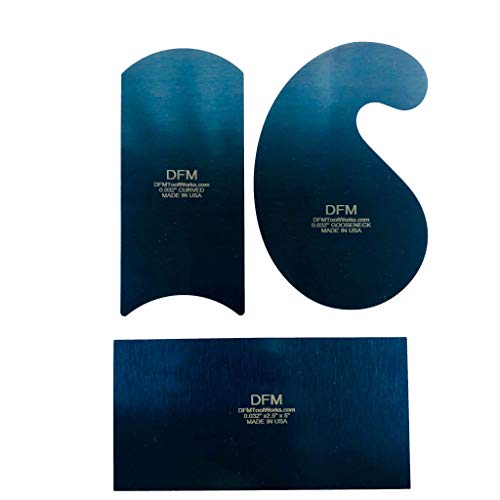
Top pickBest for shaping curved parts
1. DFM Tool Works Blue Curved Cabinet Scraper Cards, Set of 3
Three cards cut from 0.032 inch American blue spring steel, with a stated Rockwell hardness of 50 C. The maker says the cards arrive ready to sharpen and are meant to be used with a burnisher, which is sold separately. The page lists package size only, so the size of each card is not given.
Suits: shaping curved parts. Strengths: three cards and a stated steel and hardness. Weaknesses: individual card sizes are missing. Skip it if you want a burnisher in the box.


Best for flat panels and glue lines
2. DFM Tool Works Rectangle Card Scraper, 2 Pack
Two rectangle cards, each 5 inches by 2.5 inches and 0.032 inch thick, in blue spring steel with a stated 50 C Rockwell hardness. The maker says each long edge is filed smooth to make sharpening and burnishing easier. It is a plain, flat pair for panels and tabletops.
Suits: flat panels and glue lines. Strengths: clear size, thickness and steel. Weaknesses: flat shape only. Skip it if you work on molded edges.


Best for a first full kit
3. HERMIT TOOLS Scraper Burnisher with 6 Piece Scraper Set
A boxed set with a gooseneck, an oval, a rectangle, a curved scraper and two double convex and concave cards, plus a burnisher rod with a wooden handle. The burnisher is 3/8 inch by 4.75 inches, with a stated hardness of HRC 62 to 64. The cards are blue spring steel about 0.031 inch thick. One bullet names only four shapes, so check the contents against the title.
Suits: a first full kit. Strengths: many shapes and a burnisher included. Weaknesses: the shape count differs between the title and a bullet. Skip it if you only need one flat card.


Best for flat refinishing
4. Bahco 6 in Cabinet Scraper
A single 6 inch by 2.5 inch blade in hardened and tempered chrome-nickel steel, with a white plastic edge protector for storage. The maker says it removes varnish and glue without making fine dust. The product details table shows odd package measurements, so rely on the bullet size.
Suits: flat refinishing. Strengths: a named maker and an edge protector. Weaknesses: one blade and confusing table sizes. Skip it if you want several shapes.

View Bahco BAH4741500.8 6″ Cabinet Scraper, Chrome-Nickel Steel, Precision Edge on Amazon

Best for light smoothing and gentle curves
5. Clifton 3 x 6 in Super Thin Cabinet Scrapers, Pair
Two cards in UK high carbon tool steel, 3 inches by 6 inches and a very thin 0.015 inch, or 0.38 mm. The thin steel flexes easily, which suits fine finishing and slight curves. The listing has little text beyond the title and a basic details table.
Suits: light smoothing and gentle curves. Strengths: a thin, flexible pair. Weaknesses: sparse listing. Skip it if you want a stiff card for flat work.


Best for a kit with a handled burnisher
6. Therwen Card Scraper Burnishing Tool
A burnishing tool with a wooden handle, about 11.02 inches long overall, with a 6.3 inch metal rod 0.37 inch across. The text speaks of 6 carbon steel scrapers and 3 rectangular cards of different thicknesses, but the page does not clearly say what ships, so check the listing before you order.
Suits: a kit with a handled burnisher. Strengths: handle and rod sizes are given. Weaknesses: the contents are unclear. Skip it if you need exact card sizes.

View Therwen Card Scraper Burnishing Tool Cabinet Scraper Woodworking, Blue on Amazon
Care and Setup
- File the edge square, then roll a burr with a burnisher.
- Flex the card slightly and push or pull at a small angle.
- Take light passes and watch the grain.
- Keep the edges covered when stored.
Mistakes to Avoid
- Expecting a plain card to cut well without a burnished edge.
- Ordering thin cards for flat panels, or thick ones for curves.
- Assuming the listed hardness is the same across makers.
- Pressing hard instead of light, even passes.
How a Card Scraper Cuts
A card scraper looks like a plain piece of steel, but the cutting happens at a microscopic burr. When you draw a burnisher along the edge of a card, you roll a tiny hook of metal. That hook shaves wood in fine curls, leaving a surface that is smooth and often glossier than sanding can produce, without clogging the grain with dust. A scraper that produces only dust rather than shavings has lost its burr and needs to be refreshed.
Technique is simple, but it matters. You hold the card with both hands, thumbs behind the center, and flex it slightly so the middle bows. You tilt it forward until the burr catches, then push or pull along the grain with steady pressure. The angle is small, and finding it is a matter of feel. Too upright and the card chatters, too flat and it slides without cutting.
Scrapers excel on difficult grain such as figured or reversing grain, where planes tear out the surface. They remove glue squeeze-out, old finish and small imperfections, and they level joints between boards. They do not remove large amounts of wood quickly, and they are not a replacement for a plane when stock removal is needed. Think of a scraper as a finishing and cleaning tool that sits between planing and fine abrasives, and learn to read the shavings, since they tell you whether the burr is working.
Choosing Between Flat, Curved and Shaped Cards
The shape of the card decides where it works. A flat rectangle is the all-round choice for tabletops, panels, doors and glue lines. It is easy to hold and sharpen, and the long edges give you plenty of working edge. Most beginners start with a rectangle.
Curved cards have a convex and concave profile, and they follow shapes such as moldings, bowls and cabriole legs. Gooseneck scrapers have a sharply curved edge to clean up inside curves, coves and hollows. Specialty shapes such as oval or tear drop reach into tight spots. When a set includes several shapes, check the listing and images against the title, because counts may not match across the text.
Consider how you will use the cards. If you mostly flatten and finish panels, a pair of rectangles will serve. If you work with turned or carved parts, curved cards earn their place. A mixed set gives you flexibility but only pays off if you will use the shapes.
Think also about size. A large card covers more area and is easier to hold with two hands, while a small card gets into tight spots and is easier to flex. Some people prefer a card that fits comfortably in the hands without cramping, so compare dimensions against the size of your hands and the work. Sizes in listings sometimes appear only in the title or are missing, so check the product images or description.
Thickness, Steel and Flex
Thickness controls how much the card bends, and that affects feel and work. A thick card is stiffer. It stays flat, which suits leveling, and it takes more effort to flex into a curve. A thin card flexes easily and is gentle on the surface, which suits fine finishing and slight curves, but it can feel too soft for aggressive work or for flat leveling. Many woodworkers keep both.
The steel affects how well the burr forms and lasts. Cards are generally made from spring steel or high carbon tool steel. Harder steel holds an edge longer but can be harder to sharpen and may fail by chipping if it is too brittle. Softer steel rolls a burr easily but dulls faster. Makers sometimes state a hardness number, but that figure only tells part of the story, and it is not always comparable between brands. Look for cards that are flat, with a uniform thickness and edges that have been filed square, since poor flatness makes sharpening harder.
The surface finish of the faces and edges matters. A polished edge produces a cleaner burr, and smooth faces reduce friction on your thumbs. Rough stamping marks can be removed with a fine stone. Check the listing for edges that are described as filed, ground or ready to sharpen, and be aware that most cards need initial work before they cut well.
Sharpening and Burnishing Step by Step
Sharpening is the skill that makes a scraper work, and it is simpler than it sounds. Start by squaring the edge: clamp the card in a vise between wood blocks and file the edge flat and square with a fine file, then remove the file marks on a fine stone. Lay each face flat on the stone to remove any burr from filing. The goal is a crisp, square edge with no rounding.
Next, burnish. Put a drop of oil on the edge, then draw the burnisher flat along the face to harden and smooth the edge. Then hold the burnisher at a slight angle, often a few degrees off square, and draw it along the edge with firm pressure, repeating a few times. This turns a hook, which you can feel with your fingernail. Increase the angle slightly only if the burr is too small. Over-burnishing can crack a hook.
A burnisher must be harder than the card. A hardened steel rod, often with a handle, is the usual form. Check that the surface is smooth and free of nicks, since a damaged burnisher leaves a ragged edge. Test the result on a scrap piece of wood and look for shavings rather than dust. When the card stops making shavings, re-burnish the edge a couple of times before you refile. After several burnishes, a card needs to be refiled and stoned.
Take care. The burr is sharp and the card gets warm in use, so wear gloves or a thumb guard if needed.
Using Scrapers Safely and Getting Good Results
Work with the grain and take light passes. Scraping too aggressively can gouge the surface and leave ridges. Keep the card moving, and overlap your strokes, since lingering in one place makes a dip. If you feel chatter or the card digs in, change the angle or flex, and check the burr. Work on a stable surface with the board clamped, so you can use both hands on the tool.
Scrapers raise heat in your thumbs because of the flexing and friction, so take breaks or use a holder designed for the card. Some people wear tape or a thumb guard. A dedicated holder or a handled scraper changes the grip and reduces hand strain, though the feel differs from a bare card.
Clean the surface afterward. Scraping leaves a polished surface with open pores, so the finish may behave differently from a sanded surface. Test finishes on scrap pieces. Fine sanding after scraping is optional and often unnecessary. Remove shavings and dust before applying a finish, and keep your edges covered when stored so they do not nick other tools or you. A simple slot in a wooden block or the supplied edge guard works.
When buying, ask: What shapes do I need? Do I already have a burnisher and file? How thick should my cards be? Is the listing clear on size and contents? Signs it is time to replace a card include cracks, deep nicks you cannot file out, a warped face that will not lie flat and edges worn too narrow to sharpen. Wear safety glasses if you work near moving machinery.
Which card scraper should you buy?
The right card scraper depends on the shapes you work on and whether you already own a burnisher, so match your projects to the picks above before you compare steel details.
- Flat panels, tabletops and glue lines: the DFM Tool Works Rectangle Card Scraper, 2 Pack gives you a clear size and thickness and a plain flat edge to learn on.
- Moldings, bowls and curved parts: the DFM Tool Works Blue Curved Cabinet Scraper Cards, Set of 3 covers curves, but you will need to buy a burnisher separately.
- A first full kit: the HERMIT TOOLS Scraper Burnisher with 6 Piece Scraper Set includes several shapes plus a burnisher, so you can sharpen right away. Compare the contents against the title, since the post notes a mismatch in the shape count.
- One dependable blade for refinishing: the Bahco 6 in Cabinet Scraper comes with an edge protector and suits removing varnish and glue from flat surfaces.
- Fine finishing and gentle curves: the Clifton 3 x 6 in Super Thin Cabinet Scrapers, Pair flex easily, which suits light smoothing but not stiff flat work.
- A handled burnisher in a kit: the Therwen Card Scraper Burnishing Tool, once you have confirmed exactly what ships.
If you are a beginner with no burnisher, a kit that includes one removes the most common stumbling block. If you already have a burnisher and file, a pair of plain cards is usually the better use of money.
It also helps to buy for the work you do most, not the work you might do someday. A shape you never use is just another edge to store.
What to check before you buy, and who should skip it
Before you buy a card scraper, check that the listing states what you need to know, because several of these pages are thin or inconsistent. Use this checklist.
- Card size and thickness, stated for each card rather than only for the package.
- The exact number and shapes of the scrapers in the box.
- Whether a burnisher is included, and how long and how hard it is said to be.
- Whether the edges arrive filed and ready to burnish or need work first.
- Steel type, and any hardness figure given as the maker’s own claim.
- An edge guard or case for safe storage.
- Return terms and any warranty shown on the listing.
Now the honest objections. A card scraper is not a quick fix: a new card may need filing and burnishing before it cuts well, and learning the burr takes practice. Thin cards flex nicely but feel soft on flat work, and thick cards resist curves. Higher hardness does not automatically mean better results, since harder steel can be harder to sharpen.
Who should skip it? If you only sand a small, simple project once, sandpaper is likely enough. If you want fast stock removal, a plane or power tool is the better choice, because a scraper is a finishing tool. People who dislike sharpening by hand may find the routine tiresome.
When you are ready, compare the picks above, check the current listing for size and what is included, then choose the one that fits how you will use it.
Choosing a Card Scraper by the Surfaces You Finish
A card scraper is the simplest tool in this guide and the easiest to buy badly, because the differences live in steel quality, thickness, shape and edge preparation rather than in features. The six options above divide into flat cards, curved sets, and cards bundled with the burnisher that keeps them working. This section explains how to choose by the surfaces you actually finish.
Thickness is a feel you choose on purpose
Thin cards flex easily, follow gentle contours and are kind to beginners’ thumbs, but they can chatter in inexperienced hands and they remove material gently. Thick cards stay flat, resist chatter and take a heavier cut on flat work, at the cost of more thumb pressure and more heat in the hands. Most woodworkers end up owning both weights: a flexible card for curves and figured grain, a stiffer card for flattening panels and removing finish. When a listing in this guide calls a card super thin or standard, read that as a handling promise, not a quality grade.
Shape follows the profile of your work
Rectangular cards do the great majority of flat and gently curved work. Curved and gooseneck profiles reach into hollows, coves and chair parts where a straight edge bridges and misses. If your projects are tables, panels and boxes, rectangles suffice for a long time. If you shape seats, bowls, instrument parts or carved work, a curved set stops being a luxury and becomes the tool that makes scraping possible at all.
The burnisher is not an accessory
A scraper cuts with a tiny turned burr, and the burr is made and renewed with a burnisher. Sets that include one, like the HERMIT TOOLS and Therwen options in this guide, acknowledge that the card alone is half a system. If you already own a burnisher or a suitable hard, smooth steel rod, a card-only purchase makes sense. If you own neither, budget for the burnisher with the card, or your new scraper will underperform within its first hour and you will blame the wrong half of the system.
Each Pick at Work: Six Ways Into Scraping
DFM Tool Works Blue Curved Cabinet Scraper Cards, Set of 3
Curved profiles for shaped work: chair seats, sculpted edges, hollows and transitions where flat cards cannot follow. DFM’s set suits carvers, chair makers and furniture builders whose surfaces rarely stay flat for long. Owning three curves covers most concave and convex work a furniture shop meets, and these become the cards reached for whenever a project leaves the plane.
DFM Tool Works Rectangle Card Scraper, 2 Pack
The flat-work staple from the same maker. Two rectangular cards suit panel flattening, glue-line cleanup, finish preparation and tear-out rescue on figured boards. Having two means one can stay set up with a fine burr for finishing while the other takes rougher work, and a fresh card is ready when the first dulls mid-panel. For most benches, this pack is the center of the scraping kit.
HERMIT TOOLS Scraper Burnisher with 6 Piece Scraper Set
The complete starter system: cards in several shapes plus the burnisher to maintain them. It suits a woodworker adopting scraping wholesale, perhaps after one too many dusty sanding sessions, who wants every common profile and the maintenance tool in one purchase. The breadth lets you learn which shapes your work uses by using them, which is the only reliable way to learn it.
Bahco Cabinet Scraper
A single respected card from a maker known for steel. The Bahco suits the woodworker who knows exactly which card they want, perhaps replacing a worn favorite or adding a known quantity to an existing set. Single-card purchases are how experienced scrapers buy: one profile, one thickness, chosen for a defined role, rather than a set bought on hope.
Clifton Super Thin Cabinet Scrapers, Pair
Thin, flexible cards for delicate work: veneer, figured grain that tears under planes, gentle curves and final surface refinement where a heavy cut would be a defect. Clifton’s pair suits fine furniture makers and finishers who scrape as a surface treatment rather than a stock-removal step. In the right hands these leave a surface that needs little or no abrasive afterward.
Therwen Card Scraper Burnishing Tool
This listing centers on the burnishing side of the system, and it suits the owner whose cards are fine but whose burrs are inconsistent. Upgrading the burnisher and the technique around it transforms cards you already own. It is the purchase made by someone who has felt a perfect burr once and wants it on demand rather than by luck.
Head-to-Head: Sets, Singles and Systems
HERMIT TOOLS system versus DFM rectangle pair
Completeness versus focus. The HERMIT set answers every profile question at once and includes the maintenance tool, ideal when you own nothing and scrape everything. The DFM pair answers the most common question, flat work, with two quality cards, ideal when you already own a burnisher and your projects are panels and tabletops. Count your curved work honestly; it decides this one.
Bahco single versus Clifton thin pair
Standard authority versus specialized touch. The Bahco is the all-round card most benches start with; the Clifton pair is the specialist for fragile surfaces. A beginner gains more from the all-rounder. A finisher fighting tear-out on figured veneer gains more from the specialist, and will feel the difference in the first pass.
Buying a burnisher bundle versus using a substitute
Screwdriver shanks and drill rods can turn a burr in a pinch, and experienced users do it when traveling. A proper burnisher, held at a consistent angle with oil, produces a more even burr with less effort and less risk of gouging the edge. Occasional scrapers can substitute; regular scrapers should not, because burr consistency is scraping consistency.
First Scraping Session: Preparing an Edge That Cuts
Start with a card whose edge is truly square and smooth: joint the edge on a fine file or stone, remove the wire edge, and polish the faces near the edge so the burr has clean steel to form from. Add a drop of oil to the burnisher, draw it along the edge flat to consolidate the steel, then tilt it slightly and draw again to turn the burr. Protect your thumbs from the start with tape, leather guards or a holder if you use one, because a working scraper heats up and its edges are sharp in every direction. Eye protection is sensible when scraping old finish, which can flake.
Practice on a pine or poplar offcut first, then on the species you actually build with. Hold the card with both hands, flex it slightly with your thumbs so the middle of the edge leads, and push or pull at a tilt, adjusting the angle until fine shavings, not dust, roll off the edge. Dust means the burr is gone or the angle is wrong; shavings mean cutting. Work a small area to a finished standard, stop, and inspect under raking light. Once you can renew the burr and reproduce that surface twice in a row, you own the skill, and project work becomes practice with better lumber.
Troubleshooting in Diagnostic Order
When scraping goes badly, diagnose in this order. First, the burr: most failures are a missing, crushed or uneven burr, so re-burnish before changing anything else. Second, edge preparation underneath the burr: a burr turned on a rough, filed edge tears quickly, so re-joint and polish the edge if burnishing alone does not restore cutting. Third, angle and flex: dust with a good burr usually means the presentation angle is off or the flex is bowing the cutting section away from the work, so adjust hands before tools. Fourth, heat and fatigue in the card: a card worked hard gets hot and the user’s grip changes unconsciously, producing chatter and uneven passes, so rotate cards or rest. Fifth, the surface itself: reversing grain, mineral streaks and glue residue each demand a change of direction, a lighter cut or cleanup first, not more force. Sixth, the card’s steel: a card that will not hold a burr through a single panel, despite correct preparation, has given you its verdict. This order costs nothing until the final step, which is exactly how troubleshooting should be priced.
Storage, Thumb Survival and Building a Scraper Kit
Store cards flat, separated by paper or in slots, with edges protected; a scraper’s edge is its whole value and a drawer of loose cards destroys it steadily. Keep them dry and lightly oiled in damp shops, because rust pits the face right where the burr forms. Rotate cards during long sessions to manage heat, and keep thumb protection wherever the cards live so it is never skipped. Build the kit by evidence: a curved set after the first hollow you could not reach, a thin card after the first veneer that tore, a better burnisher after the first month of inconsistent burrs. Kept this way, a handful of inexpensive cards will out-finish far more expensive abrasives, which is the quiet economic argument for learning this simple tool properly.
Project Scenarios: Scrapers Solving Real Surface Problems
Rescuing figured wood that planes tear
Curly maple, ribbon mahogany and swirly grain around knots defeat planes and clog sandpaper, but a well-burnished scraper slices the fibers that tear, leaving a surface that glows instead of fuzzing. Work with the grain where it runs consistently, reverse direction where it changes, and let the Clifton thin cards or the DFM rectangles from this guide do the delicate work. This single scenario converts more woodworkers to scraping than any other, because the before and after sit side by side on the same board.
Removing an old finish without dust or chemicals
A scraper strips varnish and paint in shavings you can sweep, rather than dust you breathe or sludge you dispose of. Use a sturdier card, work in overlapping passes, and expect to re-burnish often, because finish dulls a burr faster than wood does. The Bahco card and the DFM rectangle pair suit this workhorse role, and an old card kept specifically for stripping protects your finishing cards from abuse.
Leveling glue lines and flushing joints
Dried glue squeeze-out, a slightly proud dovetail or plug, and a tabletop glue line all yield to a scraper faster and flatter than to sanding, which tends to dish the softer wood around the hard glue. A few controlled passes leave the surface flat and the surrounding wood untouched. This is daily work for the rectangle cards in this guide, and it is often the first task a new scraper owner masters.
Shaped and carved work
Chair seats, sculpted handles, bowl exteriors and carved details need an edge that follows the form. The DFM curved set and the curved profiles in the HERMIT system exist for this territory. Flex the card to match the curve, work small areas to completion, and check progress by hand as much as by eye, because shaped work is judged by touch.
Decision Guide by User Type
The beginner should buy a system, not a card: the HERMIT set with its burnisher removes the classic beginner failure of owning a scraper with no way to sharpen it. The panel and furniture builder should anchor the kit with the DFM rectangle pair and add curves when a project demands them. The fine finisher working veneer and figured stock should add the Clifton thin pair early, because their problem is delicacy, not removal. The restorer should keep a Bahco-class card for stripping and a separate fine card for the wood beneath the finish, never asking one edge to do both jobs. In each case the burnisher question answers itself: if you scrape weekly, own a proper one, like the Therwen tool’s focus suggests.
Ownership Habits: Burr Discipline
Keep a small log on the card sleeve or a shop note: which card, which burr style, which wood, and how it performed. Burrs are invisible once made, and notes turn luck into repeatability. Hone little and often rather than rescuing neglected edges, because five passes of maintenance beat fifty of repair. Keep one card as your reference standard, freshly prepared, so a doubtful card can be compared against a known-good edge in seconds. And protect the faces as carefully as the edges: a scratch across the face near the edge prints into every burr you turn afterward, which is why scrapers live in sleeves, not in the general drawer.
Technique Notes: Push, Pull and the Sound of Cutting
A scraper tells you how it is doing through your hands and ears. A working burr produces a soft hiss and a visible shaving; a failing one squeaks, chatters or goes silent and dusty. Learn to stop at the first change rather than finishing the pass, because continuing with a dead burr burnishes the surface and makes the next burr’s work harder. Some workers prefer to pull the scraper toward them for fine finishing, finding the angle easier to hold, while pushing gives more force for heavier cuts. Neither is correct in the abstract; the correct stroke is the one you can repeat identically for twenty passes, so experiment on scrap and adopt your stroke deliberately.
Heat management on long panels
On a big tabletop, the card’s temperature becomes the limiting factor before your arms do. Rotate two cards, working one while the other cools, and flex the working card less aggressively as it warms, because a hot card in tired thumbs is how chatter starts. Resting is also a diagnostic pause: surfaces inspected under raking light between rounds get corrected in small passes, while surfaces scraped in one heroic session get corrected in apologies. Professionals pace scraping like a craft, not a race, and their surfaces show it.
Scraping before finish: the final check
Before finish touches a scraped surface, wipe it with a slightly damp cloth or the finish’s own solvent on a rag, which raises remaining fuzz and reveals scratches and burr tracks that dry wood hides. Let it dry, give any raised grain a final whisper-light pass, and only then commit to finish. This five-minute inspection is the difference between a surface that looks scraped and one that looks finished, and it costs nothing but the willingness to look before you seal.
Materials Notes: What the Edge Meets
End grain, reversing grain and difficult patches
End grain scrapes slowly and rewards a very sharp burr and light passes; forcing it only tears fibers loose in bundles. Reversing grain asks you to change direction patch by patch, reading the surface like a map rather than marching across it. Mineral streaks and silica-rich spots in some species dull a burr in a single pass, and the correct response is acceptance: re-burnish and continue, budgeting edge life to the board in front of you rather than to an average board that does not exist.
Softwoods and the compression trap
Softwoods scrape easily and deceptively: a heavy burr compresses fibers that spring back after finishing, leaving a surface that looked flat and dries wavy. Use a finer burr and lighter pressure than the material seems to invite, and let the damp-cloth check described earlier have the final word. Hardwoods forgive force; softwoods reward restraint, and owning both touches is most of scraping skill.
Skill Progression: From Dust Maker to Shaving Maker
Every beginner makes dust before shavings, and the transition is the whole apprenticeship in miniature. Judge progress by three milestones: the first continuous shaving, the first panel finished without returning to abrasives, and the first burr renewed successfully three times in a row. Those milestones usually arrive within a handful of focused sessions, not months, which is why scraping converts skeptics so quickly. Keep your first well-scraped offcut on the shelf as a reference surface; when a later card feels wrong, scrape the reference wood and compare, and you will know within a pass whether the fault is the edge, the angle or the operator, in the order this guide’s troubleshooting taught you to check.
The scraper and the sander as partners
Scraping does not have to abolish sanding to earn its place. Many finishers scrape to flatten and refine, then use a brief, fine abrasive pass only where a finish’s instructions demand a key for adhesion, gaining the scraper’s flatness with the finish maker’s blessing. Others scrape after coarse sanding to remove the abrasive’s scratch pattern before it can telegraph through a finish. Either partnership beats the old habit of sanding through every grade on every surface, and your lungs, your abrasive budget and your tabletops will all notice the difference within one project.
A Note on Learning From One Board
If you take one exercise from this guide, take this one: choose a single board of the species you build with most, and finish one face of it entirely with a scraper, from rough to ready, noting every burr renewal and every change of direction the grain demands. That one board teaches more than a shelf of articles, because every principle in this guide, edge preparation, burr angle, flex, heat, direction, appears in it at least once and announces itself in the surface. Keep the board afterward as your reference standard. Future cards, future burrs and future doubts can all be tested against the surface you produced when you were paying full attention, and a personal standard like that is worth more than any maker’s specification.
Card Scraper FAQ
Do I need a burnisher?
Yes, to roll the burr that does the cutting. Only the HERMIT set and the Therwen listing include one.
Which card is the thinnest?
The Clifton pair, listed at 0.015 inch. The DFM cards are 0.032 inch.
How do I know the burr is working?
Look for fine curls or shavings coming off the wood. If you only see powder, the burr is worn and needs re-burnishing.
How often do I need to resharpen?
It depends on the wood and your technique. When shavings turn to dust, burnish the edge again, and refile it after several burnishing cycles.
Can I use a card scraper on end grain?
It is possible on small areas, but end grain is hard to work and usually needs a very sharp, well-tuned burr and light passes.
Why does my scraper chatter?
Common causes include too steep an angle, too much pressure or a poor burr. Adjust the tilt, flex and sharpness, and try lighter strokes.
Should I buy a set or a single card?
A single flat card is enough to learn on. A set makes sense when you work with curves and moldings that need different shapes.
Do I need to sand after scraping?
Often not, since scraping leaves a smooth surface. Check the result and sand lightly only if needed for your finish.
How do I protect my thumbs?
Wear gloves or a thumb guard, take breaks and consider a holder designed for cards. Friction and flexing can make the card hot.
What is the best card scraper for a beginner?
A kit that includes a burnisher, such as the HERMIT TOOLS set, is a practical start because you can sharpen the cards immediately. A plain flat rectangle is the easiest shape to learn on.
What is the difference between a card scraper and a cabinet scraper?
The terms are often used for the same thin flat steel tool. Listings use both names, so check the shape, size and thickness rather than relying on the name.
Can a card scraper replace sandpaper?
On many surfaces it can, since it leaves a smooth finish without much dust. Some people still sand lightly afterward, depending on the finish they plan to use.
Do card scrapers work on hardwood and softwood?
Yes, they are used on both, and they are especially helpful on hardwood with difficult grain. Softwood can tear more easily, so take light passes and watch the grain.
What can I use instead of a burnisher?
Woodworkers sometimes use another hardened steel rod, but it must be harder than the card and have a smooth surface. A purpose-made burnisher is the safer choice.
Can I use a card scraper to remove old finish?
Yes, scrapers can remove varnish, glue and small flaws on flat surfaces. Clean the burr often, because old finish can clog the edge and reduce its cut.
The Short Version
For three curved cards, the DFM set. For flat panels, the DFM rectangle pair. For a full kit with a burnisher, the HERMIT set. For one named-brand blade, the Bahco. For thin flexible cards, the Clifton. For a handled burnisher, the Therwen.