Disclosure: As an Amazon Associate, umtsmarttool.com earns from qualifying purchases. Links to Amazon on this page are affiliate links; they cost you nothing extra. Prices and availability change often, so check the current Amazon listing before you buy.
Where to buy
All six picks in this guide to the best compost tumblers are sold on Amazon. Start with the shortlist, then read the full reviews before you decide which tumbler fits your routine.
- FCMP Outdoor IM4000 Tumbling Composter — Best Overall. Check on Amazon — check price on Amazon.
- Jora Composter JK270 — Best for Cold Climates. Check price on Amazon.
- Miracle-Gro Dual Chamber Compost Tumbler — Best Compact Dual Chamber. Check price on Amazon.
- Envirocycle Composting Tumbler — Best for Small Spaces and Compost Tea. Check price on Amazon.
- EJWOX Dual Rotating Composting Tumbler — Best Budget Dual Chamber. Check price on Amazon.
- VIVOSUN Outdoor Tumbling Composter — Best Value Alternative. Check price on Amazon.
Read the full guide ↓
If you are shopping for the best compost tumblers, you are really shopping for time and effort. A good tumbler replaces the pitchfork work of a static pile with a few spins every couple of days, keeps the pile off the ground and away from most pests, and — when the mix of greens and browns is right — turns kitchen scraps and yard waste into usable compost in weeks rather than months. A bad tumbler does the opposite: doors that jam, a drum that is too heavy to turn when full, and thin plastic that cracks after one hard winter.
This guide compares six tumblers that cover the real range of home use, from a compact 35-gallon single drum that suits a patio to a 70-gallon insulated dual-chamber steel model built for year-round composting in cold climates. Every pick below was chosen from manufacturer specifications and reputable roundups we actually opened, and every specification printed here — capacity, chamber layout, and material — comes from those sources. Where a detail could not be verified, we left it out rather than guessing. If you are also weighing a stationary bin against a tumbler, our notes on best outdoor compost bins and the live guide to best compost bins will help you decide which style fits your yard.
One honest note before the picks: no tumbler makes compost by itself. Heat, moisture, and the balance between nitrogen-rich greens and carbon-rich browns still decide how fast a batch finishes. What the tumbler changes is how easily you can aerate and mix the pile, and how neatly the process fits into a small or tidy garden. Buy for the turning effort and door design you will actually live with, not for the largest gallon figure on the box.
In this guide
Quick Picks
The table below sums up the six best compost tumblers in this guide. Badges here match the badges in the detailed reviews, so you can jump straight to the model that fits your situation.
| Pick | Badge | Key spec |
|---|---|---|
| FCMP Outdoor IM4000 Tumbling Composter | Best Overall | 37 gal total, dual chamber, recycled plastic drum |
| Jora Composter JK270 | Best for Cold Climates | 70 gal total, dual chamber, insulated galvanized steel |
| Miracle-Gro Dual Chamber Compost Tumbler | Best Compact Dual Chamber | 37 gal total (2 x 18.5 gal), hexagonal drum |
| Envirocycle Composting Tumbler | Best for Small Spaces and Compost Tea | 35 gal single drum with compost-tea base |
| EJWOX Dual Rotating Composting Tumbler | Best Budget Dual Chamber | 43 gal total (2 x 21.5 gal), powder-coated steel frame |
| VIVOSUN Outdoor Tumbling Composter | Best Value Alternative | 43 gal dual chamber, PP panels, galvanized frame |
How These Picks Were Chosen
We built the shortlist from manufacturer listings and independent roundups, then narrowed it to six models that differ in a way that matters: chamber layout, total capacity, drum material, and how the drum is turned. Single-chamber drums suit households that batch compost — fill, close, and wait. Dual-chamber drums suit households that produce scraps every day, because one side can cure while the other side accepts fresh material, so the process never has to stop.
Specs were cross-checked against the sources recorded in the companion sources file for this article. Capacity figures are the makers’ stated totals, and for dual-chamber models we also note the per-chamber size, because a 43-gallon tumbler split into two 21.5-gallon chambers behaves very differently from a single 43-gallon drum. We did not invent hands-on testing: where this guide describes turning effort or door behaviour, it reflects the documented design — drum shape, fin depth, gearing, and door size — and widely reported owner experience with that design, stated as such.
We also applied two standing filters. First, no model with a known safety recall was considered. Second, any model whose capacity or material could not be confirmed from a real source we opened was dropped or demoted, because a compost tumbler is a multi-year purchase and the spec sheet is what you are actually buying.
The 6 Best Compost Tumblers

FCMP Outdoor IM4000 Tumbling Composter — Best Overall
This is the tumbler for most households: a family that cooks most days, has a modest garden, and wants a continuous routine without paying a premium for insulation or steel. If you have never owned a tumbler, start here.
- Capacity: 37 gallons total across two independent chambers
- Material: BPA-free, 100% recycled UV-inhibited polypropylene drum
- Frame: corrosion-resistant galvanized steel
- Design: octagonal drum with deep fins and aeration holes
- Access: one large removable door
Strengths
- Dual chambers allow continuous composting — one side cures while the other fills
- Octagonal drum and deep fins make turning easier and mix the pile as it rotates
- Recycled, BPA-free drum on a corrosion-resistant frame suits long outdoor service
Trade-offs
- At 37 gallons total, each chamber is modest for large autumn leaf volumes
- Assembly takes time and the panel fit must be careful to keep doors smooth
- No insulation, so winter batches slow down noticeably in cold climates
The IM4000 earns the top spot because its design attacks the two reasons tumblers get abandoned: turning effort and interruption. The eight-sided drum does not roll like a smooth barrel; each flat face gives the contents a small drop as it turns, which folds air into the pile instead of simply sliding it around. The deep fins double as handholds, so a few turns every two to three days is a realistic habit rather than a chore you postpone.
In daily use the dual-chamber layout is the real advantage. Kitchen scraps, coffee grounds, and shredded cardboard go into the active side; once that side is full, you close it, note the date, and start filling the second side. By the time the second side is full, the first side is usually close to finished in warm weather. That rhythm pairs well with a small countertop collection routine — see best countertop compost bins for the indoor half of the system — and it means you are never forced to dump half-finished compost just to make room.
Build quality is honest rather than luxurious. The drum is recycled plastic, which keeps weight and cost down and shrugs off rain, but it will never feel as rigid as a steel Jora. The steel frame is the part that matters most for longevity, and its corrosion-resistant finish is the right specification for a product that lives outside through wet seasons.
One honest limitation: the uninsulated plastic drum loses heat quickly, so in a cold winter the same batch that finishes in weeks during summer can stall until spring unless you add extra browns and keep the drum in the sunniest spot you have.
Best for: most households wanting a continuous, easy-turning dual-chamber routine / Not suited for: gardeners with very large leaf volumes or severe winters who need insulation
Check on Amazon — check price on Amazon.
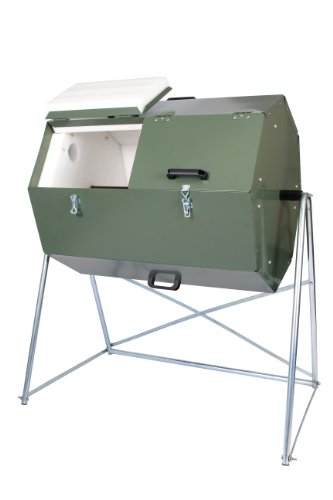
Jora Composter JK270 — Best for Cold Climates
Choose the JK270 if you compost through winter, generate a steady stream of scraps — the maker rates it for roughly 7 to 8 gallons of material a week — or simply want the most durable drum in this guide and are willing to pay for it.
- Capacity: 70 gallons total, about 35 gallons per chamber
- Material: galvanized steel frame with powder-coated insulated chambers
- Insulation: insulated walls designed to retain composting heat
- Design: elevated drum on a steel stand with aeration holes
- Access: separate locking doors for each chamber
Strengths
- Insulated steel chambers hold heat far better than thin plastic drums
- Large 70-gallon total capacity suits high weekly scrap volumes
- Elevated, sturdy stand keeps the drum off the ground and away from rodents
Trade-offs
- Premium price tier compared with every plastic tumbler here
- Steel construction makes the assembled unit heavy to relocate
- Capacity is wasted on a small household that produces few scraps
The Jora is built around a simple physical fact: compost microbes slow down as temperature falls, and a thin plastic drum does almost nothing to protect a batch from a frosty night. The JK270 wraps its chambers in insulation inside a galvanized, powder-coated steel shell, so a hot batch keeps more of its own heat. For gardeners in northern climates that difference is the difference between composting twelve months a year and composting seven.
The structure matters as much as the insulation. The drum sits on a proper steel stand with firm legs, the chambers close with positive latches that are easy to operate, and the whole unit sits high enough that emptying into a wheelbarrow is straightforward. Owners of large gardens who also run best raised garden beds tend to be the natural audience: they produce enough green waste to feed a 70-gallon system and they use enough finished compost to justify it.
It is also the most repairable-feeling design here. Steel panels, a steel frame, and simple mechanical latches age more gracefully than thin moulded plastic clips. If you expect to compost for a decade, the Jora’s construction is the strongest argument in this guide — stronger, frankly, than its capacity figure.
One honest limitation: the price is in a different league from the plastic tumblers, and the insulation only helps if you feed the drum consistently; an under-filled Jora in winter still cools down, just more slowly.
Best for: cold-climate and high-volume composters who want a decade-long steel build / Not suited for: small households or anyone shopping on a tight budget
Check on Amazon — check price on Amazon.
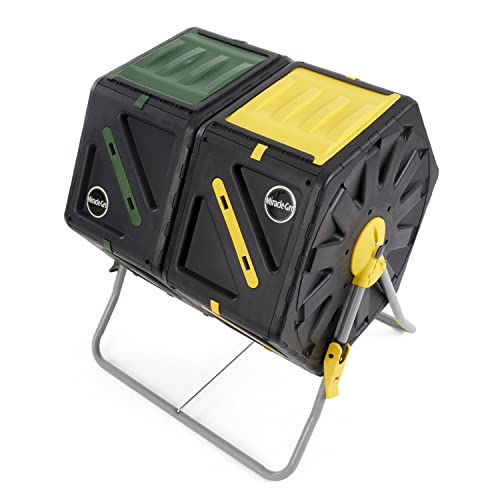
Miracle-Gro Dual Chamber Compost Tumbler — Best Compact Dual Chamber
Pick the Miracle-Gro if you like the dual-chamber idea but have a smaller patio or balcony-adjacent garden, and you want a recognised garden brand with a tidy, compact footprint.
- Capacity: 37 gallons total, 18.5 gallons per chamber
- Material: BPA-free plastic drum with steel frame components
- Design: hexagonal drum with internal mixing bars
- Aeration: vented design with chamber stoppers
- Access: sliding doors, one per chamber
Strengths
- Compact footprint suits smaller gardens and patios
- Internal mixing bars help break up clumps as the drum turns
- Sliding doors are simple to open with one hand while holding a scrap bowl
Trade-offs
- 18.5 gallons per chamber fills quickly for a family that cooks daily
- Assembly instructions are minimal, which slows first setup
- Hexagonal panels feel less rigid than the FCMP drum under a full load
Think of the Miracle-Gro as the dual-chamber concept shrunk to apartment-garden scale. The two 18.5-gallon chambers are genuinely small, and that is both the point and the warning: a couple producing modest scraps will cycle batches quickly and enjoy fast, hot, small-batch composting, while a large family will find themselves staring at two full chambers and a bowl of peelings with nowhere to go.
The internal mixing bars are a thoughtful detail at this size. Small batches clump more readily than large ones because there is less mass to tumble, and the bars give the contents something to fold against. Combined with the hexagonal drum shape, a few turns genuinely redistribute the pile rather than rotating it as one lump — provided you keep the moisture in the damp-sponge range described in the how-to section below.
For the right household this is a neat, brand-supported starting point, especially if the rest of your garden kit — gloves, tools, and best pruning shears — already lives in a small shed where every cubic foot counts. Just size it honestly against your weekly scrap volume before you buy.
One honest limitation: the small chambers are the constraint: once both sides are full and curing, there is no overflow capacity, so peak garden-clearance weekends can overwhelm it.
Best for: couples and small households with limited outdoor space / Not suited for: large families or gardeners clearing big volumes of yard waste
Check on Amazon — check price on Amazon.
Envirocycle Composting Tumbler — Best for Small Spaces and Compost Tea
The Envirocycle suits patio and deck composters, design-conscious buyers, and anyone who wants liquid compost tea as well as solid compost — and who batches rather than composting continuously.
- Capacity: 35 gallons (a smaller 17-gallon version is also made)
- Material: food-safe, BPA-free, rust-free recycled plastic
- Design: single rotating drum seated on a base that collects liquid
- Assembly: no assembly required
- Output: finished compost plus liquid compost tea from the base
Strengths
- Base collects compost tea you can dilute and feed to plants
- Arrives ready to use with no assembly
- Compact, tidy appearance suits decks, porches, and balconies
Trade-offs
- Single chamber means composting pauses while a batch cures
- The drum opening is narrower than on door-style tumblers
- Premium pricing for its capacity class
The Envirocycle does one thing no other pick here does: it separates the liquid fraction for you. As the drum’s contents break down, liquid drains into the base, and that compost tea — diluted before use — is a gentle feed for containers and houseplants. If you grow in pots on a patio, that feature alone can justify the design, and it pairs naturally with a simple best watering cans routine for feeding day.
The trade for that elegance is workflow. With one chamber, you fill the drum, stop adding, and turn until the batch finishes; fresh scraps during the cure need somewhere else to go, usually a countertop caddy held a few days longer or a municipal collection. Households that produce scraps daily and hate interruptions should choose a dual-chamber model instead. Households that cook in weekend batches will not notice the pause at all.
There is also a genuine convenience win here: no assembly. Every other tumbler in this guide asks for an hour or so of panel-and-frame work; the Envirocycle rolls out of the box and onto its base. For renters and anyone who expects to move house with their composter, that portability is worth real money.
One honest limitation: harvesting through the relatively small drum opening takes longer than emptying a wide-door tumbler, especially when the finished compost is moist and compacted.
Best for: patio composters who want compost tea and zero assembly / Not suited for: daily scrap producers who need continuous dual-chamber intake
Check on Amazon — check price on Amazon.
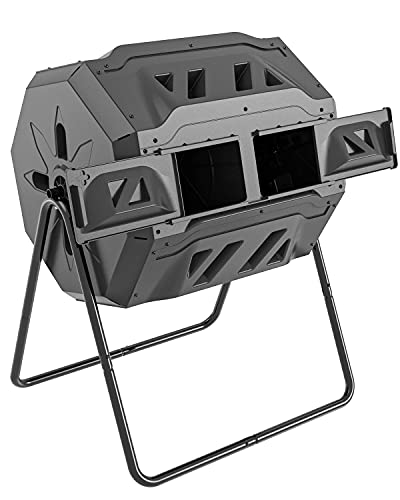
EJWOX Dual Rotating Composting Tumbler — Best Budget Dual Chamber
Choose the EJWOX if you want the dual-chamber workflow and a little more room per chamber than the Miracle-Gro offers, while staying in the budget tier of the market.
- Capacity: 43 gallons total, about 21.5 gallons per chamber
- Material: plastic drum panels with powder-coated steel frame and galvanized feet
- Design: dual chambers with sliding doors, about 10.2 x 6.1 in door opening
- Aeration: vented panels with a heat-absorbing black drum
- Access: one sliding door per chamber
Strengths
- Generous 43-gallon total capacity for the budget tier
- Black drum absorbs solar heat, which helps batches stay active
- Powder-coated frame and galvanized feet resist outdoor corrosion
Trade-offs
- Assembly is lengthy and the instructions reward patience
- Panel and door fit is less refined than on the FCMP
- Turning a fully loaded drum takes noticeable effort
On paper the EJWOX is the capacity-per-dollar winner among the dual-chamber plastic tumblers: 43 gallons split into two usable 21.5-gallon chambers, a steel frame, and sliding doors, at a budget-tier position. In practice it delivers most of that promise. The black panels genuinely help in spring and autumn sun, and the chamber size hits a sweet spot for a family of three or four.
Where the saving shows is in the details you touch. The doors slide rather than swing, which is fine, but the panel fit and hardware feel a step below the FCMP IM4000, and the build rewards a slow, careful assembly afternoon — ideally with the maker’s assembly video open beside you. Budget an unhurried hour and check every panel orientation before tightening anything.
Once built, the routine is the standard dual-chamber rhythm described in the how-to section, and the EJWOX handles it well. If your garden also needs seasonal kit like best gardening gloves for handling finished compost, buy them with the tumbler; you will want them the first time you harvest a warm, crumbly batch by hand.
One honest limitation: the drum has no gearing or crank assistance, so a full, wet 43-gallon load is heavy to rotate — turn it more often with smaller additions rather than letting it pack down.
Best for: budget buyers who still want dual chambers and family-size capacity / Not suited for: anyone who hates assembly or needs the easiest possible turning effort
Check on Amazon — check price on Amazon.

VIVOSUN Outdoor Tumbling Composter — Best Value Alternative
The VIVOSUN is for value-focused gardeners who want a widely available 43-gallon dual-chamber tumbler from a large grow-equipment brand, and who are comfortable confirming the exact door colour variant on the listing before ordering.
- Capacity: 43 gallons total, two chambers of about 18.5 to 21.5 gallons depending on listing variant
- Material: polypropylene panels with a galvanized steel frame
- Design: 360-degree rotating drum with deep fins and internal bars
- Aeration: adjustable air vents
- Access: two sliding doors
Strengths
- Large brand with wide availability and plentiful spare listings
- Deep fins and internal bars mix effectively for its class
- Adjustable vents let you balance airflow against moisture loss
Trade-offs
- Listing variants (door colours and bundles) make careful variant-checking essential
- Documentation is thinner than on the FCMP or Jora
- Frame finish is functional rather than premium
VIVOSUN sells a great deal of grow equipment, and its tumbler follows the house pattern: sensible core engineering, aggressive value positioning, and a listing family with several close variants. The tumbler itself — 43 gallons, dual chambers, deep fins, adjustable vents, sliding doors — is squarely competitive with the EJWOX and a half-step behind the FCMP on refinement.
The adjustable vents deserve a mention because they solve a real seasonal problem. In summer you want maximum airflow to feed the microbes and carry off excess moisture; in a dry, windy autumn you may want to close things down slightly so the pile does not desiccate. Being able to tune that, even crudely, gives the VIVOSUN a small operational edge over fixed-vent rivals.
Our caution is about buying, not composting: confirm the exact variant, door colour, and chamber description on the live listing before you order, because this product family is sold in several near-identical configurations. That two-minute check is the difference between the tumbler reviewed here and a bundle you did not intend to buy.
One honest limitation: variant confusion is the main risk — the same headline product appears in multiple door colours and bundles, so the listing details matter more than the headline.
Best for: value hunters who will verify the exact variant before ordering / Not suited for: buyers who want the most polished documentation and fit-and-finish
Check on Amazon — check price on Amazon.
Comparison Table
Use this side-by-side view to compare the six best compost tumblers on the specs that actually change day-to-day use. There are no prices or ratings here on purpose, because both change constantly; the live Amazon listing is the only reliable place for either.
| Pick | Capacity | Chambers | Material | Turning style |
|---|---|---|---|---|
| FCMP Outdoor IM4000 Tumbling Composter | 37 gal | Dual | Recycled polypropylene | Hand turn, octagonal drum |
| Jora Composter JK270 | 70 gal | Dual | Galvanized steel, insulated | Hand turn on stand |
| Miracle-Gro Dual Chamber Compost Tumbler | 37 gal (2 x 18.5) | Dual | BPA-free plastic | Hand turn, hexagonal drum |
| Envirocycle Composting Tumbler | 35 gal | Single | Recycled plastic, BPA-free | Roll on base |
| EJWOX Dual Rotating Composting Tumbler | 43 gal (2 x 21.5) | Dual | Plastic + powder-coated steel | Hand turn |
| VIVOSUN Outdoor Tumbling Composter | 43 gal | Dual | Polypropylene + galvanized steel | Hand turn, 360-degree |
Two patterns should jump out of the table. First, total capacity flatters dual-chamber tumblers: what governs your weekly routine is the size of one chamber, because that is all you can fill before you must stop and let it cure. Second, material predicts lifespan more reliably than any other column — insulated steel at one end, thin moulded plastic at the other, with recycled polypropylene drums on steel frames as the durable middle ground most households should aim for.
How to Choose the Right Compost Tumbler
Single chamber or dual chamber?
This is the first decision, and it should be made on your scrap rhythm rather than on capacity. If your household produces a bowl of scraps most days, a dual-chamber tumbler lets one side cure while the other accepts fresh material, so composting never stops. If you garden in bursts — a big cook on Sunday, a hedge trim once a month — a single drum you fill, close, and turn is simpler and often cheaper per gallon.
Be honest about the cure gap. With a single chamber, the weeks while a batch finishes are weeks when fresh scraps need another home: a countertop caddy, a freezer bag, or a municipal bin. Many beginners buy a single drum, discover the gap in week three, and stop composting. The dual-chamber premium is mostly insurance against that moment.
How much capacity do you actually need?
Work backwards from a week of scraps. A household that cooks from scratch daily typically fills a standard countertop caddy several times a week; add garden waste in season and the volume grows fast. As a rule of thumb drawn from the makers’ own sizing, the Jora JK270 is rated for roughly 7 to 8 gallons of fresh material a week, which is a useful benchmark: if your combined kitchen and garden output is well below that, a 35- to 43-gallon tumbler will cycle comfortably; if it is above it, look at the largest dual-chamber or steel options.
Remember that compost shrinks dramatically as it decomposes — a full chamber may yield a third of its volume in finished compost. That shrinkage is why chamber size, not headline capacity, sets your harvest rhythm, and why gardeners feeding several beds often pair a tumbler with a stationary bin for overflow leaves, as covered in best outdoor compost bins.
Drum material, insulation, and your climate
Plastic drums — polypropylene or recycled polyethylene — are light, rust-proof, and affordable, and modern UV-inhibited panels survive years outdoors. Their weakness is thermal: a thin black drum heats up in sun and cools just as fast at night, so batches pulse rather than simmer. Steel drums, especially insulated designs like the Jora, smooth out that cycle and keep microbes active deeper into winter, at a substantial price and weight premium.
Frames matter as much as drums. Look for galvanized or powder-coated steel and treat any uncoated frame as a maintenance item. The drum may outlive a rusting stand, and a collapsed tumbler full of half-finished compost is a miserable afternoon.
Turning effort and door design
You will turn this drum hundreds of times, so turning effort is a quality-of-life specification. Octagonal drums and deep fins fold the pile as they rotate; geared or crank-assisted designs (none of the six here rely on a crank, which keeps them simple) trade mechanical help for parts that can wear. A full 43-gallon drum of wet material is heavy regardless of design — the practical fix is to turn little and often, before the load compacts.
Doors decide harvesting. Wide removable doors and low drum heights make shovelling finished compost into a barrow easy; narrow sliding doors are fine for adding scraps but slower at harvest. Check the door opening against the width of your hand shovel, a detail the sources for the EJWOX helpfully quantify and most listings ignore.
Placement: sun, surface, and neighbours
Site the tumbler before it arrives. A level, well-drained spot in sun for at least part of the day helps heat; a few steps from the kitchen door helps habit; and a discreet distance from a neighbour’s patio helps relations, because even a well-run tumbler smells earthy when opened on a hot day. Avoid placing any tumbler directly against a wooden fence or wall, where splashes and leachate can stain, and keep it off prized lawn unless you accept a worn patch beneath the stand.
What tumblers do better — and worse — than a pile
A tumbler’s advantages are containment and cadence: the pile is enclosed, elevated, and turned on your schedule, so it heats more evenly and finishes faster than a neglected heap, while staying presentable in a small garden. Its disadvantages are capacity and cost per gallon, and a hard ceiling on woody material — branches and thick stalks that a ground pile digests slowly will simply occupy a tumbler. Run both if you can: the tumbler for kitchen scraps and soft garden waste, a simple heap or best outdoor compost bins station for the bulky and the woody, and let each system do the work it is good at.
Assembly and first-fill: what new owners get wrong
Every tumbler in this guide except the Envirocycle arrives as panels, a frame, and a bag of fasteners, and the first fill decides whether the first batch delights or discourages. Assemble on a flat surface, leave every fastener finger-tight until the drum is complete and square, and only then tighten in sequence — panels pulled tight one at a time warp the drum and make doors stick for the life of the product. Spin the empty drum before filling it: it should rotate freely through a full turn with no tight spot.
For the first fill, resist the urge to start with a drum full of kitchen scraps. Begin with a half-load built on the recipe in the how-to section — browns first, then alternating layers — and turn it daily for the first week while the microbial population establishes. A gentle first batch teaches you your drum’s moisture behaviour and turning weight at half stakes, and the second batch, built on that knowledge, is the one that will finish in the headline time. Owners who start this way almost never join the ranks of those who conclude that tumblers do not work.
Key Takeaways
- Dual chambers suit daily scrap producers; single drums suit batch gardeners.
- Judge a tumbler by one chamber size, not the headline total.
- Insulated steel (Jora) is the cold-climate answer; recycled plastic on a steel frame is the value sweet spot.
- Turn little and often — a full, wet drum is heavy in every design.
- Greens-to-browns balance and moisture matter more than the brand on the drum.
How to Run a Tumbler Batch, Step by Step
A reliable tumbler routine is simple, repeatable, and forgiving. Follow it for your first two or three batches before you start experimenting with accelerators or unusual materials.
- Start with a layer of browns: shredded cardboard, dry leaves, or straw across the drum floor to absorb liquid and seed airflow.
- Add greens and browns in roughly equal volumes as you go — kitchen scraps, coffee grounds, and grass clippings on the green side; shredded paper, leaves, and straw on the brown side.
- Chop or shred anything large. Small pieces present more surface to microbes and break down far faster than whole corn cobs or branches.
- Check moisture weekly: the pile should feel like a wrung-out sponge. Add water if it is dusty and dry; add a double handful of browns if it is soggy.
- Turn the drum several full rotations every two to three days. Turning mixes, aerates, and redistributes moisture in one motion.
- When the active chamber is full, stop adding to it (dual-chamber) or stop entirely (single drum) and keep turning while it cures.
- Harvest when the material is dark, crumbly, and earthy-smelling, with few recognisable scraps. Sift out any unfinished pieces and return them to the active chamber.
Keep a small caddy by the sink so scraps collect cleanly between trips — the guide to best countertop compost bins covers the indoor options — and wear best gardening gloves at harvest, when the finished material is rich, warm, and full of life you would rather not handle bare-handed for long.
Troubleshooting: Problems and Fixes
Problem: the pile smells sour or like ammonia. → Fix: it is too wet or too green. Add a generous volume of dry browns, turn daily for a few days, and check that drainage and vents are not blocked.
Problem: nothing is happening and the pile is cool and dry. → Fix: it needs moisture and nitrogen. Water it to the wrung-sponge feel, add fresh greens such as grass clippings or coffee grounds, and move the drum into more sun if you can.
Problem: fruit flies swarm when the door opens. → Fix: bury fresh scraps under a layer of browns each time you add them, and avoid leaving sweet fruit waste exposed on the surface.
Problem: the drum is suddenly very hard to turn. → Fix: it is overloaded or waterlogged. Remove some material to a holding bin, add dry browns to absorb moisture, and resume turning with a lighter load.
Problem: white mould or a grey, ashy coating appears. → Fix: this is usually a sign of a hot, dry pile and is generally harmless; mix it in, add moisture, and carry on.
Seasonal Rhythm: Spring to Winter
Spring is the tumbler’s fastest season: warming weather, fresh grass, and garden clear-outs give you greens in abundance, so stockpile browns to match. Turn every two days, keep moisture steady, and expect your quickest batches of the year. Summer demands shade awareness — a black drum in full afternoon sun can overheat and dry out; water little and often and keep vents open.
Autumn is a browns harvest disguised as a chore: shred leaves before they go in, because whole wet leaves mat into an airless layer, and fill the curing chamber before the first frost so it enters winter with maximum microbial momentum. Winter is for patience and insulation: batches slow, turning still helps, and an insulated model like the Jora keeps a genuine process alive while plastic drums wait for spring. Gardeners who also grow under cover will find the finished spring batch perfectly timed for beds prepared alongside best led grow lights seedlings coming out under lights.
Common Buying Mistakes
Buying headline capacity instead of chamber capacity
A 43-gallon dual-chamber tumbler gives you about 21 gallons of working space at a time. Buyers who size on the headline figure end up with a tumbler that is permanently full and a kitchen caddy with nowhere to empty. Always divide dual-chamber totals by two before comparing with your weekly scrap volume.
Filling with greens alone
A drum full of grass clippings and vegetable peelings collapses into a wet, airless, smelly mat. Browns — leaves, shredded cardboard, straw — are not optional filler; they are half the recipe. Stock a bag of shredded cardboard beside the tumbler so the right ratio is effortless.
Turning too rarely, then blaming the tumbler
Tumblers aerate when you turn them and only then. A drum turned monthly behaves like a sealed bin, slowly and anaerobically. Two minutes of turning every two or three days is the entire maintenance contract; if that is unrealistic, choose a stationary bin designed for passive composting instead.
Siting the tumbler in permanent shade
Shade keeps a pile cool and slow, especially in spring and autumn. Even a few hours of sun on a black drum raises internal temperatures noticeably. If your only spot is shaded, favour an insulated model and smaller, well-balanced batches.
Adding meat, dairy, and oils
These materials can be composted in specialist hot systems, but in a home tumbler they attract pests and create persistent odours. Keep the tumbler to plant material, coffee grounds, eggshells, and plain cardboard, and it will stay a good neighbour.
Final Recommendation
For most households the FCMP Outdoor IM4000 is the recommendation: the dual-chamber layout keeps composting continuous, the octagonal drum turns and mixes with the least fuss in its class, and the recycled drum on a corrosion-resistant frame is specified for years outdoors. It is the tumbler we would hand to a first-time composter without a list of caveats.
If you compost through a real winter, or your household produces scraps at the rate the Jora JK270 is built for, the runner-up is not a compromise but an upgrade: insulated steel chambers, a 70-gallon total capacity, and a stand built for a decade of service. Choose it when climate and volume, rather than budget, are your binding constraints.
Start with the FCMP Outdoor IM4000 Tumbling Composter if you want one recommendation and no second-guessing. If its trade-offs do not fit your situation, the Jora Composter JK270 is the runner-up we would buy instead, for the reasons covered in its review above.
Frequently Asked Questions
How long does a compost tumbler take to make compost?
In warm weather with a balanced mix and regular turning, a tumbler batch typically finishes in several weeks; in cool weather the same batch can take a few months. The variables that matter most are temperature, moisture, particle size, and the greens-to-browns balance — the tumbler design mainly affects how easily you can aerate the pile.
What should never go in a compost tumbler?
Keep out meat, fish, dairy, cooked food with oils, pet waste from meat-eating animals, glossy paper, and diseased plant material. Stick to fruit and vegetable scraps, coffee grounds and filters, eggshells, leaves, straw, shredded plain cardboard, and untreated garden waste for a clean, low-odour process.
Do compost tumblers attract rats and other pests?
An enclosed, elevated tumbler is far less accessible than an open pile, and steel or well-latched plastic drums keep most pests out. Problems usually start with meat or dairy additions, or with doors left unlatched. Keep the drum closed, the area tidy, and food scraps plant-based, and pest pressure stays low.
Can I compost in a tumbler through winter?
Yes, with expectations adjusted. Batches slow as temperatures fall; insulated models like the Jora JK270 keep working longest. Keep adding browns, keep the drum as full and as sunny as possible, and accept that the final cure may wait for spring. The material is not wasted — it resumes as soon as warmth returns.
How often should I turn a compost tumbler?
A few full rotations every two to three days is the standard rhythm recommended for the FCMP design and a good default for all six picks here. Turning more often does not harm a batch; turning rarely is the common cause of slow, smelly compost.
Tumbler or stationary bin — which is better?
Tumblers win on speed, tidiness, and pest resistance, and suit smaller gardens. Stationary bins win on capacity per cost and on handling large leaf volumes. Many serious gardeners run both: a tumbler for kitchen scraps and a large stationary bin for autumn leaves, which is why this guide cross-references best outdoor compost bins throughout.
What do I do with finished compost?
Spread it on beds as a mulch or soil improver, mix it into potting blends, or top-dress containers. Gardeners running best raised garden beds typically work a layer into the top of each bed at the start of the season. Sift first if you want a fine texture for seed sowing, and return any coarse unfinished pieces to the active chamber.
Can I put worms in a compost tumbler?
It is not recommended. Tumblers heat up, dry out, and rotate — three things worms tolerate poorly. Worms belong in a dedicated worm bin kept in steady, shaded conditions. A tumbler and a worm bin complement each other well: the worm bin handles a steady trickle of kitchen scraps, the tumbler handles volume and garden waste.
Why is my tumbler full of unfinished sticks and husks?
Lignin-rich material — twigs, corn husks, avocado stones, thick stalks — decomposes far more slowly than soft scraps, in any system. Sift finished compost out, return the coarse fraction to the active chamber for another cycle, and shred woody additions smaller next time. Two cycles is normal for tough material, not a failure.
How full should I fill a compost tumbler?
Fill a chamber to roughly two-thirds to three-quarters. A drum filled to the door cannot tumble its contents — the material slides as a single mass instead of folding — and an under-filled drum lacks the mass to hold heat. The working range between those extremes is where aeration, mixing, and temperature all happen at once, and it is wider and more forgiving than most new owners expect.