Where to buy
Check the latest price, availability and delivery on Amazon. Orders are placed on Amazon. We may earn a commission from qualifying purchases.
- Best full-feature meter at this budget: KAIWEETS HT118A True RMS Digital Multimeter (6000 Counts) — Check on Amazon
- Klein Tools MM325 Manual-Ranging Multimeter (600V) — Check on Amazon
- Crenova MS8233D Auto-Ranging Digital Multimeter — Check on Amazon
- INNOVA 3320 Auto-Ranging Digital Multimeter — Check on Amazon
See 2 more options in the full guide
- ANENG AN8008 True RMS Digital Multimeter — Check on Amazon
- AstroAI AM33D Digital Multimeter (2000 Counts) — Check on Amazon
Read the full guide ↓
Disclosure: As an Amazon Associate, umtsmarttool.com earns from qualifying purchases. Links to Amazon on this page are affiliate links; they cost you nothing extra. Listing details such as price and availability change often, so check the current Amazon listing before you buy.
A home needs a multimeter the way it needs a plunger: rarely, suddenly, and with no patience for a learning curve when the moment comes. The best digital multimeter for home use under $30 is the one a household will actually use — auto-ranging so nobody has to remember scales, clearly rated for receptacle-level circuits, and tough enough to live in the utility drawer for years between emergencies. The six picks below are ranked for homes rather than benches: battery verdicts for the drawer full of AAs, outlet checks before the landlord call, fuse tests that resurrect appliances, and the car battery that chooses the coldest morning of the year to quit.
Two designs dominate home use, and the right choice depends on the household. The INNOVA 3320 is the appliance-and-car specialist: auto-ranging, UL certified, with a loaded battery test that answers ‘is this battery actually dead?’ in green, yellow or red. The KAIWEETS HT118A is the one-meter-for-everything answer, with the strongest safety rating in this guide and functions a home will grow into. Below them, the AstroAI AM33D and Etekcity MSR-R500 cover the basics — live outlet, blown fuse, dead battery — at the lowest cost in the guide, and the Klein MM325 is the buy-it-for-decades option. If the same shopping trip is stocking the rest of the home kit, Best Cordless Drill For Home Use Under $30 and Best Socket Set For Home Use Under $15 are the natural companions.
Home safety framing is reassuringly simple. Everything a homeowner should measure — receptacles, appliance cords, batteries, doorbells, thermostats — sits at the CAT II level or in low-voltage territory, and every linked pick is rated and fused for it. The inside of the breaker panel is where home use stops: two picks here (MM325, HT118A) carry the CAT III rating for that space, and the guide labels the rest as receptacle-and-appliance meters so nobody has to guess. Work with the breaker off and prove it off with the meter; that single habit makes home measurement a calm, kitchen-table activity.
Quick Picks
Short on time, or comparing several options at once? Each row below names a buyer type and the product that suits it, with a link to the listing where one exists at this budget.
| Buyer type | Pick | Why it stands out | Link |
|---|---|---|---|
| Best full-feature | KAIWEETS HT118A True RMS Digital Multimeter (6000 Counts) | 6000 counts, True RMS, CAT III 1000V / CAT IV 600V, NCV and temperature | Check on Amazon |
| Best pro brand | Klein Tools MM325 Manual-Ranging Multimeter (600V) | 2000 counts, manual ranging, CAT III 600V, 6.6 ft drop protection | Check on Amazon |
| Best auto-ranging value | Crenova MS8233D Auto-Ranging Digital Multimeter | Auto-ranging, 600V AC/DC, NCV detection, CAT III 600V (current listing) | Check on Amazon |
| Best for auto/battery | INNOVA 3320 Auto-Ranging Digital Multimeter | Auto-ranging, 10 MΩ input impedance, UL certified, battery load-test LEDs | Check on Amazon |
| Best for electronics | ANENG AN8008 True RMS Digital Multimeter | 9999 counts, True RMS, DC to 999.9V / AC to 750V, capacitance and frequency | Check on Amazon |
| Best overall | AstroAI AM33D Digital Multimeter (2000 Counts) | 2000 counts, manual ranging, CAT II 600V / CAT III 300V | Check on Amazon |
How These Picks Were Chosen
We did not use these meters ourselves. We read the maker listings, manuals and specification sheets, and compared the things that decide whether a cheap meter is a tool or a toy: the published safety (CAT) rating, whether current ranges are fused, the accuracy table, and whether the functions on the dial are the ones the listing headline promises. Anything that hid its safety rating or its accuracy figures was excluded, however long its feature list ran.
The budget was applied as a ceiling, not a target. Every linked pick below is a real Amazon listing positioned within the $30 budget in the United States — check the current price on Amazon before you buy, because listing prices at this level move constantly. Where a tier honestly cannot buy a function or a safety class, the guide says so and covers the closest real options in prose instead of inventing a product to fill the slot.
For home use we ranked on drawer-readiness: auto-ranging and a battery test first, a backlit display for under-sink and attic work second, and a published CAT II-or-better rating as the non-negotiable floor. Meters that demand range knowledge to produce a first reading were placed where they belong for this lens — as the durable second-step options, not the default recommendation.
The 6 Best Digital Multimeters Under $30 for Home Use
Top pick
1. KAIWEETS HT118A True RMS Digital Multimeter (6000 Counts)
The HT118A is the most complete meter in this guide by a clear margin. It is a 6000-count True RMS auto-ranging instrument rated IEC CAT III 1000V and CAT IV 600V, measuring DC voltage to 1000V and AC to 750V, AC and DC current to 10A, resistance to 60MΩ, capacitance to 100mF, frequency to 10MHz, and temperature with the included K-type thermocouple. Non-contact voltage detection and a live-wire function are built in, the input jacks light up to show you where the leads belong for the selected function, and there is a flashlight and a backlit 2.9-inch display for the dark corners where electrical problems live.
That CAT rating deserves emphasis, because it is the specification that separates meters you may use around a home’s distribution system from meters you may not. CAT III 1000V / CAT IV 600V is a rating class shared with professional instruments; combined with fused current ranges (F600mA/250V and F10A/250V) it means the safety engineering, not just the measurement list, is a generation ahead of the manual-ranging budget meters. KAIWEETS backs it with a 36-month after-sale service promise, unusual at this level.
The costs are size and price position. It is a full-size handheld (about 8 × 5 inches in its packaging class) rather than a pocket meter, and its street price moves around the top of this guide’s budget — check the current listing, and if it has drifted above the cap on the day you shop, the Klein MM325 below is the disciplined alternative. You are also paying for functions (temperature, frequency, duty cycle) that pure household users may never touch.
Living with the HT118A, the details add up: the jacks light to confirm lead placement for the selected function, the flashlight and backlit screen handle the dark side of appliances and panels, and the thermocouple turns oven, vent and engine-bay temperature checks into a ten-second reading. It is the largest meter here and the one least likely to be borrowed casually — which, given that it is also the one rated for the serious circuits, is arguably correct behavior for a workshop.
What we like:
- CAT III 1000V / CAT IV 600V — the strongest safety rating here
- True RMS with AC and DC current, capacitance and temperature
- NCV, live-wire test, jack indicator lights and flashlight
- 36-month maker after-sale service
Honest limitation: Its price moves around the top of this budget — verify it is inside the cap on the day you buy.
Choose it if you want one meter that covers house, car and electronics without a safety asterisk. Skip it if you only ever check batteries and outlets — the cheaper meters here do that for less.
2. Klein Tools MM325 Manual-Ranging Multimeter (600V)
The MM325 is what a professional tool brand does when it builds down to a household price: it keeps the safety rating, the durability and the documentation, and trims the function list instead. It is a manual-ranging 2000-count meter measuring AC/DC voltage to 600V, DC current to 10A and resistance to 2MΩ, with continuity, diode and dedicated 1.5V/9V battery-test settings. The safety rating is a genuine CAT III 600V under IEC 61010, the housing is drop-tested to 6.6 feet (2 m), and Klein’s Lead Alert system lights LEDs at the jacks to warn you when the leads are plugged into the wrong inputs for the dial setting — a beginner-proofing feature that prevents the classic blown-fuse mistake.
Klein publishes a full accuracy table (DC voltage ±(0.5% + 3 digits) on the lower ranges), includes CAT III/CAT IV safety-capped test leads and two AAA batteries, and supports the meter through a real dealer network. The backlit display and data hold round out a package that feels engineered rather than assembled. For panel-adjacent household work — breakers, receptacles, HVAC controls at the thermostat level — this is the meter in the guide whose paperwork an electrician would nod at.
The trade-offs are the manual-ranging dial (you select every range yourself, starting high and stepping down) and a deliberately short function list: DC current only, resistance capped at 2MΩ, and no capacitance, temperature, frequency or NCV. If you want features per dollar, the KAIWEETS beats it. If you want the meter most likely to still be accurate and intact in ten years, this is the one.
The MM325’s ownership story is boring in the best way: Klein publishes the manual, the accuracy table and the fuse specifications, dealers stock the brand everywhere, and the 6.6-foot drop rating means the meter survives the garage floor that kills lesser housings. The battery-test settings under load are a quietly premium touch at this price. It is the pick for buyers who measure a tool’s cost in decades rather than dollars, and who would rather have six functions done properly than sixteen done approximately.
What we like:
- Genuine CAT III 600V rating from a professional brand
- Lead Alert LEDs prevent wrong-jack mistakes
- Drop-tested to 6.6 ft; full published accuracy table
- Dedicated battery-test settings with load
Honest limitation: Manual ranging, DC current only, and no capacitance/temperature/NCV — the function list is deliberately basic.
Choose it if you value safety certification, durability and brand support over feature count. Skip it if you want auto-ranging or electronics functions like capacitance and frequency.
3. Crenova MS8233D Auto-Ranging Digital Multimeter
The MS8233D is the point in this guide where the feature set jumps a class. Instead of choosing ranges on the dial, you choose the function and the meter picks the range — and it adds the two features budget buyers ask about most: non-contact voltage (NCV) detection for finding live cables before you touch anything, and capacitance measurement for the capacitors that start motors and run appliance boards. The current Amazon listing rates it to IEC 61010-1 CAT III 600V with dual fuse protection and an insulated rubber holster, and the kit includes test leads and alligator clips in a carry bag.
Auto-ranging changes how a meter feels in daily use more than any single specification. Checking an unknown voltage stops being a two-step guessing exercise; the meter settles on a sensible range and shows a stable reading, and the backlit display with max/min and data-hold functions behaves like the meters a class above it. For a first meter that you intend to keep rather than replace, that usability gap is the strongest argument for spending to this level instead of stopping at the manual-ranging floor.
Two honest caveats. First, this model has been sold for years and the listing’s specification block has changed across production runs, so confirm the exact function list and safety rating on the live listing before you buy — what we verified is the current listing, not every unit ever shipped. Second, Crenova is a value brand: documentation and long-term support are thinner than Klein’s or Fluke’s, and the included leads are the first thing most owners eventually upgrade.
In the hand, the MS8233D feels like the class above the manual meters: the dial turns to functions rather than ranges, the backlight is even, and the alligator clips in the kit quietly solve the third-hand problem when you are measuring a component on a bench. Battery life from the AAA cells is long thanks to auto power-off. It is the pick whose owners most often report forgetting it cost what it did — with the standing advice to confirm the live listing specification, because this model’s spec sheet has genuinely changed over its production life.
What we like:
- Auto-ranging removes the range-guessing step entirely
- NCV detection for a first check before contact testing
- Capacitance measurement for motor and appliance work
- Alligator clips and carry bag included in the kit
Honest limitation: Specifications have varied across production runs — verify the function list and CAT rating on the live listing before ordering.
Choose it if you want one meter to learn on that you will not outgrow in six months. Skip it if you want a manual-ranging meter specifically, or a pro brand’s warranty and support network.
4. INNOVA 3320 Auto-Ranging Digital Multimeter
INNOVA built the 3320 for the driveway first and the house second, and the design shows it. It is an auto-ranging meter with a 10 MΩ input impedance — the figure that matters for automotive work, because it means the meter will not load sensitive vehicle electronics while you probe them — and a dedicated battery test that applies a load and reports with color-coded LEDs: green for good, yellow for weak, red for replace. Anyone who has wondered whether a battery is actually failing or just discharged will understand why that single feature sells this meter.
The rest of the package is sensibly household-capable: AC and DC voltage, resistance on a single-setting function, DC current to 10A, continuity and diode checks, with auto shut-off after 15 minutes and rubber corner guards on the housing. It is UL certified, which puts its safety paperwork a step ahead of most meters at this level, and the attachable test leads with built-in holders and a fold-out stand make one-person under-hood work less of a juggling act.
What you give up versus the feature-loaded imports is breadth: there is no capacitance, no temperature, no frequency and no NCV, and the display is a simpler unit than the 6000-count screens elsewhere in this guide. If your electrical life is vehicles, batteries, outlets and appliances, none of that matters much. If it is electronics, the AN8008 or HT118A serves you better.
The 3320’s design details suit its driveway brief: the leads attach to the meter so they are not a separate thing to find, the stand props the display at reading angle under a hood, and the corner guards acknowledge that meters get dropped on concrete. INNOVA’s background is automotive test equipment, and the support and documentation reflect it. For households whose electrical questions are mostly about the car or its battery, this is the meter that answers in the fewest steps.
What we like:
- Battery test under load with color-coded LED verdicts
- 10 MΩ input impedance protects vehicle electronics
- UL certified — stronger safety paperwork than most rivals
- Auto-ranging with auto shut-off and lead holders
Honest limitation: No capacitance, temperature, frequency or NCV — it is a focused automotive/household meter, not a full-feature one.
Choose it if your main jobs are car batteries, charging systems and household checks. Skip it if you want electronics functions like capacitance and frequency in the same meter.

5. ANENG AN8008 True RMS Digital Multimeter
The AN8008 is a different species from the household meters above it: a pocket True RMS instrument with a 9999-count display aimed at electronics work. The range set gives it away — DC voltage resolves down to the microvolt-adjacent millivolt ranges with ±(0.5% + 3) accuracy, there are genuine microamp current ranges for measuring sleep currents in battery projects, capacitance runs to 9.999mF, frequency to 9.999MHz, and it even outputs a square wave (50Hz–5kHz) you can use as a crude signal source for testing. At roughly 113 grams it is also the meter most likely to actually be in your bag when you need it.
For electronics, this is the strongest measurement package in this guide at any of these budgets. True RMS matters when you measure anything that is not a clean sine wave — dimmed circuits, switching supplies, variable-frequency drives at low level — and the combination of high counts and microamp ranges is exactly what Arduino, Raspberry Pi and repair work asks for. Auto and manual ranging are both available, with relative measurement and data hold.
The limitation is safety certification, and it is not a small one. ANENG does not publish a CAT III rating for this meter comparable to the Klein or KAIWEETS entries here; the design includes overload protection on the resistance/capacitance/frequency ranges, but this is a bench meter for low-voltage electronics. Keep it for circuits you would power from a bench supply or a battery, and use a properly CAT-rated meter around mains distribution. It also ships without its two AAA batteries, a small but real annoyance.
On the bench, the AN8008’s party tricks compound: the square-wave output can inject a test signal into an audio or logic circuit, the relative mode zeroes out lead resistance for honest low-ohms readings, and the microamp ranges expose the difference between a microcontroller that sleeps properly and one that will eat its battery by morning. It is small enough to disappear into a laptop bag, which is precisely where bench meters earn their keep — present at the moment of curiosity, not stored in another room.
What we like:
- 9999-count True RMS display — the sharpest readings here
- Microamp ranges for electronics and battery-project work
- Capacitance, frequency, duty cycle and square-wave output
- Pocket size at about 113 g
Honest limitation: No published CAT III safety rating — a low-voltage bench meter, not a meter for mains distribution work.
Choose it if your work is electronics: microcontrollers, repairs, battery projects and bench testing. Skip it if you need a certified safety rating for household mains or panel work — pick a CAT III meter instead.
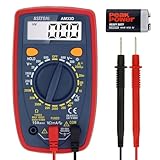
6. AstroAI AM33D Digital Multimeter (2000 Counts)
The AM33D is the meter that defines this end of the market: a 2000-count, manual-ranging digital multimeter that covers AC and DC voltage, DC current to 10A, resistance, continuity and diode testing, and does it at a price that makes it a rational first meter or second meter. The dial is laid out in clearly separated function blocks, the display is backlit, and there is a data-hold button for readings you need to write down. AstroAI rates it to IEC 61010 CAT II 600V and CAT III 300V, with double insulation and fuse protection on both current ranges (F250mA/250V on the milliamp side, F10A/250V on the 10A side).
In practice, manual ranging is the thing you are accepting in exchange for the price. You choose the range before you measure, and if you guess wrong the meter shows an overload indication and you step up. For household jobs — checking whether an outlet is live, testing a car battery, confirming a fuse — that is a minor inconvenience rather than a flaw, and many technicians argue it teaches better habits than an auto-ranging meter that hides the decision from you. DC voltage accuracy is specified at ±(0.5% + 3 digits) on most ranges, which is entirely respectable at this price and more than enough for battery, automotive and appliance work.
What it will not do matters as much as what it will. There is no AC current measurement at all, no capacitance, no temperature and no non-contact voltage detection. The AC voltage ranges are also coarse — just 200V and 500V — so it is a blunt instrument for low-voltage AC electronics. Treat it as a household and automotive meter, keep it out of distribution panels (its CAT III rating is 300V, not 600V), and it is very hard to beat for the money.
Ownership is undemanding: the meter runs on a single 9V battery in current production (earlier runs used AAA cells — check the compartment before ordering spares), the holster-style case shrugs off toolbox life, and replacement fuses are standard 250V sizes available anywhere. The one upgrade worth making early is the test leads: the included set is serviceable, but a silicone-lead set with sharper probes makes low-voltage readings noticeably more stable and is the cheapest accuracy improvement in this entire guide.
What we like:
- Backlit 2000-count display with data hold
- Fuse protection on both current ranges
- Continuity buzzer, diode test and square-wave output
- Battery and test leads included in the box
Honest limitation: Manual ranging only, and it cannot measure AC current — a real gap if you later move into HVAC or appliance motor work.
Choose it if you want the cheapest meter from a known brand that still publishes full specifications and safety ratings. Skip it if you need auto-ranging, AC current, or a CAT III 600V rating for working in breaker panels.
Comparison Table
The six picks side by side on the specifications that decide this purchase. Prices are deliberately not printed — they change too often to stay honest — so use the links to check the current Amazon listing.
| Pick | Key specification | Ranging | Current measurement |
|---|---|---|---|
| KAIWEETS HT118A True RMS Digital Multimeter (6000 Counts) | 6000 counts, True RMS, CAT III 1000V / CAT IV 600V, NCV and temperature | Auto-ranging | AC and DC current to 10A |
| Klein Tools MM325 Manual-Ranging Multimeter (600V) | 2000 counts, manual ranging, CAT III 600V, 6.6 ft drop protection | Manual ranging | DC current only (to 10A) |
| Crenova MS8233D Auto-Ranging Digital Multimeter | Auto-ranging, 600V AC/DC, NCV detection, CAT III 600V (current listing) | Auto-ranging | AC and DC current |
| INNOVA 3320 Auto-Ranging Digital Multimeter | Auto-ranging, 10 MΩ input impedance, UL certified, battery load-test LEDs | Auto-ranging | DC current to 10A |
| ANENG AN8008 True RMS Digital Multimeter | 9999 counts, True RMS, DC to 999.9V / AC to 750V, capacitance and frequency | Auto/manual ranging | AC and DC current (µA ranges included) |
| AstroAI AM33D Digital Multimeter (2000 Counts) | 2000 counts, manual ranging, CAT II 600V / CAT III 300V | Manual ranging | DC current only (to 10A) |
How to Choose a Digital Multimeter
Auto-ranging is the home feature. Home measurements happen months apart, under mild stress, often by whoever in the household drew the short straw. A meter that picks its own range (MS8233D, 3320, HT118A) produces a trustworthy answer from cold; a manual-ranging meter (AM33D, MSR-R500, MM325) asks its user to remember a skill between uses. Households that enjoy learning tools can ignore this advice; everyone else should buy auto-ranging and never think about it again.
The battery test earns its drawer space. Homes run on batteries — remotes, toys, detectors, flashlights, the car. A simple voltage reading overstates a tired battery because it is unloaded; the INNOVA 3320’s loaded test with color LEDs, and the MM325’s dedicated 1.5V/9V battery settings, answer the real question: does it still work under load? For a home meter, that feature alone justifies its ranking here.
Buy the rating for receptacles, not for panels. Home circuits you should touch top out at the receptacle: CAT II 600V / CAT III 300V (the budget picks) is the correct, sufficient rating, with CAT III 600V (MM325) or CAT III 1000V (HT118A) buying headroom and longevity rather than permission to experiment. If a home job seems to require opening the panel and you are not trained for it, the meter’s job is to confirm the problem is real before you call the electrician — which it does from the receptacle side. The same judgment call appears throughout home maintenance; our Best Stud Finder For Home Use Under $15 guide draws the same line for wall work.
Small things decide whether it gets used. A backlight for the attic and the fuse box corner. A kickstand or magnetic hang so both hands stay free (HT118A). Leads long enough to reach from outlet to a readable position. Auto power-off so the battery survives the drawer years (all the auto-ranging picks). None of these appear in headline specifications, and all of them decide whether the meter is a household tool or a household relic.
The Six Home Checks Every Household Should Know
Is the outlet dead or the appliance? AC volts at the receptacle settles it in seconds and turns a repair bill into a breaker flip surprisingly often. Is the fuse blown? Continuity, power off: beep or silence, no guessing at hairline breaks you cannot see. Is the battery dead? Voltage for a first look, a loaded test (3320) for the verdict — the check that saves a drawer of good AAs from the bin and a car owner from a no-start morning.
Is the heating element gone? Resistance across a disconnected oven, dryer or water-heater element: a sensible ohms reading means the element is intact, an open reading (OL) names the part to order. Is the doorbell transformer alive? Low-voltage AC (typically 16–24V) at the terminals separates a dead transformer from a dead button. Is the charger or the device at fault? DC volts at the charger’s plug answers it before anything gets replaced. Six checks, one meter, and a household that stops replacing working things — the same spirit as the fixes in Best Rotary Tool For Home Use Under $15.
Storing and Keeping a Home Meter Ready
A home meter’s enemy is not use; it is the drawer. Store it with the dial off, leads loosely coiled rather than kinked, and — for storage beyond a season — batteries removed, because a leaked alkaline cell destroys more home meters than electricity ever will. The auto-ranging picks here shut themselves off, which is why their batteries survive years of standby; manual picks left on a resistance range will be flat when the emergency comes.
Once a year, do a two-minute health check: fresh battery reading against a known source (a new AA at about 1.6V), continuity beep with the probes touched together, and a look at the lead insulation for cracks. If the milliamp fuse ever blows — readings of zero on the mA range after a current mishap — it is a user-replaceable part on every pick here, and replacing it is a rite of passage, not a funeral.
Care, Fuses and the Lead Upgrade Every Budget Meter Deserves
Budget meters rarely die from electronics; they die from logistics. The milliamp fuse blows during a current mistake and never gets replaced, so the range reads zero forever and the meter is declared broken. The leads fray at the probe or the jack until readings wander. The battery leaks during a long drawer season. Every one of those deaths is preventable with a five-minute annual routine: test continuity by touching the probes together (a beep and a near-zero reading), check a fresh battery’s voltage against its known value, inspect the lead insulation end to end, and confirm both current fuses with the meter’s own continuity mode after removing them.
Fuse replacement deserves precision: the fuse specification is printed in the manual and often inside the battery compartment — match the current rating, the voltage rating and the type (ceramic HRC where specified, as on the Etekcity and KAIWEETS picks) exactly. A fuse is a calibrated safety component, not a wire substitute; the day it clears on a fault is the day it pays for the meter. Never bridge a blown fuse ‘just to finish the job’ — that sentence is how meters, and occasionally their owners, get hurt.
Finally, the lead upgrade: the test leads bundled with budget meters are their weakest component — stiff PVC insulation, soft probe tips, and strain reliefs that crack. A quality silicone lead set stays flexible in a cold garage, seats firmly in the jacks, and makes low-resistance readings repeatable because the contact is stable. It costs a fraction of the meter, transfers to your next meter, and improves every measurement in this guide more than any single feature difference between the picks. Buy the meter first; buy the leads second; measure everything after that with more confidence.
Storage completes the routine. Keep the meter in its holster or case, dial set to OFF, leads loosely coiled rather than wrapped tight around the body — tight wrapping work-hardens the conductors at the strain reliefs, which is where leads actually fail. For storage longer than a season, take the batteries out; a leaked alkaline cell is the single most common cause of death for meters that are ‘hardly used’. And write the fuse specification on a label inside the battery cover the day the meter arrives: the time to learn which fuses your meter takes is when you are reading this guide, not when a range goes dead mid-diagnosis with the part number nowhere to be found.
Common Buying Mistakes
Replacing parts before measuring. The home version of the most expensive mistake: a new thermostat, element or battery bought on a hunch, when a two-minute check would have named the actual failure — often a fuse or a dead outlet that costs nothing.
Testing a battery by voltage alone and binning it. Unloaded voltage flatters weak batteries. Use a loaded battery test (3320, MM325) before declaring AAs dead or a car battery finished.
Measuring the panel because the receptacle ‘felt wrong’. Home measurement stops at the receptacle unless the meter is CAT III rated and the user is trained. Confirm from the outlet; call a professional for the panel.
Leaving the meter on in the drawer. A manual-ranging meter stored on a live range eats its battery and is dead at the moment of need. Dial to OFF, or buy auto-off — and remove batteries for long storage.
Probing an outlet with damaged leads. The leads are the insulation between your hands and the mains. Cracked or taped leads retire immediately; a replacement lead set costs less than the meter did.
Assuming a zero reading means a dead circuit. A meter on the wrong function, a blown current fuse, a flat meter battery and a genuinely dead circuit can all display nothing. Prove the meter on a known-live source before and after any ‘dead’ verdict — the prove-test-prove habit electricians use on every circuit that matters.
Assuming a zero reading means a dead circuit. A meter on the wrong function, a blown current fuse, a flat meter battery and a genuinely dead circuit can all display nothing. Prove the meter on a known-live source before and after any ‘dead’ verdict — the prove-test-prove habit electricians use on every circuit that matters.
Final Recommendation
Start with the KAIWEETS HT118A True RMS Digital Multimeter (6000 Counts). For a home at $30 it is the meter that will actually get used: forgiving of rusty skills, honest about its rating, and ready in the drawer on the day something stops working.
The runner-up is the Klein Tools MM325 Manual-Ranging Multimeter (600V). It fits the household that leans the other way — a little more learning curve or a little more specialization, exchanged for the strength its review describes.
Put it in the utility drawer with fresh batteries and this guide’s six checks in mind, and the next electrical mystery at home becomes a ten-minute diagnosis instead of a service call. For the rest of the home kit, Best Power Tool Set For Home Use Under $30 and Best Impact Driver For Home Use Under $15 cover the jobs that start where measurement ends.
Frequently Asked Questions
What can a homeowner actually do with a multimeter?
Confirm whether outlets are live and correctly fed, test fuses and heating elements, judge batteries (handheld and car), check chargers and power supplies, verify doorbell and thermostat low voltage, and prove circuits dead before changing fixtures. That list covers the majority of ‘something electrical stopped working’ events in a home.
Which pick is best for a non-technical household?
The INNOVA 3320: auto-ranging, a battery test that answers in colors rather than numbers, UL certification and rubber-armored corners. The KAIWEETS HT118A is the step-up if the household wants one meter that also covers electronics and carries the strongest safety rating in the guide.
How do I check if a car battery is failing?
Rest the car a few hours, then measure DC volts: about 12.6V is charged, 12.2V is half-discharged, below that is trouble. Better is a loaded test — the INNOVA 3320 applies a load and shows green/yellow/red. A battery that reads fine rested but collapses under load is the classic failing battery, and the loaded test is designed to catch exactly that.
Can I use these meters on 240V appliances like dryers and ovens?
Measuring voltage at a 240V receptacle is within the voltage and category ratings of the CAT II/CAT III picks here, done carefully with insulated probe grips. Working inside a live 240V appliance is a different matter — prove dead, unplug where possible, and test components (elements, fuses) on continuity and resistance with power removed.
Why does the meter show a few volts on a switched-off circuit?
Ghost voltage from capacitive coupling with nearby live wires. It is a phantom with no current behind it, common in home wiring runs, and it disappears under load. It does not mean the circuit is live — but the correct response is to prove dead properly (and, for fixture work, treat conductors with respect regardless).
How long will a home multimeter last?
Decades, mechanically. The mortal threats are leaked batteries, blown fuses left unreplaced, and damaged leads. The Klein MM325 is the pick most likely to be handed down; the budget picks will serve for years with an annual battery-and-leads check.
How do I know my budget meter is still accurate?
Check it against references you trust: a fresh alkaline battery (about 1.6V), a regulated 5V USB supply, and a resistor of known value. Readings within the published accuracy band mean the meter is healthy. Budget meters hold calibration well for household and bench decisions; if a reading ever decides something expensive or safety-critical, cross-check with a second meter before acting on it.