A spearfishing knife earns its keep on the strap and in the water. It cuts line, dispatches fish and frees you from kelp or a snag, so you want a corrosion-resistant blade, a secure sheath and a handle that works with wet hands.
The six knives below span stainless and titanium blades, from compact designs to longer ones. Sheath style and size vary, so check the listing for how each knife mounts to a leg, arm or belt. Salt water is hard on steel, so rinse every knife with fresh water after a dive. Titanium resists corrosion best but is softer, while stainless holds an edge a little longer if it is kept dry. Always check local rules for spearfishing gear, and practice drawing the knife one-handed on land before you rely on it underwater. A knife that rides on the inside of the calf stays clear of the speargun and line, while a forearm mount is quick to reach with the free hand. Check that straps are snug but not tight, because cold water can shrink wetsuit material around them. We have not used these products ourselves, so confirm sizes, materials and details on the current listing before buying.
As an Amazon Associate we earn from qualifying purchases. Links below are affiliate links, and they do not change the product information we give.
What to Look For
| Feature | Why it matters |
|---|---|
| Blade material | Titanium resists salt; stainless holds an edge well |
| Sheath | A quick-release, secure sheath prevents loss |
| Line cutter | A notch for line is useful when you tangle |
| Tip shape | A pointed tip suits fish work; a blunt tip suits general use |
| Size | Compact knives hide in a strap; longer ones offer reach |
In this guide
Specs at a Glance
| Knife | Blade | Style | Notes |
|---|---|---|---|
| Cressi Giant | Stainless steel | Straight | Leg or arm strap options |
| Cressi Predator | Stainless steel | Straight | Compact style |
| Scubapro Mako Titanium | Titanium | Straight | Rust-resistant |
| Mares Force | Stainless steel | Straight | Secure sheath |
| TUSA FK-940 | Stainless steel | Straight | Compact |
| Riffe Dive Knife | Stainless or titanium | Spearfishing | Sold with a sheath |
The 6 Best Dive Knives for Spearfishing
Top pickBest for general diving and spearfishing
1. Cressi Giant Dive Knife
A stainless dive knife from a major diving and spearfishing brand. It comes with a sheath and straps for a leg or forearm.
Suits: general diving and spearfishing. Strengths: trusted brand and strong sheath options. Weaknesses: size may be bulky. Skip it if you want a very small knife.
View Cressi Giant Dive Knife on Amazon
Best for slim carry
2. Cressi Predator Dive Knife
A compact knife aimed at spearfishers who want a quick draw. It rides easily on an arm or leg strap.
Suits: slim carry. Strengths: light feel and easy access. Weaknesses: smaller blade for heavy line. Skip it if you need a long cutting edge.
View Cressi Predator Dive Knife on Amazon
Best for salt-water divers
3. Scubapro Mako Titanium Dive Knife
A titanium knife designed to resist rust in salt water. It is a long-lasting option for frequent dives.
Suits: salt-water divers. Strengths: excellent corrosion resistance. Weaknesses: softer than steel at the edge. Skip it if you want a razor-sharp edge for slicing.
View Scubapro Mako Titanium Dive Knife on Amazon
Best for dive and fish work
4. Mares Force Dive Knife
A stainless knife from a respected diving brand, with a sheath made to hold firmly in the water. Check the listing for the blade size.
Suits: dive and fish work. Strengths: sturdy sheath and clean design. Weaknesses: fit may vary by wrist or leg. Skip it if you want titanium.
View Mares Force Dive Knife on Amazon
Best for backup carry
5. TUSA FK-940 Dive Knife
A compact dive knife from a diving gear maker. It is sized for backup cutting tasks rather than heavy work.
Suits: backup carry. Strengths: small size and easy mounting. Weaknesses: limited blade length. Skip it if you want a primary fish knife.

Best for dedicated spearfishers
6. Riffe Dive Knife
A knife from a spearfishing brand known for gear built by spearos. Different editions exist, so check the blade type and sheath.
Suits: dedicated spearfishers. Strengths: tailored to freediving use. Weaknesses: editions vary widely. Skip it if you want a general scuba knife.

Care and Setup
- Rinse in fresh water after every dive.
- Dry the knife and sheath before storing.
- Oil the pivot or lock of folding styles.
- Check straps and buckles for wear.
- Keep the edge sharp with a fine stone.
Mistakes to Avoid
- Skipping a fresh-water rinse.
- Using the knife as a pry bar.
- Mounting a knife where it snags on line.
- Choosing a blade too big for a small strap.
- Never practicing the draw before a dive.
Matching the Knife to Your Dive Style
Before comparing blades, decide what kind of diving you actually do, because a freediver hunting reef fish and a scuba diver carrying a backup tool have different needs. A freediver spends long stretches near the surface with a gun, a float line and a reel, so the knife’s first job is cutting line quickly and dispatching fish cleanly. Bulk is the enemy here, since every extra edge or buckle is something line can catch on.
A scuba diver, by contrast, usually carries a knife as a safety tool for netting, fishing line and weed. A larger blade with a blunt tip or a serrated section can make sense, because it will not puncture a buoyancy bag or a drysuit by accident. Spearfishers who also scuba dive often end up with two knives: a compact one on the forearm for fast access and a bigger one on the leg for heavier jobs.
Think about the water you hunt in. Kelp forests and rocky reefs reward a knife that can be reached with either hand and that slices through stringy growth. Open blue-water hunting with a float line puts the emphasis on cutting thick rope or braided line under load. Murky water or low light means you will often find the handle by feel, so a distinct shape matters more than an attractive finish.
Finally, be honest about how often you dive. A weekend hunter can get years from a decent stainless knife with careful rinsing. Someone in the water several times a week, especially in warm salt water, may value corrosion resistance more than edge holding, which is the usual argument for titanium.
Blade, Edge and Tip Details That Change Daily Use
Two knives made from the same material can behave very differently because of their shape. A plain edge slices fish and cuts monofilament cleanly and is easy to sharpen on a small stone. A serrated section grips rope and braided line, which is useful when a float line is under tension, but it is harder to resharpen and can snag on fabric. Many dive knives combine both, so look at how much of the edge is serrated and where it sits on the blade.
The tip tells you what the maker expects the knife to do. A pointed tip is the traditional choice for dispatching fish quickly and precisely. A blunt or squared tip is safer around gear and around your own body when you are moving in current, but it will not pierce as readily. Neither is wrong; choose by task.
Blade thickness matters too. A thick spine feels strong, yet thin, flat grinds slice better and are easier to keep sharp. Be cautious about using any dive knife as a pry bar or a screwdriver, since a snapped tip underwater is a bad moment. If you expect to pry shells or chip at rock, carry a separate tool made for it.
Handle design is the last piece. Look for a shape that stays secure when you wear thick gloves, and check that there is a hole or lanyard point if you want to tether the knife. Rubberized handles are comfortable but can trap grit and salt, so plan to rinse them thoroughly. Because exact blade lengths and grinds change between versions, read the dimensions on the current listing rather than assuming.
Sheath, Straps and Mounting Positions
A knife is only as useful as your ability to draw it and the sheath’s ability to keep it from leaving without you. When comparing sheaths, check how the release works. A single push-button or thumb-release is easy to operate with a gloved hand, while a double-lock design holds more securely but can slow a one-handed draw. Practice on land with the gloves you will wear in the water, and do it blind to simulate poor visibility.
Straps deserve as much attention as the blade. Rubber straps flex with a wetsuit, but they can stretch and lose tension over time and may crack with age and sun exposure. Webbing straps stay put but can be fiddly to adjust. Whichever you have, check that the buckle is not sharp and that loose strap ends are tucked or trimmed so they cannot snag on line or kelp.
Where you wear the knife changes how it behaves. The inner calf keeps the handle out of the way of a speargun and keeps it reachable from the surface. The forearm is faster to reach but sits near where you handle the gun and line. A belt mount is simple but can be hidden under a weight belt or buoyancy gear, so it may be hard to reach in a hurry. Many hunters set up two mounts, one for each hand.
Finally, wetsuit thickness changes every strap fit. A strap that was snug in thin neoprene may slip over a thick suit, so confirm the strap range in the listing and test it with your actual exposure protection.
Titanium Versus Stainless in Practice
The material debate comes down to what you are willing to do after a dive. Titanium is prized because it resists corrosion very well, so a titanium knife left in a gear bag overnight is far less likely to show rust. The trade-off is that it tends to be softer than good stainless, which means the edge may need touching up more often and may roll rather than chip when it hits something hard.
Stainless steel is not one material. Different grades vary in corrosion resistance and edge holding, and some perform well in salt water while others need more careful care. A knife marketed for diving should be a corrosion-resistant grade, but “stainless” on a listing does not mean it will never rust, especially at the tip, the pivot area on folders, and anywhere the finish has been scratched. Check the listing or manual for the steel type and any maker advice for salt water use.
For many people the practical answer depends on routine. If you rinse and dry gear every time, a stainless knife can last for years and may hold an edge a little longer. If gear often sits damp, or you will be diving in tropical salt water regularly, titanium removes a layer of worry. Budget also plays a part, since titanium knives generally cost more, though a plain stainless knife with good habits is a sensible first purchase.
Whichever you choose, avoid mixing metals carelessly in storage. Keep the knife away from wet aluminum or steel parts that can encourage corrosion, and let sheath and knife dry separately.
Routine Checks and Signs to Replace Your Dive Knife
A short routine keeps a dive knife dependable. After every session, remove the knife from the sheath, rinse both in fresh water, and flush the sheath so salt crystals do not build up around the retention mechanism. Let everything dry fully before putting the knife back, because a damp sheath can hold moisture against the blade for days.
Once a month or before a trip, inspect the details. Look along the edge for chips and rolled areas, check the tip for bending, and wipe the blade to spot any orange or brown spotting. Light surface spots can often be cleaned with a soft cloth and a mild abrasive pad, then protected with a thin film of the oil the maker recommends. Check the straps for cracks, stretched rubber and frayed stitching, and replace them before they fail rather than after.
Test the sheath retention by turning it upside down and shaking it gently with the knife in place. The knife should stay put until you intentionally release it. If it rattles, loosens or comes out on its own, that is a reason to replace the sheath or the strap kit before you get in the water.
Consider replacing the knife when pitting reaches the cutting edge, the tip is bent or snapped, the handle has cracked, or the lock on a folding style no longer holds firmly. Sharpening cannot fix deep corrosion, and a knife you do not trust is better retired than carried as a safety tool.
Steel Versus Titanium: A Plain Comparison
Most dive knives come in one of two materials, and the choice affects how you maintain the blade as much as how it cuts. Steel blades usually take and hold a sharp edge well and are simple to touch up, but they need rinsing and drying after salt water or they will corrode. Titanium resists corrosion and is light, though it generally does not hold an edge the same way and often needs more frequent sharpening. Neither suits everyone, so match the metal to your habits.
| Consideration | Steel | Titanium |
|---|---|---|
| Care after a dive | Rinse and dry carefully | Rinse; more forgiving |
| Edge behavior | Often easy to sharpen and keen | May dull sooner |
| Weight | Heavier | Lighter on the leg or arm |
| Best fit | Divers who maintain gear after each trip | Divers who want low upkeep |
Check the listing for the exact grade named by the maker and read their care notes, since coatings and finishes differ between models.
Sheath, Mounting and Carry Notes
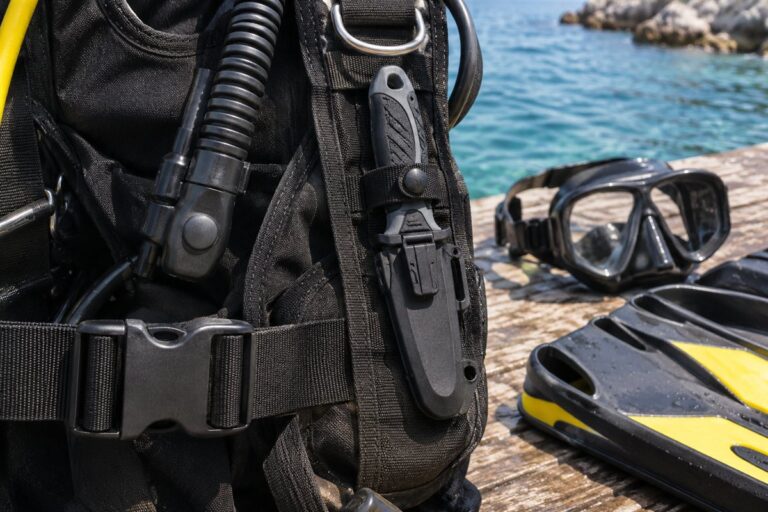
A knife is only useful if you can reach it, so think about where it will sit. Many divers wear one on the calf or forearm, while spearfishers sometimes prefer a position that stays clear of the gun and line. Look at the sheath release: it should hold firmly while swimming yet let you draw with one hand. Straps made of durable rubber or webbing with quick-release buckles are common.
- Confirm the knife locks into the sheath so it cannot slide out during a kick.
- Check that the handle is easy to grip with wet or gloved hands.
- Look at whether the tip is blunt or pointed and whether a line cutter notch is included.
- Rinse the sheath too, since sand and salt can build up behind the blade.
Local rules on knives and fishing gear vary between regions, so check the regulations in the place you dive before you carry one.
Maintenance Routine After Each Dive
Salt water is hard on any metal, so a short routine after every trip protects your knife and the sheath. Rinse in fresh water, working the blade in and out of the sheath to flush out grit. Dry thoroughly, then store the knife where air can circulate rather than sealed damp in a bag. Occasionally apply a light coat of oil suitable for your blade material, following the maker’s care sheet. Check the lock, the strap and the buckle for wear, and replace any part that looks cracked or stretched before your next outing.
Never test a blade on gear in the water; handle it deliberately, keep it sheathed when not in use, and store it out of reach of children at home.
Dive Knives for Spearfishing FAQ
Is titanium better than stainless?
Titanium resists corrosion better, but stainless often holds a sharper edge.
Where should I mount the knife?
Common spots are the calf, forearm or belt. Pick the one that avoids snags.
Do I need a line cutter?
A notch makes cutting tangled line much easier.
How big should a spearfishing knife be?
Compact is usually enough. Check the listing for exact dimensions.
Should I carry one dive knife or two?
Many spearfishers carry two, a compact one that is quick to reach and a larger one for heavy line. A single knife is fine if it is easy to draw with either hand. Redundancy matters because a lost or tangled knife is hard to replace mid-dive.
Is a serrated edge worth having on a spearfishing knife?
A serrated section helps with thick rope and braided line, but it is harder to sharpen and can snag fabric. A plain edge is better for slicing fish. Combination blades give you both, so check how much of the edge is serrated.
Can I sharpen a titanium dive knife?
Yes, though it is softer than most steels, so expect to touch it up more often. A fine stone or ceramic rod works for light edge maintenance. Follow the maker's advice for your specific blade.
How tight should the straps be?
Snug enough that the sheath does not slide, but not so tight that it restricts circulation. Cold water can shrink neoprene around the straps, so test the fit after you are already wet.
Do I need a blunt-tip knife?
A blunt tip is safer around gear, buoyancy equipment and your own body, but it is less suited to dispatching fish. Choose according to whether safety cutting or fish work is your main job.
How do I stop my knife rusting between dives?
Rinse in fresh water, dry both knife and sheath fully, and store them apart. A thin film of an appropriate protective oil can help if the maker allows it. Check for spots regularly.
What should I check before buying a dive knife online?
Confirm the blade steel, blade length, sheath release style, strap range and whether straps or mounts are included. Read the listing carefully, because editions of the same model can differ.
The Short Version
For an all-rounder, the Cressi Giant. For a slim carry, the Cressi Predator. For lasting rust resistance, the Scubapro Mako. For a secure sheath, the Mares Force. For a backup, the TUSA FK-940. For a spearo brand, the Riffe.