A dovetail saw is a small back saw with a thin blade and a stiff spine, used for the narrow, accurate cuts in dovetail joints. Fine teeth leave a smooth cut and a thin kerf makes the joint tight. The main choices are the blade length, the tooth count, whether the saw cuts on the push or pull stroke, and the style of the back.
The six picks below cover three British style brass back saws, a German style 10 inch saw, a Japanese pull saw and a folding Japanese saw with a quick change blade. Sizes, tooth counts and materials come from each listing page and are the makers’ own claims. We have not used these saws ourselves. Where a listing disagrees with itself, we say so.
As an Amazon Associate we earn from qualifying purchases. Links below are affiliate links, and they do not change the product information we give.
What to Look For
| Feature | Why it matters |
|---|---|
| Teeth per inch | More teeth leave a finer cut but cut slower |
| Kerf | A thin kerf wastes less wood in the joint |
| Back | A brass or steel spine keeps the thin plate straight |
| Cut direction | Push saws and pull saws feel different in use |
In this guide
Specs at a Glance
| Saw | Blade | Teeth | Notes |
|---|---|---|---|
| Lynx Thomas Flinn | 8 in | 20 TPI, rip filed | Brass back; beech handle; 2-3/8 in depth |
| Two Cherries 520-6020 | 10 in | 15 TPI | Brass back; German steel; 8 oz |
| Thomas Flinn Pax Gent | 8 in | 20 TPI | 0.022 in plate; 0.028 in kerf; walnut handle |
| SUIZAN Dozuki | 7 in | 17 TPI | Pull saw; 0.3 mm blade; 0.5 mm kerf |
| JORGENSEN folding | 6 in | 21 TPI | SK5 steel; 0.3 mm blade; quick change |
| Zona 35-380 | 8 in | 18 TPI | 0.020 in kerf; 1-3/4 in depth; made in the USA |
The 6 Best Dovetail Saws

Top pickBest for hand cut dovetails in hardwood
1. Lynx Thomas Flinn Taytools 8 in Dovetail Saw
An 8 inch saw with a 20 TPI plate filed for rip cutting, made by Thomas Flinn of Sheffield, England, according to the listing. The maker says the Sheffield alloy spring steel plate is taper ground and held straight by a folded solid brass back, and the stained European beech handle has brass button screws. The maximum cutting depth is listed as 2-3/8 inches. The details table shows a power source of corded electric, which cannot be right for a hand saw.
Suits: hand cut dovetails in hardwood. Strengths: a rip filed plate and a stated depth. Weaknesses: an obvious error in the power field. Skip it if you want a pull saw.


Best for larger dovetails and tenon work
2. Two Cherries 520-6020 10-Inch Brass Back Dovetail Saw
A 10 inch brass back saw with 15 teeth per inch and a pre-sharpened blade, described as having a German steel blade and a wooden handle. It weighs 8 ounces. The details table lists a speed of 4500 rpm and shows both a limited warranty and no warranty, so those fields should not be relied on.
Suits: larger dovetails and tenon work. Strengths: a longer blade and brass spine. Weaknesses: conflicting warranty and speed fields. Skip it if you want a 20 TPI saw.

View Two Cherries 520-6020 10-Inch Brass Back Dovetail Saw on Amazon

Best for fine, accurate joinery
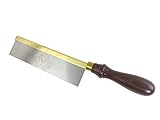
3. Thomas Flinn Pax 8 Inch Gent Dovetail Saw
An 8 inch gent style saw with a 20 TPI plate that is 1-5/8 inches wide and 0.022 inch thick, cutting a 0.028 inch kerf. The maker lists a solid rolled brass back of 0.500 by 0.160 inch, a high carbon alloy steel plate and a walnut handle 1-1/4 inches across and 5 inches long with a brass ferrule. The teeth can be resharpened.
Suits: fine, accurate joinery. Strengths: the most complete dimensions of the six. Weaknesses: a rolled brass back adds weight. Skip it if you prefer a light saw.

Best for thin kerf cheek and shoulder cuts
4. SUIZAN Dozuki Dovetail Saw, 7 in
A Japanese pull saw with a 7 inch (180 mm) blade, 17 TPI teeth and a steel back. The maker lists a 0.3 mm blade with a 0.5 mm kerf, a replaceable blade changed by hand and an overall length of 410 mm. The handle has an elastomer grip over ABS resin and the saw weighs 6.7 ounces. The warranty field shows 30 days.
Suits: thin kerf cheek and shoulder cuts. Strengths: a very thin blade and a replaceable plate. Weaknesses: a short 30 day warranty. Skip it if you want a push cutting saw.

View SUIZAN Dozuki Dovetail Saw 7″ Rip Cross Cut – Japanese Pullsaw Hand Saws on Amazon
Best for small boxes, instruments and restoration work
5. JORGENSEN 6 Inch Folding Japanese Pull Saw
A folding 6 inch pull saw with a 21 TPI SK5 steel blade, 0.3 mm thick, with a nickel plated finish. The maker says the blade changes without tools and the long handle is European beech. It weighs 0.26 kilograms. The listing says the short handle allows one hand use.
Suits: small boxes, instruments and restoration work. Strengths: a folding body and a fine tooth count. Weaknesses: the shortest blade of the six. Skip it if you cut deep, wide stock.
Best for a lightweight push saw for small joints
6. Zona 35-380 Thick Dovetail Saw
An 8 inch razor saw blade with 18 TPI, a 0.020 inch kerf and a 1-3/4 inch cut depth, described as Zona’s longest razor saw blade and suited to more forceful push stroke cuts. The overall length is 12-1/2 inches, the country of origin is the United States and the weight is 4.2 ounces. The details table shows 230 volts and no warranty, which do not fit a hand saw.
Suits: a lightweight push saw for small joints. Strengths: a stated kerf and depth. Weaknesses: odd listing fields. Skip it if you want a rigid brass back.
Care and Setup
- Hold the work firmly in a vise before sawing.
- Let a sharp saw cut with little pressure and a straight, light stroke.
- Wipe the plate dry and keep the teeth covered in storage.
- Follow the maker’s advice on resharpening or blade replacement.
Mistakes to Avoid
- Pushing hard on a thin blade and bending it.
- Trusting listing fields that contradict the product type.
- Buying a long saw for very small joints.
- Sawing past the layout line without a guide.
Tooth Geometry and Choosing Teeth Per Inch
Dovetail saws carry fine teeth, usually somewhere between about fifteen and twenty-one teeth per inch in this guide, and the number changes how the saw behaves. Fewer, larger teeth remove wood faster and feel more aggressive, so a lower count such as 15 or 16 suits thicker stock or a person who wants quicker progress. More teeth leave a smoother cut and let you start the kerf more gently, but they take more strokes. Higher counts such as 20 or 21 suit small joints in hardwood where a clean wall matters.
The shape of the teeth matters too. Rip teeth are filed square across the front, and cut along the grain like tiny chisels, which suits the long cuts in a dovetail tail or pin. Crosscut teeth are filed with bevels and sever fibers across the grain. Some listings in this guide mention rip filing, as the Lynx does, while others describe crosscut or hybrid teeth, and Japanese saws often use teeth shaped for pulling. Most woodworkers cutting the sides of a dovetail work mostly with the grain, so a rip pattern is a natural match, but many joints involve both directions. Check the listing for the tooth type, the count and whether the teeth can be resharpened, since a saw you can sharpen lasts longer. If the listing gives no tooth information, treat the saw as an unknown and look for a clearer description.
Back Weight, Blade Depth and Balance
The spine of a back saw keeps the thin plate straight and adds weight behind the cut. Brass backs, as on the Lynx, Two Cherries and Pax saws, are heavier than steel and give the saw momentum that lets it cut with little downward pressure. Steel backs are lighter and slimmer. A heavier saw can feel steady in the cut, but it may tire the hand over a long session, while a lighter saw gives more feel and finer control but needs a more careful touch. Neither is right for everyone, and a lot depends on the size of your hand and the type of work.
Blade depth, the distance from the toothed edge to the back, limits how deep you can cut. The listings mention depths such as about two and three-eighths inches or one and three-quarters inches. A shallow blade is enough for most dovetails in typical stock, while a deeper blade suits larger tenons or thicker timber. A longer plate, like the ten-inch Two Cherries, gives longer strokes, but a shorter one is easier to control for small joints. Hold the saw if you can, or look at the handle shape: a handle that fits your hand and lets your index finger point along the blade helps you steer. Open pistol grips and closed handles feel different, so consider which you prefer. Check the length of the blade against the size of the joints you plan to cut.
Push Saws Versus Pull Saws
Western dovetail saws cut on the push stroke, so the plate is under compression and needs a stiff back to stay straight. Japanese saws cut on the pull stroke, which puts the blade under tension. That allows a thinner plate and a narrower kerf, as the 0.3 mm blades on the SUIZAN and JORGENSEN show. Thin blades waste less wood and can feel smooth, but they are more fragile and can kink if forced.
The experience also differs. Push saws give a feeling of weight behind the stroke and are common in Western woodworking. Pull saws can feel lighter and more responsive, and many people find it easy to start a cut with them. A Japanese saw often has a long handle that is held with two hands, though a folding model like the JORGENSEN has a handle suited to one hand. Replaceable blades, mentioned on both Japanese saws here, mean you can renew the cutting edge instead of resharpening, which is useful if you do not want to learn sharpening. Push saws can often be resharpened by hand or by a professional. Neither style is better by default. Try to match the style to the way you like to work, the tools you already own and how much time you want to spend on maintenance.
Cutting Technique for Clean Joints
A fine saw rewards a light touch. Clamp the work firmly at a comfortable height, so your forearm can move freely along the line of cut. Mark the joint with a sharp knife or pencil, and start the cut on the waste side of the line. Use your thumb or a small block of wood as a guide at the start, and take a few light strokes to form a groove before you extend the stroke. Let the weight of the saw and the sharpness of the teeth do the work, and avoid pressing down.
Look at both faces of the board as you cut to keep the saw square, and watch the line on the near side as well as the far side. Cut straight down to the baseline and stop. Many people practice on scrap first, because angled cuts in dovetails call for a steady wrist and a clear sight line. If the saw drifts, ease off and correct slowly rather than twisting the blade, which can cause binding. After the saw cuts, clean out the waste with a chisel. Remember that a thin kerf leaves a tighter fit, so allow for the width of the cut when you decide which side of the line to saw. A good light and a clean bench make accuracy easier. Practice joints in cheap softwood before you commit to your best timber.
Sharpening, Care and First-Saw Advice
Dovetail saws stay sharp longer if you treat them gently. Never leave a saw loose in a drawer where the teeth can knock against other tools. Use a blade guard or store it hanging. Wipe the plate with a dry cloth after use, and if you work in a damp space, apply a light film of oil to protect against rust, taking care to keep oil off the wood you are about to cut. Check that the handle screws and the back are tight.
Signs that a saw needs attention include wandering cuts, a need to press hard, burnished or rough kerf walls, a bent plate and chipped or missing teeth. Resharpening needs fine files and some practice, and many makers give instructions or offer a service. For saws with replaceable blades, change the blade when cutting becomes slow. If you are new to hand tools, choose a saw whose listing gives clear information on tooth count, blade size and any warranty, and expect a learning curve. A modest, well-described saw you can use comfortably will teach you more than an expensive saw that does not suit your hand. Follow the maker’s instructions and be careful with any listing that contains obvious errors, since they may signal poor product information.
Which dovetail saw should you buy?
The right dovetail saw depends on whether you prefer a push or a pull stroke, how big your joints are and how much weight you like behind the cut. Use these pairings to narrow the six picks.
- Classic British feel with a rip filed plate: the Lynx Thomas Flinn is the choice for hand cut dovetails in hardwood.
- Larger joints and tenon work: the Two Cherries 520-6020 has the longest blade of the group.
- Fine joinery with the fullest dimensions on the page: the Thomas Flinn Pax Gent gives the most complete spec list, so it is the easiest to judge before buying.
- Thin kerf cheek and shoulder cuts: the SUIZAN Dozuki is a Japanese pull saw with a replaceable blade.
- Small boxes, instruments and restoration: the JORGENSEN folding saw is the compact, tool-free blade change option.
- A light razor style push saw: the Zona 35-380 suits small joints when you do not want a heavy brass back.
If you are new to hand sawing, a pull saw is often easier to start, while a brass back saw rewards a steady, light stroke once you have practiced. Hand size matters too, so check the handle dimensions where the listing gives them.
What to check before you buy, and who should skip it
A short checklist helps you avoid the most common dovetail saw disappointments.
- Blade length and depth, compared with the size of the joints you plan to cut.
- Teeth per inch and whether the teeth are rip or crosscut.
- Whether the plate can be resharpened, or the blade can be replaced.
- Handle shape and size, since a poor fit makes fine cuts harder.
- Any warranty or return terms, noting that several listings here show fields that contradict the product type.
- What is included, such as a spare blade or a guard for the teeth.
Be honest about the trade-offs. Brass back saws give momentum but add weight and take practice to keep square. Japanese saws cut a narrow kerf with a thin plate, yet that plate can kink if you force it. A folding saw is convenient but has the shortest blade, so it is a poor fit for deep, wide stock. Several listings contain obvious errors in their detail fields, so rely on the maker’s description and ask the seller if something matters to you.
Who should skip a dovetail saw? If you mostly cut large timber or long rip cuts, a larger tenon or panel saw is a better match. If you prefer power tools and do not plan to cut joints by hand, a dovetail saw is an unnecessary purchase.
When you are ready, compare the picks above, check the current listing for size and what is included, and choose the saw that fits how you will use it.
Reading the Six Dovetail Saws Side by Side
Dovetail saws divide along one great fault line — Western push saws with a rigid back versus Japanese pull saws with thin blades — and then subdivide by size, tooth pattern and whether the blade can be resharpened or replaced. The six picks cover both traditions, so the honest comparison starts with how you like to work, then narrows to the details.
Lynx 8 inch versus Two Cherries 10 inch
Both are Western back saws, but they aim at different stock. The shorter Lynx suits the classic dovetail workload — drawer sides, box parts, small casework — where a compact blade is easier to keep on line and the depth of cut is ample. The longer Two Cherries, with its brass back, offers more stroke length and a little more mass, which suits larger casework and thicker stock where each stroke should move more wood. Neither is better in the abstract: match blade length to the joints you cut most, because an oversize saw on small work feels like steering a bus through a doorway.
Thomas Flinn Pax gent’s saw versus the standard patterns
A gent’s saw, with its straight handle aligned with the blade, trades the leverage of a pistol grip for a delicate, fingertip feel. It shines on very small, fine work — small boxes, model-scale joinery, thin stock — where a full-size saw’s weight overwhelms the cut. If your dovetails live in drawer-scale stock, a conventional handle gives more control across a full stroke; if they live in thin, small parts, the gent’s pattern is not a compromise but the correct tool.
SUIZAN dozuki versus JORGENSEN folding pull saw
Both cut on the pull stroke with thin blades and fine teeth, leaving narrow kerfs and crisp lines. The SUIZAN is the dedicated joinery tool: rigid-backed, precise, and made for the bench. The JORGENSEN folds, which makes it the traveller of the group — site work, a portable kit, or a small shop where storage is tight. Pull-saw users consistently report that starting a cut feels easier because the blade is in tension rather than compression; push-saw users counter that the stroke and stance they already own from other saws transfer directly. Both are right, which is why hands-on feel decides this one.
Zona 35-380
The Zona is the small, fine option from a maker known for hobby-scale tools. It suits thin stock, small boxes and makers whose dovetails are closer to model scale than furniture scale. Its limits appear on thick or very hard stock, where a sturdier saw earns its keep — know your material range before choosing the lightest tool in the list.
Your First Session: Setup in the Right Order
Start with marking, not sawing. A dovetail saw can only follow the line it is given, so knife your lines, mark waste clearly, and clamp the workpiece vertically at a comfortable height with the line fully visible. Take the saw to scrap of the same thickness and species if you can, and practise starting the cut: a couple of light pull or push strokes to establish a kerf on the waste side of the line, then commit. Sight down the blade from above and check the saw is vertical before the cut deepens — corrections are free in the first few strokes and expensive later. Cut a row of practice tails, then pins, and inspect where the saw drifted: nearly every beginner drifts the same way, and knowing your personal drift is the fastest route to compensating for it.
Technique: Stance, Stroke and Line Discipline
Stand so your sawing arm, the blade and the cut line share one plane, with your eye directly over the blade. Let the saw’s weight do the work — downward pressure makes teeth grab and the cut judder, especially in thin stock. Use most of the blade’s length in a relaxed rhythm, and slow down rather than press harder when the cut resists. Split the line consistently: saw on the waste side, leaving the line visible, because you can always pare to a line but you cannot add wood back. On the second half of the joint, let the first half be your template — transferring marks directly from tails to pins, rather than measuring twice, is what makes hand-cut dovetails fit at furniture speed.
Troubleshooting in Diagnostic Order
When dovetail cuts wander, diagnose in order. First, the line: was it knifed, visible, and marked on the correct side? More joints fail at layout than at the saw. Second, the start: a kerf started off-line will be followed faithfully — restart shallow rather than steering mid-cut. Third, pressure: pressing down or sideways bends a thin blade’s path, so lighten your grip and retest on scrap. Fourth, stance: if every cut drifts the same direction, your eye is not over the blade — adjust your position, not the saw. Only after those checks should you blame the tool: unevenly set or dull teeth genuinely pull a saw to one side, and that shows as drift that follows the saw across different users and stances.
Care, Storage and Blade Manners
Fine teeth are delicate. Store a dovetail saw in a till, a sleeve or hanging — never loose in a drawer where teeth meet other tools — and wipe the blade dry after use, because a thin plate shows rust quickly. Keep the blade out of harm’s way on the bench: a saw left teeth-up where hands land is an accident with a date on it. Western saws in this class can be resharpened with the right files and practice; Japanese blades are typically replaced when dull, which is a running-cost consideration rather than a flaw. Either way, a blade guard for transport protects both the teeth and everything the saw travels with.
Choosing by the Work You Actually Do
Drawer and box makers should take the compact Western saw or the dozuki in their preferred stroke tradition. Larger casework points to the longer, heavier backed saw. Fine small-scale work points to the gent’s saw or the Zona. Travelling and site-based makers should look hard at the folding pull saw. And a beginner with no stroke loyalty yet should choose by feel if at all possible — the saw whose stroke feels natural in the first ten practice cuts is the one whose technique will still be improving in a year.
How do I stop the saw jumping out of the kerf at the start?
Start with the lightest possible strokes, using just the front portion of the blade, and let the teeth score a shallow groove before you lengthen the stroke. Keep the blade angle low at the start so more teeth engage, support the workpiece so it cannot vibrate, and check that you are starting on the waste side of a clearly knifed line — a saw jumps when it is being asked to bite too deeply, too fast, on a line it cannot see.
Should I cut pins or tails first?
Either order works, and experienced makers defend both. Tails first lets you use the finished tails as the direct template for marking pins, which most beginners find more forgiving. Pins first suits makers who prefer to transfer from the smaller pieces. Choose one order, practise it until the sequence is automatic, and only experiment with the other once your joints already fit — consistency of process is worth more than the theoretical edge of either method.
A Worked Drawer Side, Start to Finish
Take one drawer side through a full dovetail cycle and the saw’s role becomes concrete. The tails are marked from the drawer side’s end, waste shaded, and the board clamped vertically with the end grain up. Each tail cut starts on the end grain with a light scoring stroke, then deepens with the saw following the angled line on the face — angled in plan, vertical in elevation, which is why your eye must stay over the blade while your peripheral vision tracks the face line. Waste between tails is removed with a coping saw and chisel work, and then — the step that defines hand dovetailing — the finished tails are used to knife the pin lines directly onto the mating board. No measurement transfers; the saw’s own work becomes the template, so small imperfections cancel instead of accumulating.
The pins are cut the same way, on the waste side of those knifed lines, and the joint is test-fitted once, firmly, and read: tight spots are pared, never forced, because forcing a dovetail home splits the pin board. When the joint closes with hand pressure and the shoulders meet cleanly, the saw has done everything asked of it. Notice what the exercise proves: fit quality came from marking discipline and waste-side consistency, with the saw as the faithful executor — which is why the saw you find easiest to keep honest matters more than the saw with the most impressive specification.
Dovetail Saws Among Their Neighbours
Three neighbours border the dovetail saw’s territory. The tenon saw is its bigger sibling: deeper blade, longer stroke, made for tenon cheeks and shoulders; it can cut large dovetails in thick stock but is clumsy in drawer material, while the dovetail saw is hopeless on deep tenon cheeks — size is capability here, not marketing. The gent’s saw overlaps at the small end, trading handle leverage for delicacy on the thinnest work. The coping saw is not a rival but a partner, removing the waste the dovetail saw leaves between tails and pins. And the dovetail marking gauge, the knife and the chisel complete the system: the saw is one instrument in a five-piece band, and buying it without the marking tools is like buying a violin bow and expecting the violin to be included.
A Pre-Purchase Checklist
Settle five things before choosing. One: your stroke tradition — push or pull — decided by feel if possible, by honest self-knowledge if not. Two: your stock range — measure the thickest material you will dovetail, and confirm the saw’s depth of cut clears it with room to spare. Three: tooth fineness against your species — fine teeth for hard, thin, brittle stock; slightly coarser for soft, thick, fast work. Four: blade economics — a resharpenable Western blade asks for files and skill or a sharpening service, while a replaceable Japanese blade asks for spare blades in the drawer; both are legitimate, but choose consciously. Five: handle fit — the saw is guided by a relaxed hand for hundreds of strokes per project, so a handle that cramps or blisters is a defect no tooth pattern can offset. Answer those five and the six picks resolve into a shortlist of one or two, which is exactly where a good buying decision should end up.
Building Dovetail Practice Into Your Everyday Workflow
Hand-cut dovetails improve through frequency, not intensity. A maker who cuts one practice joint at the start of each bench session — five minutes, scrap material, no audience — accumulates more quality repetitions in a month than a maker who attempts a heroic full drawer once a quarter. Keep a small bundle of prepared scrap beside the bench, keep the saw racked and ready, and let the warm-up joint be as unremarkable as sharpening a pencil. The project’s joints then inherit a technique that was exercised minutes earlier rather than remembered from weeks ago.
Keep your practice joints. A dated row of them is the most honest progress record in the workshop: gaps narrow, shoulders close, and the specific fault you are currently fixing stands visible in the most recent three. When a project’s joint goes wrong, that row also tells you whether the fault is new — a bad day, a dull saw — or old and habitual, which is the difference between an adjustment and a practice plan.
How many practice joints before I cut a real project?
Enough that the sequence feels boring: marking without hesitation, starting cuts without drama, and a test fit that closes with at most one round of paring. For most beginners that point arrives somewhere in the first dozen or so practice joints in forgiving material. Move to a real project while the skill is fresh rather than chasing perfection in scrap — a simple box with real purpose teaches the last lessons practice cannot, because the stakes make you careful in the right places.
Why do my pins always end up tighter than my tails suggest?
Usually the transfer, not the sawing: if the tails are not held perfectly registered while the pin lines are knifed, the marked pins inherit a small shift, and small shifts always seem to land on the tight side. Clamp or firmly pin the tail board in its exact final position during marking, knife both sides of each tail, and double-check registration before unclamping. A joint marked accurately and sawn merely well fits better than a joint marked carelessly and sawn beautifully.
How do I cut dovetails in very hard or brittle wood?
Slow down and sharpen the equation in your favour: knife lines deeper so surface fibres are fully severed before the saw arrives, choose the finest teeth you own, and take the waste out in smaller stages so the saw never works against a full, unsupported section. Brittle woods punish forcing — the saw should feel almost idle, with the cut advancing on stroke rhythm rather than pressure. Support the board right up to the cut on both faces during waste removal, because most brittle-wood failures happen at the chisel stage, not the sawing stage, when an unsupported corner simply snaps away.
What is the best way to correct a dovetail cut that has drifted?
Correct at the fitting stage, not by re-sawing: a drifted tail or pin is pared back to its line with a chisel, using the knifed line as the authority, because the saw cannot remove a whisper and the chisel can. If the drift is consistent across a whole joint, mark the mating half from the drifted half as it actually is — hand dovetailing’s great mercy is that the template is the work itself, so honest marking converts a sawing error into a fitting footnote. Reserve re-sawing for cuts so far off that paring would change the joint’s proportions visibly.
How do I keep the saw from binding in resinous softwood?
Keep the blade clean — resin build-up on the plate drags more than dullness does — and keep strokes long and unhurried so the kerf clears its own dust. A blade that binds in pine but runs freely in hardwood is almost never dull; it is dirty or being pressed. Wipe the plate, lighten your hand, and the same saw usually finishes the joint without complaint.
How do I cut dovetails in a board wider than my saw’s comfortable stroke?
Wide boards — carcass sides rather than drawer parts — ask for the longer saws in this list and a staged approach: work the tails in groups, repositioning your stance rather than reaching, so every cut is made from the same honest body position. Depth is rarely the problem, since dovetail depth is set by stock thickness, not board width; the challenge is purely ergonomic consistency across a long row of tails. Mark the whole row first, cut the whole row second, and resist finishing one tail completely before starting the next — batch rhythm is what keeps twenty tails looking like siblings instead of strangers.
What changes when I cut dovetails in softwood after learning in hardwood?
Softwood forgives sawing errors and punishes fitting errors: it pares easily, bruises visibly, and compresses under an over-tight joint so the joint feels fitted while its fibres are crushed. Slow your fitting down, pare less per pass, and judge fit earlier. The saw itself needs no adjustment beyond a lighter hand — softwood’s lower resistance tempts speed, and speed is where its easy bruising happens. Makers who learn in hardwood first usually adapt in a single practice joint; the reverse journey takes longer.
A last word on your first dovetail saw
Every saw in this list has cut fine dovetails in someone’s hands, which means the deciding factor was never really the saw. Choose the one whose stroke tradition feels natural, whose depth covers your stock, and whose handle you can hold relaxed for an afternoon — then commit to it for a full season of joints before judging it. Saw loyalty during the learning months matters, because technique calibrates itself to one tool’s weight, balance and tooth behaviour, and switching saws mid-education restarts that calibration each time. A year from now, the right question will not be whether you bought the best saw on the page, but whether your hundredth joint fits better than your tenth — and that improvement is available with any of these six, in hands that practised.
Keeping a cutting diary for one month
For one month, note three things after each dovetail session: the material, the fault that appeared most, and the one adjustment you will try next. The diary takes two minutes and converts vague dissatisfaction into a specific, testable change — stance, pressure, marking, sharpness — instead of a general feeling that the saw is not performing. At the month’s end, the pattern in your notes is your personal curriculum, more precisely aimed than any general tutorial, because it was written by your own hands in your own timber. Most makers who try it keep the habit long after the month ends, in a notebook that lives with the saw.
Dovetail Saw FAQ
What is the difference between a push saw and a pull saw?
A push saw cuts as you push it away and needs a stiff spine, while a pull saw cuts on the pull stroke and can use a thinner blade.
Which saw has the thinnest kerf?
The SUIZAN lists a 0.5 mm kerf, about 0.020 inch. The Zona lists 0.020 inch and the Pax lists 0.028 inch.
What is the best TPI for a first dovetail saw?
Counts in the high teens are a common starting point because they balance speed and smoothness. Your wood and the size of the joint also matter. Check the listing and think about whether you will cut softwood, hardwood or both.
Do I need a rip or a crosscut dovetail saw?
Many dovetail cuts follow the grain, so rip filed teeth are a natural fit. Some saws use other patterns that work in both directions. Read the listing to see how the teeth are filed.
Can a Japanese pull saw cut dovetails?
Yes, many woodworkers use them for dovetails because the thin blade leaves a narrow kerf. The tradeoff is a more delicate plate. Choose the style that feels natural to you.
How do I stop the saw from wandering?
Start the cut with light strokes, keep your eye on both faces of the board, and let the saw do the work. Check that the work is clamped firmly and the saw is sharp.
Can I sharpen a dovetail saw at home?
Many people do, with a small file and patience, but it takes practice. Replaceable-blade saws avoid the task. Check the maker's guidance on sharpening.
Is a brass back better than a steel back?
Brass is heavier and adds momentum, while steel is lighter. Neither is better for every user. Choose according to how the saw feels in your hand.
How should I store a dovetail saw?
Keep it dry, hang it or use a guard over the teeth, and wipe it before putting it away. Protect the plate from bending.
What size dovetail saw should a beginner buy?
A saw with an 8 inch blade is a common starting size because it is easy to control on small joints. Longer blades suit larger work, and shorter ones suit very small boxes. Check the listing and match it to your joints.
What is the difference between a dovetail saw and a tenon saw?
A dovetail saw is smaller and has finer teeth for narrow, precise cuts. A tenon saw is larger and cuts deeper, suiting bigger joints. Many woodworkers keep both.
Do I need a guide to cut straight dovetails?
A guide is optional, but a marked line, a steady clamp and light starting strokes help a lot. Some people use a thumb or a small block to start the cut. Practice on scrap before cutting your final timber.
Why does my dovetail saw bind in the cut?
Binding usually comes from pressing too hard, twisting the blade or a kerf that closes behind the plate. Ease off, keep the stroke straight and make sure the wood is supported. A dull saw can also bind, so check the edge.
Are replaceable blades better than resharpenable ones?
Neither is better for everyone. Replaceable blades save you from learning to sharpen, while a resharpenable plate can last longer with care. Pick the one that fits how you maintain tools.
Can I cut dovetails in softwood and hardwood with the same saw?
Yes, many saws handle both, though finer teeth suit hardwood and fewer, larger teeth cut softwood faster. Check the tooth type on the listing. Keep the saw sharp for either.
The Short Version
For a rip filed brass back, the Lynx Thomas Flinn. For a longer blade, the Two Cherries. For a fully described gent saw, the Pax. For a thin Japanese pull saw, the SUIZAN. For a folding saw, the JORGENSEN. For a light razor style push saw, the Zona.