A precision knife is a slim, pen-style blade holder made for detail cutting. It is the tool you reach for when building models, cutting stencils, trimming paper or working in tight areas where a utility knife is too big.
The six tools below mix classic hobby knife handles with a surgical-style scalpel and a pen-style blade holder. We have not used these products ourselves, so please confirm every detail on the current listing before you buy. Blade types and handle styles vary between versions, so check what is included before you order.
As an Amazon Associate we earn from qualifying purchases. Links below are affiliate links, and they do not change the product information we give.
What to Look For
| Feature | Why it matters |
|---|---|
| Handle | Round handles roll in the fingers; flat handles resist rolling off a table |
| Blade type | Pointed blades suit detail; curved blades suit long cuts |
| Replacement blades | Check blade availability, since they dull quickly |
| Safety | A cap or case protects the point when not in use |
In this guide
Specs at a Glance
| Knife | Handle | Blade style | Notes |
|---|---|---|---|
| X-Acto No. 1 Precision Knife | Metal or plastic, round | Pointed, replaceable | Classic hobby knife |
| Excel Blades K18 Pen Style Hobby Knife | Metal, pen style | Pointed, replaceable | Comfortable for long sessions |
| Olfa AK-4 Art Knife | Metal, slim | Fine, replaceable | Art knife from a cutting-tool maker |
| NT Cutter D-400GS Design Knife | Metal, slim | Fine, replaceable | Design knife for tiny cuts |
| Fiskars Softgrip Detail Knife | Soft rubber grip | Pointed, replaceable | Cushioned handle for comfort |
| Swann-Morton Scalpel Handle No. 3 | Flat metal | Scalpel, replaceable | Medical-style handle |
The 6 Best Precision Knives
Top pickBest for general craft work
1. X-Acto No. 1 Precision Knife
The classic hobby knife that many crafters think of first. It takes a pointed replaceable blade, and the handle is light and easy to control. Spare blades are sold separately, so stock up before a big project.
Suits: general craft work. Strengths: a familiar design and easy blade swaps. Weaknesses: round handle can roll. Skip it if you want a cushioned grip.
View X-Acto No. 1 Precision Knife on Amazon
Best for long projects
2. Excel Blades K18 Pen Style Hobby Knife
A metal pen-style hobby knife with a comfortable shape for long sessions. The collet holds the blade, so swaps are quick. Its small size helps in tight corners.
Suits: long projects. Strengths: a pen-like feel and a good hold on the blade. Weaknesses: less cushion than rubber grips. Skip it if you need a safety cap.
View Excel Blades K18 Pen Style Hobby Knife on Amazon

Best for paper and craft work
3. Olfa AK-4 Art Knife
A slim art knife from a Japanese cutting-tool maker. It takes fine replaceable blades and is made for precise paper and craft work. Confirm which blade numbers fit the handle before you order.
Suits: paper and craft work. Strengths: clean lines and a fine tip. Weaknesses: narrow handle may tire hands. Skip it if you want a cushioned grip.

Best for small shapes and drafting
4. NT Cutter D-400GS Design Knife
A fine-point design knife with a slim body. It is made for cutting small shapes, graphic work and scale models. It slips easily into a toolbox drawer or a craft caddy.
Suits: small shapes and drafting. Strengths: a slim body and a fine tip. Weaknesses: small for large hands. Skip it if you prefer a thick grip.
View NT Cutter D-400GS Design Knife on Amazon
Best for comfort during long projects
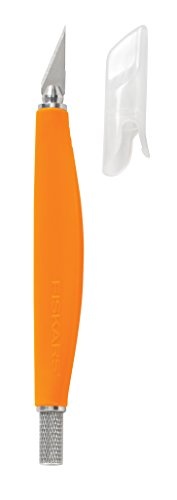
5. Fiskars Softgrip Detail Knife
A detail knife with a soft grip and a pointed blade. The cushioned handle helps reduce hand strain. Always keep a cap on the point when you set it down.
Suits: comfort during long projects. Strengths: a soft rubber grip. Weaknesses: not as slim as metal handles. Skip it if you want a thin pen handle.

Best for very fine cuts
6. Swann-Morton Scalpel Handle No. 3
A flat metal scalpel handle that takes replaceable scalpel blades. It is a favorite for model makers and fine cutting. A fresh blade makes the biggest difference to cut quality.
Suits: very fine cuts. Strengths: a sharp scalpel blade and precise control. Weaknesses: blades are very sharp and need careful handling. Skip it if you want a rounded craft handle.
View Swann-Morton Scalpel Handle No. 3 on Amazon
Care and Setup
- Change blades often, since a dull blade slips and tears.
- Store knives with a cap on the blade.
- Use a self-healing cutting mat.
- Dispose of old blades in a sealed container.
Mistakes to Avoid
- Pressing too hard in a single pass.
- Cutting toward your free hand.
- Leaving blades uncovered in a craft drawer.
- Skipping spare blades before a project.
Matching Blade Shape to the Task
Precision knife blades come in many shapes, and choosing the right one affects both quality and safety. A pointed blade with a straight edge is the all-rounder for stencils, paper cutting and model parts, since the tip reaches into corners. A curved or rounded blade suits long sweeping cuts, such as trimming around curves in cardstock or leather. A chisel-shaped blade can shave and carve thin material and clean up edges. A skew blade helps with tight corners and slicing thin sheets. Scalpel blades are available in various profiles, and their numbering systems differ from hobby blades, so do not assume a number from one brand fits another.
Think about your material. Thin paper and vinyl are easy to cut with a fine, sharp point. Thick cardboard, foam board and plastic need a firmer blade and several light passes rather than one heavy cut. Wood veneer, balsa and thin plastics benefit from a slightly sturdier blade. Many crafters keep two or three blade types on hand rather than hunting for one that does everything.
When you read a listing, check what blade the handle comes with and what blades fit it. Some handles accept only the maker’s own blades, while others use a standard fit that is shared across brands. Check the manual or listing for compatibility before buying spares.
- Pointed blade: detail, corners, general use.
- Curved blade: sweeping cuts and contours.
- Chisel blade: trimming and shaving.
- Scalpel profile: very fine cutting and delicate work.
Handle Ergonomics and Control
For detail work, the handle determines how steady your hand is. A pen-style handle that you hold like a pencil gives the best fine control for most people. Thin handles allow maximum precision but can tire the hand over long sessions, while thicker or cushioned grips reduce strain but can feel less direct. If you have arthritis, tremor or hand fatigue, a soft grip and a slightly larger diameter may make a real difference.
Shape affects safety as much as comfort. Round handles roll off a table and can drop onto a foot or damage a project, while flat or faceted handles resist rolling. Weight balance matters too. A knife with its weight toward the blade end feels different from one weighted in the grip, and heavier tools can be steadier while lighter ones allow quicker adjustments.
Check how the blade is held. Collet systems tighten around the blade, and screw-down or twist designs allow quick changes. A loose blade is dangerous and ruins cuts, so inspect the clamp after fitting a new blade and give the blade a gentle wiggle to confirm it is secure. If the clamp wears and cannot hold a blade tightly, replace the handle.
- Pen-style grip: good for fine control and long sessions.
- Cushioned grip: reduces strain, though some feel less direct.
- Flat or faceted body: resists rolling off the bench.
Try holding different handles if you can, and compare them with your hand size.
Blade Changes, Spares and Disposal
Blades dull quickly on paper and card, and a dull blade drags, tears and requires more pressure, which increases the chance of slipping. Replace the blade as soon as cuts start to look ragged or the knife needs extra force. Many users change blades far more often than they expect, so buy spares in a pack rather than one at a time. A good rule is to keep a spare blade ready before you start a big project.
Changing a blade needs care. Many handles use a collet or a clamp that you loosen, slide the old blade out of, and then tighten around a new one. Use a pair of tweezers or pliers if the blade is difficult to grip, and cut-resistant gloves if you are nervous. Hold the blade away from your fingers and work on a stable surface, with the handle supported. Never try to catch a falling blade.
Disposal is a safety issue. Do not toss loose blades into household trash, where they can cut bags and people. Use a purpose-made blade disposal container, or a sturdy sealable jar or can with a narrow slot, and follow local rules for sharps disposal. Keep spare blades in their original case or dispenser, so tips do not dull or poke through pockets.
- Change blades often rather than pushing harder.
- Store spares in a case with a labelled compartment.
- Dispose of used blades in a sealed container.
Check that the replacement blades you buy match your handle, since fit and thickness vary.
Work Surface and Cutting Technique
A good surface prolongs blade life and improves cuts. A self-healing cutting mat grips the material lightly and absorbs the blade without dulling it as quickly as glass, hard plastic or wood. Choose a size that suits your work, and replace the mat when it becomes heavily scored. Use a metal ruler as a guide rather than a plastic one, since a blade can nick plastic and wander. Keep your free hand behind the ruler, clear of the blade path.
Technique matters more than force. Make several light passes instead of one heavy cut. The first pass scores the surface and guides later passes, and it reduces the chance of tearing or wandering. Keep the blade angle consistent and pull the knife toward you instead of pushing it away where possible, using your whole forearm rather than just your fingers. Rotate the material, not the knife, when cutting curves.
Good habits include:
- Cut on a stable, well-lit surface at a comfortable height.
- Keep your fingers behind the blade and away from the cutting line.
- Do not use the knife to pry, scrape or open cans.
- Put the cap on when you pause, and store the knife with the tip covered.
If you cut curves often, a swivel-style tool or a rotary cutter may be easier for you. Practice on scrap pieces before cutting your final project.
Choosing by Craft and Budget Tier
The right precision knife depends on what you make. Paper crafters and scrapbookers value a light, easy handle and cheap, plentiful blades. Model builders often want a fine point and high control, and may prefer a scalpel-style handle with sharp, thin blades. Stencil, vinyl and sign makers value consistent blades and a comfortable grip for repetitive cutting. Leather and light craft workers may prefer sturdier blades that resist flexing. If you use the tool occasionally, a simple handle and a pack of blades is enough. If you use it daily, comfort and blade availability become more important.
Budget tiers differ in handle materials, finish and clamp quality. Lower-priced handles can serve well but may have clamps that wear out sooner or plastic that flexes. Mid-range options often add metal bodies and better balance. Higher-priced tools tend to offer more refined materials and sometimes better replacement parts. None of this is a guarantee, so read reviews that mention clamp security and long-term wear.
Questions to ask before buying:
- Are replacement blades widely available and easy to find?
- Does the listing say which blades fit and how many are included?
- Is there a cap or a case to protect the tip?
- Does the handle suit my grip and the way I work?
Replace the handle if it loosens, the clamp slips or the body bends. A basic knife with a good supply of fresh blades beats an expensive one with a dull blade.
Precision Knife FAQ
How often should I replace the blade?
Replace it as soon as it begins to drag or tear paper.
Is a scalpel the same as a hobby knife?
They are similar, but scalpels use finer, thinner blades and a flat handle.
Do I need a cutting mat?
Yes. A mat protects your table and the blade tip.
Are all blades interchangeable?
No. Blade fits depend on the handle, so match the blade number to the tool.
What is the best way to cut thick material with a precision knife?
Make several light passes against a metal ruler instead of forcing one deep cut. Replace the blade if it starts to drag.
Can I sharpen hobby blades?
Most people replace them, since the blades are thin and inexpensive. Sharpening is possible with fine stones, but it takes skill and is rarely worth it for small blades.
Are scalpel blades the same as hobby blades?
They look alike, but the fit and numbering differ between systems. Check that the replacement blade is listed as compatible with your handle.
How do I avoid slipping when cutting?
Use a sharp blade, a stable mat and a ruler. Keep your free hand behind the guide and use light, repeated passes.
What is a good mat for precision cutting?
A self-healing cutting mat is a common choice because it protects both the table and the blade. Replace it when it becomes deeply scored.
How should I carry a precision knife in a bag?
Fit the cap or put it in a rigid case so the point cannot poke through fabric. Never carry it loose.
Is it safe for children to use a precision knife?
These tools are sharp and need adult supervision. Safer craft cutters may suit younger users.
Paper, Stencils and Vinyl: How Technique Changes
Precision knives are used on thin, flexible materials, and each one calls for a slightly different approach. Paper and cardstock cut cleanly with a sharp, fresh blade and light pressure. Hold the knife like a pencil, keep the blade at a shallow angle and pull toward you in a steady line. Cutting curves works best when you rotate the paper rather than twisting the knife, which keeps the blade from binding and tearing.
Stencils, particularly thicker plastic or acetate sheets, need more passes and a steadier hand. Several light cuts are more accurate than one heavy one, and the blade must stay vertical so edges are clean. Vinyl and adhesive films are soft and can stretch if you drag a blade through them. Use a sharp point, light pressure and a firm backing surface. Cutting through the vinyl without scoring the backing sheet below takes practice, and a spare piece to test on helps.
- Paper: fresh blade, light pressure, rotate the material for curves.
- Stencil sheets: several passes and a vertical blade.
- Vinyl: sharp point, light pressure, test on scrap first.
- Photo prints and mounts: a clean, sharp edge and a metal straightedge.
Light, Magnification and Posture for Fine Detail
Many cutting errors come from poor visibility rather than a poor knife. Good lighting reduces eye strain and shows you exactly where the blade will go. A desk lamp placed to the side opposite your cutting hand avoids shadows from your hand. A bright, even light that does not glare off a glossy mat helps you see the cut line clearly.
For very small work, such as model parts, jewelry templates or intricate paper designs, a magnifier can be a valuable addition. A magnifying lamp or head-worn magnifier keeps both hands free. Take care that magnification can distort depth, so go slowly at first. Posture is part of accuracy, too. Sit at a table of the right height, rest your forearm on the surface for stability and keep your wrist relaxed. Tension in the hand leads to jerky cuts and fatigue, so take breaks and shake out your hand now and then.
Think about the knife’s design when planning your setup. A pen-style knife like the ones in this guide gives good visibility of the tip because the handle is slim. A heavier handle can block part of your view. Choose a knife that lets you see the point of the blade as you cut.
Difficult Materials: Foam, Balsa, Fabric and Leather
Some materials push a small knife to its limits, and knowing how to handle them prevents ruined work. Foam board and foam core need a very sharp blade and a slow, steady cut, since a dull blade crushes the foam instead of cutting it. Balsa wood is soft but fibrous, and it tends to split along the grain, so cut across the grain with several light passes. Fabric moves and stretches, and a precision knife is usually not the best tool for it, so a rotary cutter or scissors may serve better.
Leather and thick card are harder. A precision knife can score them, but pushing hard to cut through risks a slip or a broken blade tip. A better approach is to score lightly in multiple passes against a straightedge, and to choose a stronger knife or blade for the job if you cut such materials often. Matching the tool to the task prevents accidents and gives cleaner results.
- Foam board: sharp blade, slow cut, replace the blade often.
- Balsa: light passes and cut across the grain where possible.
- Fabric: use a rotary cutter or scissors when you can.
- Leather and thick card: score in several passes and use a suitable blade.
Organizing a Small Workshop Kit
A tidy kit makes work faster and safer. Keep the knife, spare blades, a cutting mat, a metal ruler and a small tray in one place. A pen case, a tin or a small toolbox is enough. Store blades in their original case or a dedicated holder so that tips stay protected and you can find them easily. Add a small container for used blades, a piece of tape to cover the edge before disposal and a soft cloth to wipe the knife.
It helps to keep a few different blade shapes available if you do varied work. A good habit is to label the blades or keep them in the order you use them. Many hobbyists keep a small stock of spares so a dull blade never interrupts a project. For households with children or pets, store the kit out of reach and use a lockable box if needed.
- One location for the knife, blades, mat and ruler.
- A holder or case for spare blades and a container for used ones.
- A soft cloth to keep the blade and handle clean.
- A spare mat or a piece of scrap card for testing cuts.
Frequently Asked Questions
What is the best way to cut thin vinyl with a hobby knife?
Use a fresh, sharp point, light pressure and a firm backing surface so the vinyl does not stretch. Try to cut through the vinyl without scoring the backing sheet, and practice on a scrap piece first. A steady, even pull works better than short, jerky strokes.
Should I use a magnifier for detailed knife work?
For very small work such as model parts or intricate paper designs, a magnifying lamp or head-worn magnifier can help, and it keeps both hands free. Magnification can distort depth at first, so go slowly. Good side lighting that avoids shadows from your hand also helps.
Can I cut fabric with a precision knife?
You can, but it is usually not the best tool. Fabric stretches and shifts, and a knife can snag or leave a ragged edge. A rotary cutter and mat or sharp scissors are usually better. A precision knife is more suitable for paper, film, thin card and small details.
How should I store used hobby blades?
Keep them in a sturdy container, such as a small tin or a blade disposal case, with the edges covered or wrapped in tape. Do not toss loose blades into a bin or a drawer. Keep the container out of reach of children and pets until you can dispose of it properly.
The Picks in Depth: Who Each Precision Knife Really Suits
All six tools in this guide cut with small replaceable blades, yet they suit quite different hands and habits. The differences that matter are how the handle feels over an hour of work, how securely the blade is clamped, whether a cap or case protects the point, and how easily you can buy the right spare blades a year from now. This section takes each pick in turn and spells out who will be glad they chose it and who should look at a neighbor on the list instead.
X-Acto No. 1 Precision Knife: the default starting point
The X-Acto No. 1 is the knife most crafters start with, and there are practical reasons it stays popular. The design is familiar, the pointed replaceable blade handles the general run of paper, stencil and model work, and spare blades are about as easy to find as hobby supplies get. If you are equipping a first craft kit, or replacing a lost knife without wanting to rethink your tools, this is the low-friction choice. Its light handle is easy to control for short, careful cuts, and the blade swap is simple enough that you will actually do it when the edge dulls, which is half of good cutting.
Its known weakness is the round handle, which can roll. On a cluttered bench that means a knife that migrates toward the edge and can drop point-first onto a foot or a finished piece of work. The fix is habit rather than hardware: park it on a tray, cap it between cuts, and never leave it loose near the bench edge. The other honest limit is comfort. There is no cushioning, so people who cut for long stretches, or whose hands tire easily, will feel it. Choose the X-Acto if you want the classic, widely supported option. Skip it if a cushioned grip is the feature you care about most, because that is precisely what the Fiskars below exists to provide.
Excel Blades K18 Pen Style Hobby Knife: built for long sessions
The K18’s pen-style metal body is aimed at people who hold a knife the way they hold a pen, for session after session. The collet holds the blade firmly, and a firm hold matters more than it sounds: a blade that shifts even slightly under pressure wanders off the line and can slip, so a clamp you trust lets you concentrate on the cut instead of the tool. Its small size helps in tight corners, which makes it a natural fit for model builders and anyone cutting intricate shapes where the handle itself gets in the way of seeing the work.
The trade-offs are comfort and protection. A metal pen body offers less cushion than a rubber grip, so marathon sessions can still tire the hand even if the shape is good. The original review also flags the safety cap question, so check what the listing includes and, if no cap is supplied, store the knife in a case or a pen cup with the point protected rather than loose in a drawer. Choose the K18 if your projects run long and your cuts run detailed. Skip it if you know you need a cap included in the box or a soft grip for sensitive hands.
Olfa AK-4 Art Knife: the paper specialist
Olfa is a cutting-tool maker first and foremost, and the AK-4 reflects that focus. It takes fine replaceable blades and is made for precise paper and craft work, producing clean lines with a fine tip. If your work is mostly paper, card, film and similar flat materials, a slim art knife like this feels direct in a way cushioned handles do not: you sense exactly where the tip is and how much pressure you are applying, which is what fine work rewards.
The slimness cuts both ways. A narrow handle may tire hands during long sessions, and it offers less to hold for people with larger hands or reduced grip strength. The other practical point is blade fit: confirm which blade numbers fit this handle before ordering spares, because art-knife blade systems are not universal. Choose the AK-4 if paper and craft precision are your main work and you value a fine, direct feel. Skip it if you want a cushioned grip or if your projects involve long, repetitive cutting where hand fatigue is already a problem.
NT Cutter D-400GS Design Knife: for the smallest work
The D-400GS is the fine-point specialist of this list. Its slim body and fine tip are made for cutting small shapes, graphic work and scale models, the kind of tasks where the cut itself is only a few millimeters long and the margin for error is smaller. It slips easily into a toolbox drawer or a craft caddy, which suits people who work at small scale in small spaces, or who carry their tools between a desk and a workbench.
That smallness is also its limit. The original review notes it can be small for large hands, and a handle that feels cramped leads to a tense grip, and a tense grip leads to jerky cuts and tired fingers. It is a scalpel-class tool for fine work, not a general cutter for thick card or heavy material, and asking it to do heavy work invites the slipping and tip damage the technique section warns about. Choose the D-400GS if your work is genuinely tiny and detailed. Skip it if you prefer a thick grip or need one knife to cover heavier materials as well.
Fiskars Softgrip Detail Knife: the comfort choice
The Fiskars answers the most common complaint about metal pen knives: sore hands. Its soft rubber grip cushions the fingers and helps reduce hand strain, which makes it the natural pick for long projects, for beginners whose grip is still tense, and for anyone with arthritis or hand fatigue who finds bare metal handles punishing. A pointed, replaceable blade keeps it capable of the same general detail work as the classic handles.
What you trade away is slimness. The cushioned handle is not as thin as the metal designs, so it gives slightly less of that direct, pencil-fine feel, and it takes a little more room in a tight kit. The review’s safety note applies to every knife here but is worth repeating for this one because comfort can breed carelessness: keep a cap on the point whenever you set it down, even for a moment. Choose the Fiskars if comfort decides whether you finish projects. Skip it if you want the thinnest possible pen handle for maximum visibility of the tip.
Swann-Morton Scalpel Handle No. 3: the finest edge, the most care
The Swann-Morton handle is the outlier on this list: a flat metal, medical-style handle that takes replaceable scalpel blades. Model makers favor it because scalpel blades are extremely sharp and fine, and in practiced hands that produces the cleanest cuts of any tool here. The flat profile also never rolls off a bench, a small but real safety advantage over every round handle in this guide.
It demands the most respect in return. The blades are very sharp and need careful handling, blade changes require more attention than a hobby collet, and the flat handle is a different feel from a rounded craft grip, which some people love and others never get used to. It is also a system purchase: you are committing to scalpel blades and their fit, not to hobby blades. Choose it if very fine cutting is your priority and you are comfortable with disciplined handling and disposal habits. Skip it if you want a rounded craft handle or a tool you can hand to a beginner without a safety talk first.
Head-to-Head: Comparing the Six Knives Against Each Other
X-Acto No. 1 versus Excel Blades K18. Both are classic pen-style hobby knives with collet-held blades. The X-Acto is the familiar default with the widest blade availability; the K18 puts more emphasis on a comfortable pen shape for long sessions and a firm hold on the blade. Occasional users will not feel much difference. Daily users should pick by which handle they would rather hold for an hour.
Olfa AK-4 versus NT Cutter D-400GS. These are the two slim Japanese design knives, and both reward a light touch. The AK-4 is the paper and craft specialist with a fine tip for clean lines; the D-400GS leans further into genuinely small work, tiny shapes and scale models. If your cutting is small, choose the NT Cutter. If it is precise but normal-sized, the Olfa is the more versatile of the two.
Fiskars Softgrip versus the metal handles. The Fiskars is the only cushioned grip here, and that single feature outweighs every other difference for people whose hands hurt. Everyone else is choosing among degrees of slimness and directness. If hand comfort has never been an issue for you, the metal handles give a finer feel; if it has, stop comparing and take the soft grip.
Swann-Morton versus everything else. The scalpel handle is not a better or worse hobby knife; it is a different system with sharper, finer blades and stricter handling demands. Crafters who occasionally need a very fine cut can stay with a hobby knife and a fresh blade. Model makers who cut fine details every day are the ones who gain from switching systems.
Safe Handling and Storage Habits That Prevent Most Accidents
Almost every precision knife injury follows one of a few patterns, and each pattern has a simple counter-habit. The first pattern is the dull blade: it drags, the user pushes harder, and the knife slips. The counter-habit is the one repeated throughout this guide: change blades early and often, and treat extra pressure as a signal to stop, not a technique. The second pattern is the free hand in the blade’s path. Keep your holding hand behind a metal ruler, never in front of the cut, and rotate the work rather than reaching across it. The third pattern is the loose knife: uncapped on a bench, buried in a drawer, or rolling off an edge. Cap it, case it, or park it on a tray every single time you set it down.
Storage deserves the same discipline as cutting. Keep the knife in its kit, with spare blades in their original case and used blades going straight into a sealed disposal container, never into general trash where they can cut through a bag. In a household with children or pets, the kit lives out of reach, ideally in a box that closes. When you carry the knife, it travels capped or in a rigid case so the point cannot work through fabric. These habits sound fussy in print and take seconds in practice, and they are the difference between a tool that serves you for years and one that eventually bites.
One more habit separates careful users from lucky ones: work on a stable, well-lit surface at a comfortable height, as the technique section describes, and stop when you are tired. Fine cutting late at night, hunched over a dim desk, is when slips happen. The project will still be there after a break, and a fresh blade and fresh eyes will cut it better anyway.
More Precision Knife Questions, Answered in Depth
How do I know whether a blade fits my handle before I buy spares?
Check the handle maker’s own listing or manual for the blade numbers it accepts, and match the spare pack to those numbers exactly rather than to how the blade looks in a photo. Hobby blades, art-knife blades and scalpel blades use different numbering and different fittings, and similar-looking blades are not interchangeable. If you are switching brands of spare, buy one small pack first and test the fit and the clamp’s grip before stocking up. A blade that seats but wobbles is worse than no blade at all, so give it the gentle wiggle test described in the ergonomics section.
Why do my cuts wander off the line even with a ruler?
The usual causes are a dull blade, a plastic ruler the blade has nicked, or too much pressure in a single pass. A fresh blade tracks a metal ruler cleanly because it does not need force to bite. Angle matters too: keep the blade upright against the ruler’s edge rather than leaning it, since a leaned blade rides up or digs in. If wandering happens mainly on curves, slow down and rotate the material so the knife always pulls through the cut in a comfortable direction.
What should a beginner’s first kit contain besides the knife?
A self-healing cutting mat, a metal ruler, a pack of spare blades matched to the handle, and a small sealed container for used blades. That is the whole foundation. A magnifier and side lamp help for very small work, as the lighting section explains, but they are additions, not essentials. Beginners often buy several knives before they buy spare blades, which is backwards: one familiar handle and plenty of fresh blades will produce better work than a drawer of handles all running dull edges.
Can I use a precision knife for opening packages and general tasks?
You can, but it shortens blade life and risks the fine tip on tape, staples and thick cardboard, and a damaged tip then ruins delicate work. Keep a separate, sturdier utility knife for rough jobs and reserve the precision knife for the materials it is made for. If you only ever cut paper and film, the distinction hardly matters; if you do fine model or stencil work, protecting that tip is worth the small extra effort.
How should I react if a blade snaps during a cut?
Stop, set the handle down, and find the broken piece before doing anything else, using tweezers rather than fingers to pick it up. A snapped tip usually means too much sideways pressure or a blade being forced through material that is too thick for it, so treat it as feedback: switch to lighter passes, a sturdier blade, or a different tool for that material. Put the fragment straight into your disposal container, and check the work surface for any small pieces before the next cut.
Is a heavier or lighter handle better for control?
Neither is universally better, which is why this list includes both slim light handles and the flat scalpel handle. A lighter knife allows quick, fine adjustments and tires the hand less in delicate work. A slightly heavier or cushioned handle can feel steadier for longer straight cuts and kinder over long sessions. The honest test is your own work: if your lines shake, try steadiness; if your hand aches, try comfort. Most crafters settle on one main handle and keep a second style for the tasks the first does badly.
Building Skill: Practice Habits That Improve Your Cuts
Precision cutting is a skill of small corrections, and it improves quickly with deliberate practice. Before cutting a finished piece, warm up on scrap of the same material: a few straight lines against the ruler, a few curves cut by rotating the paper, and one tight corner. This tells you how the blade is behaving today, whether the mat is gripping, and whether the blade is still fresh enough for the real work. Many spoiled projects are really untested first cuts.
Work in a sequence that protects the piece. Cut interior details before outer outlines, so the sheet stays strong and flat while you work on the delicate parts. Leave small bridges of material uncut on intricate stencils until the end, then finish them with the lightest passes. When a cut goes wrong, stop and change the blade before continuing; most torn corners happen when a user tries to rescue a cut with a dying edge. Keep finished pieces flat and weighted while adhesive or paint dries, since thin paper curls and makes the next cut harder to judge.
Finally, review your own work like a tool check. Ragged edges point to blade life. Wandering lines point to pressure and guides. Torn corners point to cutting order. Each fault has a cause you can fix in the next session, which is why a modest knife in practiced hands outperforms a fine knife used carelessly. Keep notes with a project if you repeat it, including which blade shape you used and how many passes the material needed, and the next attempt starts from knowledge instead of guesswork.
The Short Version
For the classic, the X-Acto No. 1. For long sessions, the Excel Blades K18. For paper work, the Olfa AK-4. For tiny shapes, the NT Cutter D-400GS. For a cushioned grip, the Fiskars Softgrip. For scalpel control, the Swann-Morton handle.