Where to buy: Every pick in this guide is sold on Amazon — check price on Amazon for the exact size and count you need, with a pair priced as a pair, never halved. Start with the Purple Harmony Pillow in king, tall loft if you want the one construction whose loft genuinely survives a stationary shoulder; the latex, shaped, and adjustable picks below serve standard and queen beds, and anyone still solving their loft number.
Disclosure: umtsmarttool.com is reader-supported. When you buy through links on our site, we may earn an affiliate commission from Amazon at no additional cost to you. Prices change frequently — check price on Amazon, where the price on the listing at checkout is the one that counts.
Side sleepers are the hardest readers in this series to serve honestly, because the number that decides their night — the pillow’s height under load — is printed on no listing anywhere. A loft figure is measured on a shelf, unloaded. Your shoulder is not a shelf. Lying on your side, the gap between mattress and head is set by your shoulder width, and the pillow has to fill it while compressed, for hours. Every loft here is therefore argued as a starting point, never as the sleeping height: what matters is how much of it is still there at 3 a.m.
The budget itself needs the same honesty, because $700 changes less for a side sleeper than the number suggests. After a fifth research pass, the most expensive verified pillow transaction on Amazon in this family’s research is still the Purple Harmony in king size, in the premium tier — and the tall-loft king listing this guide links is its flagship option. Between that flagship tier and $700, across every candidate the roundups name — a 100-percent-down line, a washable airfiber pillow, an organic latex shelf, a boutique down maker at this budget’s exact ceiling — not one single product could be pinned to a dated, ASIN-specific Amazon price. The shelf above the flagship tier is not expensive. It is, verifiably, empty — at $700 exactly as at $400. So this guide spends $700 the way the market allows: as an allocation. Pairs priced as sold on their listings. A different loft, fill, or geometry for each side of the bed. A tunable hedge beside a fixed flagship. For side sleepers that is no consolation prize: the loft problem is personal, and this is the first budget where nobody has to share the answer.
Two limits belong up front. No pillow fixes a mattress that lets the shoulder trench: if the bed is wrong, the pillow budget belongs to the bed. And nothing here treats neck or shoulder pain, apnea, or insomnia: persistent pain, numbness, or pauses in breathing are a conversation for a clinician, not a product page, at $700 exactly as at $30.
In this guide
Quick Picks: The 6 Best Sleep Pillows for Side Sleepers Under $700
| Pick | Best for | Fill | Size & count | Price |
|---|---|---|---|---|
| Purple Harmony Pillow | Best overall — loft that holds under load; buy the loft, then the pair | GelFlex Grid over Talalay latex core | King, single | Check price on Amazon — the lofts are separate listings, so check the tall loft’s listing specifically |
| Saatva Latex Pillow | Best high-loft latex core — the tall-shoulder answer | Shredded natural latex core, microdenier fiber outer | Standard/Queen, single | Check price on Amazon |
| Casper Hybrid Pillow with Snow Technology | Best cool landing for side sleepers | Foam layers + fiber core, phase-change bands | Standard, single | Check price on Amazon |
| Coop Home Goods Eden Cool+ Cut-Out Pillow | Best shaped pick — the shoulder notch, for a known body | Gel-infused memory foam + microfiber, adjustable | Queen, single | Check price on Amazon |
| Continental Bedding Serenity 700 Down Pillow | Best down — an indulgence, not a support pick | 80% goose down / 20% feather, 700 fill power | Standard, single | Check price on Amazon |
| Coop Home Goods Eden Pillow | Best tunable loft — set the loaded height yourself | Gel-infused memory foam + microfiber, adjustable | Queen, single | Check price on Amazon |
Read the table’s shape before its tiers: the most expensive single pick sits in the premium tier. That is not a failure of this guide’s research — it is the finding, confirmed for the fifth time. The verified Amazon pillow market tops out well below this budget, so the honest $700 guide for side sleepers shows you the constructions that hold height, the one shaped for your shoulder, the down pick labeled for what it is, and the pairings that put a different answer on each side of the bed.
How These Picks Were Chosen
Every pick had to pass the same test as our $30, $75, $100, $200, and $400 guides. The pick had to verify at or under the $700 budget for the exact size and count printed, from a dated source: a November 2026 listing crawl, a price tracker read, or a dated roundup. Singles are treated as singles and pairs as pairs, never halved. Where positioning belongs to a particular size or loft, that variant is printed wherever the pick appears; where a variant could not be pinned, the product is named without a link.
Three research questions shaped this lineup. First: does anything single verifiably transact between $400 and $700? No. The Purple Harmony king’s three loft listings were re-read on November 18, 2026: the tall loft as the linked flagship listing, the low and medium lofts as separate listings, with tracked averages in a similar range across the lofts. Second: do the down-rich queens and pairs finally verify? No. The Serenity queen two-pack’s tracker record was re-checked on November 19, 2026 and still ends on July 10, 2023 — its last recorded Amazon price is long stale, against an older historical average. A dead record is not a price, at $700 exactly as at $200. Third: does the organic shelf finally pin? Half of it, still. Saatva’s latex pillow verifies on Amazon, in the premium tier. Avocado’s Green Pillow — positioned in the mid-to-premium range by size at the brand store in November 2026 — still has no verifiable Amazon transaction behind it.
On top of that shared test, this guide applied the side-sleeper filter: every pick was re-judged on what its construction does to loft under a stationary load. A fill that migrates, saturates, or compresses flat by midnight was charged for it in its review, at full strength; a construction that holds height was credited for exactly that and nothing more. Where a pick’s place rests on feel rather than support, the review says so in those words.
Two exclusions from the earlier guides were re-checked a fifth time and stand a fifth time. A well-known feather pair still has no dated, ASIN-pinned Amazon price — the freshest roundup (updated November 9, 2026) prices a standard two-pack in the budget tier without tying the figure to the listing. A respected shredded-latex pillow still surfaces only as an undated budget-to-mid-range range; its maker’s dated Amazon prices attach to its toppers and duvet inserts, never the pillow. Both are excluded at $700 exactly as at $75.
Certifications are printed as what they are: brand claims. The Saatva’s latex is described by the brand as GOLS-certified, its cover as GOTS-certified organic cotton; the Continental’s down as RDS-certified by its maker; CertiPUR-US and GREENGUARD Gold on the Coop Eden are the brand’s stated certifications. “Hypoallergenic” appears only as an attributed maker label. Comfort claims only, throughout: a pillow can feel better or worse, higher or lower, warmer or cooler. It does not treat anything.
The 6 Best Sleep Pillows for Side Sleepers Under $700, Reviewed
1. Purple Harmony Pillow, King — The Loft That Stays, in the Loft You Choose
Every guide in this series has ended its ceiling section with this pillow’s name, and the $700 side-sleeper guide finally gets to spend real money on it — twice, in two different lofts. The Purple Harmony in king is the most expensive verified pillow in this family’s research: the tall-loft king listing was re-verified on Amazon in a November 18, 2026 tracker read — check price on Amazon for that listing. That positioning belongs to the tall loft, pinned to the tall-loft listing. The low- and medium-loft king listings are separate, with tracked averages in a similar range — the lofts are separate listings, priced independently, and this guide never lets one loft’s positioning drift onto another. A pair of kings is priced as sold on the listing, so check the pair total there before checkout.
The construction is the one our earlier guides described, scaled up: a ventilated Talalay latex core wrapped in a honeycomb layer of Purple’s GelFlex Grid, a hyper-elastic polymer with more than two thousand open air channels, inside a stretch-knit cover the brand describes as moisture-wicking. The king keeps the family’s 17-inch depth and weighs about six pounds. The three lofts (low at 5.5 inches, medium at 6.5, tall at 7.5) are the side-sleeper decision in this guide, because for this reader the loft choice is not a preference — it is the specification. A broad-shouldered side sleeper’s gap is a tall-loft gap; a narrower sleeper on a softer mattress may fill it with the medium.
Why does this construction lead a side-sleeper guide? Because of what the grid does under load. Foam compresses and stays compressed until you lift your head; fiber migrates away from the pressure point; down flattens. The grid is a spring structure: it deflects under your head and pushes back, and because it is mostly open air, there is nowhere for the displaced material to go — the loft you lie down on is very close to the loft still under you hours later. That is the loaded-height argument in its purest form, and no other construction here makes it as well. The cooling claim survives this series’ usual translation better than most: absorptive cooling saturates exactly where a stationary head rests, while the grid’s air genuinely moves all night — a comfort claim about airflow, not a treatment for night sweats, which no pillow is. The feel is distinctive: bouncy, buoyant, instantly responsive — the opposite of memory foam’s slow sink. Purple’s 30-night trial and one-year warranty are brand terms, never credited to an Amazon purchase here — check the listing’s own return terms.
Who it suits: Side sleepers — especially broad-shouldered ones — who have watched foam and fiber pillows go flat by morning; couples buying the pair in matched or mixed lofts; warm sleepers whose head stays in one place; king-bed sleepers.
Pros: The only construction here whose loft genuinely survives a stationary load; three lofts across listings, so each sleeper buys their own height; real all-night airflow; the tall loft sits in the premium tier; still the only verified product line in the upper tier.
Honest limitation: Even a pair leaves most of this budget unspent — there is no third rung to climb to. The 17-inch depth is narrower than a conventional king, the grid feel is polarizing, the core and grid are spot-clean only, and the lofts are priced independently: check price on Amazon for the tall loft’s listing specifically, rather than assuming the low and medium kings match it.
Choose it if: Your recurring complaint is a pillow that starts the night at the right height and ends it flat, you sleep on a king or can run a king pillow, and you know which loft your shoulder gap needs.
Skip it if: You sleep on a standard or queen bed (the same construction in standard is covered in our $200 guide), or you want a moldable, sink-in feel. There is no queen Harmony at any price; standard and king are the whole line.
2. Saatva Latex Pillow, High Loft — The Tall-Shoulder Answer
If the Harmony is this budget’s ceiling, the Saatva Latex Pillow is its second flagship — and for a side sleeper it earns the slot on loft before anything else. The link above is the high-loft queen, listed at about 6 to 7 inches, because the standard loft’s 4 to 5 inches is a back sleeper’s height, not a shoulder-gap height; the standard-loft queen is a sibling listing, and the distinction matters every time the pick is printed. The queen verified on Amazon in November 2026 reads — check price on Amazon — in stock, fulfilled by Amazon, at brand-store positioning — with the king also available in the premium tier. A pair is priced as sold on the listing. Or mix the flagships: a tall-loft Harmony king beside a Saatva king makes a premium mixed set well inside this budget.
The construction is a pillow inside a pillow: a removable core of shredded natural latex — described by the brand as GOLS-certified — wrapped in an outer layer of down-like microdenier fiber, inside a machine-washable organic cotton cover (Fair Trade Certified and GOTS-certified, per the listing). Fill honesty matters here, so here it is plainly: by weight, the fiber wrap is the majority of the fill — one independent breakdown put it at roughly 59 percent polyester fiber to 41 percent latex — so “latex pillow” names the core, not the whole pillow. For a side sleeper that split cuts both ways. The latex core is what matters for loaded height: shredded latex is resilient, springs back when you lift your head, and does not pack down the way fiber alone does. The fiber wrap softens the first contact — and compresses first over the pillow’s life. The loaded-loft verdict is therefore a qualified yes: the high loft starts where a side sleeper needs it, and the core holds height better than any fiber or foam fill in this tier — but the plush wrap settles, so expect the sleeping height to sit below the listed height.
Size discipline, printed where the price is: Saatva’s standard/queen measures 28 by 18 inches — shorter and narrower than the conventional 20-by-30 queen, so it will sit loose in a standard queen case. Terms discipline matters just as much: Saatva’s advertised 45-night trial and one-year warranty are brand-store terms, not credited here to Amazon purchases — an Amazon order carries the listing’s return terms. Owner reports include back sleepers who found the standard loft softer than expected: side and combination sleepers are this pillow’s home crowd, in the high loft.
Who it suits: Side and combination sleepers with a tall shoulder gap who want natural latex’s bounce and height retention with a plush first touch; warm sleepers who want airflow without a polymer grid.
Pros: A genuine shredded natural latex core that holds loaded height; the high loft sized for the shoulder gap; washable organic cotton cover; verifies at the same positioning as the brand store — no marketplace premium; the king keeps a flagship pair inside this budget.
Honest limitation: The fill is majority fiber by weight — the latex is a core, not the whole pillow, and the fiber wrap is the layer that compresses first. The 28-by-18 queen is smaller than a conventional queen and loose in standard cases. The loft is chosen at purchase, not tuned at home; the brand’s 45-night trial does not travel with an Amazon purchase.
Choose it if: You want the premium latex flagship in its high loft — singly, as a queen pair, or across the bed from a Harmony — knowing exactly how much of it is latex.
Skip it if: You need a conventional 20-by-30 queen footprint, you want to tune fill at home (either Coop), or a fully natural fill with no synthetic wrap is the point — that pillow is named in this guide’s ceiling section, still unlinked.
3. Casper Hybrid Pillow with Snow Technology — The Cool Landing, Honestly Timed
Our $200 guide linked the standard Casper Hybrid and named its cooling sibling; the $400 guides promoted it to a full pick; at $700 the Casper Hybrid Pillow with Snow Technology holds its slot on the same verification: a premium-tier pick on Amazon in November 2026 reads — check price on Amazon — against a higher brand-store positioning for the standard size. A pair is priced as sold on the listing — the pair a hot-falling-asleep couple actually buys — and in a mixed flagship set the Snow is the natural third pillow, the one that goes to whichever sleeper runs hottest.
The architecture is the Hybrid’s — foam layers wrapped around a fiber core, plush on contact and supportive underneath, with nothing to fluff or tune — plus Casper’s Snow technology: phase-change cooling bands designed to absorb the heat pulse of a head landing on the pillow and keep absorbing across the first part of the night. As a molded construction it holds its shape through the night rather than migrating: the loft Casper chose is the loft still there in the morning. The cooling claim gets this series’ standard translation, with a sharper edge for this reader. Phase-change material is a stronger first-contact system than a gel infusion, but it absorbs heat rather than moving air — and a side sleeper, pressing the same bands in one spot all night, saturates it fastest. Once the bands under your head have taken up their charge, the rest of the night belongs to the foam-and-fiber construction underneath, a middling airflow story. Buy the Snow for a cooler landing and a slower warm-up, not all-night climate; that job belongs to the grid above and the latex beside it.
Channel and size discipline, as always with Casper. The brand store positions the Snow in the premium tier for the standard and higher for the king; the verified Amazon pick here is the standard — check price on Amazon — and the king’s Amazon price did not pin in our research — if you need the king, check its price on the listing rather than assuming the standard’s. The fixed loft is Casper’s choice, positioned for side and combination sleepers; stomach sleepers will find it more pillow than they want.
Who it suits: Side and combination sleepers who fall asleep hot and want the strongest cool-landing foam pillow that verifies, with a set-and-forget construction that holds its molded shape and needs no maintenance.
Pros: Phase-change cooling stronger than gel infusion; the Hybrid’s plush-then-supportive feel with zero fluffing or tuning; a molded shape that does not migrate overnight; verifies below the brand price on Amazon; a pair fits this budget twice over.
Honest limitation: The cooling is heat absorption, not airflow — it fades as the bands saturate, fastest under a stationary head. No adjustability: the loft is Casper’s guess, not yours. The verified price is the standard size; the king’s Amazon price is unpinned in our research.
Choose it if: Your complaint is the first hot hour of the night and you want Casper’s hybrid feel with the cooling upgrade already in it.
Skip it if: You sleep hot all night (the Harmony or the Saatva), or you need to set the loft yourself.

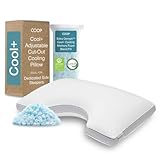
4. Coop Home Goods Eden Cool+ Cut-Out Pillow — The Shaped Answer
The Coop Home Goods Eden Cool+ Cut-Out holds the slot it earned at $400. The queen verified on Amazon in October–November 2026 tracker reads — check price on Amazon — below its list positioning and near its tracked average, in the mid-to-premium tier — an everyday positioning, not a dip. A pair is priced as sold on the listing — among the more accessible flagship pairings on the list. What the money buys is shape: this is Coop’s gel-infused adjustable fill in a cut-out profile, with a notch engineered for a side sleeper’s shoulder, so the pillow’s loft goes to the head and neck while the shoulder gets room instead of a ramp.
This guide labels the Cool+ Cut-Out a known-body pick, and the label is the review. The cut-out is a bet on geometry: it pays off if your shoulder actually lands in the notch, which depends on your shoulder width, your mattress’s firmness, and how high on the pillow you sleep. A sleeper who knows their body — measured gap, settled position — can cash that bet. What the cut-out does, when it fits, no rectangle replicates: it removes the material your shoulder would otherwise have to compress or climb, so the listed loft is spent on the head and neck instead of being wasted under the shoulder blade — the one design here that attacks the loaded-height problem by subtraction. The adjustable architecture is the Eden family’s: cross-cut gel-infused memory foam and microfiber behind a zippered liner, tuned by the handful, under the brand’s cooler-touch Cool+ cover — so the height around the notch is still yours to set. The gel infusion earns the series’ standing translation — a cooler first contact that saturates in minutes, fastest under a stationary head — so the honest reason to buy this pillow is the geometry, not the gel.
One channel fact from the Eden review below applies to the whole Coop line: Coop’s brand terms — its advertised trial and warranty — are brand terms, and the return terms on the Amazon listing are the ones guaranteed to apply to an Amazon purchase. Buy the shape because the shape fits your sleep; read the listing’s terms before checkout.
Who it suits: Committed side sleepers who know their shoulder geometry, have tuned rectangular adjustables, and still wake with their shoulder riding up the pillow; couples where only one partner sleeps on their side.
Pros: A genuine shoulder cut-out in an adjustable fill — the only shaped pick in the guide; the notch spends loft on the head instead of under the shoulder; verifies at an everyday positioning below its list; a pair stays well inside this budget.
Honest limitation: The shape is a commitment: if your shoulder misses the notch, you have bought a rectangle with a hole in it, and back and stomach sleepers will find the notch pointless or worse. The gel is a first-contact effect, not all-night cooling, and the fill still sleeps warmer than latex, down, or the grid.
Choose it if: You sleep on your side, you know where your shoulder lands, and the geometry is the feature you have been missing.
Skip it if: You are still discovering your loft (the Eden below), you change positions all night, or you want natural fill.
5. Continental Bedding Serenity 700 — The Indulgence Pick, Not the Support Pick
This review carries a warning in its title because the warning is the finding, printed at full strength: for most side sleepers, the Continental Bedding Serenity 700 is an indulgence, not a support pick. Its place rests on feel — the genuine, weightless, moldable feel of real down — and never on shoulder support. Down is the most compressible fill in the lineup: under a stationary shoulder and head, an 80-percent-down pillow gives back a fraction of its listed loft, and it keeps giving slowly through the night. A side sleeper’s gap does not shrink overnight; the pillow under it does. That mismatch is the whole story, and no fill power figure changes it.
What the pillow is, graded on its own terms, remains the genuine article — the only down-rich pillow this series has ever been able to link. The fill is 80 percent goose down and 20 percent goose feather at a stated 700 fill power, in Hungarian white goose down, inside a 400-thread-count cotton shell. The maker describes the down as RDS-certified, the pillow as made in the USA, and sells it in low, medium, and high loft versions; a side sleeper determined to buy it should take the high loft, because loft choice at purchase is the down buyer’s only substitute for adjustability. The standard size, sold singly, sits in the mid-range tier on Amazon — check price on Amazon. Its dated check is the stalest among the six picks, so verify it live before checkout. A pair is priced as sold on the listing: the down pair this budget can actually buy, in standard size.
What $700 was supposed to change for down, it did not. The down-rich queen pair does not verify at $700 either: this maker’s queen two-pack carries a premium list positioning and an older historical tracker average, but its record was re-checked on November 19, 2026 and still stops in July 2023; its last recorded Amazon price is long stale. Down-rich on Amazon, verifiably, is still a standard-size purchase. The honest costs carry too: down wants daily fluffing, and long-term owner reports describe loft loss inside the first year for some sleepers — for a side sleeper, the support quietly leaving. It is the wrong fill entirely for anyone sensitive to natural down.
Who it suits: Down devotees who sleep on their side in the high-loft version and value moldable, scrunchable feel over fixed support — and who will fluff it daily; back sleepers who want the real ratio at a verifiable price.
Pros: A true 80/20 down-rich fill with a stated 700 fill power — still the only one in this series; loft options at purchase; cotton shell at a real thread count; maker’s RDS and made-in-USA claims.
Honest limitation: Down compresses under a stationary shoulder more than any other fill here, and keeps compressing — this is the indulgence pick, not the support pick, for most side sleepers. Verified at standard size only — the queen pair’s price record is dead after a fifth check — and its price read is this guide’s stalest — check price on Amazon. Down needs daily fluffing and can lose loft within a year.
Choose it if: Down-rich feel is the thing you actually want, you wear a standard case, you take the high loft, and you will fluff it daily.
Skip it if: You need a pillow to hold a set height under your shoulder — that is the Harmony, the Saatva, or either Coop — or you need a queen size, or you are sensitive to down.

6. Coop Home Goods Eden Pillow — The Tunable Answer
At $700 the Coop Home Goods Eden changes jobs. It is no longer the value alternative to a flagship; it is the pillow that completes sets and hedges guesses. The Eden — queen single, gel-infused cross-cut memory foam and microfiber fill you add or remove through a zippered liner, extra fill bag in the box — still verifies on Amazon in multiple November 2026 reads, in the mid-range tier — check price on Amazon. A pair is priced as sold on the listing. A guest room furnished with two Eden queens and two Serenity standards fits comfortably inside this budget. And the sharper use: an Eden beside any fixed premium pick is insurance — if the fixed loft guesses wrong, the adjustable is already in the house, tunable tonight.
Its side-sleeper virtue, stated precisely: tuning changes loft, not firmness class. Adding fill raises it and firms it somewhat; removing fill lowers it. What tuning cannot do is turn shredded foam into latex’s spring or the grid’s pushback. Within that honest boundary, the Eden is the one pick whose loaded height you can iterate on your own bed: set it, sleep, adjust by the handful, sleep again. That makes it the answer for the side sleeper who does not yet know their number — and the reason a still-guessing reader should buy it before any fixed flagship, or alongside one. The spare fill needs a home while it is out of the pillow — a bag in a closet — a small, real cost of the design.
What carries over from its earlier reviews: the gel infusion is a first-contact effect — cooler when your head lands, at skin temperature within minutes, fastest under a stationary head — while the durable virtues are the softer, more down-like hand than the Original, the washable construction, and the brand’s stated CertiPUR-US and GREENGUARD Gold certifications. The channel fact carries over too, the mirror image of the Saatva’s parity: Coop’s own store lists the Eden queen for less, so Amazon carries a premium for the marketplace’s delivery and returns machinery. A reader comfortable buying direct should know the same pillow costs less there. Coop’s advertised 100-night trial and 5-year warranty are brand terms; the listing’s return terms govern an Amazon purchase.
Who it suits: Side and combination sleepers who do not yet know their number — who want to dial loaded height on their own bed over several nights; anyone furnishing a second bed inside the same budget.
Pros: Fully adjustable loft with extra fill included — the only pick whose sleeping height you set yourself; a plusher hand than the Original; machine washable; verifies at an everyday positioning; a pair stays well inside this budget.
Honest limitation: Tuning changes loft, not firmness class — the shredded fill still compresses, holds more heat than latex, down, or the grid, and its gel cooling is first-contact only. Amazon’s price sits above the brand’s own store price for the same queen. Expect a faint new-foam smell on opening and a bag of spare fill to store.
Choose it if: You want to solve your loft by experiment rather than by guess — alone, or as the hedge beside a fixed flagship.
Skip it if: You already know your geometry and want the Cool+ Cut-Out’s shape, or you sleep genuinely hot and need structural airflow.

Comparison Table
| Product | Fill | Adjustable? | Size & count | Price | Watch out for |
|---|---|---|---|---|---|
| Purple Harmony, King | GelFlex Grid over Talalay latex | No — loft chosen at purchase | King, single | Check price on Amazon | The tall loft is a separate listing — check its price specifically; pairs are priced as sold on the listing |
| Saatva Latex | Shredded latex core, microdenier fiber outer | No — loft chosen at purchase | Standard/Queen 28×18, single | Check price on Amazon | Linked listing is the high loft; fill is majority fiber by weight; a pair is priced as sold |
| Casper Hybrid Snow | Foam layers + fiber core, phase-change bands | No | Standard, single | Check price on Amazon | Cooling saturates fastest under a stationary head; king price unpinned; a pair is priced as sold |
| Coop Eden Cool+ Cut-Out | Gel-infused memory foam + microfiber | Yes — add/remove fill | Queen, single | Check price on Amazon | Known-body pick: pays off only if your shoulder lands in the notch; a pair is priced as sold |
| Continental Serenity 700 | 80% goose down / 20% feather, 700 FP | No — loft chosen at purchase | Standard, single | Check price on Amazon | The indulgence pick, not the support pick — down compresses under a stationary shoulder; queen pair’s record is dead; a pair is priced as sold |
| Coop Eden | Gel-infused memory foam + microfiber | Yes — add/remove fill | Queen, single | Check price on Amazon | Tuning changes loft, not firmness class; Amazon costs more than brand-direct; a pair is priced as sold |
How to Choose a Sleep Pillow for Side Sleepers Under $700
Measure the gap, not the pillow. Lie on your side on your own mattress, in your sleeping position, and have someone measure — or estimate against a stack of towels — the distance from the mattress surface to the side of your head where a pillow would hold it level. That distance, filled by a compressed pillow, is your target loaded height. Every listed loft here is an unloaded number; ask of each pick how much of it survives. Broad shoulders widen the gap; a soft mattress shrinks it, because the shoulder sinks in — which is why the same pillow can be right on one bed and wrong on another.
Choose the fill by loaded behavior, honestly named. The grid pushes back and holds height. A latex core springs back and holds most of its height, though its fiber wrap compresses first. Molded foam-and-fiber holds its shape but cannot be tuned. Shredded fills can be tuned to the height — but tuning changes loft, not firmness class. Down compresses the most and keeps compressing; in this guide it is the indulgence pick, not the support pick.
Price the transaction, not the advertisement. This series contains every direction of the lesson. The Saatva costs the same on Amazon as at its own store — parity. The Coop Eden costs more on Amazon than at Coop’s store; the Casper Snow costs less on Amazon than at Casper’s. And the band’s luxury names cost, as far as any dated record can show, nothing at all — no verifiable transaction exists. A price you cannot pin is not a price; it is a rumor with a currency symbol, and a bigger budget does not make rumors spendable.
Treat trials and warranties as listing terms, not brand promises. Saatva’s 45-night trial, Purple’s shortened 30-night trial, Coop’s 100-night trial, and every warranty named in these reviews are brand terms. The return window on the Amazon listing in front of you is the only recourse guaranteed to apply to your purchase. Across a multi-pillow set the terms matter more, not less: read them before checkout and keep the packaging until the second week.
Loft, Loaded: The Shoulder Gap Is the Specification
Every loft in this guide was measured the same way: unloaded, on a shelf, by the maker. A side sleeper never meets that pillow. What you meet is the pillow after your head and shoulder have spent an hour on it — compressed, warmed, and settled. The distance that matters is the gap between your mattress and the side of your head, set by your shoulder width, and the pillow’s job is to fill exactly that gap at its loaded height, so your head rests level rather than tipped down toward the bed or propped toward the ceiling. The listed loft is only the raw material.
This guide ranks constructions by what survives compression. The Harmony’s grid is a spring: it deflects and pushes back, and its displaced volume is air, not migrated fill — its loaded height is the closest here to its listed height. The Saatva’s shredded latex core is the next honest answer: latex springs back and resists packing, though its fiber wrap — the majority of the fill by weight — settles first, so its sleeping height sits below its listed height. The Casper’s molded foam-and-fiber holds a fixed shape: predictable, if not tunable. The shredded Coops let you choose the starting height yourself — an experiment you run rather than a specification you trust. The Cool+ Cut-Out takes the fifth route: it does not defend the height at all — it removes the shoulder from the equation. And down sits at the far end: it molds, and under a stationary load molding is compression, and compression is lost height — which is why its review is titled the way it is.
The practical rules fall out of the physics: measure your gap on your own mattress, because the mattress sets the gap; buy loaded behavior, not listed loft; and if you are between two lofts in a fixed-loft pick, take the taller one — a pillow can settle into the gap, but it cannot grow into it.
The $270–$700 Shelf Is Empty — So Spend It Across the Bed
The research question this budget asks is the one our $400 guide asked, with higher stakes: what actually sells up here? The answer, from a fifth pass across November 2026 tracker records, listing crawls, and dated roundups, is unchanged. One product line transacts in the upper tier: the Purple Harmony in king, across its tall-loft and its low- and medium-loft listings, with tracked loft averages in a similar range. Everything else verified here sits below that flagship tier. Above it, across five research passes at five budgets, this series has never pinned a single Amazon pillow transaction. The stretch up to $700 is not expensive. It is empty.
The names that seem to contradict that are worth naming precisely, because each fails differently. Continental Bedding’s own 100-percent-down line is quoted in the premium range in down-pillow roundups — for a queen two-pack and for a king — but those figures could not be tied to a dated tracker record, so the line is named here and not linked. The Queen Anne luxury down pillow shows conflicting third-party reads in the premium tier, with differing figures in review coverage of the same listings — not a verification. The airweave pillow, a washable airfiber pillow, sits in the premium tier at the brand store — higher still for its oversized S-Line sibling — and is reported sold through the brand’s Amazon storefront, but no ASIN-pinned dated Amazon price could be established in this pass, and the brand sells accessories as final sale. Avocado’s Green Pillow is positioned in the mid-to-premium range in November 2026 brand reads — brand-store money, none of it an Amazon transaction this guide can grade. At the budget’s exact edge sits a Scandia Home Chamonix standard pillow, at this budget’s ceiling through the brand — a channel this guide does not grade.
So the honest way to spend $700 is as an allocation, and for side sleepers the logic is sharper than for anyone else, because two side sleepers are two different gaps. The pairs, each priced as sold on its listing — never halved, and always worth checking on Amazon before checkout: two tall-loft Harmony kings; two kings at the low and medium lofts, at a higher pair total. Two Saatva queens, or two kings. Two Casper Hybrid Snows. Two Coop Cool+ Cut-Outs. Two Serenity standards. The mixed sets are where it gets interesting: a Harmony tall-loft king on the broad-shouldered side and a Saatva king on the other; a Saatva for the combination sleeper beside a Cool+ Cut-Out for the committed side sleeper; a hot sleeper’s set — the Harmony standard (from our $200 guide) for all-night airflow plus the Casper Snow for the first hot hour. The hedge and the second bed: an Eden beside any fixed pick insures the loft guess, and two Harmony standards for the main bed plus two Eden queens for the guest bed still fit inside this budget. The $700 pillow, singular, does not exist. The $700 pillow budget, spent across the verified shelf, puts the right loaded height under every shoulder in the house.
Cooling for Side Sleepers: Saturation Happens Where the Head Stays
Every cooling claim in this category deserves the same translation, and side sleepers deserve the strictest version of it. A pillow can do three things about heat. It can feel cool at first contact and absorb warmth until it reaches skin temperature — gel infusions and cool-touch covers, measured in minutes. It can absorb a larger heat pulse before saturating — phase-change materials, measured in the first part of the night. Or it can move air continuously, so heat leaves instead of accumulating — open structures and breathable cores, measured in all night. Marketing rarely distinguishes the three. This guide does, because a side sleeper’s head is the stress test for the first two: it stays in one place for hours, and whatever absorbs heat under that patch saturates there first and fastest. A bigger budget does not change the physics: there is no fourth mechanism — the top of the verified market is the same three, bought in combination.
The first-contact shelf is this guide’s two Coops: the Eden’s gel-infused fill and the Cool+ Cut-Out’s gel and cooler-touch cover, both in the mid-range tier. Neither changes the pillow’s temperature at 3 a.m. The phase-change shelf is the Casper Hybrid Snow, in the premium tier: the strongest cooling foam pillow we can link, and it still saturates — under a stationary head, soonest of all. The airflow shelf is the Harmony — standard in our $200 guide, king here — whose open grid passes air all night, with the Saatva’s latex core breathing in the same honest category. What $700 buys a hot side sleeper is the pairing: the Snow for the landing and the Harmony for the night. If you fall asleep hot and then sleep fine, first contact is enough; if you wake hot at 3 a.m., no gel or band will fix it, and the money belongs to airflow.
Common Buying Mistakes
Buying listed loft as if it were sleeping height. Loft is measured unloaded; buy the construction whose loaded height fills your gap.
Buying the Harmony in the wrong size or loft story. There is no queen Harmony at any price — standard and king are the whole line — and on the king, the tall-loft listing is separate from the low- and medium-loft listings. The loft you select is the listing you check, and the fit you get.
Buying two identical flagships for two different shoulders. The verified market’s gift at this budget is variety: a mixed set — a tall-loft Harmony beside a Saatva, a Cut-Out beside a rectangle — fits two different gaps better than the identical premium pair most couples default to.
Buying down as a support pillow. Down molds, and molding under a stationary shoulder is lost height. The down pick is the indulgence — its place rests on feel, never on shoulder support.
Assuming a famous luxury name has a price. The band’s most-quoted pillows could not be pinned to a dated Amazon price — in five consecutive research passes.
Paying for phase-change and expecting climate. Phase-change bands absorb a heat pulse — soonest under a head that never moves. All-night temperature behavior comes from airflow: the grid, or latex.
Expecting a pillow to treat a symptom. A better-fitting pillow can feel more comfortable. Persistent pain, numbness, loud snoring, or pauses in breathing need a clinician, not a checkout.
Final Recommendation
For side sleepers who know their gap and sleep on a king — or can run a king pillow — the Purple Harmony in king is the buy this budget exists for: the one construction whose loft genuinely survives a stationary shoulder, with real airflow, in the tall loft — check price on Amazon — with a pair priced as sold, in matched or mixed lofts. For queen and standard beds, the Saatva Latex Pillow in high loft is the premium answer: a latex core that holds height, at premium brand-store positioning — check price on Amazon. Sleepers who know their shoulder geometry should take the Coop Cool+ Cut-Out, the one design that spends its loft on the head instead of under the shoulder; hot fall-asleepers, the Casper Hybrid Snow, knowing its cooling is a landing, not a climate. Down devotees can take the Continental Serenity 700 as what it is — the indulgence pick, bought for feel in the high loft, never as shoulder support. And any side sleeper still guessing at their number should take the Coop Eden and tune the loaded height on their own bed — alone, or as the hedge beside a fixed flagship. No reader should hold out for a $500 or $700 single pillow: on Amazon, verifiably, there isn’t one.
Frequently Asked Questions
How much loft does a side sleeper actually need?
Enough loaded height to fill the gap between your mattress and the side of your head so your head rests level. It is set by your shoulder width and mattress sink. Measure it on your own bed, then buy a construction that holds close to that height under load: a springy grid or latex core, a molded shape, a shoulder cut-out, or an adjustable fill you can set to it.
Is there really no single pillow between $270 and $700?
None that verifies. The most expensive dated, ASIN-pinned Amazon pillow in this series’ research is the Purple Harmony king at its full list positioning, re-read November 18, 2026. Between that flagship tier and $700, every candidate failed the same test: the 100-percent-down line exists only as roundup figures, the airfiber pillow and the organic shelf publish brand-store prices only, and the boutique down maker sells through its own channel. They are named in this guide without links.
Which Harmony loft should a side sleeper buy — and what does it cost?
The loft is the fit decision, so buy the gap, not the label: the tall loft (7.5 inches listed) for broad shoulders or a firm mattress, the medium (6.5) for an average gap, the low (5.5) for narrow shoulders on a soft bed. Keep each listing’s price attached to its own listing — check price on Amazon for the loft you choose: the tall-loft king is a separate listing from the low- and medium-loft kings, with tracked averages for all three in a similar range.
Can the right pillow fix my neck pain or snoring?
A pillow that fits your sleep position can feel more comfortable, and comfort is a legitimate reason to buy one. It is not a treatment. Ongoing pain, numbness, loud snoring, or pauses in breathing warrant a clinician’s evaluation — at $700 exactly as at $30.
Keep Reading
Best Sleep Pillow Under $700 · Best Sleep Pillow For Side Sleepers Under $400 · Best Sleep Pillow Under $1000 · Best Memory Foam Pillow For Side Sleepers Under $1000 · Best Memory Foam Pillow For Side Sleepers Under $700