Where to buy
Shopping for the best trunk organizer for beginners under $30? Start with the linked picks below — check the latest price, availability and delivery on Amazon, where orders are placed. We may earn a commission from qualifying purchases. Picks marked as step-ups carry no link at this budget — the review explains what they cost and why they are worth planning for.
- Best overall under $30: FORTEM Car Trunk Organizer, 60L Two-Compartment — Check on Amazon
- DRIVE Auto Car Trunk Organizer — Check on Amazon
- TRUNKCRATEPRO Trunk Organizer, Large — Check on Amazon
- HOTOR Trunk Organizer, 2 Compartments — Check on Amazon
- HOTOR Trunk Organizer, 3 Compartments — Check on Amazon
- 8sanlione Car Trunk Organizer, 3 Compartments — Check on Amazon
Read the full guide ↓
Disclosure: As an Amazon Associate, umtsmarttool.com earns from qualifying purchases. Links to Amazon on this page are affiliate links; they cost you nothing extra. Listing details such as price and availability change often, so check the current Amazon listing before you buy.
The search for the best trunk organizer for beginners under $30 is usually a first search — the first check engine light, the first dead battery, the first trunk that needs taming — and first searches deserve guides that assume nothing. So this one explains as it goes: what the product actually does, which specifications matter and which are decoration, and where beginners reliably waste money (usually on a headline number, a fantasy rating, or a tool whose real features hide behind an app paywall). The picks are ordered for a newcomer: the simplest complete option first, the step-ups clearly labeled with what the extra money buys and what it does not. Nothing here requires experience to use safely, and every technique section is written as if it will be read in a driveway, possibly in the rain, by someone doing this for the first time — because it will be.
Thirty dollars is where trunk organizers grow walls: rigid panels, non-slip bottoms, movable dividers and handles built for the full-load carry all live in this tier, from the category’s established names. Every pick below is linked and verified against its maker’s published dimensions and materials, and the reviews spend their words on the differences that survive contact with a real trunk — structure, anchoring and how each shape uses a cargo floor.
Below are the quick picks, full reviews with verified dimensions and constructions, a side-by-side comparison, a choosing guide that begins with a tape measure, technique sections on building a trunk system that stays built — zones, grocery loading and the emergency bay — the mistakes that turn organizers back into piles, and the questions buyers ask before the first grocery run. Readers comparing the neighbouring budget should also see Best Trunk Organizer For Daily Driving Under $15.
In this guide
Quick Picks
Short on time, or comparing several options at once? Each row names a buyer type and the product that suits it, with a link where this budget honestly supports one.
| Buyer type | Pick | Why it stands out | Link |
|---|---|---|---|
| Best overall under $30 | FORTEM Car Trunk Organizer, 60L Two-Compartment | 60L capacity, 21 x 15.5 x 11.2 in, collapsible, non-slip bottom, sturdy side walls | Check on Amazon |
| Best adjustable layout | DRIVE Auto Car Trunk Organizer | 23 x 17 x 11 in, 600D Oxford canvas, collapsible to 15 x 17 x 11 in front-seat mode | Check on Amazon |
| Best compartment count | TRUNKCRATEPRO Trunk Organizer, Large | 23.6 x 14.6 x 12.5 in, up to 4 compartments, slider dividers, non-slip bottom, securing straps | Check on Amazon |
| Best compact pick | HOTOR Trunk Organizer, 2 Compartments | 21.3 x 12.6 x 10.6 in, 2 compartments, sturdy base panel, foldable | Check on Amazon |
| Best family-size value | HOTOR Trunk Organizer, 3 Compartments | 31.9 x 12.6 x 10.6 in, 3 compartments, foldable, sturdy construction | Check on Amazon |
| Best ultra-budget pick | 8sanlione Car Trunk Organizer, 3 Compartments | 27 x 13.4 x 13.4 in, 3 compartments, waterproof polyester, foldable | Check on Amazon |
How These Picks Were Chosen
The budget was applied as a hard ceiling: every linked pick is a real Amazon listing positioned within the $30 budget in the United States — check the current price on Amazon before you buy, because organizer pricing is promotion-driven and moves often. Where a well-known model straddles the tier line, the review says so plainly rather than rounding in our favor.
We did not use these organizers ourselves. We read maker listings and specification tables and compared the attributes that decide whether an organizer is still in service next year: open dimensions and capacity, wall and base construction (rigid panels versus fabric alone), compartment count and whether dividers move, non-slip treatment and anchoring, and how small it folds when the trunk must be empty. Every figure in the reviews — dimensions, capacities, materials — comes from the maker’s own published data, recorded in this guide’s sources. The companion guide Best Trunk Organizer For Road Trips Under $15 covers the adjacent case in the same detail.
One category truth shaped the rankings: structure is what money buys here. Fabric-only organizers sort light loads honestly and cost the least; rigid walls and base plates cost more and carry groceries, bottles and tools upright. The guides in this series are organized around that truth — at the lowest tier, the linked picks are the honest lightweight end plus any sturdy model whose street price genuinely visits the tier, with the rigid class presented as labeled step-ups.
The exclusions in this category are quieter but just as real. We excluded organizers sold on capacity alone with no published dimensions — a liter figure without a footprint is marketing, not information — and the class of foldable bins whose walls are a single layer of non-woven fabric with no base, which sort nothing heavier than tissue and collapse into the pile they were bought to replace. We also excluded, from the linked picks, any model whose price only visits this tier inside a coupon screenshot; the borderline cases that remain are flagged in their reviews with instructions to verify the live price. What survived is a list where every product’s dimensions, materials and structure are published by its maker and recorded in this guide’s sources, so the comparison you are making is between documented objects — which is the only comparison worth paying for.
The 6 Best Trunk organizers for Beginners Under $30
Six picks, in the order most readers should consider them. Linked picks can be bought inside this budget today; step-up picks are the verified products this budget honestly points toward, presented without links so the planning is clean. For the related search, Best Trunk Organizer Under $30 applies the same standards.
FORTEM Car Trunk Organizer, 60L Two-Compartment
Who it suits: Drivers who want the balanced default: a mid-size, sturdy-walled organizer that holds groceries and gear upright and folds away when the trunk must be empty. For a beginner, the FORTEM Car Trunk Organizer, 60L Two-Compartment has a specific virtue worth naming: it does not require experience to use correctly the first time, and its limits are the visible, forgiving kind rather than the hidden kind.
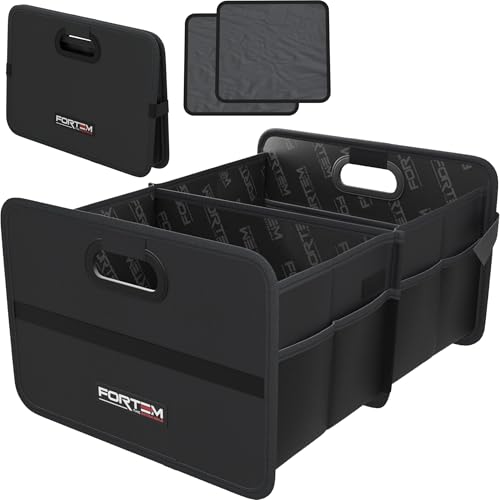
FORTEM is the name this category runs on, and this 60-liter version is its balanced form: two compartments across a 21 x 15.5 x 11.2 inch footprint, sturdy side walls that stand up instead of slumping, a non-slip bottom that resists the trunk-slide every organizer promises to prevent, and strong handles for carrying the whole load into the house in one trip.
The collapsible design is the ownership detail that matters. Folded flat, it waits under the trunk floor or against the seat back; opened, it takes the grocery run, the sports kit or the emergency supplies and keeps bottles upright and bags un-crushed. Four compartments in total counting its subdivisions give small items somewhere to be besides the bottom of a big bin.
At this size it suits sedans and mid-size SUVs best; very large cargo areas can swallow two, and the brand sells bigger versions for that case. Walls and base are the wear points on any organizer, and this one’s reinforced construction is why it headlines the guide — check the current price on Amazon, as FORTEM pricing moves around this tier.
- Sturdy walls and non-slip bottom — stays put and stays open
- 60L two-compartment format fits sedans and mid-size SUVs
- Collapses flat and carries by strong handles
Honest limitation: Mid-size footprint: large SUV trunks may want two, or the XL versions.
Choose it if you want the one-organizer answer for a sedan or mid-size SUV. Skip it if your cargo area is huge — look at the 85L-class picks or buy two.
DRIVE Auto Car Trunk Organizer
Who it suits: Drivers whose organizer must change size with the load — full width for the weekly shop, half width riding on the front seat for a solo run. For a beginner, the DRIVE Auto Car Trunk Organizer has a specific virtue worth naming: it does not require experience to use correctly the first time, and its limits are the visible, forgiving kind rather than the hidden kind.
The DRIVE organizer’s signature is its resizing: fully open it measures 23 x 17 x 11 inches with three compartments in 600D Oxford canvas; partially collapsed it becomes a 15 x 17 x 11 inch unit the maker calls front-seat mode, riding beside the driver for a small shop or a delivery shift. Adjustable securing straps with a lockdown harness keep it anchored in either shape.
That flexibility answers the real complaint about fixed organizers — that they are always the wrong size. The full footprint suits SUV and trunk duty with groceries, tools and sports gear sorted across its compartments and pockets; the collapsed form keeps a few bags upright without commandeering the cargo area. At about three pounds it is easy to move between vehicles, which households with two cars quietly appreciate.
The canvas construction is durable but not rigid in the FORTEM sense; heavily loaded with tall bottles it leans more than a stiff-walled box. Its street price also wanders around this tier, so verify the live price. For shape-shifters, it is the most adaptable pick in the guide.
- Resizes between full trunk mode and a 15-inch front-seat mode
- 600D Oxford canvas with securing straps and lockdown harness
- Light at about 3 lb — easy to swap between cars
Honest limitation: Softer walls than rigid rivals; price moves around this tier — check before buying.
Choose it if you want one organizer that adapts to load and vehicle. Skip it if you carry tall, heavy bottles daily and need rigid walls.
TRUNKCRATEPRO Trunk Organizer, Large
Who it suits: Sorters: drivers with many small things — tools, detailing kit, kids’ gear, work equipment — who need compartments and pockets more than raw volume. For a beginner, the TRUNKCRATEPRO Trunk Organizer, Large has a specific virtue worth naming: it does not require experience to use correctly the first time, and its limits are the visible, forgiving kind rather than the hidden kind.
TRUNKCRATEPRO builds the organizer for people who sort. The large format — 23.6 x 14.6 x 12.5 inches — divides into up to four compartments using two removable slider dividers, and the listing counts eleven pockets around the structure for the small items that vanish in lesser organizers. The material is a heavy-duty Oxford polyester, with a non-slip bottom and securing straps to keep the crate where you put it.
The slider dividers are the detail to value: compartments sized to the load, changed in seconds, rather than fixed partitions that fit nothing exactly. A detailing kit, a first-aid pouch, jumper cables and a grocery bag can each have a bay, and the bay sizes change when the load does. It collapses when the full trunk is needed, like every pick here.
Its shape is taller and narrower than the FORTEM, which suits SUV cargo areas and trunks with a defined well. Drivers who mostly carry big soft loads — laundry, sports bags — will use its sorting less; drivers whose trunk is a system will use it daily.
- Up to four compartments with movable slider dividers
- Eleven pockets for small-item sorting
- Non-slip bottom and securing straps included
Honest limitation: Tall, narrow shape suits defined cargo wells better than wide flat trunks.
Choose it if your trunk load is many small items that need a system. Skip it if you mostly haul a few big soft bags — simpler two-compartment picks fit better.
HOTOR Trunk Organizer, 2 Compartments
Who it suits: Sedan and hatchback drivers who want a smaller, sturdier organizer that leaves half the trunk free for the things organizers cannot hold. For a beginner, the HOTOR Trunk Organizer, 2 Compartments has a specific virtue worth naming: it does not require experience to use correctly the first time, and its limits are the visible, forgiving kind rather than the hidden kind.
HOTOR’s two-compartment organizer is the compact discipline pick: 21.3 x 12.6 x 10.6 inches with a sturdy base panel that keeps the structure honest, in a footprint that organizes the essentials — emergency kit, groceries for two, gym gear — without annexing the whole trunk. It folds flat when the space is needed for luggage or a hardware-store run.
The smaller size is also a stability advantage: less mass to slide, walls with less span to bow, and a base panel that keeps the bottom flat on uneven trunk floors. For the single driver or couple whose trunk problem is a rolling cluster of small items rather than a mountain of cargo, this is the proportionate answer, and its price point is among the friendliest in this guide.
Households that shop for a family or haul team sports gear will fill it by Tuesday. Buy size for the load you actually carry weekly — the three-compartment sibling below is the same idea at family scale.
- Compact footprint leaves trunk space free
- Sturdy base panel keeps structure and stability
- Friendly price and folds flat
Honest limitation: Two compartments fill fast for family-scale loads.
Choose it if you drive a sedan or hatch and carry a modest, regular load. Skip it if you need family-scale capacity — take the 3-compartment version.
HOTOR Trunk Organizer, 3 Compartments
Who it suits: Families who need the long-format organizer: three compartments across nearly 32 inches for the weekly shop, the sports kit and the emergency gear, all at once. For a beginner, the HOTOR Trunk Organizer, 3 Compartments has a specific virtue worth naming: it does not require experience to use correctly the first time, and its limits are the visible, forgiving kind rather than the hidden kind.
The three-compartment HOTOR stretches the format to 31.9 x 12.6 x 10.6 inches — a long, relatively narrow organizer that suits the full width of an SUV cargo area or a sedan trunk, dividing the load into three bays for the classic family split: groceries, gear, and the permanent emergency residents. It folds away when the cargo area must swallow suitcases instead.
Length is its own feature. A long organizer against the seat back leaves the rest of the cargo floor open in one usable rectangle, rather than scattering space around a square box — the layout most owners end up preferring. HOTOR also sells a cooler-equipped version of this size for drivers who want a cold bay; the standard version here keeps the price and the simplicity down.
As with all long organizers, load the heavy bay in the middle and use the trunk’s anchor points if your vehicle offers them. For family-scale sorting at a value price, this is the guide’s pick.
- Three full bays across a trunk-friendly long format
- Leaves cargo floor space in one open rectangle
- Folds flat for luggage days
Honest limitation: Nearly 32 inches long — measure smaller trunks before ordering.
Choose it if you organize for a family and your cargo area is wide. Skip it if your trunk is compact — the 2-compartment HOTOR fits the space better.
8sanlione Car Trunk Organizer, 3 Compartments
Who it suits: Drivers who want basic sorting for the least money in this guide — light loads, light duty, honest expectations. For a beginner, the 8sanlione Car Trunk Organizer, 3 Compartments has a specific virtue worth naming: it does not require experience to use correctly the first time, and its limits are the visible, forgiving kind rather than the hidden kind.
The 8sanlione is the budget floor of the category done acceptably: three compartments in a 27 x 13.4 x 13.4 inch foldable body of waterproof polyester, with the collapsible, portable brief covered and a price that undercuts every brand name in this guide. For light, bulky loads — blankets, sports clothes, the beach kit, grocery bags that need corralling rather than armoring — it does the job.
The trade is structure, and it should be stated plainly: at about 200 grams this is a fabric organizer, not a rigid crate. Its walls will not stand to attention under a case of water bottles, and it relies on its load and the trunk’s shape for posture. Loaded with soft goods, that hardly matters; loaded with heavy tools, it matters immediately.
Buy it as the honest minimum: real sorting, real fold-flat storage, at the lowest cost here — and as the first organizer for a driver who is not yet sure the habit will stick. If it does, the FORTEM is the upgrade path.
- Lowest-cost real organizer in this guide
- Waterproof polyester shrugs off damp loads
- Folds flat; three compartments for basic sorting
Honest limitation: Very light fabric build — walls will not support heavy or tall loads.
Choose it if your loads are light and soft and the budget is the point. Skip it if you carry tools, bottles or anything heavy — rigid picks only.
How the picks divide the work: by structure and by shape. The rigid-walled picks carry the heavy, upright loads; the lighter builds sort the soft majority of trunk life at lower cost; the long formats claim the seat-back line of an SUV while the compact footprints leave a sedan’s floor half free. The right question is never which organizer is best in the abstract — it is which construction matches your heaviest weekly load and which footprint your tape measure just approved. Answer those two and the list above selects itself.
Comparison Table
| Product | Format and key specification | Link |
|---|---|---|
| FORTEM Car Trunk Organizer, 60L Two-Compartment | Collapsible organizer; 60L; two compartments; non-slip bottom and handles | Check on Amazon |
| DRIVE Auto Car Trunk Organizer | Collapsible organizer; 600D Oxford; 3 compartments; partially collapsible front-seat mode | Check on Amazon |
| TRUNKCRATEPRO Trunk Organizer, Large | Collapsible organizer; up to 4 compartments; 2 slider dividers; 11 pockets per listing | Check on Amazon |
| HOTOR Trunk Organizer, 2 Compartments | Foldable organizer; 2 compartments; sturdy base panel; compact footprint | Check on Amazon |
| HOTOR Trunk Organizer, 3 Compartments | Foldable organizer; 3 compartments; long 31.9-inch format for SUVs and sedans | Check on Amazon |
| 8sanlione Car Trunk Organizer, 3 Compartments | Foldable organizer; 3 compartments; polyester; lightweight build | Check on Amazon |
How to Choose: Best trunk organizer for beginners under $30
The criteria below are the ones that separated the picks above from everything else in this category at $30. This pairs naturally with Best Trunk Organizer For Car Owners Under $30 when you are equipping the whole car.
For beginners, the emphasis inside these criteria shifts toward forgiveness. Weight the items about simplicity, built-in guidance and protection electronics above the items about depth and speed: a first purchase should succeed even when its owner does everything slightly wrong, because that is what first purchases are for. Depth can be bought later, with knowledge; a bad first experience with a category often cannot be un-bought, because it teaches avoidance instead of skill. Every pick in this guide was chosen to be a good first teacher.
- Compartments should fit your categories. Count the permanent residents of your trunk — emergency kit, cleaning supplies, sports gear, the weekly shop — and choose bays to match. Movable slider dividers, as on the TRUNKCRATEPRO, let the bays change when the categories do; fixed partitions are simpler and cheaper.
- Non-slip is a system, not a sticker. A grippy bottom helps; straps or hooks to the trunk’s anchor points finish the job. An organizer that migrates to the trunk’s rear corners has failed at its one job. Check what your car offers for anchor points and what the organizer includes for them.
- Folding flat is the storage feature. Every pick here collapses, because the trunk’s other job — luggage, furniture, the hardware-store run — regularly needs the whole floor. An organizer that folds in seconds and stores under the floor or against the seat back will actually be removed; a complicated one will be cursed and then abandoned at home.
- Lids trade access for tidiness and privacy. A lidded organizer hides its contents from windows and stacks more cleanly; an open one loads faster at the grocery curb. Decide which moment you live more often. Some models make the lid detachable, which is the honest compromise.
- Handles are for the full-load carry. The grocery pattern ends with carrying the organizer itself into the house. Strong handles, rated by construction rather than adjectives, turn six bag trips into one organizer trip — the convenience owners mention most after a month of use.
- Pockets are the small-item layer. Mesh and flap pockets around the main bays hold the phone cables, ice scraper, gloves and documents that otherwise live loose. If your trunk problem is many small things rather than few big ones, pocket count — eleven on one pick here — outranks raw liters.
- Capacity in liters needs a sanity check. Liters describe the open box’s volume, not its usefulness; wall thickness, divider layout and shape decide how much of your actual load fits. Use the dimensions and your load list as the authority, and treat the liter figure as a comparison shorthand between similar shapes.
- Buy for the weekly load, not the annual one. The organizer earns its place on the grocery run, the commute and the sports practice — the loads it sees fifty times a year. The once-a-year road trip can rent the trunk’s whole floor. Size and structure chosen for the weekly pattern will be right almost every day you own a car.
- Measure the trunk, then choose the footprint. Organizers are sold by their open dimensions — roughly 21 to 32 inches long across this guide’s picks. Measure your cargo floor’s width between the wheel wells and its depth, and leave a usable rectangle of open floor beside the organizer for suitcases and bulk items. An organizer that fills the whole trunk has organized you out of a trunk.
- Walls decide what you can carry. Rigid side walls and base plates stand up empty and keep bottles, jars and tools upright through corners. Fabric walls rely on the load for posture and suit soft goods. Match the structure to your heaviest regular load — that load, not the average one, is the requirement.
Groceries Upright: Loading for the Drive Home
More groceries are damaged by the drive than by the shop. The organizer’s contribution is geometry: bottles and jars in a bay sized to them, standing in the middle of the organizer rather than against its outer wall, with the bay’s divider snug enough that they cannot build momentum. Eggs and soft fruit ride on top of nothing heavier than bread; the cold bag, if your organizer has a cooler bay or you add one, goes against the organizer’s side nearest the cabin’s air conditioning on summer days.
Loading order is the quiet skill: heavy and rigid first, low and central; bags of cans and jars next; produce and bakery last and highest. The organizer itself should be anchored or wedged before the first bag lands — a loaded organizer that slides has simply moved the mess as a unit. Non-slip bottoms and the straps several picks include exist precisely for this load, the most dynamic one your trunk carries. If your situation sits between the two, Best Trunk Organizer Under $15 is the other half of the picture.
At home the system pays its dividend: handles out, whole shop inside in one or two carries, organizer back in the trunk before the ice cream melts. Drivers who adopt the carry-the-organizer pattern rarely go back to bag juggling, and it is the strongest argument for spending on handle construction when you choose between otherwise similar picks.
For beginners, one habit outranks every product in this guide: do the simple version of the job, in the right order, and write down what you find. Notes turn a first experience into the beginning of competence.
The Emergency Bay: What Should Live in Your Trunk Permanently
One bay of any trunk organizer should be treated as the car’s own equipment locker, stocked once and audited twice a year. The core list is short and proven: a way to start the car (jumper cables or, when budget allows, a jump pack), a way to inflate a tire (a portable inflator and a pressure gauge), light (a flashlight that is not your phone), visibility (a reflective vest or warning triangle), warmth and water for a long wait, and the paperwork your region requires. Everything on that list is small; together it fills one organizer bay exactly.
The audit habit matters more than the list. Batteries in the flashlight, charge in the jump pack, pressure in the spare tire, the inflator’s fuse and chuck present — checked when the clocks change, the traditional twice-a-year moment. An emergency bay that is audited is equipment; one that is not is a hope stored in a box. The organizer’s role is to give that equipment a fixed address so the audit takes two minutes.
Seasonal rotation completes the bay: the ice scraper and a small shovel earn their place in autumn and yield it in spring to sunscreen and extra water. In this guide’s series, the neighboring guides on jump starters and tire inflators cover the two powered residents of the bay in depth — the organizer is the shelf; those guides choose what sits on it.
For beginners, one habit outranks every product in this guide: do the simple version of the job, in the right order, and write down what you find. Notes turn a first experience into the beginning of competence.
What the Next Tier Up Buys in Trunk Organizers
Organizers are the gentlest ladder in this series: the step from this tier to the next buys structure, not a new category. Concretely, it buys walls that stand empty — rigid panels like those in the TRUNKCRATEPRO Trunk Organizer, Large and the base-plated builds — a non-slip bottom that works with the trunk’s anchor points instead of merely hoping, dividers that slide to the load, and handles sewn and reinforced for the weekly full-load carry into the house. It also buys the category’s established names, whose published dimensions and materials this guide could verify line by line, which is its own form of value.
What the step up does not buy is a different trunk. The zones still have to be assigned by you, the thirty-second reset still has to happen at the fuel station, and a rigid organizer filled carelessly is a rigid pile. That is why this guide’s advice is symmetrical: at this tier, buy the honest lightweight pick and build the habit; when the habit is proven and the loads justify it, the step-up’s structure will feel like exactly what it is — the same system, armored. Drivers who reverse the order usually own a beautiful organizer and a messy trunk.
Setting Up a Trunk System: Zones That Survive Real Life
The organizers that stay organized share one idea: permanent zones. Assign one bay to the car itself — jumper cables or jump pack, tire inflator, ice scraper, a towel, the emergency kit — and never let that bay become overflow. Assign the second zone to the household’s recurring cargo: groceries on shopping days, sports gear on practice days, emptied between. If your organizer has a third bay, it belongs to the current project — the returns bag, the library run, the donation pile — and it is allowed to be temporary, which is what keeps the other two zones honest.
Small items get a different rule: they live in pockets or in a pouch, never loose in a bay, because loose small items migrate to the bottom and re-create the original problem inside the solution. The mesh pockets on this guide’s picks are for the visible layer — gloves, cables, documents you reach for weekly. Anything you reach for monthly can live in a zipped pouch in the car zone, labeled by touch: you will find it by feel in a dark trunk if every pouch has one job. Readers comparing the neighbouring budget should also see Best Portable Jump Starter For Beginners Under $15.
Maintain the system at the fuel station, not in a spring cleaning: thirty seconds while the tank fills — trash out, one thing back in its zone, a glance at the emergency bay. Systems maintained in thirty-second installments never need rescuing, and the trunk stays the solved problem this guide’s picks are meant to make it.
For beginners, one habit outranks every product in this guide: do the simple version of the job, in the right order, and write down what you find. Notes turn a first experience into the beginning of competence.
Your First Week With the Organizer
Day one is the honest emptying. Everything comes out of the trunk — everything — and is sorted on the driveway into the car’s kit, the household’s recurring cargo, and the stratum of objects nobody can explain, which does not go back in. The organizer goes in empty, gets anchored or strapped as its design intends, and receives only the first two categories, into assigned zones: car kit in its permanent bay, recurring cargo in the working bay, pockets filled with the small-item layer. The trunk will look emptier than it has in years, which is the correct first impression of a system working.
Midweek brings the first real load — the grocery run — and with it the loading discipline from this guide: heavy and rigid low and central, glass in a snug bay, produce last and highest, and the full organizer carried in by its handles at the other end. Notice what the zones got wrong; every household’s first layout has one bay sized for a life it does not lead. Adjust the dividers now, while the evidence is fresh — that adjustment, not the purchase, is the moment the organizer becomes yours.
By the weekend, add the maintenance habit that keeps the system alive: the thirty-second reset at the fuel station, trash out and strays home. Then photograph the loaded, zoned result. The photograph sounds precious until the day a valet, a teenager or a helpful friend unloads the trunk — after which it is simply the fastest restoration manual ever written.
Common Buying Mistakes
- Letting one bay become permanent overflow, which quietly converts the whole organizer back into the pile it replaced.
- Never folding the organizer away, so the first luggage day becomes a fight — and the organizer starts living in the garage instead of the car.
- Storing loose small items in the main bays instead of the pockets, recreating the junk drawer inside a product bought to eliminate it.
- Skipping the tape measure: a 32-inch organizer in a 30-inch trunk well is a return label waiting to be printed.
- Loading heavy items high and at the ends, so the organizer tips or slides under braking instead of riding low and central.
- Buying a lidded organizer for a grocery pattern that needs open-top speed, or an open one for valuables that need hiding — the lid question is a lifestyle question.
- Buying the largest organizer because it was the best value per liter, then discovering it consumes the entire trunk floor it was meant to organize.
- Choosing fabric walls for a load of glass bottles and tools, and blaming the organizer for slumping under a job its construction never promised.
- Ignoring the trunk’s anchor points and the organizer’s straps, then listening to a loaded box tour the trunk on every corner.
Final Recommendation
Our top pick is the FORTEM Car Trunk Organizer, 60L Two-Compartment — best overall under $30 — because it answers this search most completely for the money this budget actually commands. The runner-up is the DRIVE Auto Car Trunk Organizer, the right answer when your priorities tilt toward its particular strength: 23 x 17 x 11 in, 600d oxford canvas, collapsible to 15 x 17 x 11 in front-seat mode.
Whichever you choose, apply the guide’s closing discipline: verify the specification that matters most for your car and your load against the live listing, keep the packaging until the product has proven itself in real use, and build the small routine — the monthly check, the seasonal audit — that keeps any purchase in this category earning its place. The companion guide Best Portable Jump Starter For Car Owners Under $15 covers the adjacent case in the same detail.
One last calibration before you buy: the right purchase in this category is the one matched to the car and the routine you have today, verified against the live listing’s specifications, and then actually used on the schedule the technique sections describe. Equipment earns its keep in rituals, not in receipts — set the monthly check, the seasonal audit or the pre-trip inspection on your calendar now, while the intention is fresh, and whichever pick you choose will still be serving you when the next version of this search comes around.
Frequently Asked Questions
How do I stop a trunk organizer from sliding?
Use all three defenses: the non-slip bottom, the straps or hooks to your car’s anchor points where fitted, and placement — against the seat back or a trunk wall rather than floating mid-floor. A loaded organizer that still moves is usually unanchored, not defective.
Can a trunk organizer stay in the car all the time?
That is the design intent — every pick here folds flat for the days the full floor is needed and pops back for daily duty. The habit to build is the thirty-second reset: trash out and items back in their zones whenever you fuel up, so the system never decays into a pile. For the related search, Best Portable Jump Starter For Daily Driving Under $15 applies the same standards.
What should I keep in a trunk organizer permanently?
The car’s own kit: starting aid (cables or a jump pack), a tire inflator and gauge, a flashlight, a reflective vest or triangle, basic warmth and water, and required documents. One bay, audited twice a year when the clocks change.
Do trunk organizers fit hatchbacks and SUVs?
Yes — the longer formats in this guide are designed for SUV cargo areas, and the compact picks suit hatchbacks well. Measure the cargo floor the same way; hatchbacks often reward the taller, narrower shapes, while sedans reward low, wide ones that slide under the rear deck.
Is a lid worth it?
A lid hides contents from windows, stacks flatter and keeps light items from escaping; it also slows the grocery load-in by a few seconds. Detachable lids, offered on some models in this category, are the compromise. Decide by which moment you repeat more: loading at the curb, or valuables sitting visible in a parked car.
How do I clean a trunk organizer?
Shake it out, vacuum the bays, and wipe the fabric with a damp cloth and mild soap; let it dry fully before reloading, especially after carrying anything damp. Polyester models tolerate this best; rigid panels wipe clean in seconds.
Can I use two organizers instead of one big one?
Often the better system: one permanent bay for the car’s emergency kit and one removable for shopping and gear. Two mid-size organizers also fit oddly shaped trunks that defeat one large footprint.
Will an organizer damage my trunk’s carpet or trim?
No — organizers are freestanding fabric or panel structures with non-slip bottoms; nothing screws, glues or clamps to the car. The only contact risk is a heavily loaded organizer sliding, which the anchoring advice in this guide exists to prevent.
How many organizers does a family car need?
Usually one well-chosen one, run as a zoned system. Two make sense when one must be a permanent emergency bay and the other a removable shopper — a pattern this guide’s compact and family-size picks pair together naturally.
What size trunk organizer do I need?
Measure your cargo floor and your weekly load. A compact two-compartment organizer around 21 inches suits a sedan’s essentials; three compartments around 27 to 32 inches suit family shopping and gear. Leave open floor beside the organizer for bulk items — the goal is a system, not a trunk-shaped box.
Are rigid organizers worth more than fabric ones?
For loads with weight and height — bottles, jars, tools, cleaning supplies — yes: rigid walls and a base plate keep them upright and the organizer square. For soft, light loads — blankets, sports clothes, beach gear — fabric organizers sort perfectly well at a lower price. Match structure to your heaviest regular load.