Disclosure: As an Amazon Associate, umtsmarttool.com earns from qualifying purchases. Links to Amazon on this page are affiliate links; they cost you nothing extra. Prices and availability change often, so check the current Amazon listing before you buy.
Where to buy
Short on time? This best under sink water filter for families under $150 guide starts with the short list, then explains every choice in full below.
- Waterdrop 15UA-UF Ultra Filtration Under Sink Water Filter System — Best Overall for Families. Check on Amazon
- Aquasana AQ-5200 Claryum Under Sink Water Filter — Best Certified for Children. Check on Amazon
- Waterdrop TSA 8-Layer Under Sink Water Filter System — Best for Sediment-Prone Water. Check on Amazon
- iSpring US31 3-Stage Under Sink Water Filter System — Best Three-Stage Value. Check on Amazon
- Frizzlife MP99 Under Sink Water Filter System — Best Faucet System for Families. Check on Amazon
- Waterdrop 15UA Under Sink Water Filter System — Best Two-Year Workhorse. Check on Amazon
The APEC WFS-1000, covered in prose below, straddles this cap at many sellers and is the capacity champion if your price check lands kindly. Read the full guide ↓
Best under sink water filter for families under $150: what this budget and this buyer actually get
The best under sink water filter for families under $150 must survive arithmetic that defeats prettier systems. Multiply a child’s bottle habit by three children, add two adults’ coffee, a dog’s bowl, nightly pasta water and a summer of homemade lemonade, and a 500-gallon cartridge is a season, not a solution. This ranking therefore leads with the two-year ultrafiltration workhorse, treats the excellent Aquasana as the small-family connoisseur’s pick with its capacity limit stated in plain sight, and gives the big-canister APEC an honest prose hearing at the cap’s edge.
APEC’s WFS-1000 deserves its prose paragraph. Its three full-size housings carry a 10,000-gallon class rating, the largest in this tier’s conversation, and at sellers where its price lands under the cap it is arguably the family’s best buy outright. Because its street price straddles $150 rather than sitting safely beneath it, this guide covers it without a purchase link here and links it properly in the $300 ranking, where no price contortion is needed. Families should check its current listing before deciding; the capacity maths may settle the argument.
What families are buying at this tier, beyond gallons, is trust at unsupervised moments. Children serve themselves, grandparents visit, bottles get filled at speed. Certified health-standard reductions and, in the leader’s case, a physical membrane barrier protect draws nobody supervised. That is the correct family definition of value at $150, and it outranks any single specification a marketer can headline.
In this guide
Quick Picks
| Pick | Badge | Key spec |
|---|---|---|
| Waterdrop 15UA-UF Ultra Filtration Under Sink Water Filter System | Best Overall for Families | Ultrafiltration membrane rated at 0.01 micron |
| Aquasana AQ-5200 Claryum Under Sink Water Filter | Best Certified for Children | Two-stage Claryum filtration with dedicated chrome faucet (AQ-5200.56) |
| Waterdrop TSA 8-Layer Under Sink Water Filter System | Best for Sediment-Prone Water | Eight-layer filtration media stack |
| iSpring US31 3-Stage Under Sink Water Filter System | Best Three-Stage Value | Three-stage under-sink filtration: sediment, carbon block and fine polishing stages |
| Frizzlife MP99 Under Sink Water Filter System | Best Faucet System for Families | Two-stage filtration with 0.5-micron precision |
| Waterdrop 15UA Under Sink Water Filter System | Best Two-Year Workhorse | Direct-connect design for the existing kitchen faucet |
How These Picks Were Chosen
Family methodology at this tier started from a modelled household draw and eliminated any system whose rated capacity implied more than two cartridge changes a year for that household, unless its certification story was exceptional enough to argue otherwise, which is how the Aquasana survived the cut with its limit disclosed. Certification claims were verified per model, and sediment tolerance was weighted for the many family homes whose water arrives with mains grit in it.
The 6 Best Options in This Best under sink water filter for families under $150 Guide

Waterdrop 15UA-UF Ultra Filtration Under Sink Water Filter System — Best Overall for Families
Heavy-draw households wanting a membrane barrier plus the longest inline cartridge interval available.
- Ultrafiltration membrane with pores rated at 0.01 micron
- Cartridge horizon of two years or 19,000 gallons
- Inline on the cold line to the existing faucet, nothing new on the counter
- Lead, chlorine, taste and odour reduction per the manufacturer’s listing
- WD-RF15-UF replacement cartridge
Strengths
- Membrane barrier and marathon cartridge interval in a single inline unit
- No drain, no tank and no power anywhere in the design
- Throughput headroom sized for households that draw all day
Trade-offs
- The two-year replacement, when it finally arrives, is the family’s priciest cartridge here
- Anything dissolved, fluoride included, passes an ultrafilter untouched
- Decline is gradual, so an overdue cartridge can hide behind routine
Consider what the 15UA-UF asks of its owner across two years: one installation, no attention, one cartridge change. In exchange it stands a physical membrane across the cold line, filtering every unsupervised glass a household draws. That exchange, vigilance traded for capacity, is the correct trade for homes whose risk is forgetfulness rather than exotic chemistry. It will not lower a TDS reading or touch fluoride, and it does not pretend to. Within the honest borders of non-RO filtration, it is the most complete direct-connect specification this guide can name.
Family service is unforgiving, and the Waterdrop 15UA-UF was scored under family rules. undefined undefined The caution is scope: match it to the targets it actually treats and it will not disappoint.
One honest limitation: Treat the two-year rating as a ceiling earned on clean municipal water, not as a promise for sediment-heavy supplies.
Best for: heavy-draw households wanting a membrane barrier plus the longest inline cartridge interval available / Not suited for: households whose water, space or routine fights the trade-offs above

Aquasana AQ-5200 Claryum Under Sink Water Filter — Best Certified for Children
Label-reading small households that prize certified selective filtration over raw capacity.
- Claryum two-stage system with a chrome dedicated faucet (AQ-5200.56)
- Capacity rated at 500 gallons per filter set
- Flow rated at half a gallon per minute
- WQA-verified reductions spanning lead and PFAS classes per the manufacturer
- Filter set AQ-5200R; working range 40 to 90 degrees F
Strengths
- Selective media target contaminants while leaving natural minerals in place
- Two compact housings fit cabinets that refuse tanks and triple canisters
- A published performance data sheet lets buyers audit every claim
Trade-offs
- The 500-gallon horizon is the shortest here, so busy homes change sets often
- Half-gallon flow asks patience of anyone filling a stockpot
- Cost per gallon runs above the big-canister systems
The ownership bargain is capacity for quality. Five hundred gallons disappears quickly in a home that cooks with filtered water daily, and the 0.5-GPM flow asks for patience at the pot. Small households that drink and brew more than they boil will feel neither constraint and will enjoy some of the best-tasting carbon-filtered water in this guide. Large families should read the capacity figure as the product’s defining limit and size up accordingly.
The Aquasana AQ-5200 earns a family ranking only if children, guests and cooks can all use it without instruction. undefined Ownership settles into a rhythm of rare, predictable cartridge events rather than recurring projects. undefined
One honest limitation: Frequent filter-set changes are the price of the compact design; households that hate intervals should size up.
Best for: label-reading small households that prize certified selective filtration over raw capacity / Not suited for: undefined

Waterdrop TSA 8-Layer Under Sink Water Filter System — Best for Sediment-Prone Water
Buyers who like the dedicated-faucet layout and want a deeper multi-media stack than a single carbon block provides.
- Eight-layer filtration media stack
- NSF/ANSI 42 certified
- Supplied for use with a dedicated faucet
- Multi-media design targets sediment, chlorine, taste and odour
- Under-sink canister format with replaceable cartridge
Strengths
- Layered media handles sediment before the carbon stages, protecting their working life
- Dedicated faucet means only drinking water consumes the cartridge
- A fuller treatment train than the simplest single-cartridge inline units
Trade-offs
- More layers do not turn carbon-class filtration into reverse osmosis
- The canister format takes more cabinet room than a slim inline cartridge
- Faucet installation carries the same drilling question as any dedicated tap
Like the other dedicated-faucet systems in this guide, the TSA asks for a counter opening and rewards the owner with selective filtration: only water drawn for drinking and cooking passes through the stack. It remains, honestly, a carbon-class system, so its promises stop at the dissolved fraction, but within that class the layered design is a thoughtful answer to mixed water complaints.
In a family kitchen the Waterdrop TSA is judged by its busiest quarter-hour, not its quietest. undefined undefined undefined
One honest limitation: Layer counts are a design description, not a certification; judge the TSA on its NSF/ANSI 42 scope rather than on the number eight.
Best for: buyers who like the dedicated-faucet layout and want a deeper multi-media stack than a single carbon block provides / Not suited for: households whose water, space or routine fights the trade-offs above

iSpring US31 3-Stage Under Sink Water Filter System — Best Three-Stage Value
Buyers who want multi-stage non-RO filtration with a dedicated faucet at a budget-tier price.
- Three-stage under-sink filtration: sediment, carbon block and fine polishing stages
- Dedicated faucet included
- Tankless design: no storage tank and no wastewater
- Rated for one year of typical use per filter set
- Standard fittings for DIY installation
Strengths
- Three genuine stages at a price many single-cartridge systems charge
- No tank, no drain and no power: simpler than any RO install
- Retains minerals and produces no wastewater while filtering
Trade-offs
- Non-RO scope: dissolved solids and fluoride pass through by design
- Three housings need mounting room that inline cartridges do not
- Filter sets are proprietary to the US31 format
The US31 applies RO-era staging discipline to water that never asked for a membrane. Sediment, carbon block and a polishing stage stand in a row under the sink, feeding a dedicated faucet with water that has been properly introduced to each treatment in turn. It asks for no drain, no tank and no power, and it charges a budget-tier price for a three-stage architecture that usually lives a band higher. For households whose targets are taste, chlorine and sediment, it is the most substantial hardware their money can reach.
Family service is unforgiving, and the iSpring US31 was scored under family rules. Its carbon heart goes after the chlorine chemistry that dominates everyday complaints, and leaves the water’s mineral character standing. undefined The caution is scope: match it to the targets it actually treats and it will not disappoint.
One honest limitation: Stage-by-stage replacement means keeping track of a filter set rather than one cartridge; owners should change the set together on schedule.
Best for: buyers who want multi-stage non-ro filtration with a dedicated faucet at a budget-tier price / Not suited for: buyers whose needs contradict the trade-offs above
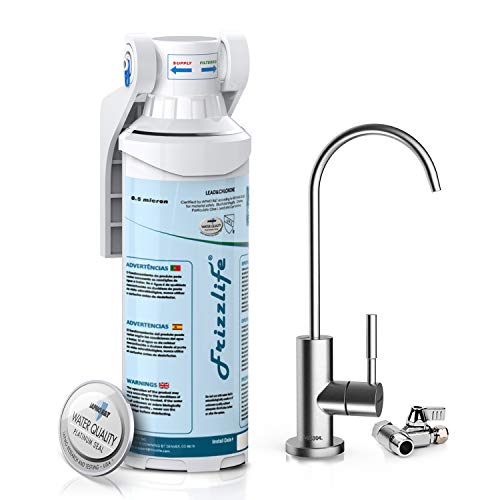
Frizzlife MP99 Under Sink Water Filter System — Best Faucet System for Families
Owners who want the MK99’s certified two-stage filtration but prefer a separate drinking tap.
- Two-stage filtration with 0.5-micron precision
- Certified against NSF/ANSI 53 and 42
- Supplied with a dedicated drinking-water faucet
- Auto shut-off filter head for dry cartridge changes
- Replacement cartridge FZ-2 family
Strengths
- Carries the same NSF/ANSI 53 and 42 certification story as the direct-connect Frizzlife
- Dedicated faucet preserves full flow at the main tap for utility water
- Twist-off cartridge changes stay quick and dry thanks to the shut-off head
Trade-offs
- Needs a countertop hole or spare opening for the included faucet
- A second tap is one more fixture to clean and to explain to guests
- Carbon-class scope: dissolved solids, fluoride and hardness remain
The MP99 separates what the MK99 combines. By giving filtered water its own small faucet, it reserves the certified two-stage cartridge for drinking duty alone and leaves the main tap at full, unfiltered pace for the kitchen’s heavy work. Owners who make the switch rarely return, because the separation clarifies everything: which water is treated, how fast the cartridge is truly ageing, and why the drinking tap pours at its own deliberate speed.
In a family kitchen the Frizzlife MP99 is judged by its busiest quarter-hour, not its quietest. undefined undefined undefined
One honest limitation: The included faucet’s finish and style may not match premium existing hardware, a cosmetic point that matters in design-led kitchens.
Best for: owners who want the mk99’s certified two-stage filtration but prefer a separate drinking tap / Not suited for: undefined

Waterdrop 15UA Under Sink Water Filter System — Best Two-Year Workhorse
Set-and-forget households that like the direct-connect idea but want to think about cartridges every two years instead of every year.
- Direct-connect design for the existing kitchen faucet
- NSF/ANSI 42 certified
- Rated service life of 24 months per cartridge
- Reduces lead, chlorine, bad taste and odour per the manufacturer listing
- Replacement cartridge WD-RF15
Strengths
- Two-year cartridge life halves the maintenance rhythm of the one-year models
- Larger cartridge body suits busier kitchens that draw a lot of cold water
- Installs inline with the same push-fit simplicity as the smaller Waterdrop units
Trade-offs
- A two-year-old cartridge demands calendar discipline, because taste gives little warning
- Still a carbon-class filter: dissolved solids and fluoride are untouched
- The bigger cartridge needs a little more vertical clearance under the sink
Doubling a cartridge’s rated life sounds like a small mercy until a household lives it: the reminder that fires every second year instead of every year, the replacement that can be planned rather than rushed. The 15UA is Waterdrop’s direct-connect formula with that mercy engineered in, a larger body, a two-year horizon and the same ten-minute install. It suits the owner whose enemy was never water quality but their own calendar.
In a family kitchen the Waterdrop 15UA is judged by its busiest quarter-hour, not its quietest. As carbon-class treatment it concentrates on taste, odour and certified reductions rather than on the dissolved fraction. The running-cost story is written by its rated capacity divided by a real household’s draw. It rewards the buyer who read their water report and punishes the one who bought a headline.
One honest limitation: Two years is a long time for any carbon cartridge in a warm under-sink cabinet; households that notice taste returning early should change on taste, not on the calendar.
Best for: set-and-forget households that like the direct-connect idea but want to think about cartridges every two years instead of every year / Not suited for: buyers whose needs contradict the trade-offs above
Comparison Table
| Pick | Filtration type | Headline specification |
|---|---|---|
| Waterdrop 15UA-UF Ultra Filtration Under Sink Water Filter System | direct-connect ultrafiltration | Rated service life of 24 months or 19,000 gallons |
| Aquasana AQ-5200 Claryum Under Sink Water Filter | dedicated-faucet carbon | Rated capacity 500 gallons |
| Waterdrop TSA 8-Layer Under Sink Water Filter System | dedicated-faucet multi-layer | NSF/ANSI 42 certified |
| iSpring US31 3-Stage Under Sink Water Filter System | dedicated-faucet carbon | Dedicated faucet included |
| Frizzlife MP99 Under Sink Water Filter System | dedicated-faucet carbon | Certified against NSF/ANSI 53 and 42 |
| Waterdrop 15UA Under Sink Water Filter System | direct-connect carbon | NSF/ANSI 42 certified |
See also Best Under Sink Water Filter For Families Under $75, Best Under Sink Water Filter Under $150 and Under Sink Water Filter Buying Guide.
How to Choose the Right System for Your Kitchen
Certification: read the standard, then the contaminant list
Certification is the only part of a filter’s marketing that a third party has verified, so it deserves slow reading. NSF/ANSI 42 attests aesthetic reductions, 53 attests health-related reductions, 58 governs reverse osmosis systems, and 372 addresses lead content in the product’s own materials. Just as important, certification belongs to an exact model and an exact claim list. A system certified for chlorine has not been certified for lead by association, and a membrane certified alone does not certify the assembled system around it. The strongest listings in this guide publish performance data sheets; the weakest hide behind the word tested.
Capacity and cartridge life: the running-cost decision
A filter’s purchase price is a down payment; its cartridges are the subscription. Compare systems on rated gallons and rated months together, because whichever limit arrives first ends the cartridge’s certified life. Small 500-gallon class systems suit light use and punish heavy use with frequent changes, while high-capacity canisters and two-year cartridges spread their cost thin for busy families. Also weigh who sells the replacement and whether the format is proprietary: a cheap system with a single-source cartridge can cost more across five years than a dearer system drinking standard filters.
Flow rate and how your household actually draws water
Flow decides whether a filter feels like an upgrade or an obstacle. Dedicated carbon faucets typically deliver around half a gallon per minute, which fills a glass briskly and a stockpot slowly. Direct-connect systems share the main tap’s plumbing, so their cartridges trim the whole cold line’s pace. Tank RO pours at line speed until the reserve runs down; tankless RO pours at its production rate, which is why the jump from 400 to 800 to 1,200 gallons per day is a felt difference rather than a spec-sheet vanity. Match the rating to your busiest hour, not your average one.
Faucet format: direct-connect, dedicated tap or smart faucet
Decide the faucet question before the filtration question, because it eliminates half the catalogue. If the counter cannot be drilled, direct-connect and existing-hole systems are your whole market. If a spare hole exists, dedicated faucets unlock the most economical cartridge usage in the category. If the household runs on data and reminders, a smart faucet’s quality readout is a feature with daily visibility. The filter behind the faucet matters enormously, but the faucet is the part you will touch ten thousand times.
Installation footprint: cabinet space, drain and power
The tape measure is a filtration tool. Record the cabinet’s clear width, depth and height, note what already lives there, and then compare against each system’s published dimensions with honest allowances for tubing bends and cartridge-removal clearance. RO buyers must also confirm a drain point for the saddle and, for tankless and UV models, a powered outlet that is not switched with the disposal in an inconvenient way. Ten minutes of measuring prevents the category’s most common return.
Families should price the second year, not the first. Add two years of cartridges at each finalist’s rated interval for your household size, and the ranking reshuffles toward big media and long intervals. Then check the human factor: a cartridge change that needs a wrench, a bucket and twenty minutes will be postponed by tired parents, while a twist-off change happens the day the reminder fires.
The School-Morning Test: Flow, Ice and Unsupervised Draws
Rate a family filter at 7 a.m., not at noon. Three bottles, a kettle and a cereal pot compete inside fifteen minutes, and systems separate themselves honestly under that load. Direct-connect cartridges trim the shared tap for everyone; dedicated faucets queue the filtered demand at their own tap while the main faucet stays fast for everything else. The picks above were ordered with that quarter-hour in mind, and the leaders are the ones whose flow and capacity keep the queue moving.
Ice is the family’s hidden draw. A refrigerator on the filtered line produces cubes and chilled water that children consume in quantities no one logs, and through a hot summer that silent draw rivals the kettle. Families planning the fridge connection should size from the top of this list, where two-year and 10,000-gallon class ratings absorb the extra load without changing the maintenance rhythm the household has learned.
See also How To Install An Under Sink Water Filter, Best Under Sink Water Filter For Families Under $300 and Water Filter Pitcher Review.
Key Takeaways
- Match the technology to your water report: carbon for taste, ultrafiltration for a particle barrier, reverse osmosis for dissolved contaminants.
- Certification attaches to an exact model and an exact contaminant list, so read the performance data sheet before paying for a claim.
- Cartridge capacity and interval decide the true cost of ownership far more than the purchase price does.
- Measure the cabinet, the drain and the counter hole situation before ordering any system in this guide.
Installing for a Busy Family Kitchen (and Feeding the Fridge)
Family installs reward ten extra minutes of planning. Decide where children will and will not reach, route tubing away from the disposal’s vibration, and, if you intend to feed the refrigerator’s dispenser and ice maker, fit the tee during the first installation rather than reopening the plumbing later. High-capacity systems earn their place here partly because a fridge connection quietly adds a second appliance’s worth of draw to the cartridge.
- Map the cabinet: filter position, tubing route, and a clear path for cartridge removal with a full cabinet.
- Shut off the cold supply, relieve pressure, and fit the main system before any optional fridge tee.
- If splitting to the refrigerator, use the manufacturer’s ice-maker kit or a proper quarter-inch tee and confirm the fridge fills at a sensible pace.
- Flush the system thoroughly before connecting the fridge line, so the ice maker never sees commissioning water.
- Label the cartridge with its change date where a parent will see it during normal cabinet use.
After install day, family maintenance is about anticipation: keep the next cartridge in the house if your model uses a proprietary fit, because a filter that runs out on a holiday weekend tends to stay expired until the following one.
Because lead contamination happens inside or just outside the home, point-of-use treatment is a rational, targeted defence. A certified health-standard claim for the exact model is the only version of lead protection worth paying for. Reverse osmosis rejects lead by size and charge along with the rest of the dissolved fraction, which is why it anchors the cautious end of the market. Ion-exchange and adsorption media in the better carbon systems are engineered specifically for this contaminant class. Homes with older plumbing should read this section twice and the price section once.
Common Buying Mistakes
Drilling first and measuring later
Counter holes are permanent, tanks are bulky and cabinets are smaller than they look in product photography. Measure the cabinet, confirm the faucet hole or spare opening, locate the drain and check for an outlet before the box arrives. Every return story in this category begins with a dimension nobody checked.
Forgetting the flush and the first gallons
Fresh carbon sheds black fines and fresh membranes shed preservative, and both are supposed to leave during commissioning. Owners who skip the flush judge a sound system by its worst glass and occasionally return it for the crime of being installed correctly but commissioned lazily. The manual’s flushing steps are chemistry with a timer; run them in full.
Letting the cartridge calendar drift
Exhausted media does not slam a door; it simply stops reducing while the water keeps flowing and the household keeps trusting. The defence costs nothing: a reminder set on install day, governed by whichever of the month rating or gallon rating arrives first, and a household culture that treats the reminder as an instruction rather than a suggestion.
Filtering the wrong line
Under-sink systems belong on the cold feed, full stop. Hot water attacks carbon media, invalidates the ratings the system was certified under and can dump captured load back into the stream. Crossed lines happen most often in cabinets rearranged by earlier appliance work, so trace both supplies from their valves with a run of the cold tap before any connection is made.
Living With the Decision: What Experience Adds to the Specifications
Utilities dose chlorine to keep water safe across miles of main, and the kitchen tap inherits the flavour. Free chlorine reacts with activated carbon almost on contact, which is why even a modest cartridge transforms a glass of tap water. Full-size canisters often outperform slim cartridges on stubborn municipal supplies simply because the water spends longer inside the media. By the time water reaches a kitchen it has generally done its disinfecting work, so removing the residual costs the household nothing in safety. This is why taste, not exotic chemistry, is the honest starting point for most under-sink purchases.
The membrane is the only component in this category that addresses the water’s dissolved fraction directly. Production rate, waste ratio and pressure requirements are all the same physics wearing different clothes. Chlorine destroys membrane film, which is why carbon pre-filters stand guard in front of every design in this guide. Membrane life is measured in years because the film works slowly and steadily rather than in bursts. The membrane rewards correct pressure and punctual pre-filters with the broadest purification a household can buy.
A pressurised tank accumulates purified water against a bladder so the faucet can pour faster than the membrane works. After a heavy draw the tank’s pace softens until production refills it, a rhythm owners learn in the first month. A tank keeps dispensing through a power cut, an independence no pumped tankless design can claim. Modern high-output membranes have narrowed the tank’s flow advantage to the first glass of the morning. The tank is a compromise, honestly priced, and for many households still the right one.
Chlorine announces itself in a delicate brew long before it bothers a glass of water. Kettles filled from a filtered tap scale more slowly when the supply’s chemistry is tamed at the source. Straight RO water brews thin for many palates, which is why remineralisation stages found their market. Carbon-filtered water is the traditional brewing sweet spot: clean of chlorine, still mineral enough to extract well. The brew test is subjective, repeatable and, for most households, decisive.
Long intervals, big canisters and efficient ratios shrink the format’s footprint considerably. A two-year cartridge is an environmental feature as surely as it is a convenience one. Water rejected by a membrane returns to the municipal cycle; it is billed, not destroyed. Plastic, transport and refrigeration make bottled water the heavyweight in any footprint contest. Buy long, maintain on schedule, recycle what the maker accepts.
Final Recommendation
Family value at this tier is measured in months between cartridge changes and in trust at unsupervised taps. Start with the Waterdrop 15UA-UF Ultra Filtration Under Sink Water Filter System (Best Overall for Families), and keep the Aquasana AQ-5200 Claryum Under Sink Water Filter (Best Certified for Children) as the closest alternative if its format suits your kitchen better. See also Is An Under Sink Water Filter Worth It and How To Choose An Under Sink Water Filter.
Context That Matters More Than Marketing: Further Notes
Rust from mains work, sand from wells and scale from ageing plumbing all arrive at the same first stage. Layered systems exist precisely to keep the coarse work away from the polishing media. Homes with chronic sediment sometimes solve it once, upstream, with a whole-house pre-filter. A first stage that clouds early is doing its job loudly; replace it and protect the rest. Grit is cheap to catch early and expensive to catch late.
Chilled water from a filtered line ends the bottled truce in most kitchens within a week. Flush the main system thoroughly before the fridge line is connected, so the ice maker never meets commissioning water. Small cartridges feel the fridge’s appetite first; generous ratings absorb it without changing the household’s rhythm. Long tubing runs cost pressure, so route the line as directly as the cabinet allows. Count the fridge in your capacity maths and the connection is pure dividend.
Nobody should buy remineralisation as nutrition; its honest product is flavour. Calcium and magnesium media dissolve in trace amounts as purified water passes over them. The quantities involved are small beside dietary intake, and the better brands say so. Households converting from spring water notice the correction immediately and approve of it. Flavour is not a frivolous specification in a product whose endpoint is a glass.
A simple gauge on an outside tap predicts RO happiness more reliably than any review can. Manufacturers publish a working range because membrane efficiency collapses below it. Booster pumps exist to lift weak supplies into that range, restoring both pace and ratio. High pressure has its own manners: regulators and hammer arrestors protect fittings and quiet the system. Treat the gauge reading as part of the product selection, because the membrane will.
A gallon rating and a month rating guard the same cartridge from two directions; whichever expires first wins. Sediment load steals chemical capacity, which is why gritty supplies age cartridges ahead of the calendar. A fridge connection quietly adds a second appliance’s draw to the same cartridge account. Flow decline and returning taste are the cartridge’s own late warnings, and both deserve obedience. Buy the rating your busiest month respects.
No utility can certify what your own pipes add to the water after it enters the house. Flushing a stagnant line reduces exposure, but a verified barrier works on the mornings nobody remembers to flush. Ion-exchange and adsorption media in the better carbon systems are engineered specifically for this contaminant class. A certified health-standard claim for the exact model is the only version of lead protection worth paying for. Treat lead as a specification to be checked, not a fear to be marketed to.
New carbon sheds fines, new membranes shed preservative, and every system sheds air. Flush durations in manuals are chemistry, not caution theatre; shortening them borrows taste trouble. Writing the date on the housing converts the next service from archaeology into reading. Owners who commission properly judge their system on its real water, not its first hour. Commissioning is thirty minutes that protect a decade of mornings.
A pressurised tank accumulates purified water against a bladder so the faucet can pour faster than the membrane works. Stored water is also a hygiene conversation, which is why commissioning flushes and periodic sanitising appear in serious manuals. Modern high-output membranes have narrowed the tank’s flow advantage to the first glass of the morning. A tank keeps dispensing through a power cut, an independence no pumped tankless design can claim. Decide the tank question with a tape measure and your household’s busiest hour, not with ideology.
Sediment is the unglamorous load that decides how long everything else in a system lasts. Layered systems exist precisely to keep the coarse work away from the polishing media. Particles lodge in carbon pores and steal capacity that was rated for chemical duty. Homes with chronic sediment sometimes solve it once, upstream, with a whole-house pre-filter. Treat sediment as its own problem and the drinking-water stages will live their full rated lives.
New carbon sheds fines, new membranes shed preservative, and every system sheds air. Flush durations in manuals are chemistry, not caution theatre; shortening them borrows taste trouble. Leak checks belong at one hour and at one morning, because pressure finds slow weeps on its own schedule. Writing the date on the housing converts the next service from archaeology into reading. Respect the ritual and the system will taste like its specification from the first week.
The honest comparison is against the bottled habit most households are actually replacing. Several manufacturers run cartridge recycling schemes that are worth the small effort they ask. Water rejected by a membrane returns to the municipal cycle; it is billed, not destroyed. Plastic, transport and refrigeration make bottled water the heavyweight in any footprint contest. The footprint shrinks further every time a household chooses capacity over novelty.
Carbon systems forgive almost any household pressure; membranes keep accounts. Booster pumps exist to lift weak supplies into that range, restoring both pace and ratio. High pressure has its own manners: regulators and hammer arrestors protect fittings and quiet the system. Manufacturers publish a working range because membrane efficiency collapses below it. Pressure is a household fact, and the best filter is the one designed around yours.
Chlorine announces itself in a delicate brew long before it bothers a glass of water. Kettles filled from a filtered tap scale more slowly when the supply’s chemistry is tamed at the source. Carbon-filtered water is the traditional brewing sweet spot: clean of chlorine, still mineral enough to extract well. Straight RO water brews thin for many palates, which is why remineralisation stages found their market. Judge the glass you actually drink from, not the one in the advertisement.
Osmosis works because pressure persuades water through a film that dissolved matter cannot follow. What the membrane rejects leaves through the drain line, carrying the contaminants with it in a concentrated stream. Production rate, waste ratio and pressure requirements are all the same physics wearing different clothes. Membrane life is measured in years because the film works slowly and steadily rather than in bursts. The membrane rewards correct pressure and punctual pre-filters with the broadest purification a household can buy.
Feeding the refrigerator is the upgrade owners describe as the one that changed the house. Flush the main system thoroughly before the fridge line is connected, so the ice maker never meets commissioning water. Long tubing runs cost pressure, so route the line as directly as the cabinet allows. Plan the connection at install time, because reopening finished plumbing to add it later is nobody’s favourite Saturday. It is the rare upgrade that delights children, guests and the person who used to buy the bottles.
A gallon rating and a month rating guard the same cartridge from two directions; whichever expires first wins. Flow decline and returning taste are the cartridge’s own late warnings, and both deserve obedience. Dedicated faucets stretch ratings by refusing to spend them on utility water. Sediment load steals chemical capacity, which is why gritty supplies age cartridges ahead of the calendar. The cheapest gallon in this category belongs to the system whose capacity your household cannot outrun.
An alkaline stage returns a modest mineral fraction and lifts the water toward neutral. The quantities involved are small beside dietary intake, and the better brands say so. Purists who prefer the membrane’s unaltered output can simply choose the platform without the stage. Calcium and magnesium media dissolve in trace amounts as purified water passes over them. Buy the stage because the water tastes better and therefore gets drunk.
Utilities dose chlorine to keep water safe across miles of main, and the kitchen tap inherits the flavour. By the time water reaches a kitchen it has generally done its disinfecting work, so removing the residual costs the household nothing in safety. Full-size canisters often outperform slim cartridges on stubborn municipal supplies simply because the water spends longer inside the media. Free chlorine reacts with activated carbon almost on contact, which is why even a modest cartridge transforms a glass of tap water. Get the disinfectant right and the rest of the specification sheet falls into its proper order.
Lead enters drinking water late in its journey, which is precisely why a filter at the final tap can answer it. Reverse osmosis rejects lead by size and charge along with the rest of the dissolved fraction, which is why it anchors the cautious end of the market. A certified health-standard claim for the exact model is the only version of lead protection worth paying for. Ion-exchange and adsorption media in the better carbon systems are engineered specifically for this contaminant class. If lead is your target, let the data sheet, not the packaging, make the promise.
Long intervals, big canisters and efficient ratios shrink the format’s footprint considerably. A two-year cartridge is an environmental feature as surely as it is a convenience one. Plastic, transport and refrigeration make bottled water the heavyweight in any footprint contest. Several manufacturers run cartridge recycling schemes that are worth the small effort they ask. Sustainability here is mostly a matter of intervals and honesty.
A simple gauge on an outside tap predicts RO happiness more reliably than any review can. Booster pumps exist to lift weak supplies into that range, restoring both pace and ratio. Upper floors, long runs and tired well pumps are the usual suspects when pressure disappoints. Manufacturers publish a working range because membrane efficiency collapses below it. Treat the gauge reading as part of the product selection, because the membrane will.
The storage tank is traditional RO’s answer to a mismatch between slow production and impatient households. Stored water is also a hygiene conversation, which is why commissioning flushes and periodic sanitising appear in serious manuals. Modern high-output membranes have narrowed the tank’s flow advantage to the first glass of the morning. A tank keeps dispensing through a power cut, an independence no pumped tankless design can claim. Decide the tank question with a tape measure and your household’s busiest hour, not with ideology.
Coffee and tea are the most sensitive instruments a kitchen owns for judging filtered water. Straight RO water brews thin for many palates, which is why remineralisation stages found their market. Cafés remineralise deliberately; a home alkaline stage is the same idea at kitchen scale. Carbon-filtered water is the traditional brewing sweet spot: clean of chlorine, still mineral enough to extract well. The brew test is subjective, repeatable and, for most households, decisive.
Frequently Asked Questions
What does TDS mean, and should I chase a low number?
TDS is best understood as a dashboard light, not a diagnosis. It tells you how much dissolved material is present in total, without naming any of it. That makes it genuinely useful for RO owners monitoring membrane condition and nearly meaningless as a quality score for carbon-filtered water, where retained minerals keep the number up while the water tastes clean. Judge systems by their certified contaminant claims; use TDS only for the narrow jobs it actually performs.
How do I know what is actually in my tap water?
Start with your utility’s annual consumer confidence report, which lists detected contaminants and their levels for municipal supplies. Well owners should commission a laboratory test, because no utility is reporting on their behalf. Match the findings to filter claims: chlorine taste needs only aesthetic treatment, a lead detection calls for certified 53-class reduction or RO, and microbial concerns point toward ultrafiltration or UV-backed systems. Buying filtration before reading your own water’s report is how households end up over- or under-protected.
Do under sink water filters remove fluoride?
Fluoride is the question that separates the two halves of this category. Carbon and ultrafiltration systems, however good, do not meaningfully reduce it; a reverse osmosis membrane does. Households that want fluoride reduction should therefore start from the RO picks in this guide and treat every non-RO claim with suspicion unless a certified performance data sheet names fluoride explicitly.
Will an under sink filter lower my water pressure or flow?
Expect a small, livable change rather than a dramatic one. Carbon stages on a dedicated tap usually run near half a gallon per minute, direct-connect models trim the main faucet’s stream a little, and pressurised tank systems pour at full speed until the tank empties. If your home’s pressure is already marginal, that baseline matters more than the filter: RO systems in particular publish a minimum feed pressure, and homes below it should consider a pumped model.
What is the difference between NSF/ANSI 42 and 53 certification?
Think of 42 as the taste standard and 53 as the health standard. Forty-two certifies reductions you can perceive, like chlorine and odour. Fifty-three certifies reductions of health-related contaminants such as lead, and it is the number that matters when a water report, rather than a flavour complaint, is driving the purchase. Always confirm the contaminant you care about is named for the exact model, because certification attaches to listed claims, not to the brand generally.
Do these filters remove PFAS?
Some do, and the claim must be checked model by model. Certain carbon systems in this guide, including Aquasana’s Claryum line and several Frizzlife and Waterdrop cartridges, publish PFAS-class reduction claims, and reverse osmosis membranes reduce PFAS effectively by size exclusion. Because PFAS covers a family of compounds, look for the specific claim, ideally a certified one referencing PFOA and PFOS, in the performance data for the exact system you are buying rather than accepting a generic forever-chemicals headline.