Where to buy
Check the latest price, availability and delivery on Amazon. Orders are placed on Amazon. We may earn a commission from qualifying purchases.
- Best overall: LIKIMIO Armoire Wardrobe Closet, 70″ H, 5 Doors, White — Check on Amazon
- Fenghua Lizhi 3 Doors Wooden Wardrobe Closet Armoire, White — Check on Amazon
- St.Mandyu Farmhouse Wardrobe Armoire Closet, 3 Doors and 2 Drawers, Brown — Check on Amazon
- Yechen 71″ Wooden Armoire Wardrobe Closet, White — Check on Amazon
See 2 more Amazon options
- TOKSOM 71.7″ Wardrobe Armoire Wooden Closet, 2 Doors and 3 Drawers, Black — Check on Amazon
- VIPEK V5 Portable Closet Wardrobe, Heavy Duty Clothes Rack with 4 Hanging Rods and 8 Shelves — Check on Amazon
Read the full guide ↓
Disclosure: As an Amazon Associate, umtsmarttool.com earns from qualifying purchases. Links to Amazon on this page are affiliate links; they cost you nothing extra. Listing details such as price and availability change often, so check the current Amazon listing before you buy.
The best wardrobes for apartments under $400 are the first in this series where the furniture is wide — and the first where a renter has to price the exit as well as the entrance. Here is the one-line finding of this guide: at $400, width finally verifies — the five-door LIKIMIO our cheaper guides could only point at now pins on Amazon — check price on Amazon — and two genuinely wide armoires, about 47 inches across, verify beside it — but every verified wardrobe in this band is still engineered board or MDF, and no solid-wood wardrobe verifies at or under $400 on Amazon at all. If you arrived here from our under-$200 guide, you will remember its shape: furniture had just entered, but narrow — a 31.5-inch flat-pack armoire in the budget tier — while the wide wooden class sat on the far side of the line, in a higher tier. At $400 that class is simply here.
What changes for an apartment is what the width costs in the two currencies renters actually hold: wall and weight. The wide cabinets here are 99 to 128 pounds of flat-pack board. They assemble in the room and do not knock down and rebuild the way tube steel does — which is why so much rental furniture is sold for almost nothing, or abandoned outright, in the last week of a tenancy. Think of the cost spread over a 12-month lease, and the reckoning only stays honest if the piece is still yours after the lease ends: a cabinet you leave behind has to be paid for all over again in the next apartment. The steel rack below is the only pick whose cost per lease keeps falling, because it is the only one that reliably travels.
So this guide is built around four wooden cabinets that were out of reach or unpinnable at $200, plus two survivors from the cheaper guides; four $200 picks lose their slots at this money, named below. For most apartment readers we would begin with the LIKIMIO five-door: the wide wardrobe this series has been naming since the $75 guide, well under this budget’s ceiling. Below you will find a quick picks table, detailed notes on each of the six products, a comparison table, a buying checklist, the mistakes renters make most in this band, and answers to the questions that come up again and again.
One boundary deserves stating before the picks. The material story does not change at $400: MDF and engineered board are what verify, from the hero to the farmhouse piece at the top of the band. The solid-wood class exists, but starts well above this budget on the channels we checked, and in-band “solid wood” labels turn out, on the listings themselves, to be engineered wood or solid legs under a board cabinet. What $400 buys is width, doors, drawers and finish. If only solid timber will do, keep saving — the gap is real and no pick below closes it.
In this guide
Quick Picks
Short on time? Each row below names a buyer type and the product that suits it, with a link to the listing.
| Buyer type | Pick | Why it stands out | Link |
|---|---|---|---|
| Best overall | LIKIMIO Armoire Wardrobe Closet, 5 Doors | The wide wooden wardrobe this series has pointed at since $75, pinned at last — check price on Amazon | Check on Amazon |
| Best wide combination | Fenghua Lizhi 3 Doors Wooden Wardrobe | About 47 inches of modular wooden cabinet, the band’s top seller by volume | Check on Amazon |
| Best farmhouse style | St.Mandyu Farmhouse Wardrobe Armoire | 47.2 inches wide, 3 doors and 2 drawers in a farmhouse finish — check price on Amazon | Check on Amazon |
| Best two-door with drawers | Yechen 71″ Wooden Armoire | The armoire the Brafab name could never pin, verified under this brand — check price on Amazon | Check on Amazon |
| Best narrow furniture compromise | TOKSOM 71.7″ Wardrobe Armoire | Real doors and drawers in the budget tier — the furniture that fits the leftover apartment wall | Check on Amazon |
| Best for moving again | VIPEK V5 Portable Closet Wardrobe | The only pick that knocks down flat at move-out: four rods and eight steel shelves | Check on Amazon |
How These Picks Were Chosen
The first filter was the budget itself, applied the same way as in our $30, $75, $100 and $200 guides: every product below is a real Amazon listing at or under $400, with an ASIN we could pin to that exact product and an offer behind it — check price on Amazon for the current figure on each one. The LIKIMIO five-door is the same product our $200 guide recorded when it sat out of reach, and its ASIN, dimensions and construction are now pinned from the Amazon page itself. The Fenghua Lizhi three-door is sold by its own maker and fulfilled by Amazon, the highest-volume wooden wardrobe in its class. The St.Mandyu farmhouse armoire sits at the top of the band. The Yechen sits in the middle of the band. The TOKSOM and the VIPEK V5 carry their $200-guide verifications forward in the budget tier. Prices in this band move, so check the live listing before you buy, and judge each pick’s cost over the months you will actually keep it.
What changed against the $200 guide is four promotions and four demotions, and all of them deserve naming. The promotions first. The LIKIMIO five-door was the cheaper guides’ wide-wooden benchmark — mentioned at $75, $100 and $200, buyable in none — and at $400 it is simply the hero. The Fenghua Lizhi combination and the St.Mandyu farmhouse piece are new classes for this series: wardrobes about 47 inches wide, the width the TOKSOM’s critics were picturing all along. The Yechen is a resolution rather than a discovery: the same two-door armoire, model XHX-25, attached to the Brafab name since the $75 guide, finally pinning under the Yechen brand. The demotions: the VIPEK V40C covered rack, both LEAIJIAFY portables and the SONGMICS ULSF03H all lose their slots — not because any of them failed verification, but because at $400 every slot goes to furniture or to the strongest steel. All four remain the recommendations of our $200 guide. The VIPEK V5 keeps the steel slot on the category’s highest sales volume and its open, reconfigurable format — and, for apartment readers, on a property no cabinet here has: it comes apart. The TOKSOM keeps the value slot as the cheapest real furniture in the series by a wide margin, and the only cabinet that fits a narrow wall.
Just as important is what we checked and left out, and why. Solid wood first: no solid-wood wardrobe verified at or under $400. The known solid-pine maker’s wardrobes sit well above this budget on the channels we checked, in a premium tier, and the one “solid pine” wardrobe in roundups for this band describes itself on its own listing as solid pine mixed with MDF, with no offer we could pin. The Brafab name still cannot be promoted: the single two-door armoire under that brand still pins no ASIN, price and offer together — its one pinnable listing remains a set of two units, showing no featured offer — so Brafab is named here unlinked, for a fourth guide running, and its twin under the Yechen brand is the pick below. The fluted VINGLI wardrobe now has an ASIN we can identify, but no live offer we could pin to it — an earlier read from our $200 research still cannot be attributed to that listing — so it stays named unlinked. The LIKIMIO two-door and the LIKIMIO farmhouse LED model both appear in coverage, but neither pins an ASIN we can verify, so both are named unlinked too. The extra-wide SONGMICS DALTEN still has no pinnable US offer — a third guide running. And premium steel answers plainly: the larger VIPEK racks could only be checked in Canadian listings. We did not use these products ourselves. We read the maker listings and specification pages, compared dimensions, rod and shelf counts, materials and stated load capacities, and favored products that solve a real wardrobe job in this band. Where a listing contradicts itself, we print the contradiction rather than quietly picking the friendlier number. Load figures throughout are maker claims, attributed to the listing that states them, and never directly comparable between brands.
The 6 Best Wardrobes for Apartments Under $400
LIKIMIO Armoire Wardrobe Closet, 70″ H, 5 Doors, White (HK-YG-06)
Who it suits: Apartment buyers who have been waiting through four guides for the wide wooden wardrobe — anyone who wants one cabinet that hangs, shelves and closes, and whose lease is long enough to justify furniture.
This is the product the $75, $100 and $200 guides could only point at. The LIKIMIO is a five-door wooden wardrobe in white: 38.03 inches wide by about 20 inches deep by 69.76 inches tall in its listing’s own figures, built from MDF, with four storage shelves, a hanging rod, three hooks on the side and an anti-tip device, at 128 pounds. Check price on Amazon for the current figure — every read in this series has found it in the same part of the band, and it sells in the hundreds per month. Five doors means a divided interior you can assign by section rather than one open box, and at 38 inches it steps up from the 31.5-inch furniture that entered at $200 while still fitting walls the 47-inch pieces below will not.
The apartment reading starts with the weight. At 128 pounds it is a place-once piece: flat-pack board does not knock down and rebuild the way tube steel does — cam-and-dowel joints tightened, loaded and lived with for a year are not designed for a second assembly — which is why cabinets like this are so often sold for almost nothing at move-out. Judge it that way: if it serves one lease and is sold or abandoned, its cost lands in that single year; kept through a second lease, it is the cheapest wide storage here. The anti-tip device is included and is not optional on a cabinet this size — but in a rental the fixing needs the landlord’s permission first (the anti-tip section below covers it); until then, load low and even, doors closed. Its paperwork needs the same honest reading: the listing states a 25-pound weight limit, and even lists a drawer capacity for a model with no drawers — template residue, printed here as found. Read it as a per-section planning figure and load the shelves as light-to-moderate duty. What the step up from the TOKSOM buys is width, two more doors and a divided interior; what it does not buy is drawers, and the construction is MDF — real furniture format, honestly described, not solid wood.
- The wide wooden wardrobe of this series, finally pinned: five doors, four shelves, hanging rod — check price on Amazon.
- 38 inches wide and 128 pounds — a divided, sectioned interior in one cabinet.
- A consistent position in the band across every read in this series.
Honest limitation: There are no drawers, and the listing’s own paperwork is sloppy — a 25-pound stated weight limit and a drawer capacity for a drawerless model. At 128 pounds it is also the heaviest commitment here: a cabinet you will most likely sell or leave at move-out. Check price on Amazon and confirm the live offer before ordering; if it has drifted over $400, the Fenghua Lizhi below is the fallback hero.
Choose it if you want the wide cabinet this budget was saved for, your storage is hanging- and shelf-shaped, and your tenancy is stable enough for furniture money. Skip it if drawers are non-negotiable — the St.Mandyu and the Yechen both have them — your wall is under 38 inches, or you already know you are moving within the year, in which case the VIPEK V5 is the pick that moves with you.
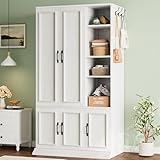
Fenghua Lizhi 3 Doors Wooden Wardrobe Closet Armoire, White
Who it suits: Apartment buyers with a long wall and a whole household’s overflow — anyone who wants the widest wooden storage this budget verifies, arranged their own way.
The Fenghua Lizhi three-door is the volume leader of this band: its three-door line sits at the top of the wooden-wardrobe sales tables, near the top of this budget — check price on Amazon — sold by Fenghua Lizhi itself and fulfilled by Amazon. It is a combination wardrobe in engineered wood — fluted door fronts, damping hinges, a metal hanging pole — at 99 pounds. Its listing prints its dimensions as 47.2″D x 18.9″W x 66.1″H — the depth and width fields appear transposed, as this series flagged for the LEAIJIAFY at $100, since 47.2 inches is the three-door class’s standard width and 18.9 inches its standard depth. Plan your wall on the transposed reading — about 47 inches wide, 19 inches deep, 66 inches tall — and confirm on the live listing. Read that way, this is the joint-widest furniture in the guide, and the only pick whose interior is designed to be rearranged rather than accepted as built — a real virtue in a shared apartment, where the hanging-to-shelving split changes with the occupants.
The apartment cautions are the wall and the exit. Forty-seven inches is the largest wall commitment in this guide, and in a small rental that wall is rarely spare: measure what the cabinet does to the door swing and the walkway before you commit. At 99 pounds it is the lightest of the wide cabinets, and it is still flat-pack board — the same place-once economics as the hero, at a higher price: a combination layout configured for this apartment’s occupants is worth the least of anything here to the next tenant. The paperwork beyond the dimensions is thinner than the hero’s: the listing states a maximum weight capacity of 50 pounds as a maker claim — modest for a cabinet this size, and one shared households should plan around rather than discover — and a shelf count of one alongside its two compartments, reflecting the combination format rather than a fixed interior. What the money buys over the LIKIMIO is nine more inches of width and the combination layout; what it gives up is the divided five-door interior and any published per-section load figure.
- The widest verified furniture in the band: about 47 inches of engineered-wood combination cabinet.
- The band’s top-selling wooden wardrobe line, near the top of this budget — check price on Amazon.
- Fluted doors, damping hinges and a metal hanging pole, sold by the maker and fulfilled by Amazon.
Honest limitation: The dimension fields appear transposed — it prints a 47.2-inch depth and an 18.9-inch width — so measure from the live listing, not the headline. Its stated 50-pound maximum capacity is the most modest load figure here, the reads for its line do not all agree, and at 47 inches wide it may dominate a small rental’s only long wall.
Choose it if width and configurable volume are the whole brief and you have about 47 inches of genuinely spare wall. Skip it if you want a fixed, divided interior with published shelf figures — that is the LIKIMIO — or your tenancy is short, since this is the most expensive piece here to leave behind.

St.Mandyu Farmhouse Wardrobe Armoire Closet with 3 Doors and 2 Drawers, 70.1″, Brown
Who it suits: Apartment buyers who want the wide wardrobe to look like a chosen piece of furniture — farmhouse finish, three doors and real drawers — in a unit they expect to stay in.
The St.Mandyu is the style pick of this guide, and it is genuinely wide: its listing dimensions read 47.2 inches wide by 19.6 inches deep by 70.1 inches tall, with three doors, two drawers and a hanging rod in a brown farmhouse finish. It sits at the top of this band — check price on Amazon. That is the honest summary of the top of this band: the step up over the LIKIMIO buys the farmhouse look, two drawers the hero does not have, and about nine inches of width, in the same engineered-wood construction class as everything else here.
The renter’s question for this pick is sharper than for any other: a style premium is money spent furnishing a room you do not own, in a finish chosen for this apartment, in the same flat-pack board that does not travel well. None of that makes it a bad buy — a long tenancy is exactly where a wardrobe should furnish as well as store — but it makes the tenancy the deciding fact. No load figure for the rod, shelves or drawers could be pinned from the reads behind this guide, and none is invented here: buy it for the format and the finish, and load it as the moderate duty its class implies. It sits nearest the ceiling of this guide, so a modest upward drift ends the qualification — check price on Amazon before anything else in your cart.
- Full wardrobe width — 47.2 inches — with three doors and the two drawers the hero lacks.
- Farmhouse finish at the top of the band — check price on Amazon.
- 70.1 inches tall: full-height hanging in the widest format this guide verifies.
Honest limitation: It is the most expensive pick here and no load figure could be pinned — check price on Amazon first, and load conservatively. It is also the purest style premium: the finish is chosen for one apartment, and the board construction will not follow you to the next.
Choose it if the wardrobe is a furniture decision, not just a storage one, your tenancy is long, and drawers plus width plus finish are worth its place at the top of the band. Skip it if the same money should buy maximum plain capacity — the Fenghua Lizhi above is as wide — or a price rise at checkout would break the budget, since this pick sits nearest the line.

Yechen 71″ Wooden Armoire Wardrobe Closet, White
Who it suits: Apartment buyers who wanted the two-door armoire with drawers that this series kept naming under another brand — the classic wardrobe shape, in the middle of the band.
The Yechen has been in this series’ research since the $75 guide under the Brafab name: a two-door wooden armoire, 29.92 inches wide by 19.68 inches deep by 70.8 inches tall, with two wide drawers, an adjustable shelf and a metal hanging rail, in laminated engineered wood at 120 pounds. Under the Brafab brand the single unit never pinned — its reads disagreed and its one pinnable listing was a set of two — but the same armoire, model XHX-25, pins cleanly under the Yechen brand: this listing, sold by Yechen Direct — check price on Amazon. Nothing about the product changed; the paperwork did. Roundup coverage reports a 100-pound capacity figure for it — a roundup-reported maker figure, not a listing read — and the listing itself states the material plainly: engineered wood, whatever any headline says.
That last point is this pick’s honest limitation, because third-party roundups describe it as a “solid wood build” — it is not, on its own listing, and a buyer who pays a mid-band price expecting solid timber has been misled by coverage, not by the maker. For a renter the shape cuts both ways. At just under 30 inches wide it fits the wall sections apartments actually have spare, and its two drawers answer the folded-clothes question the hero leaves open; but at 120 pounds it carries nearly the hero’s move-out problem at a narrower width — and the TOKSOM below is a hair wider, has three drawers to this pick’s two, and sits in a lower tier. What the money buys is the most conventional wardrobe in this guide: two doors over a hanging section and shelf, two drawers under it. It survives as the two-door answer — and as this series’ standing lesson that a product is recommendable only when its own listing’s paperwork, not its reputation, can be pinned.
- The classic two-door armoire, pinned at last: 2 doors, 2 wide drawers, adjustable shelf — check price on Amazon.
- 120 pounds of laminated engineered wood — the substantial end of the two-door class.
- Sold by Yechen Direct, with the model (XHX-25) shared with the unpinnable Brafab listing.
Honest limitation: It is engineered wood, not solid — roundups that call it solid are contradicted by its own listing. Its capacity figure reaches us through roundup coverage rather than a listing read, and at 29.92 inches it is barely wider than the TOKSOM in the lower tier — while weighing 120 pounds, so its exit cost is a wide cabinet’s, not a narrow one’s.
Choose it if you want the conventional two-door-and-drawers wardrobe and value the classic layout over raw width. Skip it if width is the metric — the LIKIMIO is wider — or you were led here by “solid wood” coverage, in which case read the solid-wood section below before buying anything.

TOKSOM 71.7″ Wardrobe Armoire Wooden Closet with 2 Doors and 3 Drawers, Black
Who it suits: Apartment buyers whose wall is narrow or whose budget is really a $200 budget wearing a $400 label — anyone who wants real furniture, with doors and drawers, and has about 32 inches of wall.
The hero of our $200 guide survives at $400 unchanged, and its record is the most stable in this series: a flat-pack engineered-wood armoire, 31.5 inches long by 18.9 inches wide by 71.7 inches tall, with two doors, a hanging rod with a shelf, and three drawers across the bottom, in the budget tier — check price on Amazon — the same position every read in this series has found for it, and the cheapest furniture in this guide. Its role at this money is different: at $200 it was the breakthrough, the first furniture in the series; here it is the narrow furniture compromise — the only cabinet that fits the leftover wall in a small apartment bedroom, and the only one whose exit cost is survivable. It is still flat-pack board and still a place-once piece, but a budget-tier cabinet sold or left at move-out is a shrug where a top-of-band one is a wound. The wide cabinets above are better wardrobes where they fit; on a 34-inch wall they are not wardrobes at all, they are returns.
Its limitations are the ones its own guide stated, unchanged. It is narrow — one person’s wardrobe, not a couple’s — and the construction is flat-pack board, assembled once and placed once. No load figure could be pinned from its listing paperwork, and none is printed here. At $400 the money you do not spend here is a real decision rather than a forced one — and for a studio or a first apartment it is frequently the right one. Furniture you can place beats furniture you cannot, at any budget in this series, and furniture you can afford to leave beats furniture you cannot.
- The furniture floor of this series: hinged doors, three drawers, hanging rod — check price on Amazon.
- The only pick that fits a narrow wall: 31.5 inches wide, full 71.7-inch height.
- The most stable position in the band — the same tier across every read since our $75 research.
Honest limitation: It is narrow, and it is flat-pack board: a single wardrobe, placed once. Check price on Amazon and confirm the live offer on the listing before ordering; if it has drifted over $400, the VIPEK V5 below is this guide’s fallback in the value slot.
Choose it if your wall is narrow, your room is small, or the wardrobe is one of several furniture jobs this budget must cover. Skip it if you have the wall for the wide cabinets above and one wardrobe must serve two people — that is what stepping up the band is for.

VIPEK V5 Portable Closet Wardrobe, Heavy Duty Clothes Rack with 4 Hanging Rods and 8 Shelves
Who it suits: Renters who know they will move again — hangers and stackers who want industrial shelving discipline and a wardrobe that leaves the apartment when they do.
The V5 keeps this guide’s steel slot on the same evidence that promoted it at $200. It sits in the budget tier — check price on Amazon — among the highest sales volumes in its category. But a simple cost-over-one-lease framing understates this pick, because unlike every cabinet above, the V5’s cost does not reset at move-out. The frame is steel, 68.9 inches long by 15.7 inches wide by 76.4 inches tall, arranged as four hanging rods and eight shelves in an open, adjustable layout, and it knocks down to tubes and shelves that fit in a car: the same rack serves lease after lease at no further cost, which no flat-pack cabinet here can claim. VIPEK’s stated maximum load is 890 pounds as a maker claim, and its listing copy puts up to 60 pounds on each hanging rod, also as a maker claim. At $400 its case is comparative: no cabinet here hangs as much or reconfigures as freely, well within this budget. The maker’s larger steel systems could not be verified with US offers, so this slot is the strongest steel evidence we have.
What the V5 does not do is cover anything, and in an apartment that limitation reads harder than it did at $200: in a studio or a small one-bedroom, the wardrobe stands in the living space, and an open rack puts every shirt on display to every guest. Dust settles, and the look is a closet system, not furniture. Its covered sibling, the V40C, was this guide’s closest demotion: it remains the recommendation of our $200 guide, and renters who want steel with a cover should start there. The V5 is also long — 68.9 inches of wall is a commitment in a small unit — even if, at 15.7 inches deep, it is the shallowest full-size frame here: shelving that happens to hang clothes, in a tier the furniture class cannot meet for this much capacity.
- Four rods and eight steel shelves: the most open storage in this guide, in the budget tier — check price on Amazon — and nothing more to pay at the next lease.
- Maker-claimed 890 lb maximum load; the category’s highest sales volume behind it.
- Adjustable, reconfigurable layout at 15.7 inches deep — the closet-conversion pick, and the only pick that knocks down flat.
Honest limitation: No cover: dust and visibility are the price of the open format, and in a studio there is no door to close on it. It is also 68.9 inches long — portable at move-out, but a large presence while it stands. The 890-pound figure is a maker’s maximum for the whole frame, not a per-shelf promise — load it distributed.
Choose it if you are fitting out a closet, alcove or spare room, your tenancy is short or uncertain, and capacity — and capacity per lease — is the metric. Skip it if the wardrobe stands in a living space and must hide its contents — every cabinet above closes, and the TOKSOM closes too, in a similar tier.

Comparison Table
The table below puts the six wardrobes side by side: construction, size, what hangs and what folds, and the load figures each maker actually publishes. Load figures are maker claims from each listing and are not comparable across brands.
| Product | Best for | Construction | Size (in) | Hanging / storage | Load figures (maker claims) | Price | Link |
|---|---|---|---|---|---|---|---|
| LIKIMIO Armoire, 5 Doors | Best overall | MDF cabinet | 38.03 x ~20 x 69.76 | Rod / 4 shelves, 5 doors, side hooks | 25 lb stated weight limit (see review) | Check price on Amazon | Check on Amazon |
| Fenghua Lizhi 3 Doors Wardrobe | Wide combination | Engineered-wood cabinet | Listing prints 47.2 D x 18.9 W x 66.1 H (fields appear transposed) | Metal pole / combination interior, 3 doors | 50 lb maximum, as stated | Check price on Amazon | Check on Amazon |
| St.Mandyu Farmhouse Wardrobe | Farmhouse style | Engineered-wood cabinet | 47.2 x 19.6 x 70.1 | Rod / 3 doors, 2 drawers | None published that we could pin | Check price on Amazon | Check on Amazon |
| Yechen 71″ Wooden Armoire | Two-door with drawers | Laminated engineered wood | 29.92 x 19.68 x 70.8 | Rail + adjustable shelf / 2 drawers, 2 doors | 100 lb reported in roundup coverage | Check price on Amazon | Check on Amazon |
| TOKSOM 71.7″ Wardrobe Armoire | Narrow furniture compromise | Engineered-wood cabinet | 31.5 x 18.9 x 71.7 | Rod + shelf / 3 drawers, 2 doors | None published that we could pin | Check price on Amazon | Check on Amazon |
| VIPEK V5 Portable Closet | Moving again | Steel frame, open | 68.9 x 15.7 x 76.4 | 4 rods / 8 shelves | 890 lb total; rod 60 lb | Check price on Amazon | Check on Amazon |
How to Choose a Wardrobe for an Apartment Under $400
The $400 band replaces the old question — how do I get furniture at all — with a better one for a renter: which width, which interior, and whether the piece is being bought for this lease or for the next three. Board quality is a constant here; tenancy is the variable. Work through the checks below in order.
- Decide the tenancy before the wardrobe. A cabinet you keep for two leases is the cheapest storage in this guide; the same cabinet abandoned after one is the most expensive. If the move is already on the horizon, the steel V5 is the honest pick; if the unit is home for years, buy the cabinet.
- Measure the wall, then measure the route in. Use each listing’s product-information dimensions, not its headline size: one pick here prints its depth and width transposed, and another’s specification block lists a drawer capacity for a model with no drawers. Then measure the apartment door, the hallway turn and the elevator — a 47-inch flat-pack arrives in long, heavy boxes, and the route is part of the purchase.
- Buy width only if the room keeps working. The 47-inch cabinets are the band’s headline, but a wide armoire that blocks a door swing or eats the walkway is worse than the 31.5-inch TOKSOM standing square. Width is a feature only where the wall is genuinely spare.
- Judge the cost over the lease you will actually keep. Check the live price on Amazon, then weigh it over the months the piece will actually serve — that is the comparison that separates the cabinets from the rack.
- Settle the anti-tip question before delivery. These are 99- to 128-pound cabinets standing 66 to 72 inches tall, and anchoring one means fixings in a wall you do not own. Read the lease, ask the landlord, and get the answer in writing before the box arrives — the topical section below covers the meanwhile.
- Decide the drawer question before the style question. The hero has no drawers; the St.Mandyu and Yechen have two; the TOKSOM has three small ones. Folded small clothes are what drawers are for, and no shelf stack substitutes — if drawers matter, they eliminate picks, and that is a feature of the decision, not a flaw in the slate.
- Read load figures as maker claims, and notice who publishes none. The figures in this band run from a stated 25-pound limit to a roundup-reported 100 pounds to the steel frame’s 890-pound whole-frame maximum. Two cabinets publish nothing we could pin. Load board cabinets conservatively and spread weight; plan rails around per-rod figures, never whole-frame headlines.
- Ignore “solid wood” in coverage; read it on the listing. Every verified pick in this guide is engineered board or MDF on its own listing, including the model roundups call solid. If a headline promises timber, the listing is the correction.
The Move-Out Problem: Pricing the Exit, Not Just the Entrance
Every guide in this series has priced wardrobes at the door of the shop. An apartment guide has to price them at the door of the building, on the last day of the lease, where flat-pack furniture’s economics are decided. A board cabinet is assembled in the room from cams, dowels and screws driven into engineered board. It can be taken apart — but the second assembly is never the first: screw holes in board widen, cam locks lose their bite, panels that were square become approximate, and a cabinet that survives disassembly usually survives it once, diminished. That is why wide flat-pack armoires change hands for almost nothing in the final week of tenancies, and why a share of them are simply left for the landlord to remove. None of this is a reason not to buy one. It is a reason to buy one with the exit already priced in: the LIKIMIO is a bargain across two leases and a considered expense across one; the St.Mandyu is a furniture decision that only a long tenancy repays.
Set against that, the steel rack’s rental economics are almost unfair. The V5’s tubes and shelves unbolt, bundle and travel in the same car as the suitcases; its cost over the first lease is the most it will ever cost per lease, because later leases add no new purchase. The practical rule this variant offers is simple: the shorter and more certain the move, the further down this slate you should shop; the longer the tenancy, the more the wide cabinets at the top earn their price. What does not change with tenancy is the material — engineered board at the bottom of the band and at the top — which is why this budget first lets you choose between width and mobility on evidence.
Anti-Tip in a Rental: Ask First, Load Low Meanwhile
The cabinets in this guide stand 66 to 72 inches tall and weigh 99 to 128 pounds before a single shirt goes in. A tall, loaded cabinet is a tipping risk in a way a low dresser is not, and every maker’s answer is the same: anchor it to the wall. The LIKIMIO ships with an anti-tip device for exactly this reason. In a rental, though, an anchor means screws in a stud, and most leases have something to say about screws. The sequence that protects both the household and the deposit is: read the lease’s alteration clause, ask the landlord or agent before the cabinet arrives — in writing, so the permission is on record — and anchor the day the answer is yes. A safety anchor is among the most commonly permitted fixings in rental housing, and landlords asked in advance rarely refuse; tenants who drill first and explain at inspection are having a different conversation.
Until the anchor is fitted, the interim discipline is loading, and it costs nothing: load the cabinet low and even, with the heaviest items on the bottom shelves and in the lowest drawers; keep upper shelves to light clothing; open one drawer at a time and close doors when the cabinet is not in use; and do not let the cabinet become a step stool or a climbing frame. None of this substitutes for the anchor on a 128-pound cabinet — it is the bridge to it, not the replacement. If the landlord refuses outright, that refusal is itself decision-relevant: a household that cannot anchor should weight the steel rack or the narrow cabinet loaded strictly low over a tall wide armoire standing free.
The Solid Wood Question: Still Not at $400
Every guide in this series has asked whether the budget buys solid wood, and $400 is the first budget where the answer deserves a section rather than a sentence — because the answer is still no, and the near-misses are now close enough to mislead. The genuine solid-wood class exists and is identifiable: solid pine wardrobes from the category’s known maker sit in a premium tier well above this budget on the channels we checked, with its larger models higher still. Nothing in that line, and nothing like it, verified at or under $400 on Amazon. What does appear in this band wearing solid-wood language is three other things: engineered-wood armoires that third-party roundups mislabel (the Yechen’s own listing says engineered wood, in a guide elsewhere calling it a solid wood build); a “solid pine” wardrobe in roundup coverage whose own description mixes pine with MDF and pins no price we could verify; and one fluted cabinet whose solid wood is real but confined to its legs, under an engineered-wood carcass — a cabinet we could not pin a live offer to in any case. For a renter the conclusion has a practical edge: since no pick here is an heirloom material, the sell-or-leave economics of the move-out section apply to the whole slate without exception. Material claims are read on the listing, not in coverage, and on that standard the whole verified class at $400 is board. Buyers who want timber should treat $400 as a deposit on the real figure, not as a price point where a label can be trusted to mean it.
Common Buying Mistakes
- Forgetting the move-out when you buy. Board cabinets do not knock down and rebuild like tube steel. A wide armoire bought for a one-year lease will most likely be sold for almost nothing or left behind — price that in before the finish charms you.
- Drilling the anti-tip anchor without asking. The anchor is a safety device and it is still two screws in the landlord’s wall. Permission asked in advance is routine; damage explained at inspection is a deposit argument.
- Believing the “solid wood” headline. In this band, solid-wood language lives in roundups and titles; the listings say engineered wood and MDF. Read the material field on the listing before paying a timber premium for board.
- Buying the set of two by accident. The most-pinnable listing for one famous two-door armoire in this category is a two-unit set. Check the set name and quantity fields before checkout — a “bargain” that is two wardrobes is a storage problem, not a saving.
- Reading a whole-frame load claim as a per-shelf promise. 890 pounds is a maker maximum for an entire steel frame; the stated figures that govern daily loading in this guide run from 25 to 100 pounds. Plan around the small numbers.
Final Recommendation
For most apartment readers, the shortlist from this guide is:
- Buy the LIKIMIO five-door armoire if you want the wide wooden wardrobe this series has been pointing at since $75 — five doors, four shelves and a rod — check price on Amazon, well within the budget.
- Buy the Fenghua Lizhi three-door if your wall is long and your storage is bulk — the widest verified cabinet in the band, in a combination layout you arrange yourself.
- Buy the St.Mandyu farmhouse wardrobe if the piece must furnish the room as well as fill it: full width, drawers, and the farmhouse finish, at the top of the band — and check the price on Amazon before you buy anything else.
- Buy the Yechen two-door if you want the classic armoire shape with drawers; buy the TOKSOM if your wall is narrow or your real budget is $200; buy the VIPEK V5 if you are moving again within the lease or fitting a closet rather than furnishing a room.
Whichever you choose, measure from the listing’s dimension figures, load to the conservative numbers, ask before you anchor, and fit the anti-tip kit the day permission lands. If what you actually want is solid wood, the saving target is honest: that class starts well above $400.
FAQ
Can you buy a real wardrobe for an apartment under $400?
Yes — in every sense except solid wood. Wide wooden wardrobes verify: a five-door MDF armoire and two cabinets about 47 inches wide, from the middle to the top of the band — check price on Amazon for each. Heavy-duty steel verifies too, and it is the only format here that moves house well. What does not verify is a solid-wood wardrobe: the known solid-pine line sits in a premium tier well above this budget on the channels we checked, and every “solid wood” claim inside this band dissolved, on the listing itself, into engineered board, a pine-and-MDF mix, or solid legs under a board cabinet.
Can I anchor a tall armoire to the wall in a rental?
Only with the landlord’s agreement — an anchor means fixings in the wall, and most leases restrict those. Ask before the cabinet arrives, in writing, and fit the kit the day permission lands. Until then, load low and even, heaviest items at the bottom, one drawer at a time. If permission is refused, weight the steel rack or a narrow cabinet loaded strictly low over a tall armoire standing free.
Why are the VINGLI fluted wardrobe and the LIKIMIO two-door not picks?
Two different paperwork failures. The VINGLI fluted cabinet now has an ASIN we can identify, but no live offer we could pin to it — an earlier read from our $200 research still cannot be attributed to that listing. The LIKIMIO two-door appears in coverage, but no ASIN could be pinned to the read. A pick in this series needs ASIN and offer together; both are named here unlinked until one read provides them.
Keep reading:
- Best Wardrobe Under $400 — the base guide this variant builds on
- Best Weighted Blanket Under $400
- Best Storage Bed Frame Under $400
- Best White Noise Machine Under $400