Disclosure: As an Amazon Associate, UMT Smart Tool earns from qualifying purchases. This guide is built from product listings and maker specifications, not our own direct testing, so confirm size, contents and current details on each product page before you buy. Listing details change often. Last updated: November 9, 2026.
A good wardrobe solves two problems at once: it holds the clothes you actually own, in the proportions you own them, and it fits the wall, ceiling and floor space you actually have. The six choices below cover the main ways to do that.
Quick Choices
| Wardrobe | Type | Best for |
|---|---|---|
| IKEA PAX | Modular frame system | A planned, built-in look tailored to your clothes |
| IKEA PLATSA | Modular click-together system | Awkward spaces, low ceilings and renters who move |
| Sauder Select Storage Armoire | Freestanding armoire | Traditional looks with drawers plus hanging space |
| ClosetMaid SuiteSymphony Starter Kit | Closet organizer system | Organizing an existing reach-in or walk-in closet |
| Prepac Elite 32 Wardrobe Cabinet | Freestanding wardrobe cabinet | A compact unit for small bedrooms |
| Mainstays Zippered Clothes Closet | Portable fabric wardrobe | Value overflow storage and temporary setups |
In this guide
Our Choices
1. IKEA PAX — Best Customizable Wardrobe System
PAX is the benchmark modular wardrobe. Rather than a finished cabinet, you choose frames — IKEA lists three widths, two heights and two depths, including a shallow depth for narrow rooms and a full depth that takes standard hangers — then fill them with KOMPLEMENT interiors: rails, drawers, pull-out trays, shoe shelves and dividers. Doors come hinged or sliding, in framed, flat, glass and mirrored styles, or frames can be left open. The strengths are planning and longevity: the online planner lets you design the run before ordering, parts stay available, and interiors can be rearranged as needs change. The trade-offs are effort and total cost: a multi-frame run is a serious flat-pack project, frames must be fastened to the wall, and doors and organizers push the bill up quickly. Choose PAX if you have a clear wall and want the closest thing to built-in storage without hiring a carpenter.
2. IKEA PLATSA — Best Modular Choice for Awkward Spaces
PLATSA is IKEA’s lighter modular system, built for spaces PAX handles badly. Frames combine high or low, run along a whole wall, or tuck under sloping ceilings and stairs, so it suits attics, eaves and odd corners. Its wedge dowel fittings click frames together largely without tools, and they come apart again just as easily, so a PLATSA setup can be rebuilt, extended or moved to a new home with little drama. You finish it with doors, shelves, wire baskets and matching interior organizers. The trade-offs are real: the lightweight frames feel less substantial than PAX, door and organizer choices are narrower, and IKEA states the furniture must be fixed to the wall. Choose PLATSA if your room has a slope, you rent and expect to move, or you want storage that rearranges as life changes. Larger frames are a two-person job, and the free planner helps you avoid ordering the wrong combination of frames and doors.
3. Sauder Select Storage Armoire — Best Traditional Freestanding Armoire
Sauder’s Select storage armoire is the classic freestanding answer: one self-contained engineered-wood cabinet with framed panel doors, in finishes such as Soft White and Cinnamon Cherry. The layout is the appeal. Behind the full-length door is a garment rod with a fixed shelf for hanging clothes; behind the shorter door, fixed and adjustable shelves take folded items; below are two drawers on metal runners with safety stops. Hanging, shelving and drawers in a single footprint suit a bedroom with no closet, or a guest room needing complete, closed storage. The limits are fixed ones: the interior cannot adapt like a modular system, and the cabinet stays the same size in your next home. Assembly is a solid afternoon of flat-pack work, and the included tip restraint should be fitted as instructed. Choice it if you want furniture that looks like furniture and asks no design decisions of you — a complete wardrobe in a single delivery.

4. ClosetMaid SuiteSymphony — Best for Organizing an Existing Closet
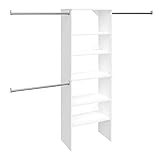
SuiteSymphony is not a standalone wardrobe; it is a wood closet organizer system that turns the closet you already have into something closer to fitted storage. The starter kit centers on a tower with five shelves, two of them adjustable, plus three expandable hang rods. ClosetMaid designs the kits for reach-in and walk-in closets roughly five to ten feet wide, with rods on one or both sides of the tower, trimmable for smaller spaces. Drawers, doors, shoe shelves and extra rods from the same collection can be added later. The limits follow from the concept: it organizes a closet rather than replacing one, so a room with no closet needs a different solution, and installation involves proper wall mounting and possible trimming. Choose it if your closet’s single rod and shelf waste most of the space, and you want double hanging plus tower shelving without paying for custom closet work.
5. Prepac Elite 32 Wardrobe Cabinet — Best Compact Single Wardrobe
The Elite 32 from Canadian maker Prepac is a straightforward freestanding wardrobe cabinet, 32 inches wide, designed to work alone or alongside other pieces in the Elite collection. Inside are two fixed shelves and a hanging rod: the top shelf suits hats and scarves, the rod handles jackets and shirts, and the fixed bottom shelf takes shoes or heavier folded items. The doors hang on adjustable hinges with metal pulls, the laminate finish comes in several colors, and Prepac backs the cabinet with a five-year limited warranty. Its compact width is both the point and the limit: one cabinet will not hold a couple’s full wardrobe, and the fixed shelves cannot be rearranged like a system. Check the depth of the version you order against your hangers. Buy it for a small bedroom, child’s room, entryway or laundry room, and pair two side by side if you need more later.
6. Mainstays Zippered Clothes Closet — Best Value Portable Wardrobe
Mainstays, Walmart’s home brand, sells the simplest wardrobe format of all: a metal frame covered by a fabric cover that zips closed, with a hanging rod inside. The 60-inch zippered clothes closet is the classic version, wide enough for a run of coats, dresses or out-of-season clothes. There is no cabinet to build; the frame assembles quickly, weighs very little, and can be carried to another room or another apartment without tools. For a dorm, a first rental, an occasional guest room or garage overflow, that simplicity is exactly the point. Be realistic about the limits: a fabric cover does not look like furniture, it protects clothes less well than a closed wooden cabinet, and the light frame is not built for dense loads of heavy coats packed tight. Treat it as flexible extra capacity at the lowest commitment, not a permanent primary wardrobe, and it performs that job well.
Best by Category
- Best customizable system: IKEA PAX, for its frame sizes, KOMPLEMENT interiors and door choices.
- Best for awkward rooms: IKEA PLATSA, which builds under sloping ceilings and comes apart for moving.
- Best freestanding armoire: Sauder Select Storage Armoire, combining hanging space, shelves and drawers behind traditional doors.
- Best inside an existing closet: ClosetMaid SuiteSymphony, adding a shelf tower and up to three hanging sections.
- Best compact wardrobe: Prepac Elite 32, a single 32-inch cabinet for small rooms and entryways.
- Best value and temporary: Mainstays Zippered Clothes Closet, the lightest, simplest overflow storage.
How to Choose
Freestanding, modular or portable?
Begin with the format. A freestanding armoire is furniture: one cabinet that works anywhere and moves rooms intact, but with a fixed layout. A modular system is planned storage: you choose frames and interiors to match your clothes and wall, and can extend it later. A portable fabric wardrobe is temporary capacity — light and quick, but neither durable nor smart-looking. Choose based on how long you will stay and how likely you are to move.
Measuring: ceiling, swing and baseboards
Measure wall width, floor-to-ceiling height and usable depth, then measure again. Tall frames need extra clearance to tilt upright during assembly, and sliding-door systems need added headroom for tracks. Check hinged-door swing: doors need a clear arc, which can rule out tight corners and nearby beds. Note baseboards, which hold cabinets off the wall and affect anchoring. Finally, measure your longest garments — a wardrobe that fits the room but not your coats has failed its main job.
Interior layout: rails, shelves and drawers
Inventory your clothes. Mostly shirts and trousers means double hanging rails, one above the other, use the height best. Long dresses and coats need a full-height section. Folded knits and jeans belong on shelves or in drawers. A workable default is one long-hang section, one double-hang section, and a column of shelves or drawers between them. Leave some open shelf space for bags and boxes; organizers can be added later.
Materials, stability and anchoring
Most wardrobes here are engineered wood — particleboard or fiberboard with a laminate or foil finish. Panel thickness, hardware quality and careful assembly decide whether a cabinet stays square or begins to sag. Anchoring is non-negotiable: tall wardrobes can tip if a child climbs open drawers or doors, which is why IKEA and Sauder supply restraints and wall fasteners. Fix to a stud or use correct wall anchors, and keep heavy items low.
Doors: hinged, sliding or mirrored
Hinged doors are simple and let you see the whole interior at once, but need clear floor space to swing. Sliding doors need no swing space and suit tight bedrooms, yet always hide part of the interior, cost more, and need track headroom. Mirrored doors double as a full-length mirror and brighten small rooms, at the listing detail of weight, fingerprints and costlier replacement if cracked. Match the door to the room’s clearances first, taste second.
Assembly effort
Assembly ranges from minutes to a weekend. A portable fabric wardrobe is fastest. PLATSA frames click together, though large combinations still need two people and wall fixing. A single armoire is a conventional flat-pack job: lay out every panel and keep hardware sorted. PAX is the biggest commitment, and ClosetMaid kits add wall mounting and possible trimming. Line up a second pair of hands for anything tall.
Wardrobe Sizes and Capacity Planning
Wardrobes are sold by width, depth and height, but what matters is how much hanging and shelf space you actually need. A simple way to plan is to measure your current clothes on a rail. Shirts, jackets and dresses each take a different amount of width, and long coats need extra vertical room that a short wardrobe cannot provide.
| Item | Space to plan for |
|---|---|
| Shirts and blouses | Short hanging, about one half of rail height |
| Trousers folded over hangers | Medium hanging |
| Dresses and long coats | Full length hanging |
| Knitwear and tees | Shelves or drawers |
Add a little spare room beyond what you own today. Clothes packed tightly crease more and make it hard to find things, and a wardrobe that is full on day one will not stay tidy for long.
Reading Construction Details on a Listing
Many wardrobes look similar in photos, so the construction notes do the real work of separating them. Particleboard and medium density fiberboard are common core materials, usually covered with a laminate or foil finish. Solid wood and plywood appear on higher-end items. Metal frames and fabric covers are typical on lightweight portable units.
Parts that carry the load
- Hanging rail: steel tubes handle weight better than thin plastic ones.
- Shelf supports: look for pins or metal brackets rather than simple plastic clips.
- Back panel: a thin fiberboard back is normal, but it should be fixed securely so the frame stays square.
- Hinges and runners: metal parts tend to hold up better over time.
Check the maker’s stated weight limits per shelf and per rail. Staying below those limits protects the furniture and avoids sagging shelves.
Caring for a Wardrobe Over Time
A wardrobe is easy to ignore, but a little upkeep keeps it useful for years. Dust the interior now and then, wipe laminate surfaces with a slightly damp cloth, and dry them afterward. Avoid harsh cleaners that can dull a finish or lift edge banding.
Air circulation matters. Leave doors ajar occasionally, avoid pressing the back of the unit hard against a damp exterior wall, and keep wet items out. Natural cedar blocks or lavender sachets can freshen the interior, but they are not a fix for dampness.
Every few months, check screws, cam locks and hinges. Flat-pack furniture can loosen as it settles, so tightening fasteners with the right tool keeps doors aligned. If you move house, use the original instructions when taking the unit apart, and label parts so reassembly goes smoothly.
Common Wardrobe Buying Mistakes
Most regrets come from planning rather than the product itself. Here are the pitfalls that crop up most often.
- Forgetting that hinged doors need clearance to swing open.
- Measuring floor width but not checking the height of the ceiling or the skirting board.
- Choosing a shallow unit that makes hangers sit crooked.
- Skipping the assembly difficulty rating and then needing a second person for hours.
- Overlooking how the box will fit through hallways and stairs.
Write down your measurements, sketch where the wardrobe will stand, and compare that sketch with the product dimensions. It takes five minutes and prevents a lot of returns.
More Wardrobes Worth a Look
IKEA BRIMNES Wardrobe with 2 Doors
The BRIMNES is a freestanding two-door wardrobe in a clean, simple style. It includes a hanging rail and shelves, with doors that close neatly to hide the contents. It suits bedrooms where you want a straightforward piece without building a full system. Because it is flat-pack, allow time for assembly and follow the supplied instructions, including any wall fixing steps.
IKEA RAKKESTAD Wardrobe with 2 Doors
RAKKESTAD is a two-door wardrobe with a slightly more traditional look than many flat-pack options. It offers hanging space and a shelf, making it a practical option for guest rooms and children bedrooms. Dimensions and finishes vary by listing, so confirm those before ordering.
Songmics Portable Closet Wardrobe
This is a metal-frame portable closet with a fabric cover, aimed at rentals, dorms and spare rooms. It typically includes a hanging rail and a few shelves, and it can be moved or stored when not needed. It is lighter than a wood wardrobe, so keep loads moderate and read the capacity notes on the listing.

Whitmor Double Rod Freestanding Closet
The Whitmor double rod closet gives you two hanging levels on a sturdy metal frame. It is useful for lots of shirts and shorter garments, and it works as a quick fix in rooms with no built-in closet. Since it has no doors, a closet in a dusty space may call for a cover.

More Questions Buyers Ask
How wide should a wardrobe be for two people?
Two adults often need more width than one, and a unit of around a hundred centimeters or more with both hanging rails and shelves usually feels workable. The right size depends on how many items you hang. Measure your clothes first, then compare against the listing dimensions and rail lengths.
Is a wardrobe with drawers better than one with only shelves?
Drawers keep small items contained and out of sight, while open shelves are easier to scan quickly. If you own lots of folded knitwear or underwear, a mix can be the most practical. Check that drawer runners and sides feel sturdy in the listing description.
Can I place a wardrobe near a radiator?
It is better to keep some distance. Constant heat can warp panels and dry out finishes. Leave a gap and follow the maker’s guidance on clearance, particularly for laminate and wood-based furniture that sits near heating.
What is the easiest way to move a flat-pack wardrobe?
Take it apart in the reverse order of assembly, keep screws in labeled bags, and wrap panels in blankets to protect the edges. Move it in sections rather than assembled, and keep the original instructions handy for rebuilding it in the new room.
Frequently Asked Questions
What depth does a wardrobe need for hanging clothes?
Standard hangers need a full-depth wardrobe for clothes to hang straight without pressing against the doors. Shallow wardrobes still work for folded storage or children’s clothes, but check the maker’s stated depth against your hangers before ordering.
Do I really need to anchor a wardrobe to the wall?
Yes. Tall, narrow furniture can tip forward, especially with drawers open or a child climbing it. Makers supply restraints and instructions for this reason. Anchor to a stud where possible, and use anchors made for your wall type.
Which is better, a wardrobe system or a freestanding armoire?
A system fits your wall and your clothes more precisely and can grow, but demands planning and assembly. An armoire is one finished piece that can move rooms or homes intact and needs no design decisions. Choose based on how long you will stay and how specific your storage needs are.
Can a wardrobe work in a room with a sloping ceiling?
Yes, with a modular system that includes low units, such as PLATSA, which is designed to build under slopes and stairs. Measure ceiling height at several points along the slope, use low sections for shelving, and put full-height hanging only where the ceiling allows.
How do I stop a wardrobe from smelling musty?
Store clothes fully dry, leave air space between garments, and open the doors occasionally in humid rooms. A small moisture absorber helps in damp spaces, and wooden interiors can be wiped with a barely damp cloth and dried fully.
Is flat-pack furniture strong enough for a full wardrobe of clothes?
Yes, when it is assembled squarely, loaded within the maker’s limits and anchored to the wall. Most failures come from skipped fasteners, overloaded shelves, or dragging an assembled unit instead of lifting it.
Bottom Line
For a permanent, tailored solution, IKEA PAX is the wardrobe to beat. PLATSA covers the rooms PAX cannot. For one finished piece, the Sauder armoire combines hanging, shelves and drawers, while Prepac’s Elite 32 does a similar job smaller. Already have a closet? SuiteSymphony organizes it. Need basic extra hanging space? Take the Mainstays portable. Whichever you choose, measure twice, plan the interior around your clothes, and anchor it to the wall.