Disclosure: As an Amazon Associate, umtsmarttool.com earns from qualifying purchases. Links to Amazon on this page are affiliate links; they cost you nothing extra. Prices and availability change often, so check the current Amazon listing before you buy.
Where to buy
Short on time? Start with the Seiko 5 Sports SRPD51, the standout pick in this guide to the best watches for men under $300. The full shortlist:
- Seiko 5 Sports SRPD51 — Check on Amazon
- Orient Bambino RA-AC0009S10B — Check on Amazon
- Citizen Eco-Drive Garrison BM8180-03E — Check on Amazon
- Invicta Pro Diver 8926OB — Check on Amazon
- Casio Duro MDV106-1A — Check on Amazon
- Timex Expedition Scout TW4B04700 — Check on Amazon
Read the full guide ↓
The best watches for men under $300 occupy the most competitive ground in watchmaking. Below this band, you are mostly buying fashion or disposability; above it, you start paying for brand prestige as much as for the watch itself. Inside it, the great Japanese manufacturers — Seiko, Citizen, Orient, Casio — fight a decades-long war that has produced genuinely excellent mechanical and solar watches, and even the value specialists like Invicta and Timex are forced to be good. The six watches in this guide are the survivors of that fight: an automatic sports watch, an automatic dress watch, a solar field watch, an automatic diver, a quartz diver and a casual field watch, each the strongest representative of its kind within the budget.
A word about the budget itself, because honesty matters more than the headline. Watch pricing is fluid: street prices move with retailer promotions, seasons and stock, and a model that sits comfortably under $300 in one month can nudge over it in another. Every pick here was chosen because its typical street pricing lives within the under-$300 band — several of them far within it — but per this site’s standing rule we print no product prices at all. Use the Amazon links to check the current figure before you buy, and treat any pick hovering near the line as a reason to wait for a promotion rather than a reason to stretch. Readers with less to spend will find the same brands’ entry models in our best watches under $150 and best watches under $50 guides; readers ready to spend more enter the tier where sapphire crystals and higher-grade movements become standard, and should expect the same discipline — verified references, no printed prices, honest limitations — to matter even more there.
In this guide
Quick Picks
| Watch | Badge | Key spec |
|---|---|---|
| Seiko 5 Sports SRPD51 | Best Overall | 4R36 automatic, 42.5 mm, 100 m, day-date |
| Orient Bambino RA-AC0009S10B | Best Dress Watch | F6222 automatic, domed crystal, leather strap |
| Citizen Eco-Drive Garrison BM8180-03E | Best Field Watch | Eco-Drive solar, 37 mm, 100 m, day-date |
| Invicta Pro Diver 8926OB | Best Automatic Diver | Automatic movement, 40 mm, 200 m |
| Casio Duro MDV106-1A | Best Budget Diver | Quartz, 200 m, screw-down crown |
| Timex Expedition Scout TW4B04700 | Best Casual Watch | Quartz, 40 mm, Indiglo backlight, 50 m |
How These Picks Were Chosen
The under-$300 band contains thousands of watches, so the shortlist was built by category rather than by brand loyalty: one winner each for overall, dress, field, automatic diver, budget diver and casual wear. Within each category the filters were the same. The movement had to be identifiable and appropriate — in-house or name-brand automatic, Eco-Drive solar, or honest quartz from the maker itself. The specifications had to be verifiable from the manufacturer’s data or the Amazon listing, and every figure in the spec boxes below was checked against an opened source. Water resistance had to match the watch’s claimed role: a diver under 200 m or a field watch under 100 m had to justify itself.
Fashion-brand watches with inflated list prices and permanent “discounts” were excluded as a class, because in this band the discount theatre hides ordinary products; the six picks come from manufacturers whose pricing is comparatively honest. Two structural biases are worth declaring. The list leans Japanese — four of six — because at under $300 the Japanese industry simply offers the most movement quality per dollar, a conclusion any honest survey of this band reaches. And it leans toward watches with long production runs and huge owner communities, because at this price the ability to find straps, parts, advice and a watchmaker who knows the movement is worth as much as a specification. Readers comparing movement philosophies before choosing should read our automatic vs quartz watches explainer, since this list deliberately contains both.
The 6 Best Watches for Men Under $300

Seiko 5 Sports SRPD51 — Best Overall
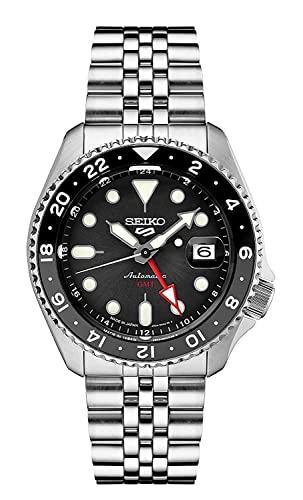
The SRPD51 suits the man who wants one watch to be his watch. It is the blue-dial member of Seiko’s 5 Sports family: a 42.5 mm steel case with a unidirectional bezel, a day-date window, LumiBrite hands and markers, an exhibition case back, and Seiko’s 4R36 automatic movement inside — a calibre that hacks, hand-winds and runs for roughly 41 hours, specifications that were unthinkable at this level a generation ago. On its steel bracelet it covers the office, the weekend and the water (100 m) without asking to be swapped for anything.
- Movement: Seiko 4R36 automatic, hacking and hand-winding, day-date
- Case: 42.5 mm stainless steel, unidirectional bezel
- Crystal: Hardlex
- Water resistance: 100 m
- Features: LumiBrite lume, exhibition case back
Strengths
- Complete package: automatic movement, day-date, lume, bezel, bracelet
- 4R36 movement is serviceable by any watchmaker, anywhere
- Blue sunray dial looks far above the price band
Trade-offs
- Hardlex crystal rather than sapphire
- 42.5 mm case is chunky on slim wrists
- Bracelet is functional rather than luxurious
The Seiko 5 formula — automatic movement, day-date, water resistance, durability, legibility — has defined the first good watch for sixty years, and the SRPD51 is its current mainstream expression. What the modern version adds is refinement: the dial’s sunray finish plays with light like a watch from the next tier up, the bezel action is positive, and the movement’s hacking seconds make it settable to the second. It is also the easiest recommendation in this guide to live with long-term, because Seiko’s scale means straps, spring bars, gaskets and movement parts will exist for decades. The wider family, including the GMT version that shares this case, is covered in our best seiko watches and best gmt watches guides.
Day to day, the SRPD51’s virtues are cumulative rather than dramatic. The day-date is set with a quickset that owners actually use, the LumiBrite charges from a walk past a window and stays readable through a film, and the 4R36’s hand-winding means a watch left off for a weekend restarts with twenty crown turns rather than the undignified shake older Seiko 5s demanded. The bracelet’s clasp is the one place the price shows — stamped rather than milled — and the aftermarket has noticed: replacement bracelets are a cottage industry for this case, which tells you both that owners keep these watches for years and exactly where Seiko saved the money. Budget for a strap swap in year one and the SRPD51’s last real weakness is optional.
The honest limitation is the crystal. Hardlex is hardened mineral glass: tougher than standard mineral, clearly short of sapphire, and on a watch worn daily it will gather hairlines over the years. At this price the trade is universal — every automatic rival here makes it too — but buyers who are hard on watches should know the Invicta below shares the compromise while the quartz picks avoid the issue differently, with cheaper replacements.
Best for: a first proper watch or a one-watch collection / Not suited for: slim wrists or sapphire purists
Orient Bambino RA-AC0009S10B — Best Dress Watch
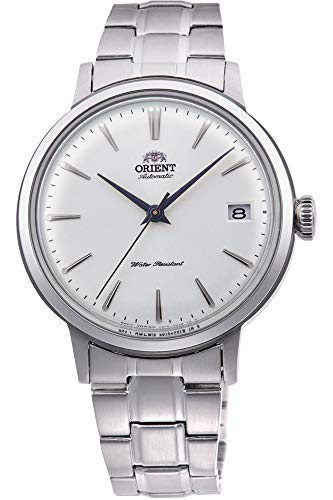
The Bambino suits the man whose under-$300 watch needs to work with a suit. Orient’s long-running dress line pairs a white dial with a domed crystal, slim applied indices and a leather strap in a case sized for cuffs rather than cockpits. Inside is Orient’s own F6222 automatic calibre — in-house, like every Orient movement, a distinction no Swiss brand at this price can claim — driving hour, minute, seconds and a date window with the restraint the genre demands.
- Movement: Orient F6222 automatic, in-house
- Dial: White, domed crystal above it
- Strap: Leather
- Functions: Three hands plus date window
Strengths
- In-house automatic movement at an entry price
- Domed crystal and white dial deliver true vintage dress character
- Slim, cuff-friendly proportions the sports picks cannot match
Trade-offs
- Dress-watch water resistance: keep it dry
- Leather strap will need replacing every couple of years
- No lume to speak of — it is a daylight and lamplight watch
The Bambino’s trick is proportion. Everything about it — the dome of the crystal, the length of the hands, the slimness of the indices — is tuned to look like a mid-century dress watch, and because Orient manufactures the movement itself, the watch’s modest price buys real horology rather than a bought-in module in a pretty case. It is the pick in this guide most likely to be complimented by people who know watches, and the one that pairs with tailoring without apology. The open-heart sibling of this watch appears in our best skeleton watches guide for readers who want the same manners with the machinery on show.
The Bambino also teaches the most useful lesson in this price band: restraint photographs better than specification. There is no lume to glow through a meeting, no bezel to fidget with, no complication beyond a date window that knows its place — and the result is a watch that looks appropriate in more rooms than any other pick here. Orient, a Seiko-group company that nonetheless designs and builds its own calibres, has refined this formula across several Bambino generations, and the current one’s hand-winding and hacking bring it fully up to modern expectations. If your under-$300 is destined for an office, a wedding season or a first job, this is the watch in the guide that will still look correct at your ten-year reunion.
The honest limitation is fragility by design. A dress watch is a fair-weather instrument: modest water resistance, a leather strap, a domed crystal that catches door frames. Bought as a second watch for work and occasions, it is perfect; bought as a sole watch for an active life, it will suffer. Pair it with the Casio Duro below and the two together cover a life for well within this guide’s budget.
Best for: office and occasion wear, vintage style on a budget / Not suited for: water, sport or one-watch active lives
Citizen Eco-Drive Garrison BM8180-03E — Best Field Watch
The Garrison (long sold under the Chandler name) suits the man who wants a watch that is simply never a problem. Citizen’s Eco-Drive movement charges from any light, so there is no battery to change and no winding to remember; the 37 mm steel case wears like the military field watches it descends from; the black dial with full Arabic numerals and a day-date window is readable at a literal glance; and the olive woven strap completes a watch that has been a default recommendation for well over a decade because nothing about it ever goes wrong.
- Movement: Citizen Eco-Drive E101, light-powered
- Case: 37 mm stainless steel
- Crystal: Mineral
- Water resistance: 100 m
- Functions: Day and date display, luminous hands
Strengths
- Eco-Drive: no battery changes, no winding, ever
- 37 mm case suits every wrist, including slim ones the other picks swamp
- 100 m rating and field-watch legibility make it a true daily tool
Trade-offs
- Small size reads as modest on large wrists
- Mineral crystal at a price where some rivals offer more
- Utilitarian styling will not dress up beyond smart casual
Field watches are the honest core of men’s watchmaking — the design was standardised for soldiers who needed time, legibility and nothing else — and the Garrison is the modern solar heir to that standard. Its virtues compound quietly: the day-date is genuinely useful, the size disappears on the wrist until you need it, the lume works, and the movement’s light diet means a watch left in a lit room is always ready. In a guide full of watches that reward enthusiasm, the Citizen is the one that rewards indifference, and for many men that is the highest praise available. Citizen’s broader Eco-Drive range is surveyed in our best citizen watches guide.
It is also the guide’s best answer for wrists the other picks cannot serve. The industry’s drift to 42 mm and beyond has left smaller-wristed men choosing between children’s watches and fashion brands; the Garrison’s 37 mm is a genuine adult field watch with a real movement, a real 100 m rating and a two-decade production history, at a price that undercuts the fashion alternatives it outsells on merit. Women buying a field watch for themselves have quietly made it a crossover favourite for the same reason. Add the Eco-Drive’s indifference to being left in a drawer for a month — it will be running, correctly, when you return — and the Garrison is the pick most likely to still be on its first owner’s wrist, unserviced and unbothered, in fifteen years.
The honest limitation is presence. At 37 mm with a plain steel case and a fabric strap, the Garrison does not announce itself, and men who want their under-$300 to look like money spent will find the Seiko and the Bambino more satisfying. The Citizen is the watch for the man who wants the time, not the attention.
Best for: everyday wear, slim wrists, zero-maintenance ownership / Not suited for: buyers wanting wrist presence
Check on Amazon

Invicta Pro Diver 8926OB — Best Automatic Diver
The 8926OB suits the man who wants the classic dive-watch silhouette — black dial, coin-edge unidirectional bezel, steel bracelet, 40 mm case — with a self-winding automatic movement, at the lowest price in this guide. Invicta’s Pro Diver has been the gateway automatic for a generation of collectors precisely because the formula is executed honestly: a Japanese automatic movement, 200 m of water resistance, a screw-down crown, and mineral crystal, in a case size copied from the most famous diver ever made.
- Movement: Automatic, self-winding
- Case: 40 mm stainless steel, unidirectional coin-edge bezel
- Crystal: Mineral
- Water resistance: 200 m
- Features: Screw-down crown, luminous dial, date with magnifier
Strengths
- Automatic movement and 200 m rating at the guide’s lowest price
- 40 mm case is the most wearable diver size
- Enormous owner community: straps, mods and advice are everywhere
Trade-offs
- Design is an unabashed homage to a famous Swiss diver
- Bracelet and clasp feel a step below the Seiko’s
- Brand’s list-price theatre means the “discount” tells you nothing
Judge the 8926OB by what arrives in the box and it is remarkable: a watch that can genuinely dive, winds itself, keeps the date, and survives the knocks of daily wear, for less than the cost of a service on a Swiss automatic. The 40 mm case is the size the design was born at, and it wears accordingly — balanced on the bracelet, flat under a cuff in a way the 42.5 mm Seiko cannot quite manage. Owners modify these endlessly, and the ecosystem of straps and parts is a real ownership advantage; our best dive watches guide places it in its wider category context.
That modding culture deserves emphasis, because it changes the value calculation. The 8926OB is one of the most-modified watches in the world: dials, hands, bezels, crystals and bracelets from a whole aftermarket industry fit it, which means the watch you buy can evolve with your taste for the price of parts rather than the price of a new watch — and a failed experiment costs a dial, not a disaster. Even unmodified, it performs its core job without drama: the bezel turns with the right weight, the crown screws home, and the automatic movement inside has powered so many of these that any watchmaker can service one blindfolded. As an entry into both automatics and divers, it has no real rival at its price; the guide ranks it fourth only because its finish and bracelet cannot match the three above it, not because its value is in question.
The honest limitations are originality and finish. The design owes everything to its inspiration, the bracelet’s folded feel betrays the price, and Invicta’s marketing — huge nominal list prices with permanent deep discounts — should be ignored entirely: the watch is worth what it typically sells for, no more and no less. Buy it as the best cheap automatic diver, not as a discounted luxury.
Best for: first automatic diver, modding platform, unbeatable value / Not suited for: originality seekers

Casio Duro MDV106-1A — Best Budget Diver
The Duro suits the man who wants a dive watch that can be worn into the water, knocked against the boat and replaced without tears if the sea wins. Casio’s MDV106 pairs a quartz movement with a stainless case rated to 200 m, a screw-down crown and case back, a unidirectional bezel and a resin strap — the complete diver checklist — at a price that makes it the default beater recommendation across the entire watch hobby. It is famously the watch a certain software billionaire wears, which tells you something about how completely it does its job.
- Movement: Casio quartz, three-hand with date
- Case: Stainless steel, unidirectional bezel
- Water resistance: 200 m
- Features: Screw-down crown, resin strap, approximately three-year battery
Strengths
- Full 200 m diver specification at a pocket-money price
- Quartz accuracy and Casio durability — the ultimate beater
- Screw-down crown is a feature rivals at this price skip
Trade-offs
- Large case wears bigger than the dressier picks
- Resin strap is functional, not handsome
- Quartz tick will not satisfy mechanical romantics
The Duro’s reputation is a rare case of the internet being right. Everything a diver needs is present and correct — the bezel turns one way with real clicks, the crown screws down, the seals are rated for actual diving depths, the lume is adequate — and everything else has been deleted in the name of price. It is the watch in this guide you buy two of: one to wear hard, one in reserve. Casio’s wider range runs from G-Shock digitals to Edifice chronographs, and the Duro’s chronograph cousin appears in the best chronograph watches roundup.
Its role in a collection is worth spelling out, because the Duro changes how you treat your other watches. Own a Duro and the Seiko stays out of the surf, the Bambino stays out of the rain, and the expensive watch stays home when you travel somewhere you would rather not flash it — the beater absorbs every risky hour in the rotation. Travel is the use case owners praise most: a 200 m quartz diver that looks respectable at dinner, survives any pool or beach, and would be an annoyance rather than a disaster to lose. At its price, it is less a purchase than an insurance policy for the rest of your watch box, and it keeps time more accurately than all of them while doing it.
The honest limitation is refinement — there is none, deliberately. The case finishing is industrial, the strap is basic resin, and the quartz movement ticks once per second with no pretence of sweep. If you want a watch that feels precious, this is not it. If you want the most capability per dollar in this entire guide, it is not close.
Best for: swimming, diving, travel and hard use on a budget / Not suited for: dress wear or mechanical purists
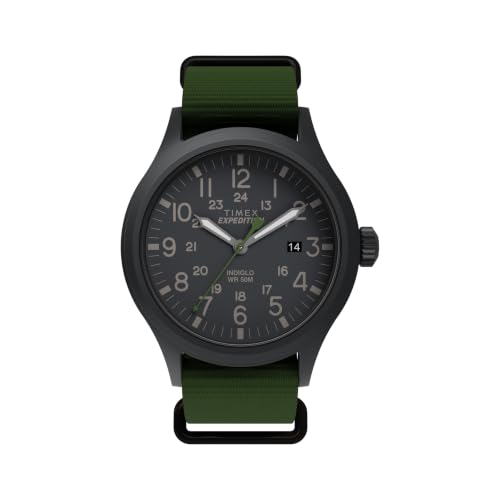
Timex Expedition Scout TW4B04700 — Best Casual Watch
The Expedition Scout suits the man who wants a watch that goes with everything he actually wears — jeans, boots, a work shirt — and costs little enough that it never needs protecting. Timex’s Expedition line is the American field watch tradition: a 40 mm case, a dial with full Arabic numerals and 24-hour markings, a date window, and the brand’s Indiglo backlight, which lights the whole dial at a press of the crown and remains the best low-light system on any watch in this guide. The green fabric slip-through strap completes a design that has been a weekender default for years.
- Movement: Timex quartz
- Case: 40 mm
- Water resistance: 50 m
- Features: Indiglo dial backlight, date window, fabric slip-through strap
Strengths
- Indiglo backlight beats every lume in this guide for instant night reading
- 40 mm case and fabric strap wear comfortably on any wrist
- Price leaves room in the budget for a second, dressier watch
Trade-offs
- 50 m rating is the joint-lowest here — splash and rain, not swimming
- Quartz tick is audible in a quiet room, a known Timex trait
- Base-metal case finishing reflects the price
The Scout’s appeal is that it asks nothing and matches everything. The field dial reads instantly, the Indiglo is genuinely the best solution ever fitted to a cheap watch for checking the time at 3 a.m., and the slip-through strap can be swapped in seconds for leather or a different fabric — the gateway to the strap hobby, where one watch becomes a dozen by changing a few inches of nylon. Timex’s heritage is real, too: the Expedition line descends from the watches that made the brand’s “takes a licking” reputation, and the Scout honours it by being effectively disposable-priced without being disposable quality. For students, new graduates and anyone whose work is hard on watches, it is the guide’s easiest yes: cheap enough to replace, good enough that you probably will not need to, and honest in a way that makes it the perfect first watch of a serious collection.
The honest limitations are water and noise. Fifty metres keeps it out of the pool, and the quartz movement’s tick — charming to some, maddening to others — is audible on a bedside table. Buy it as a daytime, dry-land, everyday companion and both limitations vanish; ask it to be a diver or a bedroom clock and they will not.
Best for: casual everyday wear, camping, first field watch / Not suited for: swimming or light sleepers
Comparison Table
| Watch | Movement | Case | Crystal | Water resistance |
|---|---|---|---|---|
| Seiko 5 Sports SRPD51 | 4R36 automatic | 42.5 mm | Hardlex | 100 m |
| Orient Bambino RA-AC0009S10B | F6222 automatic | Steel, leather strap | Domed mineral | Dress rating |
| Citizen Garrison BM8180-03E | Eco-Drive solar | 37 mm | Mineral | 100 m |
| Invicta Pro Diver 8926OB | Automatic | 40 mm | Mineral | 200 m |
| Casio Duro MDV106-1A | Quartz | Steel, resin strap | — | 200 m |
| Timex Expedition Scout | Quartz | 40 mm | — | 50 m |
How to Choose a Watch Under $300
Start with the movement decision, because at this price it defines the ownership experience more than any other choice. An automatic — Seiko, Orient, Invicta here — offers mechanical craft, a sweeping seconds hand and indefinite lifespan with servicing, at the cost of needing regular wear and accepting accuracy measured in seconds per day. Solar quartz — the Citizen — offers set-and-forget ownership and the best accuracy here, with no battery changes ever. Battery quartz — Casio, Timex — offers the lowest prices and total indifference to being left in a drawer, at the cost of a battery every few years. There is no wrong answer; there is only the answer that matches your temperament, and the explainer linked from the shortlist section above walks the trade in full.
Second, allocate by role before brand. The most common under-$300 mistake is buying one watch that is mediocre at everything instead of excellent at the thing you do most. If you wear a suit daily, the Bambino plus any beater beats a mid-tier sports watch worn apologetically with tailoring. If you swim weekly, the two 200 m divers here outrank everything. If you want one watch only, the SRPD51 is the guide’s answer precisely because its compromises are the mildest across all roles. Third, size honestly: the 37 mm Citizen and 40 mm Invicta and Timex suit most wrists; the 42.5 mm Seiko needs a medium-to-large wrist; and the Duro wears large by design. Measure your wrist, and remember lug-to-lug matters more than diameter.
Finally, spend on the things that cannot be upgraded. A strap can be replaced in seconds — and a good replacement transforms a watch more cheaply than any other change — but the movement, crystal and case are forever. That is why this guide weights movement pedigree and water resistance above dial fashion, and why the fashion brands’ under-$300 offerings, however photogenic, did not survive the shortlist: their money went to marketing and list-price theatre rather than to the calibre inside.
Key Takeaways
- Under $300 is watchmaking’s sweet spot: real movements, real water resistance, honest prices.
- Choose the movement for your temperament: automatic craft, solar convenience, or quartz indifference.
- Buy by role — dress, field, diver, casual — before brand.
- Street prices move; every pick here typically lives within the band, but check the listing before buying.
- Straps are upgradeable; movements and cases are not. Spend accordingly.
How to Set Up and Care for Your Watch
Whichever pick you choose, the first-day routine is the same:
- Size the bracelet or strap before first wear. A watch that slides will be a watch you stop wearing; jewellers size bracelets in minutes, and fabric straps adjust by hand.
- Set the date safely: on automatics, avoid changing the date between roughly 9 p.m. and 3 a.m., when the change mechanism is engaged — advance the time outside that window first, then set the date, then the exact time.
- Start an automatic with 20–30 crown turns, then wear it; start a solar watch with a day in bright light so its reserve begins full.
- Screw down the crown on the divers (Invicta, Casio) every time, without exception — an open crown voids the water resistance you paid for.
- Register the warranty and keep the box and papers; at this price they meaningfully affect resale if you upgrade later.
Ongoing care is light but specific. Rinse any watch worn in salt water or heavy sweat in fresh water and dry it; keep leather straps (Bambino) dry and rotate them in summer; store the Citizen where it sees light; and give automatics a service every few years if they are keepers — the Seiko and Orient movements reward it with decades of life. Two troubleshooting patterns cover most worries. Problem: an automatic stops overnight. Fix: it was under-wound — sedentary days do not fill a 41-hour reserve; add manual winding to your morning routine for a week and the problem usually vanishes. Problem: a quartz watch’s seconds hand jumps in two-second steps or the Indiglo dims. Fix: that is the low-battery warning doing its job — have the cell replaced promptly, and ask for the case seals to be checked at the same visit on the 200 m models.
Straps deserve their own paragraph of care, because they are the wear item on every watch here. Fabric straps (Citizen, Timex) can be hand-washed in warm soapy water and air-dried, and look new again in minutes; do this after beach trips, since trapped sand abrades both strap and case. Leather (Bambino) should never be soaked: wipe it, condition it rarely, and accept a replacement cycle of a year or two of daily wear. Resin (Duro) eventually cracks after years of sun and salt — replacements are cheap and universal, which is part of the beater bargain. Bracelets (Seiko, Invicta) need only a rinse and an occasional check that the spring bars are seated; a loose spring bar, not a broken movement, is the number one cause of dropped watches at this price, and a five-second squeeze with a spring-bar tool each season prevents it. Learn the spring-bar tool and you have learned the single most useful skill in affordable watch ownership: every strap swap, size adjustment and rescue in this paragraph runs through it.
Where the Money Goes in an Under-$300 Watch
Understanding what your budget buys — and what it cannot — prevents both disappointment and overspending. In a well-made under-$300 watch, the money divides roughly into four places. The movement takes the largest share, and it is where the Japanese majors earn their dominance: Seiko, Orient and Citizen manufacture calibres at volumes that spread tooling costs across millions of units, which is why a 4R36 or an F6222 can be both excellent and cheap. The case and its finishing come second: machined steel, a turning bezel with real clicks, threads that screw smoothly. The dial and hands take a smaller but visible share — applied markers, sunray brushing and lume cost money in proportion to how good they look. Everything else — crystal, gaskets, strap, box — is where the savings hide.
That map explains this guide’s compromises precisely. Mineral and Hardlex crystals appear because sapphire at this volume still costs enough to force a worse movement or a worse case elsewhere in the watch. Bracelets feel a step light because solid-link, solid-end-link construction is the next tier’s luxury. And it explains why fashion brands invert the map: their money goes to the logo, the packaging and the list-price theatre, leaving the movement — the part that decides whether the watch lives for three years or thirty — as the cheapest component in the box. When two watches cost the same and one has a named calibre from a watchmaker while the other has a famous name from a clothing label, the first one is not the plainer bargain; it is simply where the money went.
The map also points to the smartest upgrade path. Because straps and crystals are the replaceable, skimped components, owners routinely transform these watches later: a quality leather strap on the Bambino, a solid-link bracelet on the Seiko, a fresh crystal at service time on any of them. Bought well at under $300, the watch you own in year five can be noticeably better than the watch you unboxed — an ownership arc no fashion watch offers, because its skimped component is the one sealed inside.
Common Buying Mistakes
The first mistake is believing list prices. In this band, several brands print fantasy retail prices and sell permanently at a fraction of them; the only number that matters is the transaction price on the listing, compared against the watch’s specification. The second mistake is buying a fashion brand’s logo instead of a watchmaker’s movement: at under $300 the difference between a Seiko 4R36 and an anonymous fashion module is the difference between a thirty-year watch and a three-year one. The third mistake is ignoring size in photographs — macro product shots make 37 mm look bold and 44 mm look normal, and neither impression survives contact with your wrist.
The fourth mistake is demanding everything from one watch and ending with a compromise you dislike: the man who buys a diver to wear with suits, or a dress watch he is afraid to wear in the rain, has spent the budget without buying the satisfaction. The fifth is neglecting the total cost of ownership in the other direction — a cheap watch with an irreplaceable proprietary strap, or an automatic you will never service, can cost more over a decade than the honest picks here. Buy the watch whose upkeep you will actually perform.
Final Recommendation
For most men, the answer is the Seiko 5 Sports SRPD51: the most complete watch in this guide, with a real automatic movement, day-date, lume, 100 m of water resistance and a dial that flatters everything from a wetsuit to a blazer. The runner-up is the Citizen Garrison, for the man who values never thinking about his watch — solar power, perfect size, decade-proof design. And the guide’s favourite two-watch solution stays inside the budget’s spirit: the Bambino for the office and the Duro for everything wet, a pairing that covers a life better than any single watch here. Readers whose wrists or tastes run to the cockpit should finish with the best pilot watches guide, where this budget buys the most legible dials in watchmaking.
Frequently Asked Questions
Is $300 enough for a good automatic watch?
Yes — it is the band where good automatics genuinely begin in earnest. Seiko’s 4R36 and Orient’s in-house calibres in this guide are proven movements with hacking, hand-winding and decades-long parts support. What the budget does not buy is sapphire crystals, high-end finishing or Swiss prestige; it buys the machinery and the reliability, which most owners find is the part that matters.
Automatic, solar or quartz: which is best under $300?
The one matched to your habits. Automatics reward enthusiasts who wear a watch daily and enjoy machinery. Solar (Citizen Eco-Drive) rewards anyone who hates maintenance — it is the most accurate and the least demanding here. Battery quartz rewards the indifferent and the budget-conscious, with the lowest prices and total tolerance for drawers. This guide’s badges map the picks to those temperaments deliberately.
Why do prices on these watches change so much?
Watch retail runs on promotions, currency movements and stock cycles, so street prices for the same reference can swing noticeably between months and sellers. That is why this guide prints no prices and links every pick to its live listing: check the current figure, and if a pick sits above the $300 line when you shop, waiting for the next promotion cycle is usually rewarded.
Can I really swim with the 200 m watches here?
Yes. The Invicta 8926OB and Casio Duro carry genuine 200 m ratings with screw-down crowns, suitable for swimming, snorkelling and recreational diving, provided the crown is screwed down and the seals are maintained. The 100 m Seiko and Citizen handle swimming and showering; the 50 m Timex and the dress-rated Bambino should stay dry.
What size watch should I buy?
Measure your wrist and match the case: under about 6.5 inches, favour the 37 mm Citizen and 40 mm models; 6.5 to 7.5 inches carries everything here including the 42.5 mm Seiko; above that, the larger cases come into their own. Lug-to-lug distance decides comfort more than diameter — if the lugs overhang your wrist, size down regardless of the number.
How long will an under-$300 watch last?
Decades, if it is one of the maker-backed picks here and you keep its appointments: battery changes for the quartz models, gasket checks for the divers, a movement service every few years for the automatics. The movements in the Seiko, Orient and Citizen are documented, supported calibres — the strongest predictor of longevity at any price — which is precisely why they anchor this guide.
One watch at $300, or two cheaper ones?
It depends on your wardrobe’s split. A single watch near the top of the band — the Seiko 5 Sports here — covers the widest range of occasions and is the right answer for men who dress consistently. Two cheaper watches bought by role — the Bambino for dress, the Duro for water and weekends, in this guide — cover more extremes better, at the cost of owning two things to maintain. Most men who ask this question end up happier with the role split, because no single watch at any price is equally right in a suit and in the sea.
Are these watches good gifts?
They are close to ideal: substantial enough to feel like an event, standard enough to be serviced anywhere, and priced where a wrong guess is not a catastrophe. For a gift, favour the Citizen for recipients who will never wind or service anything, the Seiko for anyone likely to catch the watch bug, and the Bambino for formal dressers. Engraving a case back is possible on the steel models and turns a good gift into a kept one — ask the seller before purchase, since it usually voids easy returns.