Disclosure: As an Amazon Associate, umtsmarttool.com earns from qualifying purchases. Links to Amazon on this page are affiliate links; they cost you nothing extra. Prices and availability change often, so check the current Amazon listing before you buy.
Where to buy
Short on time? These are the picks that earned a place in this guide to the best water filter pitcher for beginners under $75:
- LifeStraw Home 7-Cup Glass Water Filter Pitcher — Best First Glass Pitcher. Check on Amazon
- Brita Everyday 10-Cup Pitcher with Elite Filter — Best Overall for Beginners. Check on Amazon
- Waterdrop Lucid 10-Cup Water Filter Pitcher (200-Gallon) — Best Low-Maintenance. Check on Amazon
- PUR PLUS 11-Cup Water Filter Pitcher (PPT111W) — Best If Your Home Is Bigger. Check on Amazon
- Amazon Basics 10-Cup Water Filter Pitcher — Best Value. Check on Amazon
- ZeroWater 10-Cup Ready-Pour Pitcher (ZP-010) — Best for the Curious. Check on Amazon
Read the full guide ↓
Best Water Filter Pitcher for Beginners Under $75: Nicer Materials, Same Simple Routine
A beginner with a $75 budget faces a pleasant problem: every beginner-friendly virtue is available at once — certified cartridges, clear indicators, long filter life, even glass. The best water filter pitcher for beginners under $75 is therefore not the most advanced system here; it is the one whose single new idea (glass, or a meter, or a giant cartridge) matches the beginner buying it. This guide matches six models to six kinds of first-time owner.
What has not changed from the under-$50 beginner guide is the job description: prime once, refill daily, wash weekly, change the cartridge when told. What the extra budget buys is forgiveness — longer intervals between changes, clearer signals when action is needed, and materials that make the pitcher pleasant enough to keep on the counter where habits form.
Each pick was verified against its manufacturer’s listing before earning a link, and each review names the one beginner mistake that pick most often triggers. Starting well is mostly about not learning those lessons personally.
There is a specific beginner this tier exists for: the one who has already decided. Decided against plastic, decided for maximum coverage, decided that a twice-a-year cartridge is the only kind their calendar survives. Beginners who arrive with a decision do not need protecting from premium products; they need the premium products’ instruction manuals translated into beginner language — the two-filter schedule, the evidence styles, the weight of glass — which is what this guide’s reviews do.
For the undecided beginner, this guide performs a different service: it demonstrates that the premium tier’s virtues are refinements of the same four beginner criteria used at $50 — signal, routine, ecosystem, forgiveness — rather than a new subject. Read the $50 guide’s framework in these reviews’ margins and you will see it working. Premium is a dialect of beginner, not a different language.
Our top pick overall is the LifeStraw Home 7-Cup Glass Water Filter Pitcher — the full reasoning, including where it loses, is in the reviews below.
In this guide
Quick Picks
| Pick | Badge | Key spec |
|---|---|---|
| LifeStraw Home 7-Cup Glass Water Filter Pitcher | Best First Glass Pitcher | Borosilicate glass body |
| Brita Everyday 10-Cup Pitcher with Elite Filter | Best Overall for Beginners | Long-life filter, fridge-door fit |
| Waterdrop Lucid 10-Cup Water Filter Pitcher (200-Gallon) | Best Low-Maintenance | Long-life cartridge, slim |
| PUR PLUS 11-Cup Water Filter Pitcher (PPT111W) | Best If Your Home Is Bigger | Biggest mainstream capacity |
| Amazon Basics 10-Cup Water Filter Pitcher | Best Value | Takes Brita filters |
| ZeroWater 10-Cup Ready-Pour Pitcher (ZP-010) | Best for the Curious | 5-stage, TDS meter included |
How These Picks Were Chosen
Beginner scoring at this tier kept the under-$50 criteria — clarity of the change signal, ease of refill and pour, cartridge availability, setup simplicity — and added material and evidence quality, because this budget introduces glass and manufacturer-documented filtration claims that a first-time buyer cannot be expected to interrogate alone.
We verified every specification from the manufacturer’s own listing or manual. Where a system’s evidence is the brand’s published lab work rather than third-party certification (the Clearly Filtered model, not shortlisted here but discussed in the under-$75 general guide), we say so wherever the distinction affects a beginner’s decision.
Premium beginner scoring added a teachability test: could each system’s one new idea be explained to a first-time owner in a single sentence, and does the product itself help teach it? The LifeStraw passes (its two filters are visibly different objects with visibly different clocks). ZeroWater passes (the meter is the lesson). Systems whose premium idea required a paragraph of chemistry to even state were marked down for this guide specifically — they may be excellent second pitchers.
The 6 Best Options for Beginners Under $75

LifeStraw Home 7-Cup Glass Water Filter Pitcher — Best First Glass Pitcher
Beginners who know plastic is a dealbreaker can start with glass immediately — the LifeStraw’s two-filter system is the only extra idea to learn.
- Capacity: 7 cups
- Body: borosilicate glass with a protective silicone base
- Membrane microfilter rated for 264 gallons (about 1 year)
- Activated carbon + ion exchange filter rated for 40 gallons (about 2 months)
- Dimensions: 5.8 x 5.8 x 11.25 inches; reduces lead, mercury, PFAS, microplastics and chlorine per the manufacturer’s listing
Strengths
- Glass body with a small, square footprint
- Long-life membrane filter rated for a year
- Two-stage system targets a broad contaminant list
Trade-offs
- Glass demands gentler handling than plastic pitchers
- Two filters on two schedules to track
- Filtration is deliberate rather than fast
The manufacturer’s listing credits it with reducing lead, mercury, PFAS, microplastics and a long list of chemicals while improving taste.
The two filters run on different clocks — roughly a year for the membrane, roughly two months for the carbon cartridge — which is the main routine to learn.
Glass changes the ownership experience: no plastic taste concerns and a pitcher that looks at home on a table, balanced against more careful handling.
The LifeStraw Home is the design-led outlier here: a hand-blown borosilicate glass pitcher on a silicone base, in a footprint just 5.8 inches square.
Its filtration is two-part — a membrane microfilter rated for 264 gallons works alongside an activated carbon and ion exchange cartridge rated for 40 gallons.
The honest limitation is fragility and pace: it is a beautiful, slow, glass appliance, and a busy family kitchen that knocks pitchers around will test it.
Best for: beginners who want glass from day one / Not suited for: beginners in busy family kitchens
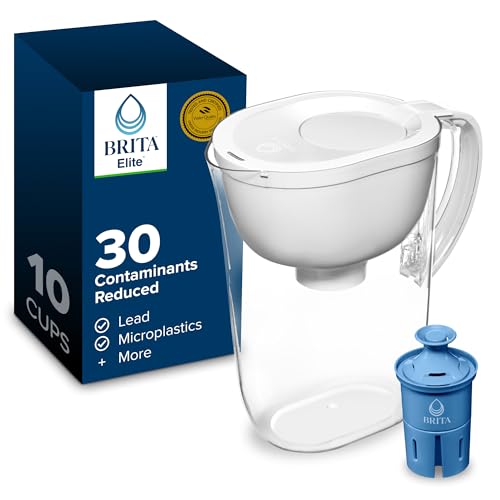
Brita Everyday 10-Cup Pitcher with Elite Filter — Best Overall for Beginners
Still the beginner benchmark at this budget: certified lead reduction, a light that tells you what to do, and a cartridge change twice a year.
- Capacity: 10 cups
- Filter: Brita Elite, rated for 120 gallons (about 6 months)
- Certification: WQA/NSF certified to reduce 99% of lead
- Also certified to reduce chlorine (taste and odor), cadmium, mercury, benzene and asbestos
- BPA-free body with an electronic filter-change indicator
Strengths
- Six-month Elite filter life keeps running effort low
- Certified lead reduction, not just taste improvement
- Fits most refrigerator doors despite the 10-cup size
Trade-offs
- Elite cartridges cost more per filter than standard ones
- Pouring slows noticeably when the reservoir is still filtering
- The electronic indicator battery is not replaceable
Because the same pitcher body accepts Brita’s standard cartridges too, you can start with the Elite and switch filter types later without replacing the jug.
The lid fills from the top, so topping up does not mean pulling the whole reservoir apart at the sink.
The Everyday is Brita’s classic oval family pitcher, and in this configuration it ships with the Elite cartridge rather than the basic one, which stretches the change interval to roughly six months.
Brita rates the Elite filter at 120 gallons and certifies it to reduce 99% of lead, alongside chlorine taste and odor, cadmium, mercury, benzene and asbestos.
The oval footprint is designed to slide into a refrigerator door shelf, and an electronic indicator on the lid tracks when the cartridge is due.
The honest limitation is pace: like most gravity pitchers it filters at a trickle, so a full 10-cup refill is a plan-ahead job rather than an instant one.
Best for: most beginners / Not suited for: beginners who specifically want glass

Waterdrop Lucid 10-Cup Water Filter Pitcher (200-Gallon) — Best Low-Maintenance
The forgetfulness-proof starter: a 200-gallon cartridge means your first filter change is months away, by which time the habit is set.
- Capacity: 10 cups
- Filter life: up to 200 gallons per cartridge
- NSF/ANSI 42 and 372 certified filtration
- Reduces PFOA/PFOS and chlorine per the manufacturer’s listing
- BPA-free construction
Strengths
- 200-gallon filter life cuts change frequency dramatically
- NSF 42 and 372 certified
- Full 10-cup capacity in a slim profile
Trade-offs
- Long-life claims assume average tap conditions
- Replacement filters are a Waterdrop-only ecosystem
- No electronic change indicator on this model
Waterdrop positions the Lucid for apartments, dorms and offices as much as houses, and the simple lid-and-pour design matches that brief.
The Lucid’s headline is cartridge endurance: Waterdrop rates its filter for up to 200 gallons, several times the 40-gallon rhythm of standard Brita and PUR cartridges.
The pitcher carries NSF/ANSI 42 and 372 certification, and the manufacturer lists reductions for PFOA/PFOS and chlorine among its tested results.
Ten cups puts it in the family-size class, while the slim Lucid profile is designed to sit in a fridge door or on a shelf without dominating it.
Fewer cartridge changes also means fewer cartridges bought and binned each year, which is the real long-term saving story here.
The honest limitation is lock-in: the long-life cartridge is proprietary, so you are trusting one brand’s supply chain for the life of the pitcher.
Best for: beginners who forget maintenance / Not suited for: beginners wanting an indicator light

PUR PLUS 11-Cup Water Filter Pitcher (PPT111W) — Best If Your Home Is Bigger
Beginners in family homes should start at family capacity rather than upgrading into it by spring.
- Capacity: 11 cups
- Filter: PUR PLUS PPF951K lead-reducing filter, 40 gallons (about 2 months)
- WQA certified to reduce lead; 3-in-1 filtration technology
- LockFit cap design keeps the lid seated while pouring
- Filter-change light indicator; dishwasher-safe pitcher
Strengths
- Largest mainstream pitcher capacity at 11 cups
- WQA-certified lead reduction with the PLUS filter
- LockFit cap and change light solve two daily annoyances
Trade-offs
- Full, it is the heaviest pitcher here to lift and pour
- Filter changes come every two months
- Takes more fridge shelf depth than slim models
The PUR PLUS 11-cup is the capacity leader among mainstream pitchers, and its PPF951K cartridge is WQA certified to reduce lead.
PUR describes the cartridge as 3-in-1 filtration, and the pitcher adds practical touches rivals often skip: a LockFit cap that stays put mid-pour and a light that flags filter changes.
Eleven cups covers a family’s drinking water plus a coffee maker cycle without an immediate refill, which is exactly where smaller pitchers fall behind.
The pitcher body is dishwasher safe, a small detail that matters when a family jug gets washed weekly.
PUR states one filter provides up to 40 gallons of filtered water before the roughly two-month change point.
The honest limitation is heft: eleven cups of water plus the jug is a two-handed pour for many people, so it suits a fridge shelf better than a door rack.
Best for: beginners in larger households / Not suited for: solo beginners

Amazon Basics 10-Cup Water Filter Pitcher — Best Value
The value starter with a clever hedge — it takes Brita filters, so your second cartridge can come from either ecosystem.
- Capacity: 10 cups
- WQA and NSF certified (system tested to NSF/ANSI 42 and 53 per the manual)
- Filter lasts up to 40 gallons
- Compatible with Brita pitchers and filters
- Made in Europe; model 1038354
Strengths
- Certified to NSF/ANSI 42 and 53
- Accepts Brita filters — no cartridge lock-in
- Full 10-cup capacity at a value position
Trade-offs
- Plain design with fewer convenience features
- 40-gallon filter rhythm, changed about every 2 months
- No electronic indicator
Its cleverest feature is compatibility — the pitcher works with Brita filters, so you are never locked into one cartridge supply.
The included filter is rated for up to 40 gallons, matching the standard-cartridge rhythm of the big brands.
It is made in Europe, a detail Amazon prints on the listing and the manual repeats for model 1038354.
For a household that wants certified filtration without paying for a brand’s design language, this is the straightforward option.
Amazon’s own 10-cup pitcher is the quiet value pick: WQA and NSF certified, with the manual confirming testing against NSF/ANSI standards 42 and 53.
The honest limitation is frills: you get certified filtration and capacity, but none of the change lights or locking lids the branded rivals have added.
Best for: budget-led beginners / Not suited for: feature-led beginners
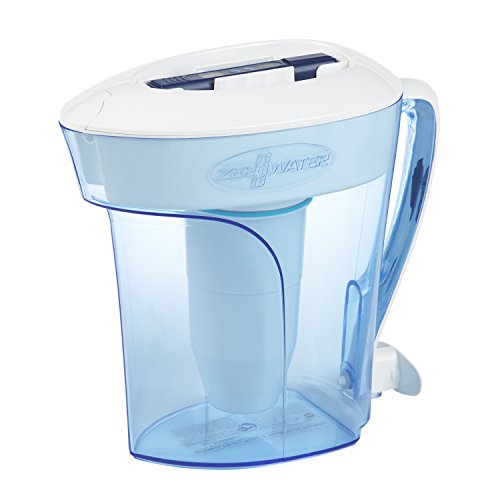
ZeroWater 10-Cup Ready-Pour Pitcher (ZP-010) — Best for the Curious
For the beginner who is really a researcher in disguise, ZeroWater’s meter turns filtration into something you can watch and verify.
- Capacity: 10 cups
- Filter: 5-stage ion exchange, designed to reduce TDS to near zero
- IAPMO certified to reduce lead, chromium, PFOA/PFOS and mercury
- TDS meter included in the box
- Ready-Pour design lets you pour while the reservoir filters; BPA-free
Strengths
- Deepest filtration here, with a meter to prove it
- Certified reductions include PFOA/PFOS
- Ready-Pour design removes the wait-to-pour problem
Trade-offs
- Filter life shrinks fast in high-TDS water
- Filtration is slower than carbon pitchers
- Some drinkers find zero-TDS water tastes flat
That meter also tells you when the filter is spent — ZeroWater’s guidance is to change the cartridge when the reading climbs to 006.
Ready-Pour means the sealed reservoir lets you dispense filtered water while a fresh batch is still filtering above it.
The trade for that depth of filtration is speed and cartridge life, both of which depend heavily on how mineral-heavy your tap water is.
ZeroWater’s whole pitch is different from carbon pitchers: a five-stage ion-exchange filter designed to strip dissolved solids down to a 000 TDS reading.
The 10-cup Ready-Pour, model ZP-010, is IAPMO certified to reduce lead, chromium, PFOA/PFOS and mercury, and it ships with a TDS meter so you can verify the reading yourself.
The honest limitation is running cost in hard-water postcodes: the five-stage cartridge does heavy work, and in high-TDS areas it can exhaust in a few weeks rather than months.
Best for: curious, measurement-minded beginners / Not suited for: beginners in high-TDS areas who will resent cartridge costs
Comparison Table
| Pick | Capacity | Filter life | Certification / system | Standout trait |
|---|---|---|---|---|
| LifeStraw Home 7-Cup Glass Water Filter Pitcher | 7 cups | Membrane 264 gal; carbon 40 gal | Manufacturer-listed reductions incl. lead, PFAS | Borosilicate glass body |
| Brita Everyday 10-Cup Pitcher with Elite Filter | 10 cups | 120 gal / ~6 months | WQA/NSF, 99% lead (Elite) | Long-life filter, fridge-door fit |
| Waterdrop Lucid 10-Cup Water Filter Pitcher (200-Gallon) | 10 cups | Up to 200 gal | NSF/ANSI 42 & 372 | Long-life cartridge, slim |
| PUR PLUS 11-Cup Water Filter Pitcher (PPT111W) | 11 cups | 40 gal / ~2 months | WQA lead (PPF951K), 3-in-1 | Biggest mainstream capacity |
| Amazon Basics 10-Cup Water Filter Pitcher | 10 cups | 40 gal | WQA/NSF 42 & 53 | Takes Brita filters |
| ZeroWater 10-Cup Ready-Pour Pitcher (ZP-010) | 10 cups | Depends on tap TDS | IAPMO: lead, chromium, PFOA/PFOS, mercury | 5-stage, TDS meter included |
Beginners at this tier should read the filter-life column as a forgiveness column: every extra month of cartridge life is a month in which a forming habit cannot be killed by a missed change. That is why two of the three longest-life systems in the entire cluster sit in this table — premium beginners are buying time, and time is the one input habits cannot substitute.
The Premium Beginner’s Paradox: More Money, Fewer Decisions
The paradox of this tier is that spending more should leave a beginner with less to think about, and the good premium systems honour it. The Elite’s six-month cartridge deletes a decision. The Lucid’s 200 gallons deletes several. The change lights delete the remembering. Each premium feature that survives this guide’s scoring is a deletion — of a date, a doubt, a chore — and each that did not survive was an addition in disguise: an app, a subscription nudge, a second filter type with no visible difference from the first.
Glass is the honourable exception, an addition that earns its place by subtraction elsewhere: it deletes the plastic question, permanently, from the beginner’s mental load. The cost is two schedules instead of one — but they are schedules the product makes visible (the membrane and the carbon cartridge look nothing alike and change at obviously different times), and visible complexity is the only kind a beginner should accept. Invisible complexity — a filter whose state cannot be seen, a claim whose evidence cannot be found — is the true enemy at this tier.
The paradox resolves into a shopping rule: at premium prices, ask of every feature ‘what does this delete?’ If the answer is a chore, a doubt or a decision, it is a beginner feature and worth its money. If the answer is nothing — if the feature merely adds a mode, a metric or a membership — it is a second-pitcher feature, and the beginner’s correct move is to admire it and walk past, in the direction of the systems above.
The paradox has a corollary worth stating before the section ends: premium beginners should be suspicious of any feature that requires the manufacturer’s app, account or cloud. A first pitcher’s job is to work during internet outages, house moves and the beginner’s own learning curve; connected features rent attention and add failure modes that have nothing to do with water. Every pick in this guide is fully functional with the power out and the phone dead — a beginner feature so fundamental it is usually invisible, and worth making visible exactly once, here.
And the paradox’s final form: the best premium beginner purchase often looks, from the outside, like an under-spend — the Elite and its cartridges, the Lucid and its spare — because the beginner correctly priced their own attention above the category’s ornaments. If your shortlist feels anticlimactic, check it against the deletion test once more. Anticlimax, at this tier, is what correctness feels like.
There is a beginner-specific reason to respect the deletion test that the choosing section only implied: beginners cannot yet distinguish a feature’s absence from a defect. The experienced owner who hears no light, sees no meter, knows the calendar carries the load; the beginner experiences the same silence as uncertainty, and uncertainty is the solvent of new habits. Premium beginners should therefore over-weight explicit feedback — the light that speaks, the meter that numbers — not because they are weaker owners but because they are earlier ones. The systems above were ranked with that ear for silence.
And the premium beginner’s graduation gift to themselves, planned now: at the first cartridge change, re-read this guide’s choosing section and mark which of your day-one beliefs survived. Most beginners find their philosophy confirmed and their anxieties composted — and the few who find a mismatch have discovered it at the cheapest possible moment, with a working system in the fridge and a clear-eyed second decision ahead. Either way, the first change is the review that matters, and you are its author.
The premium beginner’s story has an epilogue this guide can now write, because the field has watched it repeat: at the first change, the beginner discovers the premium was never really about the object. The light spoke, the spare was there, the philosophy held or was revised with full information — and the owner realises the purchase bought them a year without a single water worry, which is a year of attention spent on the rest of a new home, a new job, a new life. Beginners at thresholds should price attention honestly; it is the scarcest thing they own, and this tier is priced in it.
So the deep section closes where the guide began: premium for a beginner is not indulgence, it is triage — the deliberate purchase of a solved problem during a season of unsolved ones. If your season is calm and your curiosity is high, the mid-tiers will teach you more cheaply. If your season is a storm, buy the silence. Either way, buy it by the method, and the beginner in the title will be a beginner for exactly one cartridge.
A last beginner consideration, priced in the currency this tier trades in: the premium first system is also the easiest to hand on. When the beginner graduates — to a house, a dispenser, a plumbed kitchen — the glass or certified system they started with gifts onward intact, its method explainable in a sentence, its cartridges stocked wherever the recipient lives. A cheap first system is consumed; a premium first system is inherited. Beginners with a parent, a sibling or a future self in mind may count that quiet fact on the premium’s side of the ledger.
How to Choose a First Pitcher With a Bigger Budget
Beginners should spend this budget on exactly one upgrade and bank the rest as cartridges. The candidate upgrades, in the order beginners value them: a longer cartridge life (Elite, Waterdrop), a clearer change signal (SmartLight and change lights), glass (LifeStraw), capacity (PUR PLUS 11-cup), or measurability (ZeroWater’s meter). Pick the one that answers your known weakness — forgetfulness, plastic aversion, a big household, a scientist’s curiosity — and ignore the rest.
Do not buy filtration breadth as a beginner upgrade unless your water report asks for it. A new owner’s real risks are routine risks — a missed cartridge change, a pitcher abandoned in a cupboard — not exotic contaminants. The exception is lead: in older housing, start with a certified lead-reducing cartridge (Elite or PLUS) and let that be your one sophistication. Our How To Choose A Water Filter Pitcher How To Choose A Water Filter Pitcher guide explains how to read the local report that settles the question.
And keep the ecosystem rule from the cheaper guide: buy the spare cartridge with the pitcher. At this budget that advice matters more, because the systems here (Waterdrop, LifeStraw, ZeroWater) use proprietary cartridges that no supermarket will rescue you with on a Sunday night.
Beginners choosing at this tier should apply the friend test: could you explain your choice to a friend in two sentences, one for the system and one for its cartridge routine? If the explanation needs a third sentence, the system is too complex for a first purchase — not because you are not clever, but because routines survive on explainability. Every pick above passes the friend test; make any outside candidate pass it too.
How to Change a Pitcher Filter Without Making a Mess
Your first cartridge change is the moment the routine either clicks or feels like a chore. Done this way, it takes three minutes and no puddles.
- Change the cartridge when the pitcher is nearly empty — less water to move, less to spill. Keep a towel under the pitcher anyway; veterans do.
- Lift the reservoir out with the old cartridge in it, tip the remaining water into the sink, and pull the cartridge free over the sink.
- Give the reservoir and body a proper wash while they are apart — the change is the natural deep-clean moment.
- Prime the new cartridge exactly as its brand directs (soak or flush; ZeroWater primes on the fill), then seat it firmly until it clicks or sits flush.
- Refill, discard the first batch, reset the indicator or calendar note, and put the used cartridge in the bin once it has drained.
Problem: the new cartridge floats or sits crooked. → Push it down with a twist until it seals; a crooked cartridge bypasses silently. Problem: the first glass tastes like the old filter. → You skipped the discard batch — run one more reservoir through to the sink. Problem: flow is slower than the old cartridge ever was. → New cartridges start slow until saturated; give it two or three fills before judging.
One routine upgrade for premium beginners specifically: photograph your setup on day one — the pitcher in its spot, the cartridge box, the calendar entry. When (not if) the routine wobbles in month three, the photograph is a reset button: it shows the system as it was when it worked, and rebuilding to match a picture is easier than remembering a plan. Owners who keep the photo report the fastest recoveries from holiday-and-chaos disruptions.
Glass as a First Pitcher: A Beginner-Specific Assessment
Glass tempts beginners for good reasons — it looks like a product you will keep, and it removes the plastic question from day one. The beginner-specific catches are three. First, weight: a full glass pitcher is the heaviest first pour in this series, and new owners have not yet built the two-handed habit. Second, breakage: a first pitcher lives through your learning curve, including the reservoir-removal fumbles of the first cartridge change. Third, routine complexity: the leading glass option here runs two filters on two schedules, which is one schedule more than a beginner ideally manages.
None of that disqualifies glass; it sequences it. The LifeStraw earns its place on this list because its capacity (seven cups) keeps the weight honest and its silicone base forgives countertop knocks. But a beginner who recognises themselves in the catches should start with the Elite or the Lucid, bank the difference, and let glass be the second-pitcher reward — the same evidence-based upgrade path recommended in our Best Water Filter Pitcher For Beginners Under $50 Best Water Filter Pitcher For Beginners Under $50 guide.
Either way, the beginner metrics that matter are unchanged: glasses per day up, bottles bought down, cartridge changed on time. Judge your first pitcher by those, not by its spec sheet.
Premium beginners ask one question the $50 guide’s readers rarely do: ‘what will I wish I had bought?’ The honest answer, assembled from the category’s ownership patterns, is rarely a different pitcher — it is the spare cartridge, bought on day one, and the five minutes spent setting the reminder properly. Regret in this category is administrative, not technological. This tier’s systems minimise it; they cannot abolish it; the beginner who internalises that sentence is already ahead of most owners at any budget.
The second-most wished-for thing is a measured fridge. Premium bodies (glass especially) are less forgiving of the optimistic fit, and the beginner who measures first — using the small-spaces method linked in this guide — skips the category’s most common return. Two wishes, both cheap: a cartridge and a tape measure. Premium beginners, grant them to yourselves in advance.
Three Premium Beginners
The new parent, no bandwidth, strong feelings about plastic: the LifeStraw, with both filter dates written on the fridge in marker before the first fill. Their premium buys the material their values required, at the cost of a schedule their fridge door now manages for them. It works because the schedule was externalised on day one, not remembered.
The analyst, first flat, wants the instrument panel: the ZeroWater, unapologetically. Their beginner risk was never complexity — it was boredom — and a system that produces a number to check weekly keeps their habit alive better than any convenience feature. Know your risk; this guide’s scoring assumes the common ones, and the analyst is the exception that proves the scoring honest.
The couple who received a premium budget as a housewarming gift-card and want to spend it once, correctly: the Brita Elite plus a year of cartridges plus the Amazon Basics as a second body for the spare room — a whole water infrastructure for the budget, bought with the beginner’s most underrated insight: that coverage beats luxury in a new home’s first year.
Premium Beginner Field Notes
Note one: premium beginners wash their pitchers more, not less — the beautiful object effect. Glass and design-led systems get cleaned on schedule because their owners can see them and like them, which quietly solves the hygiene con that plagues the format. Beginners choosing glass for looks are, without knowing it, also choosing the best hygiene outcomes in the category. Vanity, correctly aimed, is a maintenance strategy.
Note two: the first premium cartridge change is the moment the ecosystem becomes real — the price, the delivery time, the fit. Beginners who bought the spare on day one experience it as a non-event; beginners who did not experience it as a fortnight of dead-filter water and a resolution. This guide has made the point in every tier, and makes it here for the last time: the spare is not an accessory, it is the second half of the product.
Note three: premium beginners graduate fastest. The combination of a clear signal, a long interval and a system they chose deliberately produces owners who, by month six, are advising friends with the confidence of the converted. The category’s best customers are made, not born — and they are made by first systems that taught without punishing. That is the standard this guide’s picks were held to.
Note four: premium beginners ask better questions faster. Having paid for a philosophy, they want to know if it is working — so they read the water report, learn their TDS, find the certification registry. The purchase recruits the curiosity that makes the second purchase excellent. Guides can teach facts; a considered first purchase teaches appetite for them, and the field notes record the premium beginner as the reader most likely to become the category’s next auditor.
The Premium Beginner’s Checklist
Five checks. Deletion: name what each candidate feature deletes from your routine — buy deletions, admire additions. Evidence: state your system’s claim style in one sentence (certified by whom, or published by the brand) — if you cannot, you are not ready to pay for it. Schedules: write every filter date the system has, on paper, before ordering. Spare: in the same basket as the pitcher. Fit: measured, with glass’s height and weight given their own respect.
Pass those five and the premium start is as safe as any in this series — safer than most mid-tier starts, in fact, because the questions were harder. The beginner who can run this checklist does not need this guide’s protection any more, which is the nicest thing a guide can say.
Common Buying Mistakes
- Buying two new ideas at once (glass and a meter and a new ecosystem) and learning none of them well.
- Skipping the spare cartridge on a proprietary system, then drinking through a spent filter while shipping happens.
- Treating the first cartridge change as a research project instead of a three-minute routine.
- Choosing filtration breadth over routine fit, then abandoning the pitcher by month three.
- Letting the two LifeStraw filters share one mental schedule — the carbon cartridge needs changing roughly six times per membrane life.
Final Recommendation
Most beginners at this budget should start with the Brita Everyday 10-Cup Pitcher with Elite Filter and a spare cartridge: it is the full beginner package with nothing left to learn later except your own preferences. Glass-committed beginners should take the LifeStraw Home 7-Cup Glass Water Filter Pitcher, and the chronically forgetful the Waterdrop Lucid 10-Cup Water Filter Pitcher (200-Gallon).
A year from now you will be the person friends ask about water filters. Start with the system you will actually maintain, and that outcome is guaranteed. The category overview in our Water Filter Pitcher Buying Guide Water Filter Pitcher Buying Guide fills in the remaining background.
Start premium if your idea is named, start simple if it is not, and in either case start — the routine is short, the water is better, and the beginner’s year is the one in which all of this is learned most easily. Your second pitcher, whenever it comes, will be bought by an expert. Make the first one a good teacher.
Begin deliberately, graduate at the first change, and keep the audit habit the purchase taught you. The premium beginner’s real product was never the pitcher — it was the owner the pitcher produced.
Frequently Asked Questions
Is glass a good choice for a first pitcher?
It can be, if you choose the manageable size (the 7-cup LifeStraw) and accept two filter schedules. Beginners who are rough on kitchenware or short on routine should start with plastic and upgrade later — the filtration is the same.
What is the easiest pitcher here to maintain?
The Waterdrop Lucid, on cartridge interval alone: up to 200 gallons per cartridge means the fewest changes. The Brita Elite (120 gallons, plus a clear indicator) is the easiest complete package.
Do I need the TDS meter that comes with ZeroWater?
Need, no — but beginners who like evidence find it genuinely motivating: you can watch the reading drop to zero and know exactly when the cartridge is spent. It turns a chore into a measurement.
How many spare cartridges should a beginner keep?
One, always. Buy it with the pitcher. For two-filter systems like the LifeStraw, keep a spare carbon cartridge (the fast-moving one) and let the membrane be ordered when its year approaches.
Can a beginner install or set up these pitchers alone?
Yes — there is no installation. Setup is washing, priming the cartridge, and discarding the first batch or two. Every model in this guide is running within fifteen minutes of opening the box.
When will I know I have outgrown my first pitcher?
When you can name its specific shortcoming — capacity, material, cartridge rhythm, filtration target. That sentence, whenever it forms, is your upgrade brief; until then, your first pitcher is the right one.
Should a beginner skip the $50 tier entirely and start here?
If a premium idea (glass, breadth, a meter) is genuinely yours, yes — starting where your brief lives beats upgrading into it. If you are merely able to spend more, start at $50 and let evidence, not budget, promote you.
What premium feature helps beginners most?
Cartridge life, and it is not close: the longer the interval, the more of the habit forms before the first test arrives. Indicators come second, glass third, breadth last — the order reverses for experienced owners, which is as it should be.
Should a premium beginner join a cartridge subscription?
Only after the first manual change, when your volume is known and the interval is proven. Subscriptions set on day one encode guesses; subscriptions set at month three encode facts. The spare-cartridge method covers the gap without commitment.
What if my premium pitcher arrives and feels too complex?
Simplify it to its one signal — light, meter or calendar — and run only that for the first quarter. Every system in this guide can be operated at that depth indefinitely; the complexity is optional depth, not required procedure.
Is a premium system harder to return if I misjudge?
The mechanics are the same as any tier’s; the discipline is to judge within the return window using the deletion test, not after a season of ambivalence. Run the system’s one signal, taste against your tap in the same week, and decide while the decision is free.
What do premium beginners most often buy next?
The spare cartridge, then — tellingly — nothing for a long while. The premium start’s completeness shows in the quiet of the second year: no upgrade itch, no ecosystem regret, just the calendar turning. It is the outcome this guide optimised for.
What do premium beginners ask at the first change?
Usually one question: ‘That was it?’ The change is a minute’s work, the signal resets, the spare is reordered in the same motion. The anticlimax is the product working as designed — and the moment the premium justifies itself to the person who paid it.
What should a premium beginner do in the first week?
Three things: commission the system exactly by the book, write both filter dates in the kitchen calendar, and taste the water against the tap once, in the same glass, so the palate has its baseline. After that, the beginner’s only job is to let the routine form — the system does the rest.