Where to buy
Check the latest price, availability and delivery on Amazon. Orders are placed on Amazon. We may earn a commission from qualifying purchases.
- Best overall: Yogasleep Dohm (White/Gray) — The Original White Noise Machine — Check on Amazon
- LectroFan EVO White Noise Machine — Check on Amazon
- Yogasleep Duet White Noise Machine & Night Light — Check on Amazon
- Dreamegg D1 Sound Machine with Night Light — Check on Amazon
See 2 more Amazon options
- Douni Sleep Sound Machine, 27 Sounds — Check on Amazon
- Magicteam Sound Machine with 20 Non-Looping Sounds (SN-A1, Black) — Check on Amazon
Read the full guide ↓
Disclosure: As an Amazon Associate, umtsmarttool.com earns from qualifying purchases. Links to Amazon on this page are affiliate links; they cost you nothing extra. Listing details such as price and availability change often, so check the current Amazon listing before you buy.
The best white noise machines for a small bedroom under $75 are not simply the best machines under $75 with a smaller room pasted on — the room changes which questions matter. In a small bedroom the machine is never far away: it sits on a small nightstand, or a shelf, or the one clear corner of a dresser, close to the bed by geometry rather than by choice. That closeness is mostly good news. Masking — raising a room’s background sound evenly so irregular noises stand out less — works at lower volume when the machine is near, and a small room needs less sound to fill it. The honest finding from our November 2026 checks, carried over from our main under-$75 guide, is that this budget buys genuinely new texture and features over the under-$30 tier: a real fan (the Yogasleep Dohm, whose sound is moving air rather than a recording, so there is no loop to hear), a headphone jack (two of the six picks below have one, after none of our under-$30 picks did), Bluetooth streaming (the Yogasleep Duet doubles as a wireless speaker), and a night light built into the machine (the Dreamegg D1 and the Duet). What the extra money does not buy is better masking: an entry-level machine placed between you and the door masks as well as a premium one from the same spot — which is why the hero of our under-$30 guide, the Magicteam, keeps a place in this guide unchanged, as the control group that proves what the extra money is really for.
What a small room adds is a set of physical constraints, and this guide is organized around them. First, footprint: unlike the palm-size pucks of the under-$30 tier, this slate is not all tiny — the Dohm is a real appliance with a stated footprint, and it has to earn its nightstand space. Second, outlets: every pick in this guide plugs in — not one of the six is rechargeable — so where the bedside outlet already feeds a lamp and a phone charger, how a machine powers itself is a real selection criterion, not a footnote. Third, surface: a machine that is also the night light (the Duet, the D1) replaces a second device instead of competing with it. And fourth, distance: the machine will be close to the sleeper whatever you do, so placement — between the listener and the noise source, at the lowest volume that works — matters more than raw sound counts.
One boundary is worth stating before the picks: the smart tier still starts above this budget. App control, schedules and sunrise alarms live above this budget — the app-controlled machines we verified all sit over the $75 line — so within this budget you can have Bluetooth, but the phone-app ecosystem is the next tier’s product, not this one’s. Within that honest map, most small-bedroom buyers should start with the Dohm, and readers who want variety instead — many sounds, a jack, a long timer — should start with the LectroFan EVO. Below you will find a quick picks table, detailed notes on each of the six machines, a comparison table, a buying checklist, the mistakes small-room shoppers make most in this band, and answers to the questions that come up again and again.
In this guide
Quick Picks
Short on time? Each row below names a buyer type and the machine that suits it, with a link to the listing.
| Buyer type | Pick | Why it stands out | Link |
|---|---|---|---|
| Best overall | Yogasleep Dohm (White/Gray) | A real two-speed fan — one footprint instead of a fan plus a speaker | Check on Amazon |
| Best digital machine | LectroFan EVO | 22 generated, non-looping sounds, a headphone jack, an 8-hour timer | Check on Amazon |
| Best with Bluetooth and light | Yogasleep Duet | 30 sounds, a Bluetooth speaker and a dimmable amber night light in one box | Check on Amazon |
| Best with night light | Dreamegg D1 | 24 sounds and a warm adjustable light — a nursery-first machine | Check on Amazon |
| Best for private listening | Douni Sleep Sound Machine | A 3.5 mm headphone jack and the smallest stated footprint here — check price on Amazon | Check on Amazon |
| Best value | Magicteam Sound Machine (SN-A1) | The under-$30 hero — the cheapest complete masking machine here | Check on Amazon |
How These Picks Were Chosen
The first filter was the budget itself, applied honestly. Every machine below is a real Amazon US listing that we could pin to an exact ASIN and a live offer that fits this guide’s under-$75 budget in our checks. Machines whose exact listing we could not pin are named without links at the end of this section. Because this guide is the small-bedroom companion to our under-$75 guide, the slate is the same six machines, re-examined for small-room duty: footprint where the record states one, power arrangements, built-in light, and how each machine behaves close to the bed. We also re-checked the under-$30 guide’s six picks: all six still belong to the under-$30 tier, but only the Magicteam keeps a pick slot here, because the other five are honestly displaced by the features this band adds, and they remain the cheaper guide’s recommendations.
A note on dimensions, because in a small-room guide size is a specification and not a garnish: we print a machine’s dimensions only where the listing record we verified actually states them. The Dohm and the Douni carry stated dimensions in this guide and the other four do not — not because they are large, but because our checks did not pin a dimension set for them, and a small-room guide that invents sizes would fail at its one job. Where a footprint figure appears below, it is arithmetic from a stated dimension pair and is labeled as such. Measure your nightstand either way.
We did not use these machines ourselves. We read the maker listings, manuals and specification pages, and compared what actually differs in this band: how the sound is made (fan, generator or recording), how many sounds there are, whether a headphone jack exists, whether a light is built in, how the timer is ranged, and how the machine is powered. Three disciplines ran through every check. First, maker claims are printed as maker claims: when a listing says its sounds are non-looping, or generated rather than recorded, we attribute that to the maker rather than assert it as tested. Second, decibel figures appear only where a listing states them — and these listings almost never do, so this guide prints none. Third, where a listing contradicts itself — and the hero below does, on its dimensions and on its power cord’s length — we print the contradiction rather than quietly picking the friendlier figure. In a small-room guide that discipline doubles: a footprint you cannot trust is worse than no footprint at all.
One word still needs the same warning it got at $30: “canceling.” Nearly every listing title in this band uses it, including the fan machine’s, and none of these machines cancels noise in the headphone sense — there is no microphone and no anti-noise waveform in any of them. They mask: they raise the room’s background sound evenly so irregular noises have less contrast to stand out against. That is a genuinely useful, physical effect, and it is also the whole of the effect; these machines do not treat any medical condition, and this guide makes no claim that they do.
Named without links, because each failed a test above: the LectroFan Classic, the EVO’s older sibling — verified in our checks, but its listings split by color across separate ASINs, it has no headphone jack, and the EVO below displaces it on features; the LectroFan Micro2, a rechargeable Bluetooth puck — the one machine in this neighborhood that would answer the outlet problem outright — displaced here because the Duet covers Bluetooth with more sounds and a light at a comparable position in this band; the Yogasleep Dohm Uno, the Dohm’s single-speed sibling — we could not pin its exact Amazon listing in our checks; the Hatch Rest, an app-controlled nursery machine — over this guide’s budget, with part of its content behind a subscription; the SNOOZ Original, an app-controlled real-fan machine positioned above this budget in our checks — over budget; Yogasleep’s app-controlled Dohm Connect, positioned by the brand above this budget — over budget; and, carried over from our under-$30 checks because they remain unpinned, the myBaby SoundSpa Portable, the Momcozy sound machine and the Yogasleep Hushh 2.
The 6 Best White Noise Machines for Small Bedrooms Under $75
Yogasleep Dohm (White/Gray) — The Original White Noise Machine
Who it suits: Small-room sleepers who would otherwise run a fan and a sound machine side by side — and anyone who has ever been kept awake by a repeating loop in a recording.
This is the machine the whole category is measured against, and at $75 it enters this series as a pick rather than a reference point. Inside the Dohm there is no speaker and no sound file: a real electric fan, running at two speeds, pushes air through the housing, and the sound you hear is that moving air. You shape it physically — flip the switch to high or low, then rotate the cap and collar to open or close the housing, which changes the tone and volume the way cupping your hands changes a whistle. Because the sound is generated by physics rather than played back, there is no loop to catch, no pattern for a light sleeper’s brain to find at 3 a.m. Yogasleep has made this machine, in evolving forms, since 1962, and says it is assembled in the USA. Check the current price on Amazon for the Dohm in White/Gray before you buy. Most roundups call this two-speed machine the Dohm Classic; the listing we pin here titles it simply the Dohm, in White/Gray, and other colors are separate listings.
For a small bedroom, the Dohm’s case is consolidation: it replaces two devices — the small fan many sleepers run for sound and air movement, and the speaker machine beside it — with one footprint, one plug, one switch. But the footprint has to be stated honestly, and here this listing contradicts itself on the very figure a small-room buyer needs most. Its product information gives dimensions of 5.5 by 5.5 by 4 inches and a weight of 1.5 pounds — a footprint of about 30 square inches (arithmetic) — while Yogasleep’s own site describes the machine at 5.6 by 5.6 by 3.5 inches, about 31 square inches (arithmetic) and half an inch shorter. We print both rather than choose. Either way, plan on a dome roughly five and a half inches square: it will share a small nightstand with a lamp or a phone, not with both and a water glass too, and a wall shelf or dresser top is a legitimate home for it. The listing copies also disagree about the power cord — six feet in one, eight feet in another — and we print that too; even the shorter figure reaches most bedside outlets in a small room, but the excess cord has to go somewhere.
The real limitation is the flip side of the purity: there is exactly one sound. It is a very good sound — a rushing-air wash whose pitch you tune with the collar — but if your household disagrees about what masking should sound like, this machine has no second answer. There is no timer — it runs until you switch it off — no night light, no headphone jack and no Bluetooth. Two speeds make for coarse volume steps compared with the fine digital ladders below, and some owners report finding it not loud enough for very noisy rooms; in a small room, where the machine sits close by geometry, that complaint matters less, but the collar still gives you tone and volume together, not separately. Buy it as the connoisseur’s single sound that also clears a device off the nightstand, not as a library.
- A real two-speed fan makes the sound — no recording, no loop, nothing to repeat.
- One appliance instead of a fan plus a speaker: one footprint, one plug, one switch.
- Check price on Amazon — sold by Yogasleep on the listing we pin.
Honest limitation: One sound only, no timer, no light, no headphone jack — and its own listing states two different dimension sets and two cord lengths, so measure your surface against the larger reading.
Choose it if loops in recordings bother you, you run a fan for sound anyway, or you want a machine with no electronics to age, pair or update. Skip it if you want sound variety, a timer, or a light in the same box.

LectroFan EVO White Noise Machine
Who it suits: Small-room sleepers who share the room or the wall — anyone who wants the widest choice of sounds, genuinely private listening through a jack, and a timer that can run most of the night.
The LectroFan EVO is the opposite philosophy from the Dohm: no fan, no recordings either — Adaptive Sound Technologies says its 22 sounds are generated electronically, in real time, so like the fan they never repeat. The library is the deepest here for pure masking tones: 10 fan sounds, 10 white, pink and brown noise variations, and 2 ocean surf sounds, played through an upward-firing speaker with fine volume steps. Two features lift it clear of the under-$30 field, and both matter more in a small room. The first is a 3.5 mm headphone jack — still rare in this category — which also works as an output to a pillow speaker: in a small shared room, private listening is often the difference between masking and a second person lying awake listening to your masking. The second is a sleep timer adjustable out to eight hours, where the cheaper machines count in minutes. It runs from USB or the included AC adapter — two ways to feed it in a room short on outlets. Check the current price on Amazon for the LectroFan EVO in White. One caution from our checks: one checker found no buy box on the White listing and linked the Charcoal colorway instead, so confirm the featured offer on this exact listing before ordering; the Charcoal is a separate listing and we do not substitute it.
Against its own sibling, the choice is clear-cut, which is why the older LectroFan Classic is named without a link in this guide: over the Classic, the EVO adds the headphone jack, the two ocean sounds and the longer timer. Against the Dohm, the trade is texture for variety: the EVO’s generated fan sounds are convincing and endlessly adjustable, but they come from a speaker, and some owners find its noise brighter and more static-like than a real fan’s — in a small room, where the speaker is close, that brightness is worth weighing, and the return window is the honest test. There is no battery, so it lives where the power is. Our checks did not pin a dimension set for this machine, so we print none; measure your surface against the live listing’s figures.
- 22 sounds described by the maker as generated and non-looping: 10 fan, 10 noise colors, 2 ocean.
- A 3.5 mm headphone jack that doubles as an output to a pillow speaker or external speaker.
- Sleep timer adjustable out to eight hours; USB or AC power, so it can run from the strip you already have.
Honest limitation: Plug-in only, with no battery — and its generated sound, however flexible, is still a speaker’s sound, which some listeners find brighter than a real fan’s, especially up close.
Choose it if you want one machine that can mask a small room, feed headphones, and time itself across a whole night. Skip it if you want real moving-air sound (the Dohm) or cordless use (no pick in this guide offers it).

Yogasleep Duet White Noise Machine & Night Light
Who it suits: Anyone whose small nightstand is already crowded — the Duet is three bedside devices in one box: sound machine, night light, Bluetooth speaker.
The Duet is Yogasleep’s modern answer to its own Dohm, and the relationship needs one clarification stated plainly, because the marketing leans on it: two of the Duet’s 30 sounds are billed as Dohm signature sounds, and they are digital interpretations, not the real fan — the fan is in the machine above, and this is a speaker. What the Duet offers instead is breadth plus two features no other pick combines, both of which pay rent in a small room. Its 30 sounds span fan sounds, white, pink and brown noise, nine nature sounds, relaxation tracks and lullabies. It is a Bluetooth speaker, so anything on your phone can play through the bedside speaker instead; there is no Wi-Fi and, per Yogasleep’s own answers, no app to install. And it carries a dimmable amber night light, the warm color chosen so a 3 a.m. hallway trip does not fully wake the household. On a small nightstand that light is the argument: one device does the work of two, and the second device’s footprint and cord simply leave the room. A sleep timer offers 45 minutes, 90 minutes or 8 hours. Check price on Amazon for the Duet before you buy; Yogasleep also sells it direct, so compare the live listing first.
The compromises are power and purity, and the power one cuts both ways in a small room. The Duet is USB-powered and the wall adapter is not included — you supply your own USB plug — and it must stay plugged in to run; there is no battery. Read uncharitably, that is a missing adapter. Read as a small-room buyer, it is the most flexible power arrangement in this guide: any USB source feeds it — a power strip’s port, a laptop, the charger already living by the bed — so the Duet does not demand the one free wall outlet the way a fixed-plug machine does. Its Bluetooth cannot be switched off manually (it stops pairing on its own after a few idle seconds, per the brand’s answers). And its masking tones are recordings and synth sounds of the ordinary digital kind, so a buyer whose only job is masking should compare it honestly against the Dohm’s fan and the EVO’s generated library before paying for the light and speaker they may not use. The listing markets it for adults and nurseries alike, so nursery buyers should apply the same placement habits as with any machine here: as far from the crib as the room allows, lower half of the volume range. Our checks did not pin a dimension set for the Duet, so we print none; verify its size on the live listing.
- 30 sounds including two Dohm signature sounds (digital), fan, noise colors, nature and lullabies.
- Bluetooth speaker for your own audio — no Wi-Fi, no app, no account.
- Dimmable amber night light: the machine is also the lamp, so a second device leaves the nightstand.
- USB-powered, so it can run from any USB source already in the room.
Honest limitation: USB-powered with the wall adapter not included and no battery — and its “Dohm sounds” are digital interpretations, not the real fan.
Choose it if you want sound, light and a phone speaker in one nightstand box, powered from whatever USB source is handy. Skip it if you want the actual fan, a battery, or masking only at the lowest price.

Dreamegg D1 Sound Machine with Night Light
Who it suits: Nursery and small-bedroom buyers who want the night light and the big sound library at the lowest price in this guide. One label, applied up front because it applies everywhere: the D1 is a nursery-first machine — its listing leads with “Baby” — that adults buy happily for the light and the library.
The D1 is the machine our under-$30 guide could only name: it sat over that guide’s line, and within the under-$75 budget it becomes the value pick of the feature band. It is a small plug-in puck holding 24 sounds — seven white noise tracks, seven fan sounds and ten nature and soothing sounds including a heartbeat-style fetal tone, that last one a reminder of the nursery-first design — with a memory function and three auto-off timer settings. Its headline addition over the cheaper Dreamegg puck in our other guide is the warm, adjustable night light, bright enough for night feeds and dimmable down for sleep. For a small bedroom the offer is the same two-for-one as the Duet’s: machine and lamp in a single footprint, one cord instead of two. Power is USB or DC adapter, and there is no battery: this is a bedside machine, not a travel one. Check the current price on Amazon on the live listing before you buy, and ignore any inflated strike-through figures some offer pages attach to it.
The nursery-first label deserves its full sentence rather than a footnote. Dreamegg’s listing title is “Sound Machine Baby”; it also markets to adults, homes and offices, and nothing prevents adult use — but its sound library leans lullaby-adjacent, its light is designed around night feeds, and in a small nursery it will sit closer to the crib than the commonly cited guidance of about 7 feet would prefer, simply because the room may not offer 7 feet. The honest small-nursery practice is the one this series prints everywhere: as far from the crib as the room allows, the lower half of the volume range, and a timer over all-night maximum volume. Dreamegg also sells newer alarm-clock versions (the listing itself flags a D1+ and a D1 Nova); those are different products, not pinned in this pass, and this pick is the original D1 only — never substitute them. Against the Duet it trades Bluetooth for a lower price and a warmer, simpler lamp; against the Douni below it trades the headphone jack for the light. Our checks did not pin a dimension set for the D1, so we print none; the live listing is where its exact size gets verified.
- 24 sounds — white noise, fan and nature — with a memory function and three timer settings.
- A warm, adjustable night light built in: the cheapest light-plus-sound combination here.
- Positioned near the lower end of this band for an upper-tier feature set — check price on Amazon.
Honest limitation: Plug-in only with no battery, and it is a nursery-first design — a baby-led listing and lullaby-adjacent sounds included, whether or not a baby is the buyer.
Choose it if the night light is the feature you came for and you want to stay well under the $75 budget. Skip it if you need a headphone jack, Bluetooth, or a machine that travels on a battery.
Douni Sleep Sound Machine, 27 Sounds
Who it suits: Anyone sharing a small room — partners on different schedules, dorm rooms, siblings — who asked the headphone question at $30 and got no answer, on the smallest budget that buys a jack.
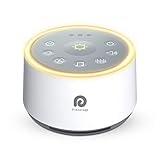
The Douni is the machine our under-$30 guide named in its final paragraph: it sat just over that guide’s budget, notable because its listing advertises the thing none of the six cheaper picks offered — a 3.5 mm earphone jack. At $75 it takes its pick slot on that feature plus the most precisely stated size in this guide. The maker’s manual and listing count 27 non-looping sounds (seven white noise, seven fan, thirteen natural sounds from birds and ocean surf to a pendulum and a train), 32 volume levels, a timer at 30, 60 or 90 minutes or continuous play, and a memory function. It is a compact wood-grain puck whose manual’s specification table states 4.4 by 4.4 by 2.3 inches and about 13.4 ounces — a footprint of about 19 square inches (arithmetic), the smallest stated footprint in this guide, small enough for the corner of a nightstand that already holds a lamp, a phone and a glass. It is powered by a DC adapter, with a USB cable included so a power bank or computer can run it too. Check price on Amazon; sales-tracking reads in our checks confirmed it among the category’s actively selling machines.
The honest caveats are about pedigree and paperwork. Douni is the smallest brand in this guide — no decades-long track record of the Yogasleep kind — and its documentation is thinner: one roundup counts 24 sounds where the maker’s own manual and listing say 27, and we print the maker’s figure while recording the disagreement here rather than hiding it. There is no night light and no Bluetooth; the jack is the whole feature story, together with the fine 32-step volume control that makes private listening genuinely adjustable. In a small room that combination is the point: the constraint in a shared small room is not filling the space with sound, it is keeping the sound to one sleeper. One sleeper gets masking through earphones or a pillow speaker while the room itself stays silent — the one job a louder room machine cannot do at all — and the Douni does it from the smallest stated footprint here, at the second-lowest price.
- A 3.5 mm headphone jack — the most affordable private listening in this guide; check price on Amazon.
- The smallest stated footprint here: 4.4 by 4.4 inches by the maker’s manual, about 19 square inches (arithmetic).
- 27 sounds by the maker’s count, 32 volume levels, timer or continuous play, memory function.
Honest limitation: The smallest brand here, with thinner documentation — one roundup counts 24 sounds against the maker’s 27 — and no light or Bluetooth.
Choose it if private listening is the requirement, the nightstand is nearly full, and the budget is tight. Skip it if you want a long-established brand, a night light, or Bluetooth streaming.

Magicteam Sound Machine with 20 Non-Looping Sounds (SN-A1, Black)
Who it suits: The small-room buyer who has read this far and realized they need none of the new features — just masking, done well, at the lowest price in the guide.
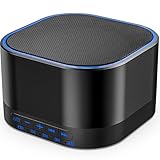
Everything about this pick is inherited from our under-$30 guide, where the Magicteam is the hero, and it earns its place here on the same evidence: check price on Amazon on the listing we pin. It is a small black plug-in cube holding 20 sounds the maker describes as non-looping — white, brown, pink and blue noise, a fan, a brook, rain, ocean, birds and a bonfire among them — with 32 volume levels, timers at 1, 2, 3 or 4 hours or continuous play, and a memory function. There is no battery; it runs from its AC adapter or any USB port — quietly useful in a small room, where a USB port on an existing strip may be easier to reach than a free wall outlet. What it proves, by standing unchanged in a guide with a much higher budget, is the finding this article opened with: for plain masking by the door, the extra money buys texture and features, not a better-masked room. In a small room that proof is at its strongest, because the small room asks the least of a machine: short distances, low volumes, one door to cover.
Its limitations are the $30 tier’s limitations, unchanged. The listing does not list a headphone jack — the feature whose absence defined the cheaper guide — and there is no light and no Bluetooth. The one-button sound cycling means your sound can be several presses away, a tax the memory function reduces to once at setup. And its sounds are recordings played through a small speaker: the maker calls them non-looping, we print that as the maker’s description, and a listener who fixates on patterns has the Dohm’s fan, not this cube, as their honest answer. Our checks did not pin a dimension set for the Magicteam, so we print none — it is a small cube in the usual bedside sense. None of that dents its role: it is the machine to buy first, live with for a month, and upgrade from only for a named feature you actually missed — the advice this whole series is built on, and which a small room, with the least to mask, should take most seriously.
- 20 sounds, described by the maker as non-looping, spanning four noise colors, fan and nature.
- 32 volume levels and timers to 4 hours — the finest cheap volume control in either guide.
- The value benchmark of this band — check price on Amazon.
Honest limitation: No headphone jack, no light, no Bluetooth, and it must stay plugged in — the $30 tier’s limits, carried up unchanged.
Choose it if masking is the whole brief and you would rather keep the extra money. Skip it if you came to this guide for the fan, the jack or the light — those are the picks above.
Comparison Table
| Product | Sound source | Sounds | Auto-off timer | Headphone jack | Link |
|---|---|---|---|---|---|
| Yogasleep Dohm (White/Gray) | Real fan | 1 (two speeds, adjustable tone) | None | No | Check on Amazon |
| LectroFan EVO | Generated electronically | 22, maker-described as non-looping | Up to 8 hours | Yes — 3.5 mm | Check on Amazon |
| Yogasleep Duet | Recordings + Bluetooth speaker | 30, plus your own audio | 45 or 90 minutes, or 8 hours | No | Check on Amazon |
| Dreamegg D1 | Recordings | 24 | Three settings | No | Check on Amazon |
| Douni Sleep Sound Machine | Recordings | 27, maker-described as non-looping | 30, 60 or 90 minutes, or continuous | Yes — 3.5 mm | Check on Amazon |
| Magicteam Sound Machine (SN-A1) | Recordings | 20, maker-described as non-looping | 1, 2, 3 or 4 hours, or continuous | No | Check on Amazon |
How to Choose a White Noise Machine for a Small Bedroom Under $75
- Count your outlets before your sounds. Every pick in this guide plugs in and none has a battery. If the bedside outlet is full, favor the flexible-power machines — the Duet runs from any USB source, the EVO from USB or its adapter, the Douni and Magicteam from USB as well as the wall — or accept that a power strip is part of the purchase.
- Measure the surface, then distrust the listing. Only two picks here carry stated dimensions in our checks — the Dohm (whose listing and brand site disagree: 5.5 by 5.5 by 4 inches against 5.6 by 5.6 by 3.5) and the Douni (4.4 by 4.4 inches by its maker’s manual). For the rest, read the live listing’s dimensions and measure your nightstand; in a small room, an inch is a real amount of furniture.
- Let one device do two jobs. On a small nightstand, a built-in light is not a garnish — the Duet and the nursery-first Dreamegg D1 each replace a separate night light, freeing its footprint and its outlet. If your nightstand already holds a lamp you love, the same feature is worth nothing.
- Ask the headphone question early. Two of these six listings have a 3.5 mm jack and four do not. In a small shared room the jack is not a bonus — it is the shortlist, because the alternative is masking the whole room for one sleeper.
- Choose the sound source for a close listener. The machine will sit near the bed whatever you do. A real fan (the Dohm) gives one perfect, loop-free wash; a generator (the LectroFan EVO) gives many loop-free tones; recordings (the other four) give the widest libraries. Close up, texture differences you would never notice across a large room become the experience.
- Place it between you and the noise. Masking works on contrast: the machine belongs between the listener and the noise source — by the door for hallway noise, on the window side for street noise — at the lowest volume that does the job. Do not buy a bigger machine to compensate for a badly placed small one.
- Match the timer to your night. Fall-asleep maskers need 30 to 90 minutes; all-night maskers should confirm continuous play (every pick here has it, or no timer at all in the Dohm’s case) or a long timer like the EVO’s eight hours.
- Check the color listing, not just the model. In this category, colors are often separate Amazon listings with separate prices and offers — the Dohm we pin is White/Gray, the EVO we pin is White. A cheaper color is a different listing; verify it as carefully as a different machine.
- For a small nursery, maximize distance, minimize volume. Common pediatric guidance is to keep the machine roughly 7 feet from the crib and the volume in the lower half of its range. A small nursery may not offer 7 feet; take the greatest distance the room allows, keep the volume low, and prefer a timer — including with the two picks here marketed for nurseries.
Outlets, Surface and Distance: The Real Small-Room Constraints
Every buying guide for this category talks about sounds, and sounds are the least of a small room’s problems. The three constraints that actually decide whether a machine works in a small bedroom are electrical, horizontal and geometric. Electrical first: this entire band plugs in — six picks, six cords, zero batteries; the rechargeable puck family lives in the lower tiers, in our under-$30 guide and in the named-without-links Micro2. A small bedroom typically offers one outlet near the bed, already spoken for by a lamp and a phone charger. So the practical question is not “does it plug in” but “how many ways can it be fed”: the Duet runs from any USB source, the EVO takes USB or its included adapter, the Douni and the Magicteam each run from USB as well as the wall. The Dohm is the strictest citizen — a fixed 120V plug, and a cord its own listing copies cannot agree on at six feet or eight. Plan the cord as furniture, because there is no spare corner for the slack to disappear into.
Horizontal second: the nightstand in a small room is contested ground — lamp, phone, water, book, glasses. A sound machine can join that contest as another object, or as a replacement. The Duet and the nursery-first Dreamegg D1 replace the night light: the footprint arithmetic is not machine-plus-lamp, it is machine-instead-of-lamp. The Dohm replaces differently — fan and speaker in one housing, the largest stated footprint in the guide at roughly five and a half inches square (its two stated dimension sets disagree; both are printed in its review), bought back by retiring a second appliance. The Douni replaces nothing and needs almost nothing: 4.4 by 4.4 inches by its maker’s manual. Geometric third: distance. In a small room the walls choose where the machine sits, and it ends up close to the bed. Treat that as the room’s one free advantage: a nearby machine masks at lower volume, and lower volume is better for everyone. Place it between you and the noise source, keep the level at the lowest that works, and the closeness becomes the setup working as intended.
What the Extra Money Buys in a Small Room — and What It Does Not
Set this guide beside our under-$30 guide and the step up itemizes cleanly, with a small-room accent. It buys texture: the fan’s moving air and the generator’s endless tones — worth more up close, where a small room forces you to listen from a few feet away all night. It buys the headphone jack, twice — in the Douni and in the LectroFan EVO — after a whole tier without one, and the jack is the single most small-room feature here, because it confines masking to one sleeper in a room too small to escape it. It buys light, twice — in a small room, a device deleted from the nightstand. It buys Bluetooth once, timer range up to eight hours, and brand depth: Yogasleep and Adaptive Sound Technologies hold four of the six slots here, where the cheaper tier belonged to younger brands.
What it does not buy is just as definite, and a small room feels each item more sharply. Not better masking: the Magicteam’s survival here is the standing proof, and a small room — one door, short distances, low volumes — is where the entry-level machine’s case is strongest. Not cordless freedom: every pick plugs in, and the small room’s one contested outlet is exactly where that absence bites. And not the smart tier: no pick here has an app, a schedule or a sunrise alarm, because in our checks those begin above this budget. Spend the extra money for a named item on the first list and this is the best-value band in the category; spend it hoping for something on the second list and no machine here will satisfy you.
Common Buying Mistakes
- Believing the title: expecting headphone-style noise cancellation from machines that mask — the word is in nearly every listing, the technology is in none of them.
- Buying for a big room’s logic: choosing by sound count when the machine will sit three feet from the pillow — close up, texture and a fine volume ladder matter, loudness does not.
- Forgetting the outlet census. Every pick here plugs in and none has a battery; count the bedside sockets before the machine arrives, not after.
- Paying for the fan’s brand and missing the fan: buying the Duet for its “Dohm sounds,” which are digital, when the actual fan is the Dohm, positioned just above it in this band.
- Trusting the strike-through price. Theatrical list prices are this band’s native art form; check the current price on Amazon instead.
- Running a nursery machine at full volume beside the crib in a small nursery. Take the greatest distance the room offers and keep the volume in the lower half of the range.
Final Recommendation
- Most small bedrooms: Yogasleep Dohm (White/Gray).
- Most flexible digital machine: LectroFan EVO.
- Sound, light and speaker in one box: Yogasleep Duet.
- Night light on a budget: Dreamegg D1 (nursery-first).
- Private listening, smallest stated footprint: Douni Sleep Sound Machine.
- Lowest price, masking only: Magicteam Sound Machine (SN-A1).
Our top two are the Dohm for anyone whose machine will live by the bed for years — the one genuinely new sound in this series, made by a fan that cannot loop, and the one pick that clears a second appliance off the nightstand — and the LectroFan EVO for anyone who wants choice: generated sounds that never repeat, a headphone jack for the shared small room, and a timer that respects a whole night. The Duet is the crowded-nightstand answer, the nursery-first D1 the small nursery’s value buy, and the Douni the quiet miracle for shared rooms. The Magicteam remains what it was: the honest floor, proof that masking itself was never the expensive part — and in a small room, which asks the least of a machine, that proof is at its most persuasive. None of these machines cancels noise or treats a condition; they mask, each in its own texture. Count your outlets, measure your nightstand, name the feature you are paying for, and order the machine that has it.
Frequently Asked Questions
Does a small room need a different machine, or just a quieter setting?
Mostly the same machine, chosen on different criteria. Masking depends on the sound’s character, its volume and the machine’s placement — between you and the noise source, at the lowest level that works — and a small room makes that easier: shorter distances, lower volumes. What changes is the selection pressure around the sound: footprint, because the nightstand is small; power, because the bedside outlet is contested; and texture, because you will hear the machine from close range all night.
Which pick takes the least nightstand space?
Of the machines whose dimensions our checks could pin, the Douni: its maker’s manual states 4.4 by 4.4 by 2.3 inches, a footprint of about 19 square inches (arithmetic). The Dohm is the largest stated footprint — its listing says 5.5 by 5.5 by 4 inches and its maker’s site says 5.6 by 5.6 by 3.5, about 30 to 31 square inches (arithmetic) either way — and we print both figures rather than choose. For the other four picks our checks did not pin a dimension set, so we print none; read the live listing’s dimensions and measure your surface before ordering.
I have one free outlet by the bed. Which pick should I get?
Start with how each machine is fed. The Duet runs from any USB source — a port on a power strip, a laptop, a charger you already own — and ships without a wall adapter, so it need not claim the free outlet at all. The EVO runs from USB or its included AC adapter; the Douni and the Magicteam each run from USB as well as the wall. The Dohm is the one strict case: a fixed plug, and a cord its listing copies describe as six feet in one place and eight in another. If a strip is not an option, the USB-fed machines are your shortlist.
Dohm or LectroFan EVO — which should I choose for a small room?
Choose by what you will actually do nightly. If you will set one sound and forget the machine exists for a decade, the Dohm: one fan sound, mechanically tuned, nothing to configure or update, and two devices’ jobs done by one box. If you will switch sounds, listen privately through the jack, or run a long timer, the EVO: 22 generated sounds, a headphone jack and eight hours of timer. Check the current price on Amazon for each before you decide — the feature list, not a small price gap, should decide.
Are these machines suitable for a small nursery?
Several are marketed for nurseries — the Dreamegg D1 is nursery-first, its listing leads with babies; the Duet is sold for adults and nurseries alike; and the Dohm has a registry following — and sound machines are a standard nursery product when used with restraint. The commonly cited pediatric guidance is about volume and distance rather than prohibition: place the machine well away from the crib — about 7 feet is the usual figure — and run it in the lower half of its volume range. A small nursery may not offer the full 7 feet; take the greatest distance the room allows, keep the volume low, and prefer a timer. If you have specific concerns about your child’s hearing or sleep, a pediatrician’s advice comes before a product page.
- Best White Noise Machines Under $75
- Best White Noise Machine Under $30
- Best Weighted Blanket Under $75
- Best Sleep Pillow Under $75
- Best Wardrobe Under $75