Disclosure: As an Amazon Associate, umtsmarttool.com earns from qualifying purchases. Links to Amazon on this page are affiliate links; they cost you nothing extra. Prices and availability change often, so check the current Amazon listing before you buy.
Where to buy
- First Alert CO710 — Best Overall — Check on Amazon — check price on Amazon
- Kidde Nighthawk KN-COPP-3 — Best Plug-In — Check on Amazon — check price on Amazon
- First Alert CO615 — Best Dual-Power Value — Check on Amazon — check price on Amazon
- X-Sense SC07 — Best Combination — Check on Amazon — check price on Amazon
- Kidde KN-COEG-3 — Best for Gas Appliances — Check on Amazon — check price on Amazon
- Kidde C3010D — Best Sealed-Battery Display — prose-only pick, see below
Read the full guide ↓
A carbon monoxide detector buying guide should do one job above all: stop you buying the wrong alarm confidently. The category is small, the technology is settled, and yet households still end up with unlisted no-name units, single alarms stretched across three floors, plug-ins with no battery backup, and combination units missing one of their two certifications. This carbon monoxide detector buying guide works through the criteria in the order they should be decided — sensing and certification, information, power, coverage, interconnection and end of life — and then shows the picks that satisfy them, so the buying decision becomes a checklist instead of a guess.
The context never changes: carbon monoxide is an odourless, colourless product of incomplete combustion from boilers, furnaces, water heaters, gas cooking, solid-fuel stoves and attached garages, and it is at its most dangerous while the household sleeps. If you want the category argued from first principles, read Is A Carbon Monoxide Detector Worth It alongside this guide; if you want single models examined at length, the Carbon Monoxide Detector Review hub is the companion piece.
The Criteria That Actually Matter
Sensor type and certification come first
Every pick in this guide uses an electrochemical sensor — the technology that defines modern CO detection — and carries a UL 2034 listing. That listing is not decoration: it fixes the alarm thresholds, the response times and the resistance to false alarms from low-level traces. Below that standard there is nothing worth buying at any price, which is why the cheapest legitimate alarms and the most expensive ones share the same sensing foundation.
Decide whether you need a display
A digital display with peak level memory converts an alarm into a monitor. You see current levels in parts per million, and the peak function stores the highest concentration since the last reset — including low double-digit events that never sounded the horn. For the alarm outside your bedrooms, that information is worth prioritising. For secondary coverage on another level, a sound-only alarm is a rational saving.
Match the power source to the room
Sealed 10-year battery alarms install anywhere and cannot be unplugged, switched off at the wall, or defeated by a dead battery — the lowest-maintenance option and the renter’s default. Plug-in alarms with battery backup suit hallways with a well-placed spare outlet and never need a battery routine beyond the backup cells. Hardwired alarms belong to new builds and renovations; nothing in this guide requires an electrician.
Think about interconnection in larger homes
When one alarm sounds, interconnected alarms sound everywhere — the difference between a basement event waking the house and it not being heard until it reaches the bedrooms. Wireless interconnection delivers this without wiring, and combination smoke-and-CO units can join the same network. In a compact flat it is unnecessary; in a three-storey house it is the single most valuable upgrade in the category.
Plan for end of life on day one
Every CO sensor expires. Sealed models announce it after their decade; plug-in models signal replacement too. Write the install date on the unit or in your phone, test monthly, and budget replacements as a known future cost rather than a surprise. An alarm of unknown age — inherited, unlabelled, or chirping a code you cannot identify — should simply be replaced.
Count coverage before features
The most common specification error is not choosing the wrong alarm but choosing too few. Price your plan as a system: sleeping-area coverage, every level, then appliance-adjacent positions. Only once the map is complete does it make sense to upgrade individual positions to display, combination or interconnected models.
In this guide
Budget Tiers, Framed Honestly
The entry tier buys legitimate protection: listed electrochemical alarms, usually plug-in or basic battery models, sometimes without a display. It is the right tier for secondary positions in a home whose main hallway alarm carries the display. The middle tier is where most households should land: digital ppm displays, peak memory, sealed 10-year batteries or dual-power plug-ins from established manufacturers — full information and full backup without paying for connectivity. The upper tier buys systems rather than sensors: interconnection so every alarm sounds everywhere, combination smoke-and-CO units, and dual CO-and-gas detection for appliance rooms. The sensing itself does not improve with money — the UL 2034 thresholds are fixed — so upper-tier money is justified only by coverage and convenience you will genuinely use.
One tier warning belongs in every version of this guide: the very cheapest end of the market, surveyed in Best Carbon Monoxide Detector Under $15, is where unlisted and short-life products concentrate. A bargain that lacks a UL 2034 listing is not a bargain at any price.
The Picks That Meet the Criteria
| Pick | Badge | Power |
|---|---|---|
| First Alert CO710 | Best Overall | sealed 10-year lithium battery (3V), non-replaceable |
| Kidde Nighthawk KN-COPP-3 | Best Plug-In | 120V AC plug-in with 9V battery backup |
| First Alert CO615 | Best Dual-Power Value | 120V AC plug-in with two AA battery backup |
| X-Sense SC07 | Best Combination | sealed 10-year lithium battery, non-replaceable |
| Kidde KN-COEG-3 | Best for Gas Appliances | electrochemical sensor for carbon monoxide |
| Kidde C3010D | Best Sealed-Battery Display | sealed 10-year lithium battery, self-activating when attached to its mounting bracket |
First Alert CO710 — Best Overall
It suits anyone who wants the alarm handled for a decade: no outlets, no battery calendar, and a display that still tells you what happened while you were out.
- Sensor: electrochemical carbon monoxide sensor
- Power: sealed 10-year lithium battery (3V), non-replaceable
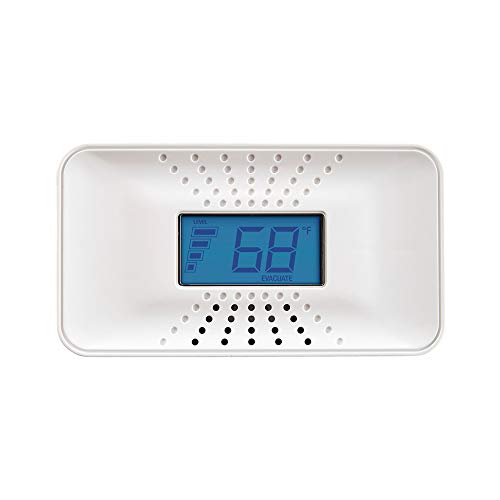
- Display: backlit digital display showing CO level in ppm, peak level and room temperature
- Alarm: 85 dB horn at 10 feet, with test/silence button
- Size: 4.75 in wide x 2.63 in high x 0.94 in deep; listed to UL 2034
Strengths
- No battery changes for the life of the alarm, which removes the most common reason CO alarms stop protecting a home
- The backlit display shows a real ppm number and the recent peak, so a slow furnace problem is visible before it becomes an emergency
- Works anywhere — tabletop, dresser or wall — with no outlet or wiring needed, including during power cuts
Trade-offs
- Battery-only design means there is no plug-in or hardwired option if you prefer mains power
- It is a standalone unit: it does not interconnect, so an alarm in the basement will not sound upstairs
- When the sealed battery reaches end of life the whole unit is replaced, not just a battery
The CO710 is built around one simple idea: the alarm that protects you for a decade should not depend on you remembering a battery. Its sealed lithium cell is rated for the same ten years as the sensor, and an end-of-life signal tells you when the whole unit is due for replacement. In practice that makes it the easiest alarm on this page to own — mount it or stand it on a flat surface, press the test button, and the routine is finished until the monthly test reminder you set for yourself.
The CO710 has no interconnection and no app alerts, so in a large or multi-storey home you need one within earshot of every sleeping area rather than relying on a single unit.
Check on Amazon — check price on Amazon

Kidde Nighthawk KN-COPP-3 — Best Plug-In
It suits households with a well-placed hallway outlet who want a permanently powered monitor whose readout they can check in passing, every day.
- Sensor: electrochemical carbon monoxide sensor
- Power: 120V AC plug-in with 9V battery backup
- Display: digital display showing CO level from 30 to 999 ppm, updated every 15 seconds, with peak level memory from 11 ppm
- Alarm: 85 dB at 10 feet; operating range 40°F to 100°F, 10–95% humidity non-condensing
- Warranty: 10-year limited warranty with end-of-life replacement signal
Strengths
- The always-on digital readout updates every 15 seconds, the clearest low-level CO picture of any plug-in alarm here
- Peak level memory stores the highest reading since the last reset, which helps a technician diagnose an intermittent appliance fault
- Plug-in power with battery backup means no battery routine in normal use and continued monitoring during outages
Trade-offs
- It needs a spare outlet at a sensible height, and the direct-plug body can crowd a double socket
- The 9V backup battery does need periodic replacement, unlike the sealed 10-year models
- It is a standalone alarm with no interconnection or smart alerts
The KN-COPP-3 is the long-running benchmark for plug-in carbon monoxide alarms, and the reason is its display discipline. The digital readout shows the carbon monoxide level in parts per million and refreshes every 15 seconds, so it behaves like a monitor, not just an alarm. Press the peak level button and it shows the highest concentration recorded since the last reset — including levels as low as 11 ppm that would never trigger the horn but absolutely should trigger a service call.
Outlet placement is the compromise: plug it into a low hallway socket and the display sits near the floor where nobody reads it, so the included extension-cord/tabletop option matters more than it first appears.
Check on Amazon — check price on Amazon
First Alert CO615 — Best Dual-Power Value
It suits buyers who want plug-in reliability and a real display, with backup batteries they can replace at any supermarket.
- Sensor: electrochemical carbon monoxide sensor
- Power: 120V AC plug-in with two AA battery backup
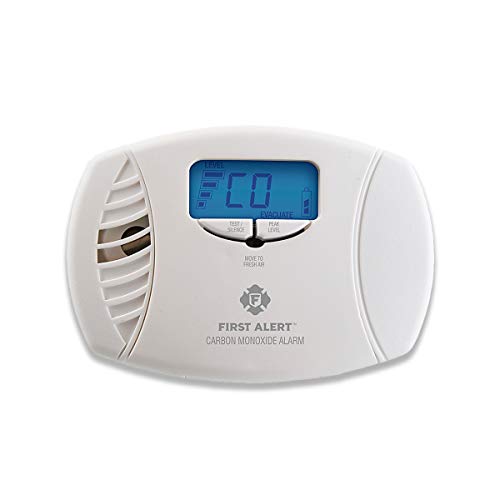
- Display: backlit digital display showing CO level in ppm, with peak level memory
- Alarm: 85 dB horn at 10 feet, with test/silence button and end-of-life timer
- Mounting: direct plug-in or wall-mounted away from the outlet using the line cord
Strengths
- Dual power gives mains reliability plus battery backup that uses common AA cells
- The backlit display and peak memory bring monitor-style information to a straightforward plug-in alarm
- The line-cord option lets you mount the alarm at a readable height instead of leaving it at floor level
Trade-offs
- No display information is visible until a button is pressed or the alarm sounds, because the backlight is not always on
- Backup AAs need replacing over the years, unlike sealed 10-year battery models
- Standalone only — no interconnection with other alarms
The CO615 is First Alert’s dual-power answer to the same hallway problem the Kidde solves: how to keep a carbon monoxide alarm permanently powered, readable, and still working when the mains fails. It plugs into a standard outlet, carries two AA batteries as backup, and puts a backlit digital display on the front that shows the current CO level in parts per million along with the peak level held in memory.
The display backlight lights on demand rather than staying lit, so for an at-a-glance hallway monitor the Kidde KN-COPP-3 is easier to read in passing; the CO615 rewards a button press instead.
Check on Amazon — check price on Amazon

X-Sense SC07 — Best Combination
It suits anyone replacing alarms wholesale who wants smoke and CO from one ceiling point, and one test routine instead of two.
- Detection: combination alarm — photoelectric smoke sensor plus electrochemical CO sensor
- Power: sealed 10-year lithium battery, non-replaceable
- Display: LCD showing CO level from 30 to 999 ppm
- Alarm: 85 dB or more at 10 feet; listed to UL 217 and UL 2034
- Size: 5.7 in diameter round ceiling/wall-mount body
Strengths
- Replaces two devices with one mounting point — smoke and CO in a single 10-year sealed unit
- The LCD gives a real CO number, which most combination alarms omit entirely
- Ten-year sealed battery means a decade with no battery routine on either sensing function
Trade-offs
- A combination unit is a compromise position: smoke alarms prefer the ceiling, while you may want the CO display at reading height
- If one sensor reaches end of life, the whole combined unit is replaced
- This standalone version does not interconnect; the SC07-W variant is the one that links alarms together
Combination alarms usually force a quiet trade: you gain a single neat ceiling unit and lose the carbon monoxide display. The SC07 is the exception worth shortlisting, because its LCD shows the CO concentration from 30 to 999 ppm alongside the smoke function, and its sealed battery is rated for ten years across both sensors. One bracket, one test routine, one replacement date — for a whole-house refresh that simplicity is the product.
Because it combines both hazards, its ceiling mounting suits smoke detection best; if reading the CO display daily matters to you, pair it with a plug-in or tabletop CO alarm at eye level.
Check on Amazon — check price on Amazon
Kidde KN-COEG-3 — Best for Gas Appliances
It suits homes with gas or propane appliances, where the utility room deserves its own dedicated watcher.
- Detection: carbon monoxide plus explosive gas (natural gas, propane and methane)
- Sensor: electrochemical sensor for carbon monoxide
- Power: 120V AC plug-in with 9V battery backup
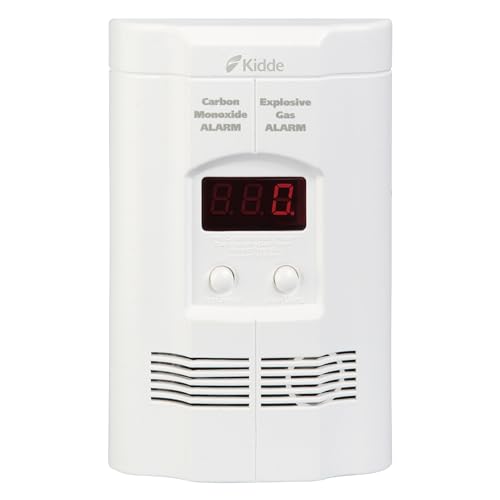
- Display: digital LED display for CO level and gas indication
- Alarm: 85 dB audible alarm
Strengths
- One outlet covers two distinct hazards — CO from combustion and leaking fuel gas before it reaches explosive levels
- Digital display keeps CO information visible in the same style as the Nighthawk plug-in line
- Battery backup keeps both detection functions running during a power cut
Trade-offs
- It only makes sense near gas appliances; in an all-electric home the gas sensor buys you nothing
- A gas alarm is not a substitute for fixing a leak — it is an early warning, and placement near the appliance matters
- Standalone unit with no interconnection or app alerts
The KN-COEG-3 exists for the room the other alarms on this page are not really designed for: the utility space with a gas boiler, a gas water heater, a gas dryer, or a propane supply. Alongside its electrochemical carbon monoxide sensor it watches for explosive gas — natural gas, methane and propane — and alarms before a leak builds toward a dangerous concentration, with a digital display covering the CO side of its job.
Explosive-gas detection has stricter placement logic than CO alone — it belongs near the gas appliances it watches, not in a distant hallway — so it complements a hallway CO alarm rather than replacing one.
Check on Amazon — check price on Amazon
Kidde C3010D — Best Sealed-Battery Display
It suits bedrooms and hallways without a usable outlet, where a sealed battery and a proper display need to coexist.
- Sensor: electrochemical carbon monoxide sensor
- Power: sealed 10-year lithium battery, self-activating when attached to its mounting bracket
- Display: digital display showing CO level from 30 to 999 ppm, updated every 15 seconds, with peak level memory from 11 ppm
- Alarm: 85 dB at 10 feet
- Size: 4.5 in x 2.75 in x 1.5 in; 10-year limited warranty
Strengths
- Sealed 10-year battery plus a full digital display and peak memory — the monitor features without any outlet
- Self-activation on the bracket means the alarm cannot be mounted and accidentally left switched off
- Compact battery body suits hallways and bedrooms where outlets are scarce or hidden
Trade-offs
- Battery-only: households that prefer mains power with backup should look at the plug-in picks instead
- No interconnection and no smart alerts — coverage depends on placing units within earshot
- Whole unit is replaced at end of life when the sealed battery and sensor expire together
The C3010D takes the sealed-battery idea and adds the thing most battery alarms leave out: information. Its digital display shows the carbon monoxide level from 30 to 999 ppm and refreshes every 15 seconds, and its peak level memory stores concentrations as low as 11 ppm — the same early-warning behaviour that makes the plug-in Nighthawk so useful, in a unit that needs no socket at all.
Availability of this exact model varies as Kidde refreshes its line, so treat it as a prose-only recommendation here: if you cannot find the C3010D itself, the sealed-battery display formula — not a no-name substitute — is what to shop for.
Prose-only pick — no verified buying link; see the main guide for the reasoning.
The ranked context for these picks — including how they were ordered for different budgets and households — lives in Best Carbon Monoxide Detector Under $100 and the under-$50 guide; this buying guide deliberately stays criteria-first.
Key Takeaways
- Cover every level of the home and the area outside each separate sleeping area first — coverage beats features.
- Every worthwhile alarm uses an electrochemical sensor and a UL 2034 listing; alarm thresholds are time-weighted by design.
- At least one alarm should have a digital display with peak memory, so intermittent faults leave evidence.
- Sealed 10-year batteries remove the most common failure in this category: the dead or missing battery.
- When an alarm sounds: outside first, then call emergency services. Never investigate first.
Understanding Carbon Monoxide in the Home
Every alarm recommended in this guide uses an electrochemical sensor and carries a UL 2034 listing, and that standard explains behaviour that surprises new owners. A UL 2034 alarm must not sound at low levels: it is required to resist alarming below 30 ppm, and its alarm windows are time-weighted — at 70 ppm it must sound within 60 to 240 minutes, at 150 ppm within 10 to 50 minutes, and at 400 ppm within 4 to 15 minutes. The logic is deliberate. Brief, low traces of CO happen around normal appliances; what harms people is sustained concentration, so the alarm trades instant reaction for accuracy you can trust.
Placement follows one rule repeated by the NFPA, the U.S. Fire Administration and the CPSC alike: a carbon monoxide alarm in a central location outside each separate sleeping area, and one on every level of the home, following the manufacturer’s instructions for height and position. Sleeping areas come first because CO is most dangerous at night, when nobody is awake to notice symptoms. Keep alarms away from bathrooms and steamy humidity, and do not mount one immediately beside a fuel-burning appliance — makers typically want a sensible distance, commonly around 15 feet, so brief normal start-up traces do not become nuisance alarms that teach you to ignore the real one.
Where to Place Your Alarms
Work through the home level by level. Start outside the bedrooms: one alarm in the hallway serving the main sleeping area, close enough that a closed bedroom door will not muffle an 85 dB horn. Then cover each remaining level — the ground floor near the living space, the basement at the top of the stairs or in the finished area, and any floor with a fuel-burning appliance that lacks coverage. Bedrooms split across two wings or two floors count as separate sleeping areas and each needs its own nearby alarm. A long hallway serving bedrooms at both ends may need an alarm toward each end rather than one stranded in the middle.
Height is governed by the manual for the model you bought, not by folklore. Carbon monoxide mixes fairly evenly with indoor air instead of rising like smoke or sinking like some fuel gases, which is why plug-in, tabletop, wall-mounted and ceiling-mounted alarms can all be legitimate. What matters more than a magic number is audibility from the bedrooms, distance from steam and cooking fumes, and a position where the test button can be reached and — on display models — the screen can actually be read.
Count appliances as well as floors. A boiler room, a utility space with a gas water heater, the wall beside an attached garage door, and a room with a regularly used fireplace are all places where an additional alarm earns its keep, mounted at the distance the manual specifies from the appliance itself. If the alarm ever sounds, the routine is not to investigate the boiler: get everyone, including pets, into fresh air first, then call the fire department or emergency services from outside, and do not re-enter until they say the home is clear. Ventilating and troubleshooting come after people are safe, and any appliance suspected of producing CO stays off until a qualified technician has checked it.
How to Install and Maintain a Carbon Monoxide Detector
- Unpack the alarm and read the placement page of its manual — the maker’s distances and heights override any general guide, including this one.
- Choose the position: outside the sleeping area or on the uncovered level, clear of steam, cooking fumes and furniture, at the manual’s distance from fuel-burning appliances.
- Fit it as designed — plug the unit into a non-switched outlet, mount the bracket for a battery model and let it self-activate, or use the line cord to wall-mount a plug-in at readable height.
- Press and hold the test button until the horn sounds and the display or LED confirms the test sequence; note the install date on the unit.
- Repeat for each level and sleeping area, then set a monthly reminder to test every unit on the same day.
- Keep vents dust-free with a soft vacuum brush, replace backup batteries on schedule, and replace the whole alarm at its end-of-life signal.
Match the power routine to the model. Plug-in alarms with replaceable backup batteries need those batteries changed on the maker’s schedule and immediately when a low-battery chirp appears; the backup is what stands between you and an unmonitored home during the outage when the generator comes out. Sealed 10-year models remove that chore entirely, which is their main ownership argument. Whichever type you own, write the replacement month on your calendar when you install it, and treat a chirping end-of-life signal with the same seriousness as a low battery in a smoke alarm — because functionally, that is what it is.
Ownership is deliberately undemanding, but it is not zero. Test every alarm monthly with its test button — the test exercises the electronics and horn, and it takes seconds per unit. Keep the vents clear: a gentle vacuum with a soft brush attachment every few months removes the dust that can slow a sensor, and never paint an alarm or spray cleaners or solvents near it. Note the installation date somewhere you will find it, because every CO sensor has a service life — modern units signal their own end of life with a distinctive chirp pattern, and when that signal comes, replacement is not optional or postponable. The sensor chemistry ages out whether the alarm has ever sounded or not.
Troubleshooting Common Carbon Monoxide Detector Problems
Problem: the alarm chirps once every minute or so but shows no CO reading
That pattern is almost always a low-battery or fault signal, not a carbon monoxide event — but check the display first. On a plug-in model, replace the backup batteries; on a sealed model, a persistent fault chirp usually means the unit is at or near end of life and should be replaced. The manual for your exact model defines its chirp codes, so match the pattern before assuming.
Problem: the alarm sounds and the display shows a high ppm number
Treat it as real. Move everyone outside to fresh air, call emergency services or the fire department from outside the home, and do not go back in to open windows, silence the alarm or fetch belongings. If anyone has symptoms — headache, dizziness, vomiting, confusion — say so when you call, because that changes the response.
Problem: repeated short alarms near a boiler or cooker that then clear
Do not dismiss these as nuisance alarms. Check the peak level memory if your model has it, note the times and weather, and book a technician to inspect the appliance and flue. Intermittent spilling is a classic early pattern of a developing combustion fault, and the peak reading is the evidence that gets it taken seriously.
Problem: the display shows a small reading that never reaches alarm level
Low double-digit readings that persist are worth one phone call to your gas utility or heating engineer, especially if they trend upward over days. UL 2034 alarms correctly stay silent at these levels, but a display model exists precisely so you can see a problem forming. A reading that returns to zero and stays there after ventilation is less concerning than one that keeps coming back.
Problem: the alarm is past its printed service life but still passes the test button
Replace it anyway. The test button checks the electronics and horn, not the remaining sensitivity of an aged electrochemical cell. The end-of-life signal and the printed replace-by date exist because sensor accuracy — the thing you are actually relying on — is what expires.
Common Buying Mistakes
Ignoring the end-of-life chirp
That repeating chirp pattern is the alarm reporting its own retirement. The sensor inside has aged out of accurate service, and pressing the silence button does not restore it. Replace the unit — and treat any alarm you cannot date, inherited with a house, as due for replacement by default.
Assuming a smoke alarm covers carbon monoxide
Smoke and CO are different hazards with different sensors. A smoke-only alarm will stay silent through a lethal CO build-up, and a CO-only alarm ignores smouldering upholstery. Combination units exist for rooms that need both — but check that any combo you buy carries both listings, UL 217 and UL 2034.
Never checking the peak memory
Owners of display alarms often never press the peak button, so the best diagnostic evidence the alarm collects goes unread. Check it monthly with the test routine — a rising peak trend is your early warning to book the boiler service before the alarm stage arrives.
Buying one alarm for a multi-level home
A single alarm cannot be heard through two floors and closed doors, and CO produced in a basement boiler room will not politely wait upstairs. Coverage follows the rule — every level, outside every sleeping area — before any money goes on upgraded features for one position.
Blocking the alarm with furniture or curtains
A plug-in alarm behind a sofa or a wall unit inside a curtained alcove samples stale air and broadcasts a muffled horn. Keep the area around every alarm clear, and if the only outlet in the right place is behind furniture, choose a line-cord or battery model that can live in the open instead.
Choosing an unlisted no-name alarm to save a little money
Carbon monoxide detection is a certified safety function, not a feature list. An alarm without a UL 2034 listing from a recognised manufacturer has no independently verified alarm thresholds at all. The saving over an established brand is small; the thing being gambled is the only warning you will get.
Codes, Landlords and Who Must Provide What
Carbon monoxide alarm requirements are set locally, and they vary — by state, by city, and by whether the home is owned, rented, newly built or merely sold. Many jurisdictions require alarms in homes with fuel-burning appliances or attached garages; many place a duty on landlords to provide and maintain alarms in rental properties; some specify placement by reference to the same rule used throughout this guide — outside sleeping areas and on every level. Because the variation is real, treat anything general — including this section — as a prompt to check, not as the answer: your local building code, fire department or tenancy guidance is the authority for your address.
Two practical conclusions survive every variation. First, compliance is a floor, not a target: a code that requires one alarm does not make one alarm the right coverage for a three-storey house, and the placement rules in this guide describe protection rather than paperwork. Second, if you rent and the provision is unclear or the existing alarms are expired, do not let the question sit while you sleep unprotected — a battery alarm you own, placed correctly and removed when you leave, settles the safety question immediately, whatever the legal one turns out to be. Keep receipts and photographs of peak readings; documentation is useful in every version of the conversation that follows.
Carbon Monoxide Sources, Room by Room
The heating plant. Boilers and furnaces produce carbon monoxide whenever combustion is incomplete, and the failures that matter — a cracked heat exchanger, a blocked or corroded flue, a downdrafting chimney on a windy night — develop gradually inside equipment that otherwise appears to work. This is why the alarm outside the bedrooms and the alarm on the boiler’s own level are the two positions no home should skip, and why an annual service by a qualified technician is the partner habit to detection: the alarm warns, the service prevents.
The water heater. Gas water heaters are easy to forget because they live in cupboards, garages and utility rooms and ask for nothing for years. A heater that backdrafts spills combustion gases into the room instead of sending them up the flue, and the spill is at its worst exactly when the heater works hardest. A detector on the same level, at the manual’s distance, is the correct response — not one inside the cupboard with the appliance, where normal start-up traces would teach you to ignore it.
The kitchen. Gas hobs and ovens produce small amounts of CO in normal operation, which is one reason alarms do not belong immediately beside the cooker. The kitchen’s real lesson is ventilation: a cooker used for hours with windows shut and no extraction is a different proposition from one used normally, and any visible sign of trouble — yellow, lazy flames instead of blue, soot marks, a pilot that keeps dying — is a reason to stop and call a technician, not to open a window and carry on.
Fires and stoves. Wood burners, open fires and solid-fuel stoves produce CO by design and rely entirely on the flue to remove it. A blocked chimney, a poorly fitting stove door, or ash left smouldering overnight in a closed room are classic incident patterns. Homes with solid fuel should treat CO detection in the living space as mandatory, keep flues swept on schedule, and never let a fire smoulder down in a room where someone will sleep on the sofa.
The attached garage and the generator. A car idling in an attached garage — even briefly, even with the door open — can push exhaust into the house through the connecting door and wall penetrations. Portable generators are the most lethal source of all in outage conditions and must only ever run outdoors, well away from windows and doors. The detector near the garage’s connecting door earns its place in every home that has one.
Testing, Drills and Household Routines
An alarm that is never tested is an assumption, not a safeguard. The monthly test takes seconds: press and hold the test button, confirm the horn sounds at full volume and the display or indicator runs its sequence, and move to the next unit. Put every alarm in the house on the same monthly day — the first of the month is the classic choice — and tie it to something you already do, so the habit survives busy periods. The test proves the electronics, battery and horn; it cannot prove sensor accuracy, which is what the expiry date and end-of-life signal are for, and confusing those two assurances is a common and consequential mistake.
Households with children should go one step further and make the sound familiar. Children who have heard the alarm in a calm moment, and who know the family rule — outside first, then find a parent or neighbour, never hide and never go back for toys or pets — respond to a 3 a.m. alarm as a drill they recognise rather than a noise to hide from under the covers. The same briefing serves overnight guests, who otherwise have no idea what the sound means or where the exits are. None of this takes an evening: it takes one conversation, repeated when the household changes.
Keep a minimal paper trail. A note in a phone — install dates, battery changes for plug-in backups, peak readings with dates, service visits — turns the alarm system from a set of boxes into a maintained system. When a technician asks “how long has it been doing that”, the household with dates and peak numbers gets a diagnosis; the household with a shrug gets a guess.
Final Recommendation
Decide in this order: map the positions (every level, outside every sleeping area), fix the power type per position, insist on UL 2034 and electrochemical sensing, give the hallway position a display with peak memory, and only then compare models. Followed honestly, that sequence lands most households on the First Alert CO710 for the key position and the Kidde Nighthawk KN-COPP-3 where a hallway outlet suits a plug-in monitor — with the remaining picks above covering combination, gas-appliance and secondary roles.
Frequently Asked Questions
Do carbon monoxide detectors also detect smoke or gas leaks?
A standard CO alarm detects carbon monoxide only. Combination alarms such as the X-Sense SC07 add a photoelectric smoke sensor in the same unit, and dual-purpose models such as the Kidde KN-COEG-3 add explosive-gas detection for natural gas, propane and methane. Choose based on the hazards in the room: a hallway usually wants CO (and often smoke), while a gas appliance room is where combined CO and gas detection earns its place. No CO alarm detects radon or carbon dioxide.
Do I need a carbon monoxide detector if my home is all-electric?
Often, yes. Attached garages are a major CO source regardless of your heating system, and fireplaces, wood stoves, gas cookers, portable generators and even a neighbour’s plant in attached housing can all produce carbon monoxide. Many local codes require alarms based on garages and fuel-burning appliances of any kind, not just boilers. The genuinely low-risk exception is a small all-electric flat with no garage, no fireplace and no fuel-burning appliance — and even there, a single battery alarm is cheap insurance.
Why does my carbon monoxide detector show a reading but not sound the alarm?
That is the UL 2034 standard working as designed. The alarm must ignore low levels — it will not sound below 30 ppm — and it responds on a time-weighted basis: roughly 60 to 240 minutes at 70 ppm, 10 to 50 minutes at 150 ppm, and 4 to 15 minutes at 400 ppm. A visible low reading that keeps returning is still worth reporting to your gas utility or heating engineer, because display models exist to catch a problem while it is still small.
Is a digital display worth it on a carbon monoxide detector?
For at least one alarm in the home, yes. The horn protects you in the moment; the display protects you over time. A ppm readout with peak level memory shows the slow, intermittent patterns — a boiler that spills on cold mornings, a flue affected by wind — that a sound-only alarm reduces to an unexplained beep. Technicians can act on a recorded peak number. Sound-only alarms still make sense as additional coverage on other levels, where being heard is the whole job.
How long does a carbon monoxide detector last?
The electrochemical sensor has a fixed service life, and modern alarms are built around roughly a decade: sealed-battery models pair a 10-year battery with a 10-year sensor and signal their own end of life, while plug-in models warn when replacement is due. The test button only proves the electronics and horn work — it cannot prove an aged sensor is still accurate. When the end-of-life signal sounds or the printed replace-by date passes, replace the whole unit promptly.
Where is the best place to install a carbon monoxide detector?
Outside the sleeping areas first, then on each level, at the height and position the manufacturer’s manual specifies. Carbon monoxide mixes with room air rather than rising or sinking strongly, so plug-in, tabletop, wall and ceiling positions can all be correct for the model designed for them. Keep alarms away from steamy bathrooms, out of direct cooking fumes, and at the manual’s stated distance from fuel-burning appliances — commonly around 15 feet — so normal start-up traces do not cause nuisance alarms.