Disclosure: As an Amazon Associate, umtsmarttool.com earns from qualifying purchases. Links to Amazon on this page are affiliate links; they cost you nothing extra. Prices and availability change often, so check the current Amazon listing before you buy.
Where to buy
- Be Smart Get Prepared 110-Piece First Aid Kit — Check on Amazon
- Surviveware Small First Aid Kit — Check on Amazon
- Johnson & Johnson All-Purpose Portable Compact First Aid Kit — Check on Amazon
Read the full guide ↓
First aid kit pros and cons: The Balance Sheet
Every household product asks for something and offers something, and a first aid kit is unusually honest about the exchange: a drawer, a modest outlay and a few minutes of attention twice a year, against calm competence during the minor incidents that domestic life reliably produces. This article lays the exchange out as a balance sheet, strength by strength and trade-off by trade-off, with the verified kits from this cluster as worked examples. It is the companion piece to How To Use A First Aid Kit How To Use A First Aid Kit, and it reaches a similar destination by a more argumentative road.
A note on scope: this guide covers basic household first aid supplies for minor incidents only. It does not provide medical advice, and no kit replaces professional care. For anything serious — heavy bleeding, breathing difficulty, chest pain, head injury symptoms, suspected fractures or severe burns — call your local emergency number first and use the kit only for basic steps such as covering a wound while help travels.
In this guide
The Strengths, Expanded
Strength one: immediacy. When a minor incident happens, the nearest supplies are the only ones that matter, and a kit puts them within arm’s reach of the kitchen, the bathroom and the front door. The alternative, improvising with tissues and hope, is slower, messier and oddly more stressful for everyone involved.
Strength two: coverage matched to reality. The incidents a kit covers, cuts, scrapes, minor scalds, bumps, splinters and blisters, are not edge cases. They are the standard texture of a lived-in home, arriving weekly in families and monthly in quieter households. A product used that often does not need a dramatic justification.
Strength three: consolidation. Most homes already own half a kit, scattered across drawers, bags and bathroom shelves, unfindable under pressure. A kit gathers those supplies into one searchable place, adds the missing basics, and gives the whole household a single answer to the question of where the plasters are.
Strength four: modest lifetime cost. After the purchase, ownership runs on a handful of replacement consumables a year, bought at ordinary prices during ordinary shopping. Compared with repeated convenience purchases of single items, the kit is the frugal option wearing a preparedness costume.
Strength five: shared competence. A labelled, guided kit raises the floor for everyone in the home. Babysitters, guests, grandparents and older children can all be pointed at the same box and use it sensibly, which no drawer of loose supplies has ever achieved.
Families should read piece counts differently. A household with children can use more bandages in a month than a single adult uses in a year, so depth in the everyday items matters more than breadth in the unusual ones. Splinter removal, blister care and minor burn cooling dominate real family use, alongside the humble plaster. Keeping a few child-friendly bandages in the mix is not a gimmick; a dressing that stays on is a dressing that works. Store the kit where the supervising adult can reach it in seconds, and restock after every sports season.
The Trade-Offs, Expanded
Trade-off one: maintenance is real. A kit is a system with a rhythm, and owners who skip the twice-yearly audit will eventually open a box of dried wipes and missing sizes. The demand is small, ten minutes twice a year, but it is non-negotiable, and it is the honest price of the strengths above.
Trade-off two: marketing noise. Piece counts in this category are close to fiction, which forces buyers to read contents lists carefully. That reading is the hidden effort cost of the purchase, and it falls on exactly the beginners least equipped to do it, a flaw of the category rather than of any single kit.
Trade-off three: space. Even a compact kit claims a drawer or a shelf section permanently. In small flats that claim competes with everything else the household owns, and a kit bought without a storage plan tends to migrate until it is lost in plain sight.
Trade-off four: scope. A consumer kit covers minor incidents only. Buyers who mistake it for emergency equipment misunderstand it, and the misunderstanding matters, because the correct response to a serious incident is professional help, with the kit playing, at most, a supporting role.
Trade-off five: duplication. Households with well-stocked bathroom cabinets will pay partly to consolidate what they already own. The consolidation has genuine value, but it should be recognised as part of what is being bought, rather than discovered afterwards with mild resentment.
Expiry dates in a first aid kit are mostly about assurance rather than sudden danger. Adhesives lose their grip, wipes dry in their packets, and ointments separate or lose potency over time, especially in warm storage. The practical routine is simple: when you buy the kit, note the earliest date inside the lid, and check the box twice a year. Replace anything opened, anything dried out and anything past its printed date. Everything else, stored cool and dry, can be judged by condition. That small discipline is the difference between owning supplies and owning a kit.
Context: What a Typical Kit Contains
- Bandages in assorted sizes, the highest-turnover contents in any home
- Gauze pads, rolled gauze and adhesive tape for larger minor wounds
- Antiseptic wipes and, in many kits, antibiotic ointment packets
- An instant cold pack for bumps and minor sprains
- Basic tools: scissors or shears, tweezers, safety pins, disposable gloves
- Sometimes: small packets of common over-the-counter items, and a first aid guide
Read against that template, the trade-offs sharpen. A kit weak in the first two lines is weak where it matters; a kit strong there but light on extras is usually a sound buy. The examples below show the template applied well in three different formats and at three different positions in the market.
Worked Examples From This Cluster

Johnson & Johnson All-Purpose Portable Compact First Aid Kit — Best for Small Spaces
Who it suits: apartment residents who will store the kit in one fixed spot.
- Hard plastic case, about 9.8 x 7 x 3.3 inches
- Includes an instant cold pack and a first aid guide
- 160 pieces
- Band-Aid brand bandages in assorted sizes
- Includes antibiotic cream, itch-stopping cream and acetaminophen caplets
Strengths
- Contents lean toward the supplies households actually consume, rather than display-only extras
- The hard plastic case format stores and opens sensibly in a real home
- Labelling and layout reduce the search time that matters during an incident
- Standard consumable sizes keep long-term restocking cheap and local
Trade-offs
- Plastic case and latches feel less rugged than fabric pouches
- Less suited to being crushed into a packed bag or boot
- Fewer tools than kits aimed at outdoor or trauma use
Start with the basics of the Johnson & Johnson All-Purpose Portable Compact First Aid Kit: 160 pieces, housed in a hard plastic case. Judged through the lens of general households, it is a kit that tries to cover a balanced household kit that covers the everyday incidents most homes actually face. That focus shows in the contents list, which leans toward the supplies households reach for weekly rather than the novelties they never touch.
The everyday verdict on the Johnson & Johnson All-Purpose Portable Compact First Aid Kit is that it removes friction. The right dressing is present, the case opens the way you expect, and the incident ends sooner. That sounds like faint praise until the comparison is a bare cupboard and a bleeding finger. Kept in any home and maintained on the simple rhythm this guide describes, it does the job its category promises.
The honest limitation is worth stating plainly. No bought kit, this one included, matches a household perfectly on day one, and piece counts across the category count small consumables generously. Treat this kit as a strong foundation rather than a finished answer: audit it when it arrives, note what your household would reach for that is missing, and build from there. Judged that way, as a starting point that covers the basics credibly for general households, it does its job well.
Best for: apartment residents who will store the kit in one fixed spot. / Not suited for: anyone shopping for professional trauma equipment or a single-sport specialist kit.
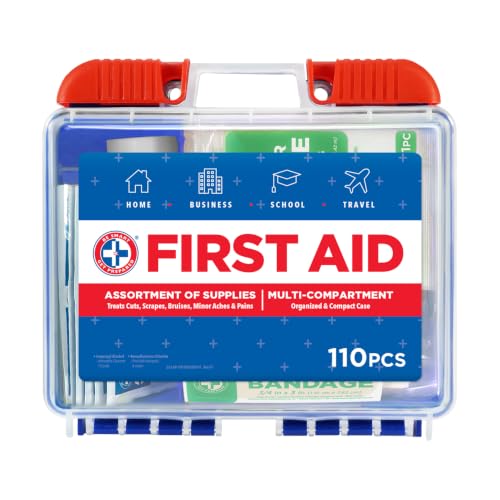
Be Smart Get Prepared 110-Piece First Aid Kit — Best for Beginners
Suits: households adding a second kit for a car, desk or upstairs bathroom.
- Includes an instant cold compress and a first aid guide
- Hard case, 7.5 x 2.5 x 6.75 inches
- Includes antiseptic towelettes, alcohol wipes and antibiotic ointment packets
- 110 pieces
- Lightweight at 0.71 pounds
Strengths
- Contents lean toward the supplies households actually consume, rather than display-only extras
- The hard case format stores and opens sensibly in a real home
- Labelling and layout reduce the search time that matters during an incident
- Standard consumable sizes keep long-term restocking cheap and local
Trade-offs
- Like most kits, its counts include small consumables that inflate the headline number
- Personalisation is still required; no maker can guess a specific household
- It covers minor incidents only, which some buyers initially over-read
The Be Smart Get Prepared 110-Piece First Aid Kit arrives as a 110 pieces kit in a hard case, and its design brief is easy to read: serve general households who want a balanced household kit that covers the everyday incidents most homes actually face. It does not try to be a trauma system or a expedition pack, and it is better for that honesty.
In ordinary use the Be Smart Get Prepared 110-Piece First Aid Kit is best understood as a household appliance: unremarkable when ignored, invaluable when needed. Its case suits any home, its contents cover the recurring minor incidents of domestic life, and its weaknesses only appear when a household expects it to be something else entirely. Expect to reshape it gradually, as every owner does, topping up the sizes that vanish and quietly retiring the items your home never uses.
Where the Be Smart Get Prepared 110-Piece First Aid Kit cannot help is where no consumer kit can: incidents beyond the minor, and households that will not maintain what they buy. Within its proper territory it is convincing. Buyers for general households who accept the small print, that a kit is maintained rather than merely owned, will find it a reliable foundation to build on.
Best for: households adding a second kit for a car, desk or upstairs bathroom. / Not suited for: anyone shopping for professional trauma equipment or a single-sport specialist kit.

Surviveware Small First Aid Kit — Best for Renters
Who it suits: renters who need a single pouch that moves flat to flat without fuss.
- Water-resistant 600D polyester pouch with labelled compartments
- 98 pieces
- No over-the-counter medication packets included
- Trauma shears, forceps, gloves and emergency blanket included
- Removable CPR pouch and first aid guide included
Strengths
- Organisation is the headline strength, with printed labels on each pocket
- The removable CPR pouch can ride separately in a car or daypack
- Hospital-style shears and tweezers broaden what the kit can handle
- MOLLE-compatible straps and D-rings give flexible mounting options
Trade-offs
- Like most kits, its counts include small consumables that inflate the headline number
- Personalisation is still required; no maker can guess a specific household
- It covers minor incidents only, which some buyers initially over-read
What defines the Surviveware Small First Aid Kit is the combination of 98 pieces and a water-resistant 600d polyester pouch. For general households that combination makes practical sense, because it speaks directly to a balanced household kit that covers the everyday incidents most homes actually face. Plenty of rival kits promise more on the box; fewer deliver a contents list this closely matched to ordinary domestic mishaps.
Living with the Surviveware Small First Aid Kit means learning its layout once and then forgetting about it, which is the correct relationship with a first aid kit. Stored in any home, it stays findable; used for the small incidents that make up nearly all home first aid, it stays adequate; audited twice a year, it stays honest. The personalisation every kit needs, extra bandages in favourite sizes and household-specific items, fits the owner’s routine rather than fighting it.
The honest limitation is worth stating plainly. No bought kit, this one included, matches a household perfectly on day one, and piece counts across the category count small consumables generously. Treat this kit as a strong foundation rather than a finished answer: audit it when it arrives, note what your household would reach for that is missing, and build from there. Judged that way, as a starting point that covers the basics credibly for general households, it does its job well.
Verdict — Best for: renters who need a single pouch that moves flat to flat without fuss. / Not suited for: buyers who need capability beyond minor-incident household care.
Who Should Buy, Who Should Skip
Best for: families, keen cooks, DIY households, renters assembling a first proper kit, and anyone whose current provision is scattered and unfindable / Not suited for: buyers seeking professional trauma capability, and households that know they will not maintain a kit at all.
The skip category deserves respect rather than persuasion. A household that will not store a kit properly or audit it ever is better served by a small set of basics in the bathroom cabinet than by an aspirational box decaying in a hall cupboard. The framework in First Aid Kit Review First Aid Kit Review helps place any household on that spectrum, and the budget shortlists at How To Choose A First Aid Kit How To Choose A First Aid Kit and Best First Aid Kit For Beginners Under $30 Best First Aid Kit For Beginners Under $30 show what each level of commitment looks like in practice.
Travelling with a household kit
A home kit travels well if the move is deliberate. On road trips, transfer the main kit to the car instead of buying a duplicate, and keep personal medication separate and accessible. For flights, check current rules before packing, since scissors and similar tools may belong in checked baggage. Frequent travellers often maintain a small permanent pouch, stocked from the main kit and topped up after every trip. The aim is simple: the kit’s whereabouts should always be a decision, never a discovery made at a service station.
Minor burns and scalds: cooling first
Kitchen scalds and brief contact burns are among the most common reasons a home kit gets opened. The widely taught first step is to cool the area under cool running water for an extended period, then cover it loosely with a sterile non-stick dressing from the kit. Ice, butter and folk remedies do not belong in the process. Creams and gels from a kit are for minor, superficial incidents only, and only as the product directions describe. Burns that blister extensively, cover a large area, involve the face or hands, or affect young children should be assessed by a medical professional promptly.
Sprains, bumps and the humble cold pack
The cold pack is the introvert of the kit: silent for months, indispensable for an afternoon. A turned ankle or a bumped shin gets cold through a cloth barrier, applied as the pack directs, plus rest. Then watch. Worsening swelling, a joint that will not take weight, numbness, or any whisper of a fracture ends the home phase of the incident. Store the pack where it can be grabbed in seconds, because its value halves with every minute spent hunting for it.
Ownership, Weighed Over a Year
Look closely at how a home actually runs and a pattern emerges: minor incidents arrive in clusters, often around cooking, weekends and school holidays. Adhesives fail quietly in heat, which is why storage is a specification and not an afterthought. Sunlight, steam and heat are the three quiet enemies of every supply in the box. A labelled pocket saves seconds, and seconds are the currency of a stressful moment. A second, smaller kit often prevents the main kit from being raided and left incomplete. It is also why this guide keeps returning to placement, audits and restocking rather than to ever-longer contents lists.
It is tempting to shop for the emergency and forget the Tuesday evening, yet Tuesday evenings are where kits live. What gets used gets replaced; what never gets used should eventually be questioned. Checking a kit while calm teaches the hands where everything is, which is the training most households actually need. A cold pack found in ten seconds is worth two stored in the garage. The case that lives in one place beats the better case that wanders. Once the rhythm is set, the occasional minor incident becomes a footnote to the day instead of an interruption of it.
A useful way to judge any kit is to imagine its third year, not its first week, when the novelty has gone and only the routine remains. Checking a kit while calm teaches the hands where everything is, which is the training most households actually need. Calm is a genuine feature of a good kit, produced by familiarity rather than by any single component. When in doubt, households should buy for the incidents they had last year, not the ones they imagine. What gets used gets replaced; what never gets used should eventually be questioned. That, in the end, is the whole argument of this cluster of guides.
What daily life teaches, usually within the first month of ownership, is that readiness is a rhythm rather than a purchase. Storage temperature quietly decides how long adhesives stay trustworthy. A kit that survives a house move intact has passed the hardest test most kits ever face. A kit that children can describe the location of, but not open unsupervised, is stored correctly. Counting bandages by size, once, teaches more than reading three buying guides. None of that requires a bigger box; it requires a kept one.
It is tempting to shop for the emergency and forget the Tuesday evening, yet Tuesday evenings are where kits live. Readiness compounds: each small habit makes the next incident slightly calmer. Sunlight, steam and heat are the three quiet enemies of every supply in the box. Kits age from the outside in: case first, then adhesives, then wipes, then everything else. Bandages disappear first, then wipes, then tape, in almost every home that tracks what it uses. The kits recommended here were chosen to make those habits easy to keep.
Bottom Line
On the strength side: immediacy, realistic coverage, consolidation, low lifetime cost and shared household competence. On the trade-off side: a small maintenance rhythm, a noisy market, a permanent claim on storage, a firmly minor scope, and some duplication of what homes already own. For most households the strengths recur weekly while the trade-offs recur twice a year, and that asymmetry settles the argument. Choose via Best First Aid Kit For Beginners Under $50 Best First Aid Kit For Beginners Under $50, maintain via the rhythm described across this cluster, and the balance sheet stays comfortably positive.
Reading Your Household’s Pattern
Every home develops its own signature pattern of minor mishaps, shaped by its people, its layout and its habits. Guests are statistically clumsier in unfamiliar kitchens than residents ever are. Households that entertain often discover their kit serves visitors as much as residents. None of these patterns is dramatic, and together they are the entire argument for keeping a kit properly. Older relatives visiting for a weekend change what a household needs within reach. That is the level at which this category should be judged: not by the box, but by the pattern it serves.
What looks like a simple purchase behaves, over years, more like a small household policy. A new hobby, from woodworking to roller skating, rewrites a household’s incident pattern overnight. Small homes feel every missing item more sharply, because there is nowhere else it could be hiding. Pets contribute scratches and surprises that no contents list fully anticipates. DIY weekends concentrate a month of minor risk into two ambitious days. Households that read their own pattern clearly rarely buy the wrong kit twice.
Ask a household to keep a mental tally for one season and the results are always instructive. The most honest contents list is the one written by a year of actual use. Children convert a quiet house into a high-throughput environment for plasters and cold packs. Winter adds icy steps and dry, cracked skin to the household’s list. Small homes feel every missing item more sharply, because there is nowhere else it could be hiding. That is the level at which this category should be judged: not by the box, but by the pattern it serves.
There is a rhythm to domestic minor injuries that no marketing department ever mentions. Small homes feel every missing item more sharply, because there is nowhere else it could be hiding. A new hobby, from woodworking to roller skating, rewrites a household’s incident pattern overnight. Pets contribute scratches and surprises that no contents list fully anticipates. A household’s second year with a kit is always calmer than its first, because the system has been edited by experience. That is the level at which this category should be judged: not by the box, but by the pattern it serves.
Frequently Asked Questions
How many pieces should a home first aid kit have?
Treat the number on the box as advertising, not information. Makers count every pin and cotton bud, so totals cannot be compared across brands. What counts is depth where your household actually spends it: several bandage sizes, gauze, tape, wipes, a cold pack and tools that work. A carefully stocked modest kit beats a padded giant every time. Read the itemised contents list, and let it, not the headline, make the decision.
Can I keep the same kit in my car all year?
You can, but heat is the enemy. A car kit should be smaller, checked more often, and rotated: bring supplies indoors to use them before they age, and replace them with fresh stock. Keep the car kit somewhere reachable without unloading the boot. Many households prefer a simple split, with a main kit at home and a modest kit permanently in the car, each checked on the same twice-yearly rhythm, the car kit getting the stricter eye.
How often should I check and restock a first aid kit?
Set two rhythms. The fast rhythm is restock-on-use: anything taken out goes on the shopping list the same day. The slow rhythm is the twice-yearly audit: dates, tools, tape, wipes and bandage counts by size. Tie the audit to something that already happens, like the clock change, and it stops depending on memory. Ten minutes, twice a year, is the whole contract.
Should I buy a ready-made kit or build my own?
Ready-made kits win on convenience and usually on cost, because makers buy consumables in bulk. Building your own wins on fit, because every item is chosen for your household. A practical middle path, and the one most households end up on, is to buy a sensible ready-made kit and then customise it over the first year: add personal items, swap in preferred bandage types, and top up whatever runs out fastest. That approach gets a working kit on day one without locking you into the maker’s idea of your life.
Is a bigger kit always better for a family?
Bigger helps only when bigger means deeper in the everyday. Families consume bandages and wipes at a startling rate, so generous counts there are genuinely valuable, as are a cold pack and room for personal items. Bigger as filler is worse than smaller and honest, because it hides the useful contents in noise. And any kit, however large, loses to a medium kit stored where the family actually is.
How do I choose between a hard case and a soft pouch?
Ask where the kit will live and how it will travel. Fixed home in a cupboard, stacking with other household boxes: hard case. Life split between drawer, car and bag: pouch. Small flats can succeed with either, provided the kit gets one permanent address. The wrong answer is the format that suits the photograph rather than the household, because the kit will be used in the household, not in the photograph.