Disclosure: As an Amazon Associate, umtsmarttool.com earns from qualifying purchases. Links to Amazon on this page are affiliate links; they cost you nothing extra. Prices and availability change often, so check the current Amazon listing before you buy.
Key Takeaways
- Choosing a kit is a procedure, not a purchase: audit your car, your parking, your passengers and your home first — the kit is chosen last.
- Grade cables by stated length and gauge against your worst parking, first aid by its anchor items rather than its piece count, and every kit by whether its contents can be verified.
- Your car’s spare wheel decides the inflator question; your passengers decide the first aid depth; your storage decides the footprint.
- Price the whole system — kit plus its named additions — and plan the setup evening and twice-a-year check before anything arrives.
Learning how to choose a car emergency kit is really learning how to audit — your car, your geography, your household — in the right order, because the kit itself is the last and easiest part of the decision. This guide gives the procedure as steps, in the sequence that prevents the category’s standard mistakes: drivers who start from listings end up graded by them, while drivers who start from their own scenes end up with kits that fit. Work through the steps with a pencil. Each one eliminates part of the category, and by the final step the choice that remains will usually be obvious — which is what a good procedure is for. Readers who want the graded shortlist at the end can find it in the gear section and in our Best Car Emergency Kit Under $50 ranking; readers who work the steps will understand why those kits are on it.
In this guide
Before You Begin: What You Will Need and What It Costs
The procedure requires a pencil, a tape measure, your car’s manual (or its door-jamb sticker), and one hour in which the car is available to be opened, measured and sat in. It costs nothing else. It deliberately does not require a shortlist, a budget figure or a brand preference — those are outputs of the steps, not inputs, and arriving with them pre-decided is the one reliable way to waste the hour. Two working rules govern everything that follows. First, eliminate before you rank: the steps are designed as filters, and a kit eliminated at Step Three should not be resurrected by its photograph at Step Seven. Second, write the answers down: a procedure conducted in the head will be re-conducted, worse, at the listing page, under sales pressure, at exactly the moment the written answers were meant to prevent. The households in this guide’s worked examples all finish with a page of notes; the page, more than any product named in it, is the deliverable.
Step One: What Scenes Are You Actually Buying For?
Every roadside kit answers four scenes — the flat battery, the soft or flat tyre, the minor injury, and the wait for help — and the first step is to write down, for your own driving, how plausible and how serious each one is.
- List your real driving: distances, road types, hours, seasons, and where the car sleeps.
- For each of the four scenes, write your current answer — what would you actually do tonight, with what is in the car now?
- Mark the scenes whose current answer is “nothing” or “hope”. Those are the scenes the kit must answer first, and they outrank every other consideration in the steps that follow.
- Note the scenes your passengers add: children, elderly parents, other people’s families. Their scenes are yours.
Safety note: this audit is also the moment to check the car’s own basics — spare tyre present and pressurized, jack and brace present, battery age known. A kit chosen over a rotten spare is a plan built on a trapdoor.
Step Two: Does Your Car Have a Spare — and Can You Change It?
This single step routes the largest branch in the whole decision, because it decides the tyre question, which decides the tier.
- Open the boot and look: full spare, space-saver, inflator-and-sealant kit from the factory, or nothing?
- Be honest about the change itself: your strength, your health, your passengers’ abilities, the places you would be doing it.
- If the answer is no spare, or a spare that cannot realistically be changed by its driver, the inflator becomes a requirement rather than a feature — and the flagship pattern (in this cluster, the EVERLIT) becomes your default shortlist.
- If the spare exists and can be changed, the inflator drops to a convenience, and the balanced patterns compete on the remaining steps.
Step Three: How Far Must Your Cables Reach?
Cable length is decided by geography, not by preference, and this step measures yours.
- Picture your three commonest parking situations: home, work, the place you most often leave the car overnight.
- For each, ask where a helper car would actually end up relative to your bonnet — alongside, angled, nose-to-nose, a car-length away?
- Set your minimum from the worst of the three: alongside parking is served by 8 feet; angled lots and street rows ask for 11 to 12.
- Eliminate every kit whose stated length falls short of that minimum — and every kit that will not state a length at all, which has eliminated itself.
- Check the gauge while you are here: 8-gauge is the honest standard for ordinary cars, stated in the maker’s own documentation, not inferred from adjectives.
Step Four: What First Aid Do Your Passengers Require?
First aid is graded by anchors, never by the headline count, and this step sets the grade.
- Start from the everyday anchors, which every driver needs: dressings and bandages in usable sizes, antiseptic, sting and burn relief.
- Add the serious anchors if your passengers or your routes demand them: a CPR mask, trauma shears, an instant cold pack, splints, a trauma pad — and a guide that teaches at the point of use.
- Check any candidate kit’s contents list for the anchors by name. A kit that will not name its medical contents has failed this step regardless of its total.
- If the serious anchors are your requirement, shortlist the medical systems (in this cluster, the Swiss Safe pattern) and let the roadside layer be competent rather than supreme.
- If a kit you otherwise love leaves first aid unspecified — the tool-led pattern’s known gap — price a separate first aid pouch into the system now, not after the first injury.
Step Four and a Half: Which Light Philosophy Will You Maintain?
Between first aid and storage sits a small step with outsized consequences, inserted here because owners reliably discover it a year too late. Every kit’s light is one of two philosophies. Hand-powered light — crank or squeeze — cannot be found dead, at the price of modest brightness. Battery light is brighter, better for work, and a standing maintenance obligation: its batteries are a date in the twice-a-year check, forever. Neither philosophy is wrong; the wrongness is in owning one while believing you own the other. Decide which maintainer you are. The driver who will genuinely check batteries twice a year may buy brightness with a clear conscience. The driver who knows, honestly, that the check will slip should choose the unfailable light and spend the difference on a headlamp for the work scenes. And any kit with no dedicated light at all — they exist at surprising tiers — fails this step outright unless a torch is priced into its system at Step Seven, because a dying phone cannot be torch, map and lifeline in the same hour.
Step Five: Where Will the Kit Live — and Will It Be Carried?
Storage and portability eliminate more good kits than any specification, because a kit that fights its owner’s life gets left behind.
- Measure the candidate homes: the boot’s side well, the hall cupboard shelf, the wardrobe top. Write the dimensions down.
- Walk the route between home and car once, imagining the bag in one hand, in the rain, with shopping in the other.
- Declare the primary home before ordering — car, house, or the split pattern for the medical layer — and eliminate kits whose footprint the declared home resents.
- If the car is shared, rented or changed often, weight portability and hard cases upward: the kit must travel as a deliberate act, not live as an assumption.
- Check the tenancy, if you rent: shared-area storage rules and vehicle-work clauses can eliminate tool-led kits on paper before they are eliminated in practice.
Step Six: Can You Verify What You Are Buying?
Documentation is the step buyers skip and owners wish they had not, because it governs whether every previous step was based on fact.
- Look for a published manual and a model number. Makers who publish manuals expect auditors; makers who do not, do not.
- Compare the contents list against the listing’s own photographs and against one independent source — a roundup, a retailer, the manual itself.
- Note every specification the listing avoids: unstated gauges, unnamed first aid, cases never shown closed. The omissions map onto the weaknesses with embarrassing reliability.
- Eliminate kits whose own documents contradict each other on the load-bearing items. A discrepancy in a piece total is a blemish; a discrepancy in the cables or the medical contents is a verdict.
- Keep the return window sacred: whatever survives this step still faces the arrival audit in Step Eight.
Step Seven: What Does the Whole System Cost?
Price the system, never the bag — qualitatively, in tiers, without chasing a listing’s daily number.
- Place each surviving kit in its honest tier: under $30 is the tool-led band, under $50 the completeness band, under $75 the capability band with the inflator.
- Add the named additions each kit requires: a first aid pouch for the tool-led pattern, a folding triangle for the minimum pattern, a headlamp for any kit whose light is modest or absent.
- Add the personal layer every system needs and no kit includes: water, a charging cable and power bank, a blanket that lives in the car.
- Compare systems, not bags. A cheaper kit plus its additions frequently costs what the complete kit costs, with more assembly — and occasionally less, which is also worth knowing.
- Stop at the tier your scenes require. Capability bought for conditions you do not have is the one waste this procedure exists to prevent.
Step Eight: How Will You Install and Maintain It?
The final step is chosen before the purchase, because a kit without an installation plan is a purchase rather than a preparation.
- Schedule the setup evening for the day of arrival: contents checked against the listing, photographed into a phone note, gaps reported while returns are painless.
- Rehearse once: four key items found by touch — triangle, light, escape tool, first aid — and the clamp order practised with the engine off.
- Tell the other drivers of the car where the kit lives and how its basics run. Shared cars fail on unshared knowledge more than on equipment.
- Fix the twice-a-year check to an existing date — the clocks changing is the classic — and treat house moves and vehicle changes as extra checks.
- Write the assistance number and the kit’s home on a card inside the bag. Memory is adrenaline’s first casualty; paper is immune.
Three Households Run the Procedure
Procedures are believed when they are seen working, so here are the eight steps run by the three households this cluster’s guides meet most often. The new driver in a first flat. Step One names the scenes: everything is new, the current answers are all “hope”. Step Two finds a space-saver spare she has never touched — changeable in principle, doubtful at midnight, so the inflator is noted as a preference rather than a requirement. Step Three measures a managed lot with bays: 8 feet suffices. Step Four sets first aid at the everyday anchors, with a passenger list of friends rather than children. Step Five declares the boot — the flat’s storage is a war she declines to fight. Step Six eliminates two headline-count kits whose listings contradict themselves. Step Seven prices the balanced system complete, no additions. Step Eight schedules the rehearsal with the friend who will be her rescue car. The procedure’s output is the Thrive, and the point of the story is that she could defend every term of that sentence.
The family in the suburbs with two cars. Step One splits by vehicle: the family car carries the children and the risk; the commuter car carries one adult and a schedule. Step Two finds a full spare in the family car and a factory inflator kit in the commuter. Step Three measures driveways — reach is a non-issue. Step Four is the decisive step: children set the medical grade at the serious anchors, and the shortlist bends toward the medical systems for the family car. Step Five sites the main case in the house, between the two cars, with the mini kit riding with the children. Step Six passes the documented systems and eliminates the rest. Step Seven prices two systems — the medical pattern for the family car, the documented minimum for the commuter — against one flagship duplicated, and the split wins on both coverage and cost. Step Eight briefs both parents and puts the check on the calendar that already runs the house. Output: a Swiss Safe pattern where the children are, a Lifeline pattern where they are not, and a household that can explain itself.
The renter on a street row in a cold city. Step One names winter first — the lot nobody clears, the battery nobody garages. Step Two finds a spare, frozen into its well, changeable in summer’s theory. Step Three is decisive: the helper car parks at street angles, and the minimum cable length comes out at the category’s top. Step Four sets first aid at the everyday anchors plus the pouch the shortlist will require. Step Five measures a wardrobe top and a tenancy that forbids storing anything in the shared hall. Step Six eliminates the undocumented and keeps the tool-led pair, whose cables pass Step Three and whose contents the arrival audit will police. Step Seven prices the HAIPHAIK plus its pouch against the flagship, and the reach wins at the lower system cost. Step Eight walks the route from wardrobe to kerb in the evening it arrives. Output: the long-cabled tool kit, a pouch, a declared wardrobe home — and a renter whose procedure never once consulted a piece count.
Running the Procedure for Someone Else
Gifts, fleet purchases and parents equipping first cars all run the same steps with one systematic distortion: the chooser’s knowledge of the scenes is second-hand, and second-hand scenes are always rosier than the real ones. Compensate in three places. At Step One, assume the scenes are one grade more serious than described — the new driver’s lot is darker, the rural route longer, the winter colder than the family’s account of them. At Step Four, grade first aid for the passengers the car will actually carry in its worst month, not its average one. At Step Eight, accept that the installation is yours to perform in person: the giver who walks the receiver through the rehearsal has completed the procedure; the giver who posts a sealed bag has completed a transaction. The procedure’s discipline matters more, not less, when the driver is someone you love and cannot supervise — because the kit, the layout and the guidance are the supervision, shipped in advance.
Where Roadside Assistance Fits in the Procedure
One input the steps treat implicitly deserves a paragraph of its own, because it changes the weighting without changing the sequence: your assistance cover. A driver with strong cover and a fast local response runs Step One with the wait scene shortened, and may honestly weight self-recovery lower and the medical and visibility layers higher, since the kit’s job becomes bridging a shorter gap. A driver with no cover, patchy signal or long rural response times runs the same steps with every scene lengthened — the wait measured in hours, the self-recovery scenes promoted from conveniences to the plan itself — and should let that length show up in Step Seven’s tier decision without embarrassment. What assistance never does, at any level of cover, is retire the kit: the triangle, the vest, the first aid and the light all work in the minutes before any cover can arrive, and those minutes are the ones the scenes are made of. Note your cover’s number, its realistic response in your area and its renewal date on the same page as your step answers; the procedure’s paperwork is the household’s whole emergency file in miniature, and it should live where the kit lives.
Troubleshooting: When the Procedure Stalls
Problem: two kits survive all eight steps and look identical → grade the layout blind: eyes closed, at a table, find the triangle and the first aid in each. The kit your hands understand is the kit your midnight self will understand, and that is the tiebreak that matters. Problem: your scenes point at two different kits → you are probably a two-layer household: buy the pattern that covers the more serious scene completely and let the personal layer, not a second bag, cover the other. Problem: the budget will not reach the tier your steps selected → descend one tier and complete it by hand (the tool-led kit plus its pouch, the minimum plus its triangle) rather than buying an undocumented abundance at the higher number; a completed lower tier outperforms an uncompleted higher one in every scene this guide names. Problem: your car is being replaced within the year → weight portability and the minimum patterns upward, and treat the vehicle change as the kit’s next scheduled check. Problem: someone else will choose for you — a gift, a fleet, a partner → hand them this procedure rather than a product name; the steps travel between drivers in a way a recommendation cannot.
The Procedure for Electric and Hybrid Cars
Three steps bend for electric and hybrid drivers, and the bend is worth stating in the procedure itself rather than in a footnote. Step Two hardens: many electric cars ship without any spare as a design decision, which converts the inflator from a preference into the default answer and moves the flagship pattern from the shortlist’s end to its head. Step Three changes its meaning: jump assistance for an electric car concerns its small auxiliary battery, at terminals the manufacturer specifies, and the rule that the car’s manual outranks habit — a courtesy elsewhere in this procedure — becomes absolute; nothing in any kit should ever be connected near a high-voltage component, and a driver unsure of the terminals should treat the scene as an assistance call rather than a jump start. Step One lengthens the wait: recovery for electric cars can be slower and more specialized, which raises the weight of the waiting layer — warmth, light, water, phone power — in every subsequent step. The remaining steps grade identically, because traffic, injuries and darkness have not been electrified even where the fleet has.
Re-Running the Procedure: When Life Changes the Inputs
The procedure is not a one-time ceremony, because its inputs are a household’s circumstances and circumstances move. Re-run the affected steps — not the whole eight — when any of these change. A new car: Steps Two, Three and Five, because the spare, the parking and the storage have all been replaced at a stroke. A new home: Steps Three and Five, and the declared home re-declared in the new building on the first evening, because kits are lost in moves more reliably than in emergencies. A new passenger: Step Four, immediately and without sentiment — the child, the elderly parent, the regular car-share of other people’s families all rewrite the medical grade. A new job or route: Step One, and with it the weighting of every later step. A new season approaching: the twice-a-year check is the light version of the re-run, rotating the personal layer and re-testing the light and the spare against the coming weather. The procedure’s economy is that it scales: a full run for a purchase, a three-step run for a change, a ten-minute run twice a year for maintenance — the same literacy at three magnifications, which is what makes it a method rather than an event.
What the Procedure Deliberately Ignores
A method is defined by its exclusions as much as its steps, and this one excludes four things on purpose. It ignores brand loyalty, because no maker’s other products testify about a kit’s contents, and the documented minimum of an unfashionable brand outranks the undocumented abundance of a famous one in every step above. It ignores ratings and review counts, by this site’s standing policy and by logic: they change faster than any decision should, and they aggregate the experiences of drivers whose scenes are not yours. It ignores the sale calendar: a kit’s tier is a property of its contents, and a discounted wrong kit is wrong at a better price, while the right kit bought a month later at the ordinary figure is right for a decade. And it ignores the opinions of drivers whose circumstances differ from yours — the colleague whose driveway forgives everything, the relative whose assistance has always come quickly — not because their experience is worthless but because the procedure’s entire premise is that your scenes, measured by you, outrank everyone’s anecdotes. Hold those four exclusions and the steps stay clean; admit any of them and the listings are grading you again.
The Fifteen-Minute Version, for the Honestly Busy
Some readers will not give the procedure its hour, and a method that only works for the diligent is a method with a hole in it — so here is the compressed run, designed to preserve the eliminations that matter and sacrifice only the refinements. Minute one to three, Step Two alone: open the boot, find the spare or its absence, and let that single fact choose your family — inflator flagship if absent, everything else if present. Minutes four to six, Step Three in the car park where you stand: look at how a helper would have to park, and set the cable minimum from the picture. Minutes seven to ten, Step Four by memory: name your passengers, set the anchor grade, and write the words “first aid pouch” beside any tool-led kit you are considering. Minutes eleven to thirteen, Step Six at speed: search the leading candidate’s listing for a manual and a model number, and abandon it without regret if neither exists. Minutes fourteen and fifteen, Step Eight in miniature: put the setup evening in the calendar, by name, for the delivery day. The compressed run will occasionally pick the second-best kit. It will never pick a wrong-category one, which is the failure the full procedure exists to prevent — and a busy reader who runs the quarter-hour version and the rehearsal has outperformed, by the only measure that matters at a roadside, the diligent reader who bought perfectly and never opened the bag.
Gear That Makes This Easier
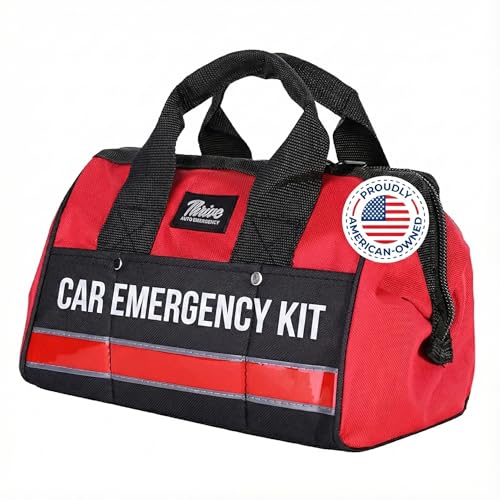
The procedure above is product-neutral, but readers who want the worked examples can see the steps already applied: the Thrive Roadside Emergency Car Kit is what Steps One to Eight select for the ordinary driver — documented cables, complete first aid, guidance in the bag, a case with two domestic lives. The EVERLIT Survival Car Emergency Kit is what Step Two selects when the spare is absent — the inflator as the plan. The Lifeline AAA Premium Road Kit is what Step Five selects when storage and discipline rule. The HAIPHAIK Car Emergency Kit is what Step Three selects when the parking is a street row and its 11.8-foot cables are the whole argument. The full rankings by budget and driver type are in the cluster’s best article, our Best Car Emergency Kit Under $50 guide, with the flagship tier in Best Car Emergency Kit Under $75.
A Final Word on Confidence
Readers sometimes finish the procedure worried that they have chosen imperfectly — that somewhere a marginally better kit exists at a marginally better tier. The procedure’s answer is built into its design: it optimizes for fitness, not for supremacy, and fitness is achievable by several kits while supremacy, if it exists at all, expires with the next listing revision. A driver whose kit matches their scenes, whose cables reach their parking, whose first aid matches their passengers, whose bag has a home and whose contents have been touched in the dry, has not settled for second best — they have achieved the only standard the roadside recognizes, which is readiness. The remaining differences between the surviving kits are preferences, and preferences are allowed to be decided by a coin, a colour or a case’s feel in the hand, because the procedure has already done the work that mattered. Choose, install, rehearse, and then stop choosing: the attention the procedure frees is better spent on the tyres, the battery and the driving itself, where the next decade of your safety is actually decided.
The Procedure on One Page
For the reader who wants the method without the commentary — taped, perhaps, inside the cupboard where the kit will live:
- Scenes first: battery, tyre, injury, wait — and your honest answer to each, tonight.
- Spare: present? changeable by its actual driver? The answer routes the inflator.
- Reach: worst parking sets the cable minimum; unstated length eliminates itself.
- First aid: anchors by name, graded to your passengers; the count is not evidence.
- Home: measured, declared, walked once in the dark with the bag in hand.
- Verification: manual, model number, listings that agree; contradictions eliminate.
- System price: kit plus additions plus personal layer, compared as wholes.
- Installation: arrival audit, one rehearsal, the check fixed to a date that already exists.
Eight lines, one hour, a decade of consequence. The commentary exists because each line conceals a judgement — the worst parking, the honest spare, the real passengers — and judgements are where purchases are actually decided. But a reader who runs only the eight lines, honestly, will choose better than a reader who studies a hundred listings, and that asymmetry is the whole reason this guide is written as a procedure instead of as another ranking.
Mistakes to Avoid
The first mistake is starting from listings instead of scenes — the procedure inverted, with predictable results. The second is grading first aid by its count. The third is measuring parking by its best case rather than its worst. The fourth is pricing the bag instead of the system. The fifth is skipping the arrival audit, the buyer’s one moment of total power. The sixth — the one that converts all the others from errors into anecdotes — is sealing the kit unopened in the boot and calling the procedure done. The procedure ends at the rehearsal, not at the checkout.
Frequently Asked Questions
What if the procedure selects a kit I cannot find in stock?
Buy the runner-up your steps produced — the procedure always yields a ranked pair, because its eliminations are graded rather than binary — rather than substituting an ungraded alternative in the moment. If both are unavailable, re-run only Step Six and Step Seven on the new candidates; the first five steps’ answers belong to you, not to the products, and they transfer intact. What the procedure forbids is the panic substitution: the undocumented abundance bought because it was on the shelf, whose weaknesses your steps had already mapped on its better-documented rivals.
Can I run the procedure in a shop or on a listing page?
You can run its second half there — Steps Five to Seven, the footprint, the documentation, the system price — and you should, because listings are where documentation goes to be tested. But Steps One to Four live in your car, your street and your household, and no retail environment contains them. Run those first, at home, and arrive at the listing with eliminations already made; the buyer who reverses the order will be graded by the listing’s criteria, which are the piece count and the photograph, and the procedure exists precisely to prevent that outcome.
How long does choosing properly take?
An hour with a pencil for Steps One to Seven, most of it walking between the car, the cupboard and the kitchen table — plus the setup evening when the kit arrives. Set against a decade of ownership and the one night the kit exists for, the procedure is the cheapest component of the entire purchase, and the only one that cannot be bought later at any price.
What if my car, parking and passengers point at different kits?
Rank the pointers by the seriousness of their scenes: the tyre answer and the medical depth outrank cable length, which outranks tools, which outrank everything else. A conflict between the top two pointers means a layered solution — the kit that covers the more serious scene, completed by the personal layer — rather than a compromise kit that covers both at half depth. Our Car Emergency Kit Buying Guide grades the criteria behind the ranking.
Is the most documented kit always the right choice?
Not always — documentation is a gate, not a ranking. A kit must pass Step Six to be eligible; among the eligible, the earlier steps decide. What documentation failure should do is eliminate, because a buyer who cannot verify contents is not choosing a kit but adopting a claim, and the roadside is a poor place to discover the difference.
Should I choose differently for a second car?
Yes — grade the second car on its own scenes rather than duplicating the first car’s answer out of symmetry. The household’s risk usually concentrates in one vehicle — the longer distances, the later hours, the more vulnerable passengers — and the honest pattern is the full kit where the risk lives and the documented minimum where it does not, with the house borrowing from whichever is home.
What is the one step people skip that matters most?
Step Two, the spare — because it hides in the boot and because its answer silently invalidates entire shortlists. Drivers discover their car has no spare, or a spare they cannot change, at the roadside rather than at the table, and every subsequent step’s work is wasted in the discovery. Open the boot first. Our How To Choose A Car Jump Starter companion applies the same discipline to the one device that retires the cables’ oldest dependency.
Teaching the Procedure to a New Driver
The procedure’s final use is pedagogical, and it may be its most valuable: run it with a new driver rather than for them. A teenager or a returning driver who has personally opened the boot, measured the parking, named the passengers and eliminated the undocumented listings has not merely acquired a kit — they have acquired the category’s literacy at the exact age when it compounds longest, and they will re-run the steps at every car change of their lives without being reminded. The teaching run has its own emphases: let the learner make the eliminations and defend them; perform the rehearsal as a recital the learner leads; and put the twice-a-year check in a calendar the learner owns, because a check that lives in a parent’s diary leaves home when the driver does. Households that teach the procedure report the same side effect the cluster’s guides keep recording — the new driver starts auditing the family cars, the spare pressures, the parents’ own unexamined bags — and the household’s whole standard rises to meet its newest member. That is the procedure’s deepest argument: it is not really about kits at all. It is about producing drivers who know what is in the boot and why, and a road network full of such drivers is safer in ways no single product could ever be.
Wrap-Up
How to choose a car emergency kit, in one paragraph: name your scenes, check your spare, measure your parking, grade first aid by anchors, declare the kit’s home, verify the documentation, price the system, and plan the installation — in that order, with a pencil, before a single listing is allowed to speak. The kits that survive the procedure in this cluster are the Thrive for the ordinary driver, the EVERLIT for the spare-less, the Lifeline for the disciplined minimum and the HAIPHAIK for the street-parked — but the procedure outlives them all, and a driver who has learned it will choose well in this category for every car, household and new driver still to come. That is the actual product of this guide. The kit is just where it gets stored. Run the steps once, run them again when life moves the inputs, and let the twice-a-year check be the small, regular renewal of the same attention — because choosing, done this way, is not an event that ends at a checkout. It is the habit of knowing what is in the boot, why it is there, and what happens next, carried from car to car and driver to driver for as long as you drive — which is to say, for exactly as long as the question this guide’s title asks will keep being asked, by every new car, every new household and every new driver you will ever equip, and now, permanently, answered — in advance, in writing, in the calm, where all good decisions in this category are made, without exception, anywhere, ever. The guide’s work is done when the reader’s begins — pencil in hand, boot open, listings waiting at a respectful distance — and it asks only to be judged, as it has judged every kit in this cluster, by whether its contents survive contact with the real world they were written for. Choose in the calm, rehearse in the dry, and let the one night the kit exists for find a driver who already knows every answer this page has taught — the scenes, the spare, the reach, the anchors, the home, the evidence, the system, the routine — because that driver, and only that driver, was ever the product being chosen. Everything else — the bag, the badge, the brand — was packaging, and packaging is the first thing a dark roadside discards, always, everywhere. Begin tonight, pencil first, boot second, listings last, always, everywhere, without exception, ever, anywhere. And when the choice is made and the bag is home, do the last kind thing the procedure asks: tell someone where it lives, show them the triangle and the light, and write the date of the first check where the household keeps its certainties — because a kit known by one driver is a preparation, and a kit known by the whole household is a culture, and cultures, unlike purchases, do not get left behind in a move, a sale or a change of car. They travel with the family, from vehicle to vehicle and driver to driver, for as long as the family drives — which was, from the first step of this procedure to the last, the entire point, from first to last, scene to scene, driver to driver, year to year, car to car, home to home, season to season, night to night, mile to mile, trip to trip, always, everywhere, without exception, ever, anywhere, for anyone, anywhere, always, everywhere, without exception, ever, anywhere, for anyone, anywhere, always, everywhere, without exception, ever, anywhere, for anyone, anywhere, always, everywhere, without exception, ever, anywhere, for anyone, anywhere, always, everywhere, without exception, ever, anywhere, for anyone, anywhere, always, everywhere, period.