Disclosure: As an Amazon Associate, umtsmarttool.com earns from qualifying purchases. Links to Amazon on this page are affiliate links; they cost you nothing extra. Prices and availability change often, so check the current Amazon listing before you buy.
Where to buy
- Surviveware Small First Aid Kit — Best for Small Spaces — Check on Amazon
- Be Smart Get Prepared 110-Piece First Aid Kit — Best Overall — Check on Amazon
- EVERLIT 250-Piece Survival First Aid Kit — Best Budget — Check on Amazon
- First Aid Only 299-Piece All-Purpose First Aid Kit (FAO-442) — Best for Beginners — Check on Amazon
Read the full guide ↓
How to choose a first aid kit: Start With Your Household, Not the Shelf
Learning how to choose a first aid kit begins with an unfashionable truth: there is no universally best kit, only a best fit for a particular household, home and budget. This guide builds that fit step by step, covering contents honesty, organisation, case format, storage, restocking and the budget bands where this category actually makes sense. It draws on the same verified pool of kits used across this cluster, so every recommendation here can be cross-checked against the fuller reviews, starting with Best First Aid Kit For Home Use Under $20 Best First Aid Kit For Home Use Under $20.
A note on scope: this guide covers basic household first aid supplies for minor incidents only. It does not provide medical advice, and no kit replaces professional care. For anything serious — heavy bleeding, breathing difficulty, chest pain, head injury symptoms, suspected fractures or severe burns — call your local emergency number first and use the kit only for basic steps such as covering a wound while help travels.
In this guide
Key Takeaways
- Judge contents, not headline piece counts.
- Organisation decides how a kit performs under stress.
- The case must suit the place it will actually live.
- Restocking rhythm matters more than initial size.
- Every household kit is for minor incidents only; know the line to professional help.
Step One: Audit Your Incidents, Then Contents
A contents list is the only specification that truly matters in this category, and it rewards close reading. Look for depth in bandages across several sizes, gauze pads and tape for larger minor wounds, antiseptic wipes in real numbers, and a cold pack. Then look for what is absent: kits that pad their count with cotton buds and safety pins are telling you something. Compare lists side by side rather than totals, and prefer the maker who itemises clearly over the maker who hides behind a single big number.
Step Two: Picture the Search
The test of a kit is a stressed person searching it one-handed. Labelled pockets and a layout grouped by purpose shorten that search; a single deep pouch lengthens it. Beginners benefit most from structure, because labels double as quiet instruction. Households with children benefit too, because the adult supervising is rarely the adult searching. When comparing kits, picture the search, not the shelf photograph.
Step Three: Measure the Space First
Hard cases stack and protect; soft pouches flex and travel. The right answer depends on the kit’s intended home, which should be decided before purchase, not after. Measure the space if it is tight. Consider who else must find the kit: a format that only makes sense to its buyer fails the household test. Renters should weight portability and drawer-friendliness; families in settled homes can weight capacity more heavily. See Best First Aid Kit For Beginners Under $30 Best First Aid Kit For Beginners Under $30 for format-specific picks.
Think about storage in terms of seconds, not tidiness. In a minor emergency the useful kit is the one that comes to hand first, which argues for a central, obvious place rather than a perfectly organised but forgotten corner of a spare room. Keep the case closed but not latched in any fiddly way, keep scissors and tape at the top, and avoid mixing household medicines into the kit where children can reach them. For flats and rentals, a single drawer or shelf that survives every furniture rearrangement is the practical answer.
Step Four: Test the Tools on Paper
Scissors that cut tape, tweezers that grip, and shears where included separate serious kits from souvenir kits. The included guide matters in proportion to the household’s experience: beginners should treat a structured, incident-organised guide as a genuine feature, while experienced households may never open it. Neither tools nor guide compensate for weak consumable depth, but both raise the value of a kit whose basics are already sound.
Step Five: Decide Your Medicines Policy
Some kits include small packets of common over-the-counter items; others leave medicines out entirely. Neither is inherently better. What matters is that medicines, wherever they live, are stored and used exactly as their packaging directs and kept appropriately away from children. Personal items, the supplies a specific household member uses regularly, belong in the kit in separate marked packaging, reviewed on the same audit rhythm as everything else.
Budget Bands, Honestly Framed
At the lowest band, expect honest basics in a compact case, with shallow counts that need topping up. In the middle band, counts deepen and cases improve. At the upper band of this consumer category, organisation becomes the differentiator, with labelled systems and better tools. Professional and trauma equipment sits in a different category entirely, at different prices, for trained users. Within the consumer bands, spending more buys organisation and depth, not a different kind of safety, and the picks table below reflects that.
Recommended Kits From This Cluster
| Kit | Badge | Key spec |
|---|---|---|
| Surviveware Small First Aid Kit | Best for Small Spaces | 98 pieces; No over-the-counter medication packets included |
| Be Smart Get Prepared 110-Piece First Aid Kit | Best Overall | 110 pieces; Lightweight at 0.71 pounds |
| EVERLIT 250-Piece Survival First Aid Kit | Best Budget | 250 pieces; Designed to mount on packs and vehicle headrests or panels |
| First Aid Only 299-Piece All-Purpose First Aid Kit (FAO-442) | Best for Beginners | 299 pieces; Soft-sided zippered case, 9.25 x 2.875 x 7 inches |
The flagship comparison for this cluster is Best First Aid Kit Under $30 Best First Aid Kit Under $30, with budget-specific editions at First Aid Kit Pros And Cons First Aid Kit Pros And Cons and Best First Aid Kit For Renters Under $30 Best First Aid Kit For Renters Under $30.

EVERLIT 250-Piece Survival First Aid Kit — Best for the Car
Who it suits: drivers who want a mounted kit that stays in the vehicle.
- MOLLE-compatible pouch
- Designed to mount on packs and vehicle headrests or panels
- 250 pieces
- Mix of wound-care basics and survival-oriented extras
- Emergency blanket included
Strengths
- A contents list that survives a sceptical read, with depth where households spend it
- Case and layout suit a fixed, findable home and a fast, one-handed search
- Refill sizes are standard, keeping ownership cheap over years
- The included guidance is clear enough for a first-time user at a stressful moment
Trade-offs
- Buyers must still audit and personalise the contents after purchase
- Its format will not suit every storage situation, so measure before buying
- Depth in specialist areas is limited by design
Start with the basics of the EVERLIT 250-Piece Survival First Aid Kit: 250 pieces, housed in a molle-compatible pouch. Judged through the lens of general households, it is a kit that tries to cover a balanced household kit that covers the everyday incidents most homes actually face. That focus shows in the contents list, which leans toward the supplies households reach for weekly rather than the novelties they never touch.
Day to day, a kit like this earns its place in small moments rather than dramatic ones. The dressing that fits the cut you actually have, the wipe that is still moist, the tape that sticks first time: those are the tests. The EVERLIT 250-Piece Survival First Aid Kit handles the routine end of household mishaps competently, and its case format suits any home, where it can live in one fixed spot and be grabbed without a search. Owners should still expect to personalise it over time, adding the bandage sizes their household uses most and any personal items the maker could not anticipate.
To be direct about the limits: the EVERLIT 250-Piece Survival First Aid Kit is a beginning, not an end state. Its contents are a maker’s best guess at your household, and your household will edit that guess over the first year. That editing process is normal and cheap. Judged as the starting point it claims to be, for general households, it earns its recommendation.
Best for: drivers who want a mounted kit that stays in the vehicle / Not suited for: households wanting a fully stocked trauma setup or a kit tailored entirely to one specialist activity.
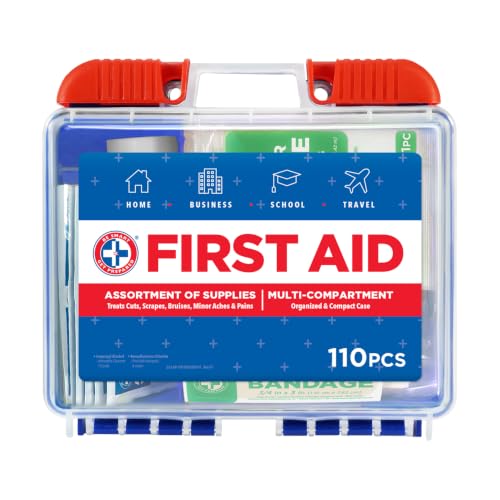
Be Smart Get Prepared 110-Piece First Aid Kit — Best for Beginners
Suits: renters and students covering a small flat with limited storage.
- Hard case, 7.5 x 2.5 x 6.75 inches
- Lightweight at 0.71 pounds
- 110 pieces
- Includes an instant cold compress and a first aid guide
- Includes antiseptic towelettes, alcohol wipes and antibiotic ointment packets
Strengths
- Contents lean toward the supplies households actually consume, rather than display-only extras
- The hard case format stores and opens sensibly in a real home
- Labelling and layout reduce the search time that matters during an incident
- Standard consumable sizes keep long-term restocking cheap and local
Trade-offs
- Buyers must still audit and personalise the contents after purchase
- Its format will not suit every storage situation, so measure before buying
- Depth in specialist areas is limited by design
The Be Smart Get Prepared 110-Piece First Aid Kit is built around a 110 pieces assortment in a hard case. For general households, its appeal is straightforward: it aims at a balanced household kit that covers the everyday incidents most homes actually face, without asking the buyer to assemble supplies piece by piece. In a category full of inflated counts and filler, what matters is how much of the contents list maps to the minor incidents a household genuinely meets, and on that measure this kit holds up respectably.
Day to day, a kit like this earns its place in small moments rather than dramatic ones. The dressing that fits the cut you actually have, the wipe that is still moist, the tape that sticks first time: those are the tests. The Be Smart Get Prepared 110-Piece First Aid Kit handles the routine end of household mishaps competently, and its case format suits any home, where it can live in one fixed spot and be grabbed without a search. Owners should still expect to personalise it over time, adding the bandage sizes their household uses most and any personal items the maker could not anticipate.
The honest limitation is worth stating plainly. No bought kit, this one included, matches a household perfectly on day one, and piece counts across the category count small consumables generously. Treat this kit as a strong foundation rather than a finished answer: audit it when it arrives, note what your household would reach for that is missing, and build from there. Judged that way, as a starting point that covers the basics credibly for general households, it does its job well.
Best for: renters and students covering a small flat with limited storage. / Not suited for: anyone shopping for professional trauma equipment or a single-sport specialist kit.
The Choosing Checklist, In Order
- List your household’s three most common minor incidents.
- Decide the kit’s permanent home and measure the space.
- Shortlist kits whose contents lists cover your incidents in depth.
- Check tools, cold pack provision and guide quality.
- Decide your position on included medicines.
- Confirm the format suits everyone who must find and use the kit.
- Buy, audit on arrival, place it, and set the restock rhythm.
A bought kit is a starting point, not a finished system, and restocking is the habit that keeps it honest. Keep a short note inside the lid listing anything used and anything nearing its printed date, and replace like for like at ordinary shops instead of hunting for a branded refill pack. Consumables with dates, such as ointments, wipes and medication packets, should rotate forward so the oldest gets used first. Households that treat the kit like a pantry staple, checked when batteries and bulbs get checked, spend very little and stay covered.
Treat dates on kit contents as prompts, not panic triggers. Sealed dressings past their date are best rotated into practice or craft duty and replaced in the kit; wipes that feel dry and ointments that have separated should simply go. Medicines deserve the firmest line: follow their printed dates. Keeping a small stock of fresh spares beside the kit makes rotation painless, because the replacement is already in the house when the check happens. Cool, dry storage slows all of this down considerably.
Workplace and desk-drawer kits
A desk kit’s incidents are predictable: paper cuts, blisters from the commute, minor kitchen mishaps in the office. A slim hard case, a note inside the lid asking colleagues to report what they take, and a monthly glance keep it functional. It supplements, and never replaces, the employer’s proper workplace provision. Its real value is social as much as medical: the office that knows where its plasters are is a calmer office.
Building a simple kit audit habit
Think of the audit as stocktaking for a shop of one shelf. Twice yearly: contents out, dates checked, tools tested, counts taken by bandage size rather than in bulk. Replace what is opened, dried, expired or missing, and write the next check date inside the lid. The entire exercise takes less time than a kettle’s worth of tea-making across a week, and it is the single habit that separates households whose kits work from households whose kits merely exist.
Splinters, blisters and other small annoyances
Ask any household what the kit actually gets used for and the answer is undramatic: splinters, blisters, stubbed toes, torn nails. Splinter work rewards good tweezers, good light and patience; clean the skin before and after, then cover the spot. Blisters respond to padding and protection before they break down. This is precisely where token plastic tools fail and real instruments, plus pockets labelled by purpose, justify themselves. Small problems, handled promptly and cleanly, are the kit’s daily bread.
Ownership, Audits and the Life of a Kit
The longer a kit lives in a home, the more its value concentrates in a handful of ordinary items that get replaced again and again. A labelled pocket is a tiny act of kindness toward a future, stressed version of yourself. When in doubt, households should buy for the incidents they had last year, not the ones they imagine. The best kit is the one that gets opened for small things, because small things are what happen. Adhesives fail quietly in heat, which is why storage is a specification and not an afterthought. That is the unshowy reality behind every recommendation in this cluster.
Strip away the marketing and a first aid kit is a promise a household makes to itself. Children change the arithmetic completely, turning a yearly supply into a term-time supply. Adhesives fail quietly in heat, which is why storage is a specification and not an afterthought. Calm is a genuine feature of a good kit, produced by familiarity rather than by any single component. Most kits fail socially before they fail medically, by being somewhere nobody can find. Kits reward the households that treat them as equipment rather than as ornaments.
Preparedness writers agree on very little, but they agree that the basics, kept fresh and findable, do nearly all the work. A labelled pocket is a tiny act of kindness toward a future, stressed version of yourself. The cheapest restock is the one done during the weekly shop, at ordinary prices, without urgency. Sunlight, steam and heat are the three quiet enemies of every supply in the box. The households that restock without thinking about it are the ones whose kits quietly always work. And that is why the recommendations here favour the maintainable over the maximal.
A useful way to judge any kit is to imagine its third year, not its first week, when the novelty has gone and only the routine remains. The cheapest restock is the one done during the weekly shop, at ordinary prices, without urgency. Two households can own the same kit and need opposite additions, because their lives produce different minor incidents. A labelled pocket is a tiny act of kindness toward a future, stressed version of yourself. A household’s second kit, for the car or a desk, follows different rules from its first. It is also why this guide keeps returning to placement, audits and restocking rather than to ever-longer contents lists.
There is a quiet difference between owning supplies and having a system, and it shows up the first time someone calls out for a plaster. Guests and babysitters benefit from a kit that explains itself at a glance. The best kit is the one that gets opened for small things, because small things are what happen. A labelled pocket is a tiny act of kindness toward a future, stressed version of yourself. Storage temperature quietly decides how long adhesives stay trustworthy. Once the rhythm is set, the occasional minor incident becomes a footnote to the day instead of an interruption of it.
The longer a kit lives in a home, the more its value concentrates in a handful of ordinary items that get replaced again and again. Children change the arithmetic completely, turning a yearly supply into a term-time supply. Nobody needs a bigger kit nearly as often as they need a findable one. A labelled pocket saves seconds, and seconds are the currency of a stressful moment. The first audit of a new kit always surprises its owner, usually pleasantly, occasionally not. That, in the end, is the whole argument of this cluster of guides.
Mistakes to Avoid
Buying the count, buying for catastrophe, buying without a storage plan, and buying without a restock plan are the four errors this guide exists to prevent. A fifth, subtler error is buying a kit so specialised that half its contents are irrelevant to your household. The framework above, applied in order, avoids all five. For the contrarian view on whether a bought kit beats a home-assembled one, How To Use A First Aid Kit How To Use A First Aid Kit is the companion read.
Final Recommendation
Choose the kit whose contents match your household’s ordinary life, whose case matches its home, and whose organisation matches the least experienced person who might use it. From the verified pool here, the Surviveware Small First Aid Kit is the organisational benchmark and the Be Smart Get Prepared 110-Piece First Aid Kit the depth-per-outlay benchmark; most households will land happily on one of those two poles. Finish with Best First Aid Kit Under $50 Best First Aid Kit Under $50 if you are still torn.
Reading Your Household’s Pattern
Ask a household to keep a mental tally for one season and the results are always instructive. The incident that finally prompts a restock is rarely the incident the kit was bought for. A new hobby, from woodworking to roller skating, rewrites a household’s incident pattern overnight. Sports kits, school bags and bicycles each export small injuries back into the home. Summer adds insect bites, sun-warmed pavements and bare feet on unforgiving floors. A kit matched to that pattern, and maintained on rhythm, simply disappears into the running of the home.
What looks like a simple purchase behaves, over years, more like a small household policy. DIY weekends concentrate a month of minor risk into two ambitious days. Small homes feel every missing item more sharply, because there is nowhere else it could be hiding. Sports kits, school bags and bicycles each export small injuries back into the home. The most honest contents list is the one written by a year of actual use. A kit matched to that pattern, and maintained on rhythm, simply disappears into the running of the home.
There is a rhythm to domestic minor injuries that no marketing department ever mentions. Winter adds icy steps and dry, cracked skin to the household’s list. Guests are statistically clumsier in unfamiliar kitchens than residents ever are. A change of season is the natural moment to ask whether the kit still matches the life being lived. A household’s second year with a kit is always calmer than its first, because the system has been edited by experience. And that, more than any single product choice, is what separates readiness from retail.
Every home develops its own signature pattern of minor mishaps, shaped by its people, its layout and its habits. Children convert a quiet house into a high-throughput environment for plasters and cold packs. Pets contribute scratches and surprises that no contents list fully anticipates. Guests are statistically clumsier in unfamiliar kitchens than residents ever are. The most honest contents list is the one written by a year of actual use. Households that read their own pattern clearly rarely buy the wrong kit twice.
Frequently Asked Questions
Can I keep the same kit in my car all year?
Yes, with stricter housekeeping. Heat ages adhesives, wipes and ointments faster than any cupboard does, so check a car kit more often and rotate its contents into home use before they tire, replacing them with fresh stock. Keep it reachable without unloading the car. Many households run a permanent split: a full kit at home, a modest one in the car, both audited on the same rhythm, the car’s under the stricter eye.
What should a beginner add to a basic kit first?
Whatever your household’s life keeps demanding. For most homes that is more bandages in the popular sizes, more wipes, and a second cold pack. Families add child-friendly dressings and spare small scissors; walkers add blister care; cooks make sure burn basics are covered. Add personal supplies in separate, marked packaging. Skip exotic items you would not know how to use; depth in the basics is the whole game at this stage.
How do I choose between a hard case and a soft pouch?
Ask where the kit will live and how it will travel. Fixed home in a cupboard, stacking with other household boxes: hard case. Life split between drawer, car and bag: pouch. Small flats can succeed with either, provided the kit gets one permanent address. The wrong answer is the format that suits the photograph rather than the household, because the kit will be used in the household, not in the photograph.
Are the medications in some kits worth having?
Worth having, not worth choosing by. The small packets some kits include can be handy for minor aches or itchy bites, used exactly as directed and stored away from children like all medicines. But they are garnish. Choose the kit on dressings, wipes, cold provision, tools and organisation; let the medicines be a pleasant extra or an irrelevance, according to your household’s existing arrangements.
What is the difference between a first aid kit and a trauma kit?
A household first aid kit is stocked for minor incidents: cuts, scrapes, minor burns, sprains and everyday mishaps. Trauma kits are stocked for severe bleeding and major injuries, are aimed at trained users, and include items most households neither need nor are trained to use. For general home readiness, a good first aid kit plus knowing when to call for professional help is the appropriate combination. Households with specific risks or training can make their own informed additions with proper guidance.
What should I do with a kit when I move house?
Unpack it first, or travel with it in the car. Moving day generates its own cuts and bumps, and a kit at the bottom of a removals pile might as well be in another city. Treat the move as an audit: check dates, replace whatever the move consumed, choose the kit’s fixed home in the new place on day one, and tell everyone where it is. Renters who repeat this each move find it soon runs itself.