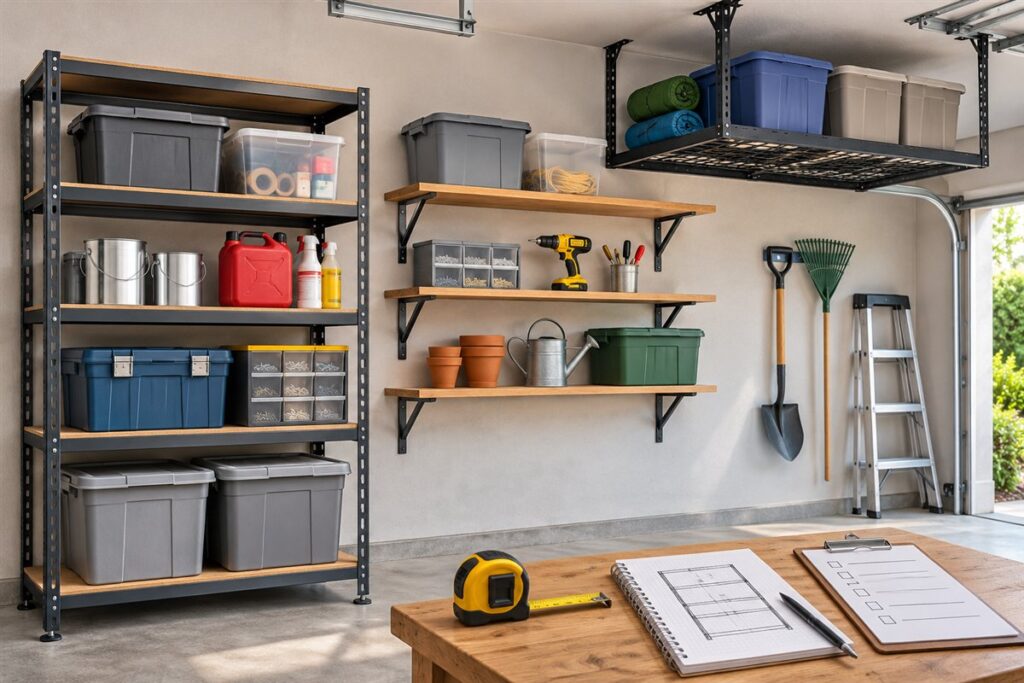
The right garage shelf holds your items within its stated limits, fits your floor space and suits your walls or floor. Decide what you are storing, then compare freestanding, wall-mounted and overhead styles.
Three Shelf Styles
- Freestanding units: stand on the floor and can be moved. They suit renters and changing needs, and they should be placed on level ground.
- Wall-mounted shelves: fix to the wall and free up floor space. They depend on the wall structure and the correct fasteners.
- Overhead racks: hang from the ceiling for seasonal items. Because they involve structure and working at height, a qualified professional should advise on mounting.
Take Stock of What You Store
Group items: heavy cans and boxes, light seasonal bins, long items like lumber, and small parts. Heavy goods belong on lower shelves of a unit built for them. Light, bulky items can go higher. Measure the tallest and widest things, because shelf spacing that is adjustable gives you more freedom.
Materials and Build
- Steel: strong and widely used; check for finished edges and rust resistance.
- Plastic or resin: resists damp and is lighter, but may have lower limits.
- Wood: customizable, and strength depends on thickness and support.
- Wire shelves: allow airflow and cut dust build-up, but small items can fall through.
Checklist Table
| Factor | Why it matters | What to check |
|---|---|---|
| Load per shelf | Overloading can cause failure | Maker’s stated limit |
| Footprint | Must leave room for vehicles and doors | Width and depth against your space |
| Wall type | Fasteners must suit the wall | Masonry, studs or other, per the manual |
| Damp | Moisture rusts and warps | Material resistance |
| Stability | Tall units can tip | Wall anchoring option |
Setting Up Sensibly
Follow the assembly instructions exactly and use every fastener supplied. Tall units should be anchored to the wall if the maker recommends it, using hardware suited to your wall. If you are unsure what your wall is made of or how to fix into it, ask a qualified professional. Keep fuels, solvents and chemicals in their original containers and follow local rules for storing and disposing of them, away from heat sources.
Leave room around the unit for doors, vehicles and walking. Label shelves by category so family members can put things back, and look over the contents once a year to clear what you no longer need.
Understanding Load Ratings
The load figure in a listing is one of the most important numbers, and it is also one of the easiest to misread. Some makers state a limit per shelf, others give a limit for the whole unit, and some give both. A unit that lists a large total capacity may still limit each shelf to a fraction of that figure. Check which number applies before you decide.
Ratings usually assume the load is spread evenly across the shelf. A heavy item concentrated in the middle, or at the front edge, can cause bowing or tipping even if the total weight is within the limit. Read the manual for notes on distributing weight, and look for any note on whether the rating applies when the unit is anchored to a wall or only when freestanding.
Keep a margin of safety. Weigh a few of your heaviest boxes with a bathroom scale to get a real idea of what you will put on each level, then choose a unit whose stated limit comfortably exceeds it. Remember that a full box of tools, paint cans or car fluids weighs more than most people expect.
- Put the heaviest items on the lowest shelf.
- Do not climb on shelves or use them as a ladder.
- Reduce the load if shelves start to bow or the frame leans.
Treat ratings as ceilings, not targets, and check the unit periodically for signs of strain.
Measuring and Planning the Layout
Good shelving starts with a tape measure and a sketch. Measure the wall length, the ceiling height and the depth you can give up before it interferes with vehicles, doors and opening storage lids. Note obstacles such as electrical panels, water heaters, outlets, switches, pipes and the swing of the garage door. Keep clear access around a panel and any equipment that needs servicing, and follow local rules on clearances.
Think about reach. The most-used items should sit between knee and shoulder height, where you can lift them safely without bending or stretching. Seasonal or rarely used items belong higher up, and the heaviest things lower down. Leave enough space between shelves for your tallest bins, with a little room to slide them in and out.
Check shelf depth against the contents. Deep shelves hold large bins but can turn into a place where things get lost at the back. Shallow shelves hold small items and keep everything in view. A mix of depths is sometimes the practical answer.
- Sketch the wall with measurements and mark each obstacle.
- Cut paper or cardboard templates for the footprint and lay them on the floor.
- Walk around the template to test door clearance and vehicle spacing.
Measure twice, and measure the delivery route as well, since long flat boxes may not fit through some doors.
Assembly, Leveling and Anchoring
Assembly quality decides how well a shelf performs. Lay out all parts and count the fasteners before you start, then follow the instructions in order. Resist the temptation to tighten everything fully at the start. Snug the fasteners until the frame is complete, check that it is square, and then tighten fully. A unit assembled out of square can rack and carry less than its stated load.
Place the unit on a level surface. Garage floors often slope toward a drain, which can make tall shelves lean. Use the leveling feet if the unit has them, or shim under the legs with a solid material that will not crush. Rest the unit on a floor that is dry, since damp can corrode steel feet and swell wood.
Tall units should be anchored to the wall using the hardware the maker supplies or recommends. The right anchor depends on the wall, whether masonry, studs or another surface, so check the wall type and the manual. Where the wall type is unclear or the unit is very heavy, ask a qualified professional. Anchoring protects against tipping when shelves are bumped or when children climb.
- Fit all braces and cross supports that come with the unit.
- Keep the shelf slightly off the wall if damp is a concern.
- Re-check fasteners after the first few weeks of use.
Organizing Shelves by Zones
A shelf is only as useful as the system on it. Divide your storage into zones based on how you use things: everyday items, tools and hardware, automotive and chemicals, garden and seasonal gear, and sports or camping equipment. Give each zone its own shelf or section so family members can find things without guessing.
Use lidded, same-sized bins where you can. Uniform bins stack neatly, protect contents from dust and make it easy to see what fits where. Clear bins show the contents, while opaque bins hide clutter. Label the front and one side, so you can read the label even when bins are stacked or pushed to the back. Keep a simple note of where the main categories live.
Store chemicals as their labels direct. Paints, solvents, fuels and pesticides should be in their original containers with the lids closed, away from heat sources, and ideally out of reach of children and pets. Keep these on a low, sturdy shelf with a lip, so a spill is contained and a fall is less likely. Never store flammable items near a water heater, furnace or other ignition source.
- Put frequently used items at the front and at waist height.
- Use hooks or a rail on the side of a unit for cords and hoses.
- Review the shelves once a season and clear out what you no longer use.
Damp, Temperature Swings and Longevity
A garage is a tougher environment than a spare room. Temperatures swing, humidity can be high and the floor can get wet from vehicles and rain. These conditions shorten the life of the wrong shelving. Bare steel can rust where the finish is scratched, particularly at the feet and at cut edges. Check for protective coatings, and touch up chips as they appear. Plastic shelving resists moisture but can become brittle in extreme cold or soften in strong heat, so check the maker’s guidance on temperature.
Wood and particleboard soak up moisture and can swell, sag or grow mildew. If you choose wood, look for a sealed finish and keep it off a damp floor. Wire shelves allow air to move and are less likely to trap damp, but a liner may be needed for small items. Keep cardboard boxes off the floor, since they draw moisture and attract pests. Plastic bins are a safer choice for important items.
Signs it is time to repair or replace a unit include sagging shelves, bent uprights, loose or missing fasteners, spreading rust, cracks in plastic and a unit that leans or rocks. Do not keep loading a unit that shows these problems. Unload it, inspect it and either repair it using parts the maker lists or replace it. Regular inspection a few times a year is a small cost compared with a collapsed shelf and a floor full of stored belongings.
FAQ
Can I place heavy items on the top shelf?
It is not a good habit. Keep heavy items low to lower the chance of tipping and make them easier to lift.
Should shelving sit against an outside wall?
Be careful with damp. Leave a small gap for airflow and use materials that cope with moisture.
How far should shelves sit from the wall?
A small gap of an inch or so can help airflow and reduce damp build-up behind the unit, but anchored units need to be fixed as the manual directs. Follow the maker's guidance and check how your particular wall behaves in wet weather.
Are plastic shelves strong enough for tools?
Some are, within their stated limits, but heavy tools concentrate weight. Check the per-shelf rating and spread loads evenly. For very heavy items, steel or well-supported wood is often a more comfortable choice.
Do I need to anchor a freestanding shelf?
Tall units can tip if bumped or climbed on, so anchoring is a good idea whenever the manual offers it. Use hardware suited to your wall type and, if unsure, ask a qualified professional.
How should I store long items like lumber or pipes?
Use a rack made for long items or a wall-mounted system with supports spaced along the length. Keep the material supported so it does not bow, and store it away from walkways.
Can I mix wall-mounted and freestanding shelving?
Yes, many garages do. Freestanding units hold heavy bins low down, while wall shelves keep lighter items off the floor. Make sure each type is used within its own rated limits.
How often should I check my shelves?
A quick look every few months is sensible. Check for leaning, loose fasteners, bowing and rust. Check again after moving heavy items or after a period of damp weather.
Is it safe to store paint and chemicals on garage shelves?
Follow each label and local rules. Keep containers closed, in their originals, on low sturdy shelves and away from heat sources. Extreme temperatures can damage some products, so check labels for storage limits.
The Short Version
List what you store, measure the space, then choose a style and material that suit the load and conditions. Follow the maker’s limits and get professional advice on wall or ceiling fixing.