Disclosure: As an Amazon Associate, umtsmarttool.com earns from qualifying purchases. Links to Amazon on this page are affiliate links; they cost you nothing extra. Prices and availability change often, so check the current Amazon listing before you buy.
Where to buy
Short on time? These are the reference models behind this walkthrough of how to choose a pool heater; the measuring method that sorts them follows below.
- Intex 28685E Solar Heater Mat — Check on Amazon
- GAME SolarPRO Curve Solar Pool Heater 72000-BB — Check on Amazon
- FibroPool FH120 Heat Pump 20,000 BTU — Check on Amazon
- Hayward W3H150FDN Universal H-Series 150,000 BTU Natural Gas Heater — Check on Amazon
Read the full guide ↓
Key Takeaways
- Measure your pool before you shop: surface area and gallon count decide the heater size, not marketing labels.
- Work out your heating load with simple arithmetic — gallons, target temperature lift, and how fast you want that lift to happen.
- Your yard narrows the field fast: an existing gas line, panel capacity, and daily sun exposure each rule whole heater families in or out.
- Above-ground and in-ground pools reward different equipment; a heater that shines in one setting often disappoints in the other.
- The cheapest heater to buy is rarely the cheapest heater to own, so judge running pattern and lifespan alongside the hardware.
Learning how to choose a pool heater starts with an uncomfortable truth: most buyers begin at the wrong end of the process. They open a catalog, compare headline numbers, and only afterwards wonder whether the unit suits the water sitting in their backyard. Reverse that order and the decision gets dramatically easier. Your pool already holds every answer that matters — its dimensions, its volume, how much sun crosses it, and how your household actually swims. The heater is simply the machine that has to match those facts.
This guide treats the purchase like a measuring exercise rather than a shopping spree. You will pace off your pool, estimate its volume two different ways, translate that volume into a heating load, and only then look at equipment. Along the way you will check the three site constraints that quietly eliminate most of the market for any given home: fuel access, electrical headroom, and solar exposure. By the final section, the shortlist should feel almost obvious, because the numbers will have done the arguing for you. If you would rather begin with a broader criteria tour, our companion Pool Heater Buying Guide walks the same ground from the features side.
One promise before we start: nothing here requires engineering training. Every calculation below uses arithmetic you can do on a phone calculator, and every formula is shown with a worked example so you can sanity-check your own figures. Grab a tape measure, a notebook, and ten quiet minutes by the pool. That modest investment prevents the two classic outcomes of heater shopping — a unit too weak to matter, or a unit so oversized that you paid for capacity you will never call on.
In this guide
Begin With a Tape Measure, Not a Catalog
Heater sizing lives and dies on surface area. Heat escapes through the water’s exposed top faster than through walls or floor, so the square footage of that surface predicts overnight losses better than any other single number. Stretch your tape along the length and width of a rectangular pool and multiply the two figures. A pool that measures 16 feet by 32 feet presents 512 square feet of surface. Round pools are just as simple: halve the diameter to get the radius, square it, and multiply by 3.14. An 18-foot round pool works out to roughly 254 square feet. Kidney and freeform shapes resist tidy geometry, so approximate them as the nearest rectangle or oval, then shave a little off the result; precision to the nearest ten square feet is plenty for heater selection.
Write that surface figure at the top of your notebook page, because you will compare it against heater ratings all the way through this process. Manufacturers and sizing charts express capability in terms of the surface a unit can service under stated conditions. When a chart assumes a modest temperature lift and a covered pool at night, an uncovered pool in a breezy yard needs to be treated as effectively larger. Honesty at this stage saves disappointment later: if your pool sits on an exposed hilltop or your household refuses covers on principle, round your surface area upward before you shop.
Depth matters too, though differently than most people expect. Depth drives volume, and volume drives the time a heater needs to raise the whole body of water. A shallow play pool warms quickly and cools quickly. A deep diving pool changes temperature slowly in both directions, which means a correctly sized heater feels sluggish on day one yet holds its gains beautifully once it gets there. Record your shallow-end and deep-end depths and average them; that average depth is the third number your notebook needs.
Turn Gallons Into a Heating Load
Volume follows from the measurements you already have. For a rectangular pool, multiply length by width by average depth, then multiply by 7.5 to convert cubic feet into gallons. Our 16-by-32 example with a 5-foot average depth holds about 19,200 gallons. Round pools use the surface area you computed, times average depth, times 7.5. Oval pools land close to the rectangular formula with a small correction downward. If your fill records give an exact figure, use it — otherwise the estimate is fine, because heater sizes come in broad steps rather than fine gradations.
Now the heating load itself. A BTU is the energy needed to raise one pound of water by one degree Fahrenheit, and a gallon of water weighs about 8.33 pounds. Multiply your gallons by 8.33 and you know how many BTUs one full degree of warming requires across the whole pool. For 19,200 gallons, that is roughly 160,000 BTU per degree. Suddenly heater ratings stop being abstract. A unit delivering 100,000 BTU per hour into the water would need well over an hour and a half of perfect operation to add a single degree to that pool — before accounting for the heat leaking away during the process.
Frame your goal as a lift and a deadline. Perhaps the pool sits at 68 degrees in May and your family swims happily at 80: that is a 12-degree lift. Perhaps you simply want to erase the overnight chill and recover 3 degrees by Saturday morning. The first goal demands sustained power; the second rewards responsiveness. Multiply degrees by your per-degree BTU figure to get the total energy for a full warm-up, then divide by the hours you are willing to wait. That quotient is the delivered output your heater must sustain. Compare it against rated output, remembering that gas heaters quote input and output differently and that heat pumps deliver less as the air cools. Readers planning the physical hookup next can pair this math with our walkthrough on How To Install A Pool Heater once the model is chosen.
Do the same arithmetic for a small above-ground pool and the picture flips. An 8,000-gallon pool — the upper limit the Intex solar mat in our reference list is built for — needs about 66,600 BTU per degree. A sunny afternoon through a solar mat, a modest heat pump running through the day, or a compact gas unit can each move that needle meaningfully. Scale is destiny in pool heating: the identical heater that feels transformative on 8,000 gallons is a rounding error on 30,000. This is why copying a neighbor’s purchase so often fails. Their water is not your water.
Let Your Yard Vote: Fuel, Power, and Sunlight
With the load calculated, walk the equipment pad and the yard with fresh eyes. Three site facts will disqualify whole categories before you compare a single model, and discovering them early saves hours of pointless research. Start with fuel. A home already served by natural gas, with a line anywhere near the pool equipment, holds the strongest card in heating: gas units deliver the largest outputs in the category and respond within hours. A home without gas service faces a different fork — propane with a tank installation, or stepping away from combustion entirely. Neither answer is wrong, but pretending the question does not exist leads buyers to fall in love with heaters they cannot feed.
Next, open the electrical panel. Heat pumps draw meaningful current across long daily runs, and resistance electric heaters draw far more. Note the panel’s total capacity, the spare breaker spaces, and the distance a new circuit would travel to reach the pad. Long cable runs and a nearly full panel both add real installation scope. None of this kills an electric option by itself, yet it belongs in the notebook beside the pool measurements, because the installed reality of a heater includes the infrastructure behind it.
Finally, watch the sun. Stand at the pool at mid-morning, midday, and mid-afternoon, or use a sun-tracking app, and honestly grade how many unobstructed hours the water and the likely panel location receive. Solar heating is gloriously cheap to run and genuinely effective inside its window, but shade from a two-story neighbor, a mature oak, or your own roofline can cut that window to ribbons. A south-facing roof slope or an open fence line nearby expands your options; a wooded lot quietly removes solar from serious contention for all but the smallest pools.
How to Choose a Pool Heater When the Pool Type Comes First
Construction style splits the market as cleanly as fuel does. Above-ground pools hold less water, lose heat through thin walls, and usually run smaller pumps with flexible hose plumbing. They reward compact, forgiving equipment: solar mats and panels sized to the pool, small heat pumps, and the dedicated above-ground gas models built for lower flow rates. In-ground pools hold far more water, sit in earth that stabilizes temperature, and run rigid plumbing with stronger circulation. They reward capacity and integration — larger heat pumps, full-size gas heaters, and controls that talk to automation systems.
Spas and swim spas form their own world. Their volumes are small but their target temperatures are high and their users expect heat on demand, which pushes the decision toward gas or dedicated electric spa units and away from anything solar-led. Attached spa spillovers on in-ground pools inherit the main pool’s heater in most builds, so size for the spa’s lift requirement during spillover mode, not just the pool’s gentler needs. If two bodies of water share one heater, the harder job sets the specification.
Also consider how the pool gets used week to week. A lap swimmer training at dawn wants water held at temperature continuously, which favors an efficient maintainer like a heat pump. A family that swims on summer weekends wants Friday-evening recovery speed, which favors gas punch. A rental property wants durability and simple controls that guests cannot misconfigure. Write your household’s pattern in the notebook in one sentence. Whenever two candidate heaters both fit the math, that sentence breaks the tie better than any spec-sheet shootout.
The Four Heater Families, Judged on the Same Scale
Gas heaters burn natural gas or propane to push water through a heat exchanger, and they remain the speed champions. Output runs from compact above-ground units near 100,000 BTU up to residential flagships several times that, and they heat regardless of air temperature. Their running pattern is episodic: fire hard, reach temperature, shut down. Choose gas when the lift is large, the deadline is short, the pool is big, or the season includes genuinely cold months. Accept that fuel consumption during a long warm-up is substantial, and that venting, clearances, and gas work belong to licensed professionals.
Heat pumps move heat from the air into the water with a refrigeration cycle, delivering several units of heat for each unit of electricity consumed. The FibroPool FH120 in our reference list, rated at 20,000 BTU, represents the compact end built for smaller above-ground pools; the family scales far upward for in-ground installations. Heat pumps excel at holding a temperature across a long season at moderate daily cost, and they fade exactly when you might want them most — cold snaps — because cold air holds less heat to harvest. They are maintainers and season-extenders rather than rescue heaters.
Solar systems circulate pool water through mats or panels that gather sunlight, adding degrees gradually across bright days at almost no running cost. The Intex mat and the GAME SolarPRO Curve in our list show the two common forms: a flat mat that suits small Intex-style pools, and a curved panel that adds capacity and includes adaptors for those same pools. Solar’s ceiling is set by your roof, your climate, and your patience. Paired with a cover, it can carry a small pool through summer beautifully; asked to rescue a cold, large, shaded pool in April, it will politely fail.
Electric resistance heaters convert electricity directly into heat in the water stream. They are compact, simple, and mostly confined to spas, swim spas, and very small pools, because the running cost of heating tens of thousands of gallons resistively is punishing in most regions. Treat them as a niche answer for small volumes and high target temperatures, not as a general pool solution.
A Seven-Step Decision Sequence That Actually Ends
Guides fail when they describe criteria without ordering them. Work these steps in sequence and do not skip ahead; each one shrinks the field for the next. Step one: record surface area, average depth, and gallons from your measurements. Step two: define the job in one line — the lift you want and the hours you will allow. Step three: compute the delivered BTU rate that job requires, using the per-degree figure from earlier. Step four: cross off heater families your site cannot support, using the fuel, panel, and sunlight checks. Step five: within the surviving families, list models whose delivered output meets your step-three rate with headroom to spare — aim above the bare number, because wind, covers left off, and aging equipment all tax real performance.
Step six: pressure-test the survivors against ownership reality. How long is the warranty on the heat exchanger, the component that decides the heater’s lifespan? Are service technicians in your area familiar with the brand? Does the unit demand a minimum flow your pump comfortably exceeds? Step seven: only now compare purchase prices across your final two or three, and weigh them against the running pattern you expect. Buyers who shop the wider value lists, such as the Best Pool Heater Under $150 and Best Pool Heater Under $300 collections, will notice those bands mostly contain solar and small-pool gear — a useful reminder that budget bands and heater families overlap heavily at the small end of the market.
Notice what this sequence never does: it never asks which heater is “best” in the abstract. It asks which heater satisfies a measured load, on a specific site, for a specific swimming pattern. That reframing is the entire discipline. Every regret story in pool heating — the feeble unit, the shocking fuel bill, the heater idle for want of a gas line — traces back to a skipped step in this order.
Reading a Spec Sheet Without Getting Fooled
Spec sheets reward skeptical readers. The headline BTU figure on a gas heater describes fuel input, and only a portion of that input becomes heat in your water — the unit’s thermal efficiency says how much. Two heaters with identical headline numbers can deliver meaningfully different warmth if their efficiencies diverge. Heat pump ratings carry a different caveat: output is quoted at warm, humid test conditions, and the same machine delivers less on a crisp morning. Neither practice is dishonest, but both mean the number on the box describes the heater’s best day, not its average one. Your headroom from step five absorbs exactly this gap.
Flow requirements deserve equal attention. Every heater wants water moving through it inside a stated range. Too little flow trips safety switches and stresses the exchanger; too much can erode components or bypass heat transfer. Match the heater’s flow window against your pump’s actual delivery at your system’s resistance, not the pump’s best-case label figure. Variable-speed pumps complicate this pleasantly: you can often find a speed that satisfies both filtration and the heater’s minimum, rather than running flat out.
Physical footprints and connections close the sale or quietly kill it. Measure the equipment pad, check door swing and service clearance, and confirm union sizes against your plumbing. Note the control style as well — a simple dial, a digital board, or automation integration — because you will interact with it weekly for years. A heater that fits the math but fights the pad, the plumbing, or the household’s patience is the wrong heater wearing the right numbers.
The Reference Picks, Mapped to the Decisions Above
Our cluster’s verified reference list contains one representative of each major family, which makes it a useful teaching set: the right choice among them is whichever matches your notebook, not whichever sounds most powerful. Read each profile against your own measurements.

Intex 28685E Solar Heater Mat — the small-pool solar starting point
This 47-by-47-inch mat is built for Intex-style above-ground pools up to about 8,000 gallons, and it works by routing filter-pump water through sun-warmed channels. Expect gentle, cumulative gains across bright days rather than any single dramatic jump, and expect a cover at night to protect whatever the day delivered. Households can chain additional mats as the pool or ambition grows. It suits owners whose step-two job is a few degrees of comfort lift in summer, whose yard passed the sunlight test, and whose budget for running costs is effectively zero.
- Format: flat solar mat, 47 in by 47 in
- Pool fit: above-ground pools up to 8,000 gallons
- Energy source: sunlight, circulated by the existing filter pump
Best for: small above-ground pools needing a modest summer lift / Not suited for: large pools, shaded yards, or anyone chasing a deadline
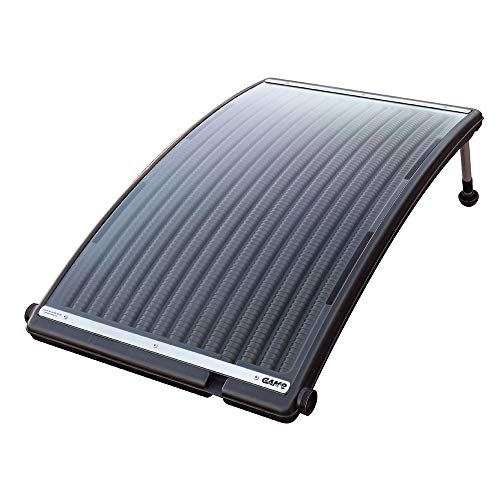
GAME SolarPRO Curve Solar Pool Heater 72000-BB — more solar surface, same gentle logic
The curved panel format gathers sun across a shaped collector and ships with Intex adaptors plus two hoses and clamps, which removes the adapter hunt that frustrates many first solar installs. The curve is not decoration: it presents more area to the sun across the day than a flat sheet of the same footprint. This is the pick when your sunlight audit came back strong, your pool sits in the small-to-mid above-ground range, and you want solar’s free running with a bit more gathering power than a single mat provides. Like every solar option, it maintains and extends rather than rescues.
- Format: curved solar panel
- In the box: Intex adaptors, two hoses, and clamps
- Energy source: sunlight, circulated by the pool pump
Best for: sun-rich small pools wanting stronger solar gain / Not suited for: cold-climate spring warm-ups or in-ground pools

FibroPool FH120 Heat Pump 20,000 BTU — the patient maintainer
At 20,000 BTU, the FH120 addresses the smaller end of the market: above-ground and compact pools where holding temperature matters more than heroic recovery. Its refrigeration cycle harvests warmth from the air, so its happiest working conditions are the mild days that make up most of a swim season. Run it steadily, cover the pool at night, and it will quietly erase the chill that keeps families out of the water in the shoulder weeks. Ask it to lift a big, cold pool by double digits and the arithmetic from earlier in this guide will explain the disappointment before it happens.
- Type: heat pump, 20,000 BTU rated output
- Pool fit: smaller above-ground and compact pools
- Strength: efficient temperature holding across long seasons
Best for: steady season-long warmth on smaller pools / Not suited for: fast warm-ups or very cold air

Hayward W3H150FDN Universal H-Series 150,000 BTU Natural Gas Heater — the deadline beater
When the notebook demands real power — a large in-ground pool, a short recovery window, a spa that must be ready by dinner — this 150,000 BTU natural gas unit is the reference list’s answer. Combustion heat does not care about air temperature, so its output in April matches its output in August. The Universal H-Series is built for in-ground installations with proper venting and professional gas connection, and it expects the site homework from earlier sections: a gas line with capacity, pad space, and clearances. If those boxes are ticked, few residential experiences beat watching the thermometer climb on your schedule instead of the weather’s.
- Type: natural gas heater, 150,000 BTU input class
- Pool fit: in-ground pools and attached spas
- Strength: rapid, weather-independent temperature lift
Best for: large pools, spas, and anyone buying back swim time / Not suited for: homes without gas service or very small pools
For a second opinion on how these four stack up in daily use, the cluster’s Pool Heater Review coverage examines the ownership experience in more depth.
When the Numbers Point Two Ways: Tiebreakers That Matter
Sometimes the sequence ends with two heaters that both fit — typically a heat pump and a gas unit for a mid-size in-ground pool, or two solar formats for a small above-ground setup. Break those ties with ownership questions rather than more spec comparisons. Which unit can a local technician service before a holiday weekend? Which one’s controls will your household genuinely enjoy using in February darkness and July glare alike? Which installation disturbs the yard less, and which leaves the cleaner path to a future upgrade, such as automation or a larger pump? The answers are personal, but they predict satisfaction better than a third decimal place on an efficiency figure.
Climate deserves the final word in any tie. In a long, mild season, the heat pump’s steady economy compounds day after day, and its cold-weather fade rarely matters because the air seldom turns truly cold. In a short, sharp season, every swim day is precious and the weather is unreliable, which rewards the gas unit’s indifference to air temperature. Desert homes with cold nights and blazing days often land on solar plus a cover, because the resource is abundant and the losses are predictable. There is no national answer — there is your latitude, your season length, and your notebook.
Problems That Trace Back to Choosing Day
Most heater complaints voiced in year two were decided in week one. Work through these patterns before you buy, because each is cheaper to prevent than to cure.
Problem: The heater runs constantly yet the water barely warms. → The usual cause is undersizing against the true surface area, often compounded by no night cover. Re-run the load math with honest measurements before blaming the machine.
Problem: The fuel or electricity bills shock the household. → Oversizing for the actual pattern is the classic culprit: a speed heater bought for a maintainer’s job. Match family to pattern, and cover the pool so purchased heat stays purchased.
Problem: The heater short-cycles or trips its safety switches. → Flow mismatch is the first suspect. Confirm the pump delivers inside the heater’s stated flow window at your system’s resistance, and check for clogged baskets and filters before calling service.
Problem: Solar panels deliver almost nothing. → Placement, not product, is usually at fault: shade during peak hours, panels plumbed after a restrictive filter, or air trapped in the lines. Re-audit the sun path and bleed the system.
Problem: The heat pump disappoints in the shoulder season. → Expectations, again: output falls as air cools. Pair it with a cover, run longer cycles during the warmest afternoon hours, and reserve judgment until you have judged it in the conditions it was designed for.
Mistakes Buyers Keep Making
The most persistent error is shopping by pool gallons alone while ignoring surface area, which drives heat loss. The second is treating the headline BTU figure as delivered heat without asking about efficiency or test conditions. Third comes neglecting the cover: an uncovered heated pool is a kettle with the lid off, and no heater family escapes that physics. Fourth is forgetting the site survey — falling for a gas heater with no gas line, or solar panels destined for permanent shade. Fifth is buying for the pool you wish you had: sizing for a future spa or a planned depth extension that may never happen, while this summer’s water sits underheated. Finally, many buyers skip the flow check and discover at installation that their modest pump cannot keep a big heater happy. Every one of these mistakes is visible in advance with the notebook method in this guide.
Your Pre-Purchase Checklist
- Surface area measured and written down, rounded up if the pool is uncovered or wind-exposed.
- Average depth and gallons calculated, ideally confirmed two ways.
- The job defined in one line: degrees of lift, hours allowed.
- Required delivered BTU rate computed from the per-degree figure.
- Gas availability, panel capacity, and daily sun hours honestly audited.
- Pool type and weekly swimming pattern matched to a heater family.
- Flow window of finalist models checked against the pump’s real delivery.
- Pad space, clearances, and connection sizes measured at the equipment site.
- Warranty on the heat exchanger and local service availability confirmed.
- A cover plan in place so the heat you buy stays in the water overnight.
The Hybrid Option Nobody Mentions at the Store
Plenty of satisfied owners heat with two modest systems instead of one large one, and the combination deserves a place in your thinking. Solar or a heat pump carries the everyday load — the daily top-ups, the season stretching, the quiet maintenance of a comfortable baseline — while a gas unit, sometimes an older existing one, handles the exceptional demands: the first warm-up of spring, the spa on a cold evening, the party that cannot wait for the weather. Each machine works in the conditions it prefers, and neither has to be sized for the other’s job. If you already own one working heater that almost meets your needs, price the gap before replacing it: adding the complementary family is often the smarter spend, and it leaves you with redundancy when one unit is down for service during the best week of the year.
Hybrids do ask for a little more plumbing thought and a household agreement about which system leads on which day. Write that agreement down — literally, on the notebook’s last page — so the setup survives forgetfulness and guests. Solar leads on bright days; the heat pump holds the baseline overnight; gas fires only for deadlines. Owners who run that simple protocol consistently report the lowest regret in the category, because no single machine is ever asked to be something it is not.
Final Recommendation
Choose from your measurements outward and this purchase becomes one of the more satisfying upgrades a pool owner can make. Small above-ground pools with good sun should start with solar — the Intex 28685E Solar Heater Mat for the gentlest entry, the GAME SolarPRO Curve when you want more gathering area. Compact pools that need dependable holding power belong with a heat pump in the FH120’s class. Large pools, spas, and deadline-driven households belong with gas, where the Hayward H-Series sets the reference standard. Above all, trust the notebook: the heater that matches your water, your yard, and your calendar will feel like the obvious choice every single swim.
One Household, Worked End to End
Abstract steps stick better with a concrete run-through, so follow a typical family through the whole sequence. Their pool is an oval in-ground measuring roughly 18 by 36 feet, with a 3-foot shallow end and an 8-foot deep end. Surface area lands near 580 square feet after the oval correction; average depth is about 5.5 feet; volume works out to roughly 24,000 gallons. Their job statement, written honestly: the water sits at 70 degrees on May weekends, the kids want 82, and the heater may run from Friday morning to Saturday morning — a 12-degree lift inside about 24 hours.
The per-degree cost is 24,000 times 8.33, almost exactly 200,000 BTU. Twelve degrees therefore means about 2.4 million BTU delivered, and spread over 24 hours that is a sustained 100,000 BTU per hour reaching the water. Now the site audit: the home has natural gas at the street but the line stops at the house, roughly 40 feet from the pad; the panel is a modern one with spare capacity; the yard is bright but the pool surface takes afternoon shade from a maple. Solar alone fails the deadline test. A heat pump could hold 82 beautifully in July yet would strain to deliver that May lift on cool nights. The family chooses gas, sized with headroom above the 100,000-delivered figure, budgets for the line extension as part of the project, and adds a cover to protect the Friday purchase through the night. Every part of that decision — family, size, infrastructure, accessory — fell out of the notebook in order.
Contrast a second household: a 15-foot round above-ground pool, about 5,300 gallons, in a fenced yard with all-day sun. Their job statement is gentler: take the edge off, add perhaps 5 degrees across a sunny week, and stretch the season by a few weeks at each end. The per-degree cost is roughly 44,000 BTU — small enough that a solar panel working daily, plus a cover, meets it without any combustion or meaningful electricity at all. Same guide, same sequence, opposite answer. That spread is the proof the method works: the process is identical, the pools are not.
Covers, Wind, and the Half of the System Nobody Prices
Every sizing figure in this guide quietly assumes you are not heating the sky. Evaporation at the surface accounts for the majority of a pool’s heat loss, and wind accelerates it ruthlessly — a breezy, uncovered pool can shed in one night what a modest heater delivered all day. This is why two owners with identical heaters report wildly different results. Before upgrading equipment, audit the loss side: a well-fitted liquid or physical cover, a windbreak hedge or fence on the prevailing-wind side, and a habit of covering the pool whenever it sits idle for more than a day. These unglamorous measures effectively enlarge any heater you buy.
Placement details compound the effect. Solar collectors belong where the midday sun actually lands, which is not always where the plumbing run is shortest. Heat pumps need breathing room — they exhaust cold air and sulk when boxed against a wall. Gas units need their venting path and clearances respected, both for safety and for the service access they will eventually require. When you walk the pad during your site audit, photograph it from several angles; installers and service techs will thank you, and the photos often reveal constraints your eyes edited out in person.
Timing, Installers, and the Questions to Ask Out Loud
When you buy matters more than most guides admit. Heater shopping in early spring puts you in the install queue with everyone else who waited for the first warm weekend, while late-autumn purchases often meet open schedules and unhurried installers — though you then wait months to enjoy the result. If your pool is already open and losing the season, speed has real value; if you are planning ahead, the off-season conversation with an installer is calmer, more detailed, and more likely to surface site problems while they are still cheap to solve. Either way, complete your notebook first: an installer who sees your measurements, job statement, and site photos can quote accurately in one visit instead of three.
Ask every installer the same five questions and write the answers down. Which exact model and size do you recommend for this measured load, and why that size rather than the next step up or down? What site work — gas, electrical, pad, venting — is included in your figure, and what is excluded? What flow rate will my pump deliver through this heater, measured how? Who handles permits and inspections in our jurisdiction? And what does the warranty cover on the heat exchanger specifically, and who performs warranty service locally? Vague answers to any of these are information in themselves. The installer who engages happily with your arithmetic is the one who will still be answering the phone in year three.
Finally, plan the first week of ownership before the truck arrives. Know where the manual will live, photograph the installed unit and its data plate, register the warranty while the paperwork is in hand, and schedule the first warm-up as a deliberate test rather than a party deadline. Run the system, watch the thermometer against your own predictions from the load math, and confirm the heater behaves the way the notebook said it should. That small ritual converts a purchase into knowledge — and if anything underperforms, you will know within days, while every receipt and contact is still fresh.
Frequently Asked Questions
How many BTUs do I actually need for my pool?
Work it out from your own water: multiply gallons by 8.33 to get the BTU cost of one degree, multiply by the lift you want, and divide by the hours you will allow. Then choose a heater whose delivered output — after efficiency, in the case of gas — clears that rate with room to spare. Charts that size by surface area alone are a decent cross-check, but your lift-and-deadline math is the more honest figure.
Is a bigger heater always safer than a smaller one?
No. Moderate headroom above your computed requirement is wise, because real conditions tax rated performance. Gross oversizing, though, buys you higher purchase cost, more demanding installation requirements, and equipment that may short-cycle on small temperature calls. Size for the job you defined, with a sensible margin — not for the largest job imaginable.
Can one heater serve both my pool and attached spa?
Usually yes, and most in-ground builds do exactly that with valving that isolates the spa for its faster, hotter cycle. The sizing catch is that the spa’s demand — high temperature, quick turnaround — should set the capacity check, because it is the harder job. Confirm the control setup supports both modes before you commit.
How much difference does a pool cover really make?
An enormous one. Most heat loss happens at the surface, especially overnight, and a cover throttles evaporation, which is the main escape route. Owners routinely find that a cover lets a smaller heater do the work they expected from a larger one, and that any heater’s running time shrinks once the lid stays on at night. Budget for the cover as part of the heating system, not as an accessory.
Should I replace an aging heater with the same size?
Only if the old size was right. Use the replacement as a chance to re-measure: pools get new liners, pumps get upgraded, shade trees grow, and swimming patterns change across a decade. Run the seven-step sequence fresh. Many owners discover their original unit was undersized all along, and the “unreliable heater” they tolerated for years was simply outmatched by the water it served.
Does heater placement on the equipment pad matter?
More than most buyers expect. Every heater needs the clearances its manual specifies for airflow, venting, and service access, and squeezing a unit against a wall or fence can throttle a heat pump’s output or make a gas heater’s eventual repair needlessly expensive. Keep the pad’s layout in your notebook from the first visit, leave room to stand and work on all serviceable sides, and remember that today’s convenient corner becomes tomorrow’s frustration when a technician cannot reach a panel. Space is a feature; buy it once, on paper, for free.
When is solar alone genuinely enough?
When three conditions meet: a small-to-moderate volume of water, several hours of unobstructed daily sun on the collectors, and goals framed as comfort lift and season extension rather than precise temperatures on cold mornings. Add a cover and realistic expectations, and solar alone can carry a pool happily through the bright months. Remove any one of the three conditions and plan on a hybrid or a different primary family.