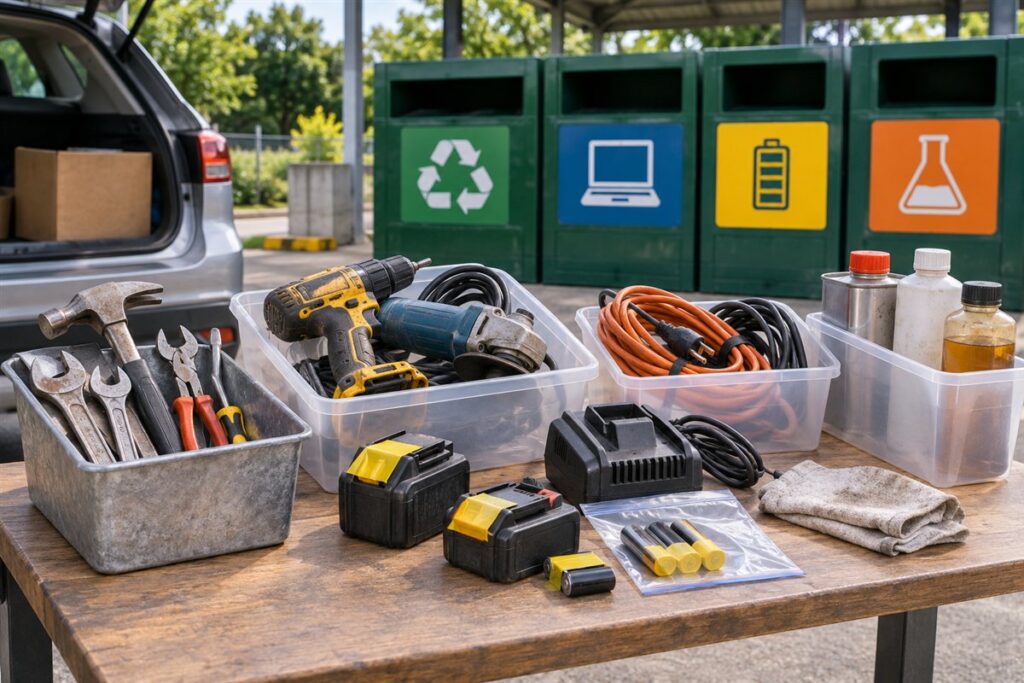
To recycle old tools and batteries, sort them by type, check what your local collection scheme accepts and take them to the right drop-off point. Batteries in particular need to follow local collection rules and should not go in household trash.
Sort What You Have
Gather the items and divide them into groups, because each group is handled differently.
- Hand tools of solid metal: often accepted as scrap metal.
- Corded and cordless power tools: electronic waste, usually handled through special collection.
- Batteries and chargers: collected separately under local battery rules.
- Extension cords and wiring: may be accepted as scrap or electronic waste, depending on your area.
- Oils, solvents and chemicals: hazardous waste with its own collection process.
Find the Right Drop-Off
Rules differ from place to place, so check your local government or waste authority. Many areas run household collection days, recycling centers, or take-back points at stores that sell batteries and electronics. Some tool makers offer take-back programs; look at the maker’s guide or website for details. Call ahead if you are unsure what is accepted.
Prepare Items Step by Step
- Remove batteries from tools before dropping them off.
- Check each battery for damage. If one is swollen, leaking or hot, do not charge it, keep it away from flammable items and ask your collection point for guidance.
- Tape over exposed terminals on loose batteries if local guidance suggests it, or place each in its own bag.
- Wipe tools clean and drain any fluid as the manual directs.
- Bundle items in a sturdy box that you can carry without strain.
- Take them to the collection point, and keep any receipt or note if one is given.
Where Things Usually Go
| Item | Usual route | Check |
|---|---|---|
| Steel hand tools | Metal recycling | Whether handles must be removed |
| Power tools | Electronics collection | If batteries must be taken out |
| Tool batteries | Battery collection point | Local battery rules |
| Chargers | Electronics collection | Cord bundling rules |
| Chemicals | Hazardous waste site | Original containers required |
Do not burn batteries, crush them or put them in household bins. If a tool still works well, consider passing it on instead of discarding it.
If you have a large number of items, such as after clearing a garage, ask your local waste authority whether a bulk collection or special collection event is available. Group items by type before you go, since sorting at the site is often not allowed and can slow the line.
Understanding Battery Types and Labels
Not all tool batteries are the same, and the type affects how they should be handled. Rechargeable tool packs commonly use lithium-ion chemistry, though some older packs use nickel-based chemistries, and some household cells in tools are single-use alkaline types. The label on the pack usually names the chemistry, the voltage and often a recycling symbol or a warning. Read it before you sort anything.
Look for markings such as a crossed-out wheeled bin, which indicates the item should not go with household waste, or a recycling mark that names the chemistry. Collection schemes often group batteries by chemistry, so knowing which you have helps you use the correct container at the drop-off point. If a label has worn off, photograph the pack and ask your collection point, or check the tool maker’s guide.
Damaged packs need extra care. Swelling, leaking, strong smells, heat or cracks mean the pack should not be charged or used. Keep such a pack in a cool place away from flammable material, ideally in a non-flammable container, and contact your local waste authority or battery collection service for instructions. Do not attempt to open or repair a pack. Many collection points have special procedures for damaged cells, and they may ask you to hand them over separately instead of mixing them with others.
Making Batteries Safe for Transport
Batteries can short-circuit if their terminals touch metal or each other, and that can cause heat or fire. Careful packing prevents this when you carry them to a drop-off. Follow your local collection scheme’s directions first, since requirements differ, and use these general ideas where they fit.
- Cover exposed terminals: non-conductive tape across the contacts, or a separate small bag for each pack, stops accidental contact.
- Keep batteries apart from metal objects: do not toss loose packs into a box with keys, coins, screws or tools.
- Use a sturdy, dry container: a plastic tub or cardboard box with dividers keeps packs from knocking together.
- Avoid heat in the vehicle: do not leave batteries in a hot car for long periods. Take them directly to the drop-off.
- Keep them upright and secure: prevent sliding and crushing in the boot or trunk.
If there is a lot of battery waste, make more than one trip rather than overfilling a container. For damaged or swollen packs, ask the collection point how to transport them, since special containers may be needed. Never put batteries in a bag that could be compressed, and never crush or puncture them.
Chargers, Cords and Accessories
Old tools rarely come alone. There are chargers, cords, bit sets, cases and manuals, and each has its own destination. Chargers and power adapters count as electrical waste, and most schemes accept them together with small appliances. Remove the charger from the tool pack, bundle the cord neatly, and put it in the electronics container if your scheme asks for that.
Before discarding, ask if the item can be reused. A charger that matches batteries you still use should be kept, while a spare charger for a discontinued system could be useful to someone else. Check the maker’s guide for compatibility, and do not pass on a charger with a damaged cord, cracked case or burnt smell.
Accessories can often be separated. Metal drill bits, blades and steel attachments may go to metal recycling if they are not mixed with plastic or electronics. Plastic cases can be recycled where the scheme accepts that plastic type, which is often stamped on the case. Cardboard packaging and manuals go with paper recycling if clean. Oil, grease and chemical residue must be removed or handled as hazardous waste, so wipe parts clean and check what your local scheme wants. If you are unsure, ask the collection point before you go, because sending mixed bundles can mean everything is rejected.
Reuse, Repair and Refurbish Before Recycling
Recycling recovers materials, but keeping a working tool in use usually saves more resources than breaking it down. Before you take a tool to a drop-off, ask whether it can be repaired, reused or passed on. A tool that fails for a simple reason, such as a worn brush, a loose cord connection or a dull accessory, may need only a small repair from a qualified technician or a manufacturer-approved service center.
Think about the tool’s age and condition. If the safety guard is damaged, the cord is frayed, the housing is cracked or the tool has a history you cannot confirm, it is safer to retire it. If it works well and is safe, offer it to a community workshop, school, charity or neighbour, and be honest about its condition. Repair events and workshops sometimes help people fix small appliances and tools, and your local council or community groups may list them.
Consider parts as well. A tool with a dead motor may still hold a good case, a useful switch or a matching battery, though removing parts is only sensible when you have the skills and the right safety precautions. Leave anything involving mains wiring or battery cells to qualified people. When repair costs approach the price of a new tool of similar quality, or replacement parts are unavailable, recycling responsibly is the sensible choice.
Record-Keeping and Avoiding Common Mistakes
A little organisation makes recycling smoother and avoids common errors. Keep a labelled box in the garage or utility area where dead batteries, broken chargers and unwanted tools can accumulate safely until you have enough for a trip. Place it on a non-combustible surface, away from heat sources and out of reach of children and pets, and store batteries in a way that stops contact between terminals.
Write down the drop-off location, its opening times and any rules, so you do not have to look them up again. Take a photo of the notice board or accepted items list if it is displayed. Keep a note of what you delivered and when, which helps if you later need to show that items were disposed of properly.
- Do not mix chemistries: follow the sorting bins at the collection point.
- Do not leave batteries on the charger indefinitely when you are preparing to dispose of them.
- Do not dispose of tools through scrap collectors if you cannot be sure the batteries and electronics will be handled correctly.
- Do not place fuel-powered equipment with fuel in it in the general pile. Drain fuel as the manual directs and ask about disposal.
Check whether the tool or battery maker offers a take-back scheme, and read the terms. If you are unsure at any step, call the collection point first. A short phone call is quicker than a wasted trip.
FAQ
Can I put dead batteries in the recycling bin at home?
Usually not. Follow local collection rules, which normally direct you to a dedicated drop-off point.
Do I need to remove personal data from tools?
Most tools hold none, but smart or app-linked ones may. Reset or unlink them as the maker directs.
Can I take old tools back to the shop where I bought them?
Some shops accept batteries and small electronics for recycling, and some offer take-back for tools. Policies differ, so check the store's website or ask at the service desk. You may not need to have bought the item there.
What should I do with a swollen battery?
Stop using and charging it, and keep it somewhere cool, away from flammable items and out of reach of children. Contact your local waste authority or battery collection service for instructions. Do not puncture, crush or try to open it.
Are cordless tools and corded tools recycled the same way?
Both are generally treated as electrical or electronic waste, but cordless tools have batteries that must be removed and handled separately. Check your local scheme for how to present each item.
Do I need to empty fuel from petrol-powered tools before recycling?
Usually yes, as the manual directs, and fuel is hazardous waste with its own disposal route. Ask your waste authority how to dispose of old fuel and whether the machine will be accepted.
Is it okay to put small hand tools in household scrap bins?
Rules vary by area. Many places want metal items taken to a scrap or recycling center, and sharp tools should be wrapped for safety. Check local guidance.
Can single-use batteries from tool accessories be recycled?
Often yes, through battery collection points, but the rules depend on where you live. Do not put them in household trash if your area asks for separate collection.
How do I find my nearest drop-off point?
Start with your local government or waste authority website, which usually lists recycling centers and collection days. Retail take-back programs and tool makers' websites may also list locations.
The Short Version
Sort items, remove batteries, and use local collection points that accept each type. Follow your area’s rules for batteries and chemicals.