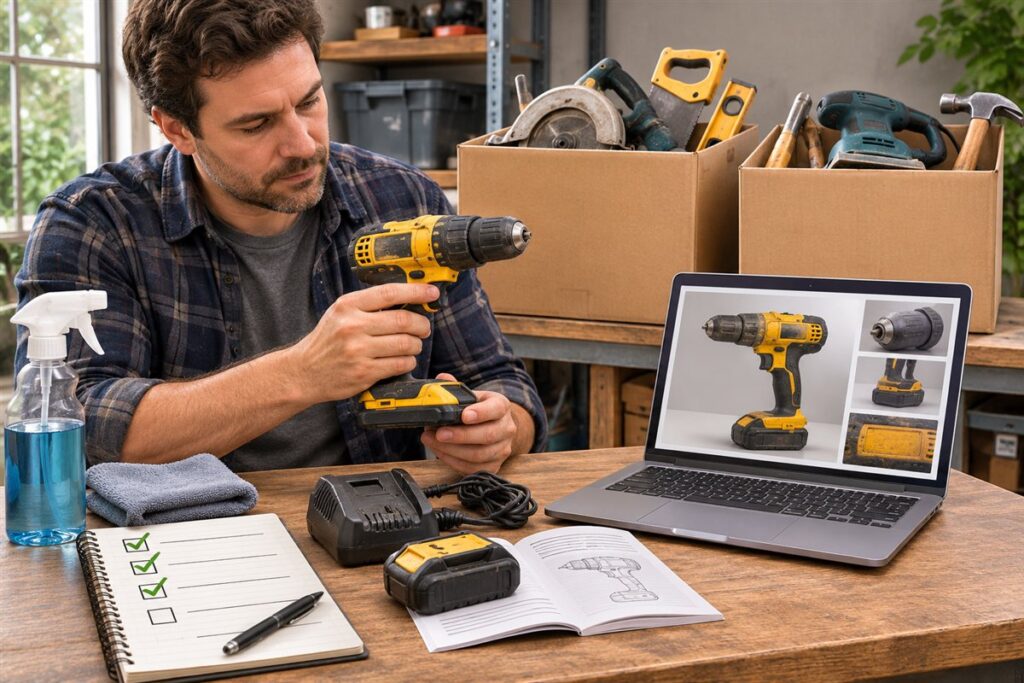
You can sell or donate old tools by checking that they work, cleaning them, describing them honestly and choosing a route that matches your goal. Selling can bring something back, and donating gets tools to people who can use them.
Decide Whether to Sell or Donate
- Sell if the tool is in good order, popular and worth the time to list and meet a buyer.
- Donate if you want a quick, simple handoff to a school, community workshop, charity or neighbor.
- Keep it if you will use it within a year, or if it is a spare for a job you do often.
- Recycle it if it is broken beyond reasonable repair, following local rules.
Check and Prepare Each Tool
- Inspect it for cracks, loose parts, damaged cords, worn guards and missing safety features. Anything unsafe to use should not be passed on.
- Check that it runs, using the maker’s manual, and note any faults.
- Remove batteries from tools that will not be handed over with a matching charger, or include the correct charger.
- Clean off dust and oil, and wipe bare steel dry.
- Gather the manual, case and accessories, or note where a copy of the manual can be found on the maker’s site.
- Take clear photos of all sides, including labels.
Be Honest in the Description
Say what the tool is, what condition it is in, and what is included. Mention any wear, repairs or faults. Avoid claims you cannot support, such as saying it has been fully serviced if it has not. A buyer or recipient who knows the facts is less likely to be disappointed, and honest notes protect you as well.
Routes Compared
| Route | Good for | Keep in mind |
|---|---|---|
| Local online listing | Bulky tools and sets | Meet in a public place and avoid sharing personal details |
| Garage or yard sale | Many small items | Be ready to bargain |
| Charity or school | Working tools in good condition | Ask what they accept first |
| Friend or family | Tools with a known history | Share what you know about their condition |
| Recycling point | Broken or unsafe tools | Follow local rules |
Power tools with older cords, damaged guards or unknown history are better recycled than passed on. Batteries that are worn or damaged should follow local collection rules rather than being given away.
Setting a Fair Asking Price
Pricing used tools is partly research and partly honesty. Start by looking at similar items for sale locally or online, and compare condition, age, included accessories and brand family. Notice what has actually sold, not just what is listed, since asking prices can run high. A tool with a matching battery and charger, a case and a manual is usually more appealing than a bare body.
Several factors affect how much buyers will pay. Battery tools depend on the battery system, and buyers often want packs that fit tools they already own, so a tool with a worn battery may be worth less than the same tool alone. Corded tools in good condition are often easier to price. Consider age, wear, any repairs and whether the model is still supported with parts and accessories.
- Leave room to bargain: many buyers expect to negotiate, so decide your lowest acceptable figure in advance.
- Bundle thoughtfully: a group of related tools or a full set can be more attractive than single items, but mixed lots may lower the price of the best piece.
- Be realistic about condition: a tool you value may be worth less to a stranger.
- Consider your time: if a small item would take a lot of effort to list and hand over, donating may be a better use of your time.
Do not claim specific performance or value that you cannot support. Describe what you know and let the buyer inspect the tool.
Photographing and Listing Effectively
A clear, honest listing attracts serious buyers and reduces time-wasting questions. Photograph each item in good daylight against a plain background. Show the whole tool, close-ups of labels and model information, any damage or wear, and everything that is included. Photos of the battery and charger labels help buyers check compatibility.
Write a title that names the type of tool and the maker if known, so people searching can find it. In the description, say how old the tool is if you know, how often you used it, whether it has been repaired and anything that does not work. List accessories included, such as case, bits, blades, manual, battery and charger. If you do not have the manual, mention where a copy can be found on the maker’s website.
Keep your language plain and factual. Avoid vague terms like “as new” unless that is accurate. State your pickup arrangements, and whether you will deliver or ship; shipping tools with batteries can involve special rules, so check the carrier’s guidance. Respond to questions promptly and be consistent with your answers. If someone asks for more photos or a video of the tool running, consider providing it, since it builds trust and helps the buyer decide.
Safety and Testing Before Handover
Your responsibility does not end at the sale. Anyone who receives a tool should be able to use it safely, so check it thoroughly before listing it. Inspect the cord, plug, housing, switch, guards and handles. Run the tool briefly, following the maker’s manual, and listen for unusual noises or smells. If it fails any check, either repair it properly through a qualified service or recycle it by local rules.
Remove blades, bits and sharp accessories from tools that will be transported, or cover them. Make sure guards are in place and working. Do not sell tools with disabled safety features, damaged insulation or missing parts. Include the manual where possible, and point to the safety information it contains. For items such as saws, grinders or nail guns, a short written note encouraging the buyer to read the manual before use is sensible.
When a buyer arrives, let them inspect the item and, if appropriate, demonstrate that it runs. Keep the demonstration safe, with the work area clear and eye protection available. For battery tools, charge the pack beforehand so it can be tested, and make sure the correct charger is included. Be clear about whether the sale is “as is”, and consider noting that in writing. This helps avoid disputes later and shows that you were upfront.
Choosing Where to Donate
Donated tools can be valuable to the right group, but not every organisation accepts every item. Before loading the car, contact the recipient and ask what they need and what condition they require. Schools, community workshops, makerspaces, training programs, tool libraries and charities each have different priorities, and many prefer hand tools and simple power tools with intact cords and guards.
Ask a few questions. Do they accept power tools or only hand tools? Do they have staff who will inspect donated items? Can they accept batteries and chargers? Is there a drop-off schedule? Some groups cannot accept items with known safety issues, or they may be limited by storage space. If your tools are a matching set, say so, since that can help them decide.
Prepare donated tools in the same way you would for a sale: clean, dry, tested and complete with accessories. Pack them securely, with sharp edges covered, and label boxes if there are several types. Ask whether the organisation provides a receipt, and keep it for your records if you need one. Tax treatment of donations varies by country and situation, so check with a qualified adviser or the relevant authority instead of assuming. Never donate items you would not be willing to use yourself.
Meeting Buyers and Completing the Sale
Selling to strangers calls for common-sense precautions. Meet in a public place if you can, or have someone with you when the buyer visits your home, and keep the tools you are selling in one area so people do not wander through the house. Avoid sharing more personal information than necessary, and keep communication within the platform’s messaging system where possible.
Agree the price and payment method before meeting. Be cautious about unusual payment arrangements, overpayments, requests to ship before payment clears or pressure to act quickly. Cash in person is common for small sales, while other methods carry their own risks, so check the platform’s guidance. Count cash carefully, and consider checking notes in daylight.
Once the sale is made, hand over the tool with its accessories and manual, and remove the listing right away so you do not get further enquiries. Take a note of what was sold and for how much, which helps with your own records. If the buyer later has a question, a short, polite reply is usually enough. Keep expectations modest, and remember that if an item does not sell after a reasonable time, you can lower the price, relist it, donate it or recycle it by local rules.
FAQ
Do I need the original box?
No, though cases, manuals and accessories make a tool easier to pass on and more useful to its next owner.
Should I sharpen blades first?
Sharpening can help, but only if you know how to do it properly or can use a qualified service. Otherwise, say plainly that the edge is worn.
Should I sell tools individually or as a lot?
Individual sales can bring more for strong items but take more time. A lot sells faster and suits mixed or low-value tools. Consider selling the best pieces separately and grouping the rest.
Can I sell a tool with a damaged battery?
Be upfront about it and, if the battery is damaged, swollen or leaking, do not sell it; recycle it by local rules. A tool can be sold without a battery if the listing says so clearly.
Is it safe to ship power tools?
Tools without batteries are usually simpler to ship. Lithium batteries often face carrier restrictions, so check the courier's rules before sending. Pack tools securely with sharp parts covered.
What if the buyer says the tool does not work after the sale?
Having described the tool honestly and let the buyer inspect it helps. If you sold it as-is, make that clear in the listing. Answer politely and decide whether a goodwill gesture is appropriate.
How do I find a local tool library or makerspace?
Search online for community workshops, ask at libraries or local councils, or look at community notice boards. Many such groups publish what they accept and when.
Should I wipe off brand labels or markings?
No. Labels and model numbers help buyers check compatibility and parts. Clean them gently so they stay readable.
Can I donate tools that need minor repairs?
Some groups welcome repair projects, but many prefer working items. Ask first and describe the fault. Do not donate anything unsafe.
The Short Version
Inspect, clean and describe each tool honestly, then sell it, give it away or recycle it. Pass on only tools that are in sound condition.