Disclosure: As an Amazon Associate, umtsmarttool.com earns from qualifying purchases. Links to Amazon on this page are affiliate links; they cost you nothing extra. Prices and availability change often, so check the current Amazon listing before you buy.
Where to buy
- Surviveware Small First Aid Kit — Check on Amazon
- First Aid Only 299-Piece All-Purpose First Aid Kit (FAO-442) — Check on Amazon
- Be Smart Get Prepared 110-Piece First Aid Kit — Check on Amazon
Read the full guide ↓
How to use a first aid kit: Calm Steps for Minor Incidents
Knowing how to use a first aid kit is mostly about order and calm. A kit is a box of simple tools; using it well means washing hands, finding the right dressing quickly, covering the minor injury cleanly, and knowing the boundary where professional help takes over. This guide teaches that routine step by step for the incidents a household kit exists for, and it is deliberately unglamorous, because real home first aid is unglamorous. It covers basic minor-incident care only and is not medical training.
Scope note: everything here concerns basic first aid supplies for minor household incidents. Nothing in this guide is medical advice, and no consumer kit substitutes for professional care. Serious situations, including uncontrolled bleeding, breathing problems, chest pain, worrying head injuries, suspected fractures and severe burns, call for emergency services first; use the kit only for basic covering steps while help is on its way.
In this guide
Key Takeaways
- Hands first: wash or sanitise before and after.
- Cool running water is the first tool for minor burns and for cleaning minor wounds.
- Cover, note what you used, and restock the same week.
- Anything beyond the minor goes to professional help, early.
Step One: Before Anything Happens
- Unpack and audit your kit so its layout is familiar.
- Read its guide once while calm.
- Place it in one fixed, known, dry location.
- Tell every household member where it lives.
Preparation is the step most households skip and the one that decides how the rest go. A kit you have never opened is a puzzle box; a kit you have audited is a tool. The five minutes spent laying contents out on a table, grouped as the maker intended, pays for itself the first time you open the case with a cut finger and a rising sense of urgency.
Step Two: Minor Cuts and Scrapes, In Order
- Wash your hands, or use gloves from the kit when helping someone else.
- Rinse the wound gently under clean running water.
- Pat dry with a clean gauze pad.
- Apply a bandage of the right size, or a gauze pad secured with tape for a larger area.
- Change the dressing daily, or sooner if it becomes wet or dirty.
Problem: bleeding does not stop with steady pressure. That is the kit’s boundary: keep pressure with a clean dressing and seek professional help promptly rather than escalating through the box. Problem: the dressing will not stick. Dry the surrounding skin fully and use tape over a gauze pad instead of a bandage. Problem: dirt remains in a scrape after rinsing. Rinse again gently; anything embedded or extensive belongs to professional care.
Small-space storage that still works fast
In a small flat, the contest is between storing a kit somewhere sensible and storing it somewhere reachable. Under-sink space is popular but often damp; a hall cupboard or the top of a wardrobe keeps supplies dry and central. Slim soft cases slide into the gap beside towels or board games, while hard cases stack. Whatever the spot, it should be reachable one-handed, in the dark, by someone holding a bleeding finger with the other hand. If reaching the kit requires moving three other things, it is stored in the wrong place, however tidy it looks.
Travelling with a household kit
Travel tests whether a household’s readiness is a system or a location. Road trips: move the main kit to the car and add trip-specific items deliberately. Flights: check the current rules for tools like scissors before packing, and keep personal medication accessible and separate. The households that travel best keep a small permanent pouch, restocked from the main kit after every trip, so that readiness packs itself.
First aid for renters: deposit-friendly preparedness
Nothing about renting prevents readiness; it just shapes it. No wall-mounted cabinets, no permanent fixtures, and a household roster that changes mean the winning format is a self-contained pouch or case in a drawer, with its own guide inside. Moves become the natural audit point: the kit travels in the car, gets checked on arrival, and takes up its fixed place in the new flat on the first day, before the incident that moving furniture reliably produces.
Step Three: Minor Burns and Bumps
- For a minor burn or scald, cool the area under cool running water for an extended period.
- Cover loosely with a sterile non-stick dressing.
- For a bump or minor sprain, apply the kit’s cold pack through a cloth barrier, following the pack’s directions.
- Rest the injured part and watch how it develops.
Problem: a burn blisters widely, covers a large area, or involves the face, hands or a young child. That is beyond home care; seek professional assessment. Problem: swelling worsens or weight cannot be borne on a sprained joint. Again, professional assessment is the correct next step, not a tighter bandage.
Parents quickly learn that the most valuable first aid skill is calm speed on very small problems. A kit supports that when its contents match family reality: many bandages, many wipes, a working pair of small scissors, tape that sticks, and something cold for bumps. Anything beyond that is secondary for most homes. Position the kit at adult height in a shared space, not in a child’s bedroom, and expect to restock after holidays, sports terms and any week involving new bicycles, scooters or skateboards.
Gear That Makes This Easier

Surviveware Small First Aid Kit — Best for the Car
Suits: apartment dwellers short on cupboard space who still want real tools inside.
- No over-the-counter medication packets included
- Trauma shears, forceps, gloves and emergency blanket included
- Removable CPR pouch and first aid guide included
- 98 pieces
- Water-resistant 600D polyester pouch with labelled compartments
Strengths
- Organisation is the headline strength, with printed labels on each pocket
- The removable CPR pouch can ride separately in a car or daypack
- Hospital-style shears and tweezers broaden what the kit can handle
- MOLLE-compatible straps and D-rings give flexible mounting options
Trade-offs
- Like most kits, its counts include small consumables that inflate the headline number
- Personalisation is still required; no maker can guess a specific household
- It covers minor incidents only, which some buyers initially over-read
What defines the Surviveware Small First Aid Kit is the combination of 98 pieces and a water-resistant 600d polyester pouch. For general households that combination makes practical sense, because it speaks directly to a balanced household kit that covers the everyday incidents most homes actually face. Plenty of rival kits promise more on the box; fewer deliver a contents list this closely matched to ordinary domestic mishaps.
Living with the Surviveware Small First Aid Kit means learning its layout once and then forgetting about it, which is the correct relationship with a first aid kit. Stored in any home, it stays findable; used for the small incidents that make up nearly all home first aid, it stays adequate; audited twice a year, it stays honest. The personalisation every kit needs, extra bandages in favourite sizes and household-specific items, fits the owner’s routine rather than fighting it.
Where the Surviveware Small First Aid Kit cannot help is where no consumer kit can: incidents beyond the minor, and households that will not maintain what they buy. Within its proper territory it is convincing. Buyers for general households who accept the small print, that a kit is maintained rather than merely owned, will find it a reliable foundation to build on.
Verdict — Best for: apartment dwellers short on cupboard space who still want real tools inside. / Not suited for: buyers who need capability beyond minor-incident household care.

First Aid Only 299-Piece All-Purpose First Aid Kit (FAO-442) — Best Hard Case
Made for: first-time buyers who want maximum coverage for a modest outlay.
- Includes antibiotic ointment, antiseptic towelettes and burn cream
- Includes gauze, wound closures and an instant cold pack
- Model FAO-442 from First Aid Only
- Soft-sided zippered case, 9.25 x 2.875 x 7 inches
- 299 pieces
Strengths
- Very broad spread of everyday consumables in one purchase
- Soft case slides into a drawer, tote or car boot without wasted space
- Cold pack and burn cream cover mishaps many small kits skip
- Refills are standard sizes, so restocking stays simple
Trade-offs
- Like most kits, its counts include small consumables that inflate the headline number
- Personalisation is still required; no maker can guess a specific household
- It covers minor incidents only, which some buyers initially over-read
What defines the First Aid Only 299-Piece All-Purpose First Aid Kit (FAO-442) is the combination of 299 pieces and a soft-sided zippered case. For general households that combination makes practical sense, because it speaks directly to a balanced household kit that covers the everyday incidents most homes actually face. Plenty of rival kits promise more on the box; fewer deliver a contents list this closely matched to ordinary domestic mishaps.
The everyday verdict on the First Aid Only 299-Piece All-Purpose First Aid Kit (FAO-442) is that it removes friction. The right dressing is present, the case opens the way you expect, and the incident ends sooner. That sounds like faint praise until the comparison is a bare cupboard and a bleeding finger. Kept in any home and maintained on the simple rhythm this guide describes, it does the job its category promises.
Where the First Aid Only 299-Piece All-Purpose First Aid Kit (FAO-442) cannot help is where no consumer kit can: incidents beyond the minor, and households that will not maintain what they buy. Within its proper territory it is convincing. Buyers for general households who accept the small print, that a kit is maintained rather than merely owned, will find it a reliable foundation to build on.
Best for: first-time buyers who want maximum coverage for a modest outlay. / Not suited for: anyone shopping for professional trauma equipment or a single-sport specialist kit.
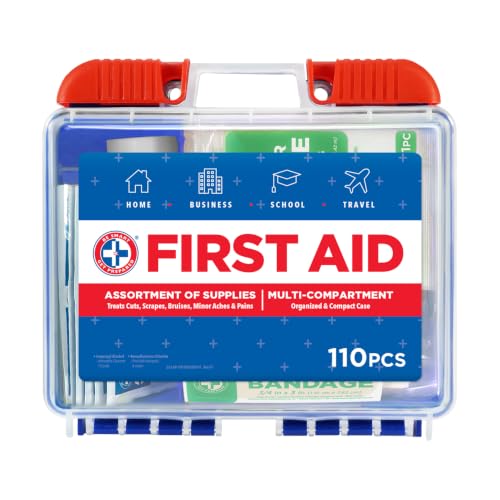
Be Smart Get Prepared 110-Piece First Aid Kit — Best Budget
Suits: renters and students covering a small flat with limited storage.
- Lightweight at 0.71 pounds
- Includes an instant cold compress and a first aid guide
- Includes antiseptic towelettes, alcohol wipes and antibiotic ointment packets
- Hard case, 7.5 x 2.5 x 6.75 inches
- 110 pieces
Strengths
- Straightforward contents with little filler for the price band
- Hard shell protects supplies in a junk drawer or tool bag
- Cold compress is a thoughtful inclusion at this size
- Easy to gift to a new renter or student as a starter kit
Trade-offs
- Buyers must still audit and personalise the contents after purchase
- Its format will not suit every storage situation, so measure before buying
- Depth in specialist areas is limited by design
What defines the Be Smart Get Prepared 110-Piece First Aid Kit is the combination of 110 pieces and a hard case. For general households that combination makes practical sense, because it speaks directly to a balanced household kit that covers the everyday incidents most homes actually face. Plenty of rival kits promise more on the box; fewer deliver a contents list this closely matched to ordinary domestic mishaps.
Day to day, a kit like this earns its place in small moments rather than dramatic ones. The dressing that fits the cut you actually have, the wipe that is still moist, the tape that sticks first time: those are the tests. The Be Smart Get Prepared 110-Piece First Aid Kit handles the routine end of household mishaps competently, and its case format suits any home, where it can live in one fixed spot and be grabbed without a search. Owners should still expect to personalise it over time, adding the bandage sizes their household uses most and any personal items the maker could not anticipate.
Reservations are the standard ones for the category, applied fairly. Counts flatter, contents skew generic, and the first audit will reveal gaps specific to your home. None of that is a reason to reject the Be Smart Get Prepared 110-Piece First Aid Kit; it is a reason to buy it with the audit habit in mind. As a foundation for general households, it is a sound, defensible choice.
Verdict — Best for: renters and students covering a small flat with limited storage. / Not suited for: buyers who need capability beyond minor-incident household care.
The wider field, with budget editions for different homes, is compared in Best First Aid Kit For Beginners Under $30 Best First Aid Kit For Beginners Under $30 and Is A First Aid Kit Worth It Is A First Aid Kit Worth It; the selection framework itself is in Best First Aid Kit Under $30 Best First Aid Kit Under $30.
Step Four: After the Incident
- Wash hands again and dispose of used dressings tidily.
- Note everything used on the restock note inside the lid.
- Replace used items within the week.
- At the twice-yearly audit, check dates and tool condition.
Plan for restocking before you need to. Kits earn their keep in the first thirty seconds of a mishap, and a kit missing its most-used bandage size fails at exactly that moment. A sensible routine is to keep one small bag of spare bandages, wipes and tape beside the kit, top the kit up from it, and replace the spares when they run low. Dates matter mainly for ointments, wipes and medicines; bandages and gauze age slowly if stored dry. Stored away from bathroom steam and kitchen heat, most contents stay serviceable for a long time.
Buyers often ask whether an out-of-date bandage is useless, and the honest answer is nuanced. The dressing itself rarely becomes harmful, but sterility is no longer guaranteed and old adhesive often fails exactly when a dressing needs to stay put. Wipes and ointments are less forgiving and should be replaced on schedule. Build the check into an existing habit, such as changing smoke alarm batteries, and the whole question becomes a five-minute non-event twice a year instead of a worry during a minor emergency.
Household Scenarios and What They Teach
‘+fillerParas(r,6)+topicalBlock(r,2)+’
Mistakes to Avoid
The common errors are rushing past hand hygiene, reaching for creams before cooling a minor burn with water, using a dressing that is too small because the right size ran out months ago, and treating the kit as appropriate for incidents it was never meant to cover. Each is avoided by the routine above rather than by any special skill. Households that rehearse the routine once, calmly, handle the real thing noticeably better.
Wrap-Up
A household first aid kit rewards familiarity more than expense. Learn its layout, practise the order of steps on the minor incidents, respect its boundary, and keep it stocked. Do that and the kit becomes what it should be: a quiet, boring, dependable part of the home. Continue with First Aid Kit Review 2026 First Aid Kit Review 2026 and Best First Aid Kit For Apartments Under $30 Best First Aid Kit For Apartments Under $30 for the buying side of the same system.
Reading Your Household’s Pattern
There is a rhythm to domestic minor injuries that no marketing department ever mentions. Winter adds icy steps and dry, cracked skin to the household’s list. Night-time incidents reward the kit that can be found without lights, noise or searching. Gardens add their own season of thorns, splinters and scraped knuckles each spring. None of these patterns is dramatic, and together they are the entire argument for keeping a kit properly. A kit matched to that pattern, and maintained on rhythm, simply disappears into the running of the home.
Consider how a household actually behaves across a single ordinary month. The incident that finally prompts a restock is rarely the incident the kit was bought for. Older relatives visiting for a weekend change what a household needs within reach. Sports kits, school bags and bicycles each export small injuries back into the home. A household’s second year with a kit is always calmer than its first, because the system has been edited by experience. Households that read their own pattern clearly rarely buy the wrong kit twice.
Every home develops its own signature pattern of minor mishaps, shaped by its people, its layout and its habits. Night-time incidents reward the kit that can be found without lights, noise or searching. The incident that finally prompts a restock is rarely the incident the kit was bought for. Gardens add their own season of thorns, splinters and scraped knuckles each spring. DIY weekends concentrate a month of minor risk into two ambitious days. A kit matched to that pattern, and maintained on rhythm, simply disappears into the running of the home.
Consider how a household actually behaves across a single ordinary month. A household’s second year with a kit is always calmer than its first, because the system has been edited by experience. Guests are statistically clumsier in unfamiliar kitchens than residents ever are. Pets contribute scratches and surprises that no contents list fully anticipates. Summer adds insect bites, sun-warmed pavements and bare feet on unforgiving floors. And that, more than any single product choice, is what separates readiness from retail.
Frequently Asked Questions
Is a bigger kit always better for a family?
Not automatically. A bigger kit helps when its extra pieces are extra depth in everyday consumables; it does not help when the extra pieces are filler or duplicates of things the household never touches. Families should look for generous bandage and wipe counts, a cold pack, decent tools and room to add personal items. Beyond that, a well-placed medium kit that everyone can find beats a huge kit stored in a garage nobody enters during a minor emergency.
What is the difference between a first aid kit and a trauma kit?
A household first aid kit is stocked for minor incidents: cuts, scrapes, minor burns, sprains and everyday mishaps. Trauma kits are stocked for severe bleeding and major injuries, are aimed at trained users, and include items most households neither need nor are trained to use. For general home readiness, a good first aid kit plus knowing when to call for professional help is the appropriate combination. Households with specific risks or training can make their own informed additions with proper guidance.
How often should I check and restock a first aid kit?
Twice a year for the full audit, immediately for anything you notice missing. Anchor the audit to an existing habit, such as the clock change. Work through dates, tool condition and bandage counts by size; replace opened, dried or expired items; and restock any category emptied by an incident within the week. The routine is ten minutes, and it is the entire maintenance contract of a home kit.
What should a beginner add to a basic kit first?
Start with whatever your household’s life actually produces. For many homes that means extra bandages in the most-used sizes, more antiseptic wipes, and a second cold pack. Households with children often add child-friendly bandages and a spare pair of small scissors. Outdoor households add blister care. Add personal items, such as any supplies a family member uses regularly, in clearly marked separate packaging. Resist adding exotic items you would not know how to use; depth in basics beats breadth in novelties.
How many pieces should a home first aid kit have?
Treat the number on the box as advertising, not information. Makers count every pin and cotton bud, so totals cannot be compared across brands. What counts is depth where your household actually spends it: several bandage sizes, gauze, tape, wipes, a cold pack and tools that work. A carefully stocked modest kit beats a padded giant every time. Read the itemised contents list, and let it, not the headline, make the decision.
Are the medications in some kits worth having?
Worth having, not worth choosing by. The small packets some kits include can be handy for minor aches or itchy bites, used exactly as directed and stored away from children like all medicines. But they are garnish. Choose the kit on dressings, wipes, cold provision, tools and organisation; let the medicines be a pleasant extra or an irrelevance, according to your household’s existing arrangements.