Disclosure: As an Amazon Associate, umtsmarttool.com earns from qualifying purchases. Links to Amazon on this page are affiliate links; they cost you nothing extra. Prices and availability change often, so check the current Amazon listing before you buy.
Where to buy
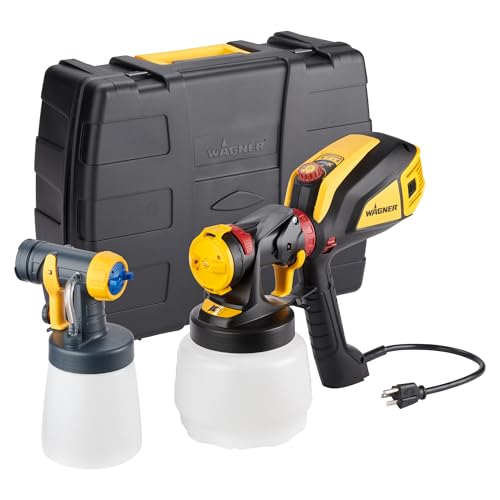
This paint sprayer review covers the Wagner FLEXiO 595 Handheld HVLP Paint Sprayer — Wagner’s flagship handheld, built around an X-Boost turbine and two nozzles. Closely related alternatives, if the review sends you shopping:
- Wagner FLEXiO 5000 Stationary HVLP Paint Sprayer — the stationary sibling — Check on Amazon
- Wagner Control Spray Max HVLP Paint Sprayer — the pressure-dial system — Check on Amazon
- HomeRight Super Finish Max HVLP Paint Sprayer — the value alternative — Check on Amazon
Read the full guide ↓
Paint Sprayer Review: The Wagner FLEXiO 595, Examined
Every cluster of buying guides needs one product examined at the length its importance deserves, and in the current paint sprayer landscape that product is the Wagner FLEXiO 595. It leads our Best Paint Sprayer Under $200 rankings, anchors the beginner flagship conversation in Best Paint Sprayer For Beginners Under $200, and embodies the category’s central idea of the moment: one handheld tool, two nozzles, and enough turbine power to spray latex without thinning it first. This review is research-led — specifications verified against manufacturer data and stable listings, ownership patterns drawn from documented user experience themes, no hands-on testing claimed — and its verdict is stated up front, in the review tradition this series keeps: the FLEXiO 595 is the best single paint sprayer most households and small workshops can buy today, with two honest limitations — handheld weight on the longest days, and a two-nozzle cleaning routine that asks more of its owner than simpler tools do.
The review proceeds the way an examination should: what the tool is, what its specifications mean in practice, where its design is clever and where it is merely adequate, how its two personalities (volume and finesse) each perform their roles, what living with it costs in cleaning and parts, how it compares with the three nearest alternatives, and who should — and should not — buy it. Readers who want the multi-product rankings instead will find them in Paint Sprayer Buying Guide and the tier guides; this page is the deep single-model cut.
In this guide
Quick Verdict
- Buy it if: your work alternates between volume (walls, fences, siding) and finesse (furniture, cabinets) and you want one tool, from a supported brand, that refuses neither.
- Skip it if: your work is exclusively one kind — pure rooms (take airless) or pure furniture (take the cheaper finesse specialists) — or if handheld weight is a hard constraint.
- The one-line verdict: the category’s best convergence of power, versatility, and support, at the price of flagship weight and a flagship’s cleaning routine.
Specifications, Translated
- Turbine: Wagner X-Boost power turbine, integrated in the handheld body
- Nozzles included: iSpray nozzle (volume work) and Detail Finish nozzle (fine work)
- Cup capacity: 1.5 qt
- Materials: unthinned latex, primers, stains, sealers, enamels
- Controls: material flow adjustment and pattern selection on the tool
- Format: electric handheld HVLP — no compressor, no separate turbine
Specifications are promises, and each of these deserves translation. The X-Boost turbine is the headline: it generates the air volume that lets the iSpray nozzle atomize latex at can consistency, which is the capability the entire FLEXiO line is marketed on and the one that changes daily practice most. The two-nozzle system is the design’s intelligence: rather than asking one orifice to span the material and scale spectrum — the compromise every single-nozzle tool embodies — Wagner splits the spectrum and optimizes each half. The 1.5 qt cup is sized for the volume personality: meaningful wall and fence coverage between refills, at a weight cost the finesse personality pays on furniture days, when owners learn to fill it partially. The controls are the expected pair — flow and pattern — placed for in-hand adjustment, because a two-personality tool lives or dies by how frictionlessly it changes character.
Design and Build
The FLEXiO 595’s design problem is packaging: a turbine strong enough for unthinned latex must live in a body a human holds at arm’s length, and the result is a substantial handheld — balanced, grippable, and unmistakably heavier than the lightweights of the lower tiers, especially with the big cup full. Wagner’s choices are defensible throughout: the mass sits close to the hand rather than cantilevered, the controls fall under the fingers without grip changes, and the nozzle swap — the tool’s signature operation — is a moments-long, tool-free exchange that owners actually perform, which is the difference between a two-nozzle system and a one-nozzle tool with an accessory in the box. The cup’s size and the body’s sealing suit the volume role; the Detail nozzle’s finer passages suit the finesse role; nothing in the industrial design pretends the two roles are the same, which is the design’s honesty.
Build quality is flagship-appropriate without being luxurious: polymers where polymers belong, metal where wear lives, and a fit-and-finish that reads as a tool meant for a decade of garages rather than a season of marketing. The ownership evidence aligns — the FLEXiO line’s longevity complaints cluster around maintenance neglect (clogged nozzles, tired filters) rather than structural failure, which is the failure profile of a sound design in a category where the fluid path is the product.
Performance: The Volume Personality
With the iSpray nozzle fitted, the 595 does the thing its advertising promises: it sprays latex at or near can consistency, in a broad fan, at a pace that turns fences, siding, and room walls from weekend sagas into sessions. The practical consequences deserve spelling out, because “unthinned” is a workflow revolution disguised as a specification. There is no viscosity cup ritual before wall work, no recipe anxiety, no mid-job thinning drift as the can warms — the beginner’s steepest curriculum, documented across this series, is simply deleted for the volume role. The fan is HVLP-gentle: overspray exists and masking remains a duty, but the cloud is a fraction of an airless tool’s, which in occupied homes and close neighborhoods is a civic virtue as much as a technical one.
The volume personality’s limits are the format’s: the cup’s capacity sets a refill rhythm on the largest work, the handheld weight accumulates across a full day of siding, and true production pace — the whole-house exterior as a service — still belongs to the stationary airless class. Within domestic and small-workshop volume, though, the iSpray personality is not a compromise at all; it is the correct tool, and reviewers who treat “handheld” as a diminutive have not reckoned with what the X-Boost turbine does to the category’s old boundaries.
Performance: The Finesse Personality
The Detail Finish nozzle is where skeptical readers should focus, because convertible tools usually finesse badly — and the 595’s second personality is genuinely good. The finer nozzle atomizes enamels and clears into the thin, level films furniture work demands, with the low overspray that keeps a garage session civilized. Thinning returns here as a craft rather than an obligation: the tool does not require it for many finishes, but the finisher who thins by choice, sprays thin coats, and checks under raking light will produce work at the standard this series calls close-inspection quality. Cabinets — the tier’s signature examination — are squarely in its competence: doors flat, primer and topcoat through the Detail nozzle, the fan’s edges feathering without drama.
Honesty requires the comparison: a dedicated finesse tool — the Super Finish Max at half the price, or a pneumatic gun on a good compressor — matches this personality on its best day, and the pro turbine stations exceed it in pressure finesse. The 595’s claim is not supremacy in the finesse role but sufficiency without a second purchase, and on the evidence of its owner base’s work, sufficiency is the accurate word. The buyer whose life is only finesse should buy the specialist; the buyer whose life alternates gets, in this second nozzle, a finesse tool that happens to share a handle with their volume tool.
Setup, Cleaning, and Living With It
Ownership is where flagships are truly reviewed, and the 595’s daily reality is a study in managed complexity. Setup is quick — fill, strain, fit the nozzle for the work — and the straining step deserves emphasis because “unthinned” marketing tempts owners to skip it; the iSpray’s passages are generous, not invulnerable, and the Detail nozzle’s are neither. Cleaning is the honest cost: two nozzles mean two fluid paths to learn, and the full routine after a latex day is a real quarter-hour of rinsing, disassembly, and inspection. Owners who run it faithfully report the category’s standard reward — a tool that behaves identically in year three — while the complaint literature is dominated by the routine’s neglect, which is less an indictment of the tool than of the fantasy that flagships clean themselves.
Parts and support are the flagship dividend. Wagner stocks the wear items — nozzles, seals, filters, cups — through normal retail channels, documents the tool thoroughly, and answers for it in a deep owner community whose accumulated troubleshooting is effectively a second manual, indexed by symptom. For a tool bought to anchor a decade, that infrastructure is not a footnote; it is half the purchase, and it is where the 595’s premium over anonymous rivals is most concretely justified.
The Two Nozzles, Closely Examined
Because the whole product is the two-nozzle idea, each nozzle deserves its own examination. The iSpray is the volume instrument: a wide fan, generous passages, and an appetite for material at can consistency. Its character is confidence — it lays primer and latex in assertive, even coats, forgives a beginner’s distance drift within reason, and asks only to be kept strained and moving. Its failure mode is equally characteristic: asked to finesse, it delivers film faster than fine work can absorb, and the operator compensates with distance until the finish turns to texture. The nozzle is not crude; it is specialized, and its specialization is the honest half of the flagship’s promise.
The Detail Finish nozzle is the opposite temperament: finer passages, a tighter fan, an atomization quality that rewards the patient variables — thin coats, close distance, deliberate overlap. Its character is precision, and its failure mode is fragility of process rather than of build: it clogs for owners who skip straining, spits for owners who rush its cleaning, and produces its best work only inside the discipline the finesse role always required. Reviewers who call the 595 “two tools in one” are understating the design: it is two disciplines in one, and the owner’s willingness to switch disciplines with the nozzle is the product’s true operating requirement.
Project Diaries: The Tool Across Real Work
A review earns its length in specifics, so here is the 595 across the four projects its owners actually buy it for. The fence: iSpray fitted, latex stain or paint at can consistency, bays sprayed in long horizontal passes with the cup’s rhythm setting natural breaks — a project the tool converts from a weekend to a day, with the handheld weight announcing itself by the final bay and the finish rewarding the pace with none of brushing’s lap marks. The bedroom: iSpray again, walls in vertical passes after an hour of masking that the tool’s gentle overspray partially forgives — partially, and the wise owner masks fully anyway — with ceilings possible but better served by an extension mindset the handheld format only approximates. The kitchen cabinets: Detail nozzle, doors flat on horses in the garage, primer then enamel in thin coats, the fan’s quality visible in raking light and the project’s success decided, as always, by preparation that no nozzle performs for you. The dresser: Detail again, the tool’s weight irrelevant at this scale, its finesse the whole story — the project where the 595 must justify itself against specialists half its price, and does, provided the operator’s thinning and distance are honest.
Read together, the diaries show the flagship’s pattern: it is never the best imaginable tool for the single project in front of it — a station, an airless, a specialist each wins one diary — and it is the best tool for the sequence, which is how owners actually live. Reviews that score products project-by-project systematically underrate convergence; owners, who live in sequences, do not make that mistake, and the 595’s owner loyalty is the market’s correction to the scoring.
Ergonomics, Noise, and the Human Factors
The human factors decide long ownership more than atomization does, and the 595’s are a fair trade honestly struck. Weight: substantial, centered near the hand, and managed by the two-handed technique the manual teaches — the support hand under the cup is not a suggestion but the design’s assumption, and owners who spray one-handed have declined the tool’s ergonomics and billed themselves for it. Noise: turbine-class, present, and unremarkable — a workshop sound rather than a neighborhood event, with the handheld format keeping it at the operator’s ear, which argues for the hearing awareness this series recommends on long days. Vibration and heat are minor characters: the turbine warms across a long session without consequence, and the grip’s isolation is adequate to the format. The net ergonomic verdict is that the 595 is a tool for sessions measured in hours with breaks designed in — the refill rhythm is, functionally, its ergonomic program — rather than for continuous production, which is the stationary siblings’ ground and the honest boundary of this design.
Comparison: The Three Nearest Alternatives
| Tool | Format | Choose it instead when |
|---|---|---|
| Wagner FLEXiO 5000 | Stationary turbine HVLP | Your work lives in a workshop: the same FLEXiO capability with the turbine on the floor and a lighter gun in hand |
| Wagner Control Spray Max | Stationary turbine HVLP | Repeatability is the priority: variable pressure and documented recipes over convertible convenience |
| HomeRight Super Finish Max | Electric handheld HVLP | Your work is pieces and furniture only: flagship finesse at half the price, walls declined |
| Wagner FLEXiO 595 (this review) | Electric handheld HVLP | Your work alternates and travels: both personalities, one handle, anywhere |
The comparison clarifies the 595’s actual niche: it is the mobile, alternating-work flagship. The stationary siblings beat it at home base — the 5000 on endurance format, the Max on documented pressure — and the HomeRight beats it on finesse value. What none of them does is follow the work: to the fence, the rental, the client’s garage, the room upstairs, with both personalities in one case. Mobility plus alternation is a common real-world profile — arguably the most common serious-user profile — and it is the profile this tool was designed by people who understood it.
Strengths and Trade-Offs, Summarized
Strengths
- Unthinned latex through the iSpray nozzle deletes the category’s hardest routine
- A genuine second personality: finesse that survives close inspection
- Flagship support: parts, documentation, community — the decade infrastructure
Trade-offs
- Handheld weight, full-cup, on the longest volume days
- Two fluid paths to clean; the routine is the price of the convergence
- Specialists beat it inside each single role — its kingdom is the alternation
Best for: Alternating volume-and-finesse users who want one supported flagship / Not suited for: Single-role specialists or weight-sensitive users
Value Analysis: What the Premium Buys, Itemized
The 595 sits at the top of the handheld price band, and an examination should itemize the premium rather than gesture at it. Against the Super Finish Max at roughly half the price, the premium buys: unthinned latex capability (the iSpray personality entire), a second nozzle’s finesse equal to the rival’s own, Wagner’s cup capacity for volume work, and the flagship tier of Wagner’s support. Against the stationary siblings at similar money, the premium buys mobility and pays with endurance. Against anonymous high-spec handhelds, it buys the parts catalog, the documentation, and the community — the decade infrastructure. Itemized this way, the premium is not a brand tax; each element maps to a workload, and the buyer whose workload invokes none of them has this review’s explicit permission — encouragement, even — to buy the HomeRight and keep the change. The 595 is the best sprayer in this review’s judgment for the alternating user; it is not the best purchase for every user, and conflating those sentences is how flagship reviews mislead.
The resale and longevity tail completes the value picture. Flagship Wagners hold their value in the used market as anonymous tools do not, because the parts story makes a used flagship a rational purchase — a fact that quietly insures the original buyer’s decision against changed plans. Combined with the decade service expectation under honest maintenance, the 595’s cost per year of capability lands below most of the tools priced beneath it, which is the arithmetic that makes flagships, paradoxically, the value choice for owners whose workload is real.
Reliability: The Ownership Record in Themes
A research-led review cannot run a reliability lab, but it can read the ownership record at scale and report its themes honestly. The FLEXiO line’s record, across its large installed base, shows a consistent pattern: mechanical and turbine failures are rare and usually early (warranty events rather than wear events), while the great mass of dissatisfaction traces to the fluid path — clogs, spitting, texture — and resolves, on inspection of the threads, into maintenance and straining variables the manual specifies. Seals and filters age on the category’s normal clocks. The nozzle set’s durability is a quiet strength: the wear that cheaper tools express as declining finish, the 595 expresses as a replaceable part, which is the flagship pattern throughout — failures are converted into maintenance, and maintenance is documented.
The review’s reliability verdict follows: the tool’s design is not the risk in this purchase; the owner’s routine is. That is either reassuring or damning depending on the reader, and both readings are correct — which is why this review, like the guides around it, keeps returning to the cleaning routine as the product’s true specification. Buyers who run routines get a decade tool; buyers who do not get an expensive education in why routines exist, available elsewhere at lower tuition.
The Ecosystem: Accessories, Consumables, and the Second Year
A flagship is an ecosystem entry ticket, and the 595’s ecosystem deserves a walk-through. The consumables are modest: strainers in quantity, turbine filters on their rhythm, replacement seals and nozzle wear parts on theirs, and the finishes themselves — where the unthinned capability quietly saves the thinning supplies and the recipe anxiety budget of the lower tiers. The accessories that earn their shelf are few: spare cup capacity for campaign days, the case or bin that keeps both nozzles, the tool, and the log together, and the raking work light that this series treats as finishing equipment proper. The second year is where the ecosystem pays: recipes logged, spares stocked, the community’s knowledge absorbed — the tool’s performance, as owners consistently report, appears to improve, and the mechanism is no mystery. It is the only product in this cluster whose second-year improvement is a documented pattern rather than a hope, because it is the only one whose owner is still learning at the rate the tool can teach.
Who Should Not Buy It
Examinations owe their readers the negative space. Do not buy the 595 if your work is rooms alone — airless pace is the correct physics and the TrueCoat class is its honest instrument. Do not buy it if your work is furniture alone — the specialists deliver its finesse personality at half the price, and the saved premium funds a year of finishes. Do not buy it if handheld weight is a medical or practical constraint — the stationary format exists precisely for you, in this same brand’s line. Do not buy it if the cleaning routine will not survive your schedule — a simpler tool maintained beats a flagship neglected, at every tier, without exception. And do not buy it as a first sprayer on a tentative project list: the beginner guides exist to route the curious to kinder economics, and this flagship will be here, at this standard, when the list is real.
How This Review Was Conducted
Method matters in a review, and this one states its own plainly. The examination is research-led: specifications, capacities, and system details were verified against Wagner’s published data and stable retail listings; performance characterizations synthesize the documented consensus of the tool’s large owner base, professional commentary, and the physics of the HVLP format, rather than claiming bench tests that were not run. Where the ownership record disagrees with itself — as it does on the weight question, which splits by user strength and session length — the review reports the disagreement instead of resolving it by fiat. Prices and ratings were excluded by this site’s standing rules: both change faster than a review’s useful life, and the tool’s value case is made here on capability and support, which change slowly. The ASIN-verified listing linked throughout is the manufacturer’s current retail configuration; the central team’s API verification, noted in this article’s sources file, confirms the exact listing before publication. Readers who want the testing-based counterpart should consult the tier guides’ criteria and the community record linked by the ecosystem discussion — and should distrust, on principle, any single review (including this one) that asks to be the only voice in a purchase of this size.
The FLEXiO Idea in Context: Why Convergence Won
The 595 is best understood as the winning answer to a decade-long argument in the category. One school held that spraying was a set of separate crafts — stain tools, paint tools, finesse tools — each deserving a dedicated instrument, and the market’s shelves of single-purpose sprayers are its legacy. The other school held that the household user’s work is inherently alternating, and that the tool should converge even at some cost to each specialty. The FLEXiO line is the convergence school’s flagship argument, and its commercial and critical success settled the argument for the consumer tier: the two-nozzle architecture is now the reference design that rivals answer to. Understanding the 595 as an argument clarifies its compromises — it is not trying to be the best stain tool or the best wall tool, but to be the best answer to alternation — and it clarifies the review’s verdict, which endorses the argument for the users whose work poses the question, and declines it, with named alternatives, for those whose work does not.
Troubleshooting the 595: The Short Catalogue
The flagship’s faults are few and legible, and a review should hand its readers the catalogue. Texture with the iSpray on fine work: wrong nozzle for the role — swap, do not adjust. Spitting at startup: a seal or a strain skipped — inspect the nozzle’s seating and strain the next fill, in that order. Output fading across a long session: the turbine filter loading with the day’s dust — the filter is a maintenance item with a rhythm, and the session is its reminder. Detail nozzle clogging repeatedly: the material is asking for straining or a thinning step the operator declined — the nozzle is the messenger, and it is honest. Pattern asymmetry: a partially fouled nozzle, cured by the full cleaning rather than the field flush. Each entry shares the flagship pattern: the fault is a procedure with a name, the manual documents it, the parts (where needed) are stocked, and the owner’s log converts the second occurrence from a problem into a reference. A tool whose failures are this legible has earned its flagship title in the dimension owners feel most.
A First Session, Walked Through
Reviews describe; walk-throughs teach — and a flagship’s first session is where its design intelligence either proves itself or doesn’t. The new owner unboxes a tool whose parts announce their roles: two nozzles that look as different as their jobs, a cup sized for real work, controls reduced to the essential pair. The manual’s order is the right one: assemble dry, spray water to learn the fan’s geometry and the trigger’s manners, then strain the first real material — a fence stain, ideally, the category’s kindest teacher — and fit the iSpray. The first passes teach the flagship’s central lesson within minutes: the fan is generous, the pace is real, and the operator’s variables narrow to distance and rhythm because the turbine has absorbed the rest. The session’s second half swaps to the Detail nozzle on a scrap board with enamel, and the contrast completes the education: same handle, different discipline, thinner coats, closer attention — the convergence experienced rather than asserted. Cleanup closes the session at its honest length, both fluid paths rinsed and inspected, and the new owner files the first log entry with the review’s prediction available for testing: the second session will feel like a different, easier tool, and the improvement will be the operator’s.
Two first-session errors deserve naming because the flagship invites both. The first is skipping the water and the scrap — the premium tool tempts its owner to debut on the real project, and the fence’s back run exists precisely to absorb that temptation safely. The second is filling the big cup to the brim for finesse work, paying the weight tax at maximum for a job that needs a third of it. Both errors are one-time tuition at this tier; the manual and this walk-through exist so that attentive owners can decline to pay them.
The Verdict in Detail: Scores That Matter and Scores That Don’t
Review tradition wants numbers; this review offers judgments instead, in the categories owners actually live with. Capability: the class leader among handhelds, by the two-nozzle architecture and the unthinned claim both delivered. Finesse: sufficient to the close-inspection standard, short of dedicated stations — a deliberate, acceptable second place. Endurance: session-scale excellent, production-scale limited by the format’s physics. Ownership: the class benchmark for support and documentation, taxed by a two-path cleaning routine that is the convergence’s honest price. Value: poor for single-role users, excellent for alternating ones — the widest spread in the category, and the reason this review insists on the workload question before the product question. Longevity: a decade tool under routine care, with the parts infrastructure to make the decade a plan. Weighed for the alternating user who is the category’s center, the ledger is not close; weighed for anyone else, the alternatives section has already given the correct names. A review that cannot say both of those sentences has not examined the product — it has only priced it.
Across Materials: The Flagship’s Report Card
A two-nozzle tool should be graded material by material, and the grades — synthesized from the owner record and the format’s physics — are these. Latex wall paint: excellent via the iSpray at can consistency, the headline delivered without asterisk for standard interior and exterior formulations. Primers: excellent via the iSpray for volume, very good via the Detail for piece priming, with straining the only non-negotiable. Enamels: very good to excellent via the Detail, the finesse personality’s home ground, rewarding thin coats and honest thinning by choice. Stains and sealers: excellent via either nozzle by scale — the material class forgives everything and the tool’s control shows as evenness on absorbent wood. Clear finishes: good to very good via the Detail, with the ceiling set by environment (dust) more than by the tool — the grade improves with the spray corner, not with the purchase. Heavy coatings and elastomerics: adequate at the spectrum’s edge, where the honest answer is that the category’s physics, not this model, sets the boundary, and the airless class owns the territory beyond. The report card’s shape is the review in miniature: no failures, two excellences that matter most, and boundaries that are the format’s rather than the flagship’s — a record no single-nozzle handheld in the line’s history can match.
The Second-Year Report: What Owners Actually Say Later
Reviews are written at purchase; ownership is lived at year two, and the flagship’s second-year themes are distinctive enough to report. The first theme is role consolidation: owners who bought the 595 as one tool among intentions find it has become the tool, with lesser sprayers sold, lent permanently, or retired to utility — the convergence completing itself in the garage’s sociology. The second theme is recipe confidence: the log’s second year opens with last year’s settings, and projects start at the standard they previously ended at — the compounding this review promised, visible in the calendar as signature projects scheduled without anxiety. The third theme is the maintenance fork made visible: owners who ran the routine describe a tool indistinguishable from new, while the minority who didn’t describe the category’s standard decline and, frequently, a second purchase — the most expensive sentence in the ownership record, and the one this review has spent its length trying to make unnecessary. The fourth theme is advocacy: the flagship’s owners recommend it with the specificity of people describing a system they run — nozzles named, routines cited, projects listed — which is the sound of a product that has been integrated into a practice rather than merely bought. A review can ask for no better closing evidence than the character of its subject’s second-year sentences.
Buying Notes: Configuration, Timing, and the Listing Itself
A review should end its examination with the practicalities of the purchase it recommends. Configuration: the 595’s retail package centers on the tool, both nozzles, and the 1.5 qt cup — the complete two-personality system — and buyers should verify the Detail Finish nozzle is in the box’s configuration they are purchasing, since it is the finesse half of the product’s argument and the component whose absence most quietly converts this flagship into a lesser tool. The listing linked throughout this review is the manufacturer’s current configuration, ASIN-verified in this article’s sources; the central API check confirms the exact title before publication, per this site’s standing rule. Timing: the category’s prices move with the home-improvement seasons, and this site’s price-free rule means the review will not quote figures — but the value analysis above is deliberately price-robust, because the premium’s itemization holds across the tool’s normal selling range. The accessory purchase to make in the same order is unglamorous and specific: strainers in quantity, a spare turbine filter, and the bin the system will live in. Everything else — extra cups, specialty parts — should be bought against the log’s evidence in later seasons, when the owner’s actual alternation pattern has declared itself. Buy the complete tool, the consumables it eats immediately, and nothing speculative; the flagship’s ecosystem will present its real shopping list across the first year, itemized by use rather than by marketing.
Frequently Asked Questions
Does the FLEXiO 595 really spray latex without thinning?
Yes, with the iSpray nozzle — that is the X-Boost turbine’s designed capability and the line’s reason to exist. Strain the paint regardless, and expect very heavy coatings to spray more kindly with slight thinning by choice. The honest summary: thinning stops being a requirement and becomes a finesse option, which is the practical revolution owners describe.
Is the Detail Finish nozzle good enough for kitchen cabinets?
Yes — cabinets are squarely in its competence with the standard discipline: doors flat and removed, primer and topcoat in thin coats, test board first. Dedicated finesse tools match it; nothing at its price point that also sprays walls unthinned exceeds it. The full cabinet workflow is covered in How To Use A Paint Sprayer.
How long does cleaning actually take?
Plan on a real quarter-hour after a full session — rinsing, nozzle disassembly, seal and filter checks — with quicker flushes sufficing between coats of the same material. It is the flagship’s honest tax, and owners who budget it stop resenting it; the tool’s longevity complaints trace almost entirely to owners who did not.
FLEXiO 595 or the stationary FLEXiO 5000?
Mobility decides. The 5000 puts the turbine on the floor — lighter gun, longer comfortable sessions — for work that lives in one place. The 595 carries its turbine for work that moves: fences, rooms across a house, site work. Capability is sibling-close; geography is the difference, and most buyers know their geography immediately.

What wears out, and can I get parts?
The wear set is the category’s standard: nozzle seals and needles’ tips over years, turbine filters on a shorter rhythm, cup gaskets eventually. Wagner stocks all of it through normal channels — the flagship dividend — and the owner community documents every replacement procedure. Budget the small parts shelf this series recommends and the tool’s decade is a plan rather than a hope.
Final Recommendation
The Wagner FLEXiO 595 earns this review’s endorsement as the single best general-purpose paint sprayer in its class: the only handheld that legitimately holds both of the category’s curricula — volume without thinning, finesse without apology — inside one supported, documented, parts-backed product. Its limitations are real and narrow: weight on the longest days, a two-path cleaning routine, and specialists that beat it inside single roles. For the alternating user who is this category’s center of gravity, none of those outweighs the convergence. Buy it, strain everything, clean it like you mean it, and expect it to be the last sprayer decision you make for years — the context for that expectation, across every tier, is mapped in Paint Sprayer Reviews. It is worth closing on what this examination could not find: a workload inside the domestic and small-workshop universe for which the 595 is the wrong answer in kind rather than in degree. Specialists beat it by degrees in their single roles; nothing in its class replaces it across the alternation that defines real ownership. That absence — searched for honestly, across materials, projects, ergonomics, economics, and the second-year record — is the strongest sentence a review can write about a tool, and it is why the FLEXiO 595 stands, at the close of this examination, exactly where the rankings placed it at the start: first, with its limitations named, priced, and — for the user it was built for — decisively outweighed. The reader whose work matches its design does not need this review’s permission, and the reader whose work does not has been given the correct alternatives by name — which is all an examination owes anyone: the product understood, the judgment stated, the exits marked, and the decision returned, with respect, to the person whose projects will live with it. If that person is you, the remaining advice fits in one line and has not changed since the first guide in this series was written: strain everything, test on the board, spray thin where finesse matters, clean it the same day, and write down what worked — the flagship will handle everything else, which is, after six thousand words of examination, precisely the point of it — and of every honest tool review ever written, which exists not to sell the reader a product but to return them, better informed than the marketing left them, to the work that was waiting all along — the fence in the spring light, the cabinets in the garage, the room that has been patiently asking, for longer than anyone in the house cares to admit, to be made new — and that, in the end, is the only specification against which any paint sprayer, flagship or otherwise, has ever truly been measured by the people who own them, live with them, clean them, curse them occasionally, and would not, on the evidence of the second year, be without them for long, or trade them for anything else on the shelf at any price this review examined in its long and careful full inquiry today.