Disclosure: As an Amazon Associate, umtsmarttool.com earns from qualifying purchases. Links to Amazon on this page are affiliate links; they cost you nothing extra. Prices and availability change often, so check the current Amazon listing before you buy.
Where to buy
Shopping for the best paint sprayer under $200? Start with the Wagner FLEXiO 595 Handheld HVLP Paint Sprayer — the tier’s defining tool, spraying unthinned latex with two nozzles for two kinds of work. The full shortlist:
- Wagner FLEXiO 595 Handheld HVLP Paint Sprayer — Best Overall Under $200 — Check on Amazon
- Wagner Control Spray Max HVLP Paint Sprayer — Best Turbine System — Check on Amazon
- Graco TrueCoat 360 Airless Paint Sprayer — Best Handheld Airless — Check on Amazon
- HomeRight Super Finish Max HVLP Paint Sprayer (C800971) — Best Value in the Tier — Check on Amazon
- VONFORN VF803 700W HVLP Paint Sprayer — Best Budget Pick — Check on Amazon
- NEU MASTER N3140 600W HVLP Paint Sprayer — Best Light-Gun Pick — Check on Amazon
Read the full guide ↓
Best Paint Sprayer Under $200: Where the Technologies Meet
The best paint sprayer under $200 is the most interesting purchase in the category, because this is the tier where the technologies converge. Below it, spraying means handheld HVLP and its disciplines — thinning, tipping, patience. Above it, money buys dedicated systems: cart airless for volume, multi-stage turbines for finesse. At two hundred dollars, a buyer can reach the first rung of every ladder at once: a flagship handheld that sprays latex unthinned, a true stationary turbine with pressure control, and a genuine handheld airless that paints rooms at professional pace. The question stops being “what can I afford?” and becomes “which technology is my work?” — the first tier where the answer is a choice rather than a compromise.
All six picks are linked with verified listings: the flagship, the system, the airless, and — deliberately — three carry-overs from the tier below that remain competitive here on value, because an honest under-$200 guide admits that some buyers should spend half the cap and keep the change. Readers still deciding their tier should compare Best Paint Sprayer Under $100; readers whose work is unambiguously volume or finesse at scale should read the step-up logic in Paint Sprayer Buying Guide. This page ranks the meeting point.
In this guide
Quick Picks
| Pick | Badge | Key spec |
|---|---|---|
| Wagner FLEXiO 595 Handheld HVLP Paint Sprayer | Best Overall Under $200 | X-Boost turbine, iSpray + Detail Finish nozzles, 1.5 qt cup |
| Wagner Control Spray Max HVLP Paint Sprayer | Best Turbine System | 510W two-stage turbine, variable pressure, 1 qt + 1.5 qt cups |
| Graco TrueCoat 360 Airless Paint Sprayer | Best Handheld Airless | Airless handheld, FlexLiner 32 oz system |
| HomeRight Super Finish Max HVLP Paint Sprayer (C800971) | Best Value in the Tier | 450W, 3 brass tips, 3 patterns |
| VONFORN VF803 700W HVLP Paint Sprayer | Best Budget Pick | 700W, 4 nozzles (1.0–3.0 mm), 1200 ml container |
| NEU MASTER N3140 600W HVLP Paint Sprayer | Best Light-Gun Pick | 600W floor turbine, 6 ft air hose |
How These Picks Were Chosen
This guide is research-led: specifications were verified against manufacturer data and stable listings, and no hands-on testing is claimed. Criteria at this tier, in order: technology fit — whether the tool’s fundamental method (handheld HVLP, turbine HVLP, airless) matches real work, since at this price a buyer is choosing a method as much as a model. Capability ceiling: unthinned latex, pressure control, room pace — the specific walls the lower tiers hit. System completeness: nozzles, cups, parts, and documentation that turn a tool into a platform. Livability, unchanged from the lower tiers — cleanup, storage, support — because a flagship that is miserable to own is a flagship returned. And value honesty: three picks here cost roughly half the cap, and they were ranked on merit against the flagships rather than padded out by price, because this guide’s loyalty is to the reader’s work, not to the tier’s ceiling.
The 6 Best Paint Sprayers Under $200

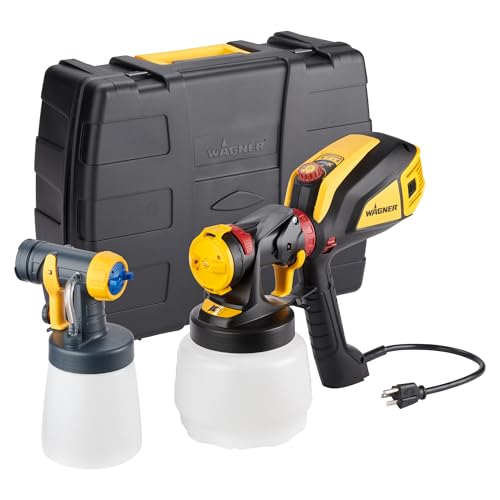
Wagner FLEXiO 595 Handheld HVLP Paint Sprayer — Best Overall Under $200
The FLEXiO 595 suits the buyer who wants the tier’s full promise in a single handheld: Wagner’s X-Boost turbine with two nozzles — the iSpray for walls, fences, and volume, the Detail Finish for furniture and finesse — and the power to spray unthinned latex, dissolving the HVLP tier’s oldest discipline. It is effectively two tools in one handle: swap nozzles and the same machine that primed the fence in the morning lays enamel on the dresser after lunch. For the majority of serious home and workshop users, this convergence is the correct answer to the tier’s question, and its controls — flow and pattern adjustments on the tool — keep both personalities legible.
- Turbine: X-Boost power turbine, handheld format
- Nozzles: iSpray nozzle and Detail Finish nozzle included
- Cup: 1.5 qt cup
- Materials: sprays unthinned latex plus stains, sealers, enamels
- Controls: adjustable flow and pattern on the tool
Strengths
- Two tools in one: volume nozzle and finesse nozzle
- Unthinned latex ends the thinning discipline for wall work
- Wagner’s system depth: parts, documentation, support
Trade-offs
- Heaviest handheld here with a full cup — long wall days are felt
- Two nozzles mean two cleaning routines to learn
- More capability than furniture-only users will touch
The flagship’s real argument is the removal of the tier boundary inside a single purchase. Every lower-tier guide in this series carries a version of the same footnote — for walls, step up; for finesse, specialize — and the FLEXiO 595 is where the footnotes retire: its owner simply changes nozzles. The honest limitation is physical, not conceptual: it is a substantial handheld, and the user whose work is all-day volume should notice that the turbine-system pick below exists precisely for them. For everyone whose work alternates — and most serious work alternates — this is the tier’s leader by design rather than by default.
Best for: Serious home and workshop users whose work alternates between volume and finesse / Not suited for: All-day volume specialists or single-purpose buyers

Wagner Control Spray Max HVLP Paint Sprayer — Best Turbine System
The Control Spray Max suits the buyer whose work has a permanent address: a spray corner, a bench, a rhythm of weekly projects. Its stationary two-stage turbine (510W) feeds a light gun, its variable air pressure makes recipes repeatable to the dial, and its two cups (1 qt and 1.5 qt) match batch sizes without waste. At this tier it is the system pick — the tool for operators who have stopped experimenting and started producing, and who feel the handhelds’ compromises (weight, fixed pressure, cup gymnastics) as friction against a known standard.
- Turbine: 510W two-stage, stationary unit
- Control: variable air pressure dial
- Cups: 1 qt and 1.5 qt containers included
- Output class: 2.7 PSI HVLP
Strengths
- Variable pressure: the recipe variable handhelds cannot offer
- Light gun endurance for production-length sessions
- A permanent station’s consistency, session after session
Trade-offs
- Station commitment: floor space and setup for every job
- Less spontaneous than the handheld flagship
- Latex at volume still prefers the airless pick’s pace
Its case against the flagship is the specialist’s case: for work that lives in one place and repeats, a system beats a convertible. Pressure control sounds like a specification; in practice it is the difference between a finish that can be re-created next month and one that can only be remembered. The honest limitation is the mirror of the FLEXiO’s: the station does not travel, does not grab-and-go, and asks its owner to maintain a place for it. Workshops and dedicated hobbyists will pay that gladly; apartment-scale users should take the flagship and never look back.
Best for: Workshop and dedicated-space users with weekly, repeatable work / Not suited for: Mobile, occasional, or space-poor users

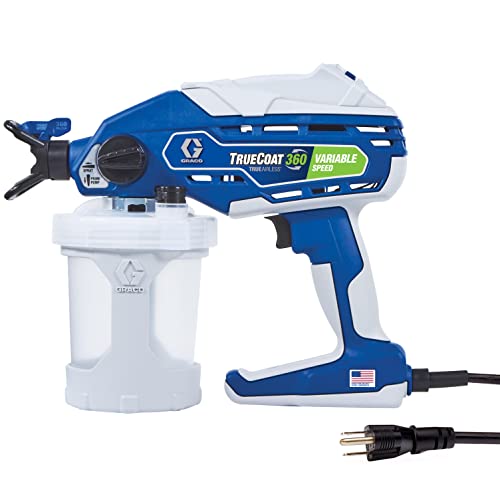
Graco TrueCoat 360 Airless Paint Sprayer — Best Handheld Airless
The TrueCoat 360 suits the buyer whose work is walls: rooms, exteriors, ceilings — the planes where HVLP pace stops being a personality trait and becomes a schedule failure. It is a true handheld airless sprayer, laying unthinned latex at room-clearing speed, and its FlexLiner system (32 oz bags in the cup) lets it spray at any angle — ceilings included — while making cleanup a matter of the liner rather than the pump. Graco’s airless pedigree stands behind the format; the reversible tip clears clogs in seconds, mid-wall, without tools.
- Type: handheld airless sprayer
- System: FlexLiner 32 oz paint bags — sprays in any direction
- Materials: unthinned latex and general coatings
- Tip: reversible spray tip for clearing clogs
Strengths
- Room pace: the only pick here that paints walls like a professional tool
- No thinning, ever — paint from can to wall
- FlexLiner cleanup is airless without the traditional penance
Trade-offs
- Overspray demands real masking — rooms become projects of preparation
- Finish finesse on furniture trails the HVLP picks
- Airless safety discipline (injection hazard) is mandatory reading
The honest framing is that this pick answers a different question from the other five, and including it is this guide’s central act of honesty: at $200, a wall-heavy buyer should not be sold a better HVLP — they should be shown the technology their work actually uses. The TrueCoat’s limitations are the technology’s: it is a coating instrument of tremendous pace and ordinary delicacy, and the buyer whose list is furniture should admire it and choose otherwise. For the room painter, nothing else on this page is close.
Best for: Rooms, exteriors, and wall-scale painting / Not suited for: Furniture finesse or overspray-sensitive interiors

HomeRight Super Finish Max HVLP Paint Sprayer (C800971) — Best Value in the Tier
The Super Finish Max appears in this guide as an act of editorial honesty: it costs roughly half the cap, and for the large class of buyers whose work is furniture, cabinets, and pieces — no walls, no production — it delivers the tier’s best finish with nothing material missing. Its three brass tips, fast cleanup, and deep support have led two of this series’ tier guides already; here it serves as the value benchmark against which the flagships must justify their premiums, and for piece-work buyers, they cannot.
- Motor: 450W electric handheld HVLP
- Tips: 3 brass spray tips included
- Patterns: 3 spray patterns
- Container: generous attached container for furniture-scale work
- Best materials: stains, sealers, enamels, paints with modest thinning
Strengths
- The tier’s best finish at half the tier’s price
- Fast cleanup and deep support — the ownership benchmark
- Leaves budget for materials, bench, and the second project
Trade-offs
- No unthinned latex, no wall pace — the flagship’s ground
- Handheld format caps session length
- Single-format tool in a tier of systems
The value argument deserves precision: the premium above this pick buys specific capabilities — unthinned latex, dual nozzles, pressure control, airless pace — and a buyer whose work invokes none of them is not being frugal by choosing it; they are being accurate. The honest limitation is the inverse: work evolves, and the buyer who suspects walls or production in their future should read the premium as insurance priced fairly. Both readings are respectable; the guide’s job is to make the buyer choose consciously, which the ranking’s structure is designed to force.
Best for: Piece-work and furniture-focused buyers at any budget / Not suited for: Wall work or production ambitions

VONFORN VF803 700W HVLP Paint Sprayer — Best Budget Pick
The VONFORN VF803 holds the tier’s floor with the same argument it made below: four nozzles, 700W, a 1200 ml container, and a complete kit at a price that leaves most of the $200 unspent. In this guide its role is the utility and the starter-system pick — the tool a buyer chooses when the budget is real but the ambitions are still forming, or when a second, sacrificial sprayer is wanted for primers and rough work beside a flagship. Its range refuses nothing in the HVLP world, and its economics forgive everything, including being outgrown.
- Motor: 700W handheld HVLP turbine
- Nozzles: 4 included — 1.0, 1.5, 2.0, and 3.0 mm
- Patterns: horizontal, vertical, and circular
- Container: 1200 ml detachable container
- Extras: cleaning and blowing joints, viscosity cup, cleaning tools
Strengths
- Maximum unspent budget: capability now, options later
- Widest nozzle range here — the rotation’s workhorse
- Ideal primer/utility partner to a flagship
Trade-offs
- Finish and support trail the branded picks
- Heaviest handheld here when full
- No flagship capabilities: thinning remains the law
There is a portfolio logic to this pick that expensive tiers rarely permit: buy the VONFORN and the Super Finish Max together — utility range plus finesse — for roughly the flagship’s price, and the pair covers more combined ground than either alone. The honest limitation is that both halves of that portfolio remain HVLP handhelds with HVLP disciplines; the buyer whose heart is set on unthinned latex or room pace should buy the technology, not the portfolio.
Best for: Budget-real buyers, starters, and utility partners to flagships / Not suited for: Buyers seeking flagship capabilities
Check on Amazon
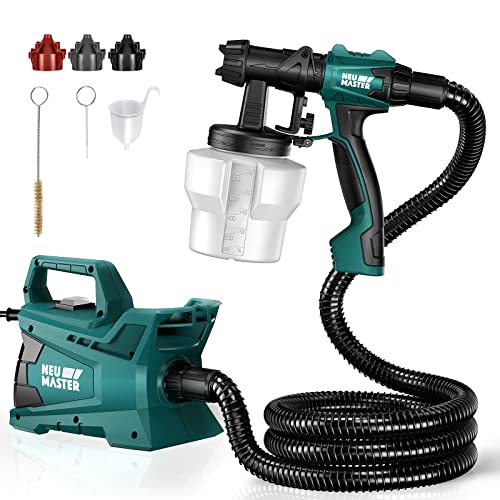
NEU MASTER N3140 600W HVLP Paint Sprayer — Best Light-Gun Pick
The NEU MASTER N3140 completes the tier’s map with the endurance format: a 600W floor turbine feeding a light gun through a 6 ft hose, for the buyer whose sessions are long and whose work is piece-and-batch rather than wall. At this price it competes not with the flagships’ features but with their formats — the operator who has tried handhelds and felt the arm’s verdict will find in this pick the tier’s most comfortable hours, at a price that leaves the flagship conversation open for later.
- Motor: 600W turbine in a floor-standing base unit
- Hose: 6 ft air hose between turbine and gun
- Patterns: 3 spray patterns
- Flow: adjustable flow control
Strengths
- Lightest in-hand hours in the tier
- Batch consistency through removed fatigue
- Price leaves room for a later flagship pairing
Trade-offs
- No pressure dial — the Control Spray Max owns that ground
- Brand support thinner than the majors’
- Setup overhead for quick jobs
Its honest position is the comfort specialist: less system than the Wagner station, less convertible than the FLEXiO, and — for the long-session operator — more sustainable than either. Buyers should choose it with eyes open about support, stocking the small spares shelf this series recommends for the brand in every guide. Within those terms it is a legitimate tier resident, not a leftover: the format it represents is one the flagships, for all their convergence, do not offer.
Best for: Long-session batch and piece work / Not suited for: System seekers or support-first buyers
Comparison Table
| Pick | Type | Tier strength | Container | Needs compressor? |
|---|---|---|---|---|
| Wagner FLEXiO 595 | Electric handheld HVLP | Unthinned latex; two nozzles, two roles | 1.5 qt | No |
| Wagner Control Spray Max | Stationary turbine HVLP | Variable pressure system | 1 qt + 1.5 qt | No |
| Graco TrueCoat 360 | Handheld airless | Wall pace, any-angle spraying | FlexLiner 32 oz | No |
| HomeRight Super Finish Max | Electric handheld HVLP | Best finish per dollar | Attached container | No |
| VONFORN VF803 | Electric handheld HVLP | Range and value floor | 1200 ml | No |
| NEU MASTER N3140 | Electric turbine HVLP | Light-gun endurance | Gun-mounted cup | No |
How to Choose at the Under-$200 Tier
Choose the technology before the model. At this tier the fork is real: handheld HVLP for alternating work, turbine HVLP for stationed production, airless for planes. The model decision inside a technology is easy; the technology decision is the purchase. The full method is in How To Choose A Paint Sprayer.
Interrogate the premium. Every dollar above the value picks buys named capabilities — unthinned latex, pressure control, dual nozzles, pace. List which capabilities your next ten projects invoke; pay for those, decline the rest without guilt.
Count the system, not the sticker. Flagships consume flagship accessories; airless consumes liners and masking; stations consume space. The honest price of each pick is its first year of ownership, and at this tier the differences are material.
Keep the livability tests. Cleanup minutes, storage, support depth — the lower tiers’ laws still bind, and a flagship abandoned to a clog is worth less than a modest tool in weekly service. Read the winner’s cleaning pages before the purchase, as always.
Respect the honest mismatch. If your work is unambiguously above this tier — daily production, whole-house exteriors — the correct move is through it, not within it; see the boundary discussion in Paint Sprayer Pros And Cons. This tier is a meeting point, not a ceiling, and treating it as one wastes exactly the money it exists to save.
Working at This Tier: Three Technologies, Three Disciplines
Key Takeaways
- Under $200 buys a technology choice, not just a better tool — choose the method first
- Unthinned latex, pressure control, and airless pace are the tier’s three flagship capabilities
- Half-cap picks remain honest winners for piece-work buyers
- Handheld HVLP (FLEXiO class): prep as usual, choose the nozzle for the work’s scale, spray unthinned latex with the iSpray or finesse with the Detail — the discipline is nozzle selection.
- Turbine HVLP (station class): set pressure by the recipe, log it, and let the station’s consistency compound — the discipline is documentation.
- Airless (TrueCoat class): mask as if the room depends on it — it does — spray in steady passes, clear clogs with the reversible tip — the discipline is preparation and safety.
- All three: strain material regardless of technology marketing; “unthinned” never meant “unstrained.”
- All three: test-board first with each material and each nozzle or tip — the tier raises capability, not exemption.
- All three: clean to the manual’s standard the same day; flagship parts are flagship-priced when neglect ruins them.
- All three: log recipes with the technology’s variables — nozzle, pressure, thinning — because at this tier the variables multiply.
- Revisit the technology choice yearly against the log; this tier’s tools hold value, and switching methods is a normal mid-ownership event, not an admission.
Problem: The flagship feels like overkill on furniture days. → It is convertible, not overkill: the Detail Finish nozzle exists for those days. Judge it across the month, not the afternoon.
Problem: Airless results disappoint on a first room. → Preparation and pace, almost always: masking skipped or passes rushed. The technology’s learning curve is real but short; the second room is the honest test.
Problem: The station’s consistency advantage is not appearing. → The log is not being kept or the pressure is being “adjusted by feel.” The system’s benefit is documentation; without it, a station is just a heavier handheld.
The Three Technologies in Depth: What Actually Changes
Because this tier is a technology choice, the technologies deserve a plain-language audit. Handheld HVLP, flagship class: a turbine in the handle blows a high volume of low-pressure air through interchangeable nozzles, atomizing finish gently with minimal overspray. Its physics favor control — thin films, fine finishes, modest material loss — and its costs are pace and, with thick coatings, thinning (waived only by the flagship’s power). Turbine HVLP, station class: the same physics with the motor on the floor and pressure on a dial — endurance and repeatability purchased with setup and space. Airless: a pump drives finish through a tiny tip at high pressure, atomizing by force rather than air — pace and unthinned capability purchased with overspray, masking labor, and a coarser floor for finish finesse. Every ranking in this guide is those three physics profiles, matched against work profiles; a reader who understands the profiles can re-derive the rankings, which is exactly the literacy a $200 purchase deserves.
Two corollaries follow. First, hybrid ownership is rational at this tier in a way it is not below: an HVLP flagship plus a handheld airless covers the entire domestic universe with each tool on its home physics, for a combined outlay many buyers reach by overspending on a single system. Second, technology loyalty is a trap: the correct answer migrates with the work, and the log — which records what the work actually was — is the only honest elector. Buyers who let last year’s log choose this year’s technology rarely buy wrong.
Room Painting at This Tier: The Airless Workflow Honestly Described
Since the airless pick will paint more rooms than everything else here combined, its workflow deserves the same concreteness this series gives furniture. A room begins as masking: floors covered, trim taped or shielded, outlets and fixtures bagged, the door sealed — an hour of preparation that feels excessive until the first room painted without it teaches the alternative arithmetic. The spraying itself is the shortest act: ceilings first with the any-angle cup, walls in steady vertical passes with fifty-percent overlap, the reversible tip clearing the day’s one clog in seconds. The pace is the point — a room’s walls in less time than the masking took — and it reframes the economics of repainting a home: the constraint stops being the painting and becomes the preparation, which was always the truth that brushing concealed by being slow everywhere.
The workflow’s discipline points are specific. Ventilate with intention — airless lays material fast, and the room’s air changes are part of the plan. Keep the gun moving and the distance honest; airless punishes hesitation with build and rewards rhythm with level films. Respect the safety briefing as engineering, not legal boilerplate: high-pressure injection injuries are the category’s one serious hazard, and they are entirely governed by the simple rules — never a hand before the tip, trigger locked when idle, pressure relieved before service. Owners who internalize the workflow find the TrueCoat class transformative; owners who skip the masking find it educational. The guide’s position is that both outcomes are available at purchase time, in the form of a decision.
Exterior Work at This Tier: Siding, Fences, and the Weather Window
Exteriors are where the tier’s technologies sort themselves most visibly, because exterior work combines planes (siding), pieces (shutters, furniture), and linear volume (fences) in a single property. The flagship’s iSpray nozzle handles siding at a credible domestic pace with HVLP’s gentle overspray — a genuine virtue where the neighbor’s car and the garden share the air — while its Detail nozzle takes the shutters and the door. The airless pick paints siding fastest and asks the most of masking and wind judgment; a breeze that HVLP forgives becomes, for airless, a distribution system for the neighborhood’s benefit. Fences split the difference: long runs reward the turbine’s endurance and the airless’s pace alike, while the handhelds serve the gate-and-a-section rhythm most households actually work in.
The weather window disciplines all of it: temperature and humidity bands from the finish maker’s label, wind low, rain absent from the forecast’s honest reading, and the sun’s position planned so the work stays in shade’s moving edge where possible. Exterior spraying at this tier succeeds on scheduling more than on equipment — the tier provides three competent technologies, and the calendar chooses among them. Homeowners who internalize that find their exteriors becoming annual maintenance rather than quinquennial rescue, which is the exterior version of this series’ whole argument.
Ownership at the Flagship Tier: Costs, Parts, and Longevity
Flagship ownership has flagship economics, and a $200 guide should state them. Wear parts cost more and matter more: turbine filters, airless tips and liners, nozzle seals — each priced above the budget tiers’ equivalents and each decisively cheaper than the neglect that ruins the assembly they protect. Parts availability, however, is the tier’s compensation: Wagner and Graco support their flagships with the deepest catalogs in the consumer category, so the ten-year ownership story — the horizon this series keeps recommending — is most credible exactly here. The buyer is purchasing, in part, a decade of findable five-dollar parts, and should value it as such when comparing against cheaper tools whose parts story ends at the warranty.
Longevity at this tier is governed by the same law as everywhere — cleaning — with one addition: storage of the system as a system. Nozzles in their case, liners stocked, the station’s hose coiled unstressed, the log with its recipes intact. A flagship maintained as a system compounds: its owner’s recipes, spares, and muscle memory all appreciate together, and the tool’s fifth year is routinely its best. That compounding is the final argument for buying this tier deliberately rather than drifted into: the investment being protected is not the tool but the practice built around it.
The Tier in the Series: Who Should Stop Here, Who Should Pass Through
A map is only useful if it marks the exits. Stop at this tier — confidently, permanently — if your work is domestic or small-workshop in scale: pieces, batches, rooms, exteriors of houses you own. The technologies here cover that universe completely, and the tiers above add duty cycle and volume that domestic work never invoices. Pass through this tier if the log shows production: daily spraying, client volume, whole-house exteriors as a service — work whose hours convert tool capability directly into income, where a station’s or cart’s premium returns itself in weeks. The pass-through buyer should still read this guide closely, because the technologies chosen here — the flagship for site work, the airless format, the recipe discipline — remain the professional’s portable layer, and the education is not refundable in the better sense: it transfers.
Between stopping and passing stands the tier’s most common resident: the serious amateur whose work grows yearly. For them the correct posture is to buy this tier’s technology honestly, run it without apology, and let the log announce — in named, recurring friction — the season when the next tier stops being a luxury. That announcement, whenever it comes, will be legible precisely because this tier was chosen well.
Fine Finishing at This Tier: How Close to Professional?
The question every flagship buyer eventually asks deserves a direct answer: with the Detail Finish nozzle, disciplined thinning by choice, dust control, and the raking-light standard, this tier’s best HVLP work is indistinguishable from professional finishing on the overwhelming majority of domestic pieces — because professional finishing is itself mostly discipline applied to similar physics. The genuine professional deltas lie elsewhere: in booth environments that remove dust from the equation entirely, in two-component materials beyond this tier’s remit, and in the operator’s ten-thousandth hour. A home or small-shop finisher at this tier should therefore stop apologizing for the equipment and start auditing the discipline — the gap, where one remains, is almost never in the gun.
That audit has a practical order. Environment first: dust is the finesse finisher’s tax, and a still-air corner, tack discipline, and patience after spraying repay more than any nozzle. Material second: strained, correctly thinned by the cup, sprayed within its weather band. Technique third: distance and overlap so practiced they survive distraction. Equipment last — and at this tier, adequate by construction. The finisher who works the audit in that order will find the flagship’s ceiling receding yearly, which is the pleasant surprise this tier keeps for its serious owners.
Safety at Higher Capability
Capability raises the safety stakes in two specific ways at this tier, and the guide would be negligent to rank power without naming them. The first is airless pressure: the TrueCoat class operates at pressures that can inject finish through skin, an injury that looks trivial and is a surgical emergency — the rules are few, absolute, and printed by Graco with unusual bluntness: never point the gun at any part of anyone, never place a hand near the tip, lock the trigger when not spraying, relieve pressure before any service, and treat any injection as an emergency-room event immediately, however small it looks. The second is volume of exposure: tools that spray faster put more finish into the air per hour, which raises the respirator from a recommendation to a system — fit, cartridges matched to the material, and ventilation that moves the cloud away rather than admiring it.
The HVLP technologies keep their gentler profile — low pressure, low overspray — but inherit the universal rules: ignition discipline with solvents, sealed rag storage, eye protection, and the fatigue law, which at flagship pace becomes more binding, not less, because more work is completed per unit of judgment. Buyers stepping up a tier should budget the safety system in the same purchase: cartridges, fit time, and the masking stock the airless workflow consumes. Capability without its safety system is not a bargain at any price, and at this tier’s prices the system is easily afforded.
Troubleshooting the Flagship Tier
Flagship faults arrive with flagship specificity, and the tier’s troubleshooting rewards the same ordered discipline as its cheaper siblings — with the variables renamed. FLEXiO-class texture problems trace first to nozzle selection (the volume nozzle asked to do finesse work, or the reverse), then to flow, then to thinning by choice. Station inconsistency traces to the pressure dial’s documentation: settings adjusted by feel between sessions announce themselves as finishes that cannot be repeated, and the cure is the log rather than the wrench. Airless pattern defects — tails at the fan’s edges, heavy center — trace to tip wear and pressure, in that order, and the reversible tip’s condition is a consumable’s question, answered by replacement rather than by cleaning heroics. Across all three, the meta-rule holds: change one variable, test on the board, record the result — the scientific method at garage scale, which this tier’s owners are equipped to run precisely because their tools expose the variables worth controlling.
The comforting constant is support: at this tier the manufacturers answer, the manuals are thorough, and the owner communities are deep and specific. A flagship problem is therefore rarely a mystery for long — provided the owner consults the system before improvising on the tool. That, finally, is the tier’s ownership bargain in one sentence: more capability, more variables, and more help than any tier below it, for the buyer willing to run the discipline that makes all three compound.
Common Buying Mistakes
Buying the flagship by default. The tier’s marketing points at the FLEXiO; the tier’s honesty points at your project list. Half this guide’s picks exist to catch buyers the flagship would overserve.
Choosing airless for finesse ambitions. Pace and delicacy trade against each other at every tier. Furniture-first buyers in an airless seat will spend the year compensating.
Ignoring first-year system costs. Liners, tips, masking, and space are part of each technology’s price. Budget the year, not the box.
Treating the tier as a ceiling. Daily production and whole-exterior work live above it. The buyer who forces this tier past its physics will buy twice — the most expensive pattern in the category, per Is A Paint Sprayer Worth It.
Abandoning the disciplines at the flagship tier. Straining, testing, logging, cleaning — unthinned latex marketing notwithstanding, the laws compound in value as the tools improve.
Final Recommendation
Most buyers under $200 should buy the Wagner FLEXiO 595: it is the only pick that answers both of the tier’s big questions — volume and finesse — in one tool, and Wagner’s system depth protects the investment. The exceptions are principled: stationed producers take the Control Spray Max, wall painters take the TrueCoat 360, and piece-work buyers should pocket the difference with the Super Finish Max and feel no lack. Choose the technology your work uses, and this tier will feel less like a compromise than like the category finally meeting you where you work. For the flagship’s single-model deep dive, see Paint Sprayer Review. One closing perspective for the buyer standing at this tier’s shelf: every lower tier in this series asks what you can afford to give up; this tier asks what your work actually is. Answer that question with the log’s honesty and the purchase makes itself — the flagship for the alternator, the station for the producer, the airless for the wall painter, the value picks for the piece worker — and the tool that arrives will feel less like a compromise negotiated with a budget than like equipment chosen by a practitioner, which, at two hundred dollars, is exactly what it should be. The tiers above will still be there if the work ever calls for them; for the great majority of readers they will not, and the sprayer bought here — matched, maintained, and mastered — will quietly become the most capable tool in the building — and, not coincidentally, the one whose owner stops reading buying guides altogether, having finally purchased the answer instead of the question, and turned their full attention at last to the work itself — the rooms, the furniture, the fences, and the long list of things that were waiting, all along, to be finished beautifully, in their own home, by their own hand, with a tool that finally asks nothing of them but the work itself and the care to do it properly, patiently, and well — the three adverbs that separate finishing from merely coating, at this tier and every other tier of tools, craft, and honest workmanship anywhere in the wide world of making and mending things well.
Frequently Asked Questions
Is the FLEXiO 595 really able to spray unthinned latex?
Yes — that is the X-Boost turbine’s defining capability with the iSpray nozzle, and it is the main reason the flagship leads this tier. Two honest qualifiers: the paint should still be strained, and very heavy coatings may still prefer slight thinning for finish quality on fine work. “Unthinned” removes the obligation, not the option, and experienced users thin by choice for finesse even when the tool does not require it.
Handheld airless or turbine HVLP for painting bedrooms?
Airless, for most bedroom projects: walls and ceilings are planes, pace matters, and the TrueCoat’s any-angle FlexLiner system is built for exactly this geometry. The turbine’s case is the room that is mostly trim, doors, and built-ins — piece work that happens to be indoors. Read your room honestly: measure the planes against the pieces, and the technology chooses itself.
Why are under-$100 picks in an under-$200 guide?
Because budgets are ceilings, not targets. A buyer whose work the Super Finish Max serves completely gains nothing from the flagship’s capabilities except their cost, and a guide that pads its rankings to the ceiling serves the ceiling, not the reader. The half-cap picks are here on merit, clearly badged, and the premium picks must — and do — justify themselves against them capability by capability.
What does variable pressure actually change?
Atomization energy, independently of flow: the station user can run gentle air for delicate clears and full air for primers through the same gun, and — the production point — return to the exact setting next month from the log. Handhelds fix pressure at design time and vary only flow, which is why their finishes are tuned by the maker rather than documented by the user. For repeatable work, that difference is the system’s whole argument.
Can the TrueCoat 360 spray furniture?
It can, and for priming and utility pieces its speed is attractive — but its atomization and overspray are tuned for planes, and fine furniture shows both. The honest division of labor at this tier: airless for walls and volume, HVLP for pieces and finesse, and the FLEXiO’s two nozzles as the single-tool bridge between them. Owners of both technologies route work by that rule and rarely regret it.
Is under $200 the last tier a home user needs?
For the overwhelming majority, yes: this tier contains a complete answer for every household workload — pieces, batches, rooms, exteriors at domestic scale. The tiers above serve production duty cycles and professional volumes. The buyer who reaches this tier thoughtfully, by technology rather than by price, has usually made their last sprayer decision for years — which is the highest compliment a tier can earn.