Disclosure: As an Amazon Associate, umtsmarttool.com earns from qualifying purchases. Links to Amazon on this page are affiliate links; they cost you nothing extra. Prices and availability change often, so check the current Amazon listing before you buy.
Where to buy
- Amazon Basics Steel Security Safe, 1.52 Cubic Feet (42SAM) — featured in this article — Check on Amazon
- Amazon Basics Steel Security Safe, 1 Cubic Foot — alternative — Check on Amazon
- SentrySafe X055 Security Safe — alternative — Check on Amazon
Read the full guide ↓
This security safe review 2026 examines the heavy end of the Amazon Basics line — the 1.52-cubic-foot model with the maker-stated 8-gauge door and 14-gauge body — as the representative of where mainstream home safes have landed this year. The 2026 context matters: keypads are universal at this level, biometric gimmicks have retreated to the margins, and the serious conversation has returned to steel, bolts, anchoring and honest peril labelling. This model is a useful lens because it gets the fundamentals expensively right while still, pointedly, claiming no fire certification at all.
The short verdict: for an owner-occupier with documents in binders, jewelry boxes and electronics to consolidate, this is the strongest mainstream answer in the cluster — provided it is anchored and provided a certified chest handles the fire risk separately. The comparisons live in Best Security Safe Under $100 Best Security Safe Under $100 (where this model appears as the prose step-up) and Security Safe Reviews Security Safe Reviews; the method lives in How To Choose A Security Safe How To Choose A Security Safe.
What 2026 Buyers Actually Get
Open the door and the year’s design consensus is on display: a removable shelf splitting a tall interior, a programmable keypad with a backup key, and a door whose stated gauge finally exceeds the body it protects. The shelf is the daily delight — documents below, valuables above, no excavation. The keypad behaviour is unremarkable in the best way: codes change in under a minute, the lockout story is a key rather than a helpline, and nothing about the product demands an account, an app or a subscription.
The omissions are equally instructive. No fire rating, because insulation would change the product’s price and weight class; no water seal, because a bolted steel door is not a gasket; no smart features, because the failure modes of small safes in the field are batteries and codes, not connectivity. A 2026 review should reward that restraint: the product knows its peril — people — and spends its whole budget there.
In this guide
Capacity and Placement in Practice
At 1.52 cubic feet the interior stops being a puzzle. Binders stand or lie naturally, a tablet and a compact camera join the document layer, and the household cash envelope stops competing with the deed box. Placement is the counterweight: this is a two-person carry to a prepared spot, ideally a ground-floor closet corner with structure beneath the anchor bolts. Measure the route — door widths, stair turns — before ordering, because returning a safe this size is nobody’s idea of a light errand.
Key Specifications: Amazon Basics Steel Security Safe, 1.52 Cubic Feet (42SAM)
- Capacity 1.52 cu ft
- Exterior 13.8 x 13 x 16.5 in (W x D x H)
- Programmable electronic keypad plus backup key
- Heavy-duty 8-gauge steel door and 14-gauge steel body (maker-stated)
- Removable interior shelf
Strengths
- Maker-stated 8-gauge door and 14-gauge body are the stoutest construction figures in this line-up
- A removable shelf splits the tall interior into document and valuables zones
- At 1.52 cu ft it handles binders, jewelry boxes and electronics that overwhelm compact safes
Trade-offs
- No fire or water certification despite the heavier steel — thickness is not insulation
- Heavier construction makes placement a two-person decision; measure doorways and shelf strength first
- Keypad still depends on batteries, with the usual override-key storage discipline required
The 1.52-cubic-foot model is the line’s heavy-duty statement: a door the maker rates at 8-gauge and a body at 14-gauge, wrapped around a tall interior with a removable shelf. In practice the shelf is the feature owners praise daily, because it separates the flat document layer from the lumpy valuables layer and ends the excavation problem that plagues single-volume safes.
The honest limitation is that gauge numbers impress on paper while anchoring still does the real work — an unbolted heavy safe is merely a heavier thing to carry away.

Amazon Basics Steel Security Safe, 1 Cubic Foot — Alternative to consider
Households outgrowing a half-cubic-foot box who need room for documents, cash trays and a small laptop or tablet in one anchored unit.
- Capacity 1.0 cu ft
- Exterior 16.93 x 14.57 x 9.06 in (W x D x H)
- Programmable electronic keypad plus emergency override keys
- Steel construction with live-door bolts
- Interior space sized for documents, cash and a small laptop or tablet
Strengths
- A full cubic foot swallows bulkier loads — document boxes, a small laptop, camera bodies — that defeat smaller safes
- Programmable keypad with override keys keeps daily access quick and lockouts recoverable
- Steel body with live bolts and anchor holes follows the same proven formula as its smaller siblings
Trade-offs
- Still no fire or water certification; capacity grew, peril coverage did not
- Its size tempts buyers to skip anchoring, yet unanchored it remains a portable box to a strong thief
- Interior is a single open volume on this format, so small items need their own pouches or trays to stay organised
Stepping from half a cubic foot to a full one changes what a home safe can be. The 1-cubic-foot Amazon Basics takes the document boxes, cash trays and small electronics that force owners of smaller safes into awkward second locations. Its wide, shallow stance suits closet floors and low shelving, and the keypad keeps the daily open-close cycle painless enough that people actually use it.
The honest limitation is organisation: one open cubic foot becomes a jumble unless you add trays, and rummaging time is time the door stands open.
Best for: alternative to consider and buyers who match the profile above / Not suited for: anyone expecting this product to do a different category’s job

SentrySafe X055 Security Safe — Alternative to consider
Apartment and home users who want a compact keypad safe with real bolts that can anchor into a closet, cabinet or furniture they own.
- Capacity 0.58 cu ft; interior 8.5 x 13.6 x 8.7 in
- Exterior 8.7 x 13.8 x 10.2 in; weight 14.2 lb
- Digital keypad taking a 1- to 8-digit code, plus 2 override keys
- 2 live-locking bolts and a pry-resistant steel door
- Bolt-down hardware included; California DOJ certified for firearm storage (maker-stated)
Strengths
- Two live-locking bolts and a pry-resistant door put it a class above latch-only lock boxes
- Bolt-down hardware is included, and anchoring is what converts its light weight into real resistance
- A 1- to 8-digit programmable code plus override keys covers both convenience and lockout recovery
Trade-offs
- Security only: SentrySafe claims no fire or water rating for the X055, so documents get no heat protection
- At 14.2 lb unanchored it can simply be carried away — the bolts are not optional, they are the point
- The 0.58 cu ft interior takes handguns, jewelry and documents, not laptops or bulky kit
Two details decide whether it works. First, the bolt-down kit: screwed into a shelf, cabinet base or floor, the safe’s resistance stops being about its 14 pounds and starts being about the furniture and structure it is married to. Second, code hygiene: a 1- to 8-digit code is only as strong as its unpredictability, so birthdays are out. The override keys belong outside the safe, ideally outside the room.
The honest limitation is that everything depends on anchoring: left loose on a shelf, this is a 14-pound box a burglar can tuck under one arm.
Best for: alternative to consider and buyers who match the profile above / Not suited for: anyone expecting this product to do a different category’s job
Verdict
Best for: owner-occupiers consolidating a household’s valuables into one anchored, shelf-organised safe / Not suited for: renters without fixing permission, fire-risk-first households, or anyone who cannot give it a permanent, load-bearing spot
Within this cluster the 42SAM-class model is the ceiling of the mainstream line; the step beyond it is not a bigger Amazon box but the certified combination safe covered as the step-up in Best Security Safe Under $100 Best Security Safe Under $100.
Common Buying Mistakes
- Trusting the word ‘fireproof’ without a lab. Unverified fire claims are marketing. Look for the classification body, the duration and the temperature together; if any of the three is missing, treat the claim as decoration.
- Buying a portable case for a stationary job. Tethered cases are excellent on the move and weak at home, where an anchored box costs little more and resists far more. Match the format to where the valuables actually live.
- Bolting into nothing. Screws into thin shelf board or plasterboard add theatre, not resistance. Anchor into joists, studs, solid furniture or concrete, or choose a heavier safe whose mass works for you.
- Sharing the code too widely. Every additional person who knows the combination is another copy of the key. Household safes work best with one or two code holders and a sealed emergency record stored elsewhere.
- Skipping the interior plan. A safe without trays, pouches or a shelf becomes a rummage pit, and rummaging means the door stands open longer and items migrate out. Ten minutes of organisation pays back every opening.
Deeper Dive: Security safe review 2026 in Practice
The shortlist was built by filtering the category rather than by collecting favourites. Anything without a verifiable manufacturer specification was cut, however popular its listing. Anything whose marketing claimed protection its documentation could not support was cut. What survived was then sorted by the job it actually does: portable deterrence, concealed storage, anchored theft resistance, certified fire protection, or some honest combination of those. Badges were assigned last, after the sorting, so that each badge describes a use case a buyer can recognise in their own home.
Two rules governed the writing. Verified specifications only: dimensions, capacities, lock types and certifications in these reviews trace back to a source we opened, and uncertain figures were dropped rather than rounded into existence. And honest tiers: when a budget band contains no certified fire safe or no true bolt-down safe, the guide says so in plain language and shows the closest honest options instead of dressing a weaker product in a stronger badge. That discipline costs a few tidy narratives, and it is worth it.
Weight and the carry-away test
Ask one brutal question of any small safe: could one person carry this out under one arm, quietly, in under a minute? If yes, its security depends entirely on anchoring or concealment. Weight helps only when combined with awkwardness and fixing; a heavy safe on an upper floor also needs a floor that can carry it. The models in this guide span featherweight travel cases to a safe that becomes furniture — place each on that spectrum honestly before buying.
Anchoring and placement
Every security safe in this guide gets stronger when it is fixed to something that is not moving. Pre-drilled holes and included bolts are therefore a headline feature, not a footnote. Anchor into floor joists, wall studs, concrete or heavy furniture; screws into thin shelf board are decoration. Placement multiplies the effect: low, boring locations beat the master-bedroom closet, and a safe that is tedious to reach is a safe a rushed intruder abandons.
Power, batteries and lockout planning
Keypad safes run on replaceable cells, typically AA or AAA sets housed on the door’s inner face or an external pack. Battery life is measured in years of normal use, but the failure mode is absolute: no power, no keypad. The defences are routine — annual battery changes, heeding low-power warnings — and architectural: an override key stored outside the safe, or a secondary code holder in the household who can be reached in a pinch.

SentrySafe SFW123GDC Fireproof and Waterproof Digital Safe — Extended consideration
Buyers stepping up to a full safe that combines certified fire and water protection with keypad access, real bolts and interior organisation.
- UL Classified fire endurance: 1 hour at 1700°F
- ETL Verified water protection: 24 hours in up to 8 inches of water; ETL Verified 15 ft fall protection
- Capacity 1.23 cu ft; exterior 17.8 x 16.3 x 19.3 in
- Backlit digital keypad with secondary locking key
- 4 large 1-inch live-locking bolts; pry-resistant hinge bar; bolt-down hardware
Strengths
- UL Classified one hour at 1700°F plus ETL Verified water and 15-foot fall protection — the fullest certification set in this guide
- Four 1-inch live-locking bolts, a pry-resistant hinge bar and bolt-down hardware give it genuine theft resistance
- Backlit keypad, interior light and a secondary key make daily use civilised despite the size
Trade-offs
- It sits well above the budget bands in this guide — this is the step-up, not the bargain
- At 1.23 cu ft and safe-grade weight, placement is a commitment; measure the route in
- Bolt-down decision needs care: anchoring can affect the water story on some installations, so follow the maker’s guidance
The SFW123GDC is what the chests in this guide grow into. It keeps their certified fire pedigree — a UL-classified hour at 1700°F, ETL-verified water protection and a 15-foot fall test — and adds the things chests lack: four one-inch bolts, a pry-resistant hinge bar, a backlit keypad with a secondary key, interior lighting and bolt-down hardware. For the first time in this line-up, one product credibly answers fire, water and theft together.
The honest limitation is cost and commitment: it asks real money and a permanent spot, which is exactly what renters and first-time buyers may not be able to give.
Best for: extended consideration and buyers who match the profile above / Not suited for: anyone expecting this product to do a different category’s job
How to Set Up a Security Safe Properly
- Choose the spot first. Pick a low, discreet location with solid structure behind or beneath it for anchoring, and confirm the floor or shelf can carry the loaded weight.
- Change the code before loading anything. Follow the maker’s sequence with the door open, test the new code three times, and only then close the door on your valuables.
- Anchor it. Mark through the pre-drilled holes, drill pilots into joist, stud, concrete or solid furniture, and drive the supplied bolts snugly. Tug-test the safe; movement means the fixing failed.
- Store the override keys elsewhere. Seal them in an envelope kept in a different room or with a trusted person — never inside the safe or beside it.
- Load with a plan. Documents flat at the back, heavy items low, the most-accessed item nearest the door. Photograph the contents for your records.
- Set the battery reminder. Put an annual battery-change note in your calendar the day the safe goes into service.
Problem: the keypad beeps but the door will not open. Fix: this is usually low battery power rather than a wrong code — replace the cells first, then retry, and use the override key only if fresh batteries do not restore operation. Problem: the safe rocks on its bolts. Fix: the anchor has missed structure or the surface is uneven; re-seat it on a flat shim and re-drive the fixings into solid material.
Deeper Dive: Security safe review 2026 in Practice
The shortlist was built by filtering the category rather than by collecting favourites. Anything without a verifiable manufacturer specification was cut, however popular its listing. Anything whose marketing claimed protection its documentation could not support was cut. What survived was then sorted by the job it actually does: portable deterrence, concealed storage, anchored theft resistance, certified fire protection, or some honest combination of those. Badges were assigned last, after the sorting, so that each badge describes a use case a buyer can recognise in their own home.
Two rules governed the writing. Verified specifications only: dimensions, capacities, lock types and certifications in these reviews trace back to a source we opened, and uncertain figures were dropped rather than rounded into existence. And honest tiers: when a budget band contains no certified fire safe or no true bolt-down safe, the guide says so in plain language and shows the closest honest options instead of dressing a weaker product in a stronger badge. That discipline costs a few tidy narratives, and it is worth it.
Fire and water: certification or nothing
Heat and flood protection exist only where a testing body has verified them. A UL classification states the furnace temperature and duration the design survived with interior limits held; an ETL verification does the same for fire, water immersion and impact in the SentrySafe chests and safes above. Anything short of a named programme with numbers attached is a hope, not a rating, and plain steel — however thick — conducts heat straight to your documents.
Capacity: read interior dimensions, not headlines
Manufacturers headline cubic feet, but your belongings care about interior inches. A tall narrow safe and a wide shallow safe can share a capacity figure while fitting entirely different loads. List what you will store, measure the largest item with its case or box, and compare against the interior dimensions in each review’s spec box. Leave roughly a fifth of the volume empty: a safe packed to compression is a safe whose contents migrate to drawers, defeating the point.
Interior organisation
A safe’s second job is retrieval. Shelves, door pockets, trays and carpeted floors decide whether opening the door is a five-second errand or a excavation. Documents want flat, dry, uncreased storage; jewelry wants separation; a backup drive wants to not be crushed by a deed box. If a model offers one open volume, budget for a tray or pouch system of your own and count that organisation time as part of the purchase.

Amazon Basics Steel Security Safe, 1.8 Cubic Feet (50SAM) — Extended consideration
Families consolidating several small lock boxes into one tall, anchored cabinet for documents and larger valuables.
- Capacity 1.8 cu ft (50 litres)
- Exterior 13.8 x 13 x 19.7 in (W x D x H)
- Programmable electronic keypad plus backup key
- Carbon steel construction
- Tall interior suited to documents, jewelry and larger valuables
Strengths
- 1.8 cu ft is the most room in this range — tall enough for upright files and stacked storage boxes
- One keypad and one location replaces the scattered keys and codes of multiple small boxes
- Carbon steel construction with the line’s standard live-bolt door and backup key access
Trade-offs
- The tall footprint needs a genuine home: a closet corner or utility space, not a random shelf
- No fire or water certification at this size either
- A single big safe concentrates risk if left unanchored or if its code is widely shared
The 1.8-cubic-foot 50SAM is the consolidation play. Households accumulate lock boxes the way they accumulate chargers — one for documents, one for jewelry, one inherited — each with its own key hunt. A single tall safe with one programmable code ends that sprawl, and its height suits upright file storage that wide, shallow safes force flat.
The honest limitation is concentration: everything in one box demands the anchoring and code discipline that smaller, distributed storage forgives.
Best for: extended consideration and buyers who match the profile above / Not suited for: anyone expecting this product to do a different category’s job
How to Set Up a Security Safe Properly
- Choose the spot first. Pick a low, discreet location with solid structure behind or beneath it for anchoring, and confirm the floor or shelf can carry the loaded weight.
- Change the code before loading anything. Follow the maker’s sequence with the door open, test the new code three times, and only then close the door on your valuables.
- Anchor it. Mark through the pre-drilled holes, drill pilots into joist, stud, concrete or solid furniture, and drive the supplied bolts snugly. Tug-test the safe; movement means the fixing failed.
- Store the override keys elsewhere. Seal them in an envelope kept in a different room or with a trusted person — never inside the safe or beside it.
- Load with a plan. Documents flat at the back, heavy items low, the most-accessed item nearest the door. Photograph the contents for your records.
- Set the battery reminder. Put an annual battery-change note in your calendar the day the safe goes into service.
Problem: the keypad beeps but the door will not open. Fix: this is usually low battery power rather than a wrong code — replace the cells first, then retry, and use the override key only if fresh batteries do not restore operation. Problem: the safe rocks on its bolts. Fix: the anchor has missed structure or the surface is uneven; re-seat it on a flat shim and re-drive the fixings into solid material.
Deeper Dive: Security safe review 2026 in Practice
The shortlist was built by filtering the category rather than by collecting favourites. Anything without a verifiable manufacturer specification was cut, however popular its listing. Anything whose marketing claimed protection its documentation could not support was cut. What survived was then sorted by the job it actually does: portable deterrence, concealed storage, anchored theft resistance, certified fire protection, or some honest combination of those. Badges were assigned last, after the sorting, so that each badge describes a use case a buyer can recognise in their own home.
Two rules governed the writing. Verified specifications only: dimensions, capacities, lock types and certifications in these reviews trace back to a source we opened, and uncertain figures were dropped rather than rounded into existence. And honest tiers: when a budget band contains no certified fire safe or no true bolt-down safe, the guide says so in plain language and shows the closest honest options instead of dressing a weaker product in a stronger badge. That discipline costs a few tidy narratives, and it is worth it.
Weight and the carry-away test
Ask one brutal question of any small safe: could one person carry this out under one arm, quietly, in under a minute? If yes, its security depends entirely on anchoring or concealment. Weight helps only when combined with awkwardness and fixing; a heavy safe on an upper floor also needs a floor that can carry it. The models in this guide span featherweight travel cases to a safe that becomes furniture — place each on that spectrum honestly before buying.
Anchoring and placement
Every security safe in this guide gets stronger when it is fixed to something that is not moving. Pre-drilled holes and included bolts are therefore a headline feature, not a footnote. Anchor into floor joists, wall studs, concrete or heavy furniture; screws into thin shelf board are decoration. Placement multiplies the effect: low, boring locations beat the master-bedroom closet, and a safe that is tedious to reach is a safe a rushed intruder abandons.
Bolts, door and hinge design
Live-locking bolts are steel rods that extend from the door into the frame when locked; they are what a pry bar actually fights. Two bolts is the honest minimum for a small safe, four is genuinely strong, and a pry-resistant or concealed hinge removes the other classic attack line. A thick door on a thin body, or the reverse, wastes material — balanced construction matters more than any single gauge number, and anchoring matters more than all of it.
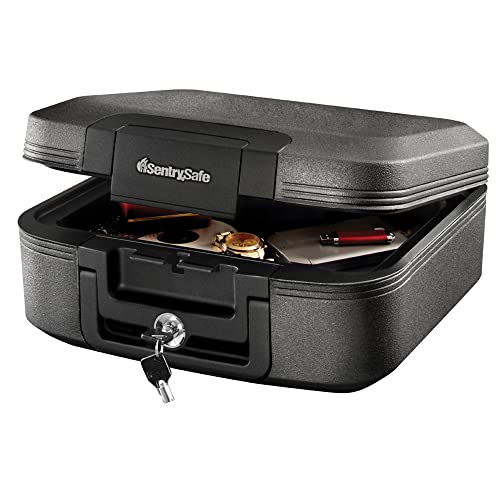
SentrySafe CFW20201 Fire and Water Chest — Extended consideration
Homeowners in fire- or flood-aware households who want a certified chest with both perils covered and room for letter-size documents.
- UL Classified fire endurance: 1 hour at 1700°F
- ETL Verified water protection: 72 hours in up to 8 inches of water
- Capacity 0.28 cu ft; interior 4.4 x 12.8 x 8.5 in
- Exterior 6.6 x 15.4 x 14.3 in
- Tubular key lock; carry handle
Strengths
- UL Classified for a full hour at 1700°F — double the entry-level chest rating
- ETL Verified to keep contents dry through 72 hours in up to 8 inches of water
- Tubular key lock and a roomy 0.28 cu ft interior that takes letter documents without folding
Trade-offs
- Key-only access means no keypad speed and keys that must be managed
- 0.28 cu ft still excludes binders and bulky valuables
- Like all chests, theft resistance is secondary — concealment is part of the plan
Position it low, keep it discreet, and let certification do the work. This is not the box for jewelry you access daily or for cash you want behind bolts; it is the box that makes sure the irreplaceable paperwork survives the worst day the house can have.
The honest limitation is that its talents are elemental, not criminal: it defeats fire and water far better than it defeats a person with time and tools.
Best for: extended consideration and buyers who match the profile above / Not suited for: anyone expecting this product to do a different category’s job
How to Use a Security Safe Day to Day
- Open with intention. Enter the code deliberately; rushed entries are the main cause of lockouts and error lockouts on delay-equipped models.
- Close and verify. Swing the door fully shut, let the bolts engage, and tug the handle before walking away — a door resting on its latch looks locked and is not.
- Spin or scramble. On combination cases, scramble the dials after closing, every time; a case left on its opening combination is an unlocked case.
- Keep the interior dry. A small silica gel pack, replaced or recharged seasonally, protects documents and metal contents from the humidity a sealed box traps.
- Audit quarterly. Four times a year, open the safe, confirm the inventory matches your list, check the battery indicator and remove anything that no longer earns its space.
Problem: you have forgotten the code. Fix: use the override key if the model has one, then reset the code with the door open and record it in a password manager. Models without an override path may require the manufacturer’s identity-verified recovery process — allow days, not minutes. Problem: the door scrapes or sticks. Fix: check for an overfilled interior pressing on the door, and confirm the safe sits level; a racked body binds its own bolts.
Deeper Dive: Security safe review 2026 in Practice
Every pick in this guide had to clear the same bar before its badge was assigned. First, the product had to be a genuine security container from an identifiable manufacturer, with published specifications we could check against the maker’s own literature rather than marketplace copy. Second, its lock, capacity and construction had to match the job its badge claims — a portable case was never allowed to pose as a bolt-down safe, and a fire chest was never credited with burglary resistance it does not claim. Third, any fire or water figure quoted in these reviews is a certification the manufacturer publishes with a testing body named; where no lab stands behind a number, the number does not appear.
The research behind the shortlist was desk research, done openly: manufacturer specification sheets, certification listings, retailer specification tables and owner documentation were cross-checked against each other, and where sources disagreed we used the maker’s own figure or left the spec out. Prices were deliberately excluded from scoring, because marketplace prices move too fast to rank by; instead each pick is placed in a qualitative tier and the budget framing comes from the guide’s own ceiling. The result is a shortlist where every product is the right answer to a slightly different question, which is why the badges matter more than the order.
Bolts, door and hinge design
Live-locking bolts are steel rods that extend from the door into the frame when locked; they are what a pry bar actually fights. Two bolts is the honest minimum for a small safe, four is genuinely strong, and a pry-resistant or concealed hinge removes the other classic attack line. A thick door on a thin body, or the reverse, wastes material — balanced construction matters more than any single gauge number, and anchoring matters more than all of it.
Capacity: read interior dimensions, not headlines
Manufacturers headline cubic feet, but your belongings care about interior inches. A tall narrow safe and a wide shallow safe can share a capacity figure while fitting entirely different loads. List what you will store, measure the largest item with its case or box, and compare against the interior dimensions in each review’s spec box. Leave roughly a fifth of the volume empty: a safe packed to compression is a safe whose contents migrate to drawers, defeating the point.
Interior organisation
A safe’s second job is retrieval. Shelves, door pockets, trays and carpeted floors decide whether opening the door is a five-second errand or a excavation. Documents want flat, dry, uncreased storage; jewelry wants separation; a backup drive wants to not be crushed by a deed box. If a model offers one open volume, budget for a tray or pouch system of your own and count that organisation time as part of the purchase.
How to Set Up a Security Safe Properly
- Choose the spot first. Pick a low, discreet location with solid structure behind or beneath it for anchoring, and confirm the floor or shelf can carry the loaded weight.
- Change the code before loading anything. Follow the maker’s sequence with the door open, test the new code three times, and only then close the door on your valuables.
- Anchor it. Mark through the pre-drilled holes, drill pilots into joist, stud, concrete or solid furniture, and drive the supplied bolts snugly. Tug-test the safe; movement means the fixing failed.
- Store the override keys elsewhere. Seal them in an envelope kept in a different room or with a trusted person — never inside the safe or beside it.
- Load with a plan. Documents flat at the back, heavy items low, the most-accessed item nearest the door. Photograph the contents for your records.
- Set the battery reminder. Put an annual battery-change note in your calendar the day the safe goes into service.
Problem: the keypad beeps but the door will not open. Fix: this is usually low battery power rather than a wrong code — replace the cells first, then retry, and use the override key only if fresh batteries do not restore operation. Problem: the safe rocks on its bolts. Fix: the anchor has missed structure or the surface is uneven; re-seat it on a flat shim and re-drive the fixings into solid material.
Deeper Dive: Security safe review 2026 in Practice
Every pick in this guide had to clear the same bar before its badge was assigned. First, the product had to be a genuine security container from an identifiable manufacturer, with published specifications we could check against the maker’s own literature rather than marketplace copy. Second, its lock, capacity and construction had to match the job its badge claims — a portable case was never allowed to pose as a bolt-down safe, and a fire chest was never credited with burglary resistance it does not claim. Third, any fire or water figure quoted in these reviews is a certification the manufacturer publishes with a testing body named; where no lab stands behind a number, the number does not appear.
The research behind the shortlist was desk research, done openly: manufacturer specification sheets, certification listings, retailer specification tables and owner documentation were cross-checked against each other, and where sources disagreed we used the maker’s own figure or left the spec out. Prices were deliberately excluded from scoring, because marketplace prices move too fast to rank by; instead each pick is placed in a qualitative tier and the budget framing comes from the guide’s own ceiling. The result is a shortlist where every product is the right answer to a slightly different question, which is why the badges matter more than the order.
Capacity: read interior dimensions, not headlines
Manufacturers headline cubic feet, but your belongings care about interior inches. A tall narrow safe and a wide shallow safe can share a capacity figure while fitting entirely different loads. List what you will store, measure the largest item with its case or box, and compare against the interior dimensions in each review’s spec box. Leave roughly a fifth of the volume empty: a safe packed to compression is a safe whose contents migrate to drawers, defeating the point.
Power, batteries and lockout planning
Keypad safes run on replaceable cells, typically AA or AAA sets housed on the door’s inner face or an external pack. Battery life is measured in years of normal use, but the failure mode is absolute: no power, no keypad. The defences are routine — annual battery changes, heeding low-power warnings — and architectural: an override key stored outside the safe, or a secondary code holder in the household who can be reached in a pinch.
Interior organisation
A safe’s second job is retrieval. Shelves, door pockets, trays and carpeted floors decide whether opening the door is a five-second errand or a excavation. Documents want flat, dry, uncreased storage; jewelry wants separation; a backup drive wants to not be crushed by a deed box. If a model offers one open volume, budget for a tray or pouch system of your own and count that organisation time as part of the purchase.
How to Set Up a Security Safe Properly
- Choose the spot first. Pick a low, discreet location with solid structure behind or beneath it for anchoring, and confirm the floor or shelf can carry the loaded weight.
- Change the code before loading anything. Follow the maker’s sequence with the door open, test the new code three times, and only then close the door on your valuables.
- Anchor it. Mark through the pre-drilled holes, drill pilots into joist, stud, concrete or solid furniture, and drive the supplied bolts snugly. Tug-test the safe; movement means the fixing failed.
- Store the override keys elsewhere. Seal them in an envelope kept in a different room or with a trusted person — never inside the safe or beside it.
- Load with a plan. Documents flat at the back, heavy items low, the most-accessed item nearest the door. Photograph the contents for your records.
- Set the battery reminder. Put an annual battery-change note in your calendar the day the safe goes into service.
Problem: the keypad beeps but the door will not open. Fix: this is usually low battery power rather than a wrong code — replace the cells first, then retry, and use the override key only if fresh batteries do not restore operation. Problem: the safe rocks on its bolts. Fix: the anchor has missed structure or the surface is uneven; re-seat it on a flat shim and re-drive the fixings into solid material.
Frequently Asked Questions
What size safe do I need for documents and jewelry?
For flat documents plus jewelry and a backup drive, a chest around 0.2 to 0.3 cu ft or a compact safe near 0.5 cu ft usually suffices. Add binders, a small laptop or a camera and the requirement jumps to around 1 cu ft or more. Measure your bulkiest item before ordering — interior dimensions, not the headline capacity, decide fit.
How often do keypad safe batteries need changing?
Plan on roughly yearly replacement with quality alkaline cells, and act immediately on low-battery warnings rather than testing your luck. Keep the override key accessible from outside the safe so a flat battery is an errand, not an emergency.
Can a security safe protect documents from fire?
Only if it carries a fire certification. Plain steel conducts heat readily, and paper inside an uncertified safe can char during a serious house fire. For irreplaceable documents, use a UL-classified or ETL-verified fire chest or fire safe, and treat any uncertified box as theft protection only.
Should I bolt my safe down?
If the safe has anchor holes, yes — anchoring is the single largest real-world security upgrade available, because it removes the carry-away option entirely. Anchor into structure: floor joists, studs, concrete or heavy furniture you own. Renters should get written permission or anchor into their own furniture instead.
Is a cheap security safe worth anything at all?
Yes, within honest limits. Even a modest steel box with a lock stops children, guests and opportunistic hands, which accounts for most real-world losses of small valuables. What a cheap safe will not do is resist a prepared burglar with tools and time — no honest guide should claim otherwise at this level.
Will a safe protect contents from flood water?
Only models with a verified water rating and an intact seal make that promise; the SentrySafe chests and safes in this guide carry ETL water verifications with stated depths and durations. Ordinary security safes have no seal and will admit water through the door gap.