Disclosure: As an Amazon Associate, umtsmarttool.com earns from qualifying purchases. Links to Amazon on this page are affiliate links; they cost you nothing extra. Prices and availability change often, so check the current Amazon listing before you buy.
This page covers the small desk pros and cons in full — the reasoning first, the products second, and the verdict stated plainly.
Where to buy
- Sweetcrispy 32 Inch Computer Desk (Rustic Brown) — The Plain-Table Case — check price on Amazon
- Pamray 32 Inch Small Computer Desk S11 with 2 Drawers (Vintage) — The Drawer Case — check price on Amazon
- WOHOMO Folding Desk 31.5 Inch (Gray-Wash) — The Folding Case — check price on Amazon
- ODK Reversible Gaming Desk 40 Inch with LED Lights (Carbon Fiber Black) — The Powered Case — check price on Amazon
Read the full guide ↓
Every format has a shape of compromise, and small desk pros and cons are unusually predictable once you see the pattern: nearly every advantage comes from the small footprint, and nearly every disadvantage comes from the same place. This page states both sides at full strength, without softening either, then shows how the cluster’s four design families — plain, drawer, folding and powered — each shift the balance. The ranked expression of these trade-offs is in Best Small Desk For Small Spaces Under $100 Best Small Desk For Small Spaces Under $100.
Best for: buyers in genuinely small rooms who measure first and store deliberately / Not suited for: buyers who need sprawling surface, rigid storage or a permanent multi-monitor battlestation
Small desk pros and cons: The Strengths, at Full Strength
In this guide
Lighting a compact workstation
A small desk near a window gets glare; a small desk in a corner gets gloom. Both are fixable with one lamp placed beside, not behind, the screen. Keep the lamp’s footprint off the desktop if you can — a clamp lamp or a wall shelf returns inches you will feel every day. Daylight from the side is the goal: screen perpendicular to the window, never facing it or backing onto it.
Paper, notebooks and analogue overflow
A small desk fails by accumulation, not by design; the surface you bought is the surface that remains visible. Even digital workers accumulate paper: post, notebooks, a printer’s output tray that never empties itself. Give paper one home — a tray, a drawer or a box under the desk — sized to a week, and empty it weekly.
The product photo never shows the skirting board, the radiator or the door swing that will actually decide fit. On depth: Depth is where small desks quietly cheat: a top that looks generous in a photo can be too shallow for a monitor at a healthy viewing distance plus a keyboard. Check depth against your screen size and your keyboard, not against the laptop shown in the listing photo, which is almost always smaller than your setup.
The Trade-Offs, at Full Strength
Renting, moving and resale reality
Compact desks move house well, which matters if your lease is short or your rooms rotate purposes. Folding and flat-pack designs survive moves that kill assembled cabinetry, and their resale listings write themselves. Keep the assembly hardware in a labelled bag taped under the top; future-you, mid-move, will be grateful.
Stability, wobble and floor type
Wobble on a small desk usually comes from the floor, the levelling feet or one under-tightened bolt, in that order. Hard floors forgive; carpet hides an uneven base until you lean on the top. Adjustable feet are worth more than extra cross-bracing here. Re-tighten frame bolts after the first week of use — new joints settle, and the second tightening is the one that lasts.
Most returns in this category trace back to one skipped measurement. On width: Measure the clear width between the two obstacles the desk must sit between, then subtract a finger’s width on each side so the frame can actually slide in. Width is the headline number, but clear width — after skirting boards and cable plugs — is the number that decides whether delivery day ends in relief or in a return label.
How Each Design Family Shifts the Balance
Cable reality in a small footprint
A small top has no spare corner for a power strip, so cables either get planned or they colonise the legroom. Route the strip to the wall side, leave one free socket for a charger, and keep the laptop brick off the desktop where its heat and weight buy nothing. A single short cable channel or even two adhesive clips change the daily feel of a compact desk more than most upgrades.
Heat, vents and where the PC lives
A tower PC under a small desk spends the legroom and warms the knees; on the desk it spends the surface. There is no free option. If the tower must live on the floor, leave airflow clearance on every vented side and keep it off carpet if the intake is underneath. Laptop users should plan for the dock or hub’s footprint from day one — it is a permanent resident, not a guest.
Treat the floor plan as the first specification and everything else as negotiable. On height: Standard desk height clusters around 29 to 30 inches, and a small desk is rarely the place to expect adjustment, so chair height and your seated elbow angle have to do the ergonomic work. If the top sits too high, your shoulders climb all day; too low, and your wrists bend. A cushion or a different chair fixes small errors, not large ones.
The Shortlist at a Glance
| Pick | Badge | Key spec |
|---|---|---|
| Sweetcrispy 32 Inch Computer Desk (Rustic Brown) | The Plain-Table Case | 32 in wide x 19.69 in deep x 29.8 in tall |
| Pamray 32 Inch Small Computer Desk S11 with 2 Drawers (Vintage) | The Drawer Case | 31.5 in wide x 15.75 in deep x 29.53 in tall |
| WOHOMO Folding Desk 31.5 Inch (Gray-Wash) | The Folding Case | 31.5 x 15.7 in small size in the listing |
| ODK Reversible Gaming Desk 40 Inch with LED Lights (Carbon Fiber Black) | The Powered Case | 40 in wide class |

Sweetcrispy 32 Inch Computer Desk (Rustic Brown) — The Plain-Table Case
This pick is a plain 32-inch table with a metal frame and a wood-look top, sold for bedrooms, dorms and first home offices. In this pros-and-cons accounting it is Exhibit A for one side of the ledger — its verified footprint and storage pattern show exactly where the balance tips.
It fits buyers whose room and daily kit match the description above. It will frustrate anyone whose measured setup overflows the top, since no storage trick rescues a surface that is simply too small.
- 32 in wide x 19.69 in deep x 29.8 in tall
- Metal frame with wood-look particleboard top
- Maker-rated capacity 176 lb
- Item weight about 15.4 lb
- Assembly tools and manual included
Strengths
- There is almost nothing to configure or break: the surface is the product, plainly and honestly made
- Verified footprint: the listing dimensions (32 in wide x 19.69 in deep x 29.8 in tall) are small enough for the rooms this guide targets
- The simple build keeps everything downstream easy too: assembly, moving house and eventual resale
Trade-offs
- The top is still a small top — your kit must fit the measured rectangle, not the photograph
- Colour and finish options vary by listing variant, so confirm the exact variant before ordering
- Particleboard and fabric parts will not age the way solid wood or rigid cabinetry would
The one structural caveat: the top is still a small top — your kit must fit the measured rectangle, not the photograph. Other compromises here are ordinary value-for-footprint trades; this one is structural and permanent, so it deserves the deciding vote.
Its appeal is practical rather than visual, and that is the right priority order for a desk that will be used harder than it will be admired. The comparison that matters is not against a dream desk but against the other five on this page, and on storage pattern and footprint honesty it holds its own. For this guide, the Sweetcrispy 32 Inch Computer Desk (Rustic Brown) was assessed on exactly that basis, with its badge — The Plain-Table Case — reflecting where that assessment landed.
Best for: buyers who need exactly this footprint and storage pattern / Not suited for: buyers whose kit or storage needs exceed the verified dimensions

Pamray 32 Inch Small Computer Desk S11 with 2 Drawers (Vintage) — The Drawer Case
This pick is a shallow 32-inch desk with two fabric drawers, aimed at bedrooms and study nooks where depth is the scarce dimension. In this pros-and-cons accounting it is Exhibit A for one side of the ledger — its verified footprint and storage pattern show exactly where the balance tips.
It fits buyers whose room and daily kit match the description above. It will frustrate anyone whose measured setup overflows the top, since no storage trick rescues a surface that is simply too small.
- Two fabric drawers, each maker-rated to 10 lb
- 31.5 in wide x 15.75 in deep x 29.53 in tall
- Model S11
- Multiple colour options in the listing family
Strengths
- Storage that lives off the desktop keeps a small top usable, and at this size that is the entire game
- Footprint, verified from the listing: the dimensions (31.5 in wide x 15.75 in deep x 29.53 in tall) are small enough for the rooms this guide targets
- Simple construction means assembly, moving and resale all stay easy
Trade-offs
- The top is still a small top — your kit must fit the measured rectangle, not the photograph
- Finishes vary between listing variants, so double-check the exact variant in the basket before ordering
- Particleboard and fabric parts will not age the way solid wood or rigid cabinetry would
Where it genuinely falls short: the top is still a small top — your kit must fit the measured rectangle, not the photograph. The rest is a fair trade of money for footprint, but that point is built into the design — it will still be true in year three, so buy only if your setup can live with it.
Its appeal is practical rather than visual, and that is the right priority order for a desk that will be used harder than it will be admired. Against its neighbours in this guide, the deciding question is habit: where do your things live at the end of a workday, and does this desk give them that home? For this guide, the Pamray 32 Inch Small Computer Desk S11 with 2 Drawers (Vintage) was assessed on exactly that basis, with its badge — The Drawer Case — reflecting where that assessment landed.
Best for: buyers who need exactly this footprint and storage pattern / Not suited for: buyers whose kit or storage needs exceed the verified dimensions

WOHOMO Folding Desk 31.5 Inch (Gray-Wash) — The Folding Case
This pick is a shallow folding desk sized for laptop work in rooms where the desk cannot stay out all day. In this pros-and-cons accounting it is Exhibit A for one side of the ledger — its verified footprint and storage pattern show exactly where the balance tips.
It fits buyers whose room and daily kit match the description above. It will frustrate anyone whose measured setup overflows the top, since no storage trick rescues a surface that is simply too small.
- Folding frame for storage between uses
- Model ASCOLI-GREY-CD-24-US
- 31.5 x 15.7 in small size in the listing
Strengths
- It disappears when the work ends, handing the room back to its other life in under a minute
- Verified footprint: the listing dimensions (31.5 x 15.7 in small size in the listing) are small enough for the rooms this guide targets
- The simple build keeps everything downstream easy too: assembly, moving house and eventual resale
Trade-offs
- The top remains a small top: your kit has to fit the measured rectangle, not the listing photograph
- Finishes vary between listing variants, so double-check the exact variant in the basket before ordering
- Particleboard and fabric parts will not age the way solid wood or rigid cabinetry would
The one structural caveat: the top is still a small top — your kit must fit the measured rectangle, not the photograph. Other compromises here are ordinary value-for-footprint trades; this one is structural and permanent, so it deserves the deciding vote.
As a piece of small-room furniture, its case rests on economy of means — nothing decorative is allowed to spend footprint that work needs. Against its neighbours in this guide, the deciding question is habit: where do your things live at the end of a workday, and does this desk give them that home? For this guide, the WOHOMO Folding Desk 31.5 Inch (Gray-Wash) was assessed on exactly that basis, with its badge — The Folding Case — reflecting where that assessment landed.
Best for: buyers who need exactly this footprint and storage pattern / Not suited for: buyers whose kit or storage needs exceed the verified dimensions
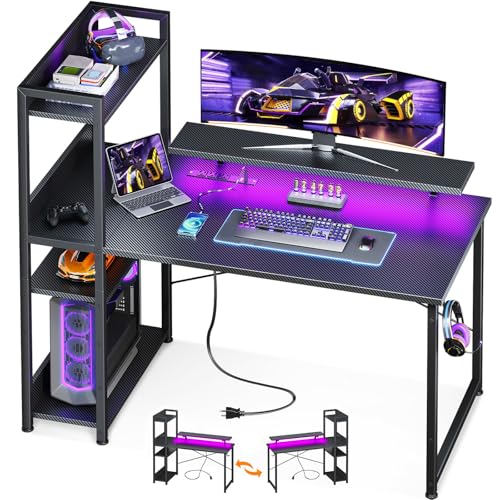
ODK Reversible Gaming Desk 40 Inch with LED Lights (Carbon Fiber Black) — The Powered Case
This pick is a 40-inch desk with LED lighting, desktop power, shelves and a monitor stand, arranged so the storage side can flip left or right. In this pros-and-cons accounting it is Exhibit A for one side of the ledger — its verified footprint and storage pattern show exactly where the balance tips.
It fits buyers whose room and daily kit match the description above. It will frustrate anyone whose measured setup overflows the top, since no storage trick rescues a surface that is simply too small.
- LED lights in the listing title
- Storage shelves and a monitor stand
- 40 in wide class
- Reversible layout
- USB charging port and power outlet in the listing features
Strengths
- Storage that lives off the desktop keeps a small top usable, and at this size that is the entire game
- Footprint, verified from the listing: the dimensions (40 in wide class) are small enough for the rooms this guide targets
- Simple construction means assembly, moving and resale all stay easy
Trade-offs
- Finishes vary between listing variants, so double-check the exact variant in the basket before ordering
- Particleboard and fabric parts will not age the way solid wood or rigid cabinetry would
- The top remains a small top: your kit has to fit the measured rectangle, not the listing photograph
The one structural caveat: colour and finish options vary by listing variant, so confirm the exact variant before ordering. The rest is a fair trade of money for footprint, but that point is built into the design — it will still be true in year three, so buy only if your setup can live with it.
As a piece of small-room furniture, its case rests on economy of means — nothing decorative is allowed to spend footprint that work needs. Buyers comparing it with the neighbouring picks should focus on the storage pattern, because that — not the top material or the finish name — is what daily life will actually test. For this guide, the ODK Reversible Gaming Desk 40 Inch with LED Lights (Carbon Fiber Black) was assessed on exactly that basis, with its badge — The Powered Case — reflecting where that assessment landed.
Best for: buyers who need exactly this footprint and storage pattern / Not suited for: buyers whose kit or storage needs exceed the verified dimensions
Final Recommendation
Begin with the measurements, shortlist from the table above, and confirm your finalist against the ranked guide in Best Small Desk Under $100 Best Small Desk Under $100 or Best Small Desk Under $150 Best Small Desk Under $150 before ordering. The cluster’s other verdicts — Is A Small Desk Worth It Is A Small Desk Worth It and Small Desk Pros And Cons Small Desk Pros And Cons — state the same conclusions from different angles, deliberately, so a buyer who reads only one page still gets the honest version.
Frequently Asked Questions
What width counts as a small desk?
Most desks sold as small sit between about 28 and 47 inches wide, with 31 to 32 inches the most common compact size. Below that you are in lap-desk and side-table territory; above it, standard desks begin. Judge by your kit’s measured footprint rather than by the label, because one maker’s small is another maker’s standard.
Do folding desks wobble?
A well-locked folding frame is steady for typing and writing; the wobble people report usually traces to an uneven floor, a lock not fully engaged or a top not seated on its brackets. Test the lock, level the feet, and a folding desk feels far more solid than its reputation suggests.
What should I measure before ordering?
Measure the clear width and depth of the space, the doorway and any stair turn the box must pass, your chair’s width, and the rectangle your kit occupies on a table. Compare all four against the listing’s dimensions. That five-minute routine prevents nearly every return in this category.
Will a 32-inch desk fit a monitor and a laptop?
Yes, with discipline: a monitor on a short stand or an arm, the laptop closed in a vertical stand or open beside it at an angle, and the keyboard centred. Two stands side by side will not fit honestly. If both screens must stay open all day, step up to a 40-inch or wider top.
Can a small desk work for gaming?
Yes, if the frame is rigid, the monitor sits on an arm or a riser, and the keyboard is compact. What a small gaming desk cannot do is host a full-size keyboard, a wide pad and speakers all at once — choose which of those matters and let the others go.
Are more expensive small desks actually better?
Up to a point: extra budget buys thicker tops, better frames, real drawers instead of fabric, desktop power and cleaner finishes. Past the mid band, you are mostly paying for materials and looks rather than function. A well-chosen budget desk with the right dimensions beats a premium desk in the wrong size every time.
Cable reality in a small footprint — a closer look
A useful habit is to live with the desk for three full workdays before judging it, because the first day flatters every new setup. If something earns a permanent place on the top, something else has to leave it — that exchange keeps small desks honest. That is the standard a small desk should be held to — not whether it impresses on delivery day, but whether it stays invisible, in the best sense, for years.
A small top has no spare corner for a power strip, so cables either get planned or they colonise the legroom. Route the strip to the wall side, leave one free socket for a charger, and keep the laptop brick off the desktop where its heat and weight buy nothing. A single short cable channel or even two adhesive clips change the daily feel of a compact desk more than most upgrades.
The honest way to shop this category is to measure first and browse second. On height: Standard desk height clusters around 29 to 30 inches, and a small desk is rarely the place to expect adjustment, so chair height and your seated elbow angle have to do the ergonomic work. If the top sits too high, your shoulders climb all day; too low, and your wrists bend. A cushion or a different chair fixes small errors, not large ones.
What a 32-inch top actually holds — a closer look
Treat any early irritation as data: it usually names a fixable setup detail rather than a wrong purchase. Keep the surface one layer deep, the cables on the wall side, and the daily items within one reach but off the top. None of this requires new purchases. It requires noticing, once, how you actually work, and arranging a small surface around that reality instead of around a photograph.
Thirty-two inches holds a laptop and a notebook, or a monitor and a keyboard with discipline, but not a monitor, a laptop, a printer and optimism. Lay your real kit out on a table and measure the rectangle it occupies; that rectangle, not the listing photo, is your minimum top. If the rectangle overflows, the honest answers are a monitor arm, a wall shelf or a wider desk — in that order.
Treat the floor plan as the first specification and everything else as negotiable. On legroom: Knee space is a volume, not a width: drawers, shelves and modesty panels all spend it, and the bill arrives at your shins. Sit at the desk in your mind before you buy it — where do your knees go when the chair rolls forward, and what do they hit?
Storage: drawers versus bags versus shelves — a closer look
The difference between a cramped desk and a cosy one is rarely the desk; it is the dozen small decisions around it. Store the week’s paper in one place, empty it on a schedule, and let nothing migrate permanently onto the desktop. The reward is a workstation that disappears into the day: everything reachable, nothing looming, and a room that still feels like a room.
Hanging bags keep the desktop clear while spending no legroom, yet everything in them is visible and within a knee’s reach. Fabric drawers are light, cheap and forgiving of odd shapes, but they sag under books and they do not lock. Open shelves suit things you grab hourly; enclosed storage suits things you grab weekly. Small desks punish storing the wrong frequency in the wrong place.
The product photo never shows the skirting board, the radiator or the door swing that will actually decide fit. On doorway: A desk that fits the room but not the doorway, the stair turn or the lift is a desk you do not own yet. Flat-pack and folding designs earn their keep here: the assembled footprint matters less than the largest rigid piece you must carry through the building.
Folding desks and the daily reset — a closer look
In practice, the buyers who stay happy with a compact desk are the ones who treated the first week as a fitting session. Write down the one thing that annoys you each day for a week; the list you end up with is short and almost entirely fixable. That is the standard a small desk should be held to — not whether it impresses on delivery day, but whether it stays invisible, in the best sense, for years.
A folding desk turns a bedroom back into a bedroom at night, that is a genuine feature in a studio or a shared room. The cost is discipline: a desk that must be cleared to fold will be cleared, and some people work better with that forced tidiness than others. Check the fold mechanism for pinch points and for a positive lock; a desk that can fold itself under load is a hazard, not a convenience.
A small desk succeeds or fails on fit before it succeeds on features. On width: Measure the clear width between the two obstacles the desk must sit between, then subtract a finger’s width on each side so the frame can actually slide in. Width is the headline number, but clear width — after skirting boards and cable plugs — is the number that determines whether delivery day ends in relief or in a return label.
Stability, wobble and floor type — a closer look
Experience with compact workstations points the same way again and again: small adjustments in the first days decide long-term comfort. Revisit screen height, chair position and lighting once the novelty fades, and adjust them in that order. None of this requires new purchases. It requires noticing, once, how you actually work, and arranging a small surface around that reality instead of around a photograph.
Wobble on a small desk usually comes from the floor, the levelling feet or one under-tightened bolt, in that order. Hard floors forgive; carpet hides an uneven base until you lean on the top. Adjustable feet are worth more than extra cross-bracing here. Re-tighten frame bolts after the first week of use — new joints settle, and the second tightening is the one that lasts.
Most returns in this category trace back to one skipped measurement. On depth: Depth is where small desks quietly cheat: a top that looks generous in a photo can be too shallow for a monitor at a healthy viewing distance plus a keyboard. Check depth against your screen size and your keyboard, not against the laptop shown in the listing photo, which is almost always smaller than your setup.
Assembly without tears — a closer look
A useful habit is to live with the desk for three full workdays before judging it, because the first day flatters every new setup. If something earns a permanent place on the top, something else has to leave it — that exchange keeps small desks honest. The reward is a workstation that disappears into the day: everything reachable, nothing looming, and a room that still feels like a room.
Photograph the half-built frame before adding the top; if something is mirrored, that photo is how you will prove it to yourself. Cam-lock furniture rewards patience: force a cam and the particleboard around it is what gives way. Lay every panel out, identify left and right before the first bolt, and keep bolts finger-tight until the frame stands square.
Treat the floor plan as the first specification and everything else as negotiable. On height: Standard desk height clusters around 29 to 30 inches, and a small desk is rarely the place to expect adjustment, so chair height and your seated elbow angle have to do the ergonomic work. If the top sits too high, your shoulders climb all day; too low, and your wrists bend. A cushion or a different chair fixes small errors, not large ones.
Lighting a compact workstation — a closer look
Treat any early irritation as data: it usually names a fixable setup detail rather than a wrong purchase. Keep the surface one layer deep, the cables on the wall side, and the daily items within one reach but off the top. That is the standard a small desk should be held to — not whether it impresses on delivery day, but whether it stays invisible, in the best sense, for years.
A small desk near a window gets glare; a small desk in a corner gets gloom. Both are fixable with one lamp placed beside, not behind, the screen. Keep the lamp’s footprint off the desktop if you can — a clamp lamp or a wall shelf returns inches you will feel every day. Daylight from the side is the goal: screen perpendicular to the window, never facing it or backing onto it.
The product photo never shows the skirting board, the radiator or the door swing that will actually decide fit. On legroom: Knee space is a volume, not a width: drawers, shelves and modesty panels all spend it, and the bill arrives at your shins. Sit at the desk in your mind before you buy it — where do your knees go when the chair rolls forward, and what do they hit?
Chair pairing for narrow desks — a closer look
The difference between a cramped desk and a cosy one is rarely the desk; it is the dozen small decisions around it. Store the week’s paper in one place, empty it on a schedule, and let nothing migrate permanently onto the desktop. None of this requires new purchases. It requires noticing, once, how you actually work, and arranging a small surface around that reality instead of around a photograph.
The chair is half the workstation and most of the comfort, yet it is the half buyers measure last. A chair without arms, or with flip-up arms, slides under a narrow top and saves the walk-around space a fixed-arm chair steals. Check that your knees, the chair base and any under-desk storage can coexist before assuming the pairing works.
A small desk succeeds or fails on fit before it succeeds on features. On doorway: A desk that fits the room but not the doorway, the stair turn or the lift is a desk you do not own yet. Flat-pack and folding designs earn their keep here: the assembled footprint matters less than the largest rigid piece you must carry through the building.
Small desk, second monitor: the honest maths — a closer look
In practice, the buyers who stay happy with a compact desk are the ones who treated the first week as a fitting session. Write down the one thing that annoys you each day for a week; the list you end up with is short and almost entirely fixable. The reward is a workstation that disappears into the day: everything reachable, nothing looming, and a room that still feels like a room.
A second screen on a 32-inch top is possible with an arm and impossible with two stands; the stands are what eat the width. If the second screen matters daily, buy the arm with the desk, not after a month of neck-turning improvisation. Portrait orientation for documents is the one configuration that genuinely fits narrow tops well.
Most returns in this category trace back to one skipped measurement. On width: Measure the clear width between the two obstacles the desk must sit between, then subtract a finger’s width on each side so the frame can actually slide in. Width is the headline number, but clear width — after skirting boards and cable plugs — is the number that determines whether delivery day ends in relief or in a return label.
Renting, moving and resale reality — a closer look
Experience with compact workstations points the same way again and again: small adjustments in the first days decide long-term comfort. Revisit screen height, chair position and lighting once the novelty fades, and adjust them in that order. That is the standard a small desk should be held to — not whether it impresses on delivery day, but whether it stays invisible, in the best sense, for years.
Compact desks move house well, which matters if your lease is short or your rooms rotate purposes. Folding and flat-pack designs survive moves that kill assembled cabinetry, and their resale listings write themselves. Keep the assembly hardware in a labelled bag taped under the top; future-you, mid-move, will be grateful.
Treat the floor plan as the first specification and everything else as negotiable. On depth: Depth is where small desks quietly cheat: a top that looks generous in a photo can be too shallow for a monitor at a healthy viewing distance plus a keyboard. Check depth against your screen size and your keyboard, not against the laptop shown in the listing photo, which is almost always smaller than your setup.
Kids, students and homework corners — a closer look
A useful habit is to live with the desk for three full workdays before judging it, because the first day flatters every new setup. If something earns a permanent place on the top, something else has to leave it — that exchange keeps small desks honest. None of this requires new purchases. It requires noticing, once, how you actually work, and arranging a small surface around that reality instead of around a photograph.
For a child’s room the desk is homework station, craft table and Lego territory in rotation, so a wipeable top outranks almost everything. Height matters differently here: a desk a child grows into beats one that fits for a single school year. Rounded corners and a stable frame matter more than storage; books live happily in a crate beside the desk.
Most returns in this category trace back to one skipped measurement. On height: Standard desk height clusters around 29 to 30 inches, and a small desk is rarely the place to expect adjustment, so chair height and your seated elbow angle have to do the ergonomic work. If the top sits too high, your shoulders climb all day; too low, and your wrists bend. A cushion or a different chair fixes small errors, not large ones.
Gaming on a small desk — a closer look
Treat any early irritation as data: it usually names a fixable setup detail rather than a wrong purchase. Keep the surface one layer deep, the cables on the wall side, and the daily items within one reach but off the top. The reward is a workstation that disappears into the day: everything reachable, nothing looming, and a room that still feels like a room.
Gaming spends width on a wide mousepad and depth on a monitor pushed back, which is exactly what a small top lacks. A monitor arm and a compact keyboard are the two purchases that make a 40-inch gaming setup honest rather than cramped. LED strips and desktop power are conveniences; the fundamentals are a rigid frame that does not flex under a leaning forearm in a long session.
Most returns in this category trace back to one skipped measurement. On legroom: Knee space is a volume, not a width: drawers, shelves and modesty panels all spend it, and the bill arrives at your shins. Sit at the desk in your mind before you buy it — where do your knees go when the chair rolls forward, and what do they hit?
Remote work calls and background — a closer look
The difference between a cramped desk and a cosy one is rarely the desk; it is the dozen small decisions around it. Store the week’s paper in one place, empty it on a schedule, and let nothing migrate permanently onto the desktop. That is the standard a small desk should be held to — not whether it impresses on delivery day, but whether it stays invisible, in the best sense, for years.
On video calls your desk is also a film set: what sits behind you and what the microphone hears both trace back to this purchase. A desk against a wall gives you a controlled background and lets a small shelf hold the notebook the camera should not see. Keep the work surface one layer deep during calls — piles read as clutter at webcam resolution even when they are organised.
The honest way to shop this category is to measure first and browse second. On doorway: A desk that fits the room but not the doorway, the stair turn or the lift is a desk you do not own yet. Flat-pack and folding designs earn their keep here: the assembled footprint matters less than the largest rigid piece you must carry through the building.
Paper, notebooks and analogue overflow — a closer look
In practice, the buyers who stay happy with a compact desk are the ones who treated the first week as a fitting session. Write down the one thing that annoys you each day for a week; the list you end up with is short and almost entirely fixable. None of this requires new purchases. It requires noticing, once, how you actually work, and arranging a small surface around that reality instead of around a photograph.
Even digital workers accumulate paper: post, notebooks, a printer’s output tray that never empties itself. Give paper one home — a tray, a drawer or a box under the desk — sized to a week, and empty it weekly. A small desk fails by accumulation, not by design; the surface you bought is the surface that remains visible.
Treat the floor plan as the first specification and everything else as negotiable. On width: Start by measuring the clear width between the two obstacles the desk must sit between, then subtract a finger’s width on each side so the frame can actually slide in. Width is the headline number, but clear width — after skirting boards and cable plugs — is the number that determines whether delivery day ends in relief or in a return label.
Heat, vents and where the PC lives — a closer look
Experience with compact workstations points the same way again and again: small adjustments in the first days decide long-term comfort. Revisit screen height, chair position and lighting once the novelty fades, and adjust them in that order. The reward is a workstation that disappears into the day: everything reachable, nothing looming, and a room that still feels like a room.
A tower PC under a small desk spends the legroom and warms the knees; on the desk it spends the surface. There is no free option. If the tower must live on the floor, leave airflow clearance on every vented side and keep it off carpet if the intake is underneath. Laptop users should plan for the dock or hub’s footprint from day one — it is a permanent resident, not a guest.
The product photo never shows the skirting board, the radiator or the door swing that will actually decide fit. On depth: Depth is where small desks quietly cheat: a top that looks generous in a photo can be too shallow for a monitor at a healthy viewing distance plus a keyboard. Check depth against your screen size and your keyboard, not against the laptop shown in the listing photo, which is almost always smaller than your setup.