Disclosure: As an Amazon Associate, umtsmarttool.com earns from qualifying purchases. Links to Amazon on this page are affiliate links; they cost you nothing extra. Prices and availability change often, so check the current Amazon listing before you buy.
Where to buy
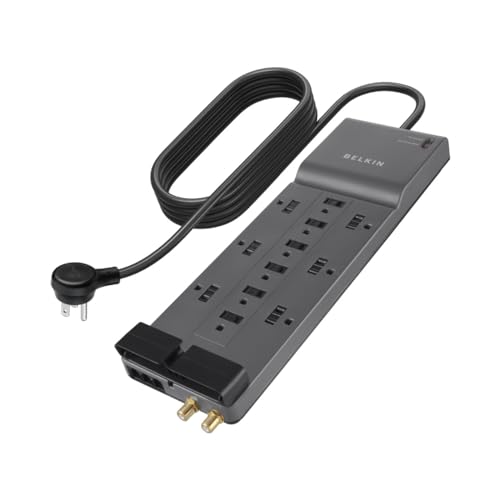
- Belkin 12-Outlet Surge Protector (BE112230-08) — Capacity Example
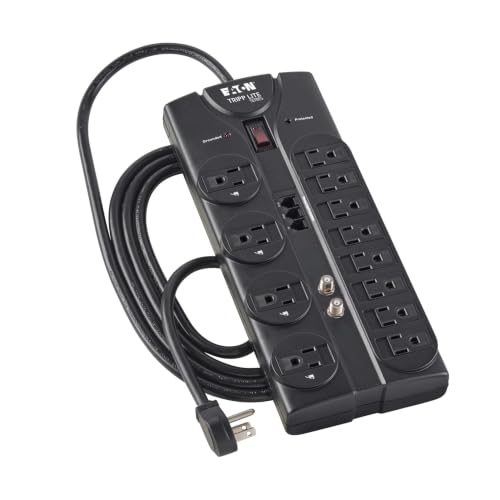
- Tripp Lite Protect It! 12-Outlet Surge Protector (TLP1208TELTV) — Fail-Safe Example
- APC Performance SurgeArrest 11-Outlet (P11U2) — Layout Example
- Furman PST-8D Power Station — Series-Mode Example
Start with the top pick: Check on Amazon
Read the full guide ↓
Weighing surge protector pros and cons honestly requires separating the technology from the marketing wrapped around it. The technology — sacrificial absorption, clamping, disconnection — is sound, documented and boring in the way good safety engineering is boring. The marketing — fantasy joule figures, lightning-proof promises, lifetime language attached to consumable components — is where the category earns its scepticism. This article argues both sides at full strength, because a buyer who has heard the cons articulated properly is exactly the buyer who will own the product correctly.
The examples are the documented instruments used across this programme — Belkin’s capacity flagship, Eaton’s fail-safe strip, APC’s layout benchmark and Furman’s series-mode conditioner — because pros and cons mean little in the abstract. The rankings that follow from this analysis are in Best Surge Protector Under $150 Best Surge Protector Under $150; the criteria version is Surge Protector Buying Guide Surge Protector Buying Guide.
The Strengths, at Full Strength
They absorb the events that actually happen. Most surge damage is not cinematic lightning; it is the accumulated diet of small transients from cycling motors and utility switching, plus the occasional restoration surge. A documented protector spends itself on exactly those events, invisibly, for years.
The good ones report on themselves. Protected indicators, grounded and wiring-fault warnings, automatic shut-off — the mature products in this category tell you their status and the wall’s status, which turns a blind consumable into a monitored instrument.
They consolidate safely. One listed strip with real spacing replaces the nest of outlet multipliers and chained extenders that is the actual fire-and-failure risk in most homes, and adds a breaker and a switch in the bargain.
The economics are asymmetric. A protector costs a small fraction of the equipment behind a single outlet cluster, and makers back the better ones with connected-equipment policies. Few household purchases offer that ratio.
The technology has a serious tier. Series-mode conditioning — the Furman in this list — removes the central compromise of the category, absorbing without the same sacrificial wear and disconnecting through sustained bad voltage. The category is not one product; it is a ladder, and the top of it is genuinely good engineering.
In this guide
The Trade-Offs, at Full Strength
They wear out silently. The defining con. MOV capacity is spent by events the owner never sees, and a cheap strip gives no sign it has become an ordinary power strip with a heroic label. Mitigation exists — indicators, shut-off, replacement discipline — but it demands the owner’s participation.
They cannot do the thing the ads imply. No plug-in protector promises survival of a direct lightning strike, none regulates a brownout, and none provides power in an outage. Buyers who conflate surge protection with those three different products will be disappointed by a device doing its actual job perfectly.
The ratings invite abuse. Joule figures are real but gameable, and the unverifiable end of the market prints numbers unconnected to components. The con is not the metric; it is that the metric’s abuse forces buyers to become datasheet readers to shop safely.
They protect only the paths you route. AC-only installation leaves coax and Ethernet as open doors, and an ungrounded outlet undermines the main diversion path. The product’s protection is a system property, and the system includes your wiring and your installation discipline.
They add a recurring cost and a chore. Replacement on a cycle, indicator checks, paperwork for policies. Small, real, and fatal to the value proposition for owners who will do none of it — for them, the honest recommendation is a panel device and unplugging habits instead, as Is A Surge Protector Worth It Is A Surge Protector Worth It concludes.
The Specification Context
For readers weighing numbers: documented flagships in this programme publish 2,880-3,940 joules with UL 1449 voltage ratings of 330-500V per mode; honest mid-range units publish 900-2,100 joules with listings; the conditioner publishes clamping and shutdown behaviour instead of joules. Those are the real axes. Any figure outside a datasheet — especially a five-digit joule claim from an unknown brand — should be treated as fiction until documented, and the absence of a VPR from a product’s literature is itself a data point about the product.
- 12 AC outlets, 4 of them transformer-spaced
- 2,880-joule AC suppression rating (Eaton datasheet)
- UL 1449 let-through rating 330V L-G, 400V L-N, 400V N-G
- 8 ft cord, 14-gauge, right-angle plug
- RJ11 telephone and 2.2 GHz coaxial protection, automatic shut-off
Who Should Buy, Who Should Skip
Best for: households with always-plugged computers, media and network equipment; buyers willing to check an indicator quarterly and replace a unit after major events; anyone whose local power flickers, storms or restores noisily. / Not suited for: buyers seeking lightning immunity, brownout regulation or backup power — three different products — and owners who will never check or replace anything, for whom a panel device plus unplugging is the honest architecture.
Between those poles sits the majority: people who will do the small disciplines if the product makes them easy. That is why this programme’s rankings consistently favour units with indicators and shut-off over units with merely bigger numbers — the pros only survive contact with real ownership when the cons are designed against.
Alternatives Worth Naming
The conditioner class answers the wear con directly and adds filtration and voltage shutdown, at several times a strip’s price. The panel device answers the discipline con — nothing to check at the outlet, everything blunted at the source — while needing point-of-use partners for sensitive gear. The UPS answers the outage question that protectors never claimed. A complete household usually ends with a combination, assembled in the order our Best Surge Protector For Emergencies Under $75 Best Surge Protector For Emergencies Under $75 guide lays out, rather than with a single heroic purchase.
Bottom Line
The pros are structural and the cons are manageable, which is the profile of a mature safety product. Buy documented, prefer units that report their own health, route every path, and replace on evidence rather than on hope. Do that, and the balance of this article is not close: the protection is worth multiples of its cost, and the trade-offs shrink to a calendar reminder and a glance at a light.
The Con That Designs the Pros
It is worth pausing on how the category’s central con — silent, sacrificial wear — has shaped its best products, because the design responses are the strongest evidence that the engineering is serious. Indicators exist because wear is silent. Automatic shut-off exists because indicators require attention. Fail-safe circuitry exists because shut-off requires the owner to notice an outage of their own making. Each feature is a confession about the previous one’s limits, engineered into the next model. Product categories that hide their weaknesses do not produce feature lists like that.
The series-mode conditioner is the endpoint of the same logic: a design that refuses the sacrificial bargain altogether. That it costs several times more is not a refutation of the strips but a measurement of what the bargain was worth. Buyers weighing pros and cons are really weighing which point on that design conversation matches their equipment, their climate and their own discipline — a more useful framing than any verdict this article could hand down.
The Argument at the Family Table
The pros and cons of this article get their fairest hearing at the family table, where one person has read the datasheets and the other has read the credit-card statement. The sceptic’s points are good ones: it wears out, it cannot stop lightning, the cheap ones are theatre. The advocate’s answers are the article’s: wear is managed by indicators and shut-off, lightning was never the claim, and the theatre is exactly why the documented floor exists. The resolution most tables reach is the correct one — protect the valuable clusters properly, skip the rest without guilt, and revisit after the first storm either way. Categories with honest middles are the ones worth buying in.
How the Balance Shifts by Household
The balance struck in this article is a national average that no household actually lives. In a lightning-dense region with ageing overhead lines, the pros lengthen: events are frequent, capacity is spent on real work, and fail-safe behaviour earns its premium within a few seasons. In a new apartment on an underground urban grid, the cons lengthen relatively: events are rarer, and the case rests on the restoration surge and the long tail of small transients. Neither household is wrong; the article’s framework — documented floor, failure behaviour, routing discipline, replacement rhythm — is what travels between them.
Equipment value shifts the balance the same way. Behind a five-figure studio, every con in this article reads as a footnote. Behind a student’s laptop and lamp, the pros compress to a single listed mid-range unit and the discipline to check it. Pros-and-cons analysis that ignores the reader’s own two variables — local power and equipment value — is horoscope, not advice; this one is built to be re-weighted.
Ownership Notes
Ownership of the Belkin settles into a routine quickly: the covers keep unused sockets clean, the lamps get a glance whenever the cabinet opens, and the strip otherwise disappears. Owners upgrading from a basic bar notice the difference in the first week — not in protection, which is invisible when it works, but in the absence of the adapter shuffle that used to greet every new device.
In daily service the Eaton’s LEDs become the household’s quiet status board: protection alive, ground present. The coax run through its jacks is the step owners most often skip and the one this programme most often recommends, because the cable feed is a genuine surge path into exactly the equipment the strip was bought to defend.
Living with the P11U2 means the desk stops being renegotiated. New gear arrives, a spaced outlet is free, and the wiring-fault lamp stays dark — the three experiences its design was optimised for. Its size, criticised in the abstract, is precisely what the spacing costs, and owners consistently report forgiving it within a week.
The PST-8D’s owners tend to describe it differently from strip owners: not as protection bought but as infrastructure installed. The filtration is audible in quiet rooms, the shutdown is a promise kept in advance, and the chassis outlasts the equipment generations plugged into it — which is the entire argument for its price, stated by the people who paid it.
Background and Detail
The joule rating tells you how much surge energy the protection circuit can absorb over its life before it is spent. Metal oxide varistors — the components that do the absorbing in most strips — degrade a little with every event, including the small ones you never notice. A higher rating therefore means a longer useful life and more headroom for a big event, not a force field. Ratings only compare meaningfully between reputable brands that publish them the same way, which is why every pick in this guide comes from a maker that prints a full datasheet.
Clamping voltage, published under UL 1449 as the Voltage Protection Rating (VPR), is the level the strip lets through to your equipment while it works. Lower is better: a strip rated at 330V or 400V L-N exposes your gear to less of the spike than one rated at 600V or 800V. Joule headlines get the marketing space, but the VPR is the figure that describes what your power supply actually experiences during an event. When a maker publishes per-mode VPR figures, as APC, Eaton and CyberPower do, that is a sign the datasheet deserves trust.
Surge protectors are consumables. Each absorbed event spends part of the protection budget, and a single severe event can spend all of it at once — after which some strips keep passing power with no protection left. Prefer models with a Protected indicator light or automatic shut-off, check the light every few months, and replace any strip after a major storm event even if it still works. A common planning horizon is three to five years for a primary strip in an active storm region, sooner if the indicator ever goes dark.
Never daisy-chain surge protectors, and never plug one into an extension cord that is not rated for the load. Chaining strips defeats their overload design, can void the connected-equipment policies that back them, and creates the exact overheating scenario the breaker is meant to prevent. One strip per wall receptacle, plugged directly in, with its cord uncoiled and uncovered, is the installation rule. If you need more outlets, buy a strip with more outlets — that is the safe version of the same purchase.
Surge Protector Pros and Cons: The Full Balance
Balance, in the end, is a property of the buyer’s situation more than of the product. This article has tried to hand over the scales rather than the verdict — the rest is your equipment list, your weather map and your honest estimate of your own discipline.
A Note on the Word ‘Protection’
Half the disappointment in this category is linguistic. ‘Protection’ sounds absolute, and the products are probabilistic: they reduce the energy of events, extend the odds across years, and convert some failures from silent to announced. Engineering has a more honest vocabulary — mitigation, rating, service life — and the makers worth buying use it in their datasheets even when their marketing departments reach for the absolute word. Reading for that vocabulary is the fastest screening test this article can teach: the brand that writes ‘reduces the risk of damage from power surges’ on page one of its manual is telling you the truth in a dialect the fantasy brands cannot speak. Prefer those brands, hold them to their published numbers, and the pros-and-cons balance in this article stops being a debate and becomes what it should have been all along — a specification you can check.
Where the Cons Are Heading
The trade-offs in this article are not static, and their direction is worth a forecast. The wear con is being engineered away from two directions: fail-safe designs that announce their own end, and series-mode designs that decline the sacrificial bargain entirely. The information con — ratings as marketing — is being eroded by the slow spread of per-mode publication, as one flagship’s datasheet shames the next one’s omissions. The discipline con shrinks as indicators become standard at ever lower prices. A buyer reading this article in five years will likely find its con list shorter and its pro list smugger, and that trajectory is itself evidence about the category’s health: technologies whose weaknesses compound do not get bought by engineers for their own racks.
The pros have a direction too, and it points the other way — toward greater necessity. Every year the average home’s plugged-in value rises and its tolerance for power events falls, because every year another appliance trades a mechanical control for a circuit board. The balance this article struck for today’s household will read, in a decade, as conservative. That is the final asymmetry worth carrying away: the cons are being designed out on a schedule, while the pros are being designed in by the entire electronics industry, one smart appliance at a time.
How Professionals Specify, and What It Teaches
There is a control group for this entire debate, and it is the people who buy protection with other people’s money on professional liability: facilities managers, studio engineers, IT departments, production electricians. Their specifications are public in aggregate, and they are monotonous — listed devices, published ratings, indicators or shut-off, replacement schedules, panel layers in serious buildings. No professional specification anywhere reads ‘largest advertised joule number, brand unimportant’. When the people who are sued for failures converge on a buying pattern, that pattern is data, and it matches this article’s balance sheet line for line.
The amateur market’s divergence from that pattern is not a mystery of taste; it is a marketing outcome. Professionals read datasheets because their incentives demand it, and consumer shelves optimise for the buyer who reads boxes. The pros-and-cons framework in this article is, in the end, an attempt to lend the consumer the professional’s incentives for one purchase: imagine the equipment is yours, the failure is yours, and the paperwork is yours — because all three are true — and the balance resolves itself.
The Balance for the Three Commonest Homes
For the apartment dweller with a laptop, a television and a console: the pros win narrowly but clearly — one documented mid-range unit, checked twice a year, and the cons reduce to a calendar entry. For the suburban household with a media wall, a home office and a storm season: the pros win decisively, and the interesting question stops being whether and becomes how layered. For the studio, the workshop and the small server closet: the balance leaves the strip category altogether, and the conditioner class turns the article’s longest con — sacrificial wear — into a historical note. Three homes, three balances, one framework: that is what a pros-and-cons analysis owes its readers, and it is why this one refuses to end with a single verdict wearing a false moustache of universality.
Related Guides in This Series
Neighbouring questions in this cluster are covered by Best Surge Protector For Home Office Under $150 Best Surge Protector For Home Office Under $150, Best Surge Protector For Travel Under $150 Best Surge Protector For Travel Under $150 and Surge Protector Review Surge Protector Review — each written to the same documentation standard as this page.
Further Detail
Workshop and garage loads deserve a separate word. Power tools themselves are crude loads that neither need nor benefit much from surge protection, but the modern workshop also holds battery chargers with real electronics, a radio, and increasingly a computer or tablet running plans and measurements. Protect the chargers and the electronics on a documented strip; let the circular saw have the bare outlet it was designed for, and keep every protector out of the dust-and-moisture path of actual work.
Home NAS boxes and small servers are the strongest quiet case in this whole subject. They hold the only copies of things, they run around the clock, and their power supplies meet every transient the house generates. The standard of care that has emerged — protector at the wall, UPS downstream, backups that do not depend on either — is cheap relative to the data. Any household that has graduated to network storage has also graduated past the question of whether protection is worth it.
The 3D printer, the laser cutter and the home CNC share a profile: costly control electronics, long unattended runs, and power supplies that dislike surprises. Their owners learned early what this guide teaches generally — a documented protector is part of the machine’s installation cost, and a UPS joins it when a ruined ten-hour print costs more than the battery does. Maker spaces that skip the protection eventually teach the lesson at retail price.
There is a small, satisfying ritual available to owners of indicated protectors after any storm: the walk. Kettle on, then room to room, a glance at each green light — network shelf, desk, media wall, chargers. Two minutes, and the household’s invisible infrastructure has reported for duty. Rituals like this are how maintenance actually survives in real homes: not as chores on a list, but as habits attached to events that already happen.
Power quality is becoming a household topic for a structural reason: the modern home’s load has quietly become electronic. Twenty years ago a surge threatened the television and the computer; today it threatens the fridge’s board, the washer’s board, the boiler’s board, the charger’s negotiation with the car. Every appliance that gained a display gained a vulnerability, which is why panel devices and point-of-use protection have moved from enthusiast purchases to standard advice.
When a protector retires, its replacement decision is the programme in miniature: same inventory, same datasheet lines, same fit questions, answered faster because the household now owns the method. That acceleration is the real return on the first careful purchase. It is also why this cluster of guides spends so many words on criteria and so few on urgency — the goal was never one transaction, but a household that buys power protection correctly forever.
Child safety changes the outlet calculation in family homes. Sliding safety covers, found on the Belkin flagship in this programme, close unused sockets against curious fingers and dropped objects; tamper-resistant receptacles in the wall do the same job upstream. Neither replaces supervision, but a protector chosen with covers removes one category of nursery and playroom hazard without any ongoing effort from the adults.
Aquariums and home theatres share a trait: their equipment is expensive, always on, and quietly intolerant of power events. Pumps, heaters with electronic controls, LED drivers and AV receivers all sit behind control boards now. Owners of both setups converge on the same answer — a documented strip or conditioner, checked on the same schedule as the water or the dusting — because the cost of the protection rounds to zero against the cost of the inhabitants or the installation.
Smart plugs and surge protectors solve different problems and should not be confused. A smart plug switches and measures; unless it is explicitly rated and listed as a surge protective device, it contains no meaningful protection. Stacking a smart plug into a protector’s outlet for scheduling is legitimate; substituting one for the other because both are white plastic rectangles is how equipment ends up defended by a radio.
Treadmills and exercise equipment invert the usual advice in an instructive way. Their motors draw hard, their manuals often demand a dedicated circuit, and a shared strip is a nuisance-trip machine. The electronics in a modern treadmill console are real, but the correct protection is the panel device and the dedicated outlet the maker specified — a case where the layered architecture, not the point-of-use strip, is the answer. Knowing when not to use a strip is part of knowing strips.
Finally, a word about buying the second unit. Owners consistently report that the second documented protector is an easier purchase than the first, because the first has already taught the household where its unprotected clusters are — the router in the hallway, the chargers in the kitchen, the spare-room desk. Coverage grows by observation. Programmes like this one publish rankings; households build systems one noticed gap at a time, and the noticing is the skill worth acquiring.
One underused diagnostic deserves promotion: the protector as witness. A unit whose indicator dies, a conditioner that logs shutdowns, an EMS that reports a pedestal’s sag — each converts an invisible property of your power into a dated observation. Households and campers who keep those observations make better decisions about everything downstream, from which appliance is really failing to whether the utility needs a call. Protection that reports is worth more than protection that merely absorbs.
Registering a protector’s warranty is the dullest five minutes in this entire subject and the one owners most regret skipping. Connected-equipment policies are contracts with conditions — correct installation, timely claims, sometimes registration — and the time to learn the conditions is the day the box opens, not the day the television dies. Photograph the receipt, save the manual’s policy page, and store both with the household documents. If a claim ever comes, it will be won or lost on exactly that paperwork.
Dormitories and rented rooms add rules of their own: many prohibit daisy-chained strips, some prohibit extension cords entirely, and cruise-style inspections of student wiring are not unknown. A single listed protector with enough outlets, plugged directly into the wall, satisfies both the safety office and the resident — which is why compact, documented units are the standard recommendation for student rooms in this programme’s travel and budget guides.
The refrigerator question comes up in every emergency discussion: should it have a surge protector? The honest answer is layered. A fridge’s control board is genuinely vulnerable and genuinely expensive, and dedicated appliance-rated protectors exist for exactly that socket. But a standard desk strip is the wrong device — the compressor’s startup draw and the strip’s design do not suit each other. If the fridge matters, buy the appliance-specific unit or rely on the panel device, and keep the strips for electronics.
Generator transfer arrangements change the surge picture at a house in ways worth one paragraph. When a home switches between utility and generator power, the changeover itself and the generator’s less regulated output argue for protection that is already installed on the important clusters — the same point-of-use units recommended throughout this programme — and for giving sensitive electronics a pause during the switchover minute itself. Backup power and surge protection are partners, not substitutes.
Voltage events have a geography. Homes at the end of rural feeders, homes under old overhead lines in tree country, and homes in lightning-dense regions simply meet more and larger transients than a new suburb on underground cable. Protection budgets should follow that geography honestly: the same equipment list justifies a flagship and a panel device in one postcode and a single documented strip in another. Local electricians, who replace the boards either way, are candid witnesses to which postcode you live in.
The connected-equipment policy figures printed on boxes — five and six digits — deserve a calm reading. They are ceilings under conditions, not balances in an account, and claims require the protector to have been correctly installed and the equipment correctly connected, signal lines included where the policy says so. Read the figure as the maker’s confidence interval made visible: a company expecting its protection to fail does not attach six figures to the failure.
Compatibility between protectors and modern lighting is a niche worth ten seconds: some LED drivers and dimmers object to the noise or the switching behaviour of particular power accessories, showing it as flicker or buzz. The fix is almost always arrangement — the lighting on its own circuit or outlet, the protector serving the electronic loads it was designed for — rather than any defect in either product. Separation of load types is the quiet theme underneath this entire subject.
Spent surge protectors should not go in the household bin without thought. They contain metal oxide varistors, circuit boards and copper that recyclers handle routinely through electronics waste streams. Many municipalities and retailers run e-waste collections that accept small power accessories. Retiring a strip responsibly is the last step of the replacement cycle this guide keeps recommending — and a strip that has absorbed a major event has genuinely earned its recycling.
Frequently Asked Questions
What is the biggest disadvantage of a surge protector?
Silent wear. The protection is consumed by events you cannot see, so ownership requires indicator checks and eventual replacement — or a fail-safe model that announces its own end.
Can a surge protector damage my equipment?
A listed unit from a real maker, correctly installed, does not damage equipment. The risks come from counterfeits, daisy-chaining, overloading and using indoor units in wet locations.
Do surge protectors protect against lightning?
They reduce damage from lightning-induced surges on the line; none promises survival of a direct strike. Unplugging remains the only complete lightning protection.
Are joule ratings trustworthy?
From makers who publish datasheets and UL 1449 data, yes, as a service-life figure. As marketplace headlines from unknown brands, treat them as unverified claims.
Is a conditioner strictly better than a strip?
It answers more failure modes — wear, sustained over-voltage, line noise — at a much higher price. For a computer desk a top strip is proportionate; for a studio the conditioner earns its premium.
What is the most common buyer mistake?
Buying on the joule headline alone, then never checking the indicator. The first error buys the wrong unit; the second retires the right one without knowing.
A three-wire outlet gives a surge three roads in: hot to neutral, hot to ground, and neutral to ground. Cheap strips protect only the first and call it done. Full three-mode protection covers all three paths, because a surge riding the ground or neutral line reaches the same circuit boards in the end. When you compare spec sheets, look for protection listed across L-N, L-G and N-G; a single combined joule figure with no mode breakdown tells you less than it appears to.
Every plug-in surge protector needs a properly grounded outlet to work. The ground path is where much of the diverted energy goes; without it, the protection circuit is partially blind. That is why the better strips carry a Not Grounded or wiring-fault indicator, and why a two-prong cheater adapter quietly defeats the point of buying protection at all. If the indicator on a new strip says your outlet is not grounded, the correct move is an electrician, not a different strip.
Surges do not respect the power cord’s monopoly. A spike can arrive on a coaxial cable feed, a telephone line or an Ethernet run and enter a TV, modem or computer from the signal side, bypassing an AC-only strip completely. If your setup still has wired coax or Ethernet feeding the same equipment, choose a strip with matching line protection and route those cables through it, accepting the small signal loss as the price of a closed door. Fully wireless setups can honestly skip this feature.
Storm preparation with surge protection is mostly about decisions made before the sky darkens. The expensive, always-plugged equipment — computers, TVs, network gear, the fridge’s control board via its outlet where accessible — should already live behind protection, because nobody reliably runs around unplugging things at midnight. During a severe event, unplugging the most valuable portable items still beats any strip; no plug-in device promises survival of a direct lightning strike, and honest makers say so. After the event, check every Protected indicator before trusting the strip again.
Should a surge protector feel warm?
No. A protector should run at room temperature in normal service. Warmth suggests overload or failing components; unplug it, reduce the load, and treat persistent warmth as a replacement signal.
Can I use a surge protector with a generator?
Yes — generator output can swing as loads change, and a documented protector is sensible downstream. Keep it dry, indoors or under shelter, and never run it in rain.
Does a surge protector protect against power outages?
It protects against the surges and sags around outages, especially the restoration spike, but it provides no power itself. Continuity is a UPS’s job.
A plug-in strip is the last layer of defence, not the only one. A Type 2 surge protective device installed at the breaker panel by an electrician blunts large, externally generated surges before they spread through the house wiring, and the plug-in strips then handle what remains plus the smaller surges generated inside the home by motors and compressors switching. The two layers multiply rather than duplicate each other. If you protect only one layer, protect the point of use for sensitive electronics — but the panel device is the upgrade that guards everything at once.
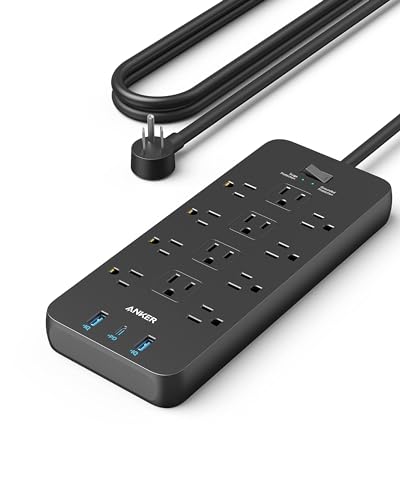
Built-in USB ports are a convenience feature, not the protection story, but they shape daily life with a strip. A shared 2.4A output charges one modern phone reasonably or two slowly; a dedicated 20W USB-C port with Power Delivery fast-charges a phone while leaving every AC outlet free. Check whether the USB output is quoted per port or in total before you buy — the difference decides whether the second device charges overnight or merely eventually.
Cord length and gauge decide where a strip can actually live. A 14-gauge cord carries the strip’s full 15A rating without meaningful voltage drop over typical lengths; thinner cords on long runs are a quiet compromise. Measure from the outlet to the desk tray or cabinet before choosing: an 8 ft cord forgives awkward rooms, while a 4 ft cord demands the furniture come to it. Flat and right-angle plugs matter in equal measure, letting furniture sit against the wall instead of perched on a plug.
The circuit breaker in a strip protects against overload — too many amps drawn for too long — which is a different hazard from a surge. Fifteen amps at 120V is roughly 1,800 watts shared across every outlet, and space heaters, kettles and hair dryers consume most of that alone. Keep high-draw heat appliances off surge strips entirely; they gain nothing from surge protection and they crowd out the electronics the strip exists to guard. The breaker tripping is information: something on the strip does not belong there.
Campground pedestals fail in ways house outlets rarely do: neutrals work loose, grounds disappear, voltage sags when every rig on the loop runs its air conditioner, and miswired pedestals present faults that damage equipment slowly. That is why RV protection splits into two classes — surge-only plugs that absorb spikes, and electrical management systems that also monitor voltage and wiring and disconnect the rig when power goes bad. For an RV with an air conditioner, a converter and modern electronics, the second class is the one that matches the risk.
Surge protectors are voltage-specific in a way phone chargers are not. A strip built for North American 120V service must never be plugged into a 220-240V outlet through a shape-only plug adapter: the protection components will fail, possibly taking connected equipment with them. For international travel, use a plain adapter with dual-voltage chargers, or a travel unit explicitly rated for the destination’s voltage. Within North America, the same unit that guards your laptop at home works in any hotel on the continent.
Some strips add EMI/RFI filtering, which strips high-frequency noise off the power line. That noise does not damage equipment the way a surge does, but it can buzz through audio gear, disturb sensitive measurement equipment and add shimmer to video. Filtering figures are quoted in decibels across a frequency range; treat them as a secondary benefit unless you run audio equipment, in which case a properly filtered bank — or a series-mode conditioner — becomes a genuine feature rather than a bullet point.
Connected-equipment policies — the dollar figures makers attach to their strips — are warranties with conditions, not insurance in the everyday sense. They generally require the strip to be correctly installed, the equipment to be properly connected including signal lines where specified, and a claim process that starts with the maker’s paperwork. Read the figure as a signal of how seriously the maker stands behind the protection rather than as a cheque already written, register the product if the maker asks, and keep the receipt with the manual.
What is the difference between a surge protector and a power conditioner?
A protector absorbs or disconnects against over-voltage. A conditioner additionally filters line noise and, in the Furman class, shuts down through sustained bad voltage. The conditioner is the broader instrument at a broader price.
Can I plug a UPS into a surge protector?
UPS makers generally advise plugging the UPS directly into the wall and protecting other gear separately, because a strip between the UPS and the wall can complicate its operation. Follow the UPS maker’s guidance for your model.
Do surge protectors work after a blackout?
Usually — but the restoration surge is exactly the event that can spend one. Check the Protected indicator after every outage before assuming the protection survived.
Are rack-mount and strip protectors different inside?
The protection principles are the same; format, outlet count and documentation differ. Judge any format by the same datasheet criteria used throughout this guide.
Should every outlet in the house have one?
No. Protect clusters of valuable, always-plugged electronics. Lamps, chargers for disposable devices and heat appliances do not need protectors, and heaters must never share one.