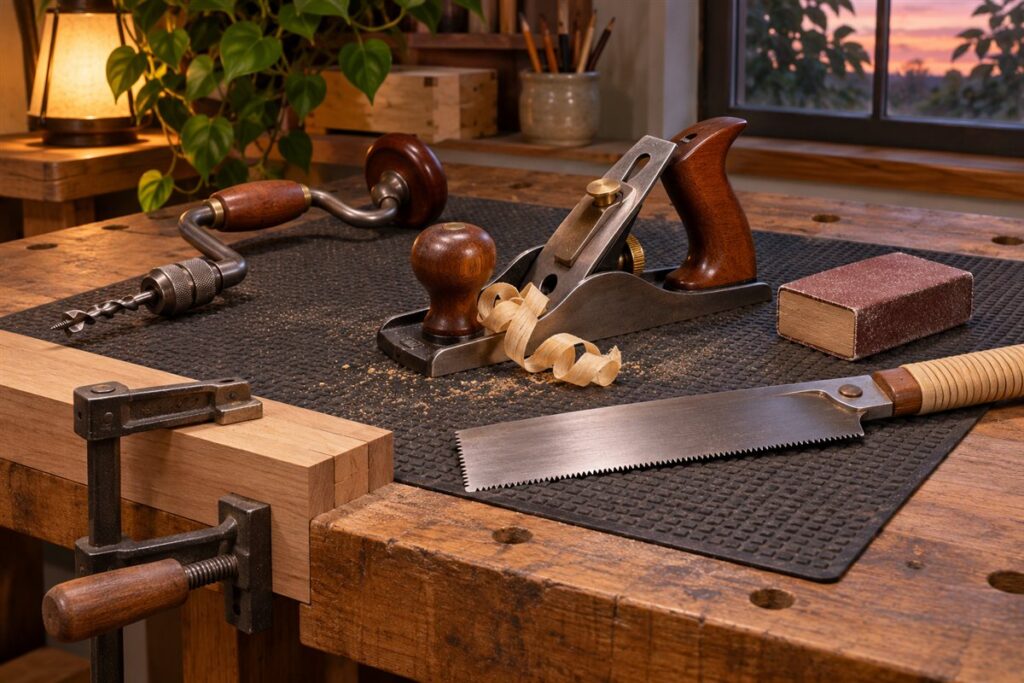
Quiet workshop hours are easier when you swap noisy power tools for hand tools, schedule the loud jobs for daytime, and control vibration. You will not make a workshop silent, but you can cut noise a lot and stay on good terms with the people nearby.
Hand Tools That Keep It Calm
- Hand saws and pull saws for cutting small stock.
- Hand planes and scrapers for shaping and smoothing.
- Chisels and mallets used with a soft-faced mallet.
- Manual screwdrivers and ratcheting drivers.
- Hand drills and brace tools for small holes.
- Sanding blocks with sanding sheets.
Hand tools take more time and effort, but they are quieter and give a lot of control. Keep blades sharp, as dull ones need more force and make more noise.
Cutting Down Noise From Any Tool
- Put the work on a solid bench with a rubber mat or foam underneath.
- Clamp the workpiece so it does not rattle.
- Use sharp bits and blades, and let the tool do the work.
- Choose lower speed settings where the maker allows.
- Close doors and windows, and consider acoustic blankets or insulation on shared walls.
- Keep dust extraction away from hard, echoing surfaces where possible.
Power tools can still be loud. Always wear hearing protection, even if your neighbours do not hear much.
Plan Around the Calendar
Check local rules and building agreements for quiet hours and noise limits. Do cutting and drilling in the daytime, and save sanding by hand, layout, assembly and finishing for the evening. Telling neighbours when a noisy job is planned often helps.
| Task | Quieter approach | Best for |
|---|---|---|
| Cutting boards | Hand saw | Small jobs |
| Smoothing | Plane or sanding block | Evening work |
| Fastening | Hand driver | Furniture |
| Hole drilling | Hand drill | Light timber |
Setting Up a Quieter Space
A few changes to the room itself can make a real difference. Heavy curtains, rugs and wall panels absorb sound, and rubber feet under machines and benches cut the vibration that travels through floors. Seal gaps around doors with weatherstrip, and keep the door closed while you work. Place noisy equipment on the side of the room furthest from shared walls.
Work out a routine too. Tell household members or neighbours when you plan to do something loud, and keep an alternative quiet task ready for late hours, such as sharpening, measuring, marking out or finishing. Always check the tool maker guide, as some tools have a lower speed mode designed to reduce noise.
How Noise Travels Through a Building
To reduce noise you need to know how it moves. Sound travels in two main ways: through the air and through solid structure. Airborne noise, such as the whine of a saw, escapes through gaps around doors and windows, thin walls and vents. Structure-borne noise, such as hammering or a machine vibrating on a bench, travels through floors, walls and joists and can be heard in rooms far from the source.
These two paths need different fixes. Airborne noise is reduced by closing gaps, adding mass and absorbing sound inside the room. Heavy doors, weatherstripping, door sweeps and thick curtains help. Structure-borne noise is reduced by decoupling: placing rubber pads, foam or anti-vibration mats beneath machines and benches so the vibration does not pass into the floor. Check the pad’s rating and size for your load.
Think about your neighbours’ point of view. Low frequencies travel farther and through walls more easily than high ones, so the thump of a mallet or the rumble of a motor may carry further than a hiss. Floors above or below you will hear footsteps and dropped items. Position your work away from shared walls and floors, and avoid dropping tools or slamming lids. Even small changes, such as putting a mat under the bench or lining a tool tray with felt, can lower impact noise. Keep expectations realistic: you can reduce noise, but not eliminate it.
Choosing Quieter Hand Tool Techniques
Hand tools are quieter than machines, but technique still affects how much sound you make. A sharp plane takes a smooth shaving with a soft hiss, while a dull one chatters and bangs. A well-set saw cuts with a gentle rasp, while a binding saw squeals. Sharpness, setup and rhythm matter as much as the tool type.
- Saws: use long, light strokes, let the teeth do the work and support the piece close to the cut to avoid buzzing.
- Chisels: pare by hand where possible, and use a soft-faced mallet rather than a metal hammer when you must strike.
- Planes: set a fine cut and keep the sole clean. Clamp the work so it does not tap or slide.
- Files and rasps: a slow, even stroke is quiet, and a handle that fits your hand prevents slipping.
- Hand drills and braces: turn at a steady pace and keep bits sharp.
Use a bench with a thick top, since a thin top acts like a drum. A non-slip mat or a layer of cork stops pieces knocking. Hold workpieces in a vise or with clamps, which also improves accuracy. Take your time: quiet work is deliberate, and rushed work tends to be noisy. Keep your hands and tools clear of the cutting path, and wear eye protection even for hand tool work.
Reducing Noise From Power Tools When You Must Use Them
Sometimes only a power tool will do, and a few habits keep the noise lower. Choose the right tool and accessory for the material: a sharp, correct blade or bit cuts more quietly than a dull one forced through the work. Many tools offer speed control, and a lower speed often means less noise, but check the manual for appropriate speeds for the material, since too slow a speed can cause burning or binding.
Clamp the work and support it fully. Unsupported material vibrates and amplifies sound, much like a speaker cone. Place a mat or foam beneath, and keep the piece from touching hard surfaces that ring. Use a dust extractor or vacuum if the tool supports one, as this controls dust, though some extractors are loud themselves. Check the noise information in the manual or product listing before purchase, if provided, but treat it as a guide, since conditions vary.
Always wear hearing protection when using power tools, even if you feel the noise is moderate. Protection preserves your hearing and lets you notice when something sounds wrong. Work in short bursts, group noisy tasks together so that the disturbance is brief, and finish them before quiet hours begin. Consider choosing a more compact or lower-powered tool for light tasks instead of a large machine, as long as it can do the job safely. Keep doors closed, and make sure no one is startled by sudden noise, particularly children, pets and sleeping neighbours.
Room Treatments and Barriers
If you often work in a shared building, changes to the room can help. Remember that there is a difference between absorbing sound inside the room, which makes the space less echoing, and blocking sound from leaving, which needs mass and sealing. Soft materials such as rugs, curtains, foam panels and fabric wall hangings absorb echo, making the room feel quieter to you, but they do little to stop sound passing through walls.
To block sound, seal gaps first. Fit draught excluders to door bottoms and weatherstripping around frames, and fill gaps around pipes and cables with suitable sealant. Solid doors block more sound than hollow ones. Heavy acoustic blankets or curtains hung over windows and doors add some reduction. For walls, adding mass with additional layers of board, or using insulation within the structure, can help, but this is a bigger project that may require permission and may involve structural, fire or electrical considerations. Check local rules and ask a qualified professional before altering walls.
Consider a mobile barrier for specific noisy tasks, such as a movable screen or a blanket-covered frame placed between the work and the shared wall. Avoid covering vents or blocking cooling, and keep all materials away from heat sources. Do not use foam that is not rated for fire safety near heat or sparks. A mix of sealing, absorption and vibration control gives the best result.
Planning, Communicating and Keeping Good Relations
Good communication costs nothing and often prevents complaints. Let neighbours or household members know when you plan noisy work, how long it will take and when you will finish. Provide a contact in case it becomes a problem. Many people accept a reasonable warning, and it shows consideration. If you share walls with others, consider a short note or a quick conversation before starting.
Know the rules. Local regulations, building agreements, lease terms or community rules may set quiet hours and noise limits, and they differ widely. Look them up instead of assuming. Follow the stricter of any set of rules, and ask building management if you are unsure.
- Plan your week: do loud cutting and drilling during the permitted daytime hours.
- Prepare in advance: mark, measure and organize materials earlier so noisy steps are short.
- Keep a quiet-task list: sharpening, sanding by hand, marking out, finishing, cleaning and organizing suit evening hours.
- Be flexible: if someone is ill, studying or working from home, adjust.
Keep a record of any agreements. If a neighbour raises concerns, listen, respond politely and look for a compromise, such as moving the loudest tasks to a different time or place. A workshop that is considerate of others is more likely to remain a welcome part of the building.
FAQ
Are cordless tools quieter?
Some are, but this varies. Check the maker’s guide.
Does a hand tool need less safety care?
No. Sharp blades and chisels can still cause harm, so keep your hands behind the cutting edge and follow the manual.
Does rubber matting under a bench really help?
It can reduce vibration passing into the floor and cut impact noise, especially under machines. Choose a mat suited to the weight and check that the bench remains stable. It will not remove airborne noise.
Are earmuffs or earplugs better for workshop use?
Both can work when properly rated and fitted. Comfort and correct fit matter more than type. Check the noise rating on the packaging and choose what you will wear consistently.
Can I make a quiet space using foam panels alone?
Foam panels mainly reduce echo inside the room. They do little to stop noise leaving the room. Sealing gaps and adding mass work better for blocking.
What jobs are quietest for late evening?
Marking out, measuring, hand sanding, sharpening, assembling with hand tools, applying finish and tidying. Check local quiet hours and keep activity gentle.
Is it possible to make a router or saw quiet?
You can reduce noise somewhat with sharp accessories, support and sensible speed, but power tools remain loud. Plan to use them at appropriate hours.
How can I tell if my workshop noise is reaching neighbours?
Ask them politely, or have someone listen from the other room while you work for a short test. Low-frequency thumps and vibration travel furthest.
Should I tell my neighbours before starting a big project?
A short heads-up is considerate and often prevents complaints. Share what you will be doing, roughly how long and your contact details.
The Short Version
Use sharp hand tools, damp vibration, and plan loud jobs for daytime. Follow local noise rules, and wear hearing protection when you do use power tools.