Disclosure: As an Amazon Associate, umtsmarttool.com earns from qualifying purchases. Links to Amazon on this page are affiliate links; they cost you nothing extra. Prices and availability change often, so check the current Amazon listing before you buy.
Where to buy
Short on time? This under sink water filter pros and cons guide starts with the short list, then explains every choice in full below.
- Waterdrop 10UA Under Sink Water Filter System — The Convenience Case. Check on Amazon
- iSpring RCC7AK Under Sink Reverse Osmosis System — The Purification Case. Check on Amazon
- APEC WFS-1000 3-Stage Under Sink Water Filter System — The Capacity Case. Check on Amazon
- Frizzlife PD600 Tankless Reverse Osmosis System — The Modern Case. Check on Amazon
- Frizzlife MK99 Under Sink Water Filter System — The Certification Case. Check on Amazon
- Waterdrop 15UA-UF Ultra Filtration Under Sink Water Filter System — The Barrier Case. Check on Amazon
This under sink water filter pros and cons page weighs the category honestly before naming the systems on each side of the argument. Read the full guide ↓
Under sink water filter pros and cons: the honest balance sheet
The under sink water filter pros and cons debate is usually conducted at the wrong altitude, with advocates praising purity in the abstract and critics mourning cabinet space in the abstract. This page lowers the argument to kitchen level. Every strength below is stated with its evidence, every trade-off with its weight, and the systems named at the end are there because each one embodies a side of the balance sheet strongly enough to argue from.
One framing matters before the lists begin. Under-sink filtration is not one product but a family spanning a thirty-dollar cartridge and a flagship appliance, and several famous pros and cons belong to specific members rather than to the family. This page marks those cases honestly: a con of tank systems is not a con of cartridges, and a pro of membranes is not inherited by carbon. Readers who keep that discipline will find the balance sheet genuinely useful.
See also Is An Under Sink Water Filter Worth It, Under Sink Water Filter Buying Guide and Best Under Sink Water Filter Under $150.
In this guide
The Strengths, in Full
Targeted treatment: money spent only on water you drink
Point-of-use filtration is the most economical architecture in home water treatment because it refuses to filter shower water, laundry water and toilet water at drinking standard. Every rated gallon of an under-sink cartridge is a gallon someone ingests, which is why the cost per protected glass undercuts whole-house treatment by an order of magnitude while delivering equal or better quality at the tap that matters.
Verified contaminant reduction, including lead and membrane-class targets
The category’s serious systems carry third-party certification against named standards for named contaminants, from lead under NSF/ANSI 53 to the broad dissolved scope of NSF/ANSI 58 reverse osmosis. That verifiability distinguishes under-sink filtration from most wellness purchases: the claim can be checked, the data sheet can be read, and the performance at your kitchen tap rests on audited evidence rather than on testimony.
Taste transformation that changes household behaviour
Chlorine and its by-products are the flavour of municipal caution, and removing them at the tap reliably converts households: children drink water voluntarily, kettles and coffee improve, and the bottled-water line in the shopping budget withers. Behaviour is the real endpoint of filtration, and the under-sink format, invisible and instant at the main tap or its dedicated sibling, changes more behaviour per dollar than any pitcher competing for fridge space.
Invisible, instant and always on
Unlike pitchers that empty and countertop units that occupy, an under-sink system is present at full strength for every draw and absent from view for every moment between. There is no appliance to refill, no reservoir to scrub and no counter surrendered. For small kitchens especially, filtration that costs no surface and no waiting is a structural advantage no rival format can copy.
A format for every constraint
Renters get reversible direct-connect cartridges. Stone counters keep their surface. Wells get UV-backed membranes. Low-pressure homes get pumped systems. Large families get 10,000-gallon canisters or 800-GPD tankless production. Few home categories span their constraint space this completely, and it means the pros-and-cons question can almost always be refined from whether to which.
The Trade-offs, in Full
The maintenance subscription is real and unforgiving
Every system here consumes cartridges, and an exhausted cartridge silently stops performing the reductions its owner believes in. The category therefore taxes forgetfulness more than money: owners must track intervals, stock replacements and perform changes that range from a ten-second twist to a wrench-and-bucket session. Households unwilling to keep that calendar own a liability disguised as an appliance.
Reverse osmosis wastes water and space by design
The membrane’s physics reject a portion of every feed gallon to drain, and traditional systems store the purified share in a tank that claims prime cabinet real estate. Modern tankless ratios soften the first charge and delete the second at flagship prices, but no RO design repeals either entirely. Buyers must accept the architecture’s costs knowingly rather than discover them at the first water bill or the first cabinet reorganisation.
Installation ranges from trivial to genuinely involved
The category’s easiest install is ten minutes; its hardest is a half-day involving a drilled counter, a drain saddle and a dozen connections. Marketing that averages those experiences misleads both audiences. Renters can be trapped by permanence they did not price, and ambitious DIYers can meet corroded valves and non-standard plumbing that no manual anticipates. The format decision must precede the product decision, always.
Claims inflation punishes casual shoppers
Stage counts multiply, the word tested impersonates certified, and brand-level banners imply model-level proof. A casual buyer can absolutely purchase a system whose verified performance is a fraction of its packaging. The defence is literacy, reading standards and data sheets, but the need for a defence is itself a legitimate entry on the cons side of this category’s ledger.
Scope limits are routinely misunderstood
Carbon does not touch fluoride. Ultrafiltration does not touch dissolved solids. Nothing at one tap softens a house. These are not defects; they are physics. But they become cons in practice because households discover them after purchase, having bought a technology against a target it never claimed to meet. The category’s information problem, not its engineering, is its largest honest drawback.
Context: What the Specifications Actually Promise
Read the specifications in this cluster the way an auditor reads accounts. A certification line names a standard, a model and a contaminant list, and all three must match your need before the number means anything. A capacity line is a ceiling earned on test water, to be discounted by your sediment and your draw. A flow line is a promise about your busiest morning, not your average one. Systems whose publishers make those readings easy are, empirically, the systems whose other claims survive scrutiny too.
Systems That Sit on Each Side of the Argument

Waterdrop 10UA Under Sink Water Filter System — The Convenience Case
Renters and first-time filter owners who want filtered water from the tap they already have, with the simplest possible plumbing job.
- Direct-connect design: filters the cold line to your existing kitchen faucet, no separate tap to drill
- NSF/ANSI 42 certified for chlorine, taste and odour reduction
- Rated service life of 12 months per cartridge
- Replacement cartridge WD-RF10
- Reduces lead and PFOA/PFOS per the manufacturer listing
Strengths
- No countertop hole and no second faucet: the filter sits inline on the cold-water line
- A single cartridge handles a full year of typical kitchen use before it needs swapping
- The twist-off cartridge change takes minutes and needs no plumber
Trade-offs
- It does not reduce total dissolved solids, so it is not a substitute for reverse osmosis
- Every cold-water use passes through the cartridge, including water you only rinse with
- Flow at the main faucet slows modestly once the cartridge ages toward the end of its year
The 10UA’s insight is that most households do not need a water system; they need their existing tap to behave better. One cartridge, hidden in the cold line, delivers exactly that behavioural change with no new fixture, no stored water and no ceremony. Its certification is the aesthetic standard, honestly held, and its lead claim rides in the listing for homes that need it. As an introduction to under-sink filtration it has no equal in this guide, and for taste-driven households it is frequently the whole journey rather than the first step.
In the context of this ranking, the Waterdrop 10UA earns its place on evidence rather than novelty. Its carbon heart goes after the chlorine chemistry that dominates everyday complaints, and leaves the water’s mineral character standing. undefined undefined
One honest limitation: Because it filters the whole cold line rather than a dedicated drinking tap, high-volume uses such as filling mop buckets also consume cartridge life.
Best for: renters and first-time filter owners who want filtered water from the tap they already have, with the simplest possible plumbing job / Not suited for: households whose water, space or routine fights the trade-offs above

iSpring RCC7AK Under Sink Reverse Osmosis System — The Purification Case
Taste-sensitive households that want certified tank RO without the flat flavour of un-remineralised output.
- Six stages of RO treatment ending in an alkaline remineralisation cartridge
- Membrane rated at 75 gallons per day
- Whole-system certification to NSF/ANSI 58 and 372
- Pressure tank and dedicated faucet in the box
- Alkaline stage returns calcium and magnesium and rebalances pH
Strengths
- Remineralisation fixes the flat flavour that makes households abandon ordinary RO
- System-level 58 certification verifies the assembled product, not a lone membrane
- The platform’s standard filter sizes keep spares cheap and everywhere
Trade-offs
- The tank claims the same generous cabinet volume as the base RCC7
- Drain losses reflect a traditional design rather than tankless thrift
- One extra cartridge joins the replacement rotation for the alkaline stage
Certification is the second upgrade. The AK is certified to NSF/ANSI 58 as a complete system, which means the assembled product, not just its membrane, was tested against the standard. In a category where component-level claims are routinely dressed up as system claims, that distinction is worth money. The platform costs remain the platform costs: a tank in the cabinet, a traditional drain ratio, and a Saturday-morning installation. Within the tank-RO class, this is the specification to beat.
Judged against the whole field in this guide, the iSpring RCC7AK makes a case built on fit rather than flash. As a membrane system it addresses the dissolved list that carbon and ultrafiltration leave untouched. The running-cost story is written by its rated capacity divided by a real household’s draw. Its limits are the honest limits of its technology, printed in the trade-offs rather than buried.
One honest limitation: The alkaline stage restores a taste-level mineral fraction only; it is not a route to high-mineral water.
Best for: taste-sensitive households that want certified tank ro without the flat flavour of un-remineralised output / Not suited for: buyers better matched to a different format in this guide

APEC WFS-1000 3-Stage Under Sink Water Filter System — The Capacity Case
Set-and-forget families wanting dedicated-faucet carbon with a decade-scale cartridge horizon.
- Three full-size stages under the sink
- Capacity in the 10,000-gallon class
- Dedicated faucet supplied
- Carbon treatment aimed at chlorine, taste, odour and sediment-class load
- Standard housings taking widely available cartridges
Strengths
- Gallonage that turns cartridge changes into a rare household event
- Generous media volume gives carbon the contact time adsorption rewards
- Standard format keeps future cartridges a commodity purchase
Trade-offs
- Full-size housings demand real cabinet width and a mounting plan
- Dissolved targets sit outside carbon’s reach entirely
- Changes are a wrench-and-towel job rather than a twist-off moment
There is a philosophy inside the WFS-1000’s three big housings: that filtration improves with contact, capacity and calm. Water moves through a serious depth of media, the cartridge account is denominated in five figures of gallons, and the whole apparatus is built from the industry’s standard shapes so that no future owner is ever hostage to a single seller. It is the least fashionable system in this guide and, for a family with sediment in its lines and patience in its temperament, possibly the most rational.
This guide places the APEC WFS-1000 where it does because its compromises land where most households feel them least. undefined undefined The caution is scope: match it to the targets it actually treats and it will not disappoint.
One honest limitation: Sediment-heavy water will load the first stage ahead of the headline capacity, so problem supplies may need pre-filtration.
Best for: set-and-forget families wanting dedicated-faucet carbon with a decade-scale cartridge horizon / Not suited for: anyone whose constraints the trade-offs above describe

Frizzlife PD600 Tankless Reverse Osmosis System — The Modern Case
Space-pressed households seeking genuine RO purification with no storage tank in the cabinet.
- Integrated tankless RO appliance rated at 600 gallons per day
- Two gallons purified for every gallon sent to drain
- TAM3 alkaline stage restores minerals and steadies pH after the membrane
- Listing claims certification to NSF/ANSI 58, 53, 42 and 372
- Built-in pump and display-faucet class controls in one body
Strengths
- Deleting the tank returns a cubic foot of cabinet to the household
- Remineralised output answers the flat-taste objection at the factory
- Efficiency doubles the traditional tank systems’ pure-to-drain performance
Trade-offs
- An under-sink outlet is mandatory; the pump and electronics need power
- On-demand production caps the pour at the pump’s pace
- Composite replacements cost more than commodity carbon cartridges
The PD600’s real subject is deletion. It deletes the tank, the canister rack, the forest of loose tubing and the standing question of how old the stored water is, and replaces them with one appliance that makes water when asked. What remains is the essential RO transaction, pressure, membrane, drain, performed at a civilised 2:1 ratio and finished with a remineralising polish. Households that open the cabinet after install day tend to say the same thing: the space came back. That, more than any contaminant figure, is why this design generation is winning the category.
Within this list’s priorities, the Frizzlife PD600 is the pick that keeps answering the same question well. As a membrane system it addresses the dissolved list that carbon and ultrafiltration leave untouched. Ownership settles into a rhythm of rare, predictable cartridge events rather than recurring projects. The caution is scope: match it to the targets it actually treats and it will not disappoint.
One honest limitation: During a power outage the system waits with the rest of the appliances; there is no stored reserve to draw on.
Best for: space-pressed households seeking genuine ro purification with no storage tank in the cabinet / Not suited for: buyers better matched to a different format in this guide
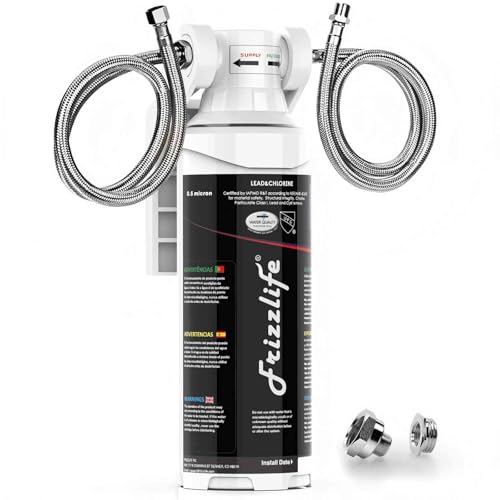
Frizzlife MK99 Under Sink Water Filter System — The Certification Case
Certification-led buyers who want health-standard claims in the simplest inline format.
- Compound two-stage cartridge with half-micron precision filtration
- IAPMO certification against NSF/ANSI 53 and 42
- Plumbs inline on the cold feed to the faucet you already have
- Flow ceiling of 1.89 litres per minute; works between 20 and 80 PSI
- FZ-2 replacement cartridge on an auto shut-off, twist-off head
Strengths
- Health-standard certification reaches lead-class claims that taste-only rivals cannot make
- Cartridge changes stay dry because the head seals itself when the cartridge twists out
- Minerals remain in the water, since nothing here demineralises
Trade-offs
- Filtered flow is gentler than the raw tap, roughly half a gallon per minute
- Dissolved solids and fluoride pass through, as with all carbon-class systems
- Replacement cartridges are a single-brand fit
Ownership details are equally considered. The filter head shuts off the water automatically when the cartridge is twisted out, so the roughly twice-a-year swap is a dry, bucket-free job, and the FZ-2 replacement is one of the cheaper cartridges in this class to keep buying. The honest limits are flow and scope: expect a gentler stream than the raw tap, and expect dissolved solids to pass through untouched, because this is precision carbon filtration, not osmosis.
Within this list’s priorities, the Frizzlife MK99 is the pick that keeps answering the same question well. As carbon-class treatment it concentrates on taste, odour and certified reductions rather than on the dissolved fraction. Ownership settles into a rhythm of rare, predictable cartridge events rather than recurring projects. The caution is scope: match it to the targets it actually treats and it will not disappoint.
One honest limitation: Expect a patient pour when filling large pots; the precision cartridge trades peak flow for filtration depth.
Best for: certification-led buyers who want health-standard claims in the simplest inline format / Not suited for: buyers whose needs contradict the trade-offs above

Waterdrop 15UA-UF Ultra Filtration Under Sink Water Filter System — The Barrier Case
Larger households that want membrane-level physical filtration plus the longest cartridge interval in the direct-connect class.
- Ultrafiltration membrane rated at 0.01 micron
- Rated service life of 24 months or 19,000 gallons
- Direct-connect to the existing kitchen faucet cold line
- Reduces lead, chlorine, bad taste and odour per the manufacturer listing
- Replacement cartridge WD-RF15-UF
Strengths
- Pairs the 0.01-micron UF barrier with a two-year, high-gallonage cartridge rating
- No tank, no drain line and no power: the whole system is one inline cartridge
- High rated throughput suits families filling pots, kettles and bottles all day
Trade-offs
- Premium cartridge pricing when the two-year replacement finally comes due
- Dissolved contaminants such as fluoride and nitrates are outside what UF can do
- Flow decline is gradual, so an overdue cartridge can hide behind habit
Consider what the 15UA-UF asks of its owner across two years: one installation, no attention, one cartridge change. In exchange it stands a physical membrane across the cold line, filtering every unsupervised glass a household draws. That exchange, vigilance traded for capacity, is the correct trade for homes whose risk is forgetfulness rather than exotic chemistry. It will not lower a TDS reading or touch fluoride, and it does not pretend to. Within the honest borders of non-RO filtration, it is the most complete direct-connect specification this guide can name.
In the context of this ranking, the Waterdrop 15UA-UF earns its place on evidence rather than novelty. It filters like a sieve and behaves like a cartridge, which is the combination this format exists for. The running-cost story is written by its rated capacity divided by a real household’s draw. The caution is scope: match it to the targets it actually treats and it will not disappoint.
One honest limitation: The 19,000-gallon figure assumes municipal water quality; sediment-heavy supplies will shorten real-world life, and the two-year clock should be treated as a maximum, not a guarantee.
Best for: larger households that want membrane-level physical filtration plus the longest cartridge interval in the direct-connect class / Not suited for: buyers whose needs contradict the trade-offs above
The Balance, by Household Type
For a renter in a small flat, the balance tips decisively positive at the cartridge end: reversible, invisible treatment with no landlord conversation required, and the cons reduce to a reminder on a phone. The same renter should read the RO sections of this page as a description of someone else’s category, because permanence and drain plumbing are not theirs to give.
For a family in its own home, the strengths compound and the trade-offs shrink into routine. Cartridge subscriptions become a line in the household calendar, cabinet space is a one-time negotiation, and the taste transformation works on the household’s most stubborn bottled-water loyalists, its children, every single day.
For a well owner, the sheet is more specialised: the pros must be read through the microbiological question, and the winning systems are those that answer it with ultrafiltration, membrane or ultraviolet barriers rather than with taste claims. The cons, meanwhile, add one entry, vigilance, because no utility is watching that water but its owner.
For the sceptical engineer, the household type this page secretly addresses, the balance is an evidence question. Certified claims survive scrutiny; marketing arithmetic does not. The category rewards that scrutiny more reliably than most, which is itself the strongest pro on this page.
Best for: buyers who recognise their kitchen in the strengths above / Not suited for: buyers whose constraints match the trade-offs instead
See also How To Choose An Under Sink Water Filter, Best Under Sink Water Filter Under $300 and Under Sink Water Filter Review.
The Longer View: Ownership Beyond the First Cartridge
Stripped water is pure, flat and faintly acidic, because the minerals that buffered it are gone. Households converting from spring water notice the correction immediately and approve of it. Purists who prefer the membrane’s unaltered output can simply choose the platform without the stage. The quantities involved are small beside dietary intake, and the better brands say so. Purity that nobody drinks has failed at its only job.
Utilities dose chlorine to keep water safe across miles of main, and the kitchen tap inherits the flavour. Catalytic carbon and generous contact time matter when the disinfectant is chloramine rather than free chlorine, because the reaction is slower. Full-size canisters often outperform slim cartridges on stubborn municipal supplies simply because the water spends longer inside the media. Free chlorine reacts with activated carbon almost on contact, which is why even a modest cartridge transforms a glass of tap water. Judge any system first on how it handles your disinfectant, because that is the flavour you will meet every day.
A gallon rating and a month rating guard the same cartridge from two directions; whichever expires first wins. Sediment load steals chemical capacity, which is why gritty supplies age cartridges ahead of the calendar. Dedicated faucets stretch ratings by refusing to spend them on utility water. Flow decline and returning taste are the cartridge’s own late warnings, and both deserve obedience. The cheapest gallon in this category belongs to the system whose capacity your household cannot outrun.
Long intervals, big canisters and efficient ratios shrink the format’s footprint considerably. Water rejected by a membrane returns to the municipal cycle; it is billed, not destroyed. Several manufacturers run cartridge recycling schemes that are worth the small effort they ask. A two-year cartridge is an environmental feature as surely as it is a convenience one. Sustainability here is mostly a matter of intervals and honesty.
The first tankful of an RO system is a rinse, not a beverage, whatever the calendar says. Owners who commission properly judge their system on its real water, not its first hour. Writing the date on the housing converts the next service from archaeology into reading. Flush durations in manuals are chemistry, not caution theatre; shortening them borrows taste trouble. Commissioning is thirty minutes that protect a decade of mornings.
Bottom Line
The balance sheet resolves by household. The pros, targeted cost, verified reduction, behaviour-changing taste and invisibility, accrue to any household that drinks its tap water and maintains what it buys. The cons, subscriptions, wastewater, installation and claims literacy, fall heaviest on the forgetful, the space-poor and the casually advised. Know which household you are, choose from the systems argued above, and the pros and cons stop being a debate and become a decision.
Notes From the Far Side of Installation Day: Further Notes
Carbon systems forgive almost any household pressure; membranes keep accounts. High pressure has its own manners: regulators and hammer arrestors protect fittings and quiet the system. Booster pumps exist to lift weak supplies into that range, restoring both pace and ratio. Manufacturers publish a working range because membrane efficiency collapses below it. Treat the gauge reading as part of the product selection, because the membrane will.
A cheap sediment layer standing guard is the best insurance a carbon bed or a membrane can hold. A first stage that clouds early is doing its job loudly; replace it and protect the rest. Layered systems exist precisely to keep the coarse work away from the polishing media. Particles lodge in carbon pores and steal capacity that was rated for chemical duty. Grit is cheap to catch early and expensive to catch late.
Tankless design deletes that compromise by making production fast enough to meet demand directly. Stored water is also a hygiene conversation, which is why commissioning flushes and periodic sanitising appear in serious manuals. Modern high-output membranes have narrowed the tank’s flow advantage to the first glass of the morning. After a heavy draw the tank’s pace softens until production refills it, a rhythm owners learn in the first month. Measure the space, price the compromise, and the architecture chooses itself.
Feeding the refrigerator is the upgrade owners describe as the one that changed the house. Small cartridges feel the fridge’s appetite first; generous ratings absorb it without changing the household’s rhythm. Flush the main system thoroughly before the fridge line is connected, so the ice maker never meets commissioning water. Long tubing runs cost pressure, so route the line as directly as the cabinet allows. Count the fridge in your capacity maths and the connection is pure dividend.
Lead enters drinking water late in its journey, which is precisely why a filter at the final tap can answer it. Ion-exchange and adsorption media in the better carbon systems are engineered specifically for this contaminant class. Flushing a stagnant line reduces exposure, but a verified barrier works on the mornings nobody remembers to flush. A certified health-standard claim for the exact model is the only version of lead protection worth paying for. If lead is your target, let the data sheet, not the packaging, make the promise.
Chlorine announces itself in a delicate brew long before it bothers a glass of water. Straight RO water brews thin for many palates, which is why remineralisation stages found their market. Kettles filled from a filtered tap scale more slowly when the supply’s chemistry is tamed at the source. Cafés remineralise deliberately; a home alkaline stage is the same idea at kitchen scale. Run your usual drink through any new system in its first week and trust the cup.
The membrane is the only component in this category that addresses the water’s dissolved fraction directly. What the membrane rejects leaves through the drain line, carrying the contaminants with it in a concentrated stream. Production rate, waste ratio and pressure requirements are all the same physics wearing different clothes. Chlorine destroys membrane film, which is why carbon pre-filters stand guard in front of every design in this guide. Choose RO when the dissolved list is your problem; choose anything else when it is not.
The honest comparison is against the bottled habit most households are actually replacing. Several manufacturers run cartridge recycling schemes that are worth the small effort they ask. Plastic, transport and refrigeration make bottled water the heavyweight in any footprint contest. A two-year cartridge is an environmental feature as surely as it is a convenience one. Sustainability here is mostly a matter of intervals and honesty.
Cabinet volume is the tank’s true price, and it is charged every day whether water is drawn or not. A tank keeps dispensing through a power cut, an independence no pumped tankless design can claim. After a heavy draw the tank’s pace softens until production refills it, a rhythm owners learn in the first month. Modern high-output membranes have narrowed the tank’s flow advantage to the first glass of the morning. Decide the tank question with a tape measure and your household’s busiest hour, not with ideology.
The lead story is a plumbing story: service lines, old solder and brass fittings between the main and the glass. Flushing a stagnant line reduces exposure, but a verified barrier works on the mornings nobody remembers to flush. Ion-exchange and adsorption media in the better carbon systems are engineered specifically for this contaminant class. A certified health-standard claim for the exact model is the only version of lead protection worth paying for. The durable fix is a barrier you can verify, installed where the contamination actually happens.
A cheap sediment layer standing guard is the best insurance a carbon bed or a membrane can hold. A first stage that clouds early is doing its job loudly; replace it and protect the rest. Homes with chronic sediment sometimes solve it once, upstream, with a whole-house pre-filter. Particles lodge in carbon pores and steal capacity that was rated for chemical duty. Treat sediment as its own problem and the drinking-water stages will live their full rated lives.
Remineralisation is where reverse osmosis negotiates with human taste. Households converting from spring water notice the correction immediately and approve of it. The quantities involved are small beside dietary intake, and the better brands say so. Calcium and magnesium media dissolve in trace amounts as purified water passes over them. The alkaline stage is a taste technology, honestly sold and honestly reviewed as one.
A gallon rating and a month rating guard the same cartridge from two directions; whichever expires first wins. A fridge connection quietly adds a second appliance’s draw to the same cartridge account. Flow decline and returning taste are the cartridge’s own late warnings, and both deserve obedience. Dedicated faucets stretch ratings by refusing to spend them on utility water. The cheapest gallon in this category belongs to the system whose capacity your household cannot outrun.
The taste most people blame on their pipes usually arrives courtesy of the treatment plant. Free chlorine reacts with activated carbon almost on contact, which is why even a modest cartridge transforms a glass of tap water. Catalytic carbon and generous contact time matter when the disinfectant is chloramine rather than free chlorine, because the reaction is slower. Full-size canisters often outperform slim cartridges on stubborn municipal supplies simply because the water spends longer inside the media. This is why taste, not exotic chemistry, is the honest starting point for most under-sink purchases.
Mineral balance shapes extraction, which is why brewers argue about water with religious intensity. Kettles filled from a filtered tap scale more slowly when the supply’s chemistry is tamed at the source. Carbon-filtered water is the traditional brewing sweet spot: clean of chlorine, still mineral enough to extract well. Straight RO water brews thin for many palates, which is why remineralisation stages found their market. Water is an ingredient; the filter is how you start choosing it.
Feeding the refrigerator is the upgrade owners describe as the one that changed the house. Plan the connection at install time, because reopening finished plumbing to add it later is nobody’s favourite Saturday. Flush the main system thoroughly before the fridge line is connected, so the ice maker never meets commissioning water. Long tubing runs cost pressure, so route the line as directly as the cabinet allows. Size the cartridge for the combined draw and forget the line exists.
The membrane is the only component in this category that addresses the water’s dissolved fraction directly. Membrane life is measured in years because the film works slowly and steadily rather than in bursts. Production rate, waste ratio and pressure requirements are all the same physics wearing different clothes. Chlorine destroys membrane film, which is why carbon pre-filters stand guard in front of every design in this guide. Understanding the film turns the rest of the RO specification sheet into plain reading.
A dry paper towel at every joint is the cheapest leak detector in the building trade. Writing the date on the housing converts the next service from archaeology into reading. Leak checks belong at one hour and at one morning, because pressure finds slow weeps on its own schedule. Owners who commission properly judge their system on its real water, not its first hour. The manual’s last page is the one that decides the first year.
A cheap sediment layer standing guard is the best insurance a carbon bed or a membrane can hold. Particles lodge in carbon pores and steal capacity that was rated for chemical duty. A first stage that clouds early is doing its job loudly; replace it and protect the rest. Homes with chronic sediment sometimes solve it once, upstream, with a whole-house pre-filter. Treat sediment as its own problem and the drinking-water stages will live their full rated lives.
A pressurised tank accumulates purified water against a bladder so the faucet can pour faster than the membrane works. Stored water is also a hygiene conversation, which is why commissioning flushes and periodic sanitising appear in serious manuals. After a heavy draw the tank’s pace softens until production refills it, a rhythm owners learn in the first month. Modern high-output membranes have narrowed the tank’s flow advantage to the first glass of the morning. Decide the tank question with a tape measure and your household’s busiest hour, not with ideology.
Water pressure is the specification nobody lists on the box and everybody lives with. Upper floors, long runs and tired well pumps are the usual suspects when pressure disappoints. Booster pumps exist to lift weak supplies into that range, restoring both pace and ratio. High pressure has its own manners: regulators and hammer arrestors protect fittings and quiet the system. Pressure is a household fact, and the best filter is the one designed around yours.
Feeding the refrigerator is the upgrade owners describe as the one that changed the house. Plan the connection at install time, because reopening finished plumbing to add it later is nobody’s favourite Saturday. Small cartridges feel the fridge’s appetite first; generous ratings absorb it without changing the household’s rhythm. Long tubing runs cost pressure, so route the line as directly as the cabinet allows. One tee, honestly planned, doubles the system’s daily usefulness.
New carbon sheds fines, new membranes shed preservative, and every system sheds air. Flush durations in manuals are chemistry, not caution theatre; shortening them borrows taste trouble. Writing the date on the housing converts the next service from archaeology into reading. Leak checks belong at one hour and at one morning, because pressure finds slow weeps on its own schedule. Prove the install twice and then forget it, which is the highest compliment plumbing earns.
Capacity ratings are ceilings earned on test water, and your household will negotiate its own figure. Dedicated faucets stretch ratings by refusing to spend them on utility water. Sediment load steals chemical capacity, which is why gritty supplies age cartridges ahead of the calendar. A fridge connection quietly adds a second appliance’s draw to the same cartridge account. Size for your real draw and the ratings stop being marketing and start being a schedule.
Chloramine, chlorine’s longer-lived cousin, is the quiet reason some city water resists cheap filtration. Free chlorine reacts with activated carbon almost on contact, which is why even a modest cartridge transforms a glass of tap water. Catalytic carbon and generous contact time matter when the disinfectant is chloramine rather than free chlorine, because the reaction is slower. By the time water reaches a kitchen it has generally done its disinfecting work, so removing the residual costs the household nothing in safety. Get the disinfectant right and the rest of the specification sheet falls into its proper order.
Water pressure is the specification nobody lists on the box and everybody lives with. Upper floors, long runs and tired well pumps are the usual suspects when pressure disappoints. Manufacturers publish a working range because membrane efficiency collapses below it. High pressure has its own manners: regulators and hammer arrestors protect fittings and quiet the system. Five minutes with a gauge prevents the most common return in this category.
Every cartridge system creates a spent cartridge; every RO system creates a reject stream. Plastic, transport and refrigeration make bottled water the heavyweight in any footprint contest. Several manufacturers run cartridge recycling schemes that are worth the small effort they ask. Water rejected by a membrane returns to the municipal cycle; it is billed, not destroyed. Weighed honestly, a maintained under-sink system is among the cleaner ways to drink clean water.
Visible grit in a glass is the supply asking for a staged answer rather than a single cartridge. Particles lodge in carbon pores and steal capacity that was rated for chemical duty. Homes with chronic sediment sometimes solve it once, upstream, with a whole-house pre-filter. A first stage that clouds early is doing its job loudly; replace it and protect the rest. Grit is cheap to catch early and expensive to catch late.
Because lead contamination happens inside or just outside the home, point-of-use treatment is a rational, targeted defence. Reverse osmosis rejects lead by size and charge along with the rest of the dissolved fraction, which is why it anchors the cautious end of the market. A certified health-standard claim for the exact model is the only version of lead protection worth paying for. Ion-exchange and adsorption media in the better carbon systems are engineered specifically for this contaminant class. If lead is your target, let the data sheet, not the packaging, make the promise.
Every RO system is really two systems: the carbon stages that protect the membrane, and the membrane itself. Chlorine destroys membrane film, which is why carbon pre-filters stand guard in front of every design in this guide. What the membrane rejects leaves through the drain line, carrying the contaminants with it in a concentrated stream. Membrane life is measured in years because the film works slowly and steadily rather than in bursts. The membrane rewards correct pressure and punctual pre-filters with the broadest purification a household can buy.
Remineralisation is where reverse osmosis negotiates with human taste. The quantities involved are small beside dietary intake, and the better brands say so. Households converting from spring water notice the correction immediately and approve of it. Calcium and magnesium media dissolve in trace amounts as purified water passes over them. Flavour is not a frivolous specification in a product whose endpoint is a glass.
Tankless design deletes that compromise by making production fast enough to meet demand directly. Modern high-output membranes have narrowed the tank’s flow advantage to the first glass of the morning. Stored water is also a hygiene conversation, which is why commissioning flushes and periodic sanitising appear in serious manuals. After a heavy draw the tank’s pace softens until production refills it, a rhythm owners learn in the first month. Measure the space, price the compromise, and the architecture chooses itself.
Frequently Asked Questions
Are tankless RO systems better than tank systems?
Neither architecture wins outright. Tankless earns its premium in space saved, water efficiency and on-demand production for busy kitchens. Tank systems answer with lower prices, a pressurised reserve that never waits for a pump, and independence from electricity. Read the head-to-head sections of this guide with your own constraints in hand: the best system is the one whose compromises land where your household feels them least.
Can an under sink filter soften hard water?
Not in any whole-home sense. These are drinking-water systems treating one tap’s worth of flow, and hardness minerals are dissolved load that they mostly pass (carbon, UF) or reject only at that single faucet (RO). If limescale is the core complaint, the remedy lives at the point of entry with a softener, while an under-sink system remains the right tool for drinking quality. Confusing the two jobs is a reliable route to disappointment with both.
How often do under sink filters really need changing?
The honest answer is the rating on your specific cartridge, interpreted with your household’s draw. A two-person flat may never approach a high-gallonage rating before the calendar expires, while a family of six can exhaust a small cartridge early. Change on whichever limit arrives first, time or throughput, and treat a clear drop in flow or the return of chlorine taste as the system asking early.
Can I install an under sink water filter myself?
Yes, with the difficulty scaled by system type. Inline cartridges are a half-hour, two-connection job. Faucet systems hinge on whether your counter already has a usable hole. RO adds a drain connection and more tubing runs, still a methodical afternoon rather than a professional job for most homes. Renters should favour the fully reversible direct-connect designs and keep every original fitting in a labelled bag.
Does reverse osmosis waste a lot of water?
RO works by rejecting a portion of the feed water to carry contaminants to the drain, so some waste is intrinsic. Older tank systems could send three or more gallons down the drain per gallon purified. The modern tankless systems in this guide run at 2:1 or even 3:1 pure-to-drain ratios, which is a dramatic improvement, and the rejected water is not lost to the planet, only to your utility bill. Households on expensive metered water should weigh that running cost; households focused on purification quality usually accept it as the price of membrane treatment.
Can filtered water from an under sink system feed my refrigerator or ice maker?
It is one of the most popular upgrades owners make after install day. A simple tee on the filtered line can supply the refrigerator’s dispenser and ice maker, and brand ice-maker kits exist for the major systems here. Plan the capacity honestly: fridge draws add up across a family, and a small cartridge that seemed adequate for drinking alone may age quickly once it also feeds ice production through a summer.