Disclosure: As an Amazon Associate, umtsmarttool.com earns from qualifying purchases. Links to Amazon on this page are affiliate links; they cost you nothing extra. Prices and availability change often, so check the current Amazon listing before you buy.
Where to buy
Shop the best fixed blade knives for hiking in one place — the Morakniv Companion leads the list. Linked picks go straight to their Amazon listing; unlinked picks are listed by name so you can search the exact model.
- Morakniv Companion — Check on Amazon
- Morakniv Kansbol — Check on Amazon
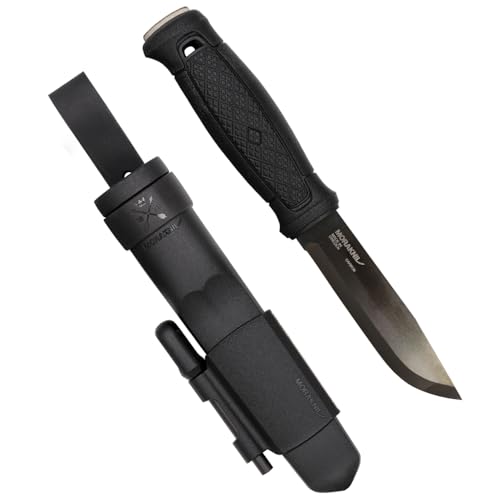
- Morakniv Garberg Carbon with Survival Kit — Check on Amazon
- Benchmade Steep Country 15006-01 — Check on Amazon
- ESEE Izula II — Check on Amazon
- Cold Steel SRK Compact — Check on Amazon
Read the full guide ↓
The best fixed blade knives for hiking solve a specific tension: a hiker wants the strength and hygiene of a fixed blade — no pivot to clog with trail food, no lock to fail with cold fingers — without paying for it in pack weight on every climb. The sweet spot is a blade of roughly three and a half to four and a half inches, a total carried weight with sheath that stays in single-digit ounces, and a handle that remains secure when hands are wet, sweaty or gloved. Anything heavier has to justify itself with capability a lighter knife genuinely cannot offer.
The six knives below span that logic from both ends. At the light end are Swedish classics that weigh about as much as an energy bar and a purpose-built American hunting pattern cut down to under three ounces of knife. At the capable end are a full-tang fire-and-wood system and a compact five-inch utility blade for hikers who split kindling at camp every night. We compared published manufacturer and retailer specifications — steel, blade length, thickness, tang and carried weight — and mapped them to real trail tasks: food prep, cordage and repair cuts, feather sticks, tent-peg whittling and emergency fire prep. We did not test these knives on trail ourselves; verify the exact variant and sheath on the current listing before buying.
A fixed blade also changes how you carry. Belt, pack-strap and hip-belt mounting all work, but the knife must be sheathed whenever you move — an unsheathed fixed blade in a pack is a hazard to you and your gear. Hikers who mostly open packages and slice cheese may honestly be better served by the folders in best folding knives for camping; this guide is for those who want a real edge at camp. Pair any pick with the maintenance basics in best knife sharpeners for pocket knives and it will outlast the boots you carry it in.
In this guide
Quick Picks
| Knife | Badge | Key spec |
|---|---|---|
| Morakniv Companion | Best Overall for Hiking | Blade length: 4.1 inches; Blade steel: Sandvik 12C27 stainless steel |
| Morakniv Kansbol | Best for Mixed Camp Work | Blade length: 4.3 inches; Blade steel: Sandvik 12C27 stainless steel |
| Morakniv Garberg Carbon with Survival Kit | Best for Fire and Woodcraft | Blade length: 4.3 inches; Blade steel: carbon steel |
| Benchmade Steep Country 15006-01 | Best Ultralight Premium | Blade length: 3.54 inches; Blade steel: CPM-S30V stainless steel |
| ESEE Izula II | Best Compact Backup | Blade length: 2.875 inches; Blade steel: 1095 high-carbon steel |
| Cold Steel SRK Compact | Best for Heavy Camp Use | Blade length: 5 inches; Blade steel: SK-5 carbon steel |
How These Picks Were Chosen
Candidates had to be fixed blades a hiker would actually carry all day: blade lengths between about 2.9 and 5 inches, published weights low enough for backpacking, and sheaths designed for belt or pack carry rather than display. We weighted four criteria. Carried weight came first, because a knife left in the car helps no one. Second was corrosion behaviour — trail knives meet rain, sweat and food acids, so stainless steels score well and carbon steels had to offer a clear capability payoff. Third was grind and thickness suited to mixed camp work rather than pure chopping. Fourth was handle security in wet conditions, favouring textured rubberised and polymer grips over smooth dress materials. Specs were taken from manufacturer and established retailer listings and cross-checked across sources where models are widely documented.
Two rules governed every judgement below. First, specifications beat stories: where a marketing claim and a published spec disagreed, the spec won. Second, honesty about limits: every pick in this guide has a stated trade-off section, because a knife with no downside is a knife whose reviewer was not paying attention. If a pick is listed without an Amazon link, that means our research verified the product and its specifications from manufacturer or retailer sources but did not tie a verified listing identifier to the exact model — we would rather send you to search the exact model name than print a link we could not verify.
The 6 Best Fixed Blade Knives for Hiking
Morakniv Companion — Best Overall for Hiking
Who it suits: Most hikers, most trails: a first fixed blade that covers camp chores without punishing the pack.
- Blade length: 4.1 inches
- Blade steel: Sandvik 12C27 stainless steel
- Grind: Scandi
- Construction: partial (stick) tang
- Weight: about 4.1 oz with sheath
Strengths
- Feather-light carried weight for a full-size fixed blade
- Stainless blade shrugs off rain, sweat and food prep
- Scandi grind is simple to keep sharp on a pocket stone
Trade-offs
- Partial tang — baton only small kindling
- Basic sheath offers limited mounting options
- Thin blade is a carver and slicer, not a pry tool
The Companion is the default recommendation in this category for good reason: it delivers a genuinely useful 4.1-inch blade at a carried weight many folders cannot beat, in stainless steel that forgives trail neglect. Around camp it carves pegs, preps food and shaves tinder with the easy control the Scandi grind is known for. Its limits are the honest limits of its weight class — split only modest kindling and never pry — but within those limits it may be the highest utility-per-ounce purchase in hiking gear.
Consider how the Morakniv Companion behaves across a full day of the work it was chosen for. Its defining specification — blade length: 4.1 inches — sets the rhythm: it determines how the knife carries between tasks, how it feels on the tenth repetition of a cut rather than the first, and how much attention it asks for in return. The headline strength, feather-light carried weight for a full-size fixed blade, is not a laboratory virtue; it is the thing owners notice when conditions are poor and time is short, which is exactly when a knife earns or loses its place in a kit.
It also helps to place this pick against the rest of the table before deciding. Every guide like this one contains a knife that is cheaper, one that is lighter or stronger, and one that is more specialised; the Morakniv Companion survives that comparison when its particular balance — summarised in the verdict line below — matches the way you actually spend your time outdoors. If it does not, the honest move is to choose the pick whose badge names your real priority, not the pick with the most impressive single specification.
Best for: Most hikers, most trails: a first fixed blade that covers camp chores without punishing the pack. / Not suited for: buyers whose main work contradicts the trade-offs above.
Check on Amazon

Morakniv Kansbol — Best for Mixed Camp Work
Who it suits: Hikers who cook real meals at camp and want one blade that carves at the back and slices at the front.
- Blade length: 4.3 inches
- Blade steel: Sandvik 12C27 stainless steel
- Blade thickness: 2.5 mm
- Grind: two-part profile grind (Scandi rear, thinner front)
- Weight: 4.7 oz
Strengths
- Two-part grind genuinely improves food slicing over a pure Scandi
- Ground 90-degree spine strikes a ferro rod
- Fuller, more secure handle than the Companion
Trade-offs
- Costs meaningfully more than the Companion for the same steel family
- Not a full-tang knife — same sensible batoning limits apply
- Sheath system is bulkier than the basic Companion sheath
The Kansbol is Morakniv’s answer to the hiker who found the Companion’s pure Scandi grind awkward on onions and sausage. Its blade is ground in two zones: Scandi near the handle for wood, thinner toward the tip for slicing, and the compromise works in the direction hikers actually use a knife — carve a peg, then make dinner. You pay more and carry slightly more than the Companion, and in return get a more versatile, more comfortable tool that still weighs under five ounces.
What separates the Morakniv Kansbol from near-neighbours in this guide is the combination, not any single line of its specification box. Blade steel: Sandvik 12C27 stainless steel works together with blade length: 4.3 inches to produce a tool with a clear personality: it rewards the user it was designed for and quietly penalises everyone else. That is why the badge matters — Best for Mixed Camp Work is a statement about fit, not a rank — and why reading the trade-off list matters more than reading the strength list twice.
It also helps to place this pick against the rest of the table before deciding. Every guide like this one contains a knife that is cheaper, one that is lighter or stronger, and one that is more specialised; the Morakniv Kansbol survives that comparison when its particular balance — summarised in the verdict line below — matches the way you actually spend your time outdoors. If it does not, the honest move is to choose the pick whose badge names your real priority, not the pick with the most impressive single specification.
Best for: Hikers who cook real meals at camp and want one blade that carves at the back and slices at the front. / Not suited for: buyers whose main work contradicts the trade-offs above.


Morakniv Garberg Carbon with Survival Kit — Best for Fire and Woodcraft
Who it suits: Hikers who practise bushcraft skills on trail — feather sticks, batoned kindling, ferro-rod fires.
- Blade length: 4.3 inches
- Blade steel: carbon steel
- Blade thickness: 3.2 mm
- Grind: Scandi
- Construction: full tang
Strengths
- Full tang tolerates regular batoning of camp kindling
- Sheath-mounted ferro rod and diamond sharpener complete the fire kit
- Squared spine scrapes sparks and pot bark equally well
Trade-offs
- Heaviest system in this group once the kit is counted
- Carbon steel needs drying and oiling discipline
- More knife than a pure food-and-cordage hiker needs
Choose the Garberg when your hiking style overlaps with the skills in our best bushcraft knives guide: it is the only pick here built to baton nightly without apology, and the survival-kit sheath means the fire tools live on the knife rather than in a forgotten pouch. The weight penalty is real, so be honest about whether you will use the capability — a Garberg carried for cheese duty is just a heavy Companion.
Ownership of the Morakniv Garberg Carbon with Survival Kit is mostly a story about its first-listed trade-off: heaviest system in this group once the kit is counted. Buyers who accept that cost up front tend to keep this knife for years, because nothing about it surprises them later. Buyers who discover it in the field tend to blame the knife for a mismatch that was printed in its specifications all along. Read the box above as a contract: the knife promises full tang tolerates regular batoning of camp kindling, and in exchange asks you to live with the compromises listed honestly beside it.
It also helps to place this pick against the rest of the table before deciding. Every guide like this one contains a knife that is cheaper, one that is lighter or stronger, and one that is more specialised; the Morakniv Garberg Carbon with Survival Kit survives that comparison when its particular balance — summarised in the verdict line below — matches the way you actually spend your time outdoors. If it does not, the honest move is to choose the pick whose badge names your real priority, not the pick with the most impressive single specification.
Best for: Hikers who practise bushcraft skills on trail / Not suited for: buyers whose main work contradicts the trade-offs above.


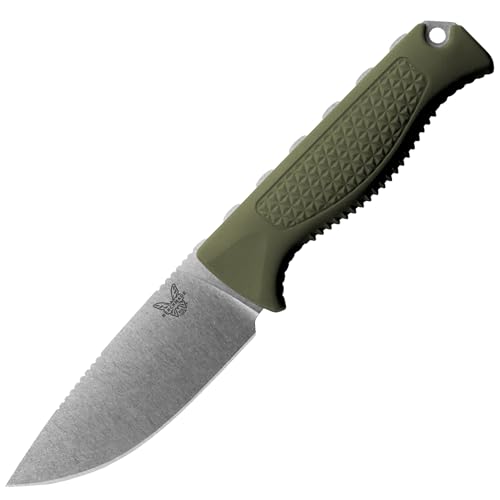
Benchmade Steep Country 15006-01 — Best Ultralight Premium
Who it suits: Weight-counting hikers and backcountry hunters who want premium steel at under three ounces of knife.
- Blade length: 3.54 inches
- Blade steel: CPM-S30V stainless steel
- Weight: 2.95 oz
- Handle: Santoprene
- Sheath: Boltaron
Strengths
- CPM-S30V holds an edge across a whole trip without a stone
- Santoprene handle stays grippy with wet or cold hands
- High-visibility styling is easy to find if set down in duff
Trade-offs
- Short handle and blade will feel small to large hands
- Premium steel wants a diamond abrasive when it finally dulls
- Designed for field dressing first; woodcraft is secondary
The Steep Country began life as a hunting knife, and hikers benefit from that brief: hunting designers obsess over ounces and wet grip, which is exactly the hiker’s problem too. At 2.95 ounces with an S30V blade, it cuts far above its weight for food, cordage and game, and the textured Santoprene handle is the most secure here in the rain. It is a slicer, not a splitter — carry it for cutting, and let a saw or a companion’s heavier knife handle firewood.
Consider how the Benchmade Steep Country 15006-01 behaves across a full day of the work it was chosen for. Its defining specification — blade length: 3.54 inches — sets the rhythm: it determines how the knife carries between tasks, how it feels on the tenth repetition of a cut rather than the first, and how much attention it asks for in return. The headline strength, cpm-s30v holds an edge across a whole trip without a stone, is not a laboratory virtue; it is the thing owners notice when conditions are poor and time is short, which is exactly when a knife earns or loses its place in a kit.
It also helps to place this pick against the rest of the table before deciding. Every guide like this one contains a knife that is cheaper, one that is lighter or stronger, and one that is more specialised; the Benchmade Steep Country 15006-01 survives that comparison when its particular balance — summarised in the verdict line below — matches the way you actually spend your time outdoors. If it does not, the honest move is to choose the pick whose badge names your real priority, not the pick with the most impressive single specification.
Best for: Weight-counting hikers and backcountry hunters who want premium steel at under three ounces of knife. / Not suited for: buyers whose main work contradicts the trade-offs above.
ESEE Izula II — Best Compact Backup
Who it suits: Hikers who want an always-on-the-body backup blade for cordage, packages and emergency tinder work.
- Blade length: 2.875 inches
- Blade steel: 1095 high-carbon steel
- Overall length: 6.75 inches
- Construction: full tang
- Carry: sheath, neck or belt options
Strengths
- Tiny full-tang blade is far tougher than any folder of its size
- Carries flat on a belt, strap or around the neck
- 1095 resharpens in seconds on a pocket stone
Trade-offs
- Short blade and handle limit food prep and carving leverage
- Carbon steel needs rust care, especially carried against the body
- Too small to be a group’s only camp knife
The Izula II is the knife that is actually there when the main knife is in the pack at the bottom of a ravine-side lunch stop. Its full-tang 1095 blade handles the ninety percent of trail cutting that is small — cord, tape, packaging, tinder shavings — and its size makes it a natural emergency and repair-kit blade. Think of it as the second knife in a two-knife system, or the only knife on fast, light days when camp cooking is not on the plan.
What separates the ESEE Izula II from near-neighbours in this guide is the combination, not any single line of its specification box. Blade steel: 1095 high-carbon steel works together with blade length: 2.875 inches to produce a tool with a clear personality: it rewards the user it was designed for and quietly penalises everyone else. That is why the badge matters — Best Compact Backup is a statement about fit, not a rank — and why reading the trade-off list matters more than reading the strength list twice.
It also helps to place this pick against the rest of the table before deciding. Every guide like this one contains a knife that is cheaper, one that is lighter or stronger, and one that is more specialised; the ESEE Izula II survives that comparison when its particular balance — summarised in the verdict line below — matches the way you actually spend your time outdoors. If it does not, the honest move is to choose the pick whose badge names your real priority, not the pick with the most impressive single specification.
Best for: Hikers who want an always-on-the-body backup blade for cordage, packages and emergency tinder work. / Not suited for: buyers whose main work contradicts the trade-offs above.
Check on Amazon

Cold Steel SRK Compact — Best for Heavy Camp Use
Who it suits: Hikers and campers whose evenings involve real firewood processing and shelter building.
- Blade length: 5 inches
- Blade steel: SK-5 carbon steel
- Handle: Kray-Ex
- Weight: about 5.1 oz
- Sheath: Secure-Ex
Strengths
- Five-inch blade splits and chops beyond the Swedish picks’ comfort zone
- Kray-Ex handle is secure and cushions heavy work
- Remarkably light for its size class
Trade-offs
- Longest blade here — check local rules and your own comfort
- Carbon SK-5 needs the usual drying and oiling
- Secure-Ex sheaths can dull an edge if the blade drags on draw
The SRK Compact shrinks a well-known heavy-duty pattern into a size and weight a hiker can justify. Five inches of SK-5 with a grippy Kray-Ex handle will process firewood, clear a tent site and handle every food task, at a carried weight close to the Kansbol’s. It is the pick for basecamp-style hiking and group trips where one shared knife does heavy work — and overkill, honestly, for a solo hiker whose fire comes from a stove.
Ownership of the Cold Steel SRK Compact is mostly a story about its first-listed trade-off: longest blade here — check local rules and your own comfort. Buyers who accept that cost up front tend to keep this knife for years, because nothing about it surprises them later. Buyers who discover it in the field tend to blame the knife for a mismatch that was printed in its specifications all along. Read the box above as a contract: the knife promises five-inch blade splits and chops beyond the swedish picks’ comfort zone, and in exchange asks you to live with the compromises listed honestly beside it.
It also helps to place this pick against the rest of the table before deciding. Every guide like this one contains a knife that is cheaper, one that is lighter or stronger, and one that is more specialised; the Cold Steel SRK Compact survives that comparison when its particular balance — summarised in the verdict line below — matches the way you actually spend your time outdoors. If it does not, the honest move is to choose the pick whose badge names your real priority, not the pick with the most impressive single specification.
Best for: Hikers and campers whose evenings involve real firewood processing and shelter building. / Not suited for: buyers whose main work contradicts the trade-offs above.
Comparison Table
| Knife | Blade | Steel | Badge |
|---|---|---|---|
| Morakniv Companion | 4.1 inches | Sandvik 12C27 stainless steel | Best Overall for Hiking |
| Morakniv Kansbol | 4.3 inches | Sandvik 12C27 stainless steel | Best for Mixed Camp Work |
| Morakniv Garberg Carbon with Survival Kit | 4.3 inches | carbon steel | Best for Fire and Woodcraft |
| Benchmade Steep Country 15006-01 | 3.54 inches | CPM-S30V stainless steel | Best Ultralight Premium |
| ESEE Izula II | 2.875 inches | 1095 high-carbon steel | Best Compact Backup |
| Cold Steel SRK Compact | 5 inches | SK-5 carbon steel | Best for Heavy Camp Use |
Read the table as a map, not a ranking: the rows differ because the jobs differ. The badge column tells you the job each knife won; the blade and steel columns tell you the physical reason it won it. If your main task is not represented by any badge, the buying guide below will help you judge which compromise is cheapest for the work you actually do — and whether a neighbouring category, linked throughout this guide, fits you better than any pick here.
How to Choose Fixed Blade Knives for Hiking
Carried weight: count the sheath, not the knife
Manufacturers advertise knife weight; hikers carry knife plus sheath plus mount. A ‘four-ounce’ knife in a heavy leather sheath can out-weigh a ‘five-ounce’ knife in polymer. When comparing picks, use the with-sheath figures where sources give them, and weigh your final setup at home before a long trip. As a working rule, most backpackers are happy under about six ounces carried; beyond that, the knife should be doing daily heavy work to earn its place.
Stainless versus carbon on the trail
Trail life is wet: rain, condensation, sweat and acidic foods. Stainless steels like 12C27 and S30V let you sheath a damp knife at a rainy camp and forget it until morning. Carbon steels like 1095 and SK-5 cut and sharpen beautifully but ask for a wipe-down ritual, and they will spot with rust against a sweaty body on neck carry. Neither is wrong — but choose the steel whose care routine you will still be doing on day nine, in the rain, when you are tired.
Carry position and trail safety
Follow standard manufacturer-style safety guidance: the knife rides fully sheathed whenever you are moving, with retention checked before stream crossings and scrambles. Belt carry suits day hikes; pack hip-belt and shoulder-strap mounts suit backpacking, keeping the blade accessible without removing the pack. Never carry a fixed blade loose inside a pack, never hand a knife to another person blade-first — pass it handle-first with the edge turned away — and re-sheath before standing up from any cutting task. If you also carry a folder from best pocket knives under $50, keep the roles separate: folder for food and small tasks, fixed blade for wood.
Finally, buy from a listing that states the exact model, steel and configuration in writing, from a seller who accepts returns. Knife categories are full of variants that share a name and differ in the one specification that made you choose the knife. The few minutes spent confirming the listing are the cheapest insurance in this entire guide, and they are the difference between the knife reviewed here and a near-namesake that merely looks like it in photographs.
Key Takeaways
- Match the knife to your dominant task first; every pick here is the best answer to a different question.
- Specifications — steel, blade length, thickness, tang or lock — predict field behaviour better than brand or price.
- Maintenance is part of the purchase: choose the steel and materials whose care routine you will actually keep.
- Safety is technique, not equipment: follow manufacturer-style guidance on grips, carry and storage every time.
- Verify the exact variant on the listing before buying; model names cover more configurations than ever.
How to Set Up a Fixed Blade for Trail Carry
- Choose the carry position first: belt for day hikes, hip-belt or pack strap for backpacking, and test it sitting, kneeling and bending before the trip.
- Mount the sheath securely following the sheath maker’s instructions, then check retention by holding the sheathed knife upside down and shaking it firmly over a soft surface.
- Practise the draw and re-sheathing at home, slowly, until both are one smooth motion you can do without looking down on the trail.
- Set a camp routine: the knife comes out for a task, returns to the sheath immediately after, and never lies loose in grass or leaf litter where a hand or knee can find it.
- For food prep, wash the blade with clean water and a drop of biodegradable soap, then dry it fully before sheathing — trail hygiene matters as much as edge care.
- At multi-day camps, strop the edge lightly each evening rather than sharpening heavily once; small maintenance keeps any of these steels working all trip.
- Before any stream crossing or scramble, press-check that the knife is fully seated in its sheath.
- At home, clean and dry the knife, oil carbon blades lightly, and store it sheathed only for transport, out of reach of children.
Trail Maintenance and Troubleshooting
Problem: the edge dulls mid-trip. Fix: strop on a belt or pack strap first; if that fails, use a pocket stone with light, consistent strokes following the original bevel — Scandi bevels lie flat on the stone, flat grinds need a shallow, steady angle.
Problem: rust spots on a carbon blade. Fix: scrub gently with a pad and oil, dry completely, and review your sheathing habit — a knife put away wet is the usual cause.
Problem: the sheath loosens over a season. Fix: check the maker’s guidance for retention adjustment or replacement; a knife that can fall out should not be carried until retention is restored.
Problem: food smells linger on the blade. Fix: wash with hot water and soap at home, dry fully, and keep a small dedicated food folder if you prefer to separate food and wood duties entirely.
A hiking knife kit stays light: knife and sheath, a pocket stone, a ferro rod if your style uses one, and the repair mindset from best multitools for edc. Add a protective spare sheath or storage option from best leather knife sheaths for home storage, and your blade is set for season after season.
The Two-Knife Trail System, and When One Knife Is Enough
Many experienced hikers quietly carry two cutting tools: a fixed blade for camp and a tiny folder or multitool for the fiddly work — opening packaging without contaminating a food blade, trimming tape, tightening a loose screw on a stove. The system works because each tool is chosen for its job instead of compromised for both. It stops working when total weight creeps past what a single good knife would have cost in ounces. The honest calculation is task-based: list what you actually cut on your last three trips. If the list is food, cordage and the odd peg, one light fixed blade from this guide is enough and a second tool is jewellery. If the list includes repairs, fishing, first aid and fire craft, the two-tool system earns its weight. Guides like best multitools for edc exist for the second list; this guide exists for the first, and confusing the two lists is how packs gain a pound a year.
Fixed Blades in Winter and Wet Conditions
Cold and wet change the fixed-blade equation in the hiker’s favour. Pivots ice, locks fill with grit and bare fingers lose the dexterity folders demand; a fixed blade with a textured handle can be drawn, used and re-sheathed with mitts on. Stainless steel earns its keep when every surface is wet for a week, and a bright handle or lanyard is not a style choice when a dropped knife disappears into snow or leaf litter. Winter also punishes one habit above all: sheathing a wet blade and forgetting it in a sealed pack pocket, which can spot even stainless steels with surface corrosion over a long, damp trip. The routine that survives winter is the routine described in this guide’s maintenance section — wipe, dry when you can, strop little and often — applied with the understanding that in bad conditions, simple tools maintained simply beat clever tools maintained never.
What About Ultralight? The Case for Carrying a Real Knife
Ultralight culture treats every ounce as a negotiation, and a fixed blade must argue harder than most items because a razor blade or a tiny folder can claim the same line on a gear list. The fixed blade’s argument is about the tail risks and the daily pleasures: the tent peg that must be carved in the rain when the aluminium one snaps, the frozen guyline, the sausage that defeats a razor blade, the emergency tinder work that turns a miserable night into a warm one. None of these happen every trip, and all of them happen eventually. The picks in this guide were chosen so the argument stays honest — the heaviest system here is a deliberate bushcraft tool, and the lightest full-size option weighs about as much as the snacks it will slice. If your trips are stove-based, well-pitched and close to the trailhead, carry the small folder and enjoy the saved ounces without guilt. If your trips wander, linger and improvise, the fixed blade is not weight; it is capability you will use in ways a spreadsheet cannot schedule.
Which Pick Fits Which Buyer?
If this sounds like you — Most hikers, most trails: a first fixed blade that covers camp chores without punishing the pack. — then the Morakniv Companion is your pick. Its badge, Best Overall for Hiking, was assigned for exactly that profile, and its trade-offs were written with your use in mind. If the description nearly fits but one trade-off touches the work you do most, move one row up or down the comparison table rather than abandoning the category: the neighbouring picks in this guide were chosen to cover the adjacent profiles, and the distance between a good knife and the right knife is usually a single honest sentence about your own habits.
If this sounds like you — Hikers who cook real meals at camp and want one blade that carves at the back and slices at the front. — then the Morakniv Kansbol is your pick. Its badge, Best for Mixed Camp Work, was assigned for exactly that profile, and its trade-offs were written with your use in mind. If the description nearly fits but one trade-off touches the work you do most, move one row up or down the comparison table rather than abandoning the category: the neighbouring picks in this guide were chosen to cover the adjacent profiles, and the distance between a good knife and the right knife is usually a single honest sentence about your own habits.
If this sounds like you — Hikers who practise bushcraft skills on trail — feather sticks, batoned kindling, ferro-rod fires. — then the Morakniv Garberg Carbon with Survival Kit is your pick. Its badge, Best for Fire and Woodcraft, was assigned for exactly that profile, and its trade-offs were written with your use in mind. If the description nearly fits but one trade-off touches the work you do most, move one row up or down the comparison table rather than abandoning the category: the neighbouring picks in this guide were chosen to cover the adjacent profiles, and the distance between a good knife and the right knife is usually a single honest sentence about your own habits.
If this sounds like you — Weight-counting hikers and backcountry hunters who want premium steel at under three ounces of knife. — then the Benchmade Steep Country 15006-01 is your pick. Its badge, Best Ultralight Premium, was assigned for exactly that profile, and its trade-offs were written with your use in mind. If the description nearly fits but one trade-off touches the work you do most, move one row up or down the comparison table rather than abandoning the category: the neighbouring picks in this guide were chosen to cover the adjacent profiles, and the distance between a good knife and the right knife is usually a single honest sentence about your own habits.
If this sounds like you — Hikers who want an always-on-the-body backup blade for cordage, packages and emergency tinder work. — then the ESEE Izula II is your pick. Its badge, Best Compact Backup, was assigned for exactly that profile, and its trade-offs were written with your use in mind. If the description nearly fits but one trade-off touches the work you do most, move one row up or down the comparison table rather than abandoning the category: the neighbouring picks in this guide were chosen to cover the adjacent profiles, and the distance between a good knife and the right knife is usually a single honest sentence about your own habits.
If this sounds like you — Hikers and campers whose evenings involve real firewood processing and shelter building. — then the Cold Steel SRK Compact is your pick. Its badge, Best for Heavy Camp Use, was assigned for exactly that profile, and its trade-offs were written with your use in mind. If the description nearly fits but one trade-off touches the work you do most, move one row up or down the comparison table rather than abandoning the category: the neighbouring picks in this guide were chosen to cover the adjacent profiles, and the distance between a good knife and the right knife is usually a single honest sentence about your own habits.
Common Buying Mistakes
Carrying a knife too heavy to bring
The most common hiking-knife mistake is buying capability you will not carry. If the knife stays home on real trips, it was the wrong knife, however impressive its specs.
Batoning a lightweight carver
Light hiking knives split kindling, not rounds. Forcing a thin or partial-tang blade through knotty wood is the classic way to end a knife and possibly injure a hand.
Sheathing a wet carbon blade
One rainy night in a sealed sheath can spot a carbon edge badly. Dry first, oil when you can, and prefer stainless if you know you will not bother.
Loose-pack carry
A fixed blade loose in a pack will eventually cut the pack, the gear or the hand reaching in. Sheathed and secured, always.
Using the tip as a can opener or pry bar
Tips are the thinnest, weakest part of any of these blades. Open cans with a multitool from best leatherman multitools and pry with a dedicated tool.
Ignoring local rules
Trail systems, campsites and jurisdictions vary on blade length and carry. A five-inch fixed blade that is unremarkable in one place may be restricted in another — check before you travel.
Final Recommendation
Start with the Morakniv Companion (Best Overall for Hiking). It earned the lead because its specification set answers the most common version of the question this guide’s title asks, with the fewest compromises a buyer has to manage. Its strengths are the ones most users feel every time they use it, and its trade-offs are the kind that good technique and honest expectations fully cover.
The runner-up is the Morakniv Kansbol (Best for Mixed Camp Work) — the better answer when your priorities tilt toward its speciality, and close enough overall that choosing it instead is a preference, not a mistake. Whichever you choose, confirm the exact variant on the listing, keep the maintenance routine your steel asks for, and let the knife’s stated limits, not enthusiasm, set the work you ask of it. A well-matched knife in this category is a decade-long tool, not a season’s experiment.
Frequently Asked Questions
Is a fixed blade better than a folding knife for hiking?
For camp work, generally yes: no pivot to clog, no lock to fail, easier cleaning after food prep. For pure walking with minimal camp tasks, a light folder may be all you need — see best folding knives for camping for the strongest folding options.
What blade length should a hiker choose?
About 3.5 to 4.5 inches covers food prep, cordage and light wood work for most hikers. Shorter blades suit backup and ultralight roles; longer blades only earn their weight when firewood processing is a daily task.
How much should a hiking knife weigh?
Use carried weight, knife plus sheath. Under about six ounces suits most backpackers; the lightest picks here are near four ounces carried, and even the heavy-duty option stays close to five ounces of knife.
Can I baton with a hiking knife?
Light batoning of small, straight-grained kindling is within the design of the full-tang picks here, following the maker’s guidance and a wooden baton. Thin and partial-tang carvers should split only small kindling, and no hiking knife should be forced through knotty rounds.
Stainless or carbon steel for wet climates?
Stainless, for most people. Carbon steels sharpen easily and are very tough, but they demand a dry-and-oil habit that is hard to keep in sustained rain. If you love carbon steel’s field sharpening, the routine is the price.
Where should I carry a fixed blade while backpacking?
Hip-belt and shoulder-strap mounts keep the knife reachable without removing the pack; belt carry suits day hikes. Whichever you choose, retention and a practised, look-free re-sheathing matter more than the exact position.