Disclosure: As an Amazon Associate, umtsmarttool.com earns from qualifying purchases. Links to Amazon on this page are affiliate links; they cost you nothing extra. Prices and availability change often, so check the current Amazon listing before you buy.
Where to buy
All six picks in this guide to the best outdoor compost bins are sold on Amazon. Start with the shortlist, then read the full reviews before you decide which bin fits your routine.
- GEOBIN Compost Bin — Best Budget Bulk Bin. Check on Amazon — check price on Amazon.
- Algreen Soil Saver Classic Compost Bin — Best Overall Stationary Bin. Check price on Amazon.
- Greenes Fence Premium Cedar Wood Composter — Best Wooden Bin. Check price on Amazon.
- Redmon Outdoor Compost Bin — Best Mid-Size Enclosed Bin. Check price on Amazon.
- FCMP Outdoor IM4000 Tumbling Composter — Best Tumbler Alternative. Check price on Amazon.
- VIVOSUN Outdoor Tumbling Composter — Best Value Tumbler Alternative. Check price on Amazon.
Read the full guide ↓
Choosing among the best outdoor compost bins is really choosing a composting method. A stationary black-box bin composts passively: you fill it, nature works slowly, and you harvest from the bottom. An expandable open bin composts in bulk: cheap, huge, and ideal for mountains of leaves. A wooden slatted bin composts airily and looks like garden furniture. A tumbler composts actively: you turn it, and it rewards you with speed. This guide includes the strongest example of each approach, plus two tumblers, so you can match the method to your garden rather than forcing your garden to match a product.
Every specification here — capacity, material, access design — comes from manufacturer information and roundups we actually opened, recorded in this article’s sources file. Capacities in this category vary wildly, from 37 gallons for the tumbler included for comparison to 246 gallons for the expandable GEOBIN, and that spread is the point: outdoor bins are sized to waste streams, not to kitchens. If your waste stream starts indoors, plan the pair together with best countertop compost bins; if you already know you want active turning, go straight to best compost tumblers after reading the comparison here.
One honest warning applies to every stationary bin below: passive composting is slow composting. A stationary bin filled in spring may not yield finished compost until the following season, and that is normal, healthy, and fine — provided you bought expecting it. Buyers who need finished compost in weeks should choose a tumbler and a balanced recipe, not a bigger stationary box.
In this guide
Quick Picks
The table below sums up the six best outdoor compost bins in this guide. Badges here match the badges in the detailed reviews, so you can jump straight to the model that fits your situation.
| Pick | Badge | Key spec |
|---|---|---|
| GEOBIN Compost Bin | Best Budget Bulk Bin | Expandable to 246 gal, perforated plastic panel |
| Algreen Soil Saver Classic Compost Bin | Best Overall Stationary Bin | 94 gal / 12 cu ft, recycled plastic, locking lid |
| Greenes Fence Premium Cedar Wood Composter | Best Wooden Bin | 173.92 gal, North American cedar, 36 x 36 x 31 in |
| Redmon Outdoor Compost Bin | Best Mid-Size Enclosed Bin | 65 gal / 8.6 cu ft, lift-off lid, 4 access doors |
| FCMP Outdoor IM4000 Tumbling Composter | Best Tumbler Alternative | 37 gal dual chamber, recycled plastic drum |
| VIVOSUN Outdoor Tumbling Composter | Best Value Tumbler Alternative | 43 gal dual chamber, PP panels, galvanized frame |
How These Picks Were Chosen
We built this list to cover methods, not just models: one expandable open bin, two enclosed stationary bins of different sizes and access designs, one wooden slatted bin, and two dual-chamber tumblers as the active-composting alternatives. Each pick is a recognised, long-sold design whose capacity and materials could be verified from sources we opened; several of these designs have been on the market for many years, which in this category is a genuine quality signal — compost bins that fail in the field disappear quickly.
Specs were treated conservatively. Where a maker states capacity two ways — the GEOBIN is titled at 246 gallons while a listing bullet states 237 — we print the headline figure the product is sold under and flag the discrepancy in the sources file rather than silently picking the larger number. Access design received as much weight as capacity, because harvesting finished compost is the moment stationary bins either delight or infuriate their owners.
No hands-on testing is claimed. Judgements about turning, harvesting, and pest resistance reflect documented design — wall thickness, lid locking, door placement, ground contact — and the consistent findings of the roundups we opened.
The 6 Best Outdoor Compost Bins
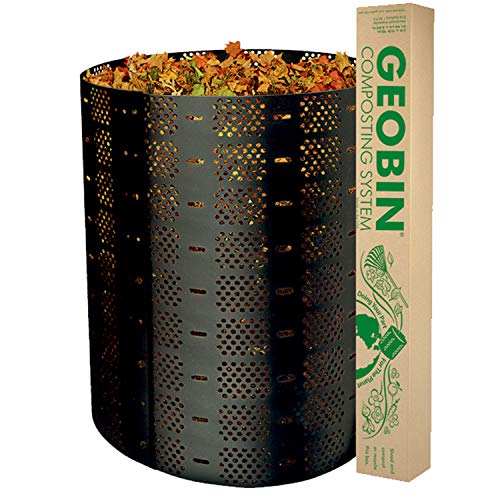
GEOBIN Compost Bin — Best Budget Bulk Bin
Choose the GEOBIN if you have a yard, a leaf problem, and a small budget: gardeners who need to process large volumes of yard waste cheaply and are happy with slow, cold composting.
- Capacity: expandable, up to 246 gallons (a listing bullet states 237 gallons — see sources note)
- Material: plastic panel, made in the USA per the maker listing
- Design: single flexible perforated panel formed into a cylinder
- Assembly: closure keys, no tools; expands to about 3.75 ft wide
- Access: open top; lift or unclip the panel to harvest
Strengths
- Enormous adjustable capacity at the lowest cost per gallon in this guide
- Perforated walls give excellent airflow for bulky, dry material
- Sets up in minutes, moves easily, and stores flat when empty
Trade-offs
- Open design does not exclude rodents — yard waste only where rats are a concern
- No lid and no finished look; it is a working tool, not garden furniture
- Harvesting means lifting or opening the whole bin rather than using a door
The GEOBIN is the compost bin reduced to its essence: one perforated plastic panel, a handful of closure keys, and physics. Form it into a small cylinder for a modest pile or expand it toward its full diameter for autumn leaves, fill it, and let air and time work. For leaves, grass, and hedge trimmings — the bulky majority of most gardens’ waste — nothing in this guide competes on capacity per cost.
Its limits are the flip side of its simplicity. The mesh does not exclude mice or rats, so in areas with rodent pressure it should carry yard waste while kitchen scraps go to an enclosed bin or a tumbler from best compost tumblers. And there is no harvest door: when the bottom layer is finished, you unclip or lift the panel, fork away the unfinished top, and take the dark material beneath. Gardeners who compost in bulk accept that rhythm happily; gardeners who want a tidy weekly harvest should not buy this bin.
One honest limitation: it is a cold, passive system with no heat retention and no pest proofing — expect seasons, not weeks, and keep food scraps out where rodents are active.
Best for: large yards processing bulk leaves and garden waste on a budget / Not suited for: kitchen-scrap composting in rodent-prone areas or tidy small gardens
Check on Amazon — check price on Amazon.

Algreen Soil Saver Classic Compost Bin — Best Overall Stationary Bin
This is the stationary bin for most gardens: a household producing regular kitchen scraps and garden waste that wants one enclosed, pest-resistant, set-and-forget station with proper harvest doors.
- Capacity: 94 gallons (12 cubic feet)
- Material: 100% recycled, BPA-free plastic
- Lid: locking, self-watering lid
- Access: wide top opening plus two sliding bottom doors
- Footprint: about 27 x 27 x 30 in class stationary bin (see listing for exact dimensions)
Strengths
- Locking lid and solid walls keep pests and weather out far better than open designs
- Sliding bottom doors allow true continuous harvesting of finished compost
- Thick recycled-plastic walls retain heat and shrug off seasons outdoors
Trade-offs
- Passive system — finished compost takes months, not weeks
- Turning must be done by hand with a fork or aerator through the top
- Open bottom means it must sit on soil, not paving, to work as designed
The Soil Saver is the classic black-box composter done properly. You load from the wide top, the locking self-watering lid sheds excess rain while letting in enough moisture, the solid walls hold heat and exclude scavengers, and — the detail that separates it from cheap lookalikes — sliding doors at the base let you shovel out finished compost from the bottom while fresh material continues its descent from above. That continuous-harvest design is why this model has remained a reference point in roundup after roundup.
Use it as the garden’s engine room: kitchen scraps arrive from your best countertop compost bins caddy, leaves and prunings go in through autumn, and a hand fork or compost aerator turned through the top every week or two keeps air in the pile. Gardeners feeding best raised garden beds will find the 94-gallon throughput well matched to a few beds’ annual appetite for finished compost.
One honest limitation: there is no shortcut in a passive box: a batch started in autumn is a batch harvested in spring or summer, and anyone promising you faster results from a stationary bin is selling you a tumbler in disguise.
Best for: most gardens wanting an enclosed, continuous-harvest stationary station / Not suited for: gardeners who need finished compost within a single season
Check on Amazon — check price on Amazon.

Greenes Fence Premium Cedar Wood Composter — Best Wooden Bin
Choose the cedar Greenes bin if your compost corner is visible, you value natural materials, and you produce enough garden waste to justify a large, airy, traditional bin — or plan to expand to a two- or three-bin system.
- Capacity: 173.92 gallons (23.25 cubic feet)
- Material: North American cedar, 3/4 in thick boards
- Dimensions: 36 in L x 36 in W x 31 in H
- Design: open slatted wooden bin, made in the USA
- Expansion: add-on kits allow multi-bin systems
Strengths
- Cedar is naturally rot-resistant and ages gracefully in a visible garden
- Slatted walls breathe, suiting bulky, airy garden waste
- Expandable with add-on kits into a classic multi-bin turning system
Trade-offs
- Open slats do not exclude pests and do not retain heat like an enclosed box
- Wood, however durable, has a finite life compared with plastic or steel
- Large footprint needs a permanent, level garden corner
A wooden compost bin is a piece of garden infrastructure, and the Greenes is built like one: thick cedar boards, a square metre-class footprint, and nearly 174 gallons of working volume. Cedar’s natural rot resistance is the right material choice for a structure that will hold damp organic matter for years, and the slatted design breathes in a way that suits the woody, airy waste — prunings, straw, leaves — that dominates a working garden.
The system’s real strength appears in year two, when an add-on kit turns one bin into two: fill one while the other cures, then fork the contents across to turn them, in the classic three-bin rhythm adapted to two. If your garden also runs best pruning shears hard through the year, the volume this bin swallows will not feel excessive for long. It is the least suitable pick here for kitchen scraps in pest-prone areas, so pair it with an enclosed caddy routine and common sense about food waste.
One honest limitation: the open, lid-free design composts cool and slow and offers no barrier to determined pests — it is a garden-waste bin first and a food-scrap bin only in low-pressure areas.
Best for: visible gardens, traditional gardeners, and future multi-bin systems / Not suited for: small gardens or food-scrap composting where pests are a problem
Check on Amazon — check price on Amazon.

Redmon Outdoor Compost Bin — Best Mid-Size Enclosed Bin
Pick the Redmon if the Soil Saver’s 94 gallons is more bin than your garden needs, but you still want an enclosed stationary bin with genuinely convenient access from any side.
- Capacity: 65 gallons (8.6 cubic feet)
- Material: plastic
- Lid: lift-off lid
- Access: four side access doors, one per side
- Ventilation: vent holes throughout the walls
Strengths
- Four access doors mean finished compost is reachable whatever side faces the path
- Lift-off lid makes bulk loading of garden waste effortless
- Mid-size 65-gallon capacity suits the average family garden
Trade-offs
- Vent holes and door fit are less pest-proof than the Soil Saver locking design
- Thinner construction feel than the Algreen
- Passive and slow, like every stationary bin here
The Redmon’s party trick is access. Most stationary bins assume you will approach from the front; the Redmon puts a door on all four sides and a lid that lifts clean off, so it can sit in a corner, against a fence, or in the middle of a working area and still give up its finished compost without being dragged around. For smaller gardens where the bin’s position is dictated by the layout, that flexibility is worth more than a few extra gallons.
In composting terms it is a conventional passive box: vent holes for airflow, ground contact at the base, and a pace set by weather and recipe rather than by the bin. Feed it the same balanced greens and browns you would feed any system — the routine in the how-to section applies unchanged — and harvest through whichever door is most convenient. It pairs well with a best watering cans habit in dry spells, when a passive pile benefits from an occasional deliberate watering.
One honest limitation: the multi-door, vented construction that makes it convenient also makes it the least sealed of the enclosed bins here, so determined pests and heavy rain both get more access than the design of the Soil Saver allows.
Best for: average gardens needing flexible four-side access in a mid-size bin / Not suited for: maximum pest resistance or the fastest possible composting
Check on Amazon — check price on Amazon.

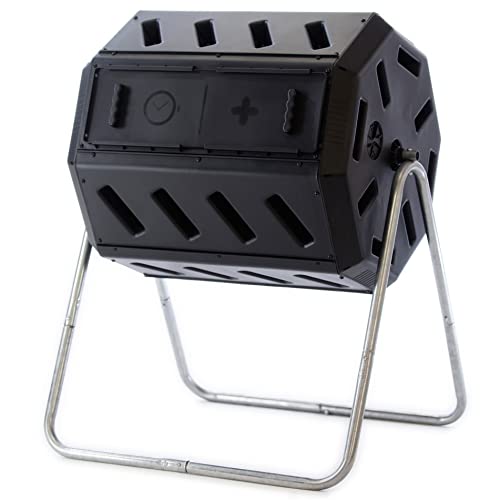
FCMP Outdoor IM4000 Tumbling Composter — Best Tumbler Alternative
Include the FCMP in an outdoor-bin shortlist if your real priority is speed and pest resistance rather than bulk: small gardens, tidy patios, and households whose waste is mostly kitchen scraps.
- Capacity: 37 gallons total across two independent chambers
- Material: BPA-free, 100% recycled UV-inhibited polypropylene drum
- Frame: corrosion-resistant galvanized steel
- Design: octagonal drum with deep fins and aeration holes
- Access: one large removable door
Strengths
- Active turning produces finished compost far faster than any passive bin
- Sealed, elevated drum is the most pest-resistant design in this guide
- Dual chambers keep fresh intake and curing batches separate
Trade-offs
- 37 gallons total is small beside the stationary bins here
- No ground contact, so you manage moisture entirely yourself
- Costs more per gallon than any stationary option
Every other pick in this guide composts passively; the FCMP is here so the comparison is honest. If your waste stream is dominated by kitchen scraps, if rodents have raided a previous open pile, or if you want finished compost this season rather than next, a tumbler is not an upgrade to a stationary bin — it is a different and better tool for your job. The full analysis lives in best compost tumblers; the short version is that dual chambers plus regular turning compress months of passive work into weeks.
The compromises are capacity and involvement. Thirty-seven gallons disappears quickly during a garden clear-out, and a tumbler asks for two minutes of turning every few days where a stationary bin asks for nothing. Most high-output gardens end up running both: the tumbler as the kitchen-scrap engine, a stationary bin like the Soil Saver or GEOBIN as the leaf-and-prunings reservoir.
One honest limitation: bulk garden waste overwhelms it — a single autumn leaf fall can exceed its total capacity, so bulk producers should treat it as a companion to a large stationary bin, not a replacement.
Best for: kitchen-scrap-focused households wanting speed and pest resistance / Not suited for: bulk leaf and garden-waste processing as the only composter
Check on Amazon — check price on Amazon.

VIVOSUN Outdoor Tumbling Composter — Best Value Tumbler Alternative
The VIVOSUN is the value route into active composting for larger households: 43 gallons of dual-chamber tumbling from a major grow brand, provided you verify the exact listing variant before ordering.
- Capacity: 43 gallons total, two chambers
- Material: polypropylene panels with a galvanized steel frame
- Design: 360-degree rotating drum with deep fins and internal bars
- Aeration: adjustable air vents
- Access: two sliding doors
Strengths
- More tumbler capacity per cost than the FCMP class
- Adjustable vents help balance airflow and moisture by season
- Deep fins and internal bars mix a full load effectively
Trade-offs
- Multiple near-identical listing variants demand careful checking
- Fit and finish trail the FCMP
- Still small beside any stationary bin for bulk waste
As a tumbler, the VIVOSUN covers the active-composting brief with room to spare: dual chambers for continuous intake, a drum that genuinely mixes thanks to its fins and internal bars, and vents you can adjust as seasons change — open for airflow in summer, partly closed against drying winds in autumn. For a family whose scraps outgrow the FCMP’s chambers, it is the natural next size up in the same workflow.
Within this outdoor-bin guide its role is identical to the FCMP’s: the fast, sealed, kitchen-scrap option standing against four passive designs. Choose between the two tumblers on chamber size and how much listing-variant checking you are willing to do; choose between tumblers and stationary bins on the method question — speed and involvement versus capacity and patience — that the buying guide below works through in full.
One honest limitation: the product family is sold in several door-colour and bundle variants under near-identical headlines, so the live listing details — not the headline — are what you must verify before ordering.
Best for: larger households wanting a value dual-chamber tumbler / Not suited for: bulk-only composting or buyers who dislike variant checking
Check on Amazon — check price on Amazon.
Comparison Table
Use this side-by-side view to compare the six best outdoor compost bins on the specs that actually change day-to-day use. There are no prices or ratings here on purpose, because both change constantly; the live Amazon listing is the only reliable place for either.
| Pick | Capacity | Type | Material | Harvest access |
|---|---|---|---|---|
| GEOBIN Compost Bin | Up to 246 gal | Expandable open bin | Plastic panel | Lift panel to harvest |
| Algreen Soil Saver Classic Compost Bin | 94 gal | Stationary enclosed | Recycled plastic | Two sliding bottom doors |
| Greenes Fence Premium Cedar Wood Composter | 173.92 gal | Stationary open slatted | Cedar wood | Open top; fork out |
| Redmon Outdoor Compost Bin | 65 gal | Stationary enclosed | Plastic | Four side doors + lift-off lid |
| FCMP Outdoor IM4000 Tumbling Composter | 37 gal | Tumbler, dual chamber | Recycled polypropylene | Removable door; tumble to mix |
| VIVOSUN Outdoor Tumbling Composter | 43 gal | Tumbler, dual chamber | Polypropylene + galvanized steel | Two sliding doors |
The table makes the method split visible. Stationary bins trade time for capacity and simplicity — 65 to 246 gallons, no moving parts, harvest in seasons. Tumblers trade capacity for time — 37 to 43 gallons, finished compost in weeks, in exchange for regular turning. Neither column of virtues is imaginary; the mistake is buying one method while expecting the other’s results.
How to Choose the Right Outdoor Compost Bin
Stationary, expandable, wooden, or tumbler?
Start with your waste stream. Mostly leaves, prunings, and garden clearings, in volume? An expandable GEOBIN or the cedar Greenes will swallow it cheaply and slowly. A mixed stream of kitchen scraps and garden waste in a normal family garden? An enclosed stationary bin — Soil Saver or Redmon — is the balanced default. Mostly kitchen scraps, limited space, or a history of pest raids? Skip passive designs entirely and buy a tumbler.
Then check your temperament. Passive bins forgive neglect for months; tumblers reward attention every few days and sulk — slowly, smellily — without it. The best outdoor compost bin is the one whose maintenance rhythm matches the gardener, a truth no capacity figure can override.
Sizing an outdoor bin honestly
Outdoor capacity needs are set by peak season, not average weeks. A bin sized for spring will overflow in October when leaves, spent plants, and hedge trimmings arrive together. As a working guide: a small garden with a countertop caddy’s worth of kitchen scraps suits the 65-gallon class; a family garden with lawn and beds suits 94 gallons; and any garden with mature trees should think in the 170- to 246-gallon class or run two systems in parallel.
Remember shrinkage: compost reduces to roughly a third of its input volume, so a large bin is not vanity — it is the working space that lets material stay in the system long enough to finish. Undersized bins force premature harvesting of half-finished compost, which then has to be stored somewhere anyway.
Lids, doors, and pest resistance
Pest resistance is a chain: enclosed walls, a lid that locks or fits tightly, doors that close flush, and plant-only inputs. The Soil Saver’s locking lid and solid walls form the strongest chain among the stationary picks; the Redmon trades a little sealing for four-side access; open designs — GEOBIN and Greenes — make no pest claims and should be fed accordingly in rodent country.
Harvest doors deserve the same scrutiny as lids. Bottom sliding doors (Soil Saver) enable continuous harvesting without disturbing fresh material on top. Four side doors (Redmon) enable harvesting from any orientation. No doors (GEOBIN, Greenes) mean periodic fork work. None is wrong; each suits a different garden layout and gardener.
Siting: soil contact, sun, and water
Stationary bins with open bases must sit on soil: earthworms and microbes migrate up from the ground, and liquid drains away instead of pooling. Paving underneath a stationary bin defeats its design. Tumblers, being sealed and elevated, can sit on a patio or deck, which is part of their small-garden appeal.
Sun warms a pile and speeds it; full shade slows everything, especially in spring. A spot that is convenient in all weathers — a short, hard-surfaced walk from the kitchen door — will be visited ten times more often than a theoretically perfect spot at the garden’s far end, and visit frequency is what keeps a pile balanced, moist, and turned.
Hot composting versus cold composting
Every bin in this guide can cold-compost: pile material in, keep it moist, and decomposition proceeds at ambient pace — safe, effortless, and slow, with the caveat that weed seeds and pathogens may survive a cold pile. Hot composting is a managed state, not a product: a large enough mass (roughly a cubic metre), a balanced greens-to-browns recipe, adequate moisture, and regular turning drive the core to temperatures that break material down in weeks and kill most seeds and pathogens on the way.
Which bins support which style? Tumblers are built for managed, faster batches at small scale. Large stationary bins can run genuinely hot if you fill them in one go with a balanced recipe rather than trickling additions in — the batch-loading technique: save material, build the whole pile in a day, turn it weekly, and harvest a finished batch rather than a continuous trickle. The GEOBIN and Greenes, filled this way with autumn leaves plus a nitrogen source, surprise many owners with their first truly hot pile.
Compost bin or compost pile — do you need a bin at all?
Honestly, no: a tidy heap in a corner composts perfectly well, and gardeners have done it for centuries. A bin buys you four things a heap cannot: containment that keeps the process presentable and the material from migrating, walls that hold heat and moisture more evenly, a lid or enclosed design that manages pests and rain, and doors that make harvesting a job of minutes. Whether those four are worth money depends on your garden’s visibility, your neighbours, your pest pressure, and your patience.
The middle path many experienced gardeners take is one enclosed bin for kitchen scraps and one open solution — a GEOBIN or a simple heap — for garden bulk. That pairing covers every waste stream in this guide at a fraction of the cost of a single premium system, and it is the configuration we would recommend to a new gardener with a full-size plot.
Multiple bins and the turning system
Serious gardens outgrow single bins, and the classic answer is a row of two or three: one filling, one curing, and optionally one holding finished compost ready for the beds. The Greenes cedar system is designed to grow into exactly this arrangement with add-on kits, but the logic works with any pairing — a Soil Saver filling beside a GEOBIN curing, for instance — because the roles matter more than matching brands. Turning, in a multi-bin garden, means forking the curing bin’s contents into the empty bay, which aerates more thoroughly than any in-place stirring.
Plan the row before the second bin arrives: level soil, a working aisle wide enough for a barrow, and a store of browns at the row’s end, because a turning day consumes browns as fast as it consumes hours. Gardeners who work beds with best pruning shears in one hand all season will recognise the principle — the system, laid out once, is what makes the work feel light. A two-bay garden rarely thinks about compost again; it simply has some, always, at exactly the moment the beds are ready for it.
Key Takeaways
- Method first: passive bins trade time for capacity; tumblers trade capacity for time.
- Size for October, not April — peak garden waste sets the capacity you need.
- Enclosed + locking lid (Soil Saver) is the pest-resistant stationary standard.
- Stationary bins need soil contact; tumblers can live on a patio.
- Many serious gardens run both: a tumbler for kitchen scraps, a big bin for leaves.
How to Run a Stationary Compost Bin
A passive bin rewards a good start and then mostly patience. Set it up this way and it will repay you for years.
- Site the bin on level soil in a convenient, partly sunny spot; loosen the soil beneath it to help drainage and worm access.
- Start with a coarse layer — twigs and straw — to keep the base airy and draining freely.
- Add greens and browns in balanced volumes as they arise: kitchen scraps and grass on the green side; leaves, straw, and shredded cardboard on the brown side.
- Bury kitchen scraps in the centre of the pile and cover them with browns to deter flies and pests.
- Keep the pile as moist as a wrung-out sponge; water it during dry spells and let the lid shed excess rain in wet ones.
- Fork or aerate the pile every few weeks to restore air pockets — less often than a tumbler, but not never.
- Harvest from the bottom doors (or by forking aside the top, on open bins) when the lowest material is dark, crumbly, and earthy.
Finished compost goes straight to work: mulch beds, feed best raised garden beds at season start, or top-dress containers. Keep a pair of best gardening gloves by the bin — harvesting is muddy, satisfying, physical work.
Troubleshooting: Problems and Fixes
Problem: the pile is cold and unchanged after months. → Fix: it is probably too dry, too brown-heavy, or too small to hold heat. Add greens and water, mix, and consolidate material rather than spreading it thin.
Problem: a sour, swampy smell. → Fix: too wet and airless. Fork in a large volume of dry browns, open the pile up, and check the bin is draining onto soil rather than sitting in a puddle.
Problem: rodents are visiting. → Fix: remove any meat, dairy, or cooked food, bury scraps centrally, secure lids and doors, and move kitchen scraps to a sealed tumbler if pressure continues.
Problem: the bin is full but nothing looks finished. → Fix: normal for a young pile. Keep adding on top, harvest patience, and take finished material from the very bottom, where the oldest layer lives.
Problem: fruit flies in summer. → Fix: cover every fresh addition with browns or a layer of soil, and keep the lid closed; flies need exposed scraps to breed.
Batch-Loading a Stationary Bin for a Faster Result
If you want one faster, hotter cycle from a passive bin, load it as a batch instead of a trickle. The method asks for a weekend of preparation and repays it with the best compost a stationary bin can make.
- Collect and store browns for several weeks beforehand: bags of autumn leaves, shredded cardboard, straw.
- Collect greens in the same window: grass clippings, garden clearings, and the kitchen output of your best countertop compost bins caddy, kept in a holding bin.
- Build the pile in layers on the day: alternate greens and browns in roughly equal volumes, watering each layer to the wrung-sponge feel.
- Chop or shred anything coarse as it goes in — particle size is the strongest speed lever you control.
- Cover the bin, wait three to four days, then fork the whole pile once to redistribute heat and air; repeat weekly.
- When turning no longer reheats the pile, let it cure undisturbed, then harvest from the bottom or by forking the batch out and sifting.
Batch loading suits gardeners whose waste arrives in seasonal surges — spring clear-outs and autumn leaf-fall — far better than the continuous rhythm, and it pairs naturally with best garden carts and wheelbarrows work on a clear-out weekend. Choose the rhythm that matches your garden’s calendar, not the one that sounds most virtuous.
Common Buying Mistakes
Siting a stationary bin on paving
An open-base bin on concrete cannot drain and cannot recruit worms and microbes from the soil. It becomes a wet box. Always give stationary bins soil contact; if only paving exists, buy a tumbler instead.
Buying capacity for the average week
Compost systems fail at peak load, not on average. Autumn leaves and clear-outs decide the size you need. If in doubt, size up or plan a second, cheap overflow — the expandable GEOBIN exists precisely for this role.
Expecting tumbler speed from a passive bin
A stationary bin is a slow biological process in a box. Expecting finished compost in a month leads to premature harvesting, disappointment, and abandoned bins. Match the method to the timeline before you buy.
Feeding the bin only greens
Grass and kitchen scraps alone collapse into a dense, wet, airless mass that smells and stalls. Browns are structural: they hold air in the pile. Keep a store of leaves or shredded cardboard beside the bin year-round.
Placing the bin as far away as possible
Out of sight becomes out of mind. A bin at the garden’s far end gets visited rarely, turned never, and filled unevenly. The best site is the convenient site — a short walk from the kitchen door, on the way to the beds it will feed.
Final Recommendation
For most gardens the Algreen Soil Saver is the recommendation: enclosed and locking against pests, generous at 94 gallons, and — decisively — equipped with bottom harvest doors that make it a true continuous system rather than a fill-and-wait box. It is the stationary bin we would install in a family garden and expect to use for a decade.
The runner-up depends on your garden. For bulk and budget, the GEOBIN at up to 246 expandable gallons has no rival for leaves and garden waste. If your real problem is kitchen scraps and speed rather than bulk, skip both and take the tumbler route detailed in best compost tumblers — method fit beats model choice every time.
Start with the Algreen Soil Saver Classic Compost Bin if you want one recommendation and no second-guessing. If its trade-offs do not fit your situation, the GEOBIN Compost Bin is the runner-up we would buy instead, for the reasons covered in its review above.
Frequently Asked Questions
How long does an outdoor compost bin take to make compost?
A passive stationary bin typically takes several months to a year depending on climate, recipe, and turning. A tumbler, actively turned with a balanced mix, can finish a batch in several weeks in warm weather. The bin sets the ceiling; the greens-to-browns balance, moisture, and particle size decide how close you get to it.
Where is the best place to put an outdoor compost bin?
On level soil, in partial sun, on a path you walk anyway — ideally a short trip from the kitchen and on the way to the beds the compost will feed. Avoid deep permanent shade, waterlogged hollows, and direct contact with wooden fences, which leachate can stain.
Can I compost kitchen scraps in an open bin?
Plant scraps, yes, with care: bury them centrally under browns and expect more fly and pest attention than in an enclosed bin. In areas with rats, keep food scraps out of open designs like the GEOBIN and Greenes entirely and route them to an enclosed bin or tumbler; use open bins for yard waste.
Do outdoor compost bins smell?
A balanced, moist-but-not-wet pile smells earthy when opened and barely at all when closed. Persistent bad odor is diagnostic, not normal: it almost always means too wet, too green, or too airless, and the fix is browns, forking, and drainage — covered step by step in the troubleshooting section above.
What is the difference between a compost bin and a compost tumbler?
A bin is stationary and passive: material descends slowly and is harvested from the bottom over months. A tumbler is a rotating drum you turn by hand: mixing and aeration accelerate the process to weeks, at smaller capacities. The comparison runs through this whole guide, and the dedicated best compost tumblers guide covers the active method in depth.
How do I keep animals out of my compost bin?
Choose enclosed walls and a locking or tight lid, keep meat, dairy, and cooked food out, bury scraps in the pile centre, and keep the area tidy. If pressure persists, a sealed elevated tumbler is the definitive answer — animals cannot reach or open it.
Can I leave a compost bin out all winter?
Yes — all six designs here are outdoor products. Composting slows or pauses in hard cold and resumes in spring; insulated tumblers keep working longest. There is no need to empty a bin for winter, and a full bin actually insulates its own core better than an empty one.
Will a compost bin attract bears or large animals?
In bear country, food scraps outdoors are an attractant in any container short of certified bear-resistant storage. Follow local guidance first: many bear-country municipalities require indoor storage of food waste or collection-only composting. Yard-waste-only bins (leaves, prunings, grass) present far less attraction and are the usual recommendation where bears are a real presence.
Can I compost on a balcony or patio with an outdoor bin?
Stationary bins need soil contact, so they do not translate to hard surfaces. For a balcony, the honest options are a tumbler, which is sealed and elevated, or an indoor worm or countertop system feeding a collection. Check building and lease rules before installing anything, and favour sealed designs out of courtesy to the neighbours below.
How do I keep compost from freezing solid in winter?
You mostly do not need to: a frozen pile is a paused pile, not a ruined one, and it resumes in spring exactly where it stopped. A full bin insulates its own core, an insulated tumbler keeps working longest, and adding material in larger, balanced batches before hard frost gives the pile the best chance of holding a warm centre.
Do I need to add compost starter or activator?
No commercial activator is required: soil from the garden, a shovelful of finished compost, or even the material clinging to last year’s bin carries every microbe a new pile needs. Activators sell convenience — a concentrated nitrogen and microbe dose — and can speed a pile that is too brown-heavy, but the same result comes free from a layer of grass clippings or a watering with diluted, leftover coffee. Spend the money on a second bin before you spend it on starter.