Disclosure: As an Amazon Associate, umtsmarttool.com earns from qualifying purchases. Links to Amazon on this page are affiliate links; they cost you nothing extra. Prices and availability change often, so check the current Amazon listing before you buy.
Where to buy
Short on time? These are the best sharpening guides for knives picks from this guide, each linked to its Amazon listing where one is verified:
- Work Sharp Precision Adjust Knife Sharpener — Check on Amazon
- Lansky Deluxe 5-Stone Sharpening System — Check on Amazon
- Work Sharp Precision Adjust Elite — Check on Amazon
- Work Sharp Professional Precision Adjust — Check on Amazon
- DMT Aligner Blade Guide — Check on Amazon
- Hapstone R2 — Check on Amazon
Read the full guide ↓
Every dull knife has the same problem, and it is almost never the steel: it is the angle. Freehand sharpening asks you to hold a blade at a constant angle, stroke after stroke, side after side — a skill that takes months to build — and the best sharpening guides for knives exist to remove that variable entirely. A guided system clamps the knife or guides the stone so the angle is set by the tool, not by your wrist, which means a complete beginner’s first edge can look like a practiced sharpener’s fiftieth. The six systems in this guide cover the full honest range: the clamp-and-rod design that made guided sharpening mainstream, the decades-old multi-stone kit that still undercuts everything, two factory upgrades for owners who catch the sharpening bug, a premium bench system, and the two enthusiast paths for readers who want to grow beyond a first kit.
Choosing between them is mostly a question of three things: which knives you own, how dull they get, and how much process you enjoy. A guided system that is perfect for reviving a drawer of neglected kitchen and pocket knives may be slow for weekly touch-ups, while a quick system may lack the coarse abrasives to repair a chipped edge. This guide badges each pick for its actual job — best overall, best budget, best upgrade, best premium, best for bench-stone users, and best for enthusiasts — and the buying-guide section explains the abrasive, angle, and clamp questions that decide satisfaction far more than brand loyalty does. If your dull drawer is mostly pocket knives, our best knife sharpeners for pocket knives coverage focuses on the compact end of the same problem.
One promise before the picks: no guided system makes sharpening instant, and none forgives a skipped grit or a rushed burr. What the best systems do is make the process repeatable — the same angle, the same progression, the same result — so that the edge you produce in month six is better than month one for reasons you can name. That repeatability is what you are buying. Everything below is about choosing the version of it that fits your knives and your patience.
In this guide
Quick Picks
| Pick | Badge | Key spec |
|---|---|---|
| Work Sharp Precision Adjust Knife Sharpener | Best Overall | Adjustable 15–30 degrees in 1-degree steps, Tri-Brasive rod, clamp system |
| Lansky Deluxe 5-Stone Sharpening System | Best Budget | Five hones from extra-coarse to ultra-fine, angles 17/20/25/30 degrees |
| Work Sharp Precision Adjust Elite | Best Upgrade | Precision Adjust platform with expanded abrasive set and carry case |
| Work Sharp Professional Precision Adjust | Best Premium | Metal-framed Precision Adjust platform, digital angle reference, full stone set |
| DMT Aligner Blade Guide | Best for Bench-Stone Users | Clamp guide that rides your own bench stones, diamond abrasive family |
| Hapstone R2 | Best for Enthusiasts | Modular guided system, rotating clamp, wide stone compatibility |
How These Picks Were Chosen
Systems were screened on the mechanics that decide results. Angle control came first: the system must set and hold a repeatable angle on both sides of the blade, with a useful range for everything from thin kitchen knives to thick outdoor blades. Abrasive progression came second: a complete system needs a genuinely coarse option for repair and reprofiling, medium grits for sharpening, and a fine finish — a kit that starts too fine cannot save a truly dull knife. Third was clamp and stone quality, because a clamp that lets the blade shift mid-session silently ruins more edges than any other single failure. Fourth was honesty about scope: systems that handle serrations, recurves, or very long blades were credited for saying so; systems that quietly struggle with them were marked down.
The shortlist was built from manufacturer specifications and established retailer listings, cross-checked across sources before any Amazon link was attached. Four Work Sharp and Lansky systems carry links confirmed from sources we opened; the two enthusiast picks are presented without purchase links, and their specifications are flagged as single-source in the notes. No hands-on testing is claimed; assessments synthesize published specifications and each system’s documented record with home sharpeners and working knife users.
The 6 Best Sharpening Guides for Knives
Work Sharp Precision Adjust Knife Sharpener — Best Overall
- Angle range: 15 to 30 degrees, adjustable in 1-degree increments
- Abrasive: Tri-Brasive rod with coarse and fine diamond plus fine ceramic
- Clamp: V-block clamp secures the blade for both sides
- Base: stable benchtop sharpening base
- Scope: pocket and kitchen knives
Strengths
- The angle dial makes repeatability effortless for beginners
- Three abrasives on one rod — no stone swapping mid-session
- Compact footprint stores in a kitchen drawer
Trade-offs
- Plastic construction flexes slightly under heavy pressure
- Included abrasives are a starter set, not a full repair arsenal
- Very long kitchen knives need repositioning in the clamp
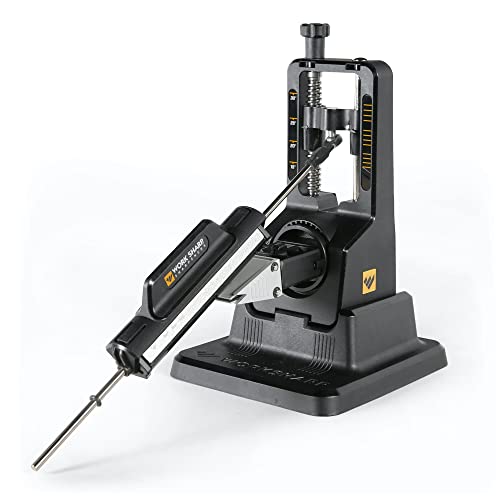
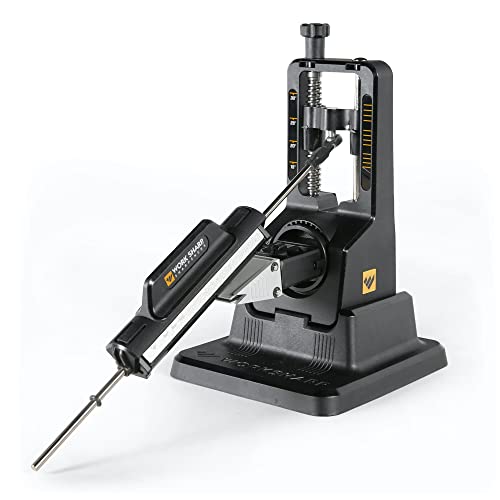
The Precision Adjust is the guided sharpener that finally made the category simple, and it did it by taking the two fiddliest parts of older systems — setting the angle and swapping stones — and engineering them down to a dial and a rotating rod. Clamp the knife in the V-block, turn the knob to your angle anywhere from 15 to 30 degrees in one-degree steps, and work the Tri-Brasive rod along the edge: coarse diamond to sharpen, fine diamond to refine, ceramic to finish. The same setup, in the same order, produces the same edge every time, which is the entire point of a guided system.
For the knives most households actually own — pocket knives, everyday kitchen knives, the hunting knife that comes out twice a year — that formula is close to ideal. The clamp holds typical blade shapes securely, the base is stable on a counter, and the whole kit packs away small enough to live in a drawer rather than demand bench space. Owners of the folders in our best pocket knives under $50 guide will find it sized exactly for their knives, and the learning curve is measured in one knife, not one season.
Its limits are construction and scope. The largely plastic build can flex if you bear down like you are filing a fence post — let the abrasive work, with light pressure, and the flex never matters. The included abrasives will sharpen and finish, but a genuinely damaged or extremely dull edge wants coarser options, which is what the Elite upgrade below exists to add. And very long chef’s knives must be repositioned in the clamp to work the full edge. None of these stops the base Precision Adjust from being the correct first guided sharpener for most people.
Best for: Best for: beginners and households sharpening pocket and kitchen knives. / Not suited for: heavy edge repair, or owners of very long blades who sharpen weekly.
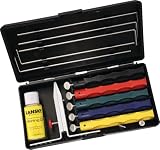
Lansky Deluxe 5-Stone Sharpening System — Best Budget
- Hones: five stones from extra-coarse (70 grit class) to ultra-fine (1000 grit class)
- Angles: 17, 20, 25, and 30 degree guide holes
- System: clamp with guide rods for each hone
- Includes: honing oil and storage case
- Record: in production for decades
Strengths
- Widest grit range at the lowest tier in this guide
- Genuinely capable of repairing and reprofiling dull edges
- Replacement hones and accessories are everywhere
Trade-offs
- Clamping and rod setup is slower than dial-based rivals
- Small hones mean more strokes on long blades
- Technique still matters — the guide helps, it does not automate
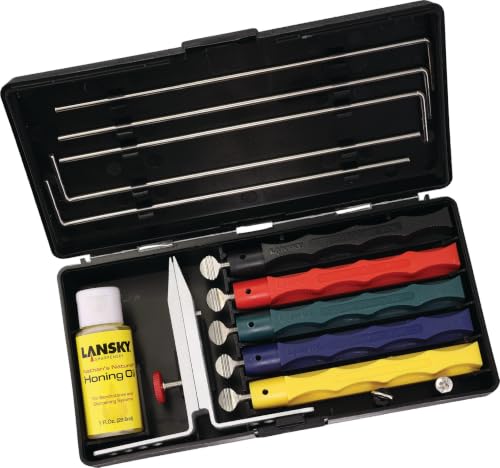
The Lansky Deluxe is the guided system your grandfather’s hardware store stocked, and it is still here because its fundamentals are right: a clamp that holds the blade, guide rods that hold the angle, and five real hones spanning the full journey from a neglected, damaged edge to a polished one. The angle slots — 17, 20, 25, and 30 degrees — cover everything from thin kitchen edges to stout outdoor blades, and the extra-coarse hone does repair work that finer starter kits simply cannot attempt.
That range is why the Deluxe remains the budget recommendation despite its age. A household reviving a drawer of truly dull knives needs abrasive breadth more than convenience, and no comparably priced rival offers five stones and four angles in a fitted case with honing oil included. The system also teaches real sharpening literacy: you learn what each grit does, how a burr forms and leaves, and how angle choice changes an edge — knowledge that transfers to every other method, including the bench stones in our best knife sharpeners for pocket knives coverage.
The cost is process. Each hone change means mounting a rod, each clamp session starts with careful setup, and the small hones make long kitchen blades a patient exercise. Owners who sharpen two knives twice a year will never mind; owners who sharpen weekly will eventually buy the Work Sharp above for speed and keep the Lansky for repair work — a two-system outcome this guide considers a success, not a failure. As a first system on a budget, or a repair kit behind a faster daily driver, the Deluxe has earned its decades.
Best for: Best for: budget buyers with genuinely dull knives to revive, and learners. / Not suited for: high-frequency sharpeners who value speed over range.

Work Sharp Precision Adjust Elite — Best Upgrade
- Platform: Precision Adjust clamp-and-rod system
- Angles: 15 to 30 degrees in 1-degree increments
- Abrasives: expanded set beyond the base Tri-Brasive, including coarser and finer options
- Includes: carry and storage case on the Elite bundle
- Scope: pocket, kitchen, and outdoor knives
Strengths
- Fixes the base model’s one weakness: abrasive range
- Same simple dial-and-clamp workflow, nothing new to learn
- Case keeps the whole system together and portable
Trade-offs
- Costs meaningfully more than the base model for stones and a case
- Same plastic platform — flex discipline still applies
- Overkill if your knives never get truly dull
The Elite is the answer to the only real criticism of the base Precision Adjust, and Work Sharp was honest about it: the platform was right, the abrasive set was thin. The Elite bundle expands the progression — coarser diamond for repair and reprofiling, finer options for polished finishes, plus a ceramic stage for serration touch-ups on many configurations — and packages the system in a proper carry case that keeps rods, clamp, and base together in one drawer-friendly box.
Who should pay the difference? The owner whose knives actually get dull: the household that cooks daily, the hunter who edges through a season, the collector maintaining a rotation of folders from our best pocket knives under $50 guide. For those users the coarse stage is not a luxury — it is the difference between a twenty-minute sharpening and an hour of grinding on a too-fine stone, which is where beginners give up and edges go to die. The Elite removes that failure mode while keeping the dial-simple workflow that made the base model the recommendation.
If your knives are maintained little and often and never reach true dullness, save the money and buy the base model — the Elite’s extra range will sit unused, and unused capability is just weight in a drawer. The Elite is an upgrade with a specific customer, and for that customer — the regular sharpener with real edges to maintain — it is the most sensible purchase in this guide.
Best for: Best for: regular sharpeners whose knives get genuinely dull. / Not suited for: occasional users, for whom the base model is the smarter spend.


Work Sharp Professional Precision Adjust — Best Premium
- Platform: professional metal-frame clamp system
- Angle: wide adjustable range with fine, repeatable settings
- Abrasives: full progression of diamond and ceramic stones included
- Build: rigid frame intended for high-volume use
- Scope: serious home and light professional sharpening
Strengths
- Rigidity removes the base platform’s flex entirely
- Full stone progression handles repair through polish in one kit
- Built for owners who sharpen many knives, often
Trade-offs
- Premium pricing far above the home systems here
- Bench footprint and setup suit a workstation, not a kitchen drawer
- Capability most households will never use
The Professional Precision Adjust is Work Sharp’s answer for the sharpener who outgrew the home platform: a rigid, metal-framed version of the clamp-and-rod idea, with a full progression of stones and the kind of repeatable angle setting — supported by a digital angle reference in its documented configuration — that high-volume sharpening demands. Where the base model asks for light pressure and a little forgiveness, the Professional simply does not flex, and owners who sharpen for family, friends, a hunting camp, or a small business will feel that difference in every session.
It earns its place in this guide as the honest ceiling of the clamp-system category: everything the home systems do, done with more rigidity, more abrasives, and more durability, at a price that only makes sense amortized across many knives and many years. If your sharpening has become a service you provide to a household, a workplace, or a club — the knives from our best survival knives and best skinning knives guides all passing across one bench — this is the platform that will not become the bottleneck.
For a single household maintaining its own drawer of knives, it is candidly more system than the work requires, and the base or Elite models will produce edges of the same quality on the same knives. Buy the Professional when the volume is real, when the bench is permanent, or when you simply want the category’s best-built tool and will enjoy owning it. All three are legitimate reasons; pretending a casual user needs it would not be.
Best for: Best for: high-volume sharpeners, permanent benches, and quality-first buyers. / Not suited for: casual households, where the base and Elite models match its edges for less.

DMT Aligner Blade Guide — Best for Bench-Stone Users
- Format: blade clamp with angle guide for use on bench stones
- Abrasives: works with your stones; DMT diamond stones are the natural pairing
- Angles: multiple guide settings for common edge angles
- Scope: owners who already own or prefer bench stones
- Maker: DMT, USA diamond abrasives
Strengths
- Guidance without giving up your bench stones
- Diamond abrasives cut any steel, including modern hard alloys
- The lowest-cost path for existing stone owners
Trade-offs
- Guide only — stones are a separate purchase if you own none
- Clamp range limits very wide or very thick blades
- Less turnkey than the self-contained systems above
The Aligner takes a different philosophy from every self-contained system in this guide: instead of replacing your bench stones, it guides them. The clamp grips the blade and sets the angle, and you work the clamped knife across the stones you already own — ideally DMT’s own diamond plates, whose abrasives cut every steel in the modern market, including the hard, wear-resistant alloys that make conventional stones feel like they are skating.
That makes the Aligner the smartest purchase in this article for one specific reader: the owner who already has stones, or who wants to learn bench-stone sharpening with training wheels that can come off. The guided sessions teach the geometry; the same stones later serve freehand work; and the total investment stays low because the abrasive you may already own does double duty. For the hard modern steels appearing on premium folders and hunting knives, diamond is not a luxury — it is the abrasive that actually cuts them in reasonable time.
The trade is turnkey convenience. There is no dial, no fitted case of matched hones, and no illusion that the system is complete in the box: without stones, it is a clamp in search of a purpose, and its clamp, like all clamps, has blade shapes it grips less happily. Buy it as part of a bench-stone strategy and it is excellent value. Buy it expecting the Work Sharp experience and you will be disappointed by a product that never promised it.
Best for: Best for: bench-stone owners and learners who want guided training wheels. / Not suited for: buyers who want a complete, self-contained kit in one box.

Hapstone R2 — Best for Enthusiasts
- Format: modular guided sharpening system with rotating clamp
- Stones: compatible with a wide range of standard-format stones
- Clamps: whole-blade and accessory clamp options in the system family
- Angles: fine, repeatable adjustment across a wide range
- Scope: enthusiast and semi-professional sharpening
Strengths
- Rotating clamp flips the knife without unclamping
- Huge stone ecosystem — use the abrasives you prefer
- Modular design grows with your ambitions
Trade-offs
- Enthusiast pricing and a real learning curve
- Modularity means decisions — and purchases — multiply
- Far beyond the needs of a household drawer of knives
Every category has a point where the tools stop being appliances and start being instruments, and in guided sharpening that point is the Hapstone class of modular systems. The R2’s signature is its rotating clamp: the knife stays clamped while the whole assembly flips, so both sides of the edge are worked at exactly the same set angle without the unclamp-reclamp cycle that introduces error into lesser systems. Around that clamp sits a modular platform that accepts a wide ecosystem of standard-format stones — diamond, ceramic, natural, and bonded abrasives from many makers.
That stone freedom is the real enthusiast argument. A guided system’s ceiling is set by its abrasives, and proprietary rods eventually limit how fine, how coarse, or how specialized your progression can become. The Hapstone removes the ceiling: reprofiling on coarse diamond, refining on ceramics, finishing on stones that polish an edge to a mirror — all on one platform, all at a dialed, repeatable angle. For the owner whose collection includes the premium blades in our best survival knives guide and who sharpens as a craft in itself, this is where the road leads.
It is also, candidly, where household sharpening does not need to go. The system costs enthusiast money, rewards enthusiast time, and multiplies decisions — clamps, stones, upgrades — that the Work Sharp buyer never has to make. Choose it because the process itself has become part of the hobby, and it will satisfy for years. Choose anything above it in this guide if what you actually want is sharp knives and your evenings back.
Best for: Best for: enthusiasts and collectors who sharpen as a craft. / Not suited for: households that want sharp knives with minimum process.
Comparison Table
| Pick | Key spec | Badge |
|---|---|---|
| Work Sharp Precision Adjust Knife Sharpener | Adjustable 15–30 degrees in 1-degree steps, Tri-Brasive rod, clamp system | Best Overall |
| Lansky Deluxe 5-Stone Sharpening System | Five hones from extra-coarse to ultra-fine, angles 17/20/25/30 degrees | Best Budget |
| Work Sharp Precision Adjust Elite | Precision Adjust platform with expanded abrasive set and carry case | Best Upgrade |
| Work Sharp Professional Precision Adjust | Metal-framed Precision Adjust platform, digital angle reference, full stone set | Best Premium |
| DMT Aligner Blade Guide | Clamp guide that rides your own bench stones, diamond abrasive family | Best for Bench-Stone Users |
| Hapstone R2 | Modular guided system, rotating clamp, wide stone compatibility | Best for Enthusiasts |
Read the table as two families. The self-contained systems — both Work Sharp tiers, the Professional, and the Lansky — sell completeness: clamp, angles, and abrasives in one box, with the differences between them being abrasive range, rigidity, and price. The platform systems — the DMT Aligner and the Hapstone — sell freedom: bring your own abrasives, grow the system over time, and accept setup and decisions as the price of that freedom.
Angle range misleads more buyers than any other specification here. The practical band for nearly all knives is roughly 15 to 25 degrees per side; systems earn their keep not by offering extreme angles but by holding an ordinary angle perfectly, on both sides, session after session. Judge by clamp security and abrasive progression first, and let the dial’s outer numbers impress you last.
How to Choose Sharpening Guides for Knives
Understand what the guide actually does, and every buying decision below it gets easier. A sharpening guide fixes the angle between blade and abrasive so that every stroke removes steel along the same plane. That single consistency is what forms a clean apex — the meeting of two flat bevels — and a clean apex is what sharp actually is. Systems differ in how they fix the angle: clamp-and-rod designs (Work Sharp, Lansky) move a small stone along a clamped blade, stone-riding guides (DMT Aligner) move a clamped blade across a bench stone, and rotating platforms (Hapstone) hold the blade in a frame that flips. The physics is identical; the ergonomics and abrasives are the real differences.
Angles: choosing degrees without the folklore
Thinner kitchen knives thrive around the lower end of these systems’ ranges, everyday pocket knives in the middle, and hard-use outdoor blades toward the stouter end — the guides in our best survival knives coverage are exactly the knives that reward a slightly stronger angle. The golden rule is to match the angle the knife already has, at least until you deliberately choose to change it: sharpening at a new angle means grinding a new bevel, which is slow work that beginners mistake for a broken system. Set the angle, verify with a marker on the bevel if your system allows the view, and only reprofile on purpose, with the coarse abrasive, knowing it will take time.
Abrasives: the progression is the product
A guided system is only as good as its grit range. Coarse abrasives — diamond especially — repair chips, restore neglected edges, and reprofile; medium grits do the ordinary work of sharpening; fine ceramics and stones refine and polish. The Lansky Deluxe’s five-hone span and the Precision Adjust Elite’s expanded set exist because a system that starts too fine cannot save a truly dull knife in reasonable time, while a system that ends too coarse leaves edges that cut but do not glide. Diamond cuts every steel including modern hard alloys; conventional stones are gentler and cheaper; ceramics finish beautifully and cut slowly. Buy the progression your dullest knife needs, not the one your sharpest knife enjoys.
Clamps and blade compatibility
The clamp is the silent failure point of guided sharpening. It must grip your actual knives — thin kitchen blades, thick outdoor spines, small pocket blades — without slipping mid-stroke, because a shifted blade means a changed angle and a wavy bevel. Check your thickest and thinnest blades against the system’s documented clamp range before buying, and be honest about awkward shapes: strong recurves, serrations, and very long chef’s knives challenge every clamp system in this guide and may need the rod-style or bench methods covered in our best knife sharpeners for pocket knives roundup instead.
Guided versus freehand: an honest word
Freehand sharpening on bench stones is a genuine skill with genuine satisfactions, and this guide is not an argument against it. It is an argument about sequence. A guided system gives you sharp knives now and teaches you what a correct bevel looks and feels like; many owners later learn freehand with that reference in their hands, and many more happily never do. Either path is respectable. The only disreputable outcome is the drawer of dull knives waiting for a skill you have not yet built — and that is the outcome every system in this guide exists to prevent.
Key Takeaways
- A guide buys repeatability: the same angle, on both sides, at every single session — that consistency is what sharp is.
- The Work Sharp Precision Adjust is the best first system; the Lansky Deluxe is the budget repair champion.
- Abrasive range decides what a system can save: coarse for repair, medium for everyday sharpening, fine for finishing and polishing.
- Match the knife’s existing angle first, before you ever reprofile on purpose.
- Clamp security is the silent specification — a shifting blade ruins more edges than any grit choice ever will.
How to Sharpen a Knife on a Guided System, Step by Step
The sequence below works, with small adaptations, on every system in this guide. Work slowly on your first knife; by your third, the rhythm will be automatic.
- Clean the blade and clamp it exactly as the system directs, centered and secure; tug-test the clamp before any abrasive touches steel.
- Set the angle to match the knife’s existing bevel — when in doubt, start in the middle of the system’s range for everyday knives, finer for kitchen knives, stouter for outdoor blades.
- Begin with the coarsest abrasive your knife’s condition honestly requires: coarse only for dull, damaged, or reprofiling work; medium for ordinary dullness.
- Stroke smoothly along the full edge, counting strokes, until you can feel a burr — a tiny wire of steel — along the entire opposite side of the edge.
- Flip the knife (or rotate the clamp) and repeat until the burr forms along the full edge on the second side; a complete burr on both sides is the definition of an apexed edge.
- Move through each finer abrasive in turn, fewer strokes at each stage, removing the previous stage’s scratches and shrinking the burr.
- Finish on the finest ceramic or stone, then strop lightly if you have one, and test on paper: a sharp edge slices cleanly without tearing or catching.
Problem: no burr forms after many strokes. Fix: your angle is not reaching the edge, or your abrasive is too fine for the knife’s condition — verify the angle setting and drop to a coarser stage. Problem: one section of edge sharpens and another does not. Fix: that section has a different angle or damage; keep working it at the set angle until its burr forms, rather than moving on. Problem: the edge is sharp in the middle and dull at the tip. Fix: your stroke is not following the blade’s curve; slow down and lift or rotate through the belly and tip so the abrasive tracks the full edge, the most common beginner correction in guided sharpening.
How to Maintain Your Guided System
Rinse or brush abrasives clean after sessions — loaded stones cut slowly and scratch unevenly — and let diamond plates dry fully before storage. Keep clamps clean and their screws snug, store rods and hones in their case rather than loose in a drawer where edges chip, and replace worn abrasives honestly: a dead stone makes every diagnosis in the section above impossible. A guided system has almost no maintenance, which is precisely why the little it asks should never be skipped.
Which System for Which Knives: A Matching Guide
For a household of kitchen knives and a couple of pocket knives, the base Precision Adjust is the complete answer, and the Elite becomes the answer the first time a genuinely neglected knife arrives — a relative’s drawer knife, a thrift-store rescue, a hunting blade after a hard season. The Lansky Deluxe serves the same household on a tighter budget and adds the repair range that makes it the better single system for reviving collections, at the price of slower sessions.
For the working knife owner — the hunter maintaining the blades in our best skinning knives guide, the tradesperson with a rotation of work folders, the camp cook responsible for a shared kitchen — volume changes the recommendation. The Elite’s range or the Professional’s rigidity stops being a luxury and becomes the difference between a system that keeps up and one that becomes the chore it was bought to eliminate. Count your knives and your sessions honestly; guided systems are priced almost exactly in proportion to the work they absorb.
For the collector and the enthusiast, the platform systems open the long road: the Aligner as the bridge from bench stones, the Hapstone as the destination where abrasives become a collection of their own. Neither is necessary for sharp knives. Both are deeply satisfying for the owner who has discovered that sharpening, done well, is not the tax on knife ownership but one of its pleasures. This guide’s badges already say which one we would buy for each job — the matching above simply asks you to name your job as precisely as the systems name theirs.
One more matching question deserves a direct answer: what should the owner of exactly one good knife buy? If that knife is a hard-working outdoor blade, the Lansky Deluxe or the Precision Adjust Elite earns its place, because outdoor edges arrive home genuinely dull and occasionally damaged, and abrasive range is the whole job. If that knife is a premium folder with a hard modern steel, diamond abrasives are non-negotiable — the Elite’s diamond progression or the DMT path — because conventional stones will feel like polishing rather than cutting. And if that one knife is a kitchen knife used daily, the base Precision Adjust’s speed of setup matters more than any other specification here, because a sharpener that takes five minutes to assemble will be skipped on the weeknights when the knife actually needs it.
Finally, budget the second purchase while you make the first. Guided sharpening has a predictable accessory trail: a strop for finishing, replacement abrasives in the grits you use most, and — for the Work Sharp platform — the upgraded abrasive sets that turn the base system into the Elite over time. None of this is a trap; it is the normal economics of a system designed to grow. But the buyer who prices only the box will misjudge every system in this guide by the same margin, so price the box, one set of replacement abrasives, and a strop together, and compare totals. On that honest arithmetic, the rankings in this guide hold — and the Lansky’s decades of cheap, universal hones look even better than they do at first glance.
Common Buying Mistakes
Starting on too fine an abrasive. A dull or damaged edge on a fine stone is an hour of frustration. Match the starting grit to the knife’s honest condition — coarse exists for a reason.
Changing the angle without meaning to. Reprofiling is slow, deliberate work. If you did not choose it, you are not sharpening badly — you are grinding a new bevel and wondering why it takes forever.
Skipping the burr check. No burr, no apex, no sharp — whatever the stroke count says. The burr is the only progress report that never lies.
Bearing down with heavy pressure. Abrasives cut; pressure only flexes plastic platforms, dishes stones, and tires your arm. Lighten up and let the grit work.
Ignoring clamp slip. A blade that shifts mid-session changes its own angle. Tug-test every clamp, every time, before the first stroke.
Expecting one system to suit every blade shape. Serrations, strong recurves, and very long blades challenge all clamp systems. Own the workaround — a ceramic rod for serrations — instead of forcing the wrong tool.
Final Recommendation
Buy the Work Sharp Precision Adjust if you are choosing one guided system for a normal household’s knives: the dial-simple angle control, the three-stage rod, and the compact clamp add up to the fastest route from dull to sharp that a beginner has ever been offered. It is the recommendation we would hand a friend, with the Elite named in the same breath if their knives arrive truly dull.
Choose the Lansky Deluxe 5-Stone instead if budget leads and your knives need revival more than maintenance — its five hones remain the widest honest range at the tier. Above those two, the Professional buys rigidity for volume and the Hapstone buys freedom for craft, while the DMT Aligner serves the bench-stone owner best of all. What every pick here shares is the only promise that matters in this category: set the angle once, and the system holds it while you learn what sharp feels like.
Frequently Asked Questions
Do guided sharpeners really work for beginners?
Yes — they are the most reliable route to a genuinely sharp edge for a first-time sharpener, because they remove the one variable beginners cannot yet control: a constant angle. Follow the burr, progress through the grits, and a first session on any system in this guide will out-cut months of freehand guessing.
What angle should I set for my knife?
Match the bevel the knife already has whenever you can. As starting points, thin kitchen knives suit the finer end of a system’s range, everyday pocket knives the middle, and hard-use outdoor blades the stouter end. Changing an angle deliberately is reprofiling — worthwhile sometimes, but slow, and never something to do by accident.
Can guided systems sharpen serrated knives?
Mostly no, with a narrow exception: a fine ceramic rod — included as a finishing stage on some Work Sharp configurations — can touch up serrations one tooth at a time. Full serration sharpening is a specialist job; the honest answer for most owners is that serrated edges are maintained lightly and replaced eventually, which is one reason this site’s knife guides favor plain edges.
Diamond or regular stones — which is better?
Diamond cuts every steel, including the hard modern alloys that conventional stones struggle with, and it cuts fast when coarse. Conventional and ceramic abrasives are gentler, cheaper, and finish beautifully. Most complete progressions use both, which is why the range of a kit matters more than the material of any single stage.
How often should I sharpen my knives?
Little and often beats rare and heroic. A knife touched up on the medium and fine stages while it is merely dull-ish takes minutes; the same knife left until it is truly dead needs the full coarse-to-fine progression. Guided systems make the light session so repeatable that most owners settle into it naturally — see the routine in our best knife sharpeners for pocket knives coverage for pocket blades specifically.
Why does my edge feel sharp in one spot and dull in another?
Almost always an angle or stroke-tracking issue: a section ground at a slightly different angle, or a belly and tip your stroke did not follow. Return to the stage where that section’s burr forms, slow down through the curve, and progress again. The troubleshooting section above walks through the three most common versions of this problem.
How long does guided sharpening take per knife?
For a maintained knife that needs only the medium and fine stages, a few minutes once the system is set up. For a genuinely dull knife worked through the full coarse-to-fine progression, plan on a focused session rather than a moment — and expect your first knife on any new system to take longest, because setup and burr-checking are skills that speed up quickly with repetition. This is also why setup speed appears in this guide’s assessments: a system you can have running in under a minute gets used for the small touch-ups that prevent the long sessions entirely.
Are expensive guided systems worth it?
At the volume they are built for, yes; at household volume, usually no. The Professional and Hapstone buy rigidity, stone freedom, and durability that only appear across hundreds of sessions. A household that sharpens monthly will get identical edges from the base Precision Adjust or the Lansky — the premium is for the process and the years, not a sharper result on any single knife.