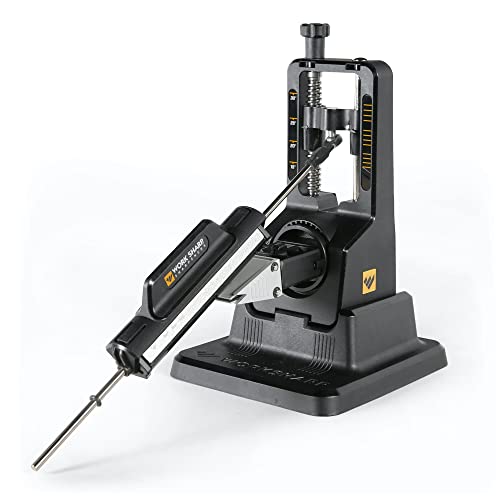
German kitchen knives are usually thicker and softer than Japanese ones, with an edge angle around 20 degrees. They respond well to electric sharpeners with matching angle guides, which makes them an easy fit for a counter-top machine.
The six sharpeners below are well-known electric options that work with western-style blades. Angles and supported knife types vary, so check each listing for compatibility with your own knives. Many German brands such as Wusthof and Zwilling use a similar edge angle, so a machine with a 20 degree setting is usually a safe match. Some newer German knives use a sharper angle, so read the knife’s care notes. Use a honing steel between sessions and save the electric machine for when slicing a tomato starts to feel like work. Before you buy, measure your counter space and check where the power cord will reach. A quiet motor is nice, but a stable base and clear angle guides matter more. Also remember that thin or hollow-ground blades can heat up, so avoid long, repeated passes and let the knife cool between rounds. Wash and dry the knife after sharpening to remove any metal dust before it touches food. If your German knives have a bolster, check that the machine lets the heel of the blade reach the abrasive so the whole edge is sharpened evenly. We have not used these products ourselves, so confirm sizes, materials and details on the current listing before buying.
As an Amazon Associate we earn from qualifying purchases. Links below are affiliate links, and they do not change the product information we give.
What to Look For
| Feature | Why it matters |
|---|---|
| Angle match | German knives typically use about 20 degrees per side |
| Guides | Spring guides hold the blade steady in the slot |
| Stages | Coarse, fine and polish stages make a smoother edge |
| Abrasive | Diamond abrasives restore dull edges quickly |
| Footprint | Counter space matters in small kitchens |
In this guide
Specs at a Glance
| Sharpener | Type | Abrasive | Notes |
|---|---|---|---|
| Chef’sChoice 1520 AngleSelect | Slot machine | Diamond | Selectable angles |
| Chef’sChoice 320 Diamond Hone | Slot machine | Diamond | Two stages |
| Chef’sChoice 100 | Slot machine | Diamond | Simple, fixed angle |
| Chef’sChoice 130 | Slot machine | Diamond | Pro-style slots |
| Chef’sChoice 250 Hybrid | Slot machine | Diamond | Hybrid design |
| Presto Professional 08810 | Slot machine | Sharpening wheels | Straight edges |
The 6 Best Electric Knife Sharpeners for German Knives
Top pickBest for mixed knife collections
1. Chef’sChoice 1520 AngleSelect Diamond Hone
A multi-stage electric sharpener that lets you select a western or Japanese angle. It can suit German knives and also sharpen thinner blades.
Suits: mixed knife collections. Strengths: selectable angles and diamond abrasives. Weaknesses: a larger body. Skip it if you want the simplest slot design.
View Chef’sChoice 1520 AngleSelect Diamond Hone on Amazon
Best for everyday German-style knives
2. Chef’sChoice 320 Diamond Hone
A compact electric sharpener with diamond abrasives and spring-loaded guides. It is aimed at western-style kitchen knives.
Suits: everyday German-style knives. Strengths: spring guides and compact size. Weaknesses: fewer stages than larger models. Skip it if you want a Japanese angle.
View Chef’sChoice 320 Diamond Hone on Amazon
Best for beginners
3. Chef’sChoice 100 Diamond Hone
An entry-level electric sharpener with diamond abrasives and a straightforward design. It is meant for fast touch-ups on straight edges.
Suits: beginners. Strengths: simple use and approachable design. Weaknesses: limited stages. Skip it if you want a polish stage.
View Chef’sChoice 100 Diamond Hone on Amazon
Best for home cooks with many knives
4. Chef’sChoice 130 Professional Sharpening Station
A more advanced electric sharpener with three stages for straight and serrated knives. It is designed for dependable results on thicker blades.
Suits: home cooks with many knives. Strengths: three stages and flexible edge support. Weaknesses: bulky on a small counter. Skip it if you only own one knife.
View Chef’sChoice 130 Professional Sharpening Station on Amazon
Best for tinkerers
5. Chef’sChoice 250 Hybrid Diamond Hone
A hybrid sharpener that combines electric and manual stages. It offers more control than a fully automatic model.
Suits: tinkerers. Strengths: extra control and manual finishing. Weaknesses: more steps to learn. Skip it if you want a one-pass design.
View Chef’sChoice 250 Hybrid Diamond Hone on Amazon
Best for simple kitchens
6. Presto Professional Electric Knife Sharpener
A budget-friendly electric sharpener with guided slots for straight edges. It suits casual cooks who want a quick fix.
Suits: simple kitchens. Strengths: low cost and easy use. Weaknesses: less refined than diamond models. Skip it if you have premium Japanese knives.
Care and Setup
- Empty any dust tray after use.
- Wipe the blade clean after sharpening.
- Follow the slot order given by the maker.
- Draw the knife straight through the guide.
- Keep the machine on a stable, dry surface.
Mistakes to Avoid
- Using a Japanese-angle slot on a German knife.
- Skipping a honing steel between sessions.
- Pushing too hard through the slot.
- Sharpening ceramic knives in a steel machine.
- Forgetting to check the knife’s recommended angle.
Why German Steel Behaves the Way It Does
German-style kitchen knives are typically made from tough stainless steel that is softer than many Japanese blades. A softer steel is less brittle, so the edge tends to roll or fold slightly under use rather than chip. That is why a regular honing steel works so well on these knives, as it realigns the folded edge, and why sharpening itself is needed less often than many people think.
The blade shape adds to the picture. Western chef’s knives usually have a pronounced belly, a thick spine and a heavy bolster, the thick band where the blade meets the handle. The curve suits a rocking cut, and the weight helps with chopping. When you sharpen, the machine has to follow that curve, and it has to be able to reach the heel of the blade past the bolster. Check whether the sharpener’s guide lets the heel reach the abrasive. If it does not, you may leave a small unsharpened section, and a lip can form near the handle over time.
Because the steel is softer, abrasive choice matters less for hardness than for finish. Diamond abrasives cut quickly and are a common match for many electric machines. Aggressive abrasive can remove more metal than needed, so ask how much is removed per pass. Over many sharpenings a knife gets narrower, which changes its balance and profile.
The practical lesson is to sharpen only when honing no longer restores a clean cut, and to use a machine that matches the factory angle. Check the maker’s care guide for your knife line to confirm the recommended edge angle.
Angle Guides, Edge Geometry and Matching Your Knives
Edge angle is the single most important compatibility check. Many traditional German knives are ground to roughly 20 degrees per side, as the post mentions, while some newer lines use a narrower angle. If a machine cuts a much different angle, it reshapes the edge, removing steel until the new angle is formed, and this takes time and removes metal. A sharper angle can feel keener but is less durable on a softer steel.
Spring-loaded guides help hold the blade at a constant angle as you draw it through. Check how the guides are described and whether the slots are narrow enough to keep a thick blade from wobbling. A slot that is too tight can scratch the bolster or the blade face, and one that is too loose gives inconsistent results. Some machines have separate slots for each stage so the blade moves from coarse to fine in sequence.
Selectable-angle models let you switch between a western and an Asian angle. That is useful if you own both kinds of knives, but you must choose the right setting each time. Mark the setting you need for each knife, and read the instructions before you change from a steeper to a shallower angle.
Look at which blade types the listing says it supports. Serrated knives, scissors, cleavers and very thick blades may not be supported by all machines. Thin boning knives and flexible blades also need care. If a knife has a full bolster, check that the guide lets the heel reach the abrasive. Ask the maker if the listing does not say.
Stages, Abrasives and Edge Finish
Most electric sharpeners divide the work into stages. A coarse stage removes metal and sets the bevel, a finer stage refines the edge, and an optional polishing stage leaves a smoother finish. For knives that are only slightly dull, you can skip the coarse stage and use the fine stage, which saves metal. For a badly worn or damaged edge, start with the coarse stage and move up.
Abrasive type affects speed and finish. Diamond abrasives cut quickly and wear slowly, so they suit tough stainless steel. Ceramic or fine abrasive wheels give a smoother finish and can be used to polish. Abrasive belts and wheels cut and also wear out, so check whether replacements are available and how easy they are to change.
A polished edge feels sharp on soft items such as tomatoes, while a slightly toothy edge bites into tougher foods and lasts a long time on a kitchen knife. German knives are often used for general chopping, so a medium-fine finish is usually practical. A very polished edge may be unnecessary for everyday cooking.
Heat is a consideration. Electric machines can heat the edge if you press hard or make many passes, and thin edges are more vulnerable. Use light, steady pressure, make only the number of passes the manual recommends and let the knife cool between rounds. Do not try to speed things up by pushing harder. After sharpening, wipe the blade clean and wash it to remove metal dust.
A Sensible Sharpening and Honing Routine
An electric sharpener removes metal, so build a routine that uses it sparingly. Hone the knife regularly, even every few uses, with a steel that matches your knife. Honing realigns the edge without removing much steel and keeps the knife cutting well for longer. Then sharpen on the machine only when honing no longer brings back a clean bite, such as when the knife crushes a tomato skin or slips on an onion.
Prepare before you start. Place the machine on a stable, dry surface, check the cord and put a towel under the unit if it tends to creep. Clean the knife first so that food residue does not clog the abrasive. Follow the manual for the order of the slots, the number of passes and the direction of pull. Draw the blade straight back with the edge guided by the slot, without twisting.
Test the result safely. A sharp knife should slice a sheet of paper or a tomato with little pressure. Avoid testing with your thumb on the edge. If the edge feels uneven, check whether the heel or the tip got missed and make another careful pass.
Keep a record. Many cooks sharpen once or twice a year for home use, but the interval depends on how often you cook and what you cut. Cutting on a hard board speeds dulling, so use wood or plastic boards. Clean and dry the knives after use and store them where the edges are protected, such as in a block or on a magnetic strip.
Buying Questions and When to Use a Pro
Before you buy, compare the machine with your actual knives. How many do you own and what are they? A set of German knives with a few western-style blades is a good match for a simple 20 degree machine, while a mixed collection may suit a selectable-angle design. Check the maximum blade height and thickness the slot accepts, whether the machine handles serrated edges and whether the bolster can pass the guide.
Think about space and noise. Electric sharpeners are small but not tiny, and a few are bulky. Measure the counter and the storage spot. Check the cord length. A quiet motor is nice, but stable feet and clear guides matter more.
Budget tiers differ in several ways. Lower-priced machines are often simpler, with fewer stages and a plainer finish. Mid-range models add more stages, spring guides and diamond abrasives. Higher-priced models tend to add selectable angles, more stages and sturdier construction. A higher price does not guarantee that the angle matches your knife, so read the listing and the manual.
Sometimes a professional is the right call. If a knife has a chipped edge, a bent tip, a badly worn heel or a valuable heirloom blade, a professional sharpener can restore the shape without removing as much steel. Signs it is time to replace a machine include worn abrasives that you cannot replace, a wobbling guide, a motor that struggles or a cracked housing. Stop using a damaged electric appliance and check with the maker.
Quick Checklist for Sharpening German-Style Blades
German kitchen knives are usually softer and thicker at the edge than their Japanese counterparts. That changes what you should look for in an electric sharpener. Use this list as a filter.
- Check that the stated angle range covers the factory edge on your knives. Many Western blades use a wider angle than Asian-style ones.
- Look for guides that hold the blade steady, since freehand wobble ruins a wide bevel.
- Confirm the machine accepts thick bolsters, or at least lets the heel of the blade reach the abrasive.
- Prefer models with more than one stage, such as coarse for repair and fine for finishing.
- Find out whether replacement belts or wheels are sold, because abrasives wear out.
Before buying, look at the angle printed on your own knife box or the maker website. A sharpener that only offers one narrow setting may remove more steel than necessary.
Mistakes to Avoid With Electric Sharpeners
A powered sharpener is fast, which means errors happen fast too. A few habits cause most of the trouble.
- Pulling too slowly or pausing mid-pass, which heats a small spot on the edge.
- Pressing hard. Let the guide and abrasive do the work with light, steady pressure.
- Running every knife through the coarse stage each time. Use coarse only when the edge is damaged or very dull.
- Skipping a wipe afterward. Metal dust left on the blade can end up on your cutting board.
- Ignoring the manual. The maker usually states which blade types should not be placed in the machine.
Knives with saw-like edges and ceramic knives often need different tools, so check the instructions before sliding those into any slot.
Decision Guide by Situation
Your kitchen habits matter more than a long feature list. Match the sharpener to how you cook.
- You own a handful of forged chef knives. Pick a unit with a wide, adjustable or well-matched angle guide and a gentle finishing stage.
- You share the kitchen with several people. Choose something with simple slots and clear indicators, so the results do not depend on skill.
- You have a collection of mixed knives. Look for a model that lists several blade types and offers more than one angle setting.
- Counter space is tight. Compact bodies with a cord that stores neatly are easier to live with.
Whichever route you take, plan a short, regular touch-up rather than waiting for a knife to become blunt. A quick pass keeps the edge close to its original shape and removes less metal over the years.
Care and Setup Notes for the Machine Itself
An electric sharpener lasts longer when you treat it as a tool that needs a little upkeep. Place it on a flat, stable surface with enough room to pull a full-length blade through without hitting a wall. Keep the cord clear of the work area, and never run the unit near water.
Abrasive wheels and belts wear down at different speeds. When sharpening takes noticeably longer, or the edge feels rough even after a fine stage, it is probably time for a replacement part. Order only the parts the maker lists for your model, and fit them exactly as the instructions describe. If anything sounds unusual, such as grinding or a rattle, switch off, unplug and contact the maker before using it again.
Electric Knife Sharpeners for German Knives FAQ
What angle do German knives use?
Many use about 20 degrees per side, though newer lines may be sharper.
Is an electric sharpener safe for German knives?
Yes, if the angle fits and you follow the instructions.
How often should I sharpen?
Only when the knife dulls. Hone more often.
Can these sharpen serrated knives?
Some can. Check the listing.
Do I need a honing steel if I have an electric sharpener?
A honing steel is still useful. It realigns a slightly bent edge between sharpenings and reduces how often you need the machine, which saves metal.
Will an electric sharpener change the angle of my German knife?
It can if the machine uses a different angle from the factory edge. Choose a machine that matches your knife's recommended angle, or accept that the first sharpening will reshape the bevel.
Can an electric sharpener reach the heel of a knife with a bolster?
It depends on the guide design. Check that the heel of the blade can reach the abrasive, otherwise an unsharpened section may remain near the handle.
How many passes should I make per stage?
Follow the manual, since the number varies by machine and by how dull the knife is. Use light pressure and avoid extra passes, which remove metal and add heat.
Is it safe to sharpen a serrated knife in an electric machine?
Only if the listing and the manual say the machine supports it. Some machines have a dedicated slot, while others can damage serrations.
Why does my knife still feel dull after sharpening?
The coarse stage may have been skipped on a badly worn edge, the heel or tip may have been missed, or the burr may not have been removed. Make another careful pass through the stages and finish with a few light strokes on a honing steel.
How should I clean the knife after sharpening?
Wash it with warm soapy water and dry it to remove metal dust. Do this before it touches food.
Can I sharpen ceramic knives in an electric machine?
Not unless the maker states it is supported. Many steel-oriented machines are not designed for ceramic blades and may damage them.
The Short Version
For selectable angles, the Chef’sChoice 1520. For compact quality, the 320. For a simple start, the 100. For three stages, the 130. For hybrid control, the 250. For budget, the Presto Professional.