Disclosure: As an Amazon Associate, umtsmarttool.com earns from qualifying purchases. Links to Amazon on this page are affiliate links; they cost you nothing extra. Prices and availability change often, so check the current Amazon listing before you buy.
Where to buy
Short on time? These are the best survival knives picks from this guide, each linked to its Amazon listing where one is verified:
- ESEE-6 — Check on Amazon
- Morakniv Garberg — Check on Amazon
- Ka-Bar Becker BK2 Campanion — Check on Amazon
- Gerber StrongArm — Check on Amazon
- Cold Steel SRK (see the review below for where it fits)
- ESEE-5 — Check on Amazon
Read the full guide ↓
A survival knife is the one tool you choose on the assumption that everything else has gone wrong, which is why the best survival knives share a stubborn set of traits: a full-tang fixed blade, a steel that tolerates abuse and resharpens anywhere, a handle that works in cold and wet hands, and a sheath that keeps the knife with you. The six knives in this guide are the designs that have earned their reputations under exactly that assumption — from the American-made workhorse that survival schools teach with, to the Swedish full-tang that finally answered the bushcraft community’s oldest complaint, to a quarter-inch-thick sharpened pry bar that treats batoning like a warm-up.
Be honest about what ‘survival’ means in your life before you buy, because the word covers two different kits. For most readers it means the knife in the truck kit, the camp kit, and the go-bag: a tool for shelter, fire, food, and repairs when plans fail within reach of civilization. For a smaller group it means a genuine wilderness blade carried on the body for days. Both groups need the same construction virtues, but they weight size and carry differently — and this guide’s badges separate the best all-rounder, the best value, the best heavy-duty tool, and the best budget blade so you can match the knife to your actual kit. Pair it with the smaller blades in our best neck knives guide and the fire and shelter skills matter more than any second knife.
One principle governs everything below: in a real emergency you will not rise to the occasion, you will fall to the level of your equipment’s simplicity. Survival knives should have no mechanism to fail, no coating-dependent edge, no handle that assumes bare warm hands, and no sharpening requirement beyond a stone and ten minutes. Every pick here honors that principle, and the differences between them are differences of emphasis — size, weight, steel philosophy, and price tier — not of fundamental trustworthiness.
In this guide
Quick Picks
| Pick | Badge | Key spec |
|---|---|---|
| ESEE-6 | Best Overall | 6.5 in 1095 blade, 0.188 in thick, 11.75 in overall, Micarta handle |
| Morakniv Garberg | Best Value | 4.3 in 14C28N stainless blade, 3.2 mm thick, full tang, Scandi grind |
| Ka-Bar Becker BK2 Campanion | Best Heavy-Duty | 5.25 in 1095 Cro-Van blade, 0.25 in thick, 16 oz, full tang |
| Gerber StrongArm | Best Accessible Full-Size | 4.8 in 420HC blade, full tang, 9.8 in overall, 7.2 oz |
| Cold Steel SRK | Best Budget Big Blade | 6.0 in SK-5 blade, 5 mm thick, Kray-Ex handle, Secure-Ex sheath |
| ESEE-5 | Best Thick-Blade Hard Use | 5.25 in 1095 blade, 0.25 in thick, Micarta handle, about 16 oz |
How These Picks Were Chosen
The screen was unforgiving. Fixed blade and full tang, without exception — a folding knife can be a fine companion, but it is not a survival primary. Blade length between four and seven inches, the band that balances shelter-building and batoning against carving and food work. Steel had to be a published, proven composition with a field-sharpening story: the 1095 family, 1095 Cro-Van, SK-5, 420HC, and Sandvik 14C28N all qualify on record. Handles had to be grippable when wet and cold, sheaths had to retain the knife through movement, and every maker had to have the distribution and warranty culture to stand behind a hard-use tool for years.
The shortlist was built from manufacturer specifications and established retailer and specialist listings, cross-checked across multiple sources before any Amazon link was attached. Three picks carry links confirmed from sources we opened; the rest are presented without purchase links where an exact model-to-listing match could not be confirmed, and single-source items are flagged in the source notes. No hands-on testing is claimed; assessments synthesize published specifications and each design’s long documented record with survival schools, military users, and the bushcraft community.
The 6 Best Survival Knives

ESEE-6 — Best Overall
- Blade: 6.5 in 1095 high-carbon steel, flat grind
- Blade thickness: 0.188 in; hardness 55–57 Rc
- Overall length: 11.75 in; weight about 12 oz
- Handle: Micarta scales, full tang with finger choil
- Sheath: molded polymer with clip plate
Strengths
- The benchmark hard-use survival blade: batons, chops, and carves in one tool
- 1095 resharpens on almost any abrasive, anywhere
- Transferable lifetime warranty with a no-questions reputation
Trade-offs
- Carbon steel rusts if stored wet — oil and dry it
- Full-size carry is a commitment on long hikes
- Powder coating wears with batoning; cosmetic, but visible
Ask survival instructors which single knife they would hand a student for a week in the woods and the ESEE-6 is the answer that keeps coming back. Its formula is deliberately unglamorous: a 6.5-inch blade of 1095 carbon steel, a full tang under Micarta scales, a flat grind, and a molded sheath. What makes it the benchmark is the balance — thick enough at 0.188 inches to baton firewood without a second thought, long enough to work as a light chopper, and still controlled enough, thanks to the finger choil, to carve a feather stick or a trap trigger.
The steel choice is a philosophy. 1095 at ESEE’s 55–57 Rc is not the hardest or the most corrosion-resistant steel in this guide; it is the toughest and the easiest to restore with whatever abrasive the world provides — a stone, a file, the unglazed ring of a ceramic mug in a pinch. In a genuine survival context that restorability is worth more than edge endurance records. Add ESEE’s transferable lifetime warranty — break it, and they repair or replace it — and the 6 becomes the rare tool you can buy once and plan a decade around. Keep it maintained with the guided systems in our best sharpening guides for knives roundup and it will simply never be the weak point of your kit.
Its costs are size and upkeep. At 11.75 inches overall it is a belt-or-pack knife, not a forget-it’s-there knife, and on a long recreational hike that presence needs justifying by the work it will do. The carbon steel will rust along the edge and the engraving if you sheath it wet and forget it — a wipe and a drop of oil prevent it entirely, but the habit is mandatory, not optional. Buyers unwilling to maintain a blade should take the stainless Garberg below and lose nothing but a little toughness.
Best for: Best for: the one-knife survival and camp kit, and anyone who wants the benchmark. / Not suited for: ultralight hikers, or owners who will not oil carbon steel.

Morakniv Garberg — Best Value
- Blade: 4.3 in Sandvik 14C28N stainless steel, Scandi grind
- Blade thickness: 0.13 in (3.2 mm)
- Overall length: 9.0 in
- Construction: full tang with exposed pommel end
- Spine: ground square for ferro-rod use
Strengths
- Full-tang Mora: the toughness critics always asked for
- Stainless steel and Scandi grind — superb carver, zero rust worry
- Squared spine throws sparks from a ferro rod
Trade-offs
- Scandi grind wedges in deep batoning compared with flat grinds
- Shorter blade than the big Americans — less chopping leverage
- Polymer sheath is functional rather than premium
For decades the bushcraft world’s review of every Morakniv ended with the same sentence: wonderful knife, shame about the partial tang. The Garberg is Mora’s answer — a full-tang, 3.2 mm-thick blade in Sandvik 14C28N stainless, with a true Scandi grind, a spine ground square to strike a ferro rod, and an exposed tang end at the pommel. It is, on paper and in the woods, the toughest knife Mora has ever made, and it keeps the virtues that made the brand famous: an edge geometry that carves wood like a hand tool and a price tier well below the American competition.
The Scandi grind is the Garberg’s personality. It bites into wood, holds a carving line, and resharpens almost by instinct because the wide bevel registers flat on a stone — beginners produce their first truly sharp edges on Scandi blades, a real advantage when the sharpener is you, tired, in the field. The stainless steel removes the carbon-steel maintenance conversation entirely, which is why the Garberg is the survival pick for wet climates, coastal use, and kits that sit in trucks and boats. Pair it with a compact backup from our best neck knives guide and the two-knife system weighs less than most single big blades.
Know the grind’s trade before you buy. A Scandi edge wedges more than a flat grind when batoning deep rounds, and at 4.3 inches the Garberg simply has less chopping leverage than the ESEE-6 — it is a carver that can survive hard use, not a splitter that can carve. The polymer sheath, while secure and available in multi-mount configurations, also feels utilitarian next to the knife’s quality. None of that dents its position as the best value in serious survival knives: no other full-tang blade of this quality asks so little money or maintenance.
Best for: Best for: bushcraft, wet climates, and value seekers who prioritize carving. / Not suited for: buyers whose main job is splitting wood, or who want a long blade.

Ka-Bar Becker BK2 Campanion — Best Heavy-Duty
- Blade: 5.25 in 1095 Cro-Van steel, drop point
- Blade thickness: 0.25 in
- Overall length: 10.5 in; weight 16 oz
- Handle: Ultramid, full tang
- Sheath: glass-filled nylon, MOLLE-compatible
Strengths
- Quarter-inch blade stock: the toughest construction in this guide
- Splits, pries, and batons beyond what thinner knives should attempt
- Comfortable Becker handle ergonomics for gloved work
Trade-offs
- A full pound before the sheath — the heaviest carry here by far
- Thick geometry slices poorly compared with the ESEE-6
- Overkill for carving and food tasks
The BK2 Campanion is the knife for people who looked at every other pick in this guide and thought: thinner than I trust. Ethan Becker designed it around a quarter-inch-thick slab of 1095 Cro-Van steel, 5.25 inches of blade on a 10.5-inch frame, and the result is less a knife than a sharpened splitting wedge with excellent manners. Batoning is not a test for the BK2; it is the activity the knife was born for, and its weight drives through rounds that stall lighter blades.
That mass is also its argument in a vehicle or base-camp kit, where carry weight barely matters and capability is everything. The Becker handle shape is genuinely comfortable for long, gloved work sessions, the Cro-Van steel sharpens as willingly as any carbon steel here, and the whole package has a decades-long record of abuse survival that no specification sheet can fake. If your survival scenario involves a truck, a cabin, or a fixed camp, the BK2 may be the most rational knife in this entire article.
On your belt, on a trail, the arithmetic reverses. Sixteen ounces before the sheath is a pound of your carry budget spent on one tool, and the thick blade that splits so well also wedges in carving cuts and pushes through food rather than slicing it. The BK2 is a specialist wearing a generalist’s reputation: buy it for splitting, prying, and indestructibility, and pair it with a thinner blade for detail work. Buy it as your only knife for a long walk and you will understand its trade-offs by mile three.
Best for: Best for: vehicle kits, base camps, and splitting-heavy work. / Not suited for: long-distance carry, carving, or slicing-focused use.
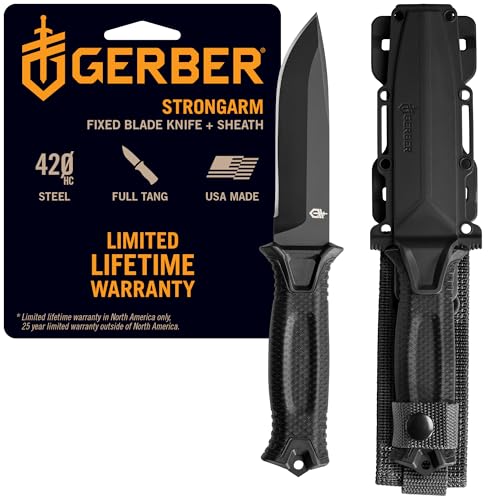
Gerber StrongArm — Best Accessible Full-Size
- Blade: 4.8 in 420HC stainless steel, drop point
- Overall length: 9.8 in; weight 7.2 oz
- Construction: full tang with striking pommel
- Handle: rubberized diamond-texture grip
- Sheath: modular system with belt and MOLLE options
Strengths
- Full-tang, made-in-USA build at an accessible tier
- Modular sheath carries horizontally, vertically, or on MOLLE
- Rubberized grip is secure in wet and cold conditions
Trade-offs
- 420HC needs more frequent sharpening than the steels above it
- Ceramic coating wears with hard batoning
- Sheath system is bulky for the blade size
The StrongArm is the survival knife for buyers who want the full-tang, American-made formula without paying benchmark money, and Gerber built it with unusual care for the tier: a 4.8-inch drop point in 420HC stainless, a full tang ending in a striking pommel, a rubberized diamond-texture grip that stays honest in rain and cold, and the most flexible sheath system in this guide, mounting vertically, horizontally, or to MOLLE webbing out of the box.
In the hand it feels like a tool designed by people who expected it to be used with gloves, in weather, by tired owners — which is to say, in survival conditions as they actually occur. The size is the sweet spot many buyers land on after trying bigger knives: long enough for batoning sensible wood and real camp work, short enough to carve and carry without negotiation. It is the easiest knife here to recommend to a first-time buyer building a first serious kit, alongside the fire and shelter basics and a detail blade from our best bushcraft knives coverage.
The compromise is the steel. 420HC is tough, stainless, and wonderfully easy to sharpen — and it will need that sharpening more often than the 1095 and 14C28N picks, especially after batoning. Plan on the five-minute touch-up habit, keep a compact stone in the kit, and the StrongArm will never actually let you down; neglect it for a season of hard use and you will feel the difference. For most buyers, that is a fair trade for the price, the sheath, and the warranty-backed American build.
Best for: Best for: first serious kits, glove-and-weather use, and flexible carry. / Not suited for: buyers who hate frequent touch-ups, or who want maximum edge life.
Cold Steel SRK — Best Budget Big Blade
- Blade: 6.0 in SK-5 carbon steel, clip point
- Blade thickness: about 5 mm (0.197 in)
- Handle: Kray-Ex rubberized grip
- Sheath: Secure-Ex polymer
- Design: Survival Rescue Knife, long military pedigree
Strengths
- Full-size, full-tang performance at the lowest tier in this guide
- SK-5 is tough and resharpens quickly in the field
- Kray-Ex handle is one of the most secure grips here when wet
Trade-offs
- Carbon steel with a coated finish still needs edge care
- Secure-Ex sheath can dull the edge if drawn carelessly
- Clip point is less ideal than a drop point for some carving
The SRK — Survival Rescue Knife — has been issued, carried, and abused for decades, and its SK-5 version is the cheapest way into a genuinely full-size survival blade from a major maker. Six inches of 5 mm-thick carbon steel, a Kray-Ex handle that grips like a tire tread, and a Secure-Ex sheath add up to a knife that batons, chops, and digs its way through a bad weekend without ever pretending to be a gentleman’s tool.
SK-5 deserves its reputation in this role. It is a tough, forgiving carbon steel that takes field sharpening gracefully — a critical trait, because budget buyers are the least likely to own premium sharpening gear and the most likely to need an edge restored on a basic stone. The handle is the other quiet triumph: in rain, with gloves, with cold-numbed hands, the SRK stays planted where slimmer handles start to wander. For a truck kit, a first go-bag, or a loaner knife for group trips, it is very hard to spend this tier of money better.
The caveats are the sheath and the steel’s upkeep. Secure-Ex sheaths are notorious in owner reports for dulling edges when the blade drags on the polymer during the draw — draw deliberately, in line, and the problem largely disappears. And SK-5 is carbon steel under its coating: wipe it, oil the edge occasionally, and store it dry. Accept those two habits and the SRK delivers roughly the capability of knives costing far more, which is precisely why it has outlived most of its competitors.
Best for: Best for: budget kits, trucks, and buyers who want full size first. / Not suited for: buyers who want stainless convenience or a premium sheath.

ESEE-5 — Best Thick-Blade Hard Use
- Blade: about 5.25 in 1095 carbon steel
- Blade thickness: 0.25 in
- Handle: Micarta scales, full tang
- Sheath: molded polymer on common configurations
- Design brief: downed-aircrew survival tool
Strengths
- Quarter-inch ESEE build with the same warranty culture as the 6
- Shorter and handier than the BK2 at the same thickness class
- Glass-breaker style pommel and bow-drill divot details on the classic design
Trade-offs
- Heavy for its length — the density is the point, and the cost
- Thick edge geometry is a poor slicer and carver
- Redundant if you already own the ESEE-6
The ESEE-5 was designed with input from aircrew survival training, and it shows in every decision: a quarter-inch-thick blade a little over five inches long, Micarta scales, a pommel meant to strike, and a build brief that assumed the user would pry, hammer, and baton with it because their life had taken a turn. It is the ESEE philosophy — toughness and warranty above all — concentrated into a shorter, denser package than the 6.
Compared with its direct rival here, the BK2, the 5 trades a little splitting leverage for ESEE’s warranty and a somewhat handier carry, and it adds survival-specific details the Becker omits. Compared with its own sibling, the 6, it trades slicing and chopping reach for that thicker, shorter, even more abuse-proof blade. These are fine distinctions, and they matter only to buyers whose use is genuinely at the destructive end of the spectrum — shelter building under time pressure, emergency egress, and kit that may be used by whoever grabs it.
For everyone else, the honest advice is that the 5 is a second knife, not a first one. Its edge geometry is too thick to carve or slice with pleasure, and its weight per inch is the highest in this guide. Own the 6 for the woods; own the 5 for the aircraft, the vehicle, and the kit that exists purely for the worst day. Judged on that brief — the brief it was actually designed for — it has few equals anywhere in the market.
Best for: Best for: vehicle and worst-day kits where prying and abuse are expected. / Not suited for: carving, slicing, or as a first and only survival knife.
Comparison Table
| Pick | Key spec | Badge |
|---|---|---|
| ESEE-6 | 6.5 in 1095 blade, 0.188 in thick, 11.75 in overall, Micarta handle | Best Overall |
| Morakniv Garberg | 4.3 in 14C28N stainless blade, 3.2 mm thick, full tang, Scandi grind | Best Value |
| Ka-Bar Becker BK2 Campanion | 5.25 in 1095 Cro-Van blade, 0.25 in thick, 16 oz, full tang | Best Heavy-Duty |
| Gerber StrongArm | 4.8 in 420HC blade, full tang, 9.8 in overall, 7.2 oz | Best Accessible Full-Size |
| Cold Steel SRK | 6.0 in SK-5 blade, 5 mm thick, Kray-Ex handle, Secure-Ex sheath | Best Budget Big Blade |
| ESEE-5 | 5.25 in 1095 blade, 0.25 in thick, Micarta handle, about 16 oz | Best Thick-Blade Hard Use |
Two axes organize this table. The first is grind and geometry: the flat-ground ESEEs and the BK2 split and baton best, the Scandi Garberg carves best, and the StrongArm and SRK split the difference with versatile drop and clip points. The second is maintenance: the Garberg’s stainless steel asks for nothing, the 420HC StrongArm asks for frequent easy sharpening, and the carbon steels ask for oil and drying in exchange for toughness and the easiest field resharpening of all.
Weight is the tax on capability, and the table makes it visible: the Garberg and StrongArm carry like tools, the ESEE-6 carries like a commitment, and the BK2 and ESEE-5 carry like insurance policies. Match the tax to the distance you will actually walk. Most failed survival-knife purchases are not bad knives — they are good knives bought for a kit they were never sized for.
How to Choose a Survival Knife
Start with tang and construction, because they are non-negotiable. A survival primary must be a fixed blade whose steel runs the full length of the handle — full tang — so that batoning, prying, and hammering loads travel through steel, not through a joint. Every pick in this guide qualifies; any knife that cannot state its tang construction plainly disqualifies itself, whatever its marketing says. Blade thickness follows: roughly an eighth of an inch is the carving-friendly floor, three-sixteenths is the all-round sweet spot the ESEE-6 occupies, and a quarter inch buys splitting insurance at a steep weight and slicing cost.
Steel: toughness and restorability beat hardness records
Survival steels are chosen for the worst sharpening conditions, not the best edge-retention charts. The 1095 family (ESEE, BK2) and SK-5 (SRK) are tough, forgiving, and restorable on basic abrasives anywhere on earth. Sandvik 14C28N (Garberg) trades a little of that toughness for stainless indifference and superb carving geometry. 420HC (StrongArm) is the easiest of all to sharpen and the quickest to need it. If your kit includes a proper stone and the habit of using it — see our best sharpening guides for knives guide — any of these steels will serve; if it does not, weight your choice toward the stainless Garberg and be honest about why.
Blade length and shape for real tasks
Four to five inches is the carving and control band; six to six and a half is the chopping and batoning band; beyond that you are carrying a machete’s responsibilities without a machete. Drop points are the safest all-round profile, clip points like the SRK’s pierce and detail a little better, and straight edges with no recurve or serrations sharpen most easily in the field — which is why every pick here is a plain edge. Serrations, tanto points, and double edges belong to other tools for other jobs.
Handle and sheath: the survival details
A survival handle must work in a gloved, wet, or numb hand: full-sized, textured, free of hot spots, and shaped so the hand cannot slide onto the edge. Micarta, rubberized Kray-Ex, and diamond-textured grips in this guide all qualify; smooth and undersized handles do not, whatever blade they carry. The sheath must retain through a fall, drain or shed water, and mount the way your kit actually carries — belt, pack, or MOLLE. A knife separated from its owner by a failed sheath is not a survival tool, it is litter with an edge.
Warranty and maker support belong in a survival purchase more than in any other knife category, because the entire premise is that this tool will be used harder than tools are supposed to be used. ESEE’s transferable lifetime warranty is the strongest expression of that idea in this guide — it follows the knife, not the receipt. The other makers here offer conventional defect warranties of varying breadth, and all of them have the distribution to make a claim realistic years later. Weigh that support honestly against purchase price: a survival knife is a decade-long commitment, and the cheapest decade is rarely the cheapest box.
Build the kit around the knife
A survival knife is the center of a kit, not the whole of it. The knife plus a ferro rod (the Garberg’s spine is ground for one), a compact sharpener, cordage, and a small detail blade such as those in our best neck knives roundup covers shelter, fire, food, and repair for most plausible emergencies. Resist upgrading the knife endlessly while the rest of the kit stays thin; the second hundred dollars is almost always better spent on the system around the blade than on the blade itself.
Key Takeaways
- Full tang, fixed blade, plain edge, published steel — the four non-negotiables of a survival knife.
- The ESEE-6 is the benchmark; the Garberg is the value and the wet-climate answer.
- Thickness is a trade: 0.188 in does everything, 0.25 in splits and pries at a weight cost.
- Field-restorable steel beats hard steel when the sharpener is a rock and the stakes are real.
- The kit around the knife matters as much as the knife: ferro rod, sharpener, cordage, detail blade.
- Practice once in calm conditions — batoning, feather sticks, fire prep, and a full resharpening at home — before the knife is ever needed in earnest, in the dark, or in bad weather.
How to Use a Survival Knife for Shelter and Fire
The core field techniques are few, learnable, and safer than improvisation. Practice them on a calm weekend, with the knife you actually carry, before any emergency asks for them.
- Batoning: place the blade across a wrist-thick round, spine up, and strike the exposed spine with a wooden baton — never a rock or metal — driving the blade through in stages and letting the wedge do the work.
- Feather sticks: brace the wood, lock your wrist, and draw the blade in long, controlled strokes to raise curls that stay attached; a bundle of feather sticks catches sparks when tinder is damp.
- Fire prep: process wood in three sizes — thumb-thick batoned splits, pencil-thick sticks, and feather sticks — before striking any spark, so the fire never waits on processing.
- Notching and lashing: carve pot hooks, tent stakes, and trap triggers with the blade section nearest the handle, where control is greatest and leverage is lowest.
- Ferro rod work: with a squared spine or the Garberg’s ground spine, brace the rod and scrape firmly to shower sparks into prepared tinder; keep the knife edge out of this job entirely.
- Food and water tasks last: keep one section of the routine — and ideally the small backup knife — clean for food, and never use the batoning blade for prying cans or digging, which are sheath-knife abuse even for the thick picks here.
Problem: the blade binds while batoning. Fix: the round is too big or too knotty for the blade length; withdraw by rocking gently, and choose smaller wood — forcing a bound blade is how tips and edges are damaged. Problem: feather sticks keep severing their curls. Fix: your angle is too steep and your wrist is rotating; flatten the angle and lock the wrist. Problem: rust appears on a carbon blade mid-trip. Fix: it is cosmetic on the flats; clean the edge on your stone, oil with any food-safe oil you carry, and do the full clean at home.
How to Maintain a Survival Knife
Field maintenance is three habits. Keep the edge touched up little and often on a compact stone rather than restoring a dead edge in the dark. Keep carbon steel dry in the sheath and oiled when stored — most survival-knife rust happens in garages and truck boxes, not in the woods. And inspect the sheath’s retention and your cordage and ferro rod on the same schedule, because the kit fails as a system or not at all. The guided systems in our best sharpening guides for knives guide handle home resharpening; the field habits above handle everything else.
Survival Knives by Kit: Truck, Pack, and Cabin
The truck kit wants the BK2 or the ESEE-5 and should not apologize for it. Weight is free in a vehicle, the work is splitting, prying, and emergency egress, and the thick blades’ slicing compromises never get a chance to matter. Add the SRK as the loaner and general blade and the kit covers a group, not just a driver. What the truck kit must not be is the place your only good knife lives: a knife in a vehicle an hour away is a story, not a tool, when the emergency is on foot.
The pack kit wants the Garberg or the ESEE-6, chosen by climate and by how much wood processing the trip honestly involves. The Garberg is the long-distance answer — light, stainless, carving-first — while the 6 earns its ounces on trips where shelter and fire work are planned rather than hypothetical. Either pairs with a neck knife or small folder for detail and food work, and either will still be the right answer in ten years, which is more than can be said for most outdoor purchases.
The cabin and base-camp kit wants the StrongArm or the SRK at every station: kitchen drawer, boat box, woodpile. These are the knives guests and family will reach for, and their combination of accessible price, easy sharpening, and honest construction makes them the right kind of expendable — good enough for every job, replaceable without grief. A premium blade at a shared cabin is a worry; a StrongArm at a shared cabin is a solution.
Whichever kit you are building, buy the knife before the accessories and use it for a season before upgrading anything. Survival gear has a way of optimizing itself on paper while failing in the hand, and the only reliable test is your own work: your wood, your weather, your hands, your sharpening habits. The six knives in this guide have passed that test for thousands of owners. Your season with one of them is the review that actually counts.
A word about training, because the best survival knife is the one its owner has actually used before the emergency. Every technique in this guide — batoning, feather sticks, ferro-rod work, shelter notching — is a perishable skill, and the time to discover that your handle has a hot spot, or that your sheath draws awkwardly with gloves, is a Saturday in October and not a February night with the weather turning. Take the new knife out for one deliberate practice session: process a fire’s worth of wood, carve the camp basics, resharpen it yourself. Owners who do this once carry their knives with a confidence that no amount of reading produces, and they also learn which of this guide’s trade-offs actually matter to their own hands.
Finally, consider the second owner. Survival knives are among the most handed-down and lent-out tools in any household, and the picks here were chosen partly for how they behave in other people’s hands: no mechanisms to misunderstand, no exotic steels that demand special sharpening, no locks to learn. The StrongArm and SRK in particular are knives you can hand to a family member in a power outage with one sentence of instruction. A tool that only its expert owner can use is a hobby; a tool anyone can use is preparedness, and the distinction decides which of these knives belongs in a shared kit.
Common Buying Mistakes
Buying a folder as a survival primary. Hinges and locks are failure points under batoning and prying. Fixed, full-tang, plain edge — the folder is the backup.
Chasing maximum thickness. Quarter-inch blades split magnificently and carve miserably. Most buyers need the 0.188-inch class and the carry weight it saves.
Choosing steel by hardness charts. In the field, toughness and restorability decide. A steel you cannot resharpen on a basic stone is a liability with good marketing.
Neglecting the sheath. Retention failure loses the knife; water-trapping sheaths rust it. The sheath is half the product — inspect it like it.
Storing carbon steel wet ‘until the weekend’. Rust does not wait for your schedule, your intentions, or the coating on the flats. Dry it, oil the edge, then store it — in that order, every single time, without exception.
Buying the knife and skipping the kit. No ferro rod, no sharpener, no cordage — the best blade in this guide cannot fix a kit that exists only on a receipt.
Never practicing with the knife before it matters. Hot spots, awkward sheaths, and dull technique all announce themselves in the first practice session. Hold that session on a calm weekend, not during the emergency the knife was bought for.
Final Recommendation
Buy the ESEE-6 if you want the benchmark: the best balance of splitting, carving, carry, and lifetime backing in the category, in a steel you can restore anywhere. It is the knife this guide would hand to a stranger heading into the woods, and that is the highest praise a survival tool can earn.
Buy the Morakniv Garberg instead if your world is wet, your distances are long, or your budget is honest — it gives up little that matters and asks almost nothing in maintenance. The BK2 and ESEE-5 own the heavy kits, the StrongArm and SRK own the accessible ones, and any of the six, carried with a ferro rod and a stone, makes you meaningfully harder to catch unprepared. That, and not any single specification, is what a survival knife is for.
Frequently Asked Questions
What size blade is best for a survival knife?
Between four and six and a half inches covers the whole honest range. Around four inches favors carving, control, and carry; around six favors batoning and chopping. Most buyers are best served in the middle — the ESEE-6 and Garberg bracket the sweet spot from opposite ends.
Why does full tang matter so much?
Because survival tasks load the knife in ways cutting never does: batoning drives force through the blade into the handle, and prying loads the joint between them. A full tang makes blade and handle one piece of steel, removing the joint that fails. It is the single construction feature this guide treats as non-negotiable.
Carbon steel or stainless for survival?
Carbon steels like 1095 are tougher and easier to resharpen in the field, and they rust if neglected. Stainless like the Garberg’s 14C28N removes the rust concern and suits wet climates and stored kits. Choose by your climate and your maintenance honesty, not by forum arguments.
Can a survival knife really baton wood safely?
A full-tang knife of adequate thickness can, with correct technique: wrist-thick wood, a wooden baton, staged strikes on the spine. It is a core survival skill for making dry firewood in wet conditions — and it is also the test that eliminates folders and thin blades from this category.
How do I sharpen a survival knife in the field?
Little and often, on a compact stone or diamond plate, keeping the factory-style angle and working the whole edge. These steels were chosen partly because they respond to basic abrasives. At home, a guided system from our best sharpening guides for knives guide restores the edge completely.
Is a thicker blade always better?
No — thickness trades slicing and carving for splitting strength and weight. A quarter-inch blade is insurance for destructive work; for the shelter, fire, and food tasks that dominate real use, the 0.188-inch class is the better tool and the lighter carry.
How long will a good survival knife last?
Decades, with the maintenance in this guide — and that is not a figure of speech. The designs here have production histories measured in decades precisely because their owners do not replace them: a full-tang carbon or stainless blade has no mechanism to wear out, handles in Micarta and modern polymers are effectively permanent, and the only consumable in the system is the sheath and the edge you restore as you go. Buy once, maintain lightly, and a survival knife is one of the few purchases that genuinely becomes cheaper every year you own it.
What else belongs in a survival knife kit?
A ferro rod, a compact sharpener, cordage, and a small detail blade cover the system. The knife is the center, not the whole — a lesson this guide’s buying section develops, and the reason we link the smaller blades in our best neck knives coverage.