Disclosure: As an Amazon Associate, umtsmarttool.com earns from qualifying purchases. Links to Amazon on this page are affiliate links; they cost you nothing extra. Prices and availability change often, so check the current Amazon listing before you buy.
How to choose an under sink water filter: start here
Learning how to choose an under sink water filter is mostly learning how to eliminate. The market presents dozens of systems as if they were rivals, but they are answers to different questions, and once your question is stated precisely, in the language of your own water report, most of the catalogue eliminates itself. This guide walks the elimination in order: target, technology, certification, format, economics, and only then the shortlist, with the cluster’s verified systems waiting in the gear section where a shortlist belongs.
You will need three pieces of evidence, all free. Your utility’s annual water quality report, or a laboratory test if you are on a well. A tape measure’s worth of cabinet dimensions. And an honest estimate of how much water your household actually drinks and cooks with daily. Armed with those, the method below takes under an hour and ends with a decision you can defend to a sceptical partner, which is the correct standard for a purchase that will live under your sink for a decade.
In this guide
Key Takeaways
- Start from your water report: the contaminant or complaint chooses the technology, not the other way round.
- Carbon fixes taste and certified lead; ultrafiltration adds a particle barrier; only reverse osmosis addresses dissolved targets like fluoride and TDS.
- Certification belongs to an exact model and an exact claim list, so read the performance data sheet before paying.
- Price the cartridge subscription over five years, at your household’s real draw, before comparing purchase prices.
- Measure the cabinet, the drain and the faucet-hole situation before ordering anything.
See also Under Sink Water Filter Buying Guide, Best Under Sink Water Filter Under $150 and Is An Under Sink Water Filter Worth It.
Step 1: Name Your Target From Your Own Water Report
Read the report the way a clinician reads bloodwork: most lines are reassurance, and one or two are the reason you are here. A chlorine or chloramine presence with no other flags is a taste target. A lead detection, or plumbing old enough to imply one, is a health-standard target. Fluoride, nitrates or a high dissolved-solids figure are membrane targets. Any microbiological note, especially on a well, is a barrier target, ultrafiltration, RO or UV depending on severity.
- Download or request your utility’s latest consumer confidence report, or commission a lab test for a private well.
- Write down, in plain words, the one or two findings or complaints that motivate this purchase.
- Rank them: safety findings first, taste findings second, preferences third.
Step 2: Let the Target Choose the Technology
Taste targets belong to carbon, the cheapest, simplest and most forgiving technology in the category. Barrier targets add ultrafiltration’s physical membrane while keeping carbon’s convenience. Dissolved targets admit exactly one technology, reverse osmosis, in either its tank or tankless architecture. Softening and whole-house sediment are not under-sink targets at all, and recognising that now saves a misdirected purchase.
- Match each written target to the technology that verifiably addresses it.
- Strike every system whose technology cannot address your first-ranked target.
- Note any second technology worth layering, such as UV on a well, as an option rather than a default.
Step 3: Verify Certification for the Exact Model
Certification is where marketing goes to be audited. Find the performance data sheet for each surviving model and confirm that your target contaminant is named, under the relevant standard, at a capacity your household can live with. Treat tested-to language as a claim awaiting proof and certified language as proof awaiting only your reading. This step routinely halves a shortlist, and it should.
- Locate the data sheet or certification listing for the exact model number, including suffixes.
- Confirm your target appears in the certified reductions, not merely in the product description.
- Record the certified capacity; you will need it for the economics step.
Step 4: Decide the Faucet and Cabinet Format
Format is fate. Direct-connect systems preserve counters and tenancies while spending cartridge life on all cold water. Dedicated faucets spend a counter hole to buy selective filtration and full main-tap flow. Tank systems spend cabinet volume for a reserve; tankless systems spend money and a power outlet to reclaim it. Measure first, including the disposal’s footprint and the drain’s position, and let the measurements veto what they must.
- Measure clear cabinet width, depth and height, and photograph the tape in place.
- Confirm whether a spare counter hole exists, can be freed, or can be drilled in your counter material.
- For RO, locate the drain point for the saddle; for tankless, pumped or UV models, confirm a usable outlet.
Step 5: Price Five Years, Not One Box
Convert each finalist into a five-year cost: purchase, plus cartridges at the rated interval divided by your household’s real daily draw, plus, for RO, a wastewater allowance on your water pricing. The exercise reliably promotes big canisters and long-life cartridges and demotes jewel-box systems with thirsty little filters. Then weigh the human cost with equal honesty: the cheapest system to own is the one whose changes you will actually perform.
- Estimate your household’s filtered gallons per day, including cooking and any planned fridge connection.
- Divide each finalist’s rated capacity by that figure to get its real interval in your home.
- Total five years of cartridges at that interval and compare totals, not shelf prices.
Step 6: Revisit the Decision After One Month of Water
Choosing well includes a scheduled second look. A month after installation, taste the water beside a glass of the old supply if any remains in a bottle, check the cabinet for the damp that announces a slow weep, and ask the household the only review question that matters: are we drinking more water and buying fewer bottles? If the answers disappoint, the cause is almost always a correctable mismatch, an overdue flush, a crossed expectation about scope, rather than a failed product, and this guide’s earlier steps will locate it.
- Calendar a thirty-day check on install day, alongside the cartridge reminder.
- Inspect every joint once more under pressure, and confirm the fridge line if fitted is still dry.
- Write down the household’s verdict; it is the data your next filtration decision, years away, will want.
Troubleshooting: Problems Owners Actually Meet
Problem: Two finalists claim the same reduction at very different prices.
Read both data sheets for capacity at that reduction. Certification is often granted at a rated gallonage, and the cheaper system’s claim may expire in a tenth of the water. Price per certified gallon, not per box, resolves the tie honestly.
Problem: Your report is clean but the water still tastes wrong.
That is a legitimate taste target, and it points to the simplest carbon systems in the category. Do not let a clean report talk you out of a purchase whose real job is pleasure, and do not let pleasure’s purchase masquerade as a health intervention when you describe it to yourself.
Problem: Your pressure is too low for the RO system you want.
Confirm with a gauge before concluding anything. Genuinely low pressure has three honest answers: a pumped RO model, fixing the home’s pressure problem at its source, or choosing a non-RO technology that forgives pressure entirely. Forcing a standard membrane to work starved produces slow, wasteful water and a disappointed owner.
Problem: Nobody in the household agrees on the budget.
Split the disagreement into its real components: one party is usually pricing the box, the other the decade. Run the five-year maths together, including the bottled water the household currently buys, and the argument usually ends, because both parties were right about different numbers.
Gear That Makes This Easier
The shortlist below is this method’s current output for the most common target profiles: certified simplicity, capacity with a barrier, full membrane treatment and compact certified carbon. It is also the gear that makes choosing easier in practice, because each system publishes the data this method asks for. See also Best Under Sink Water Filter Under $300, How To Install An Under Sink Water Filter and Under Sink Water Filter Pros And Cons.
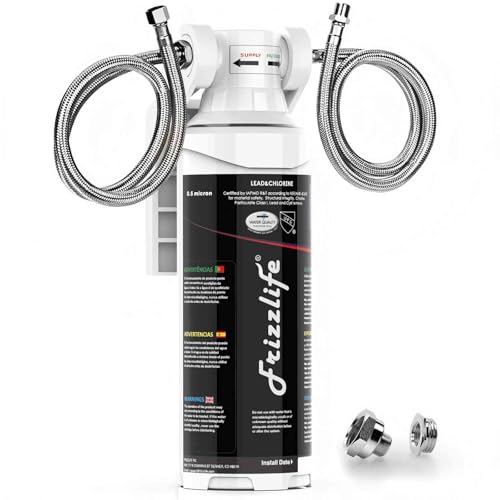
Frizzlife MK99 Under Sink Water Filter System — Best Certified Simplicity
Certification-led buyers who want health-standard claims in the simplest inline format.
- Compound two-stage cartridge with half-micron precision filtration
- IAPMO certification against NSF/ANSI 53 and 42
- Plumbs inline on the cold feed to the faucet you already have
- Flow ceiling of 1.89 litres per minute; works between 20 and 80 PSI
- FZ-2 replacement cartridge on an auto shut-off, twist-off head
Strengths
- Health-standard certification reaches lead-class claims that taste-only rivals cannot make
- Cartridge changes stay dry because the head seals itself when the cartridge twists out
- Minerals remain in the water, since nothing here demineralises
Trade-offs
- Filtered flow is gentler than the raw tap, roughly half a gallon per minute
- Dissolved solids and fluoride pass through, as with all carbon-class systems
- Replacement cartridges are a single-brand fit
Ownership details are equally considered. The filter head shuts off the water automatically when the cartridge is twisted out, so the roughly twice-a-year swap is a dry, bucket-free job, and the FZ-2 replacement is one of the cheaper cartridges in this class to keep buying. The honest limits are flow and scope: expect a gentler stream than the raw tap, and expect dissolved solids to pass through untouched, because this is precision carbon filtration, not osmosis.
In the context of this ranking, the Frizzlife MK99 earns its place on evidence rather than novelty. Its carbon heart goes after the chlorine chemistry that dominates everyday complaints, and leaves the water’s mineral character standing. Maintenance asks for a calendar entry and little else, which is the correct amount of drama for a water filter. It rewards the buyer who read their water report and punishes the one who bought a headline.
One honest limitation: Expect a patient pour when filling large pots; the precision cartridge trades peak flow for filtration depth.
Best for: certification-led buyers who want health-standard claims in the simplest inline format / Not suited for: undefined

Waterdrop 15UA-UF Ultra Filtration Under Sink Water Filter System — Best Capacity Barrier
Larger households that want membrane-level physical filtration plus the longest cartridge interval in the direct-connect class.
- Ultrafiltration membrane rated at 0.01 micron
- Rated service life of 24 months or 19,000 gallons
- Direct-connect to the existing kitchen faucet cold line
- Reduces lead, chlorine, bad taste and odour per the manufacturer listing
- Replacement cartridge WD-RF15-UF
Strengths
- Pairs the 0.01-micron UF barrier with a two-year, high-gallonage cartridge rating
- No tank, no drain line and no power: the whole system is one inline cartridge
- High rated throughput suits families filling pots, kettles and bottles all day
Trade-offs
- Premium cartridge pricing when the two-year replacement finally comes due
- Dissolved contaminants such as fluoride and nitrates are outside what UF can do
- Flow decline is gradual, so an overdue cartridge can hide behind habit
The 15UA-UF is where the direct-connect format grows up. It keeps the defining convenience of the family, one cartridge inline on the cold line and nothing new on the counter, then adds the two upgrades heavy-use kitchens actually feel: an ultrafiltration membrane for a physical barrier against fine particles and bacteria-sized contaminants, and a cartridge rated for two years or 19,000 gallons. For a family that draws filtered water for drinking, cooking, pets and plants from the same tap, that capacity rating is the difference between a filter and a background utility.
Within this list’s priorities, the Waterdrop 15UA-UF is the pick that keeps answering the same question well. It filters like a sieve and behaves like a cartridge, which is the combination this format exists for. The running-cost story is written by its rated capacity divided by a real household’s draw. Buyers should weigh its ceiling as carefully as its floor, because both are real.
One honest limitation: The 19,000-gallon figure assumes municipal water quality; sediment-heavy supplies will shorten real-world life, and the two-year clock should be treated as a maximum, not a guarantee.
Best for: larger households that want membrane-level physical filtration plus the longest cartridge interval in the direct-connect class / Not suited for: anyone whose constraints the trade-offs above describe

iSpring RCC7AK Under Sink Reverse Osmosis System — Best Full Treatment
Buyers who want traditional tank RO but dislike the flat taste and slight acidity of un-remineralised RO water.
- Six-stage reverse osmosis filtration with alkaline remineralisation
- 75 gallons per day RO membrane
- Certified to NSF/ANSI 58 and 372 for the full system
- Pressurised storage tank and dedicated faucet included
- Remineralisation stage adds calcium and magnesium and balances pH
Strengths
- The sixth alkaline stage corrects RO’s flat taste at the source
- Full-system NSF/ANSI 58 certification is stronger assurance than component-only claims
- Shares the RCC7 platform’s standard filters, support and ownership knowledge
Trade-offs
- Same cabinet-hungry tank layout as the standard RCC7
- Wastewater ratio reflects its traditional design rather than tankless efficiency
- The alkaline stage is one more cartridge in the replacement rotation
Certification is the second upgrade. The AK is certified to NSF/ANSI 58 as a complete system, which means the assembled product, not just its membrane, was tested against the standard. In a category where component-level claims are routinely dressed up as system claims, that distinction is worth money. The platform costs remain the platform costs: a tank in the cabinet, a traditional drain ratio, and a Saturday-morning installation. Within the tank-RO class, this is the specification to beat.
This guide places the iSpring RCC7AK where it does because its compromises land where most households feel them least. As a membrane system it addresses the dissolved list that carbon and ultrafiltration leave untouched. Ownership settles into a rhythm of rare, predictable cartridge events rather than recurring projects. The caution is scope: match it to the targets it actually treats and it will not disappoint.
One honest limitation: Remineralisation restores a modest mineral fraction for taste; buyers seeking high-mineral water for its own sake should not expect spring-water mineral levels.
Best for: buyers who want traditional tank ro but dislike the flat taste and slight acidity of un-remineralised ro water / Not suited for: undefined

Aquasana AQ-5200 Claryum Under Sink Water Filter — Best Compact Certified
Label-reading small households that prize certified selective filtration over raw capacity.
- Claryum two-stage system with a chrome dedicated faucet (AQ-5200.56)
- Capacity rated at 500 gallons per filter set
- Flow rated at half a gallon per minute
- WQA-verified reductions spanning lead and PFAS classes per the manufacturer
- Filter set AQ-5200R; working range 40 to 90 degrees F
Strengths
- Selective media target contaminants while leaving natural minerals in place
- Two compact housings fit cabinets that refuse tanks and triple canisters
- A published performance data sheet lets buyers audit every claim
Trade-offs
- The 500-gallon horizon is the shortest here, so busy homes change sets often
- Half-gallon flow asks patience of anyone filling a stockpot
- Cost per gallon runs above the big-canister systems
Aquasana’s Claryum approach is selective filtration: combine carbon, ion exchange and sub-micron mechanical stages to remove the contaminants people actually worry about, including lead and the PFAS class, while leaving the water’s natural mineral character alone. The AQ-5200 packages that approach into two compact housings and a dedicated faucet, and publishes a proper performance data sheet, which lets a careful buyer verify exactly which reductions were certified and to what level.
This guide places the Aquasana AQ-5200 where it does because its compromises land where most households feel them least. Its carbon heart goes after the chlorine chemistry that dominates everyday complaints, and leaves the water’s mineral character standing. Its filters are the kind a household can keep buying without a treasure hunt. It rewards the buyer who read their water report and punishes the one who bought a headline.
One honest limitation: Frequent filter-set changes are the price of the compact design; households that hate intervals should size up.
Best for: label-reading small households that prize certified selective filtration over raw capacity / Not suited for: buyers whose needs contradict the trade-offs above

Waterdrop 10UA Under Sink Water Filter System — Best Taste-Only Answer
Renters and first-time filter owners who want filtered water from the tap they already have, with the simplest possible plumbing job.
- Direct-connect design: filters the cold line to your existing kitchen faucet, no separate tap to drill
- NSF/ANSI 42 certified for chlorine, taste and odour reduction
- Rated service life of 12 months per cartridge
- Replacement cartridge WD-RF10
- Reduces lead and PFOA/PFOS per the manufacturer listing
Strengths
- No countertop hole and no second faucet: the filter sits inline on the cold-water line
- A single cartridge handles a full year of typical kitchen use before it needs swapping
- The twist-off cartridge change takes minutes and needs no plumber
Trade-offs
- It does not reduce total dissolved solids, so it is not a substitute for reverse osmosis
- Every cold-water use passes through the cartridge, including water you only rinse with
- Flow at the main faucet slows modestly once the cartridge ages toward the end of its year
What the 10UA sells is the removal of friction. There is no tank eating cabinet space, no drain saddle, no electricity, and no second tap competing for room beside the soap dispenser. You turn the cold handle and the water has passed through a certified carbon stage on its way out. For households whose water is already safe but simply unpleasant, that is exactly the right amount of intervention, and the year-long cartridge interval means the system mostly disappears from your attention after install day.
Within this list’s priorities, the Waterdrop 10UA is the pick that keeps answering the same question well. Its carbon heart goes after the chlorine chemistry that dominates everyday complaints, and leaves the water’s mineral character standing. Ownership settles into a rhythm of rare, predictable cartridge events rather than recurring projects. The caution is scope: match it to the targets it actually treats and it will not disappoint.
One honest limitation: Because it filters the whole cold line rather than a dedicated drinking tap, high-volume uses such as filling mop buckets also consume cartridge life.
Best for: renters and first-time filter owners who want filtered water from the tap they already have, with the simplest possible plumbing job / Not suited for: undefined
Mistakes to Avoid
Forgetting the flush and the first gallons
New carbon sheds fines and new systems need the manufacturer’s flush before the water tastes right. Owners who judge a filter by its very first glass sometimes condemn a good system, and owners who skip flushing RO preservatives get a memorable first sip for the wrong reason. Follow the commissioning steps exactly; they exist because the chemistry requires them.
Letting the cartridge calendar drift
An exhausted filter does not announce itself dramatically; it simply stops doing the job while the water keeps flowing. Set the reminder on the day of installation, using whichever comes first between the month rating and the gallon rating, and treat a smart faucet’s indicator as an instruction rather than a suggestion.
Filtering the wrong line
Under-sink systems belong on the cold line. Hot water damages carbon media, voids ratings and can release what the filter captured. It sounds elementary, yet crossed lines are a recurring installation error, especially in cabinets where a previous appliance has rearranged the plumbing. Trace both lines from the valves before connecting anything.
Notes From the Far Side of Installation Day
Mineral balance shapes extraction, which is why brewers argue about water with religious intensity. Cafés remineralise deliberately; a home alkaline stage is the same idea at kitchen scale. Carbon-filtered water is the traditional brewing sweet spot: clean of chlorine, still mineral enough to extract well. Kettles filled from a filtered tap scale more slowly when the supply’s chemistry is tamed at the source. Water is an ingredient; the filter is how you start choosing it.
A simple gauge on an outside tap predicts RO happiness more reliably than any review can. High pressure has its own manners: regulators and hammer arrestors protect fittings and quiet the system. Upper floors, long runs and tired well pumps are the usual suspects when pressure disappoints. Booster pumps exist to lift weak supplies into that range, restoring both pace and ratio. Five minutes with a gauge prevents the most common return in this category.
Nobody should buy remineralisation as nutrition; its honest product is flavour. Purists who prefer the membrane’s unaltered output can simply choose the platform without the stage. The quantities involved are small beside dietary intake, and the better brands say so. Calcium and magnesium media dissolve in trace amounts as purified water passes over them. Flavour is not a frivolous specification in a product whose endpoint is a glass.
Lead enters drinking water late in its journey, which is precisely why a filter at the final tap can answer it. Reverse osmosis rejects lead by size and charge along with the rest of the dissolved fraction, which is why it anchors the cautious end of the market. Ion-exchange and adsorption media in the better carbon systems are engineered specifically for this contaminant class. Flushing a stagnant line reduces exposure, but a verified barrier works on the mornings nobody remembers to flush. Homes with older plumbing should read this section twice and the price section once.
The taste most people blame on their pipes usually arrives courtesy of the treatment plant. Free chlorine reacts with activated carbon almost on contact, which is why even a modest cartridge transforms a glass of tap water. Catalytic carbon and generous contact time matter when the disinfectant is chloramine rather than free chlorine, because the reaction is slower. Full-size canisters often outperform slim cartridges on stubborn municipal supplies simply because the water spends longer inside the media. Judge any system first on how it handles your disinfectant, because that is the flavour you will meet every day.
Wrap-Up
Choose in the order this guide is written and the decision will hold: target from evidence, technology from target, certification from documents, format from measurements, and model from five-year economics. Readers who want the ranked view by budget will find this cluster’s tier lists built on exactly this method, and readers who want a second opinion on value will find the worth-it analysis equally direct. The right filter is the one your evidence selects; everything else is shopping.
The Longer View: Ownership Beyond the First Cartridge: Further Notes
Rust from mains work, sand from wells and scale from ageing plumbing all arrive at the same first stage. Layered systems exist precisely to keep the coarse work away from the polishing media. Homes with chronic sediment sometimes solve it once, upstream, with a whole-house pre-filter. A first stage that clouds early is doing its job loudly; replace it and protect the rest. The staged designs in this guide are sediment strategy wearing a product’s clothes.
Capacity ratings are ceilings earned on test water, and your household will negotiate its own figure. A fridge connection quietly adds a second appliance’s draw to the same cartridge account. Dedicated faucets stretch ratings by refusing to spend them on utility water. Flow decline and returning taste are the cartridge’s own late warnings, and both deserve obedience. Buy the rating your busiest month respects.
A tee fitting and a patient run of quarter-inch tubing turn one purchase into two appliances’ worth of value. Small cartridges feel the fridge’s appetite first; generous ratings absorb it without changing the household’s rhythm. Flush the main system thoroughly before the fridge line is connected, so the ice maker never meets commissioning water. Plan the connection at install time, because reopening finished plumbing to add it later is nobody’s favourite Saturday. Size the cartridge for the combined draw and forget the line exists.
The storage tank is traditional RO’s answer to a mismatch between slow production and impatient households. Stored water is also a hygiene conversation, which is why commissioning flushes and periodic sanitising appear in serious manuals. A tank keeps dispensing through a power cut, an independence no pumped tankless design can claim. Modern high-output membranes have narrowed the tank’s flow advantage to the first glass of the morning. Decide the tank question with a tape measure and your household’s busiest hour, not with ideology.
Every cartridge system creates a spent cartridge; every RO system creates a reject stream. A two-year cartridge is an environmental feature as surely as it is a convenience one. Plastic, transport and refrigeration make bottled water the heavyweight in any footprint contest. Water rejected by a membrane returns to the municipal cycle; it is billed, not destroyed. The footprint shrinks further every time a household chooses capacity over novelty.
New carbon sheds fines, new membranes shed preservative, and every system sheds air. Leak checks belong at one hour and at one morning, because pressure finds slow weeps on its own schedule. Owners who commission properly judge their system on its real water, not its first hour. Flush durations in manuals are chemistry, not caution theatre; shortening them borrows taste trouble. Commissioning is thirty minutes that protect a decade of mornings.
Every RO system is really two systems: the carbon stages that protect the membrane, and the membrane itself. What the membrane rejects leaves through the drain line, carrying the contaminants with it in a concentrated stream. Chlorine destroys membrane film, which is why carbon pre-filters stand guard in front of every design in this guide. Production rate, waste ratio and pressure requirements are all the same physics wearing different clothes. The membrane rewards correct pressure and punctual pre-filters with the broadest purification a household can buy.
Commissioning is the ritual that separates a good installation from a lucky one. Writing the date on the housing converts the next service from archaeology into reading. Flush durations in manuals are chemistry, not caution theatre; shortening them borrows taste trouble. Leak checks belong at one hour and at one morning, because pressure finds slow weeps on its own schedule. Prove the install twice and then forget it, which is the highest compliment plumbing earns.
A tee fitting and a patient run of quarter-inch tubing turn one purchase into two appliances’ worth of value. Flush the main system thoroughly before the fridge line is connected, so the ice maker never meets commissioning water. Plan the connection at install time, because reopening finished plumbing to add it later is nobody’s favourite Saturday. Long tubing runs cost pressure, so route the line as directly as the cabinet allows. Count the fridge in your capacity maths and the connection is pure dividend.
A reverse osmosis membrane is a sieve built at molecular scale, and everything about RO ownership follows from that image. Chlorine destroys membrane film, which is why carbon pre-filters stand guard in front of every design in this guide. Production rate, waste ratio and pressure requirements are all the same physics wearing different clothes. Membrane life is measured in years because the film works slowly and steadily rather than in bursts. The membrane rewards correct pressure and punctual pre-filters with the broadest purification a household can buy.
Chlorine chemistry explains why two homes on the same street can need different filters. By the time water reaches a kitchen it has generally done its disinfecting work, so removing the residual costs the household nothing in safety. Full-size canisters often outperform slim cartridges on stubborn municipal supplies simply because the water spends longer inside the media. Free chlorine reacts with activated carbon almost on contact, which is why even a modest cartridge transforms a glass of tap water. Judge any system first on how it handles your disinfectant, because that is the flavour you will meet every day.
Rust from mains work, sand from wells and scale from ageing plumbing all arrive at the same first stage. A first stage that clouds early is doing its job loudly; replace it and protect the rest. Homes with chronic sediment sometimes solve it once, upstream, with a whole-house pre-filter. Particles lodge in carbon pores and steal capacity that was rated for chemical duty. Treat sediment as its own problem and the drinking-water stages will live their full rated lives.
Every cartridge system creates a spent cartridge; every RO system creates a reject stream. Plastic, transport and refrigeration make bottled water the heavyweight in any footprint contest. Several manufacturers run cartridge recycling schemes that are worth the small effort they ask. A two-year cartridge is an environmental feature as surely as it is a convenience one. The footprint shrinks further every time a household chooses capacity over novelty.
Capacity ratings are ceilings earned on test water, and your household will negotiate its own figure. Sediment load steals chemical capacity, which is why gritty supplies age cartridges ahead of the calendar. Dedicated faucets stretch ratings by refusing to spend them on utility water. Flow decline and returning taste are the cartridge’s own late warnings, and both deserve obedience. Capacity is where family maths defeats individual intuition, every time.
Remineralisation is where reverse osmosis negotiates with human taste. Purists who prefer the membrane’s unaltered output can simply choose the platform without the stage. Calcium and magnesium media dissolve in trace amounts as purified water passes over them. The quantities involved are small beside dietary intake, and the better brands say so. Purity that nobody drinks has failed at its only job.
A simple gauge on an outside tap predicts RO happiness more reliably than any review can. Upper floors, long runs and tired well pumps are the usual suspects when pressure disappoints. Manufacturers publish a working range because membrane efficiency collapses below it. Booster pumps exist to lift weak supplies into that range, restoring both pace and ratio. Treat the gauge reading as part of the product selection, because the membrane will.
Your most familiar drink will grade a new filter faster and more honestly than any specification. Kettles filled from a filtered tap scale more slowly when the supply’s chemistry is tamed at the source. Carbon-filtered water is the traditional brewing sweet spot: clean of chlorine, still mineral enough to extract well. Cafés remineralise deliberately; a home alkaline stage is the same idea at kitchen scale. Judge the glass you actually drink from, not the one in the advertisement.
No utility can certify what your own pipes add to the water after it enters the house. Ion-exchange and adsorption media in the better carbon systems are engineered specifically for this contaminant class. A certified health-standard claim for the exact model is the only version of lead protection worth paying for. Flushing a stagnant line reduces exposure, but a verified barrier works on the mornings nobody remembers to flush. The durable fix is a barrier you can verify, installed where the contamination actually happens.
A pressurised tank accumulates purified water against a bladder so the faucet can pour faster than the membrane works. Stored water is also a hygiene conversation, which is why commissioning flushes and periodic sanitising appear in serious manuals. After a heavy draw the tank’s pace softens until production refills it, a rhythm owners learn in the first month. Modern high-output membranes have narrowed the tank’s flow advantage to the first glass of the morning. Decide the tank question with a tape measure and your household’s busiest hour, not with ideology.
No utility can certify what your own pipes add to the water after it enters the house. Reverse osmosis rejects lead by size and charge along with the rest of the dissolved fraction, which is why it anchors the cautious end of the market. A certified health-standard claim for the exact model is the only version of lead protection worth paying for. Flushing a stagnant line reduces exposure, but a verified barrier works on the mornings nobody remembers to flush. The durable fix is a barrier you can verify, installed where the contamination actually happens.
Commissioning is the ritual that separates a good installation from a lucky one. Flush durations in manuals are chemistry, not caution theatre; shortening them borrows taste trouble. Owners who commission properly judge their system on its real water, not its first hour. Leak checks belong at one hour and at one morning, because pressure finds slow weeps on its own schedule. Commissioning is thirty minutes that protect a decade of mornings.
The membrane is the only component in this category that addresses the water’s dissolved fraction directly. Production rate, waste ratio and pressure requirements are all the same physics wearing different clothes. Membrane life is measured in years because the film works slowly and steadily rather than in bursts. Chlorine destroys membrane film, which is why carbon pre-filters stand guard in front of every design in this guide. Choose RO when the dissolved list is your problem; choose anything else when it is not.
A cheap sediment layer standing guard is the best insurance a carbon bed or a membrane can hold. A first stage that clouds early is doing its job loudly; replace it and protect the rest. Layered systems exist precisely to keep the coarse work away from the polishing media. Particles lodge in carbon pores and steal capacity that was rated for chemical duty. Treat sediment as its own problem and the drinking-water stages will live their full rated lives.
Your most familiar drink will grade a new filter faster and more honestly than any specification. Straight RO water brews thin for many palates, which is why remineralisation stages found their market. Kettles filled from a filtered tap scale more slowly when the supply’s chemistry is tamed at the source. Carbon-filtered water is the traditional brewing sweet spot: clean of chlorine, still mineral enough to extract well. Water is an ingredient; the filter is how you start choosing it.
The honest comparison is against the bottled habit most households are actually replacing. Water rejected by a membrane returns to the municipal cycle; it is billed, not destroyed. Several manufacturers run cartridge recycling schemes that are worth the small effort they ask. A two-year cartridge is an environmental feature as surely as it is a convenience one. Weighed honestly, a maintained under-sink system is among the cleaner ways to drink clean water.
Stripped water is pure, flat and faintly acidic, because the minerals that buffered it are gone. Calcium and magnesium media dissolve in trace amounts as purified water passes over them. The quantities involved are small beside dietary intake, and the better brands say so. Households converting from spring water notice the correction immediately and approve of it. Buy the stage because the water tastes better and therefore gets drunk.
Carbon systems forgive almost any household pressure; membranes keep accounts. Booster pumps exist to lift weak supplies into that range, restoring both pace and ratio. High pressure has its own manners: regulators and hammer arrestors protect fittings and quiet the system. Upper floors, long runs and tired well pumps are the usual suspects when pressure disappoints. Measure first; the correct system for your pressure is cheaper than the wrong system at any discount.
The taste most people blame on their pipes usually arrives courtesy of the treatment plant. By the time water reaches a kitchen it has generally done its disinfecting work, so removing the residual costs the household nothing in safety. Free chlorine reacts with activated carbon almost on contact, which is why even a modest cartridge transforms a glass of tap water. Catalytic carbon and generous contact time matter when the disinfectant is chloramine rather than free chlorine, because the reaction is slower. Judge any system first on how it handles your disinfectant, because that is the flavour you will meet every day.
A pressurised tank accumulates purified water against a bladder so the faucet can pour faster than the membrane works. Modern high-output membranes have narrowed the tank’s flow advantage to the first glass of the morning. Stored water is also a hygiene conversation, which is why commissioning flushes and periodic sanitising appear in serious manuals. A tank keeps dispensing through a power cut, an independence no pumped tankless design can claim. Measure the space, price the compromise, and the architecture chooses itself.
The marker-pen habit, writing the install date on the housing, outperforms every reminder technology except the smart faucet. Dedicated faucets stretch ratings by refusing to spend them on utility water. Sediment load steals chemical capacity, which is why gritty supplies age cartridges ahead of the calendar. Flow decline and returning taste are the cartridge’s own late warnings, and both deserve obedience. The cheapest gallon in this category belongs to the system whose capacity your household cannot outrun.
Chilled water from a filtered line ends the bottled truce in most kitchens within a week. Plan the connection at install time, because reopening finished plumbing to add it later is nobody’s favourite Saturday. Long tubing runs cost pressure, so route the line as directly as the cabinet allows. Flush the main system thoroughly before the fridge line is connected, so the ice maker never meets commissioning water. Count the fridge in your capacity maths and the connection is pure dividend.
The membrane is the only component in this category that addresses the water’s dissolved fraction directly. What the membrane rejects leaves through the drain line, carrying the contaminants with it in a concentrated stream. Membrane life is measured in years because the film works slowly and steadily rather than in bursts. Production rate, waste ratio and pressure requirements are all the same physics wearing different clothes. Understanding the film turns the rest of the RO specification sheet into plain reading.
No utility can certify what your own pipes add to the water after it enters the house. Reverse osmosis rejects lead by size and charge along with the rest of the dissolved fraction, which is why it anchors the cautious end of the market. A certified health-standard claim for the exact model is the only version of lead protection worth paying for. Ion-exchange and adsorption media in the better carbon systems are engineered specifically for this contaminant class. If lead is your target, let the data sheet, not the packaging, make the promise.
Frequently Asked Questions
Can filtered water from an under sink system feed my refrigerator or ice maker?
It is one of the most popular upgrades owners make after install day. A simple tee on the filtered line can supply the refrigerator’s dispenser and ice maker, and brand ice-maker kits exist for the major systems here. Plan the capacity honestly: fridge draws add up across a family, and a small cartridge that seemed adequate for drinking alone may age quickly once it also feeds ice production through a summer.
Are tankless RO systems better than tank systems?
Neither architecture wins outright. Tankless earns its premium in space saved, water efficiency and on-demand production for busy kitchens. Tank systems answer with lower prices, a pressurised reserve that never waits for a pump, and independence from electricity. Read the head-to-head sections of this guide with your own constraints in hand: the best system is the one whose compromises land where your household feels them least.
Can an under sink filter soften hard water?
Not in any whole-home sense. These are drinking-water systems treating one tap’s worth of flow, and hardness minerals are dissolved load that they mostly pass (carbon, UF) or reject only at that single faucet (RO). If limescale is the core complaint, the remedy lives at the point of entry with a softener, while an under-sink system remains the right tool for drinking quality. Confusing the two jobs is a reliable route to disappointment with both.
How often do under sink filters really need changing?
The honest answer is the rating on your specific cartridge, interpreted with your household’s draw. A two-person flat may never approach a high-gallonage rating before the calendar expires, while a family of six can exhaust a small cartridge early. Change on whichever limit arrives first, time or throughput, and treat a clear drop in flow or the return of chlorine taste as the system asking early.
Can I install an under sink water filter myself?
Yes, with the difficulty scaled by system type. Inline cartridges are a half-hour, two-connection job. Faucet systems hinge on whether your counter already has a usable hole. RO adds a drain connection and more tubing runs, still a methodical afternoon rather than a professional job for most homes. Renters should favour the fully reversible direct-connect designs and keep every original fitting in a labelled bag.
Does reverse osmosis waste a lot of water?
RO works by rejecting a portion of the feed water to carry contaminants to the drain, so some waste is intrinsic. Older tank systems could send three or more gallons down the drain per gallon purified. The modern tankless systems in this guide run at 2:1 or even 3:1 pure-to-drain ratios, which is a dramatic improvement, and the rejected water is not lost to the planet, only to your utility bill. Households on expensive metered water should weigh that running cost; households focused on purification quality usually accept it as the price of membrane treatment.