Disclosure: As an Amazon Associate, umtsmarttool.com earns from qualifying purchases. Links to Amazon on this page are affiliate links; they cost you nothing extra. Prices and availability change often, so check the current Amazon listing before you buy.
Where to buy
Shopping for the best paint sprayer for beginners under $100? Start with the HomeRight Super Finish Max HVLP Paint Sprayer — the most forgiving full-featured sprayer a beginner can buy at this price. The full beginner shortlist:
- HomeRight Super Finish Max HVLP Paint Sprayer (C800971) — Best Overall for Beginners — Check on Amazon
- VONFORN VF803 700W HVLP Paint Sprayer — Best Value for Beginners — Check on Amazon
- HomeRight Finish Max HVLP Paint Sprayer (C800766) — Easiest to Clean — Check on Amazon
- NEU MASTER N3140 600W HVLP Paint Sprayer — Most Comfortable for Long Sessions — Check on Amazon
- Wagner Control Spray 250 HVLP Stain Sprayer — Easiest for Outdoor Beginners — Check on Amazon
- Wagner Control Spray Max HVLP Paint Sprayer — Best Step-Up for Serious Beginners — prose-only: street price usually sits just above this cap
Read the full guide ↓
Best Paint Sprayer for Beginners Under $100: Forgiveness, With Headroom
The best paint sprayer for beginners under $100 solves a subtler problem than the cheaper tier’s. At fifty dollars, a beginner needs a tool that forgives; at a hundred, they need a tool that forgives and keeps forgiving as their ambitions grow past the first dresser — because the most common beginner story is not failure but success: the first project goes well, the project list triples, and the sprayer bought for chairs is suddenly facing cabinets, a fence, and a bedroom. A beginner tool at this price should absorb the learning curve’s mistakes in month one and still be the right tool in month twelve, when the operator is no longer really a beginner.
That dual mandate — forgiveness now, headroom later — drives every ranking here. Tip systems matter doubly, because swappable tips both forgive early thinning errors and unlock later materials. Cleanup matters doubly, because the cleaning habit formed in month one decides whether the tool survives to month twelve. Support matters doubly, because a beginner’s questions arrive for years. Five picks are linked with verified listings; the sixth is a prose-only step-up for beginners who already know they are serious. Readers on tighter budgets should start with Best Paint Sprayer For Beginners Under $50; readers who suspect their first year will be ambitious should read Best Paint Sprayer For Beginners Under $200 before deciding. For most, this tier is the one where a first sprayer stops being an experiment and becomes equipment.
A word about confidence, since it is the real product at this tier. Beginners do not abandon spraying because of bad finishes; they abandon it because of bad second sessions — the clog after the triumph, the project that scaled beyond the tool, the question with no answer. Every ranking decision in this guide is quietly aimed at the second session and the tenth: tools whose cleanup cannot ambush you, whose range cannot strand your third project, whose brand will still answer in year two. Confidence built on that foundation compounds; the beginner who trusts their tool attempts the cabinet job, and the cabinet job makes them an intermediate. That is the actual mechanism this hundred dollars sets in motion.
In this guide
Quick Picks
| Pick | Badge | Key spec |
|---|---|---|
| HomeRight Super Finish Max HVLP Paint Sprayer (C800971) | Best Overall for Beginners | 450W, 3 brass tips, 3 patterns |
| VONFORN VF803 700W HVLP Paint Sprayer | Best Value for Beginners | 700W, 4 nozzles (1.0–3.0 mm), 1200 ml container |
| HomeRight Finish Max HVLP Paint Sprayer (C800766) | Easiest to Clean | Electric handheld HVLP, brass tip, 3 patterns |
| NEU MASTER N3140 600W HVLP Paint Sprayer | Most Comfortable for Long Sessions | 600W floor turbine, 6 ft air hose |
| Wagner Control Spray 250 HVLP Stain Sprayer | Easiest for Outdoor Beginners | Handheld HVLP tuned for thin materials |
| Wagner Control Spray Max HVLP Paint Sprayer | Best Step-Up for Serious Beginners | 510W two-stage turbine, two cup sizes |
How These Picks Were Chosen
This guide is research-led: specifications were verified against manufacturer data and stable listings, and no hands-on testing is claimed. Beginner criteria at this tier, in order: error absorption — whether the tool’s design converts common novice mistakes (thick mix, slow pass, late cleaning) into recoverable moments rather than ruined projects. Learning architecture: controls that teach — visible flow adjustment, pattern selection, tip choices with clear purposes — over controls that merely exist. Cleanup burden, weighted as heavily as in our under-$50 beginner guide, because the habit is the tool’s lifespan. Growth headroom: the range of materials and project scales the tool will still serve when the beginner is a beginner no longer. And support depth, because beginners ask questions for years and deserve brands that answer them. The standing tier rule applies: the one above-cap pick is prose-only and flagged. The general beginner framework extends in Paint Sprayer Buying Guide. One criterion deserves expansion because beginners consistently undervalue it: the legibility of failure. Every sprayer fails — clogs, spits, textures — but beginner tools differ enormously in how clearly they announce the cause. A branded tool with a real manual fails in sentences a novice can parse; an anonymous tool fails in riddles. Since a beginner’s first year contains dozens of small failures, the difference compounds into the difference between an education and an ordeal. Where two picks were otherwise close in this guide, the one whose failures speak plainly ranked higher — a judgment no specification table can make, and one of the few that genuinely requires a guide.
The 6 Best Paint Sprayers for Beginners Under $100

HomeRight Super Finish Max HVLP Paint Sprayer (C800971) — Best Overall for Beginners
The Super Finish Max suits the beginner who wants one tool to learn on and live with: a 450W electric handheld HVLP sprayer whose three brass tips are, pedagogically, the best teaching aid in this guide. A beginner’s universal struggle is thinning — too thick, too thin, never twice the same — and a tip set turns that struggle into a selection: if the mix is heavy, fit the larger tip and spray on. The tool adapts to the learner while the learner’s thinning eye develops, which is exactly backwards from single-nozzle tools that demand the eye first. Add HomeRight’s fast-cleaning design and genuine support depth, and this is the beginner package with the fewest dead ends.
- Motor: 450W electric handheld HVLP
- Tips: 3 brass spray tips included
- Patterns: 3 spray patterns
- Container: generous attached container for furniture-scale work
- Best materials: stains, sealers, enamels, paints with modest thinning
Strengths
- Tip set forgives beginner thinning — the tool adapts while you learn
- Best finish quality among beginner-friendly handhelds here
- Fast cleanup builds the habit that keeps the tool alive for years
Trade-offs
- More capable than a first project needs — some beginners will feel the price
- Handheld weight on long sessions until technique and stamina develop
- Thick latex still wants thinning; it teaches HVLP, not airless
The growth argument deserves its own paragraph, because it is this pick’s real claim. Beginners underestimate how quickly their project lists escalate: the chair leads to the table, the table to the cabinets, the cabinets to the fence. A tool bought for the chair that cannot serve the cabinets forces a second purchase inside the first year — the most expensive outcome in the category. The Super Finish Max’s tips and power cover that entire arc, which is why, paradoxically, the “more than you need” tool is the economical beginner choice. The honest limitation is that it cannot cover the arc beyond the fence: rooms at volume and exteriors remain the next tier’s conversation, and a beginner whose list starts there should start there instead.
A second beginner-specific virtue is the community around the tool. HomeRight’s long presence in the DIY world means every mistake a new owner can make has a forum thread, a video, and a fix — an unofficial curriculum no anonymous brand can match. Beginners do not only buy tools; they buy the answers available at 11 p.m. before a Saturday project, and on that measure this pick is the richest on the page.
Best for: Beginners who want one sprayer to learn on and keep / Not suited for: One-project buyers or airless-scale ambitions

VONFORN VF803 700W HVLP Paint Sprayer — Best Value for Beginners
The VONFORN VF803 suits the beginner whose budget is firm but whose project list is not: four nozzles spanning 1.0 to 3.0 mm, a 700W motor, a 1200 ml container, and a kit box that includes the viscosity cup and cleaning tools beginners forget to buy. It is the most complete starting package in the tier, and for beginners whose first projects are volume-shaped — the fence, the shed, the deck furniture set — its capacity teaches at the scale they actually work.
- Motor: 700W handheld HVLP turbine
- Nozzles: 4 included — 1.0, 1.5, 2.0, and 3.0 mm
- Patterns: horizontal, vertical, and circular
- Container: 1200 ml detachable container
- Extras: cleaning and blowing joints, viscosity cup, cleaning tools
Strengths
- Widest nozzle range here — every beginner material has a home
- Complete kit means the first project is not delayed by missing accessories
- Strong motor keeps atomization kind while technique develops
Trade-offs
- Heaviest in hand with a full container — beginners should start with half fills
- Finish finesse trails the Super Finish Max on close-inspection furniture
- Thinner brand support when questions or parts arise
The beginner case for the VONFORN is about momentum. First projects fail socially before they fail technically: a missing strainer, a wrong nozzle, a clogged first session, and the tool goes back in the box “for now,” which in beginner life often means forever. A kit that anticipates the beginner’s needs keeps the first three sessions moving, and three good sessions make a sprayer owner. The honest limitation is the ceiling on finesse and support — the beginner who falls for fine furniture finishing will eventually want the HomeRight’s tips and community, and should think of the VONFORN as the excellent first chapter rather than the whole book.
There is also a confidence argument unique to this pick: its sheer capability range means a beginner rarely meets a project the tool refuses. Refusals are discouraging in proportion to their earliness; a first-year tool that says yes — with the right nozzle, with reasonable thinning — to everything the household invents builds the spraying habit faster than a narrower tool with better manners. Beginners do not need the best tool for each job nearly as much as they need a tool that never cancels the job.
Best for: Beginners with varied, volume-leaning project lists / Not suited for: Fine-furniture perfectionists or support-first buyers
Check on Amazon

HomeRight Finish Max HVLP Paint Sprayer (C800766) — Easiest to Clean
The original Finish Max suits the beginner whose risk assessment is honest: “I am most likely to fail at cleaning.” Its design is the rebuttal — one brass-tipped nozzle, a short fluid path, a container that twists off, and a rinse routine that fits between spraying and dinner. For furniture-scale beginners, it remains the easiest sprayer in this entire series to live with, and its presence at this tier is a reminder that the best beginner tool is sometimes the simplest one, bought with money left over for finish, strainers, and a second project.
- Type: electric handheld HVLP
- Tip: brass spray tip
- Patterns: 3 spray patterns
- Flow: adjustable material flow control
- Best materials: stains, sealers, enamels, thinned paints
Strengths
- Fastest, simplest cleanup in the guide — the habit-forming pick
- Brass tip durability across years of beginner sessions
- Compact and light: the least intimidating tool here
Trade-offs
- Single nozzle: material range is the narrowest of the electric picks
- Small container and flow cap project scale
- Ambitious beginners will outgrow it within the first year
There is a philosophy of beginner tools that says: optimize for the second month, not the second year. The Finish Max is that philosophy in plastic and brass. Its limitations are real but they are the limitations of month six, while its virtues — instant setup, instant cleanup, instant confidence — are the currency of month one, when beginners are made or lost. The honest limitation is the growth ceiling, and it should be faced squarely: this is a first sprayer in the truest sense, and the buyer who suspects they will spray weekly should take the Super Finish Max and skip a step.
Its second beginner virtue is psychological: it is unintimidating. The controls are few, the parts are obvious, the manual is short, and the whole tool communicates “you can do this” — which, for a genuine first-timer standing in a garage with a thrift-store dresser, is a feature as real as any watt. Tools that frighten beginners get returned or shelved; tools that welcome them get used, and use is the only teacher spraying has. It is also, not incidentally, the pick most likely to be borrowed by a neighbor and returned with thanks rather than questions — the surest field test of beginner design there is, and one this little sprayer has been passing in garages for years, which is more than can be said for many tools costing twice as much and intimidating three times as hard on the day the box is first opened at home, carried out to the driveway, and confronted with a first project that suddenly looks very large and very permanent indeed in the bright and unforgiving light of a Saturday morning in the suburbs of any town anywhere in the country right today.
Best for: Beginners who prioritize easy cleanup and simple operation / Not suited for: Rapidly escalating project lists
NEU MASTER N3140 600W HVLP Paint Sprayer — Most Comfortable for Long Sessions
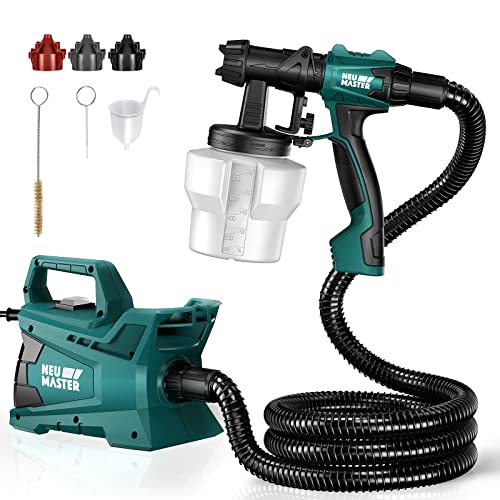
The NEU MASTER N3140 suits the beginner who learns by immersion: the weekend-long fence project, the room-and-trim marathon, the batch of six chairs sprayed in one heroic session. Its 600W turbine sits on the floor and feeds a light gun through a 6 ft hose, so the beginner’s arm — the first thing to tire and the last thing to admit it — stays fresh while technique is still being formed. Fatigue is a beginner’s hidden enemy: it degrades distance, speed, and overlap simultaneously, and its damage appears in the finish long after the session’s early pieces looked great.
- Motor: 600W turbine in a floor-standing base unit
- Hose: 6 ft air hose between turbine and gun
- Patterns: 3 spray patterns
- Flow: adjustable flow control
Strengths
- Lightest in-hand feel — technique stays consistent across long sessions
- 600W gives beginners headroom on thicker materials
- Floor turbine keeps noise at a distance from the learner’s ear
Trade-offs
- More setup than a handheld — the quick small job is not its moment
- Brand support thinner than HomeRight or Wagner
- Hose management is one more skill for a beginner to track
The learning argument is subtle and strong. Beginners form habits in their first ten hours that persist for years, and habits formed while exhausted are bad ones: creeping closer, slowing passes, skipping overlap. A tool that removes fatigue from the learning environment lets the beginner’s muscle memory encode the correct motions. The honest limitation is overhead: for the small, frequent jobs that fill a beginner’s first year, the base-and-hose setup is more ceremony than the Finish Max’s grab-and-go, and many beginners will use the lighter tool more — which is its own form of learning.
Best for: Beginners planning long, immersive project sessions / Not suited for: Quick small jobs or minimal-setup spraying

Wagner Control Spray 250 HVLP Stain Sprayer — Easiest for Outdoor Beginners
The Control Spray 250 suits the beginner whose classroom is the outdoors: the deck, the fence, the garden furniture. Wagner tuned this handheld (model 0529042) for stains and sealers — the most forgiving materials in spraying — and kept the controls to the minimum a novice must master. Outdoor stain work is the ideal beginner curriculum: thin material that needs no thinning judgment, surfaces judged at ten feet rather than ten inches, and ventilation provided by the sky. This is the tool purpose-built for that curriculum, backed by the brand whose support network a seasonal beginner can actually find.
- Type: electric handheld HVLP, model 0529042
- Tuned for: stains, sealers, and thin finishes
- Patterns: adjustable spray pattern
- Brand: Wagner Spraytech — full parts and support network
Strengths
- The gentlest learning curve in the guide: one material class, mastered fully
- No thinning guesswork for its home materials
- Wagner’s manuals and support are the most beginner-legible here
Trade-offs
- Paints are beyond its tuning — the curriculum has a hard boundary
- Small container means refills on long fences
- Indoor furniture ambitions need a different tool
There is wisdom in a first tool with a boundary, provided the beginner’s projects live inside it. The outdoor beginner learns distance, overlap, and trigger timing on material that forgives all three, in a space that forgives overspray, and graduates — if the interest holds — to a generalist with skills already formed. The honest limitation is exactly that boundary: the first painted project requires a second tool, and beginners with indoor lists should not start here no matter how gentle the on-ramp looks. For the outdoor beginner, though, there is no better first semester in this guide: the projects are real, the stakes are low, the material is kind, and the skills transfer completely to every generalist tool the graduate buys next.
Best for: Beginners whose first projects are decks, fences, and outdoor stain work / Not suited for: Paint, enamel, or indoor projects
Wagner Control Spray Max HVLP Paint Sprayer — Best Step-Up for Serious Beginners
The Control Spray Max suits the beginner who is not really tentative: the one who has read three guides, priced the tiers, and knows the first year holds weekly projects across every material. Its stationary two-stage turbine (510W), variable pressure control, and two cup sizes (1 qt and 1.5 qt) form the entry to system spraying — the format the beginner will eventually want, available now. It is prose-only because its street price usually sits just above this cap; it is included because for this specific reader, the stretch is the correct purchase and the cap is the obstacle.
- Turbine: 510W two-stage, stationary unit
- Control: variable air pressure dial
- Cups: 1 qt and 1.5 qt containers included
- Output class: 2.7 PSI HVLP
Strengths
- Variable pressure teaches the deepest spraying variable from day one
- Stationary endurance suits the serious beginner’s session lengths
- A system to grow into rather than out of
Trade-offs
- Usually priced above this cap
- Most apparatus here — setup and cleanup are real commitments
- Overkill, honestly, for tentative beginners
The case for starting one shelf up is that some beginners are apprentices in disguise: they will spray fifty projects in year one, and a tool bought for month one will be replaced by month six at a total cost exceeding this one. The Control Spray Max skips that intermediate purchase. The honest limitation is the reverse case — for the genuinely tentative, its price and apparatus raise the stakes of the first sessions, and a tool that feels like an investment can intimidate where a simpler one invites. Know which beginner you are; this guide’s other five picks exist for the other kind.
Best for: Committed beginners with weekly, varied project plans / Not suited for: Tentative first-timers or strict budgets
Prose-only pick — street price usually sits just above this cap.
Comparison Table
| Pick | Type | Beginner advantage | Container | Needs compressor? |
|---|---|---|---|---|
| HomeRight Super Finish Max | Electric handheld HVLP | Tips forgive thinning; grows with you | Attached container | No |
| VONFORN VF803 | Electric handheld HVLP | Complete kit; widest range | 1200 ml | No |
| HomeRight Finish Max | Electric handheld HVLP | Easiest cleanup; least intimidating | Attached container | No |
| NEU MASTER N3140 | Electric turbine HVLP | Lightest in hand for long sessions | Gun-mounted cup | No |
| Wagner Control Spray 250 | Electric handheld HVLP | Simplest path for outdoor stain work | Attached container | No |
| Wagner Control Spray Max | Stationary turbine HVLP | Variable pressure; a system to grow into | 1 qt + 1.5 qt | No |
How to Choose Your First Paint Sprayer at This Tier
Forecast your first year, not your first project. At this price, the tool should serve the beginner you will become. List the projects you can genuinely imagine in twelve months — not fantasies, the plausible arc — and buy for the arc’s midpoint. The full framework in How To Choose A Paint Sprayer applies, but for beginners the year-view outranks the project-view, because outgrowing a tool is this tier’s most common waste.
Prefer tip systems to single nozzles. Tips are the beginner’s training wheels and the graduate’s toolkit in one: they forgive today’s thinning while unlocking tomorrow’s materials. At this tier, a sprayer without interchangeable tips is a sprayer with an expiration date set by your ambition.
Keep cleanup non-negotiable. The price rose; the law did not change. A beginner who will not enjoy cleaning a tool will not clean it, and an uncleaned tool at this price is a hundred-dollar lesson. Read the manual’s cleaning pages before purchase — for the branded picks they are public — and buy the routine you can picture.
Buy the community as well as the tool. Beginners consume answers: videos, threads, manuals, parts diagrams. The brands with deep owner communities effectively include a support network in the box. Anonymous tools include a search engine and luck. At beginner tier, the network is worth real money.
Leave budget for the system around the tool. Respirator, strainers, masking, a practice project’s worth of finish — the system is part of the purchase. A hundred-dollar tool with nothing left for its ecosystem underperforms a seventy-dollar tool fully equipped, every single session.
The Beginner’s First Month at This Tier: A Realistic Curriculum
Key Takeaways
- Week one is for water, cardboard, and scrap — the tool’s tuition is paid in practice, not in furniture
- Each new material restarts the curriculum at the test board, however experienced you feel
- The recipe log is the curriculum’s diploma: by month’s end it should hold every material you spray
- Session one: assemble, spray water, learn every control’s effect with zero consequences.
- Session two: cardboard with your first real finish — stain is the kindest — and calibrate distance and overlap.
- Session three: a scrap piece or the hidden face of a real project; evaluate honestly in good light.
- Week two: the first real project, flat if possible, with the full routine — strain, test, spray thin, clean immediately.
- Week three: a second material, returning to the test board first; log both recipes side by side.
- Week four: a project with vertical surfaces, where runs teach flow control better than any guide.
- Throughout: clean to standard every session, and photograph results — progress you can see is progress you will continue.
- Month’s end: review the log, note which mistakes repeated, and aim the next month at them specifically.
Problem: Early pieces look great; later pieces in the same session decline. → Fatigue, almost always. Shorten sessions, use the turbine pick for marathons, and never judge your skill by hour-three work.
Problem: A new material sprays badly despite “the same settings.” → Settings do not transfer between materials; the test board does. Return to it without resentment — professionals do.
Problem: The sprayer works worse in week four than week one. → Maintenance debt: a tip or seal asking for attention. Clean deeply, inspect under light, replace the wear part — the system working as designed.
What Beginners Get Wrong About This Tier
The characteristic error of the hundred-dollar beginner is impatience with the tier below’s virtues. Having paid more, they expect the tool to thin for them, mask for them, and clean itself — and the first ordinary clog feels like betrayal. In truth this tier buys margin, not magic: thinning is easier, not unnecessary; cleanup is faster, not optional; the fan is finer, not self-steering. Beginners who keep the under-$50 disciplines — strain, test, thin, clean — find this tier’s tools magnificent. Beginners who retire the disciplines find the tools mysteriously identical to the cheap ones, because the disciplines were the performance all along.
The second error is project inflation: the new tool’s capability invites a first project at the edge of it — the whole kitchen, the tall fence — when the curriculum above exists precisely to sequence ambition. Capability is not readiness. The tool can spray the kitchen in month one; the beginner cannot, yet, and the gap closes in weeks if the ladder is respected and in months if the first disaster must be sanded out of a family’s kitchen. Choose the ladder. The third error is quieter: neglecting the log. Beginners trust memory for recipes — “I thinned it about that much” — and memory, unlike finish, does not level. Two sentences per session in a notebook converts the first year from a sequence of experiments into a body of knowledge, and it is the single habit that most separates the beginners who plateau from the ones who progress. Every pick in this guide rewards the log equally; it costs nothing and compounds forever.
The Beginner’s Material Ladder: Stain, Enamel, Latex — In That Order
Materials have a teaching order, and beginners who follow it learn faster than those who start where their ambitions point. Stain is the first teacher: thin by formulation, forgiving of overlap, honest about distance — its translucency shows every pass, which makes it a diagnostic tool as much as a finish. A beginner who sprays stain for two sessions can see their own technique improving in the work itself. Enamel is the second teacher: opaque, leveling, and demanding about thinning, it introduces the viscosity cup and the recipe log, and its unforgiving gloss shows orange peel and runs without mercy — which is precisely its pedagogical value. Latex is the third teacher and the strictest: thick, fast-drying at the tip, and intolerant of hesitation, it should be met only after the first two have built the habits it requires.
The ladder matters because each material’s failures are survivable at its rung. Stain’s mistakes sand out or darken into character; enamel’s mistakes sand back and recoat; latex’s mistakes, met unprepared, become the story beginners tell about why they returned the sprayer. The tools in this guide were ranked partly on ladder coverage — the tip systems that let a beginner climb without changing tools — and the curriculum in the previous section is simply the ladder with dates attached. Climb it in order and by the latex rung you will wonder what the fear was about; the fear was about starting there.
Troubleshooting the Beginner Year: The Five Recurring Problems
Beginner problems repeat so reliably that they can be catalogued in advance, and a catalogue turns panic into procedure. First, spitting: droplets in the fan, caused by a partial clog, an emptying container, or a loose tip — stop, clean, tighten, strain, resume. Second, orange peel: the pebbly texture of under-atomized finish — thin slightly, move closer, slow the pass, verify the tip matches the material. Third, runs: gravity collecting excess finish — less flow, faster passes, thinner coats, and the humility to spray vertical work in two light coats rather than one brave one. Fourth, dry spray: a dusty, rough film from spraying too far away or in hot, moving air — close the distance, shade the work, respect the weather. Fifth, the clog that ends sessions: dried material at the tip, prevented by straining and mid-session tip wipes, cured by the cleaning routine performed immediately rather than eventually.
Notice the pattern: every problem is a procedure, not a mystery, and every procedure is short. The beginner year goes well for owners who learn to consult the catalogue before the emotions — who treat each defect as the tool communicating a specific, fixable variable. The tools in this guide were chosen to keep that catalogue short and legible: their failures are the standard five, announced clearly, rather than exotic malfunctions requiring a service center. That legibility, more than any performance figure, is what “beginner-friendly” means in practice.
The Hundred-Dollar Beginner Versus the Fifty and the Two-Hundred
Beginners at three budgets face three different bargains, and honesty about them helps more than loyalty to any tier. The fifty-dollar beginner buys a narrower tool and keeps money for materials and mistakes — a genuinely sound strategy for the uncertain, because the cheapest education is the one whose tuition you can afford twice. The two-hundred-dollar beginner buys airless speed or system depth that a first year rarely uses, and risks the intimidation of apparatus; that tier suits beginners only when their project lists are already large and named. The hundred-dollar beginner — this guide’s reader — buys the middle bargain: a tool with no material refusals inside the HVLP world, a support ecosystem, and enough headroom that the second purchase, when it comes, is a specialization rather than a replacement.
The middle bargain fails only when the forecast fails: the “beginner” who sprays twice and stops overpaid by fifty dollars, and the one who sprays weekly from month one underpaid by a tier. Both errors are forecasting errors, not tool errors, which is why this guide keeps returning to the year’s project list as the real specification. Write the list before opening the listings. It is the only step in the entire purchase that cannot be delegated to a review — including this one.
Common Buying Mistakes
Buying for the first project only. At this tier that is the expensive error: the tool outgrown in a season costs twice. Forecast the year.
Treating the step-up as the default. The Control Spray Max is right for committed beginners and wrong for tentative ones. Apparatus intimidates; match the tool to your actual certainty.
Spending the whole budget on the tool. The ecosystem — protection, strainers, masking, practice finish — is part of the purchase. A starved system makes a good tool look bad. Concretely: hold back roughly a fifth of the total budget for the ecosystem on your first purchase, and treat any plan that spends it all on the sprayer as a plan to underuse the sprayer. The ecosystem is also where beginner money is safest — strainers, respirators, and masking serve every future tool, while the sprayer itself is the one component you might upgrade.
Skipping the practice curriculum because the tool is “good.” Good tools raise the ceiling; practice raises the operator. The curriculum in this guide is four sessions long and pays for the tool in avoided disasters. See also Is A Paint Sprayer Worth It for the arithmetic of avoided disasters.
Comparing only within the tier. Some beginners belong at fifty dollars, some at two hundred. The honest comparison set includes the tiers above and below — which is why this series writes them as one map.
Final Recommendation
Most beginners under $100 should buy the HomeRight Super Finish Max: it forgives the learning curve with its tips, rewards the graduate with its finish quality, and supports both with the deepest beginner ecosystem in the tier. The runner-up is the VONFORN VF803 for value-driven beginners with volume-shaped lists, and the committed beginner’s honest alternative is the stretch to the Control Spray Max. Whichever you choose, run the first-month curriculum before judging it — the tool you own after four disciplined sessions is a different, better tool than the one that came out of the box. For the deep single-model view, see Paint Sprayer Review. A closing encouragement, because beginners deserve one from a guide that has spent pages on their mistakes: spraying is a genuinely learnable skill with an unusually kind learning curve — the first session already produces work you will be pleased with, and every session after adds a visible increment. The tools above are the ones that protect that curve from interruption. Buy the one matched to your year, run the curriculum, keep the log, and by the time the second season arrives you will be answering other beginners’ questions — which is the true graduation this tier sells.
Frequently Asked Questions
What makes a sprayer “beginner-friendly” at this price?
Three things: a tip or nozzle system that lets the tool adapt to imperfect thinning, a cleanup routine short enough to become a habit, and controls that teach — pattern, flow, and pressure presented as clear choices rather than mysteries. Power and speed, the headline specs, matter least to beginners; forgiveness and legibility matter most, and they are what this guide ranked.
Should a beginner buy the Super Finish Max or two cheaper sprayers?
The Super, for almost every beginner. Two cheap sprayers divide the budget across two sets of compromises and two learning curves; one good sprayer concentrates it into a single tool that serves the whole first year. The two-tool strategy makes sense later, as specialization — a finesse tool plus a volume tool — bought against named needs, not as a beginner’s opening move.
How long until a beginner gets good results?
Good results — smooth, even, presentable — arrive in the first session for most beginners, because spraying is inherently forgiving of smoothness. Consistently excellent results across materials and shapes take the first-month curriculum in this guide: four to six sessions of sequenced practice. The gap between the two is mostly pacing and thinning judgment, both of which are learnable on schedule rather than by talent. One honest caveat: progress is not linear across projects. A beginner may master flat furniture and then feel like a novice again on their first vertical, spindled, or glossy project — each new shape re-opens one variable. Treat those regressions as the curriculum working, not as evidence about your aptitude; the log will show the underlying skills (distance, overlap, thinning) transferring even when a new shape humbles the result.
Can a beginner spray kitchen cabinets with these tools?
Yes — cabinets are this tier’s signature project, and the Super Finish Max in particular is built for them. Spray doors flat and off the boxes, prime and topcoat in thin coats with the right tips, and give the project a weekend rather than an afternoon. The beginner who has run the practice curriculum first will find cabinets demanding but entirely achievable; the one who debuts on them will find them educational in the expensive sense.
Is the turbine-style NEU MASTER too much for a first sprayer?
Not too much — just differently much. Its setup has more pieces than a handheld’s, but its in-hand lightness forgives the long sessions where beginners otherwise form tired habits. Choose it when your project list is session-heavy (fences, room sets, chair batches); choose a handheld when your list is job-heavy (one piece at a time, often). The mistake is not the format but the mismatch: turbine for marathons, handheld for errands, and honest self-knowledge to tell them apart.
What safety gear does a beginner need at this tier?
The same as any tier: a fit-tested respirator with cartridges matched to the finish, eye protection, ventilation with an exhaust path, and ignition discipline around solvents. Add one beginner-specific item: patience with fit. A respirator worn wrong is decoration, and beginners should spend the unglamorous ten minutes on fit and seal before the first session, per the manufacturer’s instructions.
When will I know I have outgrown a beginner sprayer?
When your frustrations become specific and recurring: constant refills on your typical project, materials your tips cannot serve, sessions your arm cannot finish. Vague dissatisfaction is usually technique; named, repeated friction is equipment. At that point the step-up logic in Best Paint Sprayer For Beginners Under $200 maps each frustration to its tier.