Disclosure: As an Amazon Associate, umtsmarttool.com earns from qualifying purchases. Links to Amazon on this page are affiliate links; they cost you nothing extra. Prices and availability change often, so check the current Amazon listing before you buy.
Where to buy
Six verified heaters sit below the $300 line, and the honest headline is that every one of them works with sunshine or a wall socket rather than fuel. The short list comes first; the reasoning, sizing math and safety rules follow underneath.
- XtremepowerUS Solar Pool Heater Panel 2 ft x 10 ft — Best Overall. Check on Amazon
- GAME SolarPRO Curve Solar Pool Heater 72000-BB — Best Budget.
- Intex 28685E Solar Heater Mat — Best for Beginners.
- Bestway Solar-Powered Pool Heating Pad — Best for Small Pools.
- GABROGA Immersion Water Heater 2000W with Thermostat — Best for Sunny Yards.
- crazybrace Immersion Water Heater 2000W — Best for Small Volumes.
Read the full guide ↓
Best pool heater under $300: buying degrees, not machinery
If you are hunting for the best pool heater under $300, start by reframing what the money purchases. It does not purchase a machine that forces cold water warm on demand. Gas units and heat pumps live several price bands higher, and pretending otherwise only sets up a disappointed June. What this budget genuinely buys is captured sunlight, plumbed carefully: enough collector surface to add a few degrees, stretch the swim calendar at both ends, and take the bite out of a pool that sits a touch too cool for comfort.
Think of the purchase as buying degrees across a season rather than heat on a Tuesday. A well-placed solar array feeding a covered pool behaves like a patient savings account. Small deposits arrive every bright afternoon, and the cover stops the account leaking overnight. Owners who judge this tier by that standard tend to love it. Owners who expect a cold plunge pool to feel like a spa by the weekend tend to blame the equipment for a mismatch that was really about expectations.
This guide ranks six products whose details could be tied to the exact model through manufacturer material or a listing for that precise item. Four gather sunlight through panels, a curved collector or mats. Two are immersion units, included under strict limits: they suit small volumes of water in tubs and little inflatable pools, never a full-size pool, and they demand the electrical discipline described later. Readers comparing approaches should also work through Pool Heater Buying Guide and How To Choose A Pool Heater before money changes hands.
In this guide
Quick Picks
| Pick | Badge | Key spec |
|---|---|---|
| XtremepowerUS Solar Pool Heater Panel 2 ft x 10 ft | Best Overall | Rigid-style panel measuring roughly 2 ft by 10 ft |
| GAME SolarPRO Curve Solar Pool Heater 72000-BB | Best Budget | Curved collector shaped to catch light across the day |
| Intex 28685E Solar Heater Mat | Best for Beginners | 47 in by 47 in mat for above-ground pools up to 8,000 gallons |
| Bestway Solar-Powered Pool Heating Pad | Best for Small Pools | Solar heating pad made for above-ground pools |
| GABROGA Immersion Water Heater 2000W with Thermostat | Best for Sunny Yards | 2000W submersible immersion heater with thermostat control |
| crazybrace Immersion Water Heater 2000W | Best for Small Volumes | 2000W immersion element running on 110–125V AC |
How These Picks Were Chosen
Selection began with a hard filter: any product whose specifications could not be confirmed against documentation for that exact model was dropped, however often it appears in other roundups. What survived was then scored on four questions. How much water can it realistically influence? Does it suit the above-ground and modest in-ground pools most readers at this budget actually own? What will ownership demand in plumbing, space and daily habits? And how gracefully does it scale when a pool or an ambition outgrows the first purchase?
No laboratory or backyard testing is claimed here. The method is research-led on purpose: verified figures, manufacturer sizing guidance, and the shared physics of evaporation, surface area and flow that no brand escapes. Where a number could not be pinned down, it was left out instead of borrowed. That conservatism is why the list looks short. Six products earned a place; a longer list padded with unverifiable claims would have been easier to write and worse to trust.
Badges were assigned after scoring, not before. The overall winner had to combine meaningful collector area with a growth path. The budget badge went to the strongest result available for the least commitment. Lens badges mark the pick a specific household type should read first, and the immersion units carry narrow badges deliberately, because their safe territory is narrow.
The 6 Best Pool Heater Under $300 Options, Examined One by One

XtremepowerUS Solar Pool Heater Panel 2 ft x 10 ft — Best Overall
Every solar shortlist at this budget eventually runs into the same wall: surface area. Mats and pads warm the water that touches them, but a household wanting the largest lift sunshine alone can deliver needs a proper panel, and that is the territory this XtremepowerUS unit occupies. It is a flat, rigid-style collector about two feet wide and ten feet long, designed to sit on a roof, a fence line or a ground rack while pool water circulates through it and returns warmer than it left.
- Panel footprint of approximately 2 ft x 10 ft
- Suitable for in-ground pools as well as above-ground pools
- Plumbs into the pump and filter circuit you already own
- Extra panels can be chained on as the pool or budget grows
Strengths
- Collector area dwarfs what any mat on this list offers
- Modular thinking: a second or third panel joins the same run later
- Once plumbed, sunshine does the work and the fuel bill stays at zero
Trade-offs
- Demands a sunny mounting spot with room for a ten-foot run
- Installation involves real plumbing rather than a quick hose swap
- Cloudy weeks still mean a cool pool, whatever the panel size
Placement decides this product’s fate more than any specification printed on the box. A panel angled toward the midday and afternoon sun, fed by a pump schedule that runs during bright hours, will outperform a larger array dumped in shade behind a garage. Roof mounting keeps it away from foot traffic and lawn tools, though it adds hose length and asks you to think about how water drains back when the pump stops. Ground racks are easier to service and easier to shade by accident as shrubs grow, so leave clearance and check the sun path in midsummer, not just in spring.
Flow through the panel deserves equal care. Push water too quickly and each pass picks up little warmth; starve the flow and the return line delivers a thin trickle of hot water that barely moves the average. Most owners settle into a middle setting, often with a diverter valve so the panel can be bypassed at night, when a collector radiates heat away instead of gathering it. That single habit, plus a cover after sunset, separates the owners who report a transformed season from those who report a gadget that did nothing.
The honest limitation is commitment: this is the only pick here that asks for a genuine installation project, and households wanting a heater running by this evening should look at the mats further down instead.
Best for: owners ready to plumb a panel run once and harvest the strongest solar lift on this list / Not suited for: anyone expecting fuel-fired speed or warmth during a grey, cold snap
GAME SolarPRO Curve Solar Pool Heater 72000-BB — Best Budget
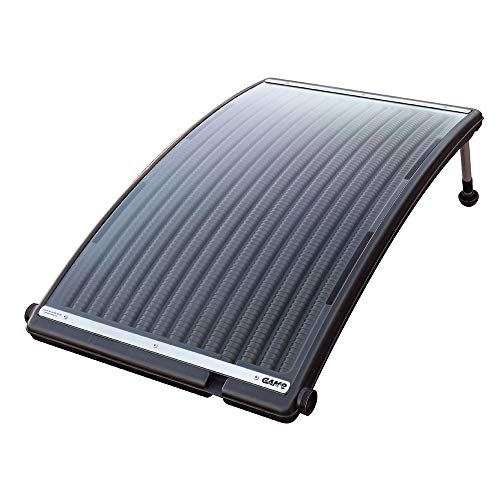
Flat collectors share a quiet weakness: they face one direction, so they peak when the sun lines up with them and loaf for the rest of the day. The SolarPRO Curve answers with geometry. Its collector bows upward, presenting tubing to the light at a spread of angles from morning through late afternoon, which smooths the day’s heating curve for pools that cannot spare a roof or a long fence run.
- Curved solar collector for above-ground and in-ground pools
- Designed for Intex and Bestway pools; Intex adaptors included
- Two hoses and clamps supplied in the box
- Arched profile meets the sun at changing angles through the day
Strengths
- Curved shape keeps collecting outside the midday peak window
- Box contents anticipate the hoses and adaptors owners usually hunt for
- Sits beside the pool, so no ladder work or roof penetrations
Trade-offs
- Collector area is modest next to a full panel run
- Ground placement eats patio or lawn space beside the pool
- Best results still depend on an unshaded patch of yard
Compatibility is this unit’s home turf. It was designed with the big above-ground brands in mind, and the included adaptors spare new owners the classic first-weekend errand of driving around for a fitting that almost matches. Setup reads more like assembling pool furniture than plumbing a house system: position the curve where sun lands, connect the hoses, let the existing pump push water through, and watch the return stream on a bright afternoon.
Expectations should be scaled to a single curved collector. It is a genuine warmer for small and mid-size above-ground pools, particularly when paired with a cover that banks the day’s gain, and owners of larger water should treat it as the first module of a pair rather than a whole answer. Read alongside Pool Heater Pros And Cons if you are weighing one larger panel against two smaller collectors, because the trade is mostly about space and hose runs rather than heating principle.
The honest limitation is scale: one curve will not drag a big, deep pool up to bath temperature, and buyers with generous volume should budget for a second unit or step up to the panel above.
Best for: above-ground owners wanting the easiest meaningful solar gain for the least fuss / Not suited for: large pools expecting one compact collector to transform the water alone

Intex 28685E Solar Heater Mat — Best for Beginners
If the panel sounds like a project and the curve sounds like furniture, the Intex mat is the entry ramp. It unrolls flat beside an above-ground pool, connects into the filter pump’s circulation with the included fittings, and starts returning sun-warmed water the same afternoon. There is no mounting hardware, no roof work and nothing to wire, which is exactly why it converts more sceptics than any other format in budget solar.
- Mat measuring 47 in x 47 in
- Rated for above-ground pools up to 8,000 gallons
- Hose attachment and adaptors included
- Several mats can be connected in series for bigger pools
- Runs off the pool’s existing filter pump
Strengths
- Same-day setup with the fittings already in the box
- Flat profile stores rolled or folded when the season ends
- Series connection lets a cautious first purchase grow later
Trade-offs
- One mat influences modest volumes only
- Lying flat, it gives up the angled exposure the curve exploits
- Needs the pump running through sunny hours to earn its keep
The mat’s working principle is patience multiplied by circulation. Water passes through its dark channels slowly enough to pick up heat, returns to the pool, and the whole body of water creeps upward across a bright day. A single mat on a small pool with a cover at night produces the classic result owners describe: the chilly edge gone, afternoon swims comfortable weeks earlier than last year. Doubling mats in series roughly doubles the collecting surface without changing anything else about the setup.
Care is mostly about kindness to vinyl and plastic. Keep foot traffic off it, coil hoses without kinks, and let it dry before winter storage so nothing grows inside the channels. Owners planning their first season will find the walkthrough in How To Install A Pool Heater a useful companion, even though this mat is the gentlest installation in the category.
The honest limitation is ambition: the mat tops out quickly on larger or deeper pools, and it will not rescue a pool sited in permanent shade.
Best for: first-time owners who want proof that solar works before spending more / Not suited for: deep or shaded pools hoping a single mat will perform miracles

Bestway Solar-Powered Pool Heating Pad — Best for Small Pools
Bestway’s pad plays the same position as the Intex mat, with one practical distinction: it speaks Bestway’s own plumbing language natively. Households running a Bestway above-ground pool and its FlowClear filtration gear get a heater that drops into the line they already own, without adaptor archaeology or hose improvisation at the start of the season.
- Solar heating pad built for above-ground pools
- FlowClear solar heating design
- Connects in line with the pool’s filtration system
- Additional pads can be combined for larger pools
Strengths
- Native fit for Bestway pools and FlowClear filtration
- Inline connection keeps the setup to a single loop
- Extra pads stack the heating surface when needed
Trade-offs
- Owners of other pool brands may need adaptors the box does not promise
- A single pad is a gentle warmer, not a rapid heater
- Ground space in full sun is still a requirement, not an option
Think of the pad as a toll booth the water visits on its way back to the pool: every circulation cycle pays a little warmth into the system. That is why pump scheduling matters more than any other variable. Running filtration through the brightest stretch of the day, rather than overnight out of habit, can be the difference between a pad that visibly helps and one that seems decorative. A floating thermometer removes the guesswork; log the morning temperature for a week and the pad’s contribution stops being a matter of opinion.
Durability questions follow the format rather than the brand. Any ground-level solar pad lives where hoses drag, feet wander and mower wheels turn, so route it away from traffic and give it a defined home on a board or a clear patch of decking. Treated that way, it asks for almost nothing: an occasional rinse, a check that connections stay snug, and dry storage once the leaves turn.
The honest limitation is ecosystem gravity: the pad is happiest inside Bestway’s own world, and mixed-brand setups should confirm fittings before ordering rather than after.
Best for: Bestway pool households wanting a heater that plugs into their existing loop / Not suited for: owners of large in-ground pools shopping for a primary heater

GABROGA Immersion Water Heater 2000W with Thermostat — Best for Sunny Yards
The two immersion units on this list play by different rules from everything above, and the GABROGA is the more controlled of the pair. It is a 2000W submersible element with a thermostat and a stainless guard, built to warm small, contained volumes of water — a tub, a bucket, a little inflatable pool — quickly and directly, rather than nudging thousands of gallons through sunshine.
- 2000W submersible immersion heater
- Built-in thermostat control
- 304 stainless steel guard
- Intended for inflatable and small above-ground pools, tubs and buckets
Strengths
- Thermostat control sets a target instead of running blind
- Guarded element is easier to handle and position safely
- Heats small volumes far faster than any solar format
Trade-offs
- Small volumes only; it is not a whole-pool heater
- Demands constant adult supervision while energised
- Electricity does the work, so running it is never free
Used inside its fence, this is a genuinely handy device. Filling a small inflatable pool for children on a cool morning, taking the chill off a soaking tub, or warming water for outdoor chores are jobs it finishes in a fraction of the time a hose from the house would need, and the thermostat stops the guess-and-check cycle of cheaper elements. The guard keeps the hot coil off container walls and curious fingers, though it reduces neither the need for attention nor the rules below.
Those rules are absolute. The heater runs only while fully submerged, only in non-conductive containers, only on a protected circuit, and only while an adult is present and nobody is in the water. It comes out and is unplugged before anyone climbs in, every time, without exceptions for quick dips. Households unwilling to run that routine should stay with solar, which is slower and far more forgiving. The broader verdict in Is A Pool Heater Worth It is worth reading before choosing speed over patience.
The honest limitation is scope married to discipline: step outside small volumes or relax the supervision rules and this pick stops being a convenience and becomes a hazard.
Best for: adults warming tubs, buckets and small inflatable pools under direct supervision / Not suited for: anyone imagining it as a shortcut to heating a full-size swimming pool

crazybrace Immersion Water Heater 2000W — Best for Small Volumes
Where the GABROGA adds a thermostat, the crazybrace keeps the formula bare and adds information instead: a 2000W guarded element plus an LCD thermometer, so the person warming a bucket or a stock tub can watch the number climb and pull the plug at the right moment rather than testing with a wrist and hoping.
- 2000W immersion element, 110–125V AC
- 304 stainless steel guard
- LCD thermometer included
- Heats small volumes — about 5 gallons in minutes
- For non-conductive containers: buckets, tubs and small inflatable pools
Strengths
- Included thermometer turns guesswork into a reading
- Simple construction with a guarded element
- Fast on the small volumes it was actually built for
Trade-offs
- No thermostat, so it relies on the operator to stop it
- Strictly a small-volume tool, whatever the listing photos imply
- Requires the same unbroken supervision as any immersion heater
The thermometer sounds like a minor accessory until the first cold morning you use it. Warming water for a pet bath, a portable shower or a small plunge becomes a timed, repeatable routine instead of folklore, and repeatability is what separates a tool from a trick. The guarded coil sits in the container, the display tells the truth, and the job ends when the number says so.
Everything said about its sibling applies here with extra emphasis, because there is no thermostat to catch a forgotten heater. Submerged only, non-conductive container only, protected circuit only, adults only, nobody in the water while it runs, unplugged and removed before use. Households that treat those lines as fine print should choose solar and accept the slower road, which forgives distraction in a way electricity never will.
The honest limitation is the missing thermostat: convenience depends entirely on a present, attentive operator, and unattended use is simply off the table.
Best for: methodical owners warming buckets and tubs who like watching a thermometer / Not suited for: busy households likely to wander off while water heats
Comparison Table
| Pick | Key spec | Also know |
|---|---|---|
| XtremepowerUS Solar Pool Heater Panel 2 ft x 10 ft | Rigid-style panel measuring roughly 2 ft by 10 ft | Works with in-ground and above-ground pools alike |
| GAME SolarPRO Curve Solar Pool Heater 72000-BB | Curved collector shaped to catch light across the day | Built around Intex and Bestway pools, with Intex adaptors in the box |
| Intex 28685E Solar Heater Mat | 47 in by 47 in mat for above-ground pools up to 8,000 gallons | Mats link together in series when one is not enough |
| Bestway Solar-Powered Pool Heating Pad | Solar heating pad made for above-ground pools | FlowClear design connects in line with the filtration system |
| GABROGA Immersion Water Heater 2000W with Thermostat | 2000W submersible immersion heater with thermostat control | 304 stainless steel guard surrounds the heating element |
| crazybrace Immersion Water Heater 2000W | 2000W immersion element running on 110–125V AC | LCD thermometer included for checking the water as it warms |
How to Choose a Pool Heater Under $300 Without Buying Twice
Begin with volume, because volume is destiny in pool heating. Count your gallons honestly — length by width by average depth, or the figure on the pool’s documentation — and compare it against what each format can influence. Mats and pads speak in thousands of gallons. Panels speak in surface area relative to the pool’s own surface. Immersion units speak in buckets. A mismatch here cannot be fixed by enthusiasm, and it is the single most common reason budget heaters get returned or resented.
Next, audit your sunlight like an accountant. Stand where the heater would live at ten, at noon and at three, on a clear day, and note what shade arrives from fences, trees and the house itself. Solar equipment fed four honest hours of sun will beat premium gear fed ninety minutes of dappled light, every week of the season. If the audit fails everywhere at ground level, that is an argument for the roof-mounted panel or for accepting a smaller ambition, not for buying a bigger mat and hoping.
Then weigh the plumbing you already own. Every solar pick here borrows the pool’s pump, so its power and hose sizes shape what connects cleanly. Brand ecosystems matter at the margins: Intex fittings flatter Intex mats, Bestway pads speak FlowClear fluently, and universal panels ask for a little more adaptation in exchange for a bigger ceiling. Finally, decide your growth posture. Formats that chain — panels, mats, pads — let a household start with one unit and add a second next season. That path usually beats stretching for the largest single purchase on day one.
Where Pool Heat Actually Goes: The Evaporation Problem
New owners picture heating as a one-way street: put warmth in, water gets warm. Real pools leak heat continuously, and the largest leak is evaporation from the surface. Every gallon that evaporates carries a meaningful packet of warmth with it, which is why a windy, uncovered pool can lose overnight everything a solar array deposited during the day. Heating a pool without covering it is like filling a bucket with a hole in the bottom and shopping for a faster tap.
- A cover used every night is worth more than a second collector for most households
- Windbreaks — fences, hedges, screens — quietly raise any heater’s effective output
- Running the pump through bright hours, not dark ones, matches circulation to collection
- Night bypass on a panel run stops the collector radiating the day’s gain back to the sky
There is a second, quieter leak worth naming: cold ground and cold nights conduct warmth out of an above-ground pool’s walls and floor. A pool sitting on bare earth gives back some of the day’s gain to the soil beneath it, which is why owners who place insulation or even a simple ground cloth under a new pool report a warmer baseline before any heater enters the picture. None of this replaces a collector. It simply means the water you warm has fewer exits to escape through, and every degree you buy stays bought for longer.
Treat retention as half the heating system and the rankings in this guide start to make deeper sense. The panel wins overall partly because owners who install one tend to adopt the full routine — bypass valve, cover, daytime pumping — and the routine multiplies the hardware. A mat inside the same routine will outperform a panel owned casually. Budget accordingly: some of the $300 belongs to the heater, and some belongs to the cover and habits that let the heater’s work survive the night.
Setting Up a Solar Loop You Can Bypass, Drain and Forget
Installation quality decides whether solar feels like infrastructure or like a hobby. The goal is a loop that collects by day, isolates by night, drains before frost and never fights the filter for flow. Work through it in order:
- Place the collector where your sun audit found the longest bright window, raised or angled if the format allows
- Connect the loop after the filter, so debris never reaches the collector’s narrow channels
- Fit a diverter or bypass arrangement so water can skip the collector at night and during servicing
- Run the pump on a schedule centred on the bright hours rather than the clock hours you happen to be awake
- Pressure-check every joint at full pump speed, then again after the first hot afternoon expands the hoses
- Before the first frost, drain the collector completely and store mats and pads dry, indoors where possible
Problems that surface later almost always trace back to one of three roots. Problem: the return water feels warm but the pool average never climbs. That is a retention failure — check the cover habit before blaming the collector. Problem: flow through the filter drops sharply after installation. Look for a kinked hose or a mat plumbed against its intended direction. Problem: gains vanish on windy days. That is evaporation winning; a windbreak or a better-sealed cover is the fix, not another heater.
Living With Each Pick: Notes From the First Fortnight
The panel announces itself quietly. Day one is plumbing and pressure checks; day three is the first morning the thermometer reads higher than the household expects; by the second week the conversation shifts from whether it works to whether a second panel joins it before July. Owners who mounted it high also discover the hidden dividend: the ground beside the pool stays clear for chairs, toys and the general archaeology of summer.
The curve earns affection differently. It becomes part of the pool’s furniture, close enough to touch, and children name it before adults do. Its fortnight lesson is consistency: nothing dramatic on any single day, yet the water that used to need a brave first swimmer by noon is simply pleasant. Owners learn to rotate nothing, adjust nothing, and let the shape do its slow geometry with the sun.
The mat’s first fortnight is a study in low stakes. It goes down in an afternoon, comes up for a lawn party in minutes, and proves the solar principle so cheaply that the household’s real debate becomes where the permanent setup should live. The immersion pair, meanwhile, teach rhythm of another kind: fill, submerge, supervise, unplug, swim. Households that enjoy small rituals keep them for years; households that wanted automation quietly retire them to warming wash water and stop pretending they were pool equipment at all.
What ‘Free’ Solar Heat Actually Costs Across a Season
Solar heating is often sold as free, and the claim is half honest. Sunshine sends no invoice, yet the system that harvests it runs on a pump you pay to power, hoses that age in ultraviolet light, and an hour of your attention at each end of the season. Counting those costs plainly is not an argument against solar; it is how owners avoid the small resentments that curdle into buyer’s remorse by August.
The pump dominates the ledger. Every solar format here borrows circulation, and circulation during bright hours is electricity spent on purpose. Households that already run filtration through the middle of the day will notice almost no change. Households that filtered at night out of habit and now move those hours into the sun will see the schedule change on the bill even though the total pumping hours stay similar. Either way, the figure remains in a different universe from fuel-fired heating, which is precisely why this tier exists.
Consumables are humble but real. Hose sections harden and weep at their fittings after a few summers. Clamps loosen as plastic creeps through hot afternoons. A mat stored wet can need a thorough cleaning before its second season, and a panel drained late can turn one hard frost into a repair. None of this is expensive in isolation; all of it rewards the owner who budgets a small maintenance allowance and a free hour in spring, rather than discovering three small failures on the first warm weekend of the year.
Against those costs, weigh what the tier replaces. Shoulder-season weeks are the prize: the fortnight in spring when the pool would otherwise sit green and ignored, and the fortnight in autumn when one cold snap used to end everything. A household that swims twenty extra days a year because the water stayed kind has bought those days at a rate no other heating technology at any price matches for small pools. That arithmetic, more than any single degree reading, is why owners of these modest systems so often become their loudest defenders.
Reading a Thermometer Like an Owner, Not a Shopper
Shoppers ask how hot a heater gets. Owners ask how warm the pool is at seven in the morning, because that number — the overnight floor — is what a heating system actually controls. A pool that peaks beautifully at four in the afternoon and crashes by dawn is a pool with a retention problem wearing a heating costume. Log the dawn reading for two weeks after any installation and you will know more about your system than any specification sheet can tell you.
Three patterns cover nearly every outcome. A rising floor week over week means collection and retention are working together; protect that routine and change nothing. A flat floor with warm afternoons means the cover or the wind is stealing the gain; fix the leak before buying input. A floor that tracks the weather exactly, warm spell or cold, means the collector is undersized or undersunned for the volume; that is the one case where adding surface area is the honest answer. The comparisons in Pool Heater Review and the long view in Pool Heater Reviews reward readers who arrive with their own numbers in hand.
Common Buying Mistakes
Judging a solar heater after one cloudy weekend is the classic error. These systems report their performance across weeks of weather, not across a Saturday. Give any pick here a fortnight of logged morning temperatures before deciding it failed — and log honestly, because memory edits bad weather out and keeps the disappointment.
Buying surface area for a pool in shade runs a close second. No collector manufactures sunlight, and a shaded installation disappoints at any price. Third comes neglecting the cover, which quietly taxes every format on this list. Fourth, treating immersion heaters casually: they are supervised appliances for small volumes, and the moment one is treated as a set-and-forget pool heater, the purchase has gone wrong regardless of brand.
Finally, beware the upgrade spiral in both directions. Some owners chain four mats onto a pool that needed a panel and a cover; others buy the panel for a paddling pool’s worth of ambition. Match the format to the volume and the sun first. The badge order in this guide exists to make that match quickly — overall power, budget geometry, beginner ramp, brand-native pad, then two narrow electric tools for small water only.
Final Recommendation
Start with the XtremepowerUS Solar Pool Heater Panel 2 ft x 10 ft if your yard offers sun and your patience offers a weekend: it is the strongest, most scalable answer this budget contains, and it keeps paying every bright day after installation. Households wanting the gentlest possible entry should take the GAME SolarPRO Curve Solar Pool Heater 72000-BB instead, accept a smaller lift, and spend the savings on the cover that makes any lift last.
Whichever route you choose, check price on Amazon on the current listing before ordering, confirm the fittings against your pump and hoses, and commit to the retention routine from the first day. Under $300, the heater is only half the system. The other half is a cover, a schedule and a thermometer — and owners who run both halves rarely stay disappointed for long.
If a neighbour asks in September whether the whole exercise was worth it, the honest answer from most households in this tier is a calendar, not a number: count the mornings the pool was swum in that would previously have been watched from the deck. That count, repeated across springs and autumns year after year, is the return this budget promises — and it is a promise the equipment above can genuinely keep.
Frequently Asked Questions
Will a heater under $300 warm a large in-ground pool?
Only modestly, and only with realistic framing. A panel run can take the edge off a smaller in-ground pool and extend its comfortable weeks, especially with a cover, but thousands of extra gallons dilute every degree. Large in-ground pools ultimately belong to the heat pump and gas tier several budgets above this one.
How many degrees can solar heating actually add?
Expect a few degrees of lift across a run of bright days rather than a transformation overnight, with the exact figure governed by collector area, sun hours, wind and cover discipline. The effect compounds: water that starts each morning slightly warmer finishes each evening slightly warmer again.
Do I need a bigger pump to run a solar mat or panel?
Most setups borrow the existing filter pump successfully, because mats, pads and panels are designed around ordinary circulation. What matters is flow balance: enough movement to carry warmth back to the pool without straining the filter. If pressure climbs sharply after installation, suspect a kink or a reversed connection before suspecting the pump.
Can an immersion heater heat my whole pool if I leave it longer?
No — and that idea is exactly the misuse these products must be fenced against. Immersion units here are built for small, contained volumes under constant supervision. A full pool is the wrong volume, the wrong setting and the wrong risk, regardless of how long the element runs.
What should I buy first: a second collector or a cover?
For most households, the cover. Retention multiplies whatever collection you already own, while a second collector adds input to a pool that may be leaking the first one’s work overnight. Once nights are sealed, additional surface area becomes a genuinely good second purchase.
How long will budget solar equipment last?
Panels, mats and pads have no fuel system and few moving parts, so their lifespan is mostly a story of sun exposure, careful winter draining and storage, and hoses replaced as they age. Owners who drain and store them dry each autumn routinely get many seasons; equipment left full of water through a freeze usually does not.
Should I run the pump at night to keep the water warm?
Almost never with solar in the loop. Circulating through a collector after dark turns it into a radiator that sheds the day’s gain to the night sky, unless a bypass keeps the water out of it. Night circulation also stirs the warm surface layer into the cold depths. Let the pool rest under its cover and save the pumping for the hours when the sun is paying for it.
A Season With Solar: What Changes by Month Three
By the third month, owners stop describing the heater and start describing the routine. The pump timer matches the sun without being thought about. The cover goes on in the evening the way a door gets locked. The thermometer reading at breakfast decides whether the afternoon holds a swim, and it is right often enough that nobody argues with it anymore.
That is the real product this budget sells. Not a dramatic machine, but a pool that opens earlier, closes later and feels kinder in between — provided the household runs the retention half of the system with the same seriousness as the collecting half. Choose the format that fits your volume, your sun and your brand of plumbing, and the season will do the rest.
One last encouragement for households still hesitating on the fence between formats: the cost of starting small is unusually low in this category, because the small formats chain. A mat bought this spring becomes the second collector beside a curve next spring, and a panel installed this year accepts a sibling the year after. Solar is one of the few pool purchases where the cautious first step is rarely wasted money, so long as the first step is pointed at real sun.