Disclosure: As an Amazon Associate, umtsmarttool.com earns from qualifying purchases. Links to Amazon on this page are affiliate links; they cost you nothing extra. Prices and availability change often, so check the current Amazon listing before you buy.
Where to buy
- Intex 28000E Deluxe Wall Mount Surface Skimmer — Check on Amazon
Read the full guide ↓
Pool Skimmer Review 2026: The Intex 28000E, Re-Examined for the Season Ahead
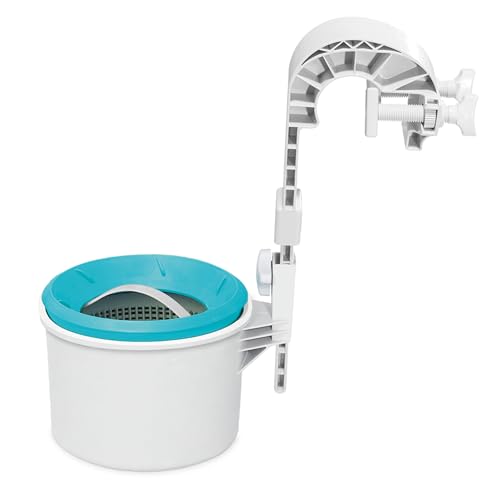
A pool skimmer review 2026 has a specific job that a timeless review does not: to ask what the coming season changes about a product the category already knows. The Intex 28000E Deluxe Wall Mount Surface Skimmer — the soft-sided pool’s default automatic skimmer for years, a pump-driven wall-mount with a floating intake, a polypropylene body, and a removable basket, listed for pumps of 800 GPH and above with a manual flow window running from about 1,000 to 4,000 GPH — does not change for 2026. Everything around it does: the pools it serves keep growing in size, the solar robots keep pressing from above, the skimmer-sock accessory pattern keeps spreading, and a new cohort of owners keeps inheriting soft-sided pools from the great installation years. This review re-examines the 28000E against the 2026 landscape — its enduring design logic, its installation and rhythm, its place between the Bestway alternative and the MUWOOB sock pattern, and its honest answer to the robot question — and closes with a verdict for the season ahead.
The short verdict: for a soft-sided Intex pool with an adequate pump, the 28000E remains the correct first purchase of 2026, as it was in the seasons before — not because nothing better has been invented, but because the things invented since solve different pools’ problems, and this pool’s problem is still a wall that cannot be plumbed and a surface that must be skimmed on the pump the pool already owns. Readers speccing whole systems will find it ranked in Best Pool Skimmer Under $75 Best Pool Skimmer Under $75 and its sibling tiers; readers weighing the eras will find Pool Skimmer Reviews Pool Skimmer Reviews. This page is the single product, in the current year, at length.
In this guide
The Product in Brief
- Type: wall-mount surface skimmer, pump-driven
- Compatibility: Intex Easy Set and metal-frame pools
- Pump requirement: 800 GPH minimum per listing; manual window approximately 1,000–4,000 GPH
- Construction: polypropylene body
- Intake: floating, self-adjusting to water level
- Basket: removable, top access, with handle
- Mounting: adjustable bracket over the pool wall; removable for storage
Design Logic: The Appliance That Fits Its Wall
The 28000E’s design begins from its wall’s nature: soft-sided pools cannot be cut, should not be loaded, and are drained, moved, and stored on rhythms no plumbed fitting survives. The wall-mount answers with a bracket that hooks over the wall’s top edge, an intake body that hangs in the water from it, and a hose that borrows the pump’s suction — the whole apparatus installable in minutes, removable in fewer, and priced as the appliance it honestly is. The floating intake is the design’s intelligence: it rides the level swings that soft-sided pools, with their flexible walls and splashy populations, generate more than any other pool type, keeping the skimming sheet at the surface where the debris is. The polypropylene body trades the plumbed fitting’s decade for a few seasons of light, cheap, replaceable service — the correct trade for a wall whose own lifespan is counted the same way. Nothing in the design pretends to permanence, and that honesty is why it has outlasted, in its niche, a generation of more ambitious products — products that promised the soft-sided pool a plumbed fitting’s life and delivered, instead, a season of compromises against a wall that was never going to hold still for them.
The 2026 context sharpens the design’s virtues rather than dating them. Soft-sided pools have grown — the large frame pools that anchor family summers are bigger water than the category’s early years imagined — and the 28000E’s flow window, generous at the top, scales with them provided the pump does. Meanwhile the accessory ecosystem that has grown around the pattern — socks for fine debris, spare baskets and hoses on every shelf — means the 2026 buyer purchases not a lone appliance but a small civilisation of support, which was not always true and is now the product’s quiet second specification.
Installation and the First Week
Installation remains the category’s gentlest: choose the wall position down-current of the return’s sweep, hook the bracket over the edge, set the intake’s depth by the bracket’s adjustment, connect the hose to the suction side as the manual directs, prime the pump, and watch the draw establish. The failure modes are the familiar three — a position chosen against the current, a hose connection short of airtight, a pump below the flow window — and the first week exists to convict them while the pool is still a novelty the owner is watching. The manual’s flow window deserves 2026 emphasis: the smallest cartridge pumps shipped with entry pools sit below it, and the single commonest disappointment in this product’s owner literature is a starved draw blamed on the skimmer that belongs to the pump. Read the pump’s label before the order; the review cannot say it more plainly, and neither can the manual.
Across the 2026 Debris Calendar
Spring’s pollen film remains the wall-mount’s honest limit and the sock’s opportunity: the basket alone passes fines to the filter, and owners whose gardens flower heavily should run the sock pattern from the first week rather than discovering it in the first film. Summer is the product’s home terrain — insects, grass, dust, the daily fall of a used pool — processed on the split pump schedule this cluster recommends, with the basket’s rhythm at twice a week for most households. Autumn’s leaves test the intake’s width, which is a standard mouth’s width, and the net remains the event tool; the 28000E’s defence is that its pool type usually stands in the open, away from the worst canopy, by the logic of where soft-sided pools get placed. Winter is the appliance’s dividend: lifted off, rinsed, and stored in a deck box in minutes, with no plumbing to drain and no battery to tend — the seasonal overhead the robot era, for all its gifts, has not matched.
Failure Modes and What They Cost
The ledger is an appliance’s: the basket cracks at the handle across seasons; the hose perishes in ultraviolet on a similar clock; the bracket’s adjustment tires. Every item is a shelf part at an appliance price, and the body’s own life — a few seasons of sun and chemistry — is the horizon the whole product is honestly built to. Total the soft-sided decade and the owner has bought the unit perhaps three times, each time in minutes, each time current — a ledger that looks wasteful beside the plumbed fitting’s until it is set beside the soft-sided pool’s own lifespan, against which it is exactly proportioned. Proportion, the review submits, is the product’s deepest design virtue, and the one its imitators most consistently miss: everything about the 28000E is sized to its wall’s real horizon, neither apologising for it nor pretending past it. The 2026 buyer should hold one further line in the ledger: the pattern’s ubiquity means the replacement is never a research project, and in the season’s best fortnight that fact is worth more than the unit’s price.
The Robot Question, Answered for This Pool
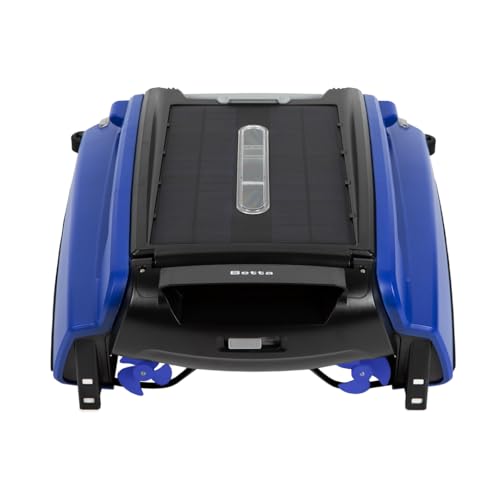
Every 2026 review of a passive product owes its reader the autonomous comparison, and for the soft-sided pool it is a real one: the solar robots are wall-agnostic, and the Betta family reviewed elsewhere in this cluster skims this exact water without a bracket. The honest answer is sequencing and sun. The robot costs a multiple of the wall-mount, eats sunlight the pool may or may not have, and asks storage and battery care the appliance never does; the wall-mount asks a pump schedule and a two-minute round. For the household whose round is kept, the 28000E’s water at swim time matches the robot’s, and the difference buys seasons of other things. For the household whose round is fiction — travel, shifts, the pool at a second property — the robot is not an indulgence but the first honest answer, and this review refers those readers to the cluster’s robot coverage without a syllable of passive-era pride. The product’s dignity is that it does not need the comparison suppressed; it wins its pool on arithmetic any owner can check — pump label, sunlight, the honesty of one’s own round — and a product confident enough to be judged by its buyer’s facts rather than its maker’s claims is, in any year, the one a review can recommend without reservation.
Alternatives Worth Weighing

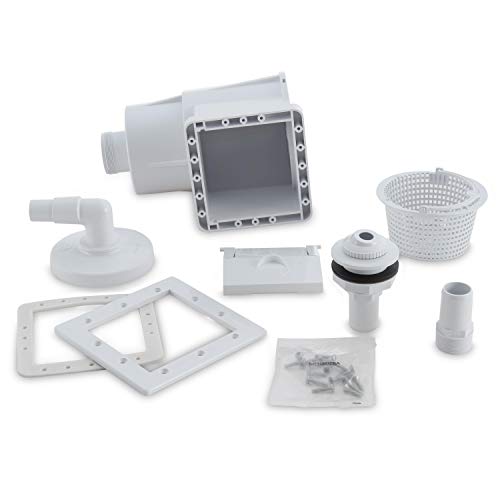
Bestway Flowclear Wall Mount Surface Skimmer 58233E
The sibling for the other brand’s wall: the Bestway 58233E matches the 28000E’s logic with a lower pump threshold — 530 gal/h and above — that suits Bestway’s stock pumps, at the price of brand lock-in and a steel-wall exclusion. Cross-shoppers are really choosing pools, not skimmers; owners of each brand should buy their own pattern and spend the deliberation on the pump label instead.

MUWOOB Above Ground Pool Skimmer with Skimmer Socks
The pattern’s fine-debris evolution: the MUWOOB ships the Intex-style wall-mount with five skimmer socks in the box, formalising the accessory its owners kept improvising. For garden-side pools whose load is film and fines, it is arguably the 2026 form of the product — the same mechanism, specified for the debris that actually arrives — at the price of the rinse rhythm the socks impose and a smaller brand’s support.
Verdict for 2026
The Intex 28000E enters 2026 as it entered the seasons before: the correct default for its wall, its pump window, and its owner’s round. Buy it with a spare basket, run socks if your garden is fine, place it by the current rather than by convenience, and let the robot question wait for the season your schedule actually fails — at which point this cluster’s coverage will be waiting, and so will the sun’s arithmetic. If the review has a sentence to be remembered by, it is the one the product has been making for years without print’s help: the right appliance, on the right wall, fed by the right pump, is not a compromise awaiting a better technology — it is a finished answer, and 2026 has not changed its question. Check the current listing on Amazon before ordering, and confirm the model 28000E on the box when it arrives.
The 2026 Buyer in Focus: Who Is Shopping This Season
The season’s buyers arrive in recognisable cohorts, and the product meets each differently. The inheritors — households that acquired a soft-sided pool with a house, or received one from family — meet the 28000E as the answer to “what is the skimmer for this wall,” and for them the review’s counsel is audit-first: check the existing unit’s basket and hose, read the pump’s label, and replace only what the audit convicts, because a large share of inherited units need a basket and a rhythm rather than a successor. The upgraders — owners of entry pools moving to the large frame installations — meet it as the carry-over question, and the answer is that the unit transfers if the pump’s label still fits the window, with the larger water arguing for the sock pattern and a second look at placement, since a bigger pool’s current map is not the smaller one’s enlarged. The replacers — owners whose unit died in last season’s sun — meet it as the simplest transaction in the category, and their only 2026 refinement is to buy the spare basket in the same order this time. Three cohorts, one product, and a review that serves all of them by refusing to pretend their questions are the same.
Placement Science for a Bigger-Pool Era
Placement was always this product’s unwritten specification, and 2026’s larger pools make it worth writing. The principle is unchanged — the intake belongs where the surface current delivers, which the return jet’s aim largely decides — but a large frame pool’s current has structure a small one lacks: a fast lane along the return’s axis, slack water behind the ladder, and corners whose fate depends on the wind’s quarter. The season’s correct method is empirical and takes one calm morning: float a leaf at several addresses, watch the deliveries, and mount the bracket where the leaf arrives rather than where the deck is convenient. Owners who inherit a predecessor’s placement should re-run the test rather than honouring it, because pumps, returns, and gardens all change between owners. And the sock-era refinement: a socked basket’s finer capture slightly reduces the draw’s tolerance for a marginal position, so the socked pool should be placed by the test with extra care — the fineness dividend is paid only where the water actually arrives.
The Sock Question, Settled for the Season
No accessory question follows this product like the sock’s, so the 2026 review settles it with a decision rule. Run socks if two of three hold: your debris is visibly fine (pollen, blossom, seed, dust film); your filter is a cartridge whose cleaning you resent; your rhythm tolerates a rinse every few days in the fine season. Decline them if your load is leaves, your rhythm is weekly, or your pump sits at the window’s bottom, where the sock’s resistance is a tax the draw cannot spare. Owners in between should run the experiment the pattern makes cheap: one socked month against one bare month, judged by the cartridge’s state and the surface’s morning face. The review’s own position, for the record, is that the sock is the single highest-value accessory in the soft-sided world for the pools it suits — and a small, daily, entirely avoidable chore for the pools it does not, which is why the rule, not the enthusiasm, is what this page hands the season.
How This Review Was Conducted
Method, as this cluster’s reviews require. Specifications are the manufacturer’s and the listing’s, opened during research, with the manual governing the flow window where the two emphasise differently. The ownership account — placement, rhythm, failure ledger, the sock’s rule — synthesises the documentation and the pattern’s extensive owner literature across recent seasons, projected onto the 2026 landscape only where the landscape demonstrably changed: pool sizes, the accessory pattern’s maturity, and the robot alternative’s credibility. No test numbers are invented and no fixed ratings are quoted, because a wall-mount’s performance is a function of a specific pool’s pump and placement, and a review that printed a universal figure would be inventing the precision it claimed. What can be certified is structural — wall, window, wear, support — and the verdict is confined to it.
Living With It Through a Full Season: The Diary Form
April: the unit comes out of the deck box, the hose is inspected against the light for the winter’s verdict, the basket clicks into a body that has forgotten nothing. May: pollen writes the sock decision on the surface, and the household either adopts the rotation or accepts the film with open eyes. June and July are the product’s invisibility — the round, the rinse, the occasional repositioning after a storm rearranges the garden’s delivery — and invisibility, in a pool appliance, is the review’s highest available praise. August tests the hose’s sun-hours and the owner’s rhythm against the heat’s evaporation, and the floating intake earns its design in the level’s daily swing. September’s first leaves are netted by hand while the basket takes the ordinary fall, in the partnership every guide in this cluster prescribes. October: the unit is lifted, rinsed, and stored in minutes, and the season closes with the product having asked, in total, perhaps two hours of its owner’s year. That diary — unglamorous, bounded, repeatable — is the 28000E’s actual 2026 specification, and no specification sheet in the category states it, because it is written in the owner’s calendar rather than the manufacturer’s.
The Pump Conversation the Product Keeps Starting
More 28000E ownerships are decided by the pump than by the skimmer, and the 2026 review gives the pump its own hearing. The window — 800 GPH at the listing’s floor, roughly 1,000 to 4,000 in the manual’s working range — is not a suggestion but the mechanism’s physics: below it, the sheet at the intake is too weak to carry debris across the lip; above it, nothing bad happens at all, which is why larger pools with generous pumps report this product at its best. The season’s typical situations sort cleanly. The entry pool with a sub-window cartridge pump should upgrade the pump — a purchase that pays across filtration as well as skimming — rather than blaming or replacing the skimmer. The mid-range pool inside the window should service the cartridge before diagnosing anything, since a loaded filter silently demotes a compliant pump below the floor. The large pool near the window’s top should enjoy the product’s best self and spend its worry on placement instead. In each case the skimmer is the constant and the pump the variable, and a review that did not say so would be leaving its readers to learn the category’s commonest lesson at retail prices.
Environmental Ledger, 2026 Edition
The season’s buyers increasingly ask the durability question in environmental dress, and the wall-mount’s answer is genuinely two-sided. Against it: it is a plastic appliance with a multi-season rather than multi-decade life, and a household that keeps a soft-sided pool for a decade will cycle several. For it: each unit is small, single-polymer, and free of electronics and batteries; its energy is borrowed from a pump that runs regardless; and its replacements are driven by a wall whose own lifespan is the binding constraint — the skimmer is not the pool’s shortest-lived component, merely its most visible one. The balanced verdict this review offers is that the 28000E is as durable as its context permits, and that buyers who want the decade ledger should change the context — the hard-sided pool and its plumbed fitting — rather than asking an appliance to be infrastructure. Honest categories, honestly matched, are the environmental policy a pool owner can actually execute.
The Review’s Remaining Doubts, Stated for 2026
Three open questions follow the product into the season, and a dated review should date them. The flow window’s floor is the first: as entry pools ship with ever more modest pumps, the share of owners whose label falls below the window grows, and the product’s reputation increasingly depends on a component it does not control — a structural risk no redesign of the skimmer itself can retire. The second is the large-pool question: as frame pools grow toward plumbed-pool volumes, some owners will find a single standard intake’s coverage, however well placed, genuinely thin, and the honest answers — a return-jet second point, or the robot — both live outside this product. The third is the era’s pace: if autonomous prices fall the way young categories’ prices do, the wall-mount’s arithmetic will need re-arguing in a future season’s review, and this page’s verdict should be read with its year attached, as its title insists. None of the three moves the 2026 verdict for the pool the product serves. All three are recorded so that the season’s reader can see the review thinking, not merely concluding.
What a 2026 Owner Should Do in the First Thirty Days
Week one: mount it by the leaf test, not by the deck’s convenience, and watch one full pump block a day until the draw’s healthy look is memorised. Week two: service the basket slowly once, learn the seating click, and write the record — model, pump rating, mounting position, the date. Week three: settle the sock question by the rule this review gives, and if socks are adopted, start the rotation while the rhythm is still new enough to shape. Week four: stock the spare basket and confirm the seasonal storage spot, so October’s lift-off has a destination. Thirty days, and the appliance’s whole ownership is established: placed by evidence, serviced by rhythm, documented on a page, and spared against its one predictable failure. The owners whose multi-season reports fill this product’s literature are, disproportionately, the ones who spent that first month this way — a fact the 2026 reader can still act on, which is the most useful sentence a dated review can print.
Genuine Article, Current Season: The Buying Drill
The pattern’s ubiquity attracts look-alikes and stale stock in roughly equal measure, and the 2026 buyer’s verification is brief. The listing should name Intex and the model 28000E plainly; the box should repeat both; the basket and bracket should be the pattern’s own rather than a silhouette’s approximation. Buyers should also confirm they are purchasing the current unit rather than a predecessor’s remainder where the listing is ambiguous — the pattern has been stable for years, which makes old stock mostly harmless, but the hose and basket in a long-shelved box have aged in the dark, and the season’s price difference rarely compensates. Keep the receipt with the pool’s record page. Thirty seconds at the listing, ten at the door, and the product this review examined is the product in the water — a drill whose brevity is itself a finding about the standard the pattern has become.
The Soft-Sided Pool in 2026: Why This Product’s Pool Is Winning
A dated review should read its product’s habitat as carefully as the product, and the habitat is thriving. The soft-sided pool has completed its journey from seasonal novelty to default family infrastructure: larger frames, better pumps, longer ownership, and a resale and inheritance traffic that keeps units in service across households. Each trend lands on this skimmer’s side of the ledger. Larger pools sit higher in its flow window. Better pumps acquit its draw. Longer ownership rewards its support ecosystem. Inheritance multiplies the owners who meet it as the known answer rather than as a choice. The product’s risks, recorded in the doubts section, are real but external — pump floors, coverage physics, era pricing — while its habitat’s momentum is internal and compounding. A 2026 verdict is therefore not merely that the 28000E remains correct, but that the pool it serves has become the category’s centre of gravity, and the centre, as always, is where the standard lives.
Sound, Sight, and the Health Signals of a Wall-Mount
The 28000E reports its health in two channels, and the 2026 owner should be literate in both. By sight: the draw’s signature is the slow convergence of fines toward the intake across a still morning, and the basket’s fill pattern is a diagnostic — evenly loaded means the placement is right; loaded on one side means the current is arriving at an angle the bracket’s adjustment can correct. By sound: a healthy installation is quiet at the wall, and the two voices that matter are the gurgle of air — a hose joint or a low level asking for attention — and the pump’s changed note when a matted basket or a loaded cartridge raises the system’s resistance. Neither channel requires instruments, and both reward the baseline week this review prescribes, because a signal is only legible against a remembered normal. Owners who learn the pair own the product’s whole maintenance philosophy: watch, listen, service the consumable the signal names, and leave the mechanism alone.
Closing Assessment for the Season
The 2026 review closes where the product lives: on a soft-sided wall, in the sun, doing a job whose specification has not changed because the water has not. The season’s context — bigger pools, maturing accessories, a credible robot alternative — has clarified the 28000E rather than threatening it, the way a standard is clarified by the arrival of alternatives that must define themselves against it. Buy it by the pump label, place it by the leaf, sock it by the rule, and store it by the minutes it asks. The next dated review in this line will re-argue the arithmetic against whatever the era does next; this one, for 2026, finds the arithmetic intact and the product, once again, the first purchase its pool should make — confidently, and with the spare basket in the same order.
Children, Safety, and the Bracket on the Wall
A wall-mount lives where swimmers are, and a complete review addresses its household physics. The bracket and body present no sharp geometry by design, and the unit’s position — chosen by the current — should also be chosen against the pool’s traffic: out of the ladder’s swing and the jumping zone’s splash line where the wall allows, because a skimmer knocked askew skims nothing and a swimmer who lands on a bracket remembers it. The standing rule of every skimming system applies with its usual force: the pump is off before hands work at the intake, a rule that belongs on the household’s record page rather than in a review’s fine print. Teach children the basket’s service as a supervised job and the product becomes, like the robot in its different way, a small curriculum in how the pool works — which households consistently report as the appliance’s unlisted feature.
The Counterfactual: A Soft-Sided Season Without It
Run the season the other way, as this cluster’s reviews like to do. Without the wall-mount, the soft-sided pool’s surface is skimmed by hand or not at all: the net’s daily pass that starts as a pleasure and ends, by July, as the chore whose skipping is visible by breakfast. The debris that escapes the net waterlogs and sinks, and the cartridge — the pool’s smallest, hardest-worked component — inherits the whole load, shortening its service rhythm and clouding the water it was sized to polish. By August the household is shopping for exactly this product, in the season’s worst stock and temper, having paid for the delay in filtration and mornings. The counterfactual is not a catastrophe; it is a tax, levied daily, in the currency of attention — and the 28000E’s entire case, in 2026 as in every season, is that it retires the tax for the price of an appliance and two minutes on a round.
A Note on Reviews, Years, and Trust
This page carries a year in its title, and the year is a promise about method: that the verdict was re-argued against the current landscape rather than inherited from the product’s reputation. Reputation is a lagging indicator — it survives the conditions that created it — and the soft-sided category has moved enough, in pool sizes, pumps, accessories, and alternatives, that an inherited verdict would be a small dishonesty even when it happened to be right. The 2026 re-argument found the product’s case intact and, in the habitat section’s terms, strengthened; a future year’s may not, and the cluster’s dated reviews exist so that the change, when it comes, is announced by a page whose title admits its own expiry. Readers should hold every dated review in the category to that standard, this one included — and should notice that the product itself, indifferent to print, will be on the wall either way, skimming.
The Upgrade Path From Here
Owners ask what this product leads to, and the 2026 map has three honest exits. The first is depth within the pattern: socks, spares, a second collection point at the return — the completion route the cluster’s budget guides itemise, which most households will find is the whole journey. The second is the era exit: the solar robot, bought when the schedule fails, with the wall-mount retained as the pump-hours backbone in the hybrid this cluster’s reviews describe. The third is the pool exit: the hard-sided installation and its plumbed fitting, at which point the 28000E is gifted onward with the old pool, its lessons fully portable and its hardware honourably retired. None of the exits is a repudiation — each is a household’s circumstances changing around a product that served its season exactly as specified — and a review can give the appliance no higher closing praise than that its owners leave it, when they leave it, for reasons that are never its fault.
Resale, Gifting, and the Second-Hand Unit
Soft-sided pools circulate, and their skimmers circulate with them, so the 2026 review prices the second-hand unit honestly. A used 28000E with a whole basket, a supple hose, and a bracket whose adjustment still grips is worth having at the pattern’s usual second-hand discount, because its failure modes are visible and its wear parts are cheap — the buyer is purchasing the body’s remaining seasons, which the inspection can estimate. A unit with a perished hose or a cracked basket is worth its body alone, and the arithmetic should be done before the purchase rather than at the first mounting. Sellers, for their part, should know that the skimmer’s presence — named, working, with its spare — is one of the signals that separates a kept pool from a stored one in a buyer’s eyes, and that the record page, travelling with the pool, is worth more than the appliance it describes. Circulation is this product’s native element; it was designed to be removed, handed on, and remounted, and the second-hand market is simply its design philosophy operating at household scale.
Frequently Asked Questions
Does a solar cover change how the 28000E should be run?
Yes, in scheduling only: covered hours are prevention hours, during which the surface path is blocked, so the pump’s skimming blocks should be concentrated into the uncovered part of the day. The hardware is indifferent to the cover; the calendar is not, and households that make the single adjustment find the pair — cover by night, skimmer by day — to be the soft-sided pool’s most efficient configuration.
How does the 28000E handle a pool party?
A crowded soft-sided pool is a level event as much as a debris event, and the floating intake is the design’s answer to both: it rides the displacement swings that a fixed intake would gulp through, and the basket takes the day’s load without choking. The owner’s part is the event rhythm this cluster prescribes everywhere — a net pass before the guests, the basket serviced after — after which the product’s margins handle the rest without drama.
Is the 28000E still worth buying in 2026?
For its pool — soft-sided Intex, adequate pump, kept round — yes, on the same arithmetic as ever: it is the only mechanism designed for that wall, its support ecosystem is deeper than when it launched, and its competition solves different problems at multiples of its commitment. Worth is a match, and the match has not moved.
Can the 28000E be the only skimmer a pool needs?
For the standard soft-sided installation, yes — it is designed as the pool’s complete automatic surface system, with the hand net as its event partner rather than its competitor. The configurations that outgrow a single unit announce themselves through the leaf test’s stall or the schedule’s failure, and both have named answers elsewhere in this cluster; until one announces itself, the single wall-mount is not a compromise but the specification.
What changed for this product in 2026?
The product, nothing; the context, three things: larger soft-sided pools push owners toward the top of its flow window, so pump verification matters more; the sock pattern has matured from improvisation to a shipping configuration, as the MUWOOB alternative shows; and the solar robots have become a genuine second answer for schedule-bound households, which sharpens rather than threatens the wall-mount’s case for everyone else.
Is one 28000E enough for the largest frame pools?
For most, yes — placed by the leaf test and fed by a pump in the window’s upper half, the single intake covers a large soft-sided surface on the split schedule. The exceptions announce themselves honestly: a persistent stall corner the test convicts on repeated mornings. That pool’s answers are the return-jet second point or the robot, both covered in this cluster — and the diagnosis, not the pool’s size alone, should make the call.
My pump is below the stated minimum. What happens?
A soft draw that worsens as the filter loads — the product’s commonest disappointment and its most preventable. The remedies in order: service the cartridge, confirm the hose run is short and airtight, and if the label itself is below the window, upgrade the pump or choose the lower-threshold Bestway pattern where the wall allows. Do not blame the skimmer first; it is the messenger.
What is the first sign the unit itself, not the system, is failing?
A draw that stays weak after the cartridge is serviced, the hose proven airtight, and the level confirmed — with the intake’s float moving freely — points at the unit’s own wear: a tired bracket letting the intake ride wrong, or a body connection admitting air. Work the system’s order first, as every guide in this cluster insists, because the unit is the least likely culprit in its own installation; but when the order is exhausted, believe it, and replace the appliance without nostalgia.
How many seasons should I expect from one unit?
Treat it as a few-season appliance with annual wear parts, and let your own sun and chemistry set the exact count. Owners who store it out of the winter, rinse the basket rather than forcing it, and keep the hose out of permanent tension report the long end of the pattern’s range; the design’s honesty is that it never promised the plumbed fitting’s decade, and its price never charged for one.
Does the 28000E work on other brands’ soft-sided pools?
The pattern is Intex-geometry — bracket, hose, and intake sized for Intex walls and fittings — and owners of other brands report the usual spectrum of improvisation. This review’s counsel is the cluster’s standing one: buy your own wall’s pattern where one exists, because the bracket’s fit and the hose’s connection are the product, and a skimmer adapted is a skimmer whose draw and security are both negotiable. The Bestway alternative exists precisely so that no owner needs to improvise.
Can I leave it mounted under a winter cover on a pool that stays up?
Pools winterised in place should have the unit lifted and stored rather than trapped under a cover in freezing water — the appliance’s plastics and hose are not specified for the freeze, and its removal is measured in minutes. Frost-free households keeping the pool filled and running may leave it mounted with the pump’s schedule maintained, treating winter as a quiet season rather than a closed one.
What does the 28000E cost to run for a season?
Its energy is the pump’s, already spent on filtration; its consumables are a basket on its seasons’ clock, a hose on a similar one, and socks if the household runs them. This cluster prints no prices, so the review gives the shape instead: the season’s running cost is a small fraction of the unit’s purchase, dominated by whichever wear part the sun retires that year — which is the appliance ledger working exactly as designed, and the reason the product’s total cost surprises owners pleasantly at the multi-season view.
Should I buy the robot instead this year?
Only if your schedule, not your skimmer, is the failing component — or your pool has no usable wall and no wish for a bracket. The review’s test is behavioural: if the basket round was kept last season and the water was ready, the wall-mount’s arithmetic still wins; if the round was fiction, buy the era that matches your life, from the cluster’s robot review, with this page’s blessing. Either way, the decision will have been made from evidence about your own household rather than from a listing’s promises, which is the only upgrade that never depreciates.