Disclosure: As an Amazon Associate, UMT Smart Tool earns from qualifying purchases. This guide is built from product listings and maker specifications, not from our own hands-on testing. Prices are approximate and can change, so check the current price before you buy. Last updated: November 10, 2026.
A bedroom wardrobe is the piece you buy when the closet is too small, shared or simply missing — common in older houses, guest rooms and rentals where adding a built-in is not an option. This guide covers enclosed wooden wardrobes and armoires only: cabinets with real doors that hide the clutter and read as furniture. (Open racks and fabric portable closets are covered in our affordable wardrobes guide.) The six picks below are organized by the decision you actually face — how much wall width you can spare, whether you want a mirror or drawers, and whether solid wood is worth the premium to you — and for each one we flag the dimensions and trade-offs that decide whether it works in your room.
In this guide
Quick Picks
Short on time? These are the six bedroom wardrobes we would shortlist first. Width and depth matter more than styling here: measure your wall and your longest hanging clothes before you fall in love with any of them.
| Pick | Type | Best for |
|---|---|---|
| Sauder Palladia Armoire | Two-door armoire with drawer | Best overall bedroom wardrobe |
| ModernMate 3-Door Wardrobe | Three-door wardrobe with mirror | Best wardrobe with a mirror |
| NDOHCUO Arched Armoire | Four-door arched wardrobe | Best large wardrobe |
| From the Tree Furniture Armoire | Solid pine two-door armoire | Best solid wood wardrobe |
| ANCTOR Armoire Wardrobe Closet | Narrow wardrobe with mirror and drawers | Best for small bedrooms |
| TOKSOM Wardrobe Armoire | Two-door wardrobe with three drawers | Best budget wardrobe |
Our Picks
1. Sauder Palladia Armoire, Vintage Oak (420608) — Best Overall
The Palladia is the most balanced wardrobe here: 36.3 inches wide, 21.42 inches deep and 66.61 inches tall, in a warm Vintage Oak finish with framed panel doors that suit traditional and transitional bedrooms. That 21.42-inch depth is the headline spec — it is deeper than most flat-pack armoires, so standard hangers sit straight instead of angling against the doors. Inside there is a garment rod for hanging, one adjustable shelf for folded stacks, and a wide bottom drawer that opens on smooth metal runners for shoes, spare blankets or sweatshirts. Sauder builds it from engineered wood, and at about 130 pounds it feels substantial once assembled.
The trade-off is height and hardware simplicity. At under 67 inches tall it gives up the top shelf of storage that 71-inch rivals offer, and you get one drawer rather than a bank of them. Assembly is a typical Sauder flat-pack job: methodical, two-person work. Choose the Palladia if you want one well-proportioned, furniture-grade armoire for a primary bedroom and your hanging clothes are mostly shirts, blouses and jackets rather than floor-length dresses.

2. ModernMate 3-Door Wardrobe Armoire Closet with Mirror (HK-BA-YN11) — Best with a Mirror
A mirrored door is the oldest space trick in the bedroom, and the ModernMate builds a full wardrobe around it: 47.2 inches wide, 20.9 inches deep and 70.9 inches tall, with three doors, a mirror for outfit checks, two hanging rods and two drawers that run on steel ball-bearing slides — a nicer touch than the plain wooden runners many budget wardrobes use. The two-rod layout is the practical win: couples can split the cabinet left and right instead of fighting over one rail, and the near-21-inch depth keeps hangers clear of the doors.
At 47 inches wide this is a two-person wardrobe, not a space-saver, and the mirror door makes it the heaviest single panel to handle during assembly — build it in the room where it will live. The styling is plain modern white goods rather than heirloom furniture. Pick the ModernMate if you share a bedroom, lack a full-length mirror elsewhere, and have a genuine 4 feet of wall to give a wardrobe.
3. NDOHCUO Arched Armoire Wardrobe Closet with 4 Doors, Natural — Best Large Wardrobe
When the problem is sheer volume, this is the biggest cabinet on the list: 63 inches wide and 70.5 inches tall, with four arched doors in a light natural finish, two hanging rods and eight shelves. The layout splits naturally into two wardrobes side by side — his and hers, or hanging on one side and folded storage on the other — and eight shelves is more shelf storage than the rest of this list combined. The arched door tops soften what would otherwise be a very large, boxy piece, which matters when a wardrobe this size dominates a bedroom wall.
Be honest about the depth and the footprint: at 18 inches deep it is the shallowest wardrobe here, so bulky hangers and wide-shouldered coats sit tighter than in the Palladia, and 63 inches of width plus door swing is a lot to ask of a small room. It is engineered wood, not solid timber, despite the wood-look finish. Choose it if two people need maximum enclosed storage from one purchase and your bedroom wall can take a five-foot-plus cabinet.
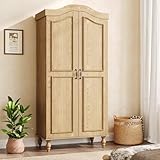
4. From the Tree Furniture Solid Wood Armoire, Unfinished — Best Solid Wood
Every other pick here is engineered wood; this one is 100% solid pine, and the maker says so plainly: never MDF, never particle board. Behind the two panel doors you get one hanging rod and four adjustable shelves, so the interior can shift from mostly hanging to mostly folded as your storage needs change. It arrives unfinished — smooth-sanded and ready for paint, stain or sealant — which makes it the only wardrobe on this list you can match exactly to your bedroom’s woodwork or repaint when you redecorate.
That flexibility is also the work: finishing a wardrobe this size means sanding, sealing and drying time before a single shirt goes in, and unfinished pine shows every dent until it is protected. It is a two-door cabinet with no drawers and no mirror. Pick it if you distrust flat-pack panels, plan to keep a wardrobe for many years, and like the idea of choosing the finish yourself — for a nursery, it can be repainted as the child grows.
5. ANCTOR Armoire Wardrobe Closet with Mirror, Rustic Maple (HK-YG-20) — Best for Small Bedrooms
The ANCTOR squeezes the full wardrobe checklist into a narrow footprint: just 36.2 inches wide and 18.7 inches deep, yet 70.9 inches tall, with four doors, three drawers, shelves, a hanging rod and a mirror, in a warm Rustic Maple finish. Most narrow wardrobes make you choose between drawers or a mirror; this one includes both, which is exactly what a small bedroom or studio needs when the wardrobe is also your dresser. At about 129 pounds it is a solid, stay-put piece, and the maker rates the clothes rod for up to 30 pounds of hanging clothes.
The compromise is depth: 18.7 inches is slim, so wide hangers and bulky winter coats will crowd, and the rod’s stated 30-pound capacity suits everyday clothes rather than a heavy coat collection. The four-door, three-drawer front is also visually busy for a minimalist room. Choose the ANCTOR if your free wall is barely three feet wide but you refuse to give up drawers or a mirror to fit a wardrobe onto it.
6. TOKSOM Wardrobe Armoire Closet, Black (71.7″) — Best Budget
The TOKSOM is the value pick with a design twist: a 31.5-inch-wide, 71.7-inch-tall wardrobe in black with wavy, wave-textured door panels and gold-tone handles that look far more deliberate than most budget furniture. The layout is the classic one — two doors over a hanging rod and shelf, with three drawers below for folded clothes and accessories — and it ships in a single box, which keeps delivery simple for apartment buildings and stairs. The maker builds it from MDF panels, like most wardrobes at this tier.
Set expectations accordingly: at 18.9 inches deep it is a slim cabinet for shirts and folded wear, not for bulky coat storage, and a single-box flat-pack of this height is still a careful two-person build. Black shows dust and fingerprints faster than the lighter finishes above. Pick the TOKSOM if you want an enclosed wardrobe with real drawers at an entry-level tier and the modern black finish suits your room.

Best Picks by Category
- Best overall: Sauder Palladia Armoire, Vintage Oak — the deepest cabinet here, with a rod, adjustable shelf and a smooth metal-runner drawer.
- Best with a mirror: ModernMate 3-Door Wardrobe — mirror door, two hanging rods and ball-bearing drawer slides in a 47-inch frame.
- Best large wardrobe: NDOHCUO Arched Armoire — 63 inches wide with four doors, two rods and eight shelves for two people’s storage.
- Best solid wood: From the Tree Furniture Armoire — 100% solid pine, unfinished so you choose the paint or stain, with four adjustable shelves.
- Best for small bedrooms: ANCTOR Armoire Wardrobe Closet — mirror, three drawers and hanging space in a 36.2-inch-wide footprint.
- Best budget: TOKSOM Wardrobe Armoire — three drawers and a hanging section in a single-box flat-pack with a modern black finish.
Notice the pattern: width is what you shop for, but depth is what you live with. Every wardrobe above hangs standard clothes; the ones near 21 inches deep simply do it without the doors brushing your sleeves.
How to Choose
Measure the wall, the ceiling and the delivery path
Start with the wall the wardrobe will stand on: width first, then ceiling height — most full-size wardrobes here are 67 to 71 inches tall, which clears an 8-foot ceiling easily but can clash with sloped ceilings and low beams. Then measure the path in: doorways, hall turns and stair landings. Flat-pack wardrobes arrive as panels, so the assembled size is rarely the problem; pre-assembled and solid-wood pieces are the ones that get stuck on stairs.
Depth decides what actually hangs
A standard hanger is about 17 to 18 inches wide, and a shirt on it needs roughly 20 to 22 inches of cabinet depth to hang straight without the doors pressing on the sleeves. Wardrobes around 21 inches deep, like the Palladia and ModernMate, handle everyday clothes comfortably. Slimmer cabinets around 18 to 19 inches deep still work for shirts and folded wear, but wide-shouldered coats and bulky hangers will crowd. Depth is the spec buyers most often get wrong, so check it before the finish.
Interior layout: rods, shelves and drawers
Count your clothes by type before choosing a layout. Long dresses and coats need a tall, uninterrupted hanging drop; shirts and jackets can share a rod with shelves above. Folded clothes do better in drawers than on deep shelves, where stacks topple. If two people share one wardrobe, two rods or a four-door split layout prevents daily negotiation. Adjustable shelves are worth having because the right layout changes as wardrobes fill up.
Materials: engineered wood versus solid wood
Most wardrobes in this class are engineered wood — MDF or particleboard with a foil or laminate finish. It is consistent, affordable and fine for a stationary cabinet, but it dislikes being moved, over-tightened screws and standing water. Solid wood, like the pine armoire above, costs more and needs a finish, yet it can be repaired, repainted and kept for decades. Be honest about how long you will keep the piece and how often you move house.
Doors: hinged, mirrored and clearance
Nearly all freestanding wardrobes use hinged doors, which need clear swing space in front — roughly the width of one door leaf. Narrower doors on a wide cabinet, as on the four-door NDOHCUO, swing into less room than two wide doors. A mirrored door replaces a separate full-length mirror and bounces light around a small bedroom, but adds weight to the panel. Sliding doors solve clearance problems, yet they remain rare in freestanding wardrobes at this tier.
Stability, anchoring and assembly
Any tall, narrow cabinet can tip if a child climbs it or drawers are pulled out and loaded unevenly, so use the anti-tip hardware the maker includes and anchor the wardrobe to a wall stud — this is not optional in a child’s bedroom. Build the unit in the room where it will live, on a level floor, with two people; assembled wardrobes in this class weigh 100 pounds or more and are awkward to move up stairs. Keep the instructions and spare hardware: cam locks and hinges are the parts you will want in five years.
Which bedroom wardrobe should you buy?
Choose the bedroom wardrobe that fits your wall width and the way you hang clothes. The six picks here differ mainly in width, depth and interior layout, so match those to your room before thinking about color.
- If you want one well-proportioned armoire for a primary bedroom: the Sauder Palladia Armoire offers a deeper cabinet with a rod, shelf and drawer.
- If you share a room and lack a mirror: the ModernMate 3-Door Wardrobe has a mirror, two rods and two drawers.
- If two people need maximum capacity: the NDOHCUO Arched Armoire has four doors, two rods and eight shelves, but needs a large wall.
- If you want solid wood you can finish yourself: the From the Tree Furniture Armoire is solid pine, supplied unfinished.
- If your wall is narrow but you want drawers and a mirror: the ANCTOR Armoire Wardrobe Closet fits both into a slim footprint.
- If you want drawers at an entry-level tier: the TOKSOM Wardrobe Armoire has a hanging section with three drawers.
For long dresses and coats, check the hanging height and the depth before anything else. For mostly folded clothes, the drawers and shelves in the ANCTOR, TOKSOM or NDOHCUO layouts may matter more than a rod.
Think about the room as well. A mirrored door suits a bedroom with no full-length mirror, while a plain door suits a room where a mirror would clash. Dark finishes show dust, and lighter finishes tend to feel more open in a small space.
What to check before you buy a wardrobe, and who should skip it
Before buying a bedroom wardrobe, measure the wall, the ceiling and the path into the room, then confirm depth and interior layout on the listing. Dimensions printed on the page matter more than the photos.
- Width, depth and height: compare each with your space, including door swing.
- Depth against hangers: make sure your usual hangers and coats will hang straight.
- Rod capacity: check any stated weight limit for hanging clothes.
- Drawers and shelves: confirm how many there are and whether shelves adjust.
- Assembly: note the time it takes, the number of people needed and whether it ships in one box.
- Anti-tip hardware: confirm it is included and plan to anchor the unit.
- Returns and warranty: read the seller’s terms, since furniture is awkward to send back.
The trade-offs are plain. Most wardrobes here are engineered wood, which is affordable but dislikes being moved after assembly. Solid pine can be refinished but costs more effort and may need finishing first. Slimmer cabinets save floor space but crowd bulky coats. Mirrors and extra drawers add weight and make assembly harder.
Who should skip it? If your room has space for a built-in closet or you rent and move often, a portable or open rack may be easier to carry. If you hang mostly very long garments, a standard wardrobe may be too short. And if your room has a sloped ceiling, measure carefully before buying a tall cabinet.
Compare the picks above, check the current listing for size and what is included, then choose the one that fits how you will use it.
Frequently Asked Questions
What is the difference between a wardrobe and an armoire?
In modern listings the words are used interchangeably for a freestanding cabinet for hanging clothes. Traditionally an armoire is a taller, furniture-style piece — often with panelled doors and a drawer or two — while wardrobe describes any enclosed clothes storage. Shop by dimensions and interior layout, not by which word the listing uses.
How deep does a bedroom wardrobe need to be?
Around 21 to 24 inches of exterior depth is comfortable for standard hangers; 18 to 19 inches works for shirts and slimmer hangers but crowds coats. If most of what you hang is everyday clothing, a 20-inch-deep cabinet is a sensible minimum. Always compare the maker’s stated depth, not the photo, which makes every cabinet look deep.
Do I really need to anchor a wardrobe to the wall?
Yes. Tall clothing storage is exactly the category regulators warn about for tip-over risk, especially with drawers open or a child climbing. Every pick here should be secured with its included anti-tip hardware into a wall stud. It takes ten minutes during assembly and is the single most important safety step in this guide.
Can one wardrobe serve two people?
Yes, if you choose for it: look for 47 inches of width or more, two hanging rods or a four-door layout you can split into zones, and at least a couple of drawers. The ModernMate and NDOHCUO picks are built for that. A single-rod, two-door wardrobe under 36 inches wide is realistically one person’s cabinet.
Will a large wardrobe fit through my door and up the stairs?
Flat-pack models arrive as panel boxes and almost always fit; the constraint is the box length, usually close to the wardrobe’s height. Solid-wood and pre-assembled pieces need the full doorway, hallway and stair-turn measurements checked before ordering. When in doubt, build or place the wardrobe in its final room and do not plan to move it assembled.
How do I keep a closed wardrobe from smelling musty?
Only put away clothes that are fully dry, leave the doors ajar for a day after wearing something in damp weather, and keep an open box of baking soda or a cedar block inside. A wardrobe against a cold exterior wall benefits from a small gap behind it so air can circulate and condensation does not form on the back panel.
How wide should a bedroom wardrobe be for one person?
A wardrobe around three feet wide is enough for many single users who hang everyday clothes. Add drawers or shelves if you fold a lot. Measure your wall first and allow room for the doors to open.
What is the best bedroom wardrobe for a small room?
A narrow wardrobe with built-in drawers and a mirror saves buying extra furniture. The ANCTOR in this guide is built around that idea. Check its depth, since slim cabinets crowd bulky hangers.
Is solid wood better than engineered wood for a wardrobe?
Solid wood can be repaired and repainted, so it may last longer, but it usually costs more and may need finishing. Engineered wood is lighter and cheaper but dislikes being moved after assembly. Pick by how long you plan to keep it.
Can I move a wardrobe after assembling it?
It is possible but risky for flat-pack models, which can loosen at the joints. If you must move it, empty it, remove drawers and doors and use several people. Where you can, assemble it in its final room.
How do I organize a two-door wardrobe?
Hang everyday clothes on the rod, fold heavier items on shelves and use drawers for small things. Keep the items you wear most at eye level. Rotating seasonal clothes elsewhere frees space.
Should a wardrobe go against an outside wall?
You can, but leave a small gap if possible so air circulates and damp does not build up behind it. Check the wall for condensation after cold spells. Interior walls are usually the safer choice.
Bottom Line
For most bedrooms, the Sauder Palladia is the wardrobe to beat: near-full depth for hangers, a drawer that runs on metal, and a finish that behaves like furniture. Couples who need a mirror and two rods should take the ModernMate, and anyone chasing maximum capacity the 63-inch NDOHCUO. The From the Tree pine armoire is the long-term, finish-it-yourself choice; the ANCTOR packs mirror and drawers into the smallest footprint; the TOKSOM keeps the budget honest. Whichever you choose, confirm the depth against your hangers, plan the anchoring before assembly day, and check the current price before you order.