Disclosure: As an Amazon Associate, umtsmarttool.com earns from qualifying purchases. Links on this page are affiliate links; they cost you nothing extra. Prices and availability change often, so check the current Amazon listing before you buy.
Most germguardian air purifier problems are the problems of an honest, simple machine — and that is meant as praise, sincerely, before it is meant as diagnosis. The GermGuardian towers that fill so many bedrooms, nurseries, and office corners are not sensor-laden instruments and have never pretended to be; they are a fan, a HEPA filter with a charcoal pre-filter layer, a UV-C bulb in the models so equipped, and a tall cabinet that has been in production, in its essentials, for years — long enough for its habits to be completely known. Their failure modes are correspondingly legible, and this guide is largely a translation of them: a filter overdue in a way the machine announces through noise and smell rather than through an app; a charcoal layer spent while the HEPA behind it still has honest life; a UV bulb at the end of its invisible tether; a tower that has developed a rattle, a lean, or a smell of its own. This guide works through the catalogue in the order of likelihood, separates faults from the ordinary behaviour of a value machine at work, and closes with the current AC4825 itself — still sold, still supported, still the reference point — for owners whose tower has reached the honest end of its service and who want its like again.
Two ground rules, as throughout this series of troubleshooting guides. Model-specific procedures — filter reset sequences, bulb replacement steps, disassembly of any kind — belong to your model’s manual, and this guide will refer you there rather than guess at the order of screws. And the electrical boundary is absolute, with one addition specific to this family of machines: a UV-C bulb is not a thing to handle casually, or ever to test by looking at it. If the cabinet is damaged, the cord is compromised, or anything smells hot or electrical at any point, unplug the machine and let that be the end of its troubleshooting career.
Key Takeaways
- The charcoal pre-filter layer is this family’s fastest-wearing part: it exhausts on odor long before the HEPA stage behind it is spent, and most “the purifier stopped working on smells” reports are a charcoal layer asking — in the only language it has, which is the smell itself — to be changed.
- The HEPA filter itself is judged by airflow and noise, not by the indicator alone — a loaded filter makes the tower louder and weaker together, and the bare test separates filter from fan in minutes.
- UV-C bulbs fade invisibly and on their own schedule; a dark bulb or an elapsed replacement interval means the UV feature is decorative until the bulb is changed per the manual, while the filtration — the machine’s real work — continues unaffected.
- New-filter smells, rattles, and mustiness each have a short differential: packaging odor that fades in days, a filter or panel seated a fraction off, a pre-filter changed in a damp room or a tower sited in humidity’s path.
- The AC4825’s longevity is the family’s whole argument: filters and bulbs remain widely stocked, and most towers should be maintained for years before replacement enters the conversation.
The reader who has come here with a specific symptom may, of course, jump to its section; the order of the guide — charcoal, HEPA, bulb, smells, sounds, calendar — is the order of likelihood, and a reader working a live problem is invited to treat the sequence as a checklist rather than a narrative, clearing each layer before suspecting the next. Troubleshooting out of order is how households buy HEPA filters for charcoal problems and towers for seating problems; the order is the economy.
In this guide
Problem One: The Smells Came Back — the Charcoal Layer’s Confession
The GermGuardian design layers its filtration with a frugality that defines the whole family: room air meets a charcoal pre-filter first, which handles coarse particles and takes the first — and by far the fastest — share of the odor load, before the HEPA element sheltered behind it handles the fine fraction at its leisure. The layering is economical and honest, and it creates the family’s signature complaint as reliably as a signature: the two layers age on entirely different schedules, and only one of them announces its age in a language owners instinctively understand. The charcoal exhausts in a matter of months in a pet or cooking household — weeks, in the hardest-working litter rooms — while the HEPA behind it may have a year or more of particle life remaining, entirely unaware that its partner has retired. The owner experiences a machine that demonstrably still works — dust controlled, fan strong, light on — while every odor it once caught walks past it again at full strength, and concludes that the purifier has failed at the very moment it has merely, and precisely, consumed its cheapest part, exactly as designed. The remedy is the layer’s replacement, on its own schedule, without touching the HEPA behind it; and households that learn to buy the charcoal layer the way they buy any household consumable — ahead of need, in pairs, from the same shelf as the detergent — stop filing this report altogether, and wonder briefly why it ever seemed like a machine problem. The deeper physics of carbon exhaustion, and the doorway test that detects it, are laid out in the do air purifiers help with bad smells guide.
It is worth pausing on how characteristic that misdiagnosis is, because it generalises across the whole family and, frankly, across the whole category: the part that wears fastest is the part whose failure is blamed on the whole. A purifier is a small parliament of consumables aging at different rates under one cabinet, and nearly every “the machine has gone bad” in this guide’s experience has been one member’s retirement announced as the government’s collapse. Learn your machine’s parliament — which member retires first, which second, which serves for years — and you will never again buy a government when all you needed was a by-election.
Problem Two: Louder and Weaker Together — the HEPA’s Turn
When the complaint is not smell but strength — airflow at the outlet diminished, the tower’s voice risen at every speed, dust reappearing on the shelf at its old pace — the suspicion moves one layer deeper, to the HEPA element itself, loaded now with the fine fraction of a season, or a year, or a renovation it was never consulted about. The test is the series’ standard one, performed per your manual’s allowance and with the room’s occupants elsewhere: run the machine briefly with the filter removed, and compare its voice and its breath against the loaded state. A tower that breathes freely and quietly bare is a tower asking for a filter; a tower still straining without one has a mechanical story, and the later sections will help you price it. Two GermGuardian specifics deserve emphasis. First, seat the replacement exactly: this family’s filters sit in a frame whose fit is the filtration, and a filter cocked a few millimetres off its seat bypasses air around its edges while reporting health in every other way — the classic cause of “new filter, same dust.” Second, resist the vacuum-and-reuse temptation beyond a gentle surface clean of the pre-filter side; HEPA media that has loaded through its depth does not recover in a Hoover’s embrace, and a filter stretched past its evidence costs more in the fan’s labour and the room’s air than it saves in the shop.
Problem Three: The UV Light — Dark, Flickering, or Forgotten
The UV-C feature in the equipped models generates its own quiet category of confusion, because the bulb’s life is invisible in both directions: it can be exhausted while the machine appears identical in every respect, and its indicator arrangements vary by model and era in ways that have misled many a careful owner into either panic or complacency. Begin from this guide’s standing position on the technology itself, argued in the are air purifiers safe for pets analysis: the UV stage is a garnish on the filtration, not a reason the machine works, and its absence changes the tower’s real performance — particles and carbon-caught odors — not at all. Troubleshooting therefore proceeds calmly. If the bulb is dark or its replacement interval has long elapsed and you value the feature, replace the bulb exactly per the manual, handling it as the manual directs and never testing it by eye. If the machine’s controls behave as though a fault exists around the UV circuit — refusing modes, behaving inconsistently — that is an electrical matter for the manufacturer’s support, not a bulb errand. And if you simply never replace it, the honest consequence is a tower that filters exactly as well as it ever did, minus a feature whose contribution was always the hardest to measure. Many owners, told this plainly, choose exactly that — and their air does not suffer for the decision.
Problem Four: The New Filter Smells Strange
A fresh filter — particularly a fresh charcoal layer — can carry a faint sweet, chemical, or cardboard note for its first days, the smell of manufacturing and packaging being aired by the very airflow it serves. The differential that matters is time: a new-filter smell fades across the first several days of running and does not return; a smell that persists beyond that window, or that arrives months into a filter’s life, belongs to a different investigation — the mustiness differential of Problem Five. Ventilate the room during the first days if the note bothers you, run the machine continuously rather than in bursts so the airing completes, and do not be talked into scented remedies, which merely add a second smell to a temporary first one. If a replacement filter smells strongly wrong out of the packet — sharp, acrid, unmistakably chemical — that is a product to return rather than to install: genuine filters have a quality system behind them, and a unit that fails the nose at the door is telling you something about its provenance worth hearing.
Problem Five: Mustiness — the Tower as Its Own Source
A purifier that begins contributing a stale note to its room — the faint, closed-cupboard smell on the outlet air that owners describe as the machine “smelling like an old house” — is reporting moisture, in this family as in every other, and the report is reliable enough to act on without further evidence. Work the suspects in order. The charcoal layer, again — a spent one that has absorbed a damp season can re-emit its archive on humid days, and changing it is both the test and, usually, the cure. The machine’s siting: a tower that lives in a bathroom’s steam path, beside a kitchen’s boiling, or against a cold exterior wall’s condensation is filtering a swamp and wearing the evidence. The room itself: a musty tower in a musty room may be the messenger rather than the author, and the do i need an air purifier diagnostic’s moisture warnings apply — find the water before blaming the filter. And the household’s habits: a tower switched off for weeks in a damp house arrives at its next run carrying the interval in its media. The remedies follow the suspects — fresh charcoal, a drier corner, the room’s moisture fixed at its source — and a filter that has taken mustiness into its HEPA depth does not give it back; replace it, and relocate the machine so its successor does not inherit the same season.
Problem Six: Rattles, Buzzing, and the Tower’s Posture
A tall, light tower is an honest reporter of its circumstances. A buzz that arrives on hard flooring may vanish on a mat; a rattle at one speed is often the filter frame, the rear panel, or the charcoal layer seated a breath off true; a tower that has developed a lean or a wobble is telling you about its feet, its floor, or an old knock it never reported. Reseat everything the design lets you reseat — filter, charcoal layer, panel — on a level surface, run through the speeds, and let the machine re-testify. What survives that audit divides as it does across this series: airflow sounds belong to loading and placement, while a grinding or bearing note that tracks the fan and survives a fresh filter is the mechanism’s own biography, and on a machine of this family’s price the arithmetic of repair versus replacement is usually short. Price the successor — profiled below, and still in production — before authorising any repair beyond the consumables; value machines earn their keep by being maintained cheaply and replaced without ceremony, not by being rebuilt.
One more differential deserves its sentence before the calendar, because it impersonates filter failure so convincingly in this family: the newly decorated or newly furnished room. Fresh paint, a new rug, a flat-pack wardrobe — each loads the air with a season’s worth of odor and dust in a fortnight, and the tower, unchanged and healthy, suddenly appears to lose its grip while its charcoal consumes in weeks what should have lasted months. The machine is not failing; the room is publishing. Ventilate heroically while the sources are young, forgive the charcoal its shortened life this once, and re-baseline the household’s expectations when the room settles — the tower will return to its old character as the room returns to its, and the episode will have taught the household the deepest lesson in this guide: that a purifier’s behaviour is a report on its room, first, and on itself only second.
Owners of this family ask one question so often that it earns its paragraph before the calendar does: is my tower supposed to sound like that? Usually, yes — the family’s acoustics are honest rather than engineered, its speeds are three honest fan settings rather than a sculpted curve, and its sleep credentials were never the point of the design. What is not normal, at any point in its life, is change: a tower that sounds different this month than it did last is reporting something, and the report is worth the ten minutes the layers take to audit. Constancy is the machine’s baseline; difference is its language. Learn the baseline when the tower is new and healthy — stand with it for one unhurried minute through its speeds — and every future symptom in this section will announce itself against a remembered normal, which is the cheapest diagnostic instrument a household can own.
The Preventive Calendar, GermGuardian Edition
Monthly: vacuum the intake areas and wipe the tower down with the damp cloth its cabinet deserves; glance at the charcoal layer if your model makes it easy, because its condition is the household’s odor forecast for the coming weeks, printed in grey. On the charcoal layer’s own schedule — months, not years, and shorter in pet and cooking homes: replace it, and write the date where the household keeps such records. On the HEPA’s schedule: replace on the evidence of airflow and noise, with the indicator as a reminder rather than a verdict, and seat the new unit with the unhurried care Problem Two prescribes — flush, square, and clicked home, because in this design the fit is the filtration. On the UV bulb’s schedule, if you keep the feature: replace per the manual, and let the date be recorded with the filters’. Annually: audit the tower’s corner with fresh eyes — furniture drifts, curtains migrate, humidity finds new paths through a house across a year — and reconsider the room itself, because the last chapter of many a GermGuardian’s story is a machine faithfully serving a brief that quietly outgrew it: the nursery that became a teenager’s den, the spare corner that became the dog’s. The family’s whole ownership proposition — the proposition that has kept it in production while cleverer machines came and went — is that this calendar is short, cheap, and sufficient; keep it faithfully, and the tower’s problems stay the size of its price, which is to say, small.
And let the calendar section close with the household ritual that binds the whole system together: when a layer is changed, the old one is looked at, the date is written, and the tower is run for one minute through its speeds while somebody actually listens. That minute — repeated a few times a year, costing nothing — is the difference between a household that meets its purifier’s problems in this guide’s pages and one that meets them at the doorway, announced by smell. Ritual is only maintenance that has learned to keep its own appointments.
A Diagnostic Evening: One Tower, Worked in Order
Assemble the method on a composite case: a four-year-old tower in a cat owner’s bedroom, reported as “not doing anything anymore — the room smells like cat by morning and it’s got louder.” The undisciplined response replaces the machine or, worse, replaces it with something three times the price for a problem measured in one layer. The disciplined evening opens the cabinet. The charcoal layer comes out grey-black and exhausted — its date, reconstructed from memory, is older than the cat’s last birthday — and a fresh one goes in from the pair bought ahead. The HEPA behind it, inspected, shows honest loading but passes the bare test’s comparison with something left in it; it stays, with its replacement pencilled for the season’s turn. The tower, reseated carefully — filter flush, panel clicked home — runs its speeds on the bedroom rug, and the rattle that had joined the choir that spring turns out to have been the old charcoal frame’s farewell performance. By morning the room’s testimony has changed, and the total expenditure stands at one charcoal layer and twenty minutes. The case is ordinary to the point of parable, which is the family’s whole reputation in miniature: its problems are real, frequent, and priced in consumables, and the owner who learns the layers never meets the same problem twice.
Notice, too, what the diagnostic evening did not require: no account, no app, no firmware, no hold music, no permission. A cloth, a spare layer, and the manual’s filter page carried the whole repair, and the machine’s gratitude was expressed by morning in the only currency it deals in. Keep that evening in mind when the tower’s eventual replacement is shopped, and let it set the bar the successor — this brand’s own, or another’s — must clear: not more features, but the same legibility. A machine you can interrogate with your own senses will always outserve, across a decade, a machine that can only be believed.
Buying a Used GermGuardian: The Short, Honest Checklist
Used towers circulate at prices that tempt, and the checklist is blessedly short because the machine is. Assume both consumable layers are at the end of their lives whatever the seller says — the charcoal certainly, the HEPA probably — and price the machine as a cabinet, a fan, and two imminent filters. Run every speed and listen for the mechanical family of sounds, since the fan is the one component whose condition is the purchase. Check the tower for the lean that betrays a knock, and the cabinet for cracks around the filter door, whose fit is the filtration. If the model has the UV feature, treat the bulb as spent and price accordingly, or simply plan to run without it, as this guide’s analysis permits with a clear conscience. And confirm the exact model against current filter stock before money moves — the family’s common models are supported everywhere, but a rare variant with orphaned filters is a lamp, not a purifier. A used tower that passes, priced with its filters counted, is one of the second-hand market’s soundest small buys; the design’s simplicity, which limits its features, is precisely what makes its second-hand condition so easy to audit.
Indicator Lights and the Reset Ritual, Demystified
The family’s filter indicator — where a model has one — is an estimator wearing a uniform, and it generates two opposite errors that this guide has met in every brand it covers. The first is obedience: a light that reddens on schedule while the filter, inspected, has honest life left, talking the owner into an early change. The second is amnesia: a reset performed during a cleaning rather than a change, after which the light certifies a spent filter as healthy for a full further cycle. The defence against both is the household’s own record — the date written on the filter’s frame at fitting, the charcoal layer’s changes kept with the household calendar — because paper does not reset itself during a spring clean. Treat the indicator as a reminder service, subordinate to the evidence of airflow, noise, and nose, and the two errors lose their power. Owners sometimes ask whether the machine “knows” something they do not; on the subject of its filters, it does not. It counts. Counting is useful, and it is not knowledge, and the difference is the whole of this section.
When the Room Outgrows the Tower
The last differential in any GermGuardian workup is not in the machine at all. Towers accumulate households: the studio flat’s corner unit becomes the family home’s living-room machine by inertia, and its complaints — weak effect, constant high speed, charcoal consumed at a gallop — are the sound of a correctly functioning purifier assigned to three times its designed room. Before concluding that a tower has declined, audit the assignment: one closed room, of the size its verified rating contemplates, with the machine run continuously. Restored to its brief, many a “failing” GermGuardian recovers completely; confirmed in an oversized brief, its honest future is a bedroom, and the living room’s future is a larger machine from the wider roundups. Machines, like employees, are often blamed for their postings. The kindest and cheapest troubleshooting in this entire guide is the sentence that reassigns them.
Before contacting the manufacturer, assemble the small dossier that speeds a value brand’s support as much as a premium one’s: the exact model from the label, its approximate age, the symptom stated as behaviour — “louder at medium since March, charcoal changed in February” — and the steps already worked, in order. Support agents run the same order of suspicion this guide teaches, and an owner who arrives having cleared the layers skips directly to the useful part of the script. On a machine of this price the likely resolutions are a consumable, a seating, or a warranty replacement; all three arrive faster with evidence than with adjectives.
Repair or Replace: The Value Machine’s Arithmetic
The decision, for this family, is refreshingly unromantic. Consumables — charcoal, HEPA, bulb — are always worth it while the fan and cabinet are sound; they are the machine’s designed maintenance, priced accordingly. A fan or control fault on a tower whose filters are also due is almost never worth a repair bill, because the successor below is a current, warranted, widely discounted machine whose filters your household already knows. The exception is sentiment of the legitimate kind — a tower that has served a particular room for a decade may be replaced like-for-like precisely because the household’s habits are built around it, and that is not sentimentality but ergonomics. What follows is the current AC4825, verified for this article, and one modern alternative for households whose brief has outgrown the tower format.

GermGuardian AC4825 — The Same Tower, New
Badge: The like-for-like successor
- Filtration: HEPA filter with charcoal pre-filter layer
- Verification: AHAM Verifide, up to about 743 sq ft on the listing
- Extras: UV-C light option, three speeds
- Format: 22-inch tower — the family’s long-running design
There is a particular satisfaction in a product line where the successor to your machine is your machine, new: the AC4825 remains in production with its filter ecosystem stocked from motor factors to marketplaces, and a household replacing a tired tower loses nothing to relearning — the filters, the rhythms, the corner it fits are all the ones already in the family’s muscle memory. Its compromises are the ones this guide has spent its length describing, and they are the compromises of an honest value design: light carbon by layer, no sensor theatre, nothing to pair. For the tower’s natural constituency, that is not a limitation list. It is the specification.
Strengths
- Unmatched filter and parts availability for its class
- Simple, legible maintenance — the subject of this entire guide
- Slim tower footprint for corners and small rooms
Trade-offs
- No auto mode or air-quality sensing
- Charcoal layer needs its own replacement rhythm
- UV feature is garnish, as this guide has argued
Best for: existing owners replacing like with like, and value-first bedrooms. Not suited for: households wanting sensors, apps, or deep carbon. Its budget context is set out in the budget air purifiers guide.

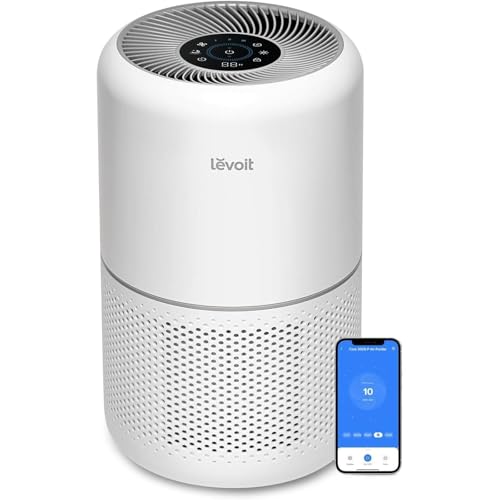
Levoit Core 300-P — The Modern Alternative
Badge: For households whose brief outgrew the tower
- Filtration: 3-in-1 cartridge — pre-filter, HEPA stage, carbon
- Verification: AHAM Verifide rating on the listing
- Coverage: rooms up to about 1,073 sq ft on the listing
- Extras: quiet sleep mode, wide cartridge-variant ecosystem
If the tower’s replacement conversation is really a format conversation — the household now wants a sleep mode worth the name, a cartridge that changes in one motion, pet and allergy variants within one ecosystem — the Core 300-P is the natural next address at a kindred price philosophy. It trades the GermGuardian’s layer-by-layer thrift for cartridge convenience and a quieter night, and its filters are stocked with the same ubiquity that made the tower’s ownership painless. Households split between the two are usually split on temperament rather than performance, and this guide blesses either direction honestly come by.
Strengths
- Verified performance with a genuinely quiet sleep mode
- One-motion cartridge changes, variants for pets and allergies
- Filter supply as wide as the tower’s own
Trade-offs
- Cartridge replaced whole — no cheap charcoal-only refresh
- Cylindrical footprint differs from the tower’s corner fit
- Light carbon, as with the tower
Best for: bedrooms wanting quiet and cartridge simplicity. Not suited for: owners who prize the layered-filter economy of the GermGuardian design. See the best tower air purifiers roundup for the format’s wider field.
There is a philosophy embedded in this little tower that its owners absorb without noticing, and it deserves a paragraph before the verdict: it is the philosophy of the maintainable thing. Nothing in the machine is sealed against its owner; every consumable is reachable, every symptom is legible, every part that wears is a part that can be bought. In a decade when appliances increasingly present themselves as oracles — sealed, sensor-fed, and mute about their own condition — the GermGuardian’s legibility is almost radical, and it is why a troubleshooting guide for it can be written with such confidence in its readers. You do not need the manufacturer’s permission, an app, or a subscription to know what your machine needs. You need a screwdriver’s worth of curiosity and this guide’s order of suspicion, and the machine meets you more than halfway, in smells and sounds that mean exactly what they seem to mean.
And a note for the household that runs several of these towers — a configuration this family’s price makes common, and its simplicity makes sane. Fleet ownership has one diagnostic superpower: the comparison. When one tower seems weak, run it beside a sibling at the same speed in the same room and compare airflow, noise, and — after an hour — effect; a clear difference indicts the weaker unit’s layers, while identical behaviour in both suggests the room’s load has changed and neither machine is at fault. Fleet ownership also disciplines the consumables: charcoal layers bought in a small stock, changed across the fleet on a rolling calendar, with dates kept on a single card. The tower was designed, whether its maker knew it or not, to be owned in platoons — and a platoon, properly rotated, almost never has a problem that survives the evening.
Finally, the guide should acknowledge the emotional register of value-appliance ownership, because it differs from the premium brands’ and it matters to the verdicts. Nobody writes love letters to a GermGuardian; nobody feels betrayed by one either. Its problems arrive without drama and leave without invoices, and its owners’ loyalty is of the durable, unglamorous kind — the loyalty owed to a kettle, a broom, a good knife. Troubleshooting such a machine is correspondingly calm work: no forums of anguish, no firmware vigils, just layers, dates, and the occasional rattle. If this article has a hope beyond the fixing of towers, it is that more appliances were built — and owned — in exactly that spirit.
Print the calendar, if you print anything, and fix it where the spare charcoal layers are kept: a monthly glance, a charcoal rhythm measured in months, a HEPA judged by evidence, a bulb on its own schedule if the feature is kept, and a corner audit once a year. The symptom sections of this guide exist for the day something speaks up; the calendar exists so that day is rare, and usually resolved before dinner. The owners who need this article least are the ones who read its shortest section as the main text — an inversion every troubleshooting guide in this series endorses, and none more cheerfully than this one, for a machine whose entire design philosophy is that maintenance should be boring.
A last word for the owner reading with a screwdriver already in hand and a certain midnight energy: this machine forgives almost everything except hurry. Its panels seat in one order, its layers face in one direction, and its problems are nearly all patient ones that will keep until morning. Work it rested, in daylight, with the manual open and the old parts laid out in the order they came off, and the tower will reward the method by being exactly as simple as it looks. The few genuinely urgent items in this catalogue — the electrical smells, the damaged cord, the cracked cabinet near the UV bulb — are urgent in the direction of stopping, not of fixing, and they are solved by an unplugged machine and a clear conscience. Everything else is a layer, a date, or a corner. It can wait for the kettle.
So the whole guide compresses, in the end, to a queue of five suspects that can be recited in a kitchen: charcoal, HEPA, bulb, seating, siting — in that order, every time, before the machine itself is suspected of anything. The queue is sorted the way all good queues are, by the joint arithmetic of likelihood and price, and it resolves, in the overwhelming run of cases, before its final member is reached. Keep the queue, keep the dates, and keep a spare charcoal layer in the cupboard, and the tower in the corner will do the rest — quietly, cheaply, and for years that embarrass machines costing five times as much, which was the family’s proposition from the beginning.
And the guide’s truly final word belongs to the used filter itself, which owners are invited, once, to actually look at before it goes into the bin: the grey gradient of a season’s air, darker at the intake face, holding in its pleats a physical census of the household — its dust, its dander, its street, its cooking, its year. That object is the machine’s whole argument made visible, and a household that has seen it once understands its purifier differently forever: not as a box that hums, but as a trap that fills, honestly and on schedule, with everything the family did not have to breathe. Change it with a small ceremony of respect. It earned it, and so, in a sense, did the tower that caught it.
And if the workup ends, as it occasionally will, at a fan at the end of its bearings on a tower that has given eight or ten years — let the guide say for this family what it has said for the premium ones, in the family’s own register: that is not a failure, and it is barely even an ending. It is a consumable the size of the whole machine, consumed. Replace it with its own successor, transfer the household’s habits and the spare charcoal layers without missing a beat, and let the old tower go with the respect due to anything that did its job, cheaply and without complaint, for a decade. Very few purchases in a home can say as much.
Keep, finally, the household notebook habit that this series prescribes for every brand and that suits this family’s layered design best of all: three dates, kept on one card in the cupboard where the spares live — charcoal, HEPA, bulb. With those three dates, every symptom in this guide becomes a ten-second diagnosis before it becomes a ten-minute one, because each layer’s age is the first fact its failure mode asks for. Without them, the same symptoms are mysteries to be solved from memory, and memory — as every filter indicator ever reset in error testifies — is the least reliable instrument in the house. The card costs nothing, takes a minute a year, and is worth more than any feature the tower does not have.
To which this guide adds its standing benediction for the family’s owners, the most self-reliant in the category: you bought a machine whose every secret is reachable with a cloth, a calendar, and ten unhurried minutes, and the years it will give you are bounded less by its construction than by your willingness to feed it layers on schedule. That is a fair trade, honestly printed on no box, and it is why this unglamorous tower will be filtering bedrooms long after louder designs have been retired by their own sophistication. Feed it, date it, and let it be boring. Boring, in a purifier, is the sound of everything working.
The family’s owners will recognise their own households somewhere in this guide — the cat bedroom, the platoon of towers, the cupboard with its card of dates — and that recognition is the guide’s final claim on their trust: these problems were not collected from a manual’s imagination but from the long, shared record of a machine that has been failing, gently and cheaply, in the same few ways in millions of rooms. A failure mode that common is not a scandal. It is a curriculum, and it is now yours.
Final Recommendation
Work this family’s problems in their own order — charcoal, HEPA, bulb, seating, siting — and you will find that nearly all of them resolve at the price of a layer or a cloth, which is the deepest compliment a troubleshooting guide can pay a design. The GermGuardian tower does not hide its condition inside an app or encode it in a sensor’s opinion; it tells you, in smell and sound and strength, exactly what it needs, and what it needs is almost always the consumable it was built around. Feed it those, on their several schedules, and the machine will repay the attention with the only thing it ever promised: years of unglamorous, adequate, honestly filtered air, at a price that never required a paragraph of justification.
Frequently Asked Questions
My GermGuardian smells like plastic or chemicals even after weeks. What is wrong?
Distinguish the new-filter note, which fades in days, from a persistent smell with a longer life. A lasting chemical note usually traces to a non-genuine filter of doubtful provenance — return or replace it with a genuine unit — or to the machine’s siting near a heat source or in a room whose own chemistry (fresh paint, new furniture) the tower is faithfully reporting. A hot or electrical character to the smell at any point ends the investigation: unplug the machine and treat it as an electrical fault.
How often should I replace the charcoal pre-filter?
On the evidence of your nose, which in practice means every few months in a pet or cooking household and at longer intervals in a quiet one — always well ahead of the HEPA filter behind it. The charcoal layer is inexpensive by design; its economy is realised by changing it on time rather than by stretching it. When familiar odors greet you at the doorway despite the machine running, the layer has finished, whatever the calendar says.
Why does my GermGuardian not remove odors anymore?
Because its charcoal pre-filter layer — the thin first stage that handles smell — exhausts months before the HEPA filter behind it wears out, and odor breakthrough is its way of reporting. Replace the charcoal layer on its own; the HEPA stage likely has substantial life left. If a fresh charcoal layer does not restore odor control, the source itself may have outgrown the machine’s light carbon, which is a sizing conversation rather than a fault.
How do I know if the HEPA filter or the fan is the problem?
Run the bare test, per your manual’s allowance: briefly operate the machine with the filter removed and compare airflow and noise. Free, quiet breathing without the filter convicts the filter — replace it, seating the new one exactly. Continued weakness and strain with no filter fitted points to the fan and mechanics, which on this family’s pricing is a replacement conversation rather than a repair one.
The UV light stopped working. Is the purifier still effective?
Yes, at everything that constitutes its real work. The UV stage is an addition to the filtration, not a part of it: particles are captured by the HEPA filter and odors by the charcoal whether or not the bulb glows. If you value the feature, replace the bulb per the manual’s instructions and schedule. If you do not, the tower filters on, honestly diminished by nothing measurable.
My GermGuardian rattles at certain speeds. What should I check?
Seating and surface, in that order. Remove and reseat the filter, the charcoal layer, and the rear panel exactly as the manual shows; set the tower on a level, softer surface if it stands on hard flooring; and run the speeds again. Most rattles are a fraction of misalignment announcing itself. A grinding or bearing note that survives reseating and a fresh filter is mechanical wear, priced against a new tower rather than repaired.
Can I wash the GermGuardian’s HEPA filter to extend its life?
No — washing destroys HEPA media’s fine structure, and a washed filter is a former filter. The charcoal pre-filter layer and the cabinet’s intake areas can be vacuumed as the manual allows, and that surface care genuinely extends the system’s life by keeping the coarse load off the HEPA. The HEPA itself is a consumable: judge it by airflow, noise, and age, and replace it when the evidence converges.
Is it worth repairing a GermGuardian tower?
Consumables, always — they are the design’s maintenance, cheaply priced and widely stocked. Mechanical or electrical faults, almost never: the current AC4825 is an inexpensive, warranted machine whose filters your household already owns habits for, and a repair bill approaches its price with none of its freshness. The honest exceptions are trivial fixes — a panel, a seating, a surface — which are not repairs so much as the troubleshooting this guide exists to teach.
Why does my GermGuardian smell of warm plastic on high speed?
A faint warm-plastic note from a brand-new tower, or from one returning to service after months in storage, is commonly reported and often fades within a day of ventilated running. Dust settled on internal surfaces can add a stale, heated smell the first time the fan works hard. Persistent or strengthening smells are different: if the odour becomes sharp, acrid or electrical, or the casing feels unusually warm, unplug the machine and contact the manufacturer rather than continuing to run it. Never spray fragrance into the intake to cover the smell; that coats the filter, adds to its load, and destroys the evidence a support team would need to diagnose a genuine fault.