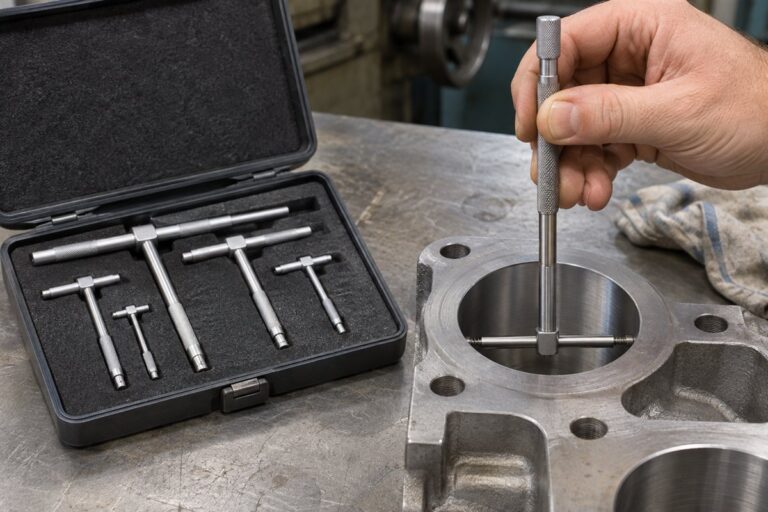
A feeler gauge is a set of thin steel blades of known thickness. You slide blades into a gap until one fits snugly, and that blade’s marked thickness is the gap. The main choices are how many blades you need, how thin and thick they run, whether they are straight or tapered and how long they are.
The six sets below range from a pocket set of 20 flat blades to a long 25 blade set with 12 inch blades. Blade counts, ranges and sizes come from each listing page and are the makers’ own claims. We have not used these sets ourselves, and you should follow the maker’s manual for use. Where a listing disagrees with itself, we say so.
As an Amazon Associate we earn from qualifying purchases. Links below are affiliate links, and they do not change the product information we give.
What to Look For
| Feature | Why it matters |
|---|---|
| Thickness range | Sets start near 0.001 inch and stop between 0.025 and 0.040 inch |
| Blade shape | Straight, tapered and offset blades reach different gaps |
| Length | Short blades fit a pocket, while 12 inch blades reach deeper |
| Markings | Dual inch and metric marks save a conversion |
In this guide
Specs at a Glance
| Set | Blades and range | Material | Notes |
|---|---|---|---|
| Spurtar 32 blade | 32 tapered; 0.001 to 0.04 in | Manganese steel | Folding case with thumbscrew; dual marked |
| PEC Tools 26 blade | 26 straight; 0.0015 to 0.025 in | Hardened and tempered high-carbon steel | Removable blades; steel case |
| Precision Brand 19G20 | 20 flat blades; 0.001 to 0.025 in | C1095 high-carbon spring steel | 1/2 by 5 inch blades; vinyl case |
| Stanley Proto J000TL | 25 blades; 0.0015 to 0.040 in | Listed as blend | 12 inch long blades; weight figures conflict |
| CRAFTSMAN CMMT14105 | 32 blades; 0.015 to 0.035 in listed | Stainless steel | Range does not fit a 32 blade set |
| GEARWRENCH 164 | 12 blades and 6 wire gauges | Not listed | Spark plug wire gaps; 1.6 oz |
The 6 Best Feeler Gauge Sets
Top pickBest for a wide range in one folding tool
1. Spurtar 32 Blade Tapered Feeler Gauge
A folding set of 32 tapered blades from 0.001 to 0.04 inch (0.03 to 1.00 mm) in manganese steel. The sizes are etched on each blade in both units, the edges are polished and the blades fold into a plated steel case with a thumbscrew. The maker also coats them with oil.
Suits: a wide range in one folding tool. Strengths: 32 blades and dual markings. Weaknesses: tapered blades only. Skip it if you want long blades.
View Spurtar 32 Blade Tapered Feeler Gauge Set on Amazon
Best for thin gaps
2. PEC Tools Straight Feeler Gauge 26 Blades
A folding set of 26 straight blades from 0.0015 to 0.025 inch in hardened and tempered high-carbon steel. The maker says each leaf is marked with its thickness and that a lock nut holds one or more blades in position. The blades are removable and can be replaced one at a time, and the set is listed as made in the USA.
Suits: thin gaps. Strengths: removable blades and a lock nut. Weaknesses: tops out at 0.025 inch. Skip it if you need thicker blades.
View PEC Tools Made in USA Straight Feeler Gauge 26 Blades on Amazon
Best for a flat case for a drawer
3. Precision Brand 19G20 Feeler Gage Poc-Kit
A pocket set of 20 flat blades, one each of 0.001, 0.0015, 0.002 and up to 0.025 inch, cut from half inch wide C1095 high-carbon spring steel. Each blade is 5 inches long and etched in metric and decimal, and the set folds flat in a vinyl case with a pocket for each blade.
Suits: a flat case for a drawer. Strengths: separate blade pockets. Weaknesses: a vinyl case rather than steel. Skip it if you want a folding fan.
View Precision Brand 19G20 Assorted 20 Piece Feeler Gage Poc-Kit on Amazon
Best for deep gaps
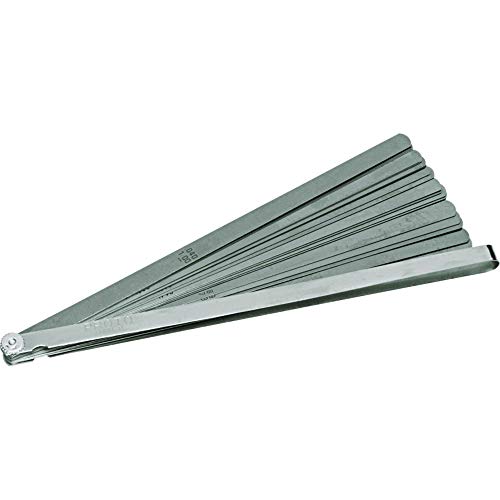
4. Stanley Proto J000TL Long Feeler Gauge
A set of 25 half inch by 12 inch blades in a steel holder, with sizes from 0.0015 to 0.040 inch etched in decimal and metric. The listing gives a measurement accuracy of plus or minus 0.001 inch. It lists 2.4 ounces in the details table but 0.72 pounds in a bullet, so the weight figures conflict.
Suits: deep gaps. Strengths: 12 inch blades and a 0.040 inch top size. Weaknesses: a conflicting weight. Skip it if you want a pocket size.
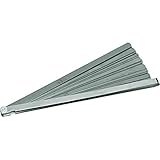
View Stanley Proto J000TL 25 Blade Long Feeler Gauge Set on Amazon

Best for stainless blades
5. CRAFTSMAN CMMT14105 32-Blade Feeler Gauge
A 32 blade set with stainless steel blades and a listed 4.2 ounce weight. The listing gives a blade range of 0.015 to 0.035 inch (0.038 to 0.889 mm), which looks implausible for a 32 blade set, since the steps would be extremely small. Check the box or the maker’s page for the real sizes.
Suits: stainless blades. Strengths: a name-brand set and stainless steel. Weaknesses: a range that looks wrong. Skip it if you need confirmed sizes.


Best for spark plug gap checks
6. GEARWRENCH 164 Feeler Gauge and Wire Gap Set
A compact set of 12 blades and 6 wire gauges in a storage case, aimed at spark plug gaps. The page lists 1.6 ounces and a 3.9 inch case. It also lists a voltage of 12 volts, which makes no sense for a hand gauge, so treat that field as an error.
Suits: spark plug gap checks. Strengths: wire gauges included. Weaknesses: only 12 blades and an odd voltage field. Skip it if you want a wide blade range.

Care and Setup
- Follow the maker’s instructions for use and storage.
- Check the marked thickness on the blades against the listing.
- Keep the set in the case the maker supplies.
Mistakes to Avoid
- Buying straight blades when you need tapered ones.
- Assuming every set covers the same thickness range.
- Trusting a listing range without reading the blade marks.
- Ignoring a listing that disagrees with itself.
What Feeler Gauges Are Used to Measure
Knowing the job comes first, because the right set depends on the gaps you actually measure. Feeler gauges are commonly used to check valve lash on engines, spark plug and points gaps on older equipment, the clearance between a cutter and a stop on woodworking machines, the gap between brake or clutch parts, and the flatness of a surface against a straightedge. Hobbyists also use them on motorcycles, small engines, bicycles, guitars and 3D printer beds.
Each task has its own typical gap range. Engine valve clearances tend to fall in the thin to medium range of the blades, while setting a large gap on a machine guide can call for the thickest blades in a set. Because the range of blades varies from set to set, check your service manual for the gap you need, then confirm that the set you are considering includes a blade at or near that thickness, plus a few sizes either side so you can feel the difference between too tight and too loose.
Think about access too. Gaps deep inside an engine bay or under a cover are easier with long or tapered blades. Gaps in shallow, open spots can be measured with short blades. A set that covers both kinds of access may cost more or take more space, so decide which situations you will meet most often.
If your work involves one narrow task, such as checking spark plug gaps, a small specialized set may serve you better than a large general-purpose one. If you tinker with many machines, a broad set is more flexible. Always follow the maker’s manual for the machine you are working on, since the correct measurement technique varies and a gauge only tells you the gap, not what the gap should be.
Straight, Tapered and Wire Gauges Explained
The list covers several blade designs, and each one has a particular strength. Straight blades are flat strips of constant width and thickness. They are the most common type and work well for most clearance checks where the blade can slide in straight. Their uniform shape makes it easy to feel a consistent drag.
Tapered blades narrow toward the tip. That makes it easier to start the blade into a tight gap and to reach into recesses, because the narrow end goes in first. The trade-off is that a tapered blade may not give an accurate reading unless it is inserted far enough that the full-width section is in the gap. The listing notes for tapered sets are worth reading so you know where on the blade the marked thickness applies.
Offset or angled blades, where the tip is bent, help reach over obstructions. Not every set includes them, so check the product page if you need one. Long blades reach deeper into openings, while short pocket blades are more compact and easier to control.
Wire gauges, such as those included with one set on this list, are round wires of known diameter used to check spark plug gaps. Round wires measure the gap between a curved electrode and a flat one more accurately than a flat blade can, because a flat blade can rest on the high spots of an electrode. If you work mostly on spark plugs, wire gauges are worth having. For other tasks, they are less useful, so a flat blade set is the more general tool.
Do not assume that more blades means better coverage. Duplicate sizes, or a pile of very similar blades, may matter less than a well-spaced range. Look at the range and step size, not just the count.
Blade Material, Finish and Accuracy Claims
Feeler gauge blades are usually made of hardened steel in some form, with carbon steel, spring steel and stainless steel all appearing in listings. The material affects how the blades wear, how well they resist rust and how they feel. Carbon-based steels can rust if left damp, so a light coat of oil and dry storage matters. Stainless steel resists corrosion better, though the real difference depends on the grade and finish.
Finish is also important. Blades should have smooth, burr-free edges and clearly marked thickness. A rough edge can scratch a surface or give a false reading, and worn or illegible markings defeat the purpose of the tool. When a set arrives, inspect each blade and test the markings against each other. A good habit is to stack two blades and confirm that their combined thickness is close to the mark of a matching larger blade, although stacking can add error and is not recommended for precise work.
Accuracy claims need careful reading. Some listings give a tolerance, while others say nothing. Treat any such figure as the maker’s own statement, not an independent measurement, and remember the note about listings that disagree with themselves. If a blade range or weight looks implausible, check the box, the manual or the maker’s website. If you need traceable accuracy for professional or regulated work, a general-purpose set may not be the right tool, and you should look for documentation of calibration.
Dual inch and metric markings are a practical bonus because they save you converting. If your manual lists gaps in millimeters but the blades are marked in thousandths of an inch, a conversion error is easy to make. Check that the markings are etched or stamped and not just printed, since printed marks wear off with use.
Using a Feeler Gauge With a Consistent Feel
A feeler gauge reading is based on touch, so technique matters as much as the tool. The aim is a slight, consistent drag: the blade should slide in with light resistance, not fall freely and not need force. Practice on a known gap if you can, so you learn what the right amount of drag feels like.
- Clean the surfaces first. Dirt, oil film and carbon deposits change the gap. Wipe the area with a clean cloth before measuring.
- Start thin and work up. Begin with a blade that slides in freely and move to thicker ones until you feel a light drag. The last blade that goes in with slight resistance is your measurement.
- Keep the blade flat. Tilting it or inserting it at an angle gives a false reading. Slide it in straight and parallel to the surfaces.
- Do not force it. Jamming a blade into a gap can bend it and damage the surface. A bent blade should be retired.
- Measure the same way each time. Use the same pressure, direction and position so readings can be compared.
- Allow for temperature. Many engine specifications are given for a cold or warm engine, so follow your service manual.
Repeat the measurement a couple of times to check consistency. If you get different results each time, the surfaces may be dirty, the part may be moving or the blade may be damaged. Always follow the maker’s manual for your equipment and for the gauge itself, and take extra care working near hot engines or moving machinery.
Storage, Wear and When to Replace a Set
A feeler gauge is a precision-style hand tool, so how you store it affects how long it stays reliable. Return blades to the case or holder after each use, and keep the case closed. Moisture and fingerprints can lead to rust on carbon steel blades, so wipe them dry and apply a thin film of light oil if the maker suggests it. Keep sets away from damp garages where possible, and avoid tossing them loose into a toolbox with heavier tools that can nick or bend them.
Handle blades by their edges or holder and avoid bending them. A kinked blade can no longer slide cleanly or give an accurate reading. If the set is a folding type, do not over-tighten any lock nut or thumbscrew, and do not use the blades to scrape or pry. That is the quickest way to ruin a thin strip of steel.
Know the signs that it is time to replace a blade or the set: markings that have faded or can no longer be read, rust pitting, bent or creased blades, rough edges and blades that no longer slide smoothly. Some sets allow individual blades to be replaced, and a few makers sell replacement leaves, so check before buying whether that is possible. For frequently used sizes, such as those common in valve adjustments, the blades near the middle of the range may wear first.
Finally, before buying, ask a few simple questions. Which gaps do I measure, and does the set cover them? Do I need flexible, long or tapered blades? Are the marks in the units I use? Does the listing contradict itself on any detail? Is the case sturdy enough for my workshop? If a listing has obvious data errors, confirm details with the seller or look at the maker’s own documentation before you rely on it.
Which feeler gauge set should you buy?
The best feeler gauge set is the one whose blade shape, length and thickness range match the gaps you measure. Use the named sets below as a starting map, then confirm sizes on the listing.
- One folding set for many jobs: the Spurtar tapered set, which lists a wide range and dual markings.
- Thin gaps with replaceable blades: the PEC Tools straight set, since its leaves can be swapped one at a time.
- A flat set for a drawer or tool bag: the Precision Brand 19G20, with a separate pocket for each blade.
- Deep gaps: the Stanley Proto J000TL, because of its long blades.
- Spark plug gaps: the GEARWRENCH 164, which adds wire gauges to its blades.
- Stainless blades: the CRAFTSMAN CMMT14105, but verify the real size range first, as the post explains.
If you are still undecided, write down the largest and smallest gap in your service manual. Pick the set that covers both with a few sizes to spare, then think about length and shape. Compare the picks above, check the current listing for the blade range and case, then choose the one that fits the work you do most.
What to check before you buy a feeler gauge set, and who should skip it
Before buying a feeler gauge set, check that it contains a blade at your required gap, that the markings are readable and that the listing makes sense. A set that fails any of those checks will cost you more time than it saves.
- Required gap: find the figure in your manual and confirm a matching blade, with sizes either side.
- Units: make sure the marks are in the units your manual uses, or are dual marked.
- Blade shape: tapered for tight starts, straight for steady drag, long for deep access.
- Case: a sturdy case protects thin blades and keeps them separated.
- Listing quality: if a listing contradicts itself, ask the seller or check the maker’s page before relying on it.
- Returns and replacements: read the return terms and see whether single blades can be replaced.
Is a larger set worth it? Only if your jobs vary. A big set means more blades to keep clean, and many may never be used. Many people do better with a well-spaced range than with the highest count.
Who should skip a basic set: anyone who needs traceable, documented accuracy for regulated work, and anyone who measures only a single known gap that a dedicated gauge already covers.
Going Deeper: How Each Pick Behaves in Real Work
A feeler gauge set looks simple on the bench, but the differences between the sets above only show up once you start measuring the same gap over and over. Blade length changes how much control you have in a tight engine bay. A folding holder changes how quickly you can find the next size. A removable blade changes what happens when one leaf gets bent or worn. This section walks through each pick in the context of the jobs people actually buy these sets for, so you can match the tool to your work instead of just counting blades.
Spurtar 32 Blade Tapered Set in Everyday Use
The Spurtar set suits owners who want one folding tool that covers a wide spread of thicknesses without carrying loose leaves around. The tapered shape helps when the opening is narrower than the blade itself, such as a recessed valve bucket or a tight contact point housing, because the narrower tip can enter where a full-width leaf would catch on the edges. In practice, the main strength here is convenience: you fan the blades, find the marked size, fold the rest away, and measure. The honest limitation is the folding format itself. If you need two blades side by side in a confined space, or you want to lay a single leaf flat on a surface plate for a comparison check, a folding set is less flexible than a set with removable leaves. Owners who measure the same few gaps repeatedly, such as a single motorcycle or a small fleet of similar engines, tend to be happiest with this style because the sizes they use most stay together and are easy to find by touch and by marking.
Who should skip it: if your work involves frequent stacking of several leaves to build up an in-between thickness, or you regularly replace individual worn blades, look at the removable-blade options below instead. Who should choose it: home mechanics, small-engine owners and anyone setting valve clearances or ignition gaps on a modest range of equipment who values a compact, self-contained tool.
PEC Tools Straight Set and the Value of Removable Blades
The PEC Tools set takes the opposite approach. Straight, removable blades reward a more methodical workflow. You can take out only the leaves you need for a job, lay them in order on a clean cloth, and work through a set of valves or a row of contacts without the whole fan getting in the way. That matters more than it sounds. A full fan dangling from the measurement point adds weight and can tilt the blade, which changes the drag you feel and can lead you to accept a gap that is not really the size you think it is. With a single leaf in hand, the feel is cleaner and easier to repeat.
The trade-off is housekeeping. Loose leaves are easier to misplace, easier to mix up between sets, and easier to leave behind in an engine bay if you are not careful. The habit that makes this style work is simple: count the leaves out, count them back in, and return them to the holder in size order every time. Machinists and careful engine builders who already work that way get a lot from this format. Casual users who only measure a gap once or twice a year may find the folding sets less fussy.
Precision Brand Poc-Kit and Pocket Work
The Precision Brand kit is built around portability. A flat pocket case protects the leaves and keeps the set together in a toolbox drawer, a glove compartment or a service van. That suits technicians who move between machines and need a dependable set on hand rather than the widest possible range on the bench. The limitation to keep in mind is that compact kits usually ask you to plan ahead: check that the thicknesses you need for your equipment are actually in the case before you rely on it as your only set. If your work spans both very thin and relatively thick gaps, pair a pocket kit like this with a broader bench set rather than expecting one small case to cover everything.
Stanley Proto Long Blades and Reach Problems
Long blades solve a specific problem: the gap is there, but your hand cannot get close to it. Deep-set valves, recessed assemblies and machinery where surrounding parts block a short leaf all reward extra length. The Stanley Proto set earns its place when reach, not range, is the limiting factor. Longer blades do ask for a lighter touch. A long, thin leaf flexes more easily, and pushing it into a gap with force can bow the blade and give a false sense of drag. The technique that works is to support the blade close to the tip with your other hand where space allows, slide it in parallel to the surfaces, and judge the drag over the full travel rather than at the first point of contact. If almost all of your measuring happens on open, easy-to-reach parts, the extra length is not a drawback, but it is not an advantage either, and a standard-length set may feel more direct.
CRAFTSMAN Stainless Set and Damp Workshops
Stainless blades appeal to owners whose tools live in damp garages, marine environments or anywhere that surface rust on plain steel leaves has been a recurring annoyance. Rust matters on a feeler gauge for a practical reason, not a cosmetic one: a roughened or pitted blade is effectively thicker and rougher than its marking says, and it drags differently, so your measurements drift without you noticing. A stainless set reduces that maintenance burden, though it does not remove it entirely. Wiping blades dry after use and storing the set closed still applies. Owners in dry, climate-controlled workshops who already oil their tools as a habit may not notice much difference day to day, while owners in humid conditions often find stainless the difference between a set that stays trustworthy and one that quietly stops being accurate.
GEARWRENCH Set and Spark Plug Work
The GEARWRENCH set stands out because it combines flat leaves with wire gauges, and wire is the better tool for many spark plug gaps. A round wire presents a consistent contact to a curved or worn electrode surface where a flat blade can bridge across high spots and mislead you. If plug gapping is a regular part of your work, that combination saves you buying a separate wire gauge set. If you never touch plugs and your work is all flat gaps such as valve lash or contact points, the wire portion adds little, and one of the flat-only sets above will suit you just as well. As with any dual-purpose tool, check that the flat-leaf range still covers the gaps you measure most, rather than choosing on the wire feature alone.
Head-to-Head: Choosing Between the Main Styles
Folding Fan Versus Removable Leaves
This is the decision that shapes daily use more than any single specification. A folding fan keeps every blade captive, is quick to search, and is hard to lose pieces from. It is the better choice for mobile work, occasional use and shared toolboxes where loose parts tend to wander. Removable leaves give a cleaner measuring feel, easier stacking and the option to replace one damaged blade instead of the whole set. They suit a fixed bench, a single careful owner and work where repeatability matters more than speed. Neither style is more accurate by itself; accuracy comes from clean, unworn blades and a consistent technique, and both styles can deliver that when they are looked after.
Tapered Versus Straight Blades
Tapered blades earn their keep in narrow openings and anywhere the entry to the gap is smaller than the gap itself. Straight blades give full-width contact along the leaf, which some users find easier to judge on open, flat gaps, and they are the natural partner for stacking because the contact area stays consistent. If you mostly measure open gaps on a bench or on accessible engine parts, straight blades feel straightforward and predictable. If you often work through small access points, a tapered set will frustrate you less. Many experienced owners end up with one of each over time, using the tapered set for access work and the straight set for bench work.
Flat Leaves Versus Wire Gauges
Flat leaves measure flat gaps. Wire gauges measure gaps between curved or uneven surfaces more honestly. The classic case is a used spark plug, where the electrodes are no longer perfectly flat. A flat blade can sit on the high spots and suggest the gap is smaller than the effective opening, while a wire of the marked size either passes with the right drag or it does not. For valve clearances, bearing clearances checked with leaves, and similar flat work, leaves remain the right tool. Let the shape of the surfaces you measure decide which form you need, and be cautious of any single tool that claims to do both jobs equally well without compromise.
A Repeatable Measuring Routine
More measurement error comes from inconsistent technique than from the set itself. The routine below works with any of the picks above and is worth practising until it becomes automatic.
- Clean the gap first. Dirt, carbon and old oil add thickness that is not part of the gap, and a blade pushed through debris tells you about the debris, not the clearance.
- Clean the blade. Wipe each leaf you plan to use on a clean cloth and check it against the light for bends, kinks or rough spots before you start.
- Work up in small steps. Begin with a leaf you expect to be slightly loose, then move up one size at a time until you find the leaf that slides with a firm, even drag.
- Keep the blade parallel. Enter the gap in line with the surfaces. A blade angled across the opening feels tighter than the gap really is.
- Judge drag over the full travel. A leaf that is tight at the entry and loose further in is telling you the surfaces are not parallel or the blade is flexing, so reposition rather than forcing a conclusion.
- Confirm with the neighbours. The size below your chosen leaf should feel clearly loose and the size above should refuse or feel excessively tight. If both neighbours feel similar, slow down and repeat.
- Record what you found. Note the measured gap and the specified gap for each position before you adjust anything, so you can see patterns across cylinders or contact sets instead of treating each one in isolation.
Building In-Between Sizes by Stacking
Stacking two or more leaves lets you check a gap that falls between marked sizes, and it is a legitimate technique when it is done carefully. Use the fewest leaves you can, prefer thicker leaves over many thin ones, and make sure every leaf in the stack is clean and flat, because a single kinked leaf adds error you cannot see. Add the markings together for your total, then confirm the stack behaves as one piece: it should enter the gap without the leaves fanning or separating. Stacking is best used for checking and comparing. For a final adjustment that you will lock down and rely on, a single leaf of the exact size, where one exists in your set, gives the most trustworthy feel.
Troubleshooting Odd Readings
The Same Gap Feels Different Every Time
Inconsistent feel usually traces back to one of a few causes. The blade may not be entering parallel, so practise the approach angle on an open gap first. The surfaces may be dirty or burred, so clean and inspect them. Your hand pressure may be varying, which is common when you are reaching into an awkward space; support the blade, slow down, and let the drag come to you rather than pushing for it. Finally, the blade itself may be worn thin in the middle from heavy use, which is a sign to compare it against a less-used leaf of a neighbouring size or to retire that leaf.
A Blade That Used to Fit No Longer Does
If a gap that previously accepted a leaf now refuses it, do not assume the gauge is at fault. Gaps change: deposits build up, parts wear, and previous adjustments settle. Clean the gap thoroughly and re-measure before concluding anything. If the cleaned gap still refuses the leaf, measure with the sizes either side to establish the new clearance, then decide whether the change is expected wear or a sign of a problem elsewhere in the machine.
Bent, Kinked or Rough Blades
A bent leaf cannot be trusted, and straightening it on the bench rarely restores its original thickness or flatness. Treat a kinked blade as finished: remove it from a removable set, or stop using that leaf in a folding set and rely on stacking neighbours if you must continue. Rough or rusted blades should be cleaned gently and re-checked; if the surface stays rough, the leaf will drag misleadingly and should be retired. This is one reason removable-blade sets appeal to heavy users: a single damaged leaf does not end the life of the whole tool.
Decision Scenarios
You Service One Vehicle You Own
Find the specified clearances for your engine first, then choose the set whose range covers those sizes comfortably with leaves to spare on either side. A folding tapered or straight set is usually the practical answer, because your measuring is occasional, the sizes are known, and keeping the tool together matters more than ultimate flexibility. Add a wire gauge or a combination set only if you also gap your own plugs.
You Run a Small Workshop
Variety is your problem: different machines arrive with different clearances, and more than one person may use the tools. A removable-blade bench set for careful work, plus a folding set that can travel to a machine, covers most situations without duplication of cost. Label which set lives where, and make leaf counts part of the end-of-job routine so losses are noticed the same day.
You Are Learning Engine Work
Choose the set that matches the clearances in the manual for the engine you are learning on, and spend your effort on technique rather than on the widest range. Practise the routine above on gaps you can verify another way, such as measuring a stack of leaves against a known reference, until your sense of drag is consistent. A mid-range folding set is a sensible place to begin; you can add a specialist set later when you know which gaps you measure most.
Care Habits That Keep a Set Honest
Feeler gauges are measuring tools, and they stay accurate only while their thickness stays true. Wipe leaves after use, especially after measuring in oily or dirty gaps, because gritty residue acts like fine abrasive the next time the blade slides. Store the set closed or in its case so the thin leaves are protected from being bent by heavier tools in a drawer. Keep the set dry; if your workshop is damp, a light protective film recommended by the maker helps, but wipe it off before measuring so it does not add to the apparent thickness. Periodically fan the set out and inspect every leaf, not just the ones you use often, because damage to a rarely used leaf is easy to miss until the day you need it. Finally, resist using leaves as scrapers, shims or pry tools. A leaf used as a shim under load can take a permanent set, and a leaf used as a scraper will not measure honestly afterwards.
Reading Results With Confidence
Understanding What Drag Should Feel Like
The correct drag is often described as the resistance of pulling a leaf through a well-fitted gap: firm, smooth and even, with no catching and no looseness. Beginners tend to accept the first leaf that enters, which biases measurements small, or to force a leaf that should not fit, which biases them large and can spring the gap open on delicate parts. A useful calibration exercise is to measure a gap you have already set with a known single leaf, then deliberately test the sizes either side until the difference between loose, correct and too tight is unmistakable in your hands. Repeat that exercise whenever you change to a different style of set, because tapered and straight leaves, and long and short leaves, each present drag slightly differently, and your hands need a short recalibration rather than a new technique.
Working on Warm Versus Cold Components
Clearances are normally specified for a defined condition, most often a cold engine, and metal parts change size as they warm. Measuring a warm component against a cold specification produces confusion that no gauge can resolve. Follow the specification’s stated condition for the machine you are working on, allow the component to reach that condition fully, and be consistent about it across every position you measure, so comparisons between cylinders or contact sets remain meaningful. If you must measure in a different condition for diagnostic reasons, record the condition alongside the reading so the number can be interpreted later rather than mistaken for a cold specification result.
Keeping a Measurement Record
A simple written record transforms feeler gauge work from a series of isolated adjustments into maintenance knowledge. Note the date, the machine, each position measured, the clearance found, the clearance specified and what you adjusted. Over time those notes reveal wear trends, show whether an adjustment is holding, and save you re-measuring from scratch at the next service. They also protect you from the commonest memory error in this work: remembering the specification from a different model or year and setting a whole engine to the wrong clearance with complete confidence.
Feeler Gauge Set FAQ
What is a feeler gauge used for?
It measures narrow gaps by sliding blades of known thickness into the space until one fits.
Which set has the longest blades?
The Stanley Proto lists 12 inch blades, while the Precision Brand set lists 5 inch blades.
How do I read a feeler gauge measurement?
Slide blades into the gap until one fits with a light drag. The thickness marked on that blade is the gap. If two blades bracket the gap, the real value lies between them.
Can I stack blades to measure a larger gap?
Many people do, but stacking adds the error of each blade and the layers can trap oil or dirt. For important work, use a single blade of the right size when possible.
Why does my blade feel different each time?
Dirt, oil film, a bent blade or a moving part can change the feel. Clean the surfaces, check the blade is flat and use the same pressure each time.
Should I buy inch or metric markings?
Choose the units your service manual or work uses. Sets with both markings save conversions, but check that both are etched or stamped on the blade and not just printed.
Do feeler gauges rust?
Carbon steel blades can rust in damp conditions, while stainless steel resists it better. Wipe blades dry, add a thin film of oil if the maker suggests it and keep the set in its case.
Can I use a feeler gauge to check spark plug gaps?
You can, but round wire gauges are generally better for curved electrodes because a flat blade may sit on the high spots. Follow your equipment manual for the correct gap and method.
How do I know if a blade is worn out?
Look for faded markings, bends, rust pits or rough edges. If a blade no longer slides smoothly or the size cannot be read, replace it or the set.
How many blades do I need in a feeler gauge set?
You need enough to cover your required gap with sizes on either side. Beyond that, extra blades add little. Look at the range and step size instead of just the count.
Are tapered or straight feeler gauges better?
Neither is better in general. Tapered blades start easily in tight gaps, while straight blades give a consistent drag. Choose by the access you have.
Can I use a feeler gauge to set valve lash?
Many people do, since valve clearance is a common use. Follow your engine's service manual for the specified gap, temperature and method. A gauge only reports the gap, not what it should be.
What is the difference between inch and metric feeler gauges?
They measure the same gaps but mark the blades in different units. Use the units in your manual to avoid conversion errors. Dual-marked blades cover both.
Why is my feeler gauge blade bent?
Blades usually bend when forced into a gap or used to pry or scrape. A bent blade can give false readings, so retire it. Insert blades straight and never force them.
How do I clean a feeler gauge?
Wipe the blades with a clean, dry cloth, then add a thin film of light oil only if the maker suggests it. Keep them in the case and away from damp. Do not scrub the markings.
The Short Version
For a wide folding range, the Spurtar. For removable blades, the PEC Tools. For a flat pocket case, the Precision Brand. For long blades, the Stanley Proto. For stainless steel, the CRAFTSMAN. For spark plug gaps, the GEARWRENCH.