A drill stand holds a hand drill on a column or in a guide so the bit travels in a straight line, much like a small drill press. Some are full column stands with a rack, others are compact guides that clamp on the drill, and one here is a stand for a rotary tool. The main choices are the collar size, the travel, the angle range and the base.
The six stands below cover a Euronorm column stand, a mobile stand, two portable guides, a bench stand and a rotary tool stand. Sizes and features come from each listing page and are the makers’ own claims. We have not used these products ourselves. Where a listing looks wrong, we say so.
As an Amazon Associate we earn from qualifying purchases. Links below are affiliate links, and they do not change the product information we give.
What to Look For
| Feature | Why it matters |
|---|---|
| Collar fit | The drill’s neck must match the clamp, such as 43 mm |
| Travel | Sets how deep a hole you can drill in one pass |
| Angle range | Guides with set angles help with angled holes |
| Base | A wide base or bolt slots keep the stand steady |
In this guide
Specs at a Glance
| Stand | Fits | Capacity | Notes |
|---|---|---|---|
| wolfcraft 5027000 | 43 mm Euronorm neck | 40 mm wood; 10 mm metal | Die-cast aluminium; 420 mm rack; depth stop |
| Wolfcraft 4522 | 43 mm drills | 1.69 in listed | Dust port; V-groove; base plate |
| Milescraft DrillMate | 3/8 and 1/2 in cordless drills | 3/8 in chuck included | 45, 60, 75 and 90 degree settings |
| Kreg Drill Guide Pro | 3/8 and 1/2 in cordless drills | 3/8 in chuck included | -45 to 45 degrees; dust port; 3.1 lb |
| WQV vertical stand | Collar 1.50 to 1.65 in | 1.65 in listed | Height and 0 to 90 degree angle; 7.7 lb |
| Dremel 220-01 | Dremel rotary tools | 2 in depth | 15 degree steps to 90; 4.9 lb |
The 6 Best Drill Stands

Top pickBest for repeat straight holes with a 43 mm drill
1. wolfcraft Drill Stand I 5027000
A die-cast aluminium column stand with a Euronorm collar of 43 millimeters, a 40 millimeter round column and a 420 millimeter toothed rack. A depth stop with a quick adjuster and a scale ring sets depth to the millimeter. The page lists drilling capacity of 40 millimeters in wood and 10 millimeters in metal, and a weight of 7.98 kilograms.
Suits: repeat straight holes with a 43 mm drill. Strengths: a rack feed and a depth scale. Weaknesses: heavy and tied to the 43 mm neck. Skip it if your drill neck is another size.

View wolfcraft Drill Stand I 5027000 I For controlled drilling on Amazon

Best for holes along a line and on round stock
2. Wolfcraft 4522 Tec Mobil Drill Stand
A mobile stand for 43 millimeter drills with a straight guide for drilling a line of holes, an extra handle for placement, a dust extraction port and a V-groove for round parts. The page includes odd figures, such as wind powered, 33600 amps and 45 newton meters, that do not describe a stand, so we ignore them. Check the maker’s manual for real limits.
Suits: holes along a line and on round stock. Strengths: a dust port and V-groove. Weaknesses: unreliable spec lines on the page. Skip it if you want clean, trustworthy data.


Best for angled and edge holes with a cordless drill
3. Milescraft DrillMate Portable Drill Guide
An all-metal guide that attaches to 3/8 and 1/2 inch cordless drills and includes a 3/8 inch chuck with key. It offers locking angle settings of 45, 60, 75 and 90 degrees and a self-centering base for round stock up to 3 inches. The maker says the rubber feet can be removed to mount it as a jig. The page lists a weight of 1.81 grams, which cannot be right.
Suits: angled and edge holes with a cordless drill. Strengths: fixed angle settings. Weaknesses: small chuck and a wrong weight figure. Skip it if you need a column stand.

View Milescraft DrillMate Portable Drill Guide Adjustable Precision Drilling Jig on Amazon
Best for angled wood holes with dust control
4. Kreg Drill Guide Pro (KDG6500)
A portable guide for 3/8 and 1/2 inch cordless drills with an included 3/8 inch chuck and key. The maker lists adjustable angles from -45 to 45 degrees without fixed stops, a built-in dust collection adapter, a depth stop, non-slip feet and a V-groove. The page gives 3.1 pounds and 2.5 by 6 by 12 inches, and no spec table.
Suits: angled wood holes with dust control. Strengths: stepless angles and a depth stop. Weaknesses: limited spec detail on the page. Skip it if you want a rack feed.
View Kreg Drill Guide Pro, Portable, Adjustable Woodworking Drill Guide, KDG6500 on Amazon
Best for a bench setup that tilts
5. WQV Vertical Drill Stand
A benchtop stand for drills with a collar diameter of 1.50 to 1.65 inches. The head adjusts in height and in angle from 0 to 90 degrees, and an aluminum alloy base can be screwed to a bench. Crossing slots in the base hold a vise or mold. The page lists 7.7 pounds, and the power line says corded electric at 110 volts, which describes the drill, not the stand.
Suits: a bench setup that tilts. Strengths: angle and height adjustment. Weaknesses: a narrow collar range. Skip it if your collar is outside 1.50 to 1.65 inches.
Best for small, fine drilling
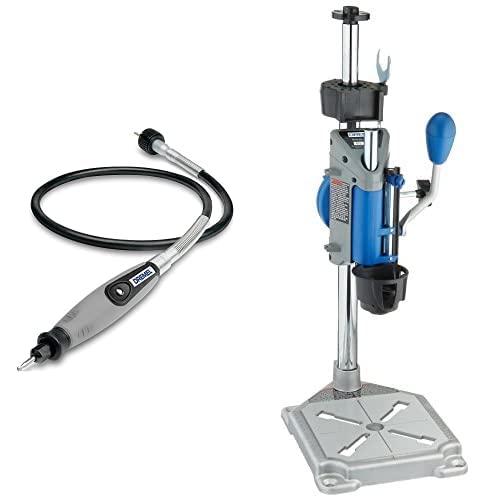
6. Dremel Drill Press Rotary Tool Workstation Stand (220-01)
A stand for Dremel rotary tools, not for a full size drill. It drills straight and angled holes in 15 degree steps up to 90 degrees, with a depth capacity of up to 2 inches, a depth stop, inch and metric markings and cord clips. A base with four clamping points is listed. The maker names fit with Dremel 4300, 4000, 3000, 200, 100, 8250, 8240 and 8220 tools. A bullet gives a telescopic height of 16 to 29 inches for the flex shaft use.
Suits: small, fine drilling. Strengths: angle steps and a depth stop. Weaknesses: only for listed rotary tools. Skip it if you use a full size drill.

View Dremel Drill Press Rotary Tool Workstation Stand, 220-01 on Amazon
Care and Setup
- Measure your drill’s collar or neck before you order.
- Clamp or bolt the base to the bench and follow the maker’s manual.
- Keep the column or rods clean and lightly oiled.
- Set the depth stop before you drill.
Mistakes to Avoid
- Buying a stand whose clamp does not match the drill neck.
- Trusting spec lines that make no sense.
- Using a rotary tool stand for a large drill.
- Skipping a clamp on the work.
Drill Stand, Drill Guide or Drill Press: Which Fits
Three tools solve the same problem of keeping a hole straight, and they differ a lot in size and cost. A drill press is a freestanding or bench machine with its own motor. A drill stand holds your hand drill in a frame, usually on a column with a base, and you lower the drill with a lever or rack. A drill guide is a smaller device that clamps to the drill or sits on the work and keeps the bit square or at a set angle. The picks in this guide include all of these types except a full press.
A column stand suits repeated straight holes, especially in wood or soft metal, where you want consistent depth and a stable platform. It needs bench space and holds a drill that matches its clamp. A guide is lighter and portable. It fits small shops, job sites and users who drill at several angles. A rotary tool stand, like the Dremel pick, is for small, light work with a rotary tool and does not replace a stand for a full-size drill.
Questions to settle first:
- Do you drill the same kind of hole many times, or do you need angled and varied holes?
- Is it a permanent bench setup or something you carry?
- Do you already own a corded drill with a standard neck, or a cordless drill with a large body?
If you do precision work often and have the space, a true drill press may be a better long-term investment than a stand. A stand gets you most of the way for far less space and money, and many people find that adequate for home and hobby work.
Matching Your Drill to the Clamp
Compatibility is the most common reason a stand disappoints. Many corded drills have a round neck behind the chuck, commonly 43 millimeters on European drills, and stands such as the wolfcraft entries listed here are built for that collar. Other drills have a different neck diameter, a tapered body or no round collar at all, and a clamp that does not match will hold the drill loosely or tilted. Measure the neck of your drill with calipers or a tape before you order, and compare the number to the listing.
Cordless drills are trickier. They often have no neck at all, so the guide-style products listed here, like the Milescraft and Kreg, clamp onto the drill body or use the chuck. Listings tend to name the chuck sizes they cover, such as 3/8 and 1/2 inch. The WQV stand in this guide lists a collar range, and a drill whose collar falls outside that range will not fit. Do not assume a universal clamp will work for every drill.
- Measure the neck diameter and note the chuck size.
- Check whether the drill is corded or cordless, and how heavy it is.
- Confirm that your drill’s handle and trigger can clear the stand’s column or frame.
- Read the listing for any weight limit on the clamped tool.
If a listing leaves out the fit information, ask the seller or choose another model. A poor match is both frustrating and unsafe.
Depth, Travel and Precision
Once the drill fits, the next question is how well the stand controls the hole. Travel is the distance the drill can move down in a single pass. A short travel is fine for thin boards and sheet metal, but deeper holes need a longer column or a stand that you can adjust. Some stands use a rack and pinion with a handle, which gives smooth, controlled feed. Others use a simple lever or slide. A rack feed gives better control when drilling harder material.
A depth stop is one of the most useful features. It lets you set the maximum depth so you do not go through the workpiece or drill past a mark. Some stands include a scale ring or a quick adjuster that sets depth in millimeters or fractions of an inch. Check that the stop locks firmly and does not creep.
Rigidity is the third factor. A rigid column and a sturdy base prevent the drill from flexing, which keeps the hole square. A thin or lightweight stand may flex under load, producing holes that wander or enlarge. After you assemble the stand, check squareness with a small engineer’s square against the bit and the base. If the bit is not square, adjust per the manual before you drill.
- Longer travel and a rack feed suit repeat work and deeper holes.
- A depth stop with a clear scale saves time and mistakes.
- A heavy, wide base improves stability.
Angles, Bases and Workholding
Straight holes are the most common need, but some jobs call for angles, such as pocket holes, dowel joints or drilling into a sloped surface. A guide with preset angles, like those listed for 45, 60, 75 and 90 degrees, makes angled work easy to repeat. One with a stepless range lets you pick any angle in the range but may take more effort to set accurately. A stand that tilts at 15 degree steps is easier for repeat settings than one with a free pivot.
The base determines how the stand sits and how it can be secured. A wide base with slots or holes lets you bolt it to a bench, which is the best way to prevent movement. A base with a V-groove helps hold round stock such as pipe or dowel. A dust port, found on some entries here, helps connect a vacuum and keeps the work area cleaner.
Workholding is just as important as the stand. A stand cannot hold the workpiece for you, and a spinning bit can grab thin material and spin it. Clamp the work to the base or the bench, and use a backer board under the hole so the bit does not tear out the underside.
- Clamp the work every time, even for small holes.
- Use a sacrificial block under the work to prevent breakout.
- Check that angle locks are tight before you start the drill.
Good workholding matters more to accuracy than most extra features.
Setup, Speed Settings and Upkeep
Proper setup turns an adequate stand into an accurate one. Place the stand on a flat, solid bench, and bolt or clamp it down if the design allows it. Mount the drill following the maker’s manual, tighten the clamp evenly and make sure the drill cannot slide. Then check that the bit is square to the base before you drill into good material, and test on scrap.
Match speed to the material. Larger bits and harder materials generally call for slower speeds, while small bits in softer materials can run faster. Use sharp bits, because a dull bit drags and pushes harder against the stand, which reduces accuracy. For metal, mark the spot with a center punch, and consider a lubricant if the maker advises it. Withdraw the bit from time to time when drilling deep holes to clear chips.
Keep the stand in good condition:
- Wipe the column or rods clean and apply a light oil as the manual recommends.
- Check that the clamp screws and locks stay tight, since vibration can loosen them.
- Keep dust out of the sliding parts, using the dust port if available.
Signs of trouble include a column that wobbles, a clamp that no longer grips, play in the feed handle and holes that come out crooked even when you set things up carefully. When those problems appear and cleaning and tightening do not fix them, a replacement is better than fighting an inaccurate tool. A rotary tool stand should be used only with the tool it was designed for, and never with a large drill.
Which drill stand should you buy?
The best drill stand is the one that fits your drill and the kind of holes you make most often. Decide between straight holes, angled holes and small precision work, then match the pick.
- Repeated straight holes with a corded 43 mm drill: the wolfcraft 5027000 offers a rack feed and a depth scale.
- A line of holes or holes in round stock: the Wolfcraft 4522 has a straight guide and a V-groove, though its spec lines need checking in the manual.
- Angled holes at preset angles on a cordless drill: the Milescraft DrillMate lists locking settings.
- Any angle in a range, with dust collection: the Kreg Drill Guide Pro lists stepless angles and a dust port.
- A bench stand that tilts and adjusts in height: the WQV vertical stand, provided your drill collar falls within its listed range.
- Small, fine drilling with a rotary tool: the Dremel 220-01, which is only for the rotary tools it names.
When two options seem close, let your drill decide. A stand that cannot grip your drill is no bargain, and a guide that fits your chuck may serve you better than a column stand that does not. Compare the picks, then open the listing buttons above to confirm fit.
What to check before you buy a drill stand, and who should skip it
Before you buy a drill stand, check the clamp fit, the travel and the base, since these decide whether it works with your drill at all. Do the checks on the listing and in the manual rather than relying on the title.
- Neck or collar diameter of your drill against the listed clamp size.
- Chuck size covered, if the product is a guide for a cordless drill.
- Travel and depth stop, so the stand can reach the depth you need.
- Base: bolt slots, width and whether it can be fixed to a bench.
- Angle range and whether the lock holds firmly.
- What is included, such as a chuck, key or dust adapter.
- Weight of the stand and whether your bench can take it.
- Warranty and return terms on the listing.
Weigh the trade-offs honestly. A guide is portable but less rigid than a column stand. A column stand gives better control but ties you to a drill with the right neck and takes bench space. Some listings in this guide include doubtful figures, so confirm limits in the maker’s manual.
Skip a stand if you drill rarely and freehand holes are good enough, or if you already have space and budget for a true drill press. Skip the Dremel stand if you use a full size drill. Compare the picks above, check the current listing for fit and what is included, then choose the one that suits how you will use it.
Drill Stand FAQ
What is the difference between a drill stand and a drill guide?
A stand has a column and a base and feeds the drill down. A guide clamps to the drill and keeps the bit straight or at a set angle.
Which one tilts to angles?
The Milescraft, Kreg, WQV and Dremel list angle adjustment. The wolfcraft stands list straight drilling.
Will any drill fit any drill stand?
No. Stands clamp to a specific neck diameter or chuck size, such as 43 mm on some models, and guides list the chuck sizes they cover. Measure your drill and compare the figure with the listing.
Can I use a cordless drill in a column stand?
Only if the stand's clamp can grip it. Many cordless drills have no round neck, so a guide that clamps to the body or chuck may be a better match. Check the listing for compatibility.
Is a drill stand as accurate as a drill press?
It can give straight, repeatable holes, but accuracy depends on the rigidity of the stand, the fit of the drill and good workholding. A true drill press is usually more rigid.
Do I need to bolt the stand to the bench?
It is best to if the base has slots or holes. A fixed base prevents movement and improves accuracy, especially with larger bits.
What does a depth stop do?
It limits how far the bit can travel, so you can drill to a set depth without going through the work. Check that it locks firmly.
Can I drill angled holes with a stand?
Some stands and guides tilt or have preset angles. Check the listing for the range, and make sure the lock is tight before you start.
How do I check that the bit is square?
Hold a small engineer's square against the bit and the base. If there is a gap, adjust the stand according to the manual before drilling.
Is a drill stand worth it for occasional use?
It can be if you need straight, repeatable holes in joinery or metal. For a few rough holes, a hand-held drill is usually enough. A compact guide is a lighter commitment than a column stand.
Can I use a drill stand as a drill press?
It can imitate one for light work, but it is usually less rigid than a press. Expect good results in wood and soft metal, and check the maker's capacity figures before drilling harder material.
Can a drill guide hold the drill at 90 degrees for pocket-free dowel holes?
Guides with a square setting are made for that kind of work. Clamp the workpiece, set the stop and test on scrap to confirm the hole is square.
How tight should the drill be clamped in a stand?
It should be firm enough that the drill cannot slide or twist under load, but not so tight that it distorts the housing. Follow the manual and recheck after the first few holes.
Does a dust port on a drill guide really help?
It helps when connected to a vacuum, because it pulls chips away from the bit and the line of sight. It will not catch everything, so wear eye protection anyway.
What should I do if the holes drift off line in a stand?
Check that the drill is seated, the work is clamped, the bit is sharp and the column is square to the base. A dull bit or a loose clamp is a common cause.
What a Drill Stand Can and Cannot Promise: Precision in Plain Terms
A drill stand turns a handheld drill into a guided tool, and the quality of the result depends on three separate things that marketing tends to blur together. The first is guidance: the carriage or guide bushings keep the bit travelling in a straight line instead of wandering as your wrist tires. The second is squareness: the base must sit flat and the column must stand at a true right angle to it, or every hole inherits the same lean. The third is control of depth and feed: a stand with a smooth return spring and a readable depth stop lets you repeat a hole depth across a whole project instead of guessing by eye. No stand in this guide turns a handheld drill into a machining centre, and none should be asked to. What the best of them do — the wolfcraft 5027000 as a column stand, the Milescraft DrillMate and Kreg Drill Guide Pro as portable guides — is remove the human wobble from ordinary drilling in wood, flat-pack furniture, dowelling and light metal, which is where most home drilling actually happens.
Judge any stand you are considering by how it handles the moment the bit meets the work. A stand whose base flexes, whose clamp lets the drill creep, or whose carriage has side play will produce a hole that starts in one place and finishes in another, no matter how impressive its angle scale looks. Conversely, a modest guide with tight bushings, a flat base and a drill clamped firmly will drill a straighter hole than a tall column stand used carelessly on a dusty, uneven bench. That is why the checks later in this section — seating the base, test-drilling in scrap, verifying square with the bit lowered by hand — matter more than any single specification, and why two users can report opposite experiences with the same product: the stand is only half of the system, and the drill, the bit and the setup are the other half.
Column stand, portable guide and rotary workstation are different tools
Keep the three families in this guide separate in your mind. The wolfcraft 5027000 and the WQV vertical stand are bench tools: the work comes to them, the drill stays mounted, and they reward a permanent spot on the bench. The Wolfcraft 4522 Tec Mobil, Milescraft DrillMate and Kreg guide are portable: the guide goes to the work, which is the only practical answer for drilling into an assembled cabinet, a door on its hinges or a board too long for any bench. The Dremel 220-01 workstation belongs to neither camp; it is a dedicated holder for a rotary tool, aimed at small, precise holes in craft, model and light hobby material, and judging it by the standards of a full-size drill stand misses its point entirely.
Scenarios From Real Jobs, Matched to the Picks
Dowelling a bookcase or a tabletop edge is the classic portable-guide job. The holes must be vertical, evenly spaced and the same depth, and the workpiece is far too large to move to a bench press. This is Milescraft DrillMate and Kreg Drill Guide Pro territory: clamp or hold the guide firmly on the edge, set the depth stop on the bit, and work along the line, clearing chips between holes so the guide reseats flat every time. The Kreg’s stepless angle adjustment earns its keep when the joint is not square, while the Milescraft’s fixed angle settings suit the common angles that repeat across furniture work. The Wolfcraft 4522 adds a different trick for this kind of job — line drilling along a fence-like reference — which suits shelf-pin holes and repeated rows where spacing consistency matters more than any single hole.
Bench-based repetitive drilling is the column stand’s moment. Drilling a batch of identical wooden parts, model components or small brackets on the wolfcraft 5027000 or the WQV, you set the depth once, position each part against a simple stop block clamped to the base, and drill without re-measuring. The job becomes fast precisely because the stand holds the drill and you hold the work with both hands free to position it — the reverse of handheld drilling. Keep the base bolted or firmly clamped for this work; a stand that skates a few millimetres when the bit grabs will ruin the batch consistency you bought it for.
Small-scale precision work — drilling tiny holes in model parts, jewellery findings, circuit-board material or thin craft metal — is where the Dremel workstation makes sense and where a full-size drill, however well guided, is simply the wrong tool: too heavy, too coarse in its speed control, and fitted with bits far larger than the work needs. Conversely, do not ask the Dremel stand to drill construction lumber. Matching the stand family to the scale of the work is the single most common buying mistake in this category, and it is entirely avoidable by naming your three most frequent jobs before you order.
Head-to-Head Comparisons That Decide the Purchase
wolfcraft 5027000 vs WQV vertical stand
Both are bench column stands, so the decision rests on execution rather than concept. The wolfcraft is the more established design with a depth scale that supports repeatable work, and it suits a user setting up a semi-permanent drilling station. The WQV tilting stand answers when angled holes on the bench are a regular need rather than an exception. If your bench work is overwhelmingly vertical, choose the stand that does vertical best and solve the rare angled hole with a wedge or jig; if angled bench drilling is weekly work, the tilting base stops being a feature and becomes the requirement.
Milescraft DrillMate vs Kreg Drill Guide Pro
These portable guides compete directly. The Milescraft leans on positive, fixed angle stops — quick to set, hard to set wrong — which suits users who drill the standard angles repeatedly and want to move fast. The Kreg offers stepless angle adjustment and dust extraction, which suits users whose work includes odd angles, interior work where dust matters, and longer sessions where a cleaner cut and a cleaner room both count. Neither is universally better; the question is whether your projects speak in standard angles or in whatever angle the existing building happens to present.
Any stand vs saving for a bench drill press
Be honest about volume and material. A stand or guide used a few times a month on wood and light material is a rational, space-saving purchase. A user drilling metal weekly, needing variable speeds, a tilting table and a chuck that runs true under load, will outgrow any stand quickly and should treat the stand as a portable complement rather than a substitute. Many experienced shops own both: the press for the bench, the guide for the work that cannot come to the bench.
Setup, First Use and Getting Square
Unplug the drill or remove its battery before mounting it in any stand — mounting involves both hands near the chuck and trigger, and that is exactly when accidental starts happen. Seat the drill’s collar fully in the clamp, tighten evenly, and check that the drill body cannot rotate under a firm hand twist; a drill that twists in the clamp will drill oval holes and can jam. With the drill still off, lower the bit by hand beside a square or against the edge of a known-flat block resting on the base, and rotate the chuck slowly: the gap between bit and block should stay constant. If it does not, shim or reseat the base, clean swarf from under it, and check the column fixings before blaming the drill.
Make your first holes in scrap of the same material. Set the depth stop a fraction shallow, drill, measure the actual depth, then adjust — depth stops are set by trial on every stand in this guide, and the trial belongs in scrap, not in the workpiece. Use the drill’s speed setting appropriate to the bit and material, let the bit reach full speed before contact, and feed with steady, moderate pressure: a stand removes wobble, not the need for technique, and forcing a dull bit through hardwood will burn the hole walls in a stand just as surely as it does freehand. For portable guides, clamp the guide where the layout allows it rather than relying on hand pressure alone, especially for the first hole of a run, which sets the pattern for the rest.
A quick accuracy routine to repeat monthly
Drill two holes in a thick scrap block, insert two straight rods or bit shanks, and sight along them from two directions. Parallel rods mean the setup is square; rods that converge or splay mean something has shifted — a knocked column, a worn bushing or a base that no longer sits flat. Two minutes, once a month, catches drift before it reaches a real project.
Troubleshooting: Holes That Drift, Lean or Tear
Work in this order. First, the base: is it fully seated, clean underneath and clamped or bolted as the job requires? More leaning holes trace back to a base rocking on a chip or a bench bow than to any defect in the stand. Second, the clamp: can the drill rotate or creep in its mount under load? Re-seat the collar and re-tighten. Third, the bit: a bent or dull bit starts where it wants, not where you point it, and no guide can fully correct a bit that is already deflecting; swap in a known-good sharp bit and repeat the test hole before adjusting anything else. Fourth, the carriage or bushings: lower the drill slowly with the motor off and feel for side play or a gritty patch in the travel; clean the column, and treat persistent play as wear.
Fifth, your feed: entering too fast, especially at an angle setting, lets the bit skate across the surface before it bites — start the hole with a centre punch mark in metal or an awl mark in wood, touch the spinning bit down lightly to establish the start, then feed. Sixth, the material itself: grain that runs steeply, knots, and the boundary between earlywood and latewood all steer a bit, which is why a test hole in the actual offcut predicts more than any specification. If holes lean consistently in one direction across different bits and materials, the column-to-base squareness has shifted and needs the setup routine again; if they lean randomly, the fault is almost always seating, clamping or the bit — the first three steps, repeated patiently.
Care, Storage and a Decision Guide by User
Stands live on benches and collect the dust their own work creates. Brush the column and carriage, keep sliding surfaces clean and very lightly lubricated only where the maker allows it, and check the return spring and depth-stop fixings for looseness every few sessions. Portable guides belong in a case or drawer, not loose in a toolbox where their machined faces and bushings get knocked by heavier tools. Store a column stand with the carriage lowered and the drill removed if the bench is shared, both to save space and to stop the mounted drill becoming a lever that bends something when it is knocked.
Choose by the work you can name. The furniture and flat-pack improver drilling dowels and shelf pins in large pieces should start with the Milescraft or the Kreg, decided by the fixed-versus-stepless angle question above. The bench-based hobbyist making repeated small parts should start with the wolfcraft 5027000, or the WQV if angled bench work is routine. The user whose drilling is mostly on site, in assembled furniture or in rooms where the work cannot move, is the Wolfcraft 4522’s natural owner. The modeller and craft worker should skip full-size stands entirely and take the Dremel workstation. And the user who cannot name a recurring guided-drilling job at all should borrow or buy the simplest guide first — a stand earns its bench space through repetition, not through the hope of it.
Three Worked Jobs: Shelf Pins, a Batch of Parts and a Door Hung in Place
Concrete jobs show where each stand type earns or loses its keep. First, a row of shelf-pin holes inside a built bookcase — a portable-guide job by definition, since the bookcase cannot come to the bench. The winning habits are reference and rhythm: register the guide against the same face for every hole so spacing errors do not accumulate, set the depth stop once on a test piece of the same material, and clear chips from the guide’s seat between holes, because a guide resting on its own dust is a guide drilling at a small, random angle. The Wolfcraft 4522’s line-drilling character and the Kreg and Milescraft guides all serve this job; the differentiator in practice is how positively each registers against your reference edge, which is a thing to test with your hands, on your furniture style, before the day of the job.
Second, a batch of identical small parts on the bench — the column stand’s showcase. Set the wolfcraft 5027000 or the WQV up once with a stop block on the base, verify the first part completely, and the batch becomes a rhythm of position, drill, clear, repeat. The failure mode to guard against is drift by familiarity: by part twenty, the stop block has been nudged, the base has crept, or the depth stop has settled, and the parts have quietly diverged. Re-verify against the first part at intervals — every ten parts is a sane rhythm — because a batch setup, like every repeatable setup, repeats its errors with the same fidelity as its successes.
Third, drilling a door in place for a new lock or hinge — the job where portable guides justify their existence to sceptics. The work is vertical, the surface is finished, and a slipped start is a visible scar. Centre-mark with an awl, clamp the guide where the door’s construction allows, start the bit slowly until the hole is established, and protect the finished face around the guide with tape or a thin pad that does not compromise the guide’s seating. A column stand cannot help you here at any price, which is the cleanest illustration in this guide of why portability is a capability and not a compromise.
Ownership: Bushings, Springs and Knowing a Stand’s Remaining Life
A drill stand’s working life is written in its moving interfaces. Guide bushings wear oval where the bit passes most; columns develop play where the carriage travels most; return springs soften; depth-stop threads wear where they are set most often. Each wear point has a simple test already described in this guide — the two-rod squareness check, the slow-travel feel test, the depth repeatability trial — and the ownership habit that matters is running those tests on a schedule and writing the results down, so wear is a trend you observe rather than a failure you meet mid-project. A stand that passes its tests is not old; a stand that fails them is not serviceable, whatever its age, and confusing the two in either direction wastes money.
Spares and support should figure in the purchase for any stand you expect to keep. Bushings, springs and clamps are the parts that wear, and a maker who supplies them turns a worn stand into a maintained stand. Where parts are unavailable, the honest lifecycle is use, test and replace as a unit — acceptable for a portable guide bought for occasional work, less acceptable for a bench installation you have built a workflow around. Finally, store the stand as you would have it found: drill removed, carriage lowered, base clean, portable guides cased. A stand stored under bench clutter arrives at its next job pre-damaged, and its first holes of the day will report the fact whether you test it or not.
Before You Order: A Five-Check Fitting Exercise
Run these checks with your actual drill and your actual work in mind. First, the collar: measure or confirm your drill’s mounting collar against the stand’s clamp range, because a drill that cannot be clamped as designed cannot be guided as designed, and adapters improvised at the bench rarely restore the original accuracy. Second, the work envelope: name your largest and smallest regular jobs and confirm the stand serves both — travel and throat for the large, fine control for the small. Third, the bench or the workpiece: decide where the stand will live or travel, and confirm the base can be secured there as the maker intends. Fourth, the angle question: list the angles you have actually drilled in the past year, honestly, and let that list — not an imagined future — choose between fixed stops and stepless adjustment. Fifth, the drill press question, asked one last time: if your honest job list is weekly metal drilling at the bench, redirect the budget; if it is guided holes in wood, furniture and large work, proceed with confidence.
Keep the results of that exercise with the tool. When a stand disappoints later, the checklist tells you whether the disappointment is a setup fault you can correct or a purchase mismatch you should correct by resale and replacement — two problems with opposite solutions that feel identical from behind the drill. Distinguishing them early is the last skill this guide can give you, and it is worth the five minutes it costs.
The Short Version
For a column stand with a depth scale, the wolfcraft 5027000. For a mobile line-drilling stand, the Wolfcraft 4522. For fixed angles, the Milescraft. For stepless angles and dust, the Kreg. For a tilting bench stand, the WQV. For a rotary tool, the Dremel.