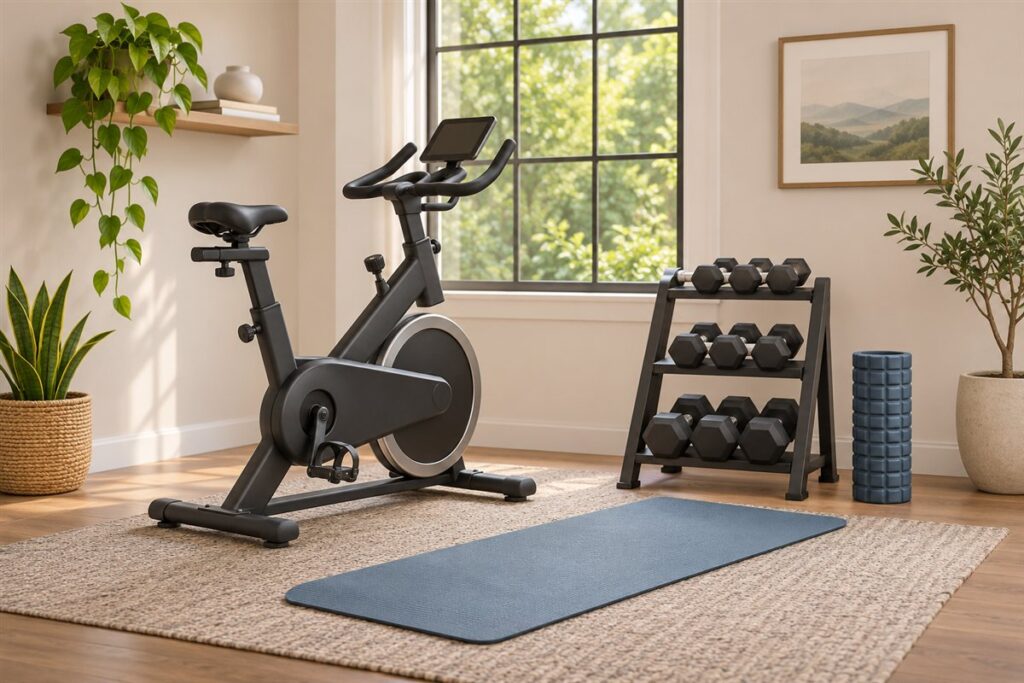
An air bike is a stationary exercise bike that uses a large fan as its resistance. The harder you push and pull the handles and pedals, the more resistance the fan creates, so one machine covers easy warm-ups and all-out intervals without any dial to adjust.
Air bikes suit home gym owners, garage trainers and anyone who wants a full-body cardio machine with few moving parts. We have not used these products ourselves; this guide compares listing information so you know what to weigh before you buy.
As an Amazon Associate we earn from qualifying purchases. Links on this site are affiliate links, and they do not change the information we give.
What to Look For
| Factor | Why it matters | What to check |
|---|---|---|
| Frame and footprint | A steady frame keeps hard efforts from rocking the bike. | Check frame material, floor space and the maker’s stated user weight limit. |
| Drive system | Belt and chain drives differ in noise and upkeep. | See which drive the listing names and what upkeep it asks for. |
| Console | A clear display helps you follow intervals and distance. | Look for timer, interval modes and whether it needs batteries. |
| Seat and handles | Fit decides whether long sessions feel comfortable. | Check seat adjustment range and handle grip material. |
| Moving it | Heavy machines are awkward to shift around a garage. | Look for transport wheels and a stated assembled weight. |
| Assembly | Some arrive in many parts and need patience. | Read about tools included and the manual’s step count. |
Setup and Care Tips
- Place the bike on a flat, firm floor or a mat so it stays level.
- Adjust the seat height and reach before your first full session.
- Wipe sweat from the frame and console after each workout.
- Check bolts and pedals for looseness every few weeks.
- Follow the maker’s lubrication guidance for the drive.
Mistakes to Avoid
- Buying on looks alone and ignoring the frame weight limit.
- Skipping seat adjustment and then blaming the bike for discomfort.
- Putting the machine on a sloped or uneven surface.
- Forgetting to check that the room has space for the fan guard and handles.
- Ignoring upkeep until the drive gets noisy.
How Fan Resistance Changes the Way You Train
An air bike does not have a resistance knob. The fan spins as you push the pedals and pull the handles, and the faster you move, the more air it has to push, so effort rises quickly with speed. This is why the same machine can feel gentle at a slow pace and punishing during sprints. There is no set wattage or level to choose, only how hard you decide to work.
This has practical consequences for buyers. Because you control the intensity entirely, the bike suits mixed groups, such as a household with different fitness levels, without any adjustment between users. It also suits interval training well, since resistance responds instantly when you speed up or slow down. Steady-state sessions are possible too, but you need to hold a consistent pace, because the bike will not do it for you.
Check how the listing describes the fan housing and the flywheel or drive. The size and design of the fan influence how much air moves and how the bike feels, though listings can differ in what they report. You will also feel a breeze from the fan, which many people appreciate during a hard workout, but it can be noticeable in a small room.
Also consider noise. A fan makes a rushing sound that increases with effort, and that may matter if you share walls or train when others are sleeping. Look for any description of noise from the manufacturer, and treat it as a general guide rather than a precise measure.
Fitting the Bike to Your Body and Your Room
Comfort over a long session depends on how well the bike adapts to you. Check the seat adjustment range in the listing, both for height and for forward-back position, and compare it with your inseam and torso. A seat that adjusts in two directions generally gives more flexibility. Look at the handle reach as well. Moving handles are a big part of the workout, so their length and grip should suit your arm length.
Pedals deserve attention. Some bikes come with straps or cages, and some with plain pedals. If you plan to wear regular trainers, check that the pedals are comfortable and secure. If you prefer clip-in shoes, confirm that the pedals are compatible or can be swapped.
Check the user weight limit and your own weight, with a margin. A bike with a higher stated limit usually has a sturdier frame, but check the actual numbers in the manual.
- Measure the floor space including the area behind and beside the bike for getting on and off.
- Check ceiling height if you are tall, since your head and arms move upward during use.
- Check doorways and stairs if the bike must be carried in an assembled state.
- Place a mat under the bike to protect the floor and reduce slipping.
If you share the bike with others, make sure the seat and handles can be changed quickly without tools if the design allows it.
Console Features and What You Actually Need
Air bike consoles range from a basic display to more detailed screens with interval programs. Think about how you train before paying attention to features. If you do simple timed efforts and rests, a clear timer and an interval function may be enough. If you follow structured workouts, look for a console that shows time, distance, speed or a measure of effort, and calories, with the understanding that estimated readings are approximate and vary from machine to machine.
Readability matters more than the number of functions. A large display that you can read during hard effort is more useful than a crowded one. Check whether it is backlit if you train in a dim garage. Also check how it is powered. Some use batteries, which you will need to replace, and some generate their own power from the movement. Read the listing for details.
Some bikes support connecting to a phone or heart rate strap. If this interests you, check what type of connection is listed and what apps or devices are compatible, since compatibility varies. Do not assume all bikes can pair with any device.
Lastly, think about whether you will use the data. Many people find a simple timer and a basic distance reading plenty. Others like to log progress and compare sessions. Choose the console that suits your motivation, and do not pay extra for features you will not use.
Drive Types, Noise and Upkeep
The drive is the part that transfers your effort to the fan. Belt drives and chain drives are the two common types, and they differ in feel and care. A belt drive is often described as quieter and cleaner, with no oil needed, though the belt may require tension checks and eventual replacement. A chain drive resembles a bike chain, which many people find durable and easy to service, but it may need periodic cleaning and lubrication and can be louder.
Look at what the maker says about upkeep. Questions to ask include how often to check tension or lubrication, which parts are replaceable, and whether the manual explains the process clearly. If spare parts are listed or available, that is a good sign for long-term ownership.
Routine care is simple:
- Wipe sweat from the frame, seat, handles and console after sessions, since salt and moisture can damage finishes over time.
- Check bolts, pedals and handle joints for tightness regularly, as vibration can loosen them.
- Keep the fan cage clear of dust and debris, and keep hair, clothing and fingers away from moving parts.
- Follow the maker’s lubrication guidance and avoid using the wrong product.
Listen for new noises such as clicking, grinding or rubbing, which may indicate a loose part or wear. Stop using the bike until you find the cause. If your machine is under warranty, check the terms before attempting repairs.
Questions to Ask Before You Buy and Signs of a Good Fit
With so many similar-looking machines, it helps to compare on a consistent set of questions. Write them down and check each against the listing, the manual and any customer information provided.
- What is the stated user weight limit, and does it leave a comfortable margin for me?
- What is the assembled size and weight, and can I move it if needed?
- How is the frame built, and does the listing mention stability features like leveling feet?
- What drive does it use, and what upkeep does the maker describe?
- Are the seat and handles adjustable enough for everyone who will use it?
- What does the warranty cover, and for how long?
- How many parts need assembly, and are tools included?
Be cautious with listings that lack basic details such as dimensions, weight limits or maintenance information. If critical facts are missing, contact the seller or choose a model with clearer documentation.
Budget tiers can be described in general terms. Lower-priced bikes tend to be simpler, with basic consoles and lighter frames. Mid-range models often add sturdier builds and better adjustments. Higher-end options may have heavier frames and more refined details. Use your own priorities to decide where extra spending makes sense, which is usually in frame strength and fit rather than extras. A bike that fits you and feels stable will get used more than one with more features that you rarely touch.
FAQ
Is an air bike good for beginners?
Many people use them at an easy pace, since resistance rises only as fast as you push. Begin with short sessions and build up gradually.
How much space does an air bike need?
Most are roughly the length of a standard bike plus room at each side. Measure the floor area in the listing against your room before ordering.
Are air bikes loud?
They produce fan noise that rises with effort, and drive type adds to it. If noise matters, check the listing for any description and consider where you will place the bike.
Can I adjust the resistance on an air bike?
Not directly. Resistance comes from the fan and rises as you speed up, so you change the intensity by changing your effort.
Is an air bike a good choice for small spaces?
It depends on the model, since some are long and heavy. Measure the assembled footprint and leave clearance around it for safe use.
Do I need special shoes?
Most people use regular trainers on flat pedals. If you want clip-in shoes, check that the pedals are compatible.
How should I move an air bike?
Look for transport wheels and a stated weight in the listing. Tilt it carefully, and ask for help if it is heavy.
What should I do if the bike wobbles?
Check that it is on a flat, firm surface and adjust any leveling feet. Tighten bolts as the manual directs, and stop using it if the wobble persists.
Questions to Ask Before You Buy
- Where will the bike live, and can I move it easily to use it or store it?
- Do the arm handles and pedals have adjustments that suit my height and reach?
- How loud is the fan likely to be for the people sharing my home?
- Does the console show the numbers I actually want, such as time, distance and calories as a rough guide?
- What does the floor under the bike need to withstand?
- Is there a way to contact the maker for spare parts like belts and pedals?
Matching It to Your Space and Routine
Air bikes suit people who like short, hard intervals more than long, quiet rides. Because resistance comes from a fan, the effort you feel follows how hard you push. That makes sessions easy to set up, yet it also means the noise rises with effort. If you train early or late, think about neighbours and sleeping family members.
Look at the footprint on paper, then add room around it. You need space to mount, to move the arms freely and to reach the console. A small mat under the frame helps protect flooring and cuts movement during sessions.
Feature Trade-offs
| Feature | Benefit | Consideration |
|---|---|---|
| Belt drive | Smoother and quieter feel | May need occasional adjustment |
| Chain drive | Common and easy to service | Needs periodic lubrication |
| Transport wheels | Simple to roll aside | Frame is still heavy to tilt |
| Basic console | Fewer parts to fail | Fewer built-in programs |
Storage Notes
Wipe the frame and handles after each session and keep the unit away from damp corners, since sweat and humidity can mark metal parts over time. Check bolts on the seat and pedals now and then, because regular hard use can loosen them. If space is tight, a corner near an outlet with a small mat beneath the wheels is usually easiest to reach and clean.
Who Should Skip It
If you prefer a steady, low-noise session while watching a screen or reading, a different type of indoor bike may suit you better. People with joint concerns or a medical condition should talk with a qualified professional before choosing any high-effort machine. Anyone who dislikes airflow blowing toward the legs may also find the fan design irritating.
Whatever you choose, follow the maker’s manual, local rules and a qualified professional where needed for assembly, user weight limits and adjustment.
The Short Version
Pick an air bike by frame strength, drive type, console clarity and how well it fits you. Match those four points to your room and your routine and the choice gets much easier.