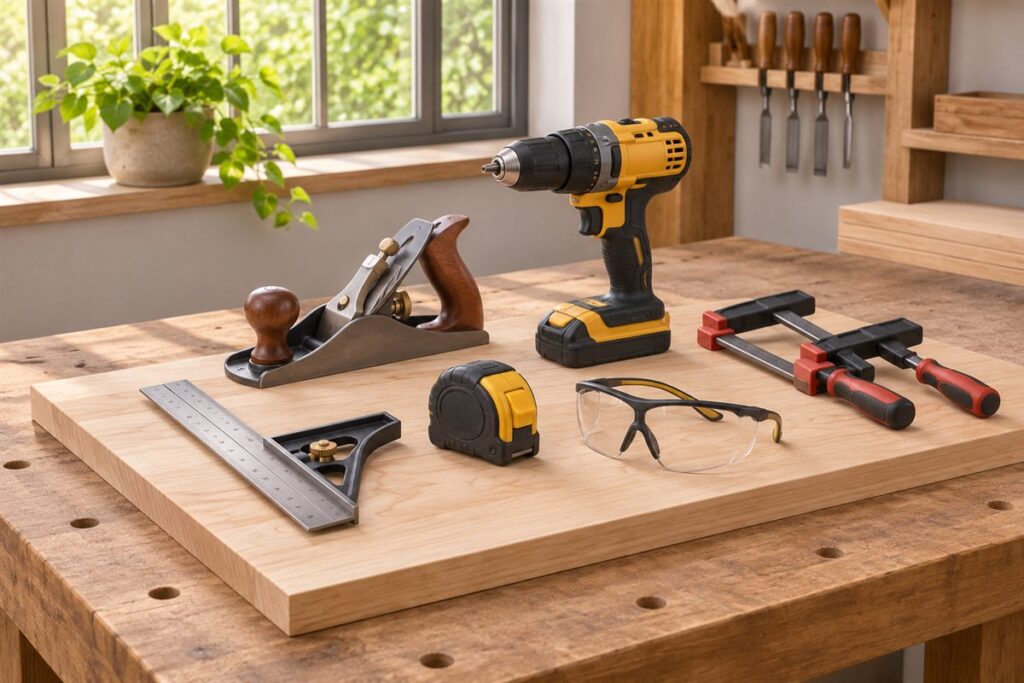
A good work light puts even, glare-free light where your hands are working. Choose by the type of job, the power you have available and how easily you can aim the beam. A few simple checks will narrow the field quickly.
Match the Light to the Job
Close bench work, such as marking out or small repairs, needs a focused and steady beam. Larger jobs, such as working under a vehicle or lighting a whole wall, call for a wide flood of light. Many workers keep two lights: a broad one for the room and a small movable one for detail.
- Bench tasks: adjustable arm or clamp light with a diffused lens.
- Large areas: tripod or stand-mounted flood light.
- Tight spaces: slim handheld or magnetic light.
Brightness and Light Quality
Brightness is usually listed in lumens, but a higher number is not automatically better in a small space, where it can cause glare and harsh shadows. Colour matters too. Neutral to cool white light tends to show detail well, while very warm light can make marks harder to read. Makers describe this as colour temperature, so check the maker’s guide.
If you match colours or read fine pencil lines, look for a light described as having good colour rendering.
Power Choices
| Option | Strength | Trade-off |
|---|---|---|
| Corded mains | Steady output with no charging | Cord can trip you or limit reach |
| Rechargeable built-in | Easy to carry and reposition | Run time varies, so check the guide |
| Tool battery compatible | Shares packs you already own | Only works with one battery family |
For any lamp used outdoors or in damp areas, look at the ingress protection information the maker supplies and use the light only as the manual allows. Keep cords away from sharp edges and moving tools, and avoid running them through places where they can be pinched.
Setting Up the Light
- Place the light to the side and slightly above the work so your hand does not cast a shadow over the cut or joint.
- Angle it so the beam does not shine into your eyes or reflect from shiny metal.
- Add a second light from the opposite side if shadows remain.
- Make sure the stand or clamp is steady, and keep the base clear of tools and cords.
- Let hot lamps cool before moving them, and follow the maker’s guidance on heat.
FAQ
Are LED work lights better than older bulbs?
LED lights generally run cooler and use less energy, and many are compact. Older halogen units can get very hot, so give them extra clearance and read the maker’s warnings.
How many lumens do I need?
It depends on room size and the task. Compare the figures for lights you are considering and favour adjustable output so you can reduce glare in tight spaces.
The Short Version
Choose a work light that suits the task, whether that is a focused bench lamp or a wide stand light. Check power type, glare control and mounting, and follow the maker’s manual for heat, cords and damp locations.