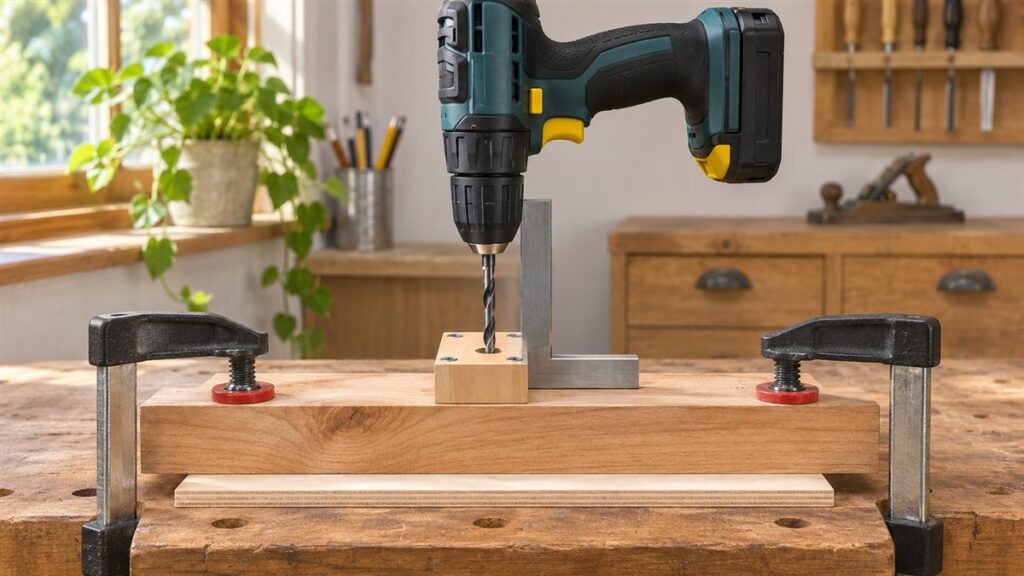
Straight holes come from good marking, a firm hold on the work and careful alignment of the drill, checked from two directions. Without a drill press this takes some care, but a few simple aids make a clear difference. Read your drill’s manual and use the eye protection and clamping advice it gives.
Prepare the Work
- Mark the hole centre with a pencil cross, then make a small dent with a centre punch or a nail so the tip does not wander.
- Clamp the work to a bench so it cannot spin or lift. Never hold small pieces by hand while drilling.
- Place a scrap board underneath to reduce tear-out where the bit exits.
- Choose a sharp bit of the right type for the material, such as a twist bit for metal or a brad point for wood.
- Insert the bit fully in the chuck, tighten it as the manual states and remove the chuck key if one is used.
Aids for Straight Alignment
| Aid | How it helps | Notes |
|---|---|---|
| Square placed beside the bit | Shows the bit is upright from one side | Check from a second side too |
| Drill guide block | Holds the bit at a fixed angle | Choose the right hole size |
| Drill stand attachment | Acts like a small drill press | Follow its instructions |
| Drilled scrap block | Homemade guide with a hole drilled first | Make the guide hole on a drill press if you can |
| Depth stop or tape flag | Controls hole depth | Set before drilling |
Drilling Technique
- Rest the bit tip in the dent and hold the drill so its body lines up with the square.
- Squeeze the trigger gently to begin at slow speed, then raise speed as the bit bites. Metals and large bits generally call for slower speeds, so check the bit maker’s guide.
- Apply steady, moderate pressure in line with the bit. Do not lean sideways.
- Back the bit out now and then to clear chips, especially in deep holes.
- Ease off pressure as the bit breaks through, since the drill can grab at that moment.
- Pull the bit out while it is still turning, then release the trigger.
When drilling larger holes, brace yourself and keep a firm grip on the drill, since it can twist if the bit jams. Wear eye protection and avoid loose sleeves and long hair near the chuck. Do not wear gloves if your manual tells you not to.
Common Problems
- Hole drifts to one side: the bit was dull or pressed sideways. Begin again with a pilot hole.
- Bit wanders at the outset: make a deeper centre dent or begin with a smaller bit.
- Ragged exit: use a backing board and slow down at breakthrough.
- Smoke or colour change on metal: the bit is too fast or dull. Slow down and use cutting fluid if the maker suggests it.
FAQ
Is a drill press much better?
A press holds the bit at a fixed angle and is often easier for repeat holes. A hand drill with a guide works well for many jobs.
Does drilling speed matter?
Yes. Material and bit size affect the best speed, so check the bit maker’s guide and your drill’s manual.
The Short Version
Mark and dent the centre, clamp the work, align the drill with a square and drive steadily. Back the work with scrap and follow the drill’s manual for safe use.