Hard knife steels such as S30V, S90V and S110V resist wear because they contain tough carbides. Ordinary stones wear slowly against them, so diamond abrasive is the dependable choice for a keen edge.
The six sharpeners below use diamond plates, rods or stones. They span guided systems, rod sets and bench kits, so you can pick a setup that fits your skill and your budget. Guided systems lock the angle for you, which helps beginners, while rod sets and bench stones suit freehand sharpeners. Diamond cuts fast, so use a light touch and fresh water or a drop of lubricant. Start with a coarser plate for reprofiling and finish on a fine one for a smooth bite. A marker swipe on the bevel shows where the stone is cutting, which makes it easy to confirm you are hitting the very edge. Clean the plate between grits so coarse particles stay out of your final polish. We have not used these products ourselves, so confirm sizes, materials and details on the current listing before buying.
As an Amazon Associate we earn from qualifying purchases. Links below are affiliate links, and they do not change the product information we give.
What to Look For
| Feature | Why it matters |
|---|---|
| Abrasive | Diamond cuts carbide-rich steels that stones can struggle with |
| Grit range | Coarse, medium and fine plates cover repairs through polishing |
| Angle control | Guided systems repeat angles consistently |
| Stability | A firm base prevents slipping during strokes |
| Knife types | Check that the system fits folders, kitchen knives and fixed blades |
In this guide
Specs at a Glance
| Sharpener | Type | Abrasive | Notes |
|---|---|---|---|
| Spyderco Tri-Angle Sharpmaker | Rod system | Ceramic, with diamond rods optional | Fixed angle options |
| Work Sharp Precision Adjust Elite | Guided system | Diamond plates | Adjustable angles |
| KME Precision Knife Sharpener | Guided system | Diamond stones | Clamped blade |
| Wicked Edge Go | Guided system | Diamond stones | Compact bench setup |
| Lansky Deluxe Diamond Kit | Guided kit | Diamond hones | Clamp and hone set |
| DMT Aligner Kit | Guided kit | Diamond hones | Includes clamp and guide |
The 6 Best Diamond Knife Sharpeners for Hard Steel
Top pickBest for users who want fixed angles and quick touch-ups
1. Spyderco Tri-Angle Sharpmaker
A popular rod-based system with fixed angle slots. You can add diamond rods to cut harder steels, and the setup is easy to learn.
Suits: users who want fixed angles and quick touch-ups. Strengths: easy angle control and simple use. Weaknesses: diamond rods are often an extra purchase. Skip it if you want to reprofile heavily.
View Spyderco Tri-Angle Sharpmaker on Amazon
Best for guided sharpening
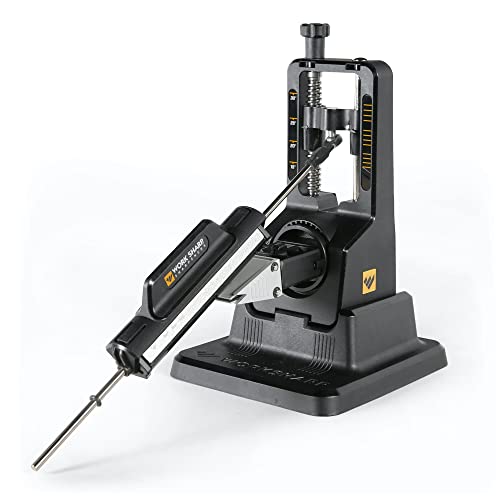
2. Work Sharp Precision Adjust Elite
A guided system with diamond plates and adjustable angles. It is aimed at repeatable results on folders, kitchen knives and more.
Suits: guided sharpening. Strengths: flexible angles and strong precision. Weaknesses: a larger footprint than rod sets. Skip it if you want a pocket kit.

Best for patient sharpeners
3. KME Precision Knife Sharpener with Diamond Stones
A clamp-and-rod system in which the blade is held steady while diamond stones move across it. It is known for careful results.
Suits: patient sharpeners. Strengths: steady results and a rigid frame. Weaknesses: a learning curve. Skip it if you want something fast.
View KME Precision Knife Sharpener with Diamond Stones on Amazon
Best for enthusiasts who want accuracy
4. Wicked Edge Go Knife Sharpener
A compact version of a well-known guided system with diamond stones. It aims to bring precision to a smaller setup.
Suits: enthusiasts who want accuracy. Strengths: reliable angle control and a refined feel. Weaknesses: a higher cost than basic kits. Skip it if you sharpen only occasionally.
View Wicked Edge Go Knife Sharpener on Amazon
Best for new sharpeners
5. Lansky Deluxe Diamond Knife Sharpening System
A guided kit with a clamp and a set of diamond hones. It has been a staple for years and is easy to use.
Suits: new sharpeners. Strengths: approachable price and clear setup. Weaknesses: fixed rods have some play. Skip it if you want pro-level precision.

View Lansky Deluxe Diamond Knife Sharpening System on Amazon
Best for hard-steel users
6. DMT Aligner Kit
A guided kit from a diamond abrasive specialist, with a clamp and diamond hones. The diamonds are designed to hold up well to hard steels.
Suits: hard-steel users. Strengths: durable diamond hones and easy setup. Weaknesses: less adjustability than premium systems. Skip it if you want a single bench stone.
View DMT Aligner Kit on Amazon
Care and Setup
- Rinse diamond plates with water after use.
- Brush swarf off the surface with a soft brush.
- Do not press hard, since pressure can wear the diamond coating.
- Store plates flat and dry.
- Mark the edge with a marker to confirm you reach the apex.
Mistakes to Avoid
- Pressing too hard on a fresh diamond plate.
- Mixing grits without rinsing in between.
- Skipping a marker check on the bevel.
- Using oil on plates that call for water.
- Choosing a fixed angle that does not match the knife.
Why Diamond Works on Hard Steels and Where It Does Not
Modern wear-resistant knife steels contain hard carbide particles that conventional stones wear against slowly. Diamond is harder than those carbides, so it cuts them instead of just rubbing past, which makes sharpening faster and more consistent. That is the reason diamond plates, rods and hones are the usual advice for steels like those named in this guide.
Diamond abrasives are made by bonding diamond particles to a metal plate or a rod. The grit size is rated by number or by color code, and the particle size is a main factor in how quickly it cuts and how smooth the finish is. Coarser grits remove metal quickly to repair damage or change an angle, while finer grits refine the edge. Some brands label grits in micron sizes rather than mesh numbers, so check which scale a listing uses before comparing.
Diamond is not free of drawbacks. A new plate can feel aggressive and leave deep scratches, which break in and soften with use. Diamond also removes metal quickly, so it is easy to take off more steel than you intended, particularly on thin kitchen knives. Over time, the diamond layer wears, and a plate that once cut fast will slow down.
It is also possible to over-engineer your setup. If you own a mix of knives, only some of them are hard steels, and a plain stone may handle the rest. A diamond sharpener is most valuable when your collection includes steels that stones struggle with, and for repair work such as fixing chips or restoring a badly dulled edge.
Grit Progression and Choosing the Right Edge Finish
A sharpening session follows a sequence, from coarse to fine. A coarse grit sets the edge and removes damage, a medium grit removes the coarse scratches and a fine grit creates a polished edge. Skipping steps leaves the previous scratches in place and the edge feels rough. If the knife is only slightly dull, you can start at the medium or fine plate and save time and metal.
What finish do you want? A more toothy edge from a medium grit slices through rope, fibers and tough packaging well and holds its bite. A polished edge from a fine grit glides through food and paper cleanly but can feel less aggressive on fibrous material. Kitchen cooks often prefer a refined finish, while outdoor and utility users may prefer a bit of bite. There is no single correct answer.
When comparing sets, look at how many grits are included and whether they can be replaced. A kit with one or two plates is enough for maintenance and light repairs, while a set with a coarse option helps with reprofiling. Verify the grit sizes on the listing, as some kits only mention terms like coarse or fine without numbers.
Finishing with a strop or a very fine hone can polish away the burr and leave a keener edge. Take care to keep the angle low and consistent, because a stropping motion with a rolled angle can round the edge. Test the result by slicing paper or a soft material, and look at the edge under bright light for any shiny spots that show a missed area.
Guided Systems Versus Freehand and Rod Setups
The six products here fall into three styles. Guided systems clamp the knife and move a stone or hone along a fixed path, so the angle stays constant from stroke to stroke. Rod systems hold the rods at fixed angles, and you draw the knife down them while keeping it vertical. Freehand setups use a plate or stone and require you to hold the angle by feel.
Guided systems are the easiest way to get repeatable results, especially for a beginner. They take a little time to set up each session, and clamp capacity limits the knives they can hold, so check that the clamp suits the blades you own, such as thick folders, thin kitchen knives or long blades. A larger footprint means you need table space and a stable surface.
Rod systems are quick to use and good for regular touch-ups. Their fixed angles are convenient, but they may not match your knife’s existing edge angle, and diamond rods are often optional extras. Rods are less suited to heavy reprofiling than plates, though they work well for keeping an edge sharp.
Freehand sharpening on a flat diamond plate offers the most flexibility and takes the most practice. Practicing on an inexpensive knife first is a sensible step. Whichever style you choose, consider the amount of time you want to spend, how many knives you have and how much precision you require.
Choosing and Holding the Sharpening Angle
The edge angle is a trade-off. A lower angle cuts more easily but is more fragile, while a higher angle is sturdier and holds up better under hard use. Hard steels with high wear resistance can be chippy at very thin angles, so many people choose a slightly sturdier angle for them than for tougher steels. Check the knife maker’s guidance if it is available.
The simplest approach is to match the angle already on the knife. Use a marker on the bevel and make a gentle stroke; the ink shows where the abrasive is touching. If the ink is removed only near the shoulder or only at the edge, adjust the angle. Repeat until the ink comes off along the whole bevel. This cheap test works with any style of sharpening.
Keep the stroke consistent. Use light pressure, since diamond cuts without force, and let the abrasive do the work. Count your strokes and alternate sides to keep the edge even. Watch for the formation of a burr, a thin wire of metal on the opposite side of the edge, which signals that you have reached the apex. Remove it with lighter strokes or a gentle strop.
Different knives need different handling. Thin kitchen knives need a gentle touch and lower pressure. Thick outdoor knives may need more strokes. Check that the clamp or rest does not scratch the blade, and tape the blade if you worry about cosmetic marks.
Plate Upkeep, Wear and Signs It Is Time to Replace
Diamond plates last a long time if treated properly, but they are not permanent. Clean them after each session with water and a soft brush to remove the metal swarf that clogs the surface. Follow the maker’s advice on whether to use water or a lubricant; some plates are intended for dry use, others for water, and using the wrong fluid can shorten life. Dry the plate and store it flat, away from impacts.
Use moderate pressure. Pressing hard can strip diamond from the surface and leave bald patches. Avoid sharpening soft materials like aluminum, brass or wood on the plate, which can clog the surface and be difficult to clean. Use a separate tool for those jobs. Do not drop the plate, since the base can bend or crack.
- Cutting speed has dropped sharply even after cleaning.
- Bright, bare spots appear where the diamond has worn away.
- The plate is warped or the base is bent.
- A clamp no longer holds the blade firmly, or rod guides have developed play.
Replacement plates are available for many systems, so check whether the product you choose has replaceable hones. This matters for long-term cost, since you may only need to replace the abrasive and not the whole kit. Check the warranty and return terms on the listing, and keep the instructions for your system in a safe place.
Diamond Knife Sharpeners for Hard Steel FAQ
Why use diamond for hard steel?
Diamond is harder than the carbides in modern steels, so it cuts them efficiently.
Will diamond ruin a soft knife?
No, but it will remove metal fast. Use light strokes.
Do I need a guide?
Not required, but guides help beginners keep a steady angle.
How often should I sharpen?
Only when the edge stops slicing paper or tomato cleanly.
Are diamond sharpeners only for hard steels?
No. They also work on softer steels but remove metal quickly, so use light pressure. They are most valuable with steels that stones sharpen slowly.
What grit should I start with?
Start with a fine or medium plate for maintenance, and use a coarse plate only for damage or to change the angle. Check the grit scale in the listing before comparing sets.
Do I use water or oil on diamond plates?
Follow the maker's instructions. Many use water or are used dry, and using the wrong lubricant can clog the surface or shorten its life.
How do I know if I have reached the edge?
Color the bevel with a marker and see where the ink is removed. A small burr along the opposite side of the edge also signals that you have reached the apex.
Can I sharpen serrated knives with these?
Only if the system includes a tapered rod or a tool made for serrations. Flat plates and standard clamps are designed for plain edges.
Will a guided system fit all my knives?
Not necessarily. Check the clamp capacity for blade thickness and length, and see whether very thin or very large blades are supported.
How long do diamond plates last?
It depends on use, pressure and the quality of the coating. Clean them regularly, avoid heavy pressure, and replace them when cutting speed drops and the surface shows bare spots.
Matching a Diamond Sharpener to the Knives You Own
The best sharpener is the one that suits your collection and your patience. Before buying, list the knives you want to maintain and note their steel, thickness and length. Then match them to a system.
A few pocket folders in hard steel
Short, thick blades fit almost any clamp, so a guided kit such as the Lansky Deluxe Diamond or the DMT Aligner is a straightforward choice. If you mostly touch up an edge between uses, the Spyderco Tri-Angle Sharpmaker with diamond rods is quick and compact, though the post notes diamond rods are often a separate purchase.
Thin kitchen knives
Thin blades remove metal quickly on diamond, so use light pressure and a fine plate. Check that the clamp grips a thin blade without slipping and that it does not scratch the sides. Many kitchen blades are also longer than folders, so confirm the clamp can reach the heel to the tip.
Thick outdoor and fixed blades
Thicker blades may exceed the clamp width on lighter kits. Check the listing for maximum blade thickness. These knives also benefit from a coarse plate for reprofiling, so look for a set that includes one.
A mixed collection with only a few hard steels
If most knives are in softer steel, a diamond plate is still useful, but you may not need a premium guided system. A modest kit used with a gentle touch can handle everything.
Setting Up a Safe, Stable Sharpening Station
Sharpening is slow and repetitive, which is when attention drifts. A steady setup prevents slips and gives better edges.
- Use a firm, flat, non-slip surface. A wet towel or rubber mat under a base keeps it from sliding.
- Good light matters. You need to see the bevel and the marker ink, so use a bright lamp angled across the edge.
- Keep fingers behind the edge and away from the path of the stroke. Many guided systems keep hands clear, but rod setups need extra care.
- Have water and a soft brush at hand to clear swarf, and a clean cloth to dry the plate and the blade.
- Wipe the finished knife, since metal dust left on a blade can stain or scratch.
- Work at a comfortable height. Poor posture makes strokes inconsistent and tires you.
- Keep children and pets out of the area, and store sharpened knives safely.
Be careful testing the edge. Slicing paper or a tomato is safe, but running a thumb across the edge is how people get cut. Check for shiny spots under light, which suggest a missed section.
Troubleshooting a Dull or Uneven Result
Even with good gear, a first session may not go as planned. A few symptoms and their usual causes can help.
- The edge still feels dull after sharpening: you may not have reached the apex. Use the marker test and continue on the coarser plate until the ink disappears along the whole edge, then work up the grits.
- The edge feels rough or toothy: the final grit was too coarse, or the burr was not removed. Finish with a fine plate and light alternating strokes or a strop.
- The edge is sharp in the middle but dull near the tip or heel: the angle rolled up at the ends. Slow down and keep the clamp or rod consistent through the whole length.
- Scratches on the side of the blade: the clamp or guide has touched the steel. Use a little tape on the blade, or adjust the clamp position.
- The plate seems slow: swarf may be clogging it. Clean it with water and a soft brush, then try again with lighter pressure.
- Small chips appear on a hard steel: the angle may be too thin for the steel, or the blade is brittle. Move to a slightly sturdier angle.
Patience pays off. Most beginners improve quickly after a few sessions on a less valuable knife.
Budget Versus Premium: Where the Money Goes
This list ranges from simple rod sets and entry-level guided kits to precision systems such as the Wicked Edge Go and the KME. The jump in cost typically pays for stiffer clamps, finer angle adjustment, more rigid frames and better abrasive options. Lower-cost kits such as the Lansky Deluxe offer a clear setup and approachable use, though the post notes that fixed rods have some play. Premium systems reward patience with more repeatable results, but they have a learning curve and take more bench space.
Think about how often you sharpen. If you do it a few times a year, a simple kit will serve you well and the extra precision of a premium system may go unused. If you enjoy the process, own a number of hard-steel knives or want finer angle control, the higher tier can be satisfying. Whichever you pick, check the replaceable plate options and the warranty so the abrasive can be renewed without replacing the whole system.
Frequently Asked Questions
What angle should I sharpen a hard steel folding knife?
Match the angle already on the blade, using the marker test to confirm. Hard, wear-resistant steels can chip at very thin angles, so many people choose a slightly sturdier angle. Check the knife maker’s recommendation if one is published.
Can I use a diamond sharpener on ceramic knives?
Only if the maker’s instructions allow it. Ceramic is very hard and brittle, and sharpening it needs a diamond abrasive, but home use can chip the blade. Check the knife and sharpener guidance before trying, or use a professional service.
Why does my new diamond plate feel rough at first?
New plates often have loose or sharp particles that cut aggressively and leave deeper scratches. This usually settles with use. Start with light pressure, and follow the maker’s break-in advice if they give any.
Is a guided diamond sharpener better than freehand?
Guided systems keep the angle steady, which helps beginners and gives repeatable results. Freehand work is faster to set up and more flexible, but takes practice. Choose guided if consistency matters, and freehand if you enjoy the skill.
The Short Version
For simplicity, the Sharpmaker. For flexible angles, the Work Sharp Precision Adjust. For care and rigidity, the KME. For a compact guided system, the Wicked Edge Go. For beginners, the Lansky Deluxe. For a diamond kit, the DMT Aligner.